
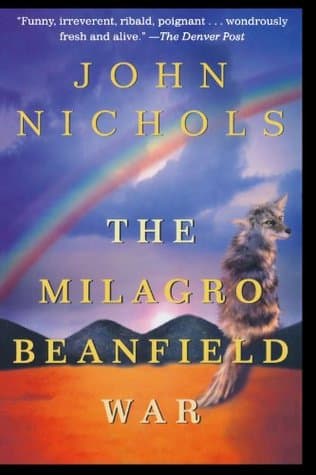
Synopsis
Covers the whole plot, including the ending.
- Difficulty
- Medium
- Pacing
- Moderate
- Mood
- Quirky, Humorous, Resilient, Heartwarming, Socially Conscious
- Read it if
- You enjoy a quirky, character-driven story about community resistance, social justice, and the clash between traditional ways of life and capitalist development, with a healthy dose of humor and heart.
- Skip it if
- You prefer fast-paced thrillers or stories with clear-cut heroes and villains, or if you dislike slow-burn narratives with many subplots and a large ensemble cast.
The Milagro Beanfield War Plot Summary
Covers the whole plot, including the ending.
Joe Mondragon Illegally Irrigates His Beanfield
The story begins in the small, poor Chicano village of Milagro, New Mexico, where water rights disputes have existed for a long time. Joe Mondragon, a young local, decides to plant a small beanfield on his inherited land. Despite a severe drought and the fact that the main irrigation ditch, the 'acequia madre,' is controlled by the Milagro Valley Recreation and Development Company (MVDRC) for their resort project, Joe illegally taps into the water supply. This act, driven by Joe's desire to grow beans for his mother, immediately puts him at odds with local law enforcement and the developers who see it as a direct threat to their plans for a 'cultural recreation area' and golf course.
Sheriff Bernabé Montoya Investigates
Sheriff Bernabé Montoya, a Chicano lawman who understands his community but is bound by state duties, investigates Joe's water diversion. Bernabé tries to persuade Joe to stop, explaining the legal problems and political pressure he is getting from the Governor and the MVDRC. Joe remains stubborn, insisting on his right to the water. Bernabé is in a difficult position, torn between enforcing the law and his empathy for the villagers and their historical claims to the land and water. This first confrontation shows the clash between traditional communal values and corporate interests.
The Community Rallies Around Joe
News of Joe's beanfield and his defiance spreads quickly through Milagro. Many villagers are initially cautious, fearing problems from the developers. However, Amarante Córdova, an elderly local who has long advocated for community rights, sees Joe's act as a symbol of resistance. Amarante starts to gather support, reminding people of their ancestral water rights, the injustices they have faced, and the slow loss of their traditional way of life. Slowly, others like Ruby Archuleta, the garage owner and community activist, and Nancy Mondragon, Joe's cousin, begin to support Joe, bringing him food and helping him tend the field, turning his personal act into a communal stand.
Ladd Devine III and the MVDRC React
Ladd Devine III, the ambitious developer behind the Milagro Valley Recreation and Development Company, sees Joe's beanfield as a nuisance that threatens his project. He, along with his associate Charley Bloom, pressures Governor Wallace and other state officials to resolve the situation quickly. Devine's frustration grows as the villagers continue to support Joe and the legal channels are slow due to the complexities of water rights in New Mexico. He begins to plan more aggressive tactics, including sending state police to intimidate Joe and the community, and considering a forced removal of Joe from his land.
State Intervention and Growing Tensions
As the situation in Milagro grows, the state government, pressured by Ladd Devine, sends more state police officers, including Captain Stryker, to keep order and eventually remove Joe from his field. The increased police presence creates a tense atmosphere in the village, leading to minor skirmishes and acts of passive resistance from the villagers. Joe continues to stubbornly tend his field, often under police surveillance. Bernabé Montoya finds his authority undercut by the state police, who care less about local customs and more about enforcing the developers' agenda, further separating him from his superiors.
The Community Organizes and Resists
Inspired by Joe and Amarante, the people of Milagro begin to organize more formally. Ruby Archuleta uses her influence to get media attention and legal advice. The community uses various tactics, from staging protests and sit-ins to anonymously giving Joe supplies and protection. Even the local youth, like the 'gang' led by Seferino, find ways to help the resistance, often through mischievous acts that frustrate authorities without causing serious harm. The villagers' unity and resourcefulness make it difficult for the state police to simply remove Joe without causing a major public incident, further complicating Devine's plans.
Governor Wallace's Dilemma
Governor Wallace is in a difficult political position. He is invested in the success of Ladd Devine's resort project, which promises economic development and jobs. However, the Milagro situation is getting negative press and threatening to upset his Chicano voters. He tries to find a compromise, attempting to negotiate with Joe and the villagers through emissaries, but Joe's unwavering stance and the community's solidarity are hard to break. The Governor's efforts to seem fair while still pleasing Devine show the influence of money and power on state politics.
The Final Confrontation Approaches
As the beans in Joe's field begin to ripen, showing his efforts' culmination, the tension in Milagro reaches a high point. Ladd Devine, desperate to clear the land before his investors lose patience, pushes for a decisive, forceful resolution. Governor Wallace, under extreme pressure, reluctantly authorizes a large police and National Guard deployment to remove Joe and his supporters. The villagers prepare for the confrontation, fortifying the beanfield, and planning to resist non-violently but firmly. Sheriff Bernabé Montoya, unable to align his duties with his conscience, begins to make choices that side him more closely with his community.
The Milagro Beanfield War Erupts
The day of the confrontation arrives with a massive deployment of state police and National Guard troops descending upon Milagro. The villagers, led by Amarante, Ruby, and Joe, stand their ground around the beanfield. What happens is a chaotic and darkly comic 'war' with strategic retreats, unexpected interventions, and the stubbornness of the Milagro residents. Animals, including goats and a pig named Pinky, play unexpected roles in disrupting the authorities. Bernabé Montoya, at a critical moment, chooses to side with his community, using his knowledge of the terrain and local customs to subtly hinder the state forces, preventing a violent crackdown and adding to the confusion.
A Pyrrhic Victory and Lingering Uncertainty
In the chaotic aftermath, the state forces are forced to retreat, unable to effectively remove Joe and the unified community without resorting to extreme violence that would cause national outrage. Joe's beanfield, though partly damaged, remains. The villagers celebrate a hard-won, if temporary, victory. Ladd Devine's resort project is significantly delayed and its future uncertain. While Milagro has asserted its rights and preserved its immediate way of life, the 'war' does not definitively end. The underlying issues of land, water, and power remain, suggesting that while this battle was won, the larger struggle for cultural survival and justice in Milagro will continue, but with a renewed sense of hope and solidarity.
The Milagro Beanfield War Characters
Joe Mondragon
Protagonist
Impulsive young man whose act of defiance sparks the 'Milagro Beanfield War'.
Joe is a hot-headed, somewhat naive, but ultimately principled young Chicano in Milagro. He is driven by a simple desire to plant beans for his mother, an act that unexpectedly thrusts him into the center of a major conflict. Joe is stubborn and resistant to authority, often acting on instinct rather than careful planning. His personal attachment to his land and his heritage makes him unwilling to compromise, despite threats and pressures. His initial isolation gradually transforms into a symbol of communal resistance, though he often remains bewildered by the larger political forces at play.
Relationships: Bernabé Montoya (antagonistic at first, then begrudging respect, eventually allied); Amarante Córdova (mentorship and inspiration); Ruby Archuleta (ally and supporter); Nancy Mondragon (cousin and supporter)
Bernabé Montoya
Supporting
Milagro's Chicano sheriff, torn between loyalty to his community and duty to the state.
Bernabé is a thoughtful and often conflicted character, serving as the local sheriff. He is a Chicano man deeply rooted in the Milagro community, understanding its history, struggles, and values. However, he is also an officer of the state, tasked with upholding the law, which often puts him at odds with his own people. Throughout the novel, Bernabé grapples with this internal conflict, trying to find a balance between his professional obligations and his moral compass. His eventual decision to subtly aid the villagers reflects his ultimate loyalty to his heritage and community.
Relationships: Joe Mondragon (initially adversarial, then protective); Amarante Córdova (respectful, historical connection); Ruby Archuleta (colleague and friend, often in disagreement); Captain Stryker (antagonistic, professional rivalry)
Amarante Córdova
Supporting
Elderly, wise, and respected community elder who inspires resistance.
Amarante is a revered elder in Milagro, a symbol of the community's history, wisdom, and resilience. He is a 'trickster' figure, full of stories, proverbs, and an unwavering belief in the traditional ways and the rights of the people. Amarante is instrumental in galvanizing the villagers, reminding them of their ancestral water rights and inspiring them to unite behind Joe Mondragon. He often appears to be a simple old man, but his shrewd observations and strategic advice prove invaluable to the resistance. His connection to the land and the past makes him a powerful voice for cultural preservation.
Relationships: Joe Mondragon (mentor and inspiration); Ruby Archuleta (respected elder, often consulted); Milagro Villagers (revered community leader)
Ruby Archuleta
Supporting
Feisty and intelligent local businesswoman and community activist.
Ruby is a strong, independent woman who owns the local garage and is a prominent figure in Milagro. She is intelligent, pragmatic, and fiercely protective of her community. Ruby acts as an organizer, strategist, and liaison, using her connections and resourcefulness to gather support, legal advice, and media attention for Joe's cause. She often provides a grounded perspective and is instrumental in translating the villagers' passion into organized action. Ruby represents the modern, educated Chicana, who nonetheless remains deeply committed to her cultural roots and the fight for justice.
Relationships: Joe Mondragon (ally and supporter); Bernabé Montoya (friend and often sparring partner); Amarante Córdova (respects his wisdom, works with him); Nancy Mondragon (friend and fellow activist)
Ladd Devine III
Antagonist
Ambitious Anglo developer behind the Milagro Valley Recreation and Development Company.
Ladd Devine III is the primary antagonist, representing the forces of corporate greed and external exploitation. He is a smooth, wealthy, and politically connected Anglo developer who sees Milagro as nothing more than a prime location for his lucrative resort and golf course. Devine is arrogant and dismissive of the local culture and historical rights, viewing Joe's beanfield as a minor inconvenience to be swiftly crushed. He uses his financial and political power to pressure state officials and enforce his will, embodying the modern capitalist drive to commodify land and resources.
Relationships: Governor Wallace (political ally, business partner); Charley Bloom (subordinate, business associate); Joe Mondragon (adversary, obstacle to his plans)
Charley Bloom
Supporting
Ladd Devine's cynical and somewhat disillusioned associate.
Charley Bloom is Ladd Devine's right-hand man, a cynical and pragmatic individual who handles many of the practical aspects of the MVDRC's operations. While he shares Devine's goals, he often has a more realistic, albeit still condescending, understanding of the challenges posed by the Milagro community. Bloom is less ideologically driven than Devine, more interested in simply getting the job done. He represents the bureaucratic and logistical arm of the antagonistic forces, often frustrated by the unexpected turns of events in Milagro. He sometimes displays a fleeting, almost detached, understanding of the villagers' perspective.
Relationships: Ladd Devine III (boss and partner); Governor Wallace (professional contact)
Governor Wallace
Supporting
State governor caught between corporate interests and voter demands.
Governor Wallace is a politician focused on maintaining power and appearing effective. He is heavily invested in the economic promises of Ladd Devine's resort project but also mindful of his Chicano voter base. He attempts to navigate the Milagro conflict by seeking compromises and applying political pressure, but ultimately finds himself in a no-win situation. The Governor embodies the political compromises and moral ambiguity inherent in state governance when faced with powerful corporate lobbies and grassroots community resistance. He is often depicted as a man under immense stress, trying to manage an unmanageable crisis.
Relationships: Ladd Devine III (political and financial ally); Bernabé Montoya (superior, demanding compliance)
Nancy Mondragon
Supporting
Joe's cousin, a strong supporter and active participant in the resistance.
Nancy is Joe Mondragon's cousin and a dedicated member of the Milagro community. She is a spirited and outspoken young woman who quickly rallies to Joe's side, providing practical support, emotional encouragement, and actively participating in the community's organized resistance. Nancy represents the younger generation's commitment to preserving their heritage and fighting for their rights. She is often seen working alongside Ruby Archuleta, helping to spread information and mobilize the villagers. Her unwavering loyalty to Joe and her community makes her a vital part of the Milagro resistance.
Relationships: Joe Mondragon (cousin and staunch supporter); Ruby Archuleta (friend and fellow activist)
Captain Stryker
Supporting
Rigid and by-the-book state police captain.
Captain Stryker is a humorless, dedicated, and strictly by-the-book state police officer dispatched to Milagro to enforce order and remove Joe Mondragon. He represents the impersonal, bureaucratic arm of state power, devoid of understanding or empathy for the local culture and historical grievances. Stryker's rigid adherence to rules and procedures makes him an ineffective leader in the fluid and culturally nuanced environment of Milagro, often leading to comical frustration. He is a foil to Bernabé Montoya, highlighting the difference between local law enforcement and external state intervention.
Relationships: Bernabé Montoya (superior, often at odds); Joe Mondragon (adversary, target of his enforcement)
The Milagro Beanfield War Themes
Community and Resistance
This theme is about the power of a unified community to resist outside forces threatening its way of life. Joe Mondragon's act of planting beans becomes a rallying point, turning into a communal struggle for water rights, land, and cultural survival. The villagers of Milagro, initially hesitant, come together through the guidance of elders like Amarante Córdova and activists like Ruby Archuleta, using both passive and active forms of resistance. Their collective stubbornness, resourcefulness, and deep connection to their heritage allow them to withstand the pressures from the state and developers, showing the strength found in unity.
“They say a man has a right to plant his beans. And if he plants them, he has a right to water them.”
Land and Water Rights
This theme is the literal and symbolic core of the conflict. Control of water, specifically the acequia madre, is essential for survival in arid New Mexico and is linked to the historical claims of the Chicano community. The Milagro Valley Recreation and Development Company's use of these resources for a luxury resort directly threatens the villagers' ability to farm and maintain their traditional lifestyle. The 'beanfield war' is a fight to reclaim and protect these essential rights, showing the historical injustices faced by indigenous and Chicano populations in the American Southwest regarding land and water ownership.
“Water is life. Without it, we are nothing. And this water belongs to us, not to them.”
Cultural Identity and Preservation
The novel explores the struggle to preserve Chicano culture, traditions, and a communal way of life against modern development and Anglo-American consumerism. The villagers' connection to their land, language, stories, and shared history (represented by figures like Amarante Córdova) are all under threat. Joe's beanfield becomes a symbol not just of water rights, but of Milagro's entire cultural identity. The resistance is as much about maintaining a distinct cultural heritage as it is about physical resources, emphasizing the importance of tradition and community when faced with homogenization.
“Milagro was not a place for progress. It was a place for remembering.”
Power and Corruption
The theme of power dynamics is clear in the contrast between the wealthy, politically connected developers (Ladd Devine III) and the poor, marginalized villagers of Milagro. The novel shows how money and influence can corrupt political processes, with Governor Wallace often bending to Devine's will, and how state institutions (like the police) can be used to enforce the interests of the powerful. The 'war' shows the unfairness when a small community tries to challenge a well-funded, politically entrenched corporate entity, showing the imbalance of power in society and the challenges to achieving justice.
“Money talks, and in this state, it shouts. Loud.”
The Absurdity of Conflict
Despite the serious underlying issues, the novel gives the conflict a strong sense of humor and absurdity. The 'war' itself is often farcical, with comical miscommunications, unexpected interventions (like the pig Pinky), and individual stubbornness. The contrast between the gravity of the developers' plans and the seemingly minor 'threat' of a beanfield creates an ironic and often funny narrative. This comedic approach humanizes the struggle, making the characters and their plight more endearing, while also subtly criticizing the irrationality of the powerful forces that often start such conflicts.
“It was a war of tactical retreats, a patchwork war, fought more by stubbornness than by strategy.”
Plot Devices & Literary Techniques
Magical Realism
Subtle integration of fantastical elements into an otherwise realistic narrative.
The novel subtly weaves elements of magical realism into its narrative, particularly through characters like Amarante Córdova and the pig Pinky. Amarante often seems to possess an almost supernatural understanding of events and a deep connection to the land and its spirits, while the pig Pinky's actions during the climax seem to defy normal animal behavior, acting almost as an agent of chaos on the side of the villagers. These elements add a unique, whimsical, and distinctly Latin American flavor to the story, suggesting a spiritual dimension to the struggle and blurring the lines between the mundane and the miraculous.
Omniscient Narrator with digressions
A wide-ranging narrator who offers commentary, backstories, and philosophical musings.
The novel employs an omniscient narrator who not only recounts the plot but also frequently digresses to provide extensive backstories for even minor characters, historical context for Milagro, philosophical reflections on life and death, and humorous observations. This narrative style creates a rich, textured tapestry of the community, deepening the reader's understanding of the motivations and interconnectedness of all the characters, and reinforcing the idea that the 'beanfield war' is a culmination of generations of history and struggle, not just a singular event. It also contributes to the novel's often leisurely and anecdotal pace.
Symbolism (The Beanfield)
Joe's beanfield as a multifaceted symbol of resistance and survival.
Joe Mondragon's beanfield is the central symbol of the novel. Initially, it represents a simple act of personal defiance and a desire for sustenance. As the conflict escalates, it transforms into a powerful symbol of the entire community's struggle for their ancestral water rights, land, cultural identity, and traditional way of life. The act of planting and nurturing the beans against overwhelming odds embodies hope, resilience, and the deep connection between the people of Milagro and their land. Its survival at the end signifies a victory for the community's spirit and heritage.
Trickster Archetype
Characters who use cunning and non-traditional methods to challenge authority.
The novel features several characters who embody the trickster archetype, most notably Amarante Córdova and, to some extent, Joe Mondragon himself. Amarante, with his seemingly harmless demeanor and folksy wisdom, subtly guides the community and outwits the authorities through indirect means. Joe's initial act of illegal irrigation is a trickster move, as is the villagers' use of various non-violent, often humorous, tactics to frustrate the state police. This device highlights the ingenuity and resourcefulness of the marginalized in challenging powerful, conventional forces, often by turning their own rules and expectations against them.
The Milagro Beanfield War Quotes
“The Milagro Beanfield War is not a war of bullets and bombs, but a war of spirit and will.”
“Water is life, and in the desert, it is everything.”
“A man's land is his soul, and when you take it, you take his soul.”
“In Milagro, the poor have always been poor, but they have never been powerless.”
“The law is written by the rich to protect the rich.”
“Sometimes a small act of defiance can grow into a revolution.”
“We are not fighting for beans; we are fighting for our way of life.”
“The heart of the valley beats in the rhythm of the irrigation ditches.”
“Fear is the weapon of the oppressor, and courage is the shield of the oppressed.”
“In the end, it is not the size of the army but the strength of the cause that matters.”
“Every bean in that field is a seed of hope.”
“The old ways are not forgotten; they are just waiting to be remembered.”
“When you stand up for what is right, you are never alone.”
“The land does not belong to us; we belong to the land.”
Quiz
10 questions on the plot and the characters. Each answer comes with a short explanation.
Question 1
What illegal action does Joe Mondragon take at the beginning of the novel that sparks the conflict?
- He steals sheep from a neighboring ranch
- He illegally taps into the main irrigation channel to water his beanfield
- He sabotages a construction site for a new development
- He starts selling moonshine without a license
Show answer
B. He illegally taps into the main irrigation channel to water his beanfield The novel opens with Joe Mondragon illegally diverting water from the main irrigation channel to his arid beanfield, which becomes the symbolic act that ignites the conflict between the local farmers and the development interests.
Question 2
What does Joe's beanfield come to symbolize for the small farmers and sheepmen of Milagro?
- A new economic opportunity for the town
- Their lost rights and lost lands
- A religious miracle that will save the town
- A tourist attraction to bring in revenue
Show answer
B. Their lost rights and lost lands As the conflict develops, the beanfield becomes a powerful symbol of resistance against the Anglo water barons and developers, representing the community's struggle to reclaim their rights and ancestral lands.
Question 3
How is the Milagro beanfield war primarily described as being fought?
- Through violent armed confrontations
- Through legal battles in the courts
- More by tactical retreats than by battlefield victories
- Through political campaigns and elections
Show answer
C. More by tactical retreats than by battlefield victories The book describes the conflict as a 'patchwork war' where the community uses strategic withdrawals and small-scale resistance rather than direct confrontations, reflecting the resourcefulness of the underdog community.
Question 4
Where do the Anglo water barons and power brokers gather to discuss how to handle the threat posed by Joe's beanfield?
- In Milagro's town hall
- At Joe Mondragon's house
- Downstate in the capital
- At a luxury resort in another state
Show answer
C. Downstate in the capital The development interests convene 'downstate in the capital' to strategize about destroying the symbolic beanfield that threatens their multimillion-dollar land-development schemes.
Question 5
What is the primary motivation of the Anglo water barons and power brokers in opposing Joe's beanfield?
- To protect the environment from agricultural runoff
- To enforce water usage laws fairly across all users
- To preserve traditional farming practices in the region
- To protect their multimillion-dollar land-development schemes
Show answer
D. To protect their multimillion-dollar land-development schemes The development interests see Joe's symbolic act as a threat to their lucrative real estate projects, which depend on controlling water rights and land use in the region.
Question 6
How is the town of Milagro described in terms of its economic condition?
- A prosperous agricultural community
- A rapidly growing suburban area
- A dirt-poor town
- A tourist destination with thriving businesses
Show answer
C. A dirt-poor town The book repeatedly emphasizes Milagro's poverty, describing it as 'dirt-poor,' which establishes the economic disparity that fuels the conflict with the wealthy developers.
Question 7
What literary tone does the novel employ in telling the story of Milagro's struggle?
- Solemn and tragic throughout
- Wildly comic and lovingly tender
- Cold and detached journalistic style
- Mysterious and suspenseful
Show answer
B. Wildly comic and lovingly tender The book description notes that the tale is 'wildly comic and lovingly tender,' blending humor with affection for the characters and their struggle, which creates a unique narrative voice.
Question 8
What does the description of Milagro 'groping its way toward its own stubborn salvation' suggest about the community's approach to change?
- They eagerly embrace modern development proposals
- They passively wait for outside help to solve their problems
- They move forward haltingly but with determined resistance
- They quickly organize violent revolution against the developers
Show answer
C. They move forward haltingly but with determined resistance The phrase 'half-stumbling and partly prodded, gropes its way toward its own stubborn salvation' captures the community's imperfect but determined effort to reclaim their rights through resistance, rather than through organized revolution or passive acceptance.
Question 9
Which of the following best describes the nature of the conflict in 'The Milagro Beanfield War'?
- A personal feud between two families over land inheritance
- A cultural clash between traditional Hispanic farmers and Anglo development interests
- A religious conflict between different faith communities
- A technological dispute over irrigation methods
Show answer
B. A cultural clash between traditional Hispanic farmers and Anglo development interests At its core, the novel depicts a cultural and economic conflict between the traditional Hispanic farming community of Milagro and the Anglo business interests seeking to develop the land for profit, with water rights as the central issue.
Question 10
What does Joe Mondragon's character as a 'feisty hustler with a talent for trouble' contribute to the novel's plot?
- It establishes him as a criminal mastermind who carefully plans the conflict
- It makes him an unlikely but effective catalyst for community resistance
- It shows he is primarily motivated by personal financial gain
- It indicates he will eventually betray the community to the developers
Show answer
B. It makes him an unlikely but effective catalyst for community resistance Joe's characterization as a 'feisty hustler' rather than a traditional hero makes him an imperfect but compelling catalyst whose spontaneous act of defiance unexpectedly mobilizes the entire community against the development interests.
The Milagro Beanfield War FAQ
What is 'The Milagro Beanfield War' about?
The novel follows Joe Mondragon, a poor Chicano farmer in the fictional town of Milagro, New Mexico, who illegally irrigates a small beanfield from a water channel controlled by wealthy Anglo developers. This act sparks a grassroots rebellion among the town's Hispanic farmers and sheepherders against a massive land-development scheme that threatens their traditional way of life and water rights.
Why should I read 'The Milagro Beanfield War'?
It's a vibrant, humorous, and deeply human portrayal of community resistance against corporate exploitation, blending social commentary with rich character studies. The book masterfully captures the spirit of a small town fighting for its identity through a mix of comedy, tragedy, and cultural authenticity.
What is the background/setting of 'The Milagro Beanfield War'?
Set in the 1970s in the impoverished, fictional Hispanic town of Milagro in northern New Mexico, the story unfolds against a backdrop of historical land disputes and water rights conflicts between longtime residents and outside developers. The arid landscape and economic struggles shape every aspect of life in the community.
What are the most memorable quotes from the book?
While specific quotes vary, the novel is known for its colorful dialogue capturing the characters' resilience, such as Joe's defiant declarations about his beanfield or the townsfolk's wry observations about their predicament. Nichols' prose often highlights themes of justice and cultural pride through memorable turns of phrase.
What writing style does John Nichols use?
Nichols employs a lively, comic, and richly descriptive style, blending satire with heartfelt realism. His narrative weaves together multiple perspectives—from poor farmers to corrupt politicians—creating a tapestry of voices that reflect the community's diversity and the absurdities of the conflict.
What minor details add significant meaning to the story?
Small acts like the town's elderly women secretly supporting Joe's beanfield with prayers or the recurring imagery of broken-down trucks symbolize the community's resourcefulness and decay. The beanfield itself, though tiny, becomes a powerful symbol of resistance against large-scale development.
What are some subtle foreshadowing moments?
Early mentions of the town's history of failed rebellions and Joe's reputation as a troublemaker hint at the coming conflict. The developers' initial dismissive attitude toward the beanfield foreshadows their underestimation of the community's resolve, leading to escalating tensions.
What unexpected character connections exist?
Characters like Ruby Archuleta, a local businesswoman, and Sheriff Bernabé Montoya find themselves torn between loyalty to Milagro and pressure from outside forces. Their internal conflicts reveal hidden alliances and tensions that deepen the story's exploration of community versus individual interests.
What are unspoken character motivations?
Joe Mondragon's rebellion is driven not just by economic need but by a deep-seated pride and desire to reclaim his dignity. Similarly, many townsfolk join the cause out of unspoken grief over lost lands and cultural erosion, masking their pain with humor or resignation.
What psychological complexities do characters exhibit?
Characters grapple with conflicting loyalties, such as Sheriff Montoya's struggle to uphold the law while sympathizing with his neighbors. The developers, though often portrayed as villains, display a mix of greed and genuine belief in progress, adding nuance to the moral landscape.
What are the major emotional turning points?
Key moments include the initial rallying of the community around Joe's beanfield, violent confrontations with developers' agents, and personal sacrifices by townsfolk. The climax involves a collective stand that transforms the conflict from a local dispute into a symbol of broader cultural survival.
How do relationship dynamics evolve?
Relationships shift from initial apathy or division to solidarity as the beanfield war progresses. Friendships are tested, romances blossom amid the strife, and generational divides bridge as elders and youth unite against a common threat, reflecting the town's growing cohesion.
Which parts remain ambiguous or open-ended?
The novel leaves some outcomes unresolved, such as the long-term fate of Milagro or whether the rebellion will lead to lasting change. Characters' personal futures are often hinted at but not fully detailed, emphasizing the ongoing nature of their struggle.
What are controversial scenes or decisions?
Joe's illegal water diversion sparks debate over civil disobedience versus lawfulness. Scenes of confrontation between townsfolk and developers raise questions about violence as a means of resistance, with some characters advocating pacifism while others embrace more aggressive tactics.
'The Milagro Beanfield War' ending explained: how it ends & what it means
The novel concludes with the community achieving a symbolic victory, as the beanfield becomes a rallying point that temporarily halts the development plans. However, the ending is bittersweet, suggesting that the war is ongoing and the town's salvation lies in its stubborn unity rather than a definitive triumph.
What deeper themes are explored through the beanfield conflict?
The beanfield war serves as a metaphor for larger struggles over environmental justice, cultural preservation, and economic inequality. It highlights how small acts of defiance can ignite collective action and challenge systemic oppression, resonating with real-world movements for indigenous and rural rights.
How does humor function in the novel?
Humor is used to diffuse tension and humanize the characters, from Joe's mischievous antics to the townsfolk's witty banter. It underscores the absurdity of the conflict while reinforcing the community's resilience, making the serious themes more accessible and engaging.
What role does the landscape play in the story?
The arid New Mexico setting is almost a character itself, shaping the characters' livelihoods and the conflict over water. Descriptions of the land evoke both its beauty and harshness, mirroring the town's struggles and grounding the political themes in a tangible, physical reality.
About the author
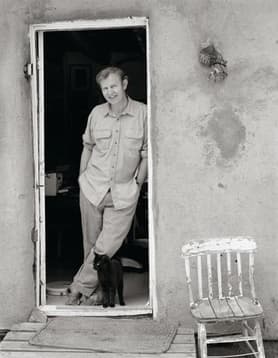
John Nichols is an American author known for his fiction that often explores themes of social justice and the American Southwest. His notable work, The Milagro Beanfield War, delves into the complexities of land use and community in a small New Mexico town. Nichols' writing reflects his deep connection to the region and its cultural landscape.
Similar books
- The Grapes of Wrath
John Steinbeck
4.0 (750k) average on GoodreadsHistorical FictionExplores themes of social injustice, community struggle, and the resilience of the working class against powerful forces.
- East of Eden
John Steinbeck
4.4 (429k) average on GoodreadsLiterary FictionFeatures a rich cast of characters and explores generational conflicts and the struggle for survival in a specific American setting.
- One Hundred Years of Solitude
Gabriel García Márquez
4.1 (753k) average on GoodreadsLiterary FictionShares a magical realist tone, a focus on a specific community's history, and a blend of humor and poignant social commentary.
- The Monkey Wrench Gang
Edward Abbey
4.1 (21k) average on GoodreadsPoliticsShares environmentalist and anti-establishment themes, but Abbey's work focuses more on direct action and eco-terrorism with a more confrontational and less community-centric approach. Nichols' novel emphasizes collective action and cultural preservation.
- To Kill a Mockingbird
Harper Lee
4.3 (4.5M) average on GoodreadsHistorical FictionIn the 1930s Jim Crow South, Harper Lee writes about racial injustice, moral growth, and the quiet courage of a lawyer father, Atticus Finch, as seen through his young daughter's eyes.
- The Great Gatsby
F. Scott Fitzgerald
3.9 (3.8M) average on GoodreadsHistorical FictionIn the opulent Roaring Twenties, a mysterious millionaire's lavish parties hide his desperate, tragic pursuit of a lost love, exposing the emptiness within the American Dream.






Enjoyed the summary?
A summary gives you the shape of the book. The book itself has the detail, the examples and the voice.
Find The Milagro Beanfield War on AmazonAs an Amazon Associate, BookBrief earns from qualifying purchases. How we're funded