
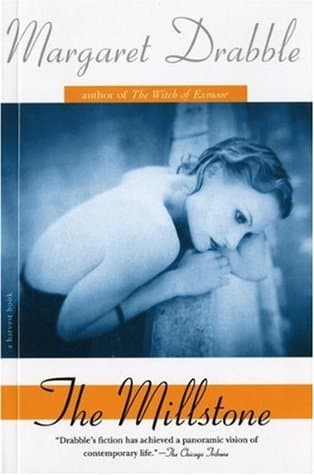
Synopsis
Covers the whole plot, including the ending.
- Difficulty
- Medium
- Pacing
- Slow
- Mood
- Introspective, Reflective, Realistic, Poignant
- Read it if
- You appreciate character-driven literary fiction exploring female independence and motherhood in a specific historical context.
- Skip it if
- You prefer fast-paced plots, clear-cut romances, or stories with strong male protagonists.
The Millstone Plot Summary
Covers the whole plot, including the ending.
An Independent Life
Rosamund Stacey, a brilliant and independent postgraduate student living in a comfortable London flat, focuses on her academic work and literary interests. She has a detached, almost analytical view of relationships, observing her friends' romantic lives with curiosity and intellectual superiority. Despite the 1960s sexual revolution, Rosamund has little experience, having only a few awkward encounters. She values her freedom above all else, seeing emotional attachments as possible distractions from her studies. Her life is ordered, and she prides herself on being self-sufficient, often comparing herself to her more conventional female friends who seem focused on marriage and men.
The Fateful Party
At a party with her friend Lydia, Rosamund meets George Matthews, a BBC radio announcer. Their interaction is awkward and brief. Driven by a desire for experience and perhaps curiosity, Rosamund allows George to take her back to his flat. The encounter is passionless and mechanical, without emotional connection or romance. Rosamund feels detached throughout, as if she is observing the event rather than participating. She leaves his flat the next morning with no intention of seeing him again, seeing the experience as a minor, unimportant deviation from her carefully built independent life.
Unexplained Symptoms
In the weeks after meeting George, Rosamund notices changes in her body. She feels nausea, fatigue, and a general sense of unease. Being rational, she at first dismisses these symptoms, blaming stress, a change in diet, or a lingering cold. She tries to keep her usual routines, continuing her academic work and social life, but finds herself increasingly distracted and uncomfortable. Her intellectual detachment keeps her from at once considering the obvious explanation, reinforcing her self-perception as someone immune to such common biological occurrences.
The Pregnancy Test
While discussing her symptoms with her friend Sarah, Sarah jokingly suggests Rosamund might be pregnant. This remark startles Rosamund, forcing her to face a possibility she had actively suppressed. The realization comes with shock and a strange sense of inevitability. She gets a pregnancy test, and the positive result confirms her fears. The news is disorienting, shattering her carefully built image of herself as a self-sufficient, unattached individual. She grapples with the implications of this unplanned pregnancy, understanding that her life, as she knows it, is about to change completely.
A Difficult Decision
Facing an unplanned pregnancy in a society where single motherhood is still stigmatized and abortion is illegal, Rosamund considers her options. Her first thoughts are of abortion, but the practical difficulties and moral dilemmas of illegal procedures weigh on her. After much thought and a deep feeling that she cannot end the life within her, she makes the unconventional decision to keep the baby. This choice is a turning point, showing a shift from her purely intellectual existence to embracing a biological and emotional commitment. She resolves to face the challenges of single motherhood directly, determined to keep her independence.
Confronting George
Rosamund decides to tell George Matthews, the baby's father, about her pregnancy. She approaches him with a clear intention: to state the facts and assure him she expects nothing from him, especially not marriage. However, George, misunderstanding her intentions through social expectations, immediately assumes she is seeking a commitment. He reacts with awkwardness and a misguided sense of obligation, offering to marry her. Rosamund, appalled by his misunderstanding and patronizing tone, quickly corrects him, repeating her desire for independence and her sole responsibility for the child. The encounter strengthens her resolve to raise the baby on her own terms.
The Birth of Octavia
Rosamund has a difficult labor and gives birth to a daughter, whom she names Octavia. Childbirth is physically grueling and emotionally profound, marking a clear transition into motherhood. Despite the initial shock and the immense responsibility, Rosamund quickly develops a deep, instinctive bond with her baby. She finds herself unexpectedly fulfilled by the demands of caring for Octavia, discovering a new part of her existence that goes beyond her previous intellectual pursuits. Her life shifts, now centered around the needs of her infant, challenging her ideas of independence and self-sufficiency.
Octavia's Illness
Octavia, a few months old, suddenly becomes seriously ill with a congenital heart defect. This crisis throws Rosamund's world into chaos. Doctors explain that Octavia needs a delicate and risky heart operation. Rosamund, previously so detached, becomes consumed by fear and anxiety for her daughter's life. She spends hours at the hospital, her academic work and social life abandoned for constant vigilance and prayer. This period of vulnerability and fear for Octavia's survival removes any remaining intellectual aloofness, showing the depth of her maternal love and commitment.
The Operation and Recovery
Octavia undergoes the complex heart operation, and after an agonizing wait, the surgery is successful. Recovery is slow but steady, and Rosamund stays by her daughter's side, observing every improvement. The experience of nearly losing Octavia changes Rosamund. She emerges from this ordeal with a renewed sense of purpose and a strong bond with her daughter. Her previous life, focused on solitary intellectual pursuits, now seems distant and less meaningful. She understands that her independence has not been lost, but redefined by the responsibility and love she feels for Octavia.
A New Chapter
With Octavia fully recovered, Rosamund settles into her role as a single mother. She continues her academic work, but now with a different view, often bringing Octavia to lectures or study sessions. She finds contentment in her new life, managing the challenges of balancing motherhood with her intellectual ambitions. Her relationships with friends deepen as they see her resilience and devotion. Rosamund's journey ends with a deep understanding that true independence is not about isolation, but about making choices that align with one's deepest values, even if those choices defy social norms. She finds joy and strength in her bond with Octavia, recognizing it as the most fulfilling part of her existence.
The Millstone Characters
Rosamund Stacey
Protagonist
A brilliant, independent academic who becomes a single mother by choice.
Rosamund is a highly intelligent and fiercely independent postgraduate student of English literature. She prides herself on her intellectual prowess and emotional detachment, viewing relationships as secondary to her academic pursuits. Initially naive about sex and social conventions, she is analytical and often aloof, seeking to control her life through reason. Her decision to embrace single motherhood, despite societal pressures, reveals a deep-seated strength and an unconventional morality. She is observant, reflective, and initially struggles with expressing deep emotions.
Relationships: Octavia (Daughter, central to her transformation); George Matthews (Father of Octavia, a brief, awkward encounter); Lydia (Close friend, more conventional, initially a sounding board); Sarah (Friend who inadvertently suggests Rosamund's pregnancy)
Octavia Stacey
Supporting
Rosamund's infant daughter, whose birth and illness drive the plot and Rosamund's character development.
Octavia is Rosamund's daughter, conceived during a casual one-night stand. Though an infant, her presence is central to the narrative, acting as the catalyst for Rosamund's profound transformation. Her initial fragility, followed by a life-threatening illness and subsequent recovery, brings out the deepest maternal instincts and love in Rosamund. She represents the tangible consequence of Rosamund's choices and the unexpected joy and challenge of motherhood. Her vulnerability shatters Rosamund's intellectual defenses and forces her to engage with raw emotion.
Relationships: Rosamund Stacey (Daughter, the focus of Rosamund's love and devotion)
George Matthews
Supporting
The BBC announcer and biological father of Octavia, representing conventional male reactions.
George is a BBC radio announcer, introduced as the man with whom Rosamund has her one-night stand. He is largely unremarkable and somewhat self-absorbed. When confronted with Rosamund's pregnancy, he reacts with a mixture of awkwardness, societal expectation, and a misguided sense of chivalry, offering marriage rather than understanding Rosamund's independent stance. He represents the conventional male perspective of the era, unable to comprehend Rosamund's unconventional choices and her desire for self-determination outside of traditional marital structures. He quickly fades from the narrative after their brief, uncomfortable encounter.
Relationships: Rosamund Stacey (Brief sexual partner, father of Octavia); Octavia (Biological father, but has no active role in her life)
Lydia
Supporting
Rosamund's close friend, representing more conventional female aspirations.
Lydia is one of Rosamund's close friends, who hosts the party where Rosamund meets George. She represents a more conventional path for women of their generation, valuing marriage and family life within traditional structures. While supportive of Rosamund, she initially struggles to fully grasp Rosamund's radical decision to become a single mother. She provides a contrast to Rosamund's intellectual aloofness and highlights the societal norms Rosamund defies. Her reactions often serve to underscore Rosamund's unique perspective.
Relationships: Rosamund Stacey (Close friend, confidante)
Sarah
Supporting
A friend who inadvertently prompts Rosamund to consider her pregnancy.
Sarah is another friend of Rosamund's. Her role in the narrative is brief but pivotal, as her casual, joking suggestion that Rosamund might be pregnant is the catalyst that forces Rosamund to confront her symptoms and ultimately confirm her condition. She is a background character who serves as a plot device to move Rosamund's realization forward, representing the everyday interactions that can have profound consequences. She is less developed than Lydia but contributes to the social tapestry of Rosamund's world.
Relationships: Rosamund Stacey (Friend)
The Millstone Themes
Female Independence vs. Societal Expectations
The novel explores Rosamund's commitment to independence in a society that largely expects women to marry and conform to traditional roles. Her decision to pursue an academic career and then to raise a child alone challenges these norms. This theme is clear in her initial detached view of relationships, her refusal of George's misguided marriage proposal, and her ultimate success in creating a fulfilling life as a single mother. Her journey highlights the struggle for self-determination against the backdrop of 1960s social pressures.
“She had always prided herself on her independence, on her ability to manage her own life without reference to anyone else. Now, she would have to learn a new kind of independence.”
The Nature of Motherhood and Love
At first, Rosamund approaches life with intellectual detachment, but motherhood changes her. The unexpected joy and fierce protectiveness she feels for Octavia show a deeper, more emotional side of her character. The theme is most powerfully explored during Octavia's illness and recovery, where Rosamund's intellectual pursuits are completely overshadowed by her maternal love. This shows how love, especially maternal love, can redefine one's priorities and provide an unexpected source of fulfillment, even for someone who previously valued logic above all.
“She had never known such a depth of feeling, such a terrifying, exhilarating bond. It was as if her heart had grown outside her body.”
The Unpredictability of Life
Rosamund's planned, intellectual life is disrupted by an unplanned pregnancy from a casual encounter. This theme shows how life's significant events often come from unexpected circumstances, defying rational control. Her journey shows that even the most independent and logical individuals are subject to the unpredictable forces of biology and chance. Octavia's sudden illness further reinforces this, showing how quickly life can shift from routine to crisis, forcing adaptation and resilience.
“Life, she discovered, was not a logical progression, but a series of arbitrary incidents, some joyous, some terrible.”
Self-Discovery Through Adversity
Rosamund's journey is one of self-discovery, especially through the challenges of single motherhood and her daughter's illness. These difficulties force her to face her vulnerabilities, emotional depths, and the limits of her intellectual detachment. She learns about her capacity for love, resilience, and unconventional strength. Her transformation from an aloof academic to a devoted, capable mother shows how overcoming significant obstacles can lead to a richer, more authentic understanding of oneself and one's true priorities, ultimately leading to a more integrated identity.
“She had thought she knew herself, but motherhood had revealed a stranger, stronger self.”
Plot Devices & Literary Techniques
Unreliable Narration (Subtle)
Rosamund's initial intellectual detachment colors her perception, making her an initially unreliable interpreter of her own emotional state.
While not overtly unreliable, Rosamund's highly intellectual and detached perspective at the beginning of the novel subtly shapes the reader's understanding of events and her own feelings. She often rationalizes or dismisses her emotional responses, leading the reader to initially see her as perhaps more in control or less affected than she truly is. This device highlights her journey of emotional awakening, as her self-perception gradually aligns with her deeper feelings, particularly after Octavia's birth and illness.
The Millstone Metaphor
The title itself, representing both burden and anchor.
The 'millstone' in the title serves as a central metaphor. Initially, Rosamund, and perhaps society, might view an unplanned child as a burden or a 'millstone around her neck,' hindering her independence and academic career. However, as the story progresses, the child, Octavia, transforms into an anchor, providing purpose, love, and a new, richer form of independence. The metaphor evolves, reflecting Rosamund's changing perspective and the profound, multifaceted impact of motherhood on her life, ultimately representing not a weight but a foundational element.
The BBC Announcer
George Matthews' profession as a BBC announcer symbolizes a superficial, public persona.
George Matthews' profession as a BBC announcer is not accidental. It subtly symbolizes a certain superficiality and public-facing persona, contrasting with Rosamund's private, intellectual world. His voice is heard by many, yet his character is shallow and his understanding of Rosamund is profoundly lacking. This device highlights the chasm between public perception and private reality, and underscores Rosamund's preference for genuine connection and authenticity over societal facades, especially in her decision to raise Octavia on her own terms.
The Millstone Quotes
“It was her first discovery of the fact that the world was composed of millions of separate individuals, each with a separate history, and that one's own history, however important to oneself, was not necessarily important to anybody else.”
“She had always been good at being alone, but now she was alone in a different way, a more absolute way.”
“The baby lay there, a small, red, wrinkled object, and Rosamund felt nothing. No surge of love, no great maternal instinct. Just a kind of blank, exhausted wonder.”
“One could not, she thought, be at once a serious academic and a serious mother. One would have to choose.”
“She was learning, slowly, that there were some things you could not read about in books, some things that had to be experienced.”
“Love, she found, was not a sudden, overwhelming emotion, but a slow, quiet accumulation of small acts and small recognitions.”
“The world was full of women who had babies, and went on with their lives. But they had husbands. Or families. Or money. Rosamund had none of these things.”
“She felt a strange, fierce protectiveness, a sense that this small, helpless creature was entirely her responsibility, and that she would defend her against all comers.”
“It was not a question of being happy, or even content. It was a question of survival.”
“The greatest danger, she thought, was not the physical hardship, but the erosion of the mind, the slow creeping loss of her own identity.”
“She had chosen, or had been chosen, for a life of singular devotion. And in that devotion, she found a strange, unexpected kind of freedom.”
“The problem with being intelligent was that one was always aware of one's own deficiencies.”
“She was a millstone, she knew, around her own neck. But she was also a millstone that ground out a kind of meaning, a kind of existence.”
“And then, quite suddenly, she smiled. A real smile, not just a polite one. A smile that was entirely for Octavia.”
Quiz
10 questions on the plot and the characters. Each answer comes with a short explanation.
Question 1
What is Rosamund Stacey's academic field of study at the beginning of the novel?
- History
- English Literature
- Sociology
- Classics
Show answer
B. English Literature Rosamund is a doctoral student in English Literature, specializing in Elizabethan poetry, which is a significant part of her intellectual identity before motherhood.
Question 2
What is the name Rosamund gives to her baby daughter?
- Anna
- Clara
- Octavia
- Laura
Show answer
C. Octavia Rosamund names her daughter Octavia, a name that reflects her classical interests and the uniqueness of her situation.
Question 3
What is the primary reason Rosamund initially decides against seeking an abortion for her unplanned pregnancy?
- Her religious beliefs strictly forbid it.
- She fears the illegality and potential dangers of the procedure.
- Her family strongly advises her against it.
- She feels an immediate, overwhelming maternal bond.
Show answer
B. She fears the illegality and potential dangers of the procedure. In 1960s London, abortion was illegal and often dangerous. Rosamund, being pragmatic, weighs the risks and decides to carry the baby to term.
Question 4
What does Rosamund's friend, Lydia, primarily represent in the novel?
- A rival for Rosamund's academic success.
- A more traditional, domestic path for women.
- A contrasting example of casual sexual liberation and its potential consequences.
- A source of constant financial support for Rosamund.
Show answer
C. A contrasting example of casual sexual liberation and its potential consequences. Lydia embodies the 'free love' spirit of the 60s, having multiple casual relationships and abortions, offering a stark contrast to Rosamund's more reserved nature and her decision to keep her baby.
Question 5
What significant health issue does Octavia face shortly after birth, requiring a hospital stay?
- A severe allergic reaction
- A heart murmur
- A lung infection
- A kidney infection
Show answer
D. A kidney infection Octavia suffers from a kidney infection, which is a major plot point, causing Rosamund immense anxiety and forcing her to confront her new responsibilities and vulnerability.
Question 6
How does Rosamund's relationship with her parents evolve after she becomes a single mother?
- They disown her due to the scandal.
- They offer immediate and unwavering financial support but little emotional understanding.
- They are initially shocked but eventually offer practical help and a gradual acceptance.
- They move in with her to provide full-time childcare.
Show answer
C. They are initially shocked but eventually offer practical help and a gradual acceptance. While initially taken aback, Rosamund's parents, particularly her mother, provide practical support like gifts and occasional babysitting, showing a gradual, albeit sometimes awkward, acceptance of her unconventional choice.
Question 7
The title 'The Millstone' primarily refers to which of the following themes?
- The burden of academic expectations.
- The feeling of being weighed down by an unplanned child and societal judgment.
- The physical weight of the baby during pregnancy.
- The enduring nature of traditional marriage.
Show answer
B. The feeling of being weighed down by an unplanned child and societal judgment. The 'millstone' metaphorically refers to the perceived burden or obstacle that Octavia, as a child born out of wedlock, might represent for Rosamund's future and social standing, particularly in the context of the biblical phrase 'millstone around one's neck.'
Question 8
What is the primary internal conflict Rosamund faces throughout the novel regarding her identity?
- Her desire for wealth versus her commitment to academia.
- Her intellectual independence versus the profound emotional demands of motherhood.
- Her loyalty to her friends versus her loyalty to her family.
- Her political activism versus her personal desire for a quiet life.
Show answer
B. Her intellectual independence versus the profound emotional demands of motherhood. Rosamund, an intellectual and independent woman, struggles to reconcile her former life of scholarly pursuits and solitude with the all-consuming, emotionally demanding reality of caring for a baby.
Question 9
Who is the father of Octavia, and what is his role in Rosamund's life after the pregnancy is confirmed?
- He is a committed partner who helps raise Octavia.
- He is a casual acquaintance from a one-night stand, whose identity Rosamund largely keeps secret and who plays no active role.
- He is a married man who offers financial support but remains distant.
- He is Rosamund's long-term boyfriend who eventually leaves her.
Show answer
B. He is a casual acquaintance from a one-night stand, whose identity Rosamund largely keeps secret and who plays no active role. The father is a casual acquaintance, George, from a one-night stand. Rosamund deliberately keeps his identity a secret and he plays no role in Octavia's upbringing, underscoring Rosamund's independence.
Question 10
By the end of the novel, what is Rosamund's ultimate feeling towards Octavia, despite the challenges of single motherhood?
- She feels resigned to her fate but still harbors resentment.
- She has found profound love and fulfillment, transforming her life positively.
- She plans to give Octavia up for adoption due to overwhelming stress.
- She feels indifferent, having adapted to the routine of motherhood.
Show answer
B. She has found profound love and fulfillment, transforming her life positively. Despite the initial 'millstone' perception and the immense difficulties, Rosamund ultimately finds deep, unconditional love and fulfillment in motherhood, concluding that Octavia has enriched her life profoundly.
The Millstone FAQ
What is the central premise of 'The Millstone'?
The Millstone follows Rosamund Stacey, an intelligent but naive Cambridge graduate living in 1960s London, who experiences an unplanned pregnancy after a casual encounter. Despite societal disapproval of single motherhood, she decides to keep her baby, Octavia, and navigate the challenges of raising a child while pursuing her academic career.
Who is Rosamund Stacey and what is her initial character like?
Rosamund Stacey is a postgraduate student focused on Elizabethan poetry, characterized by her intellectual brilliance and extreme social awkwardness, particularly concerning relationships and sex. She maintains a detached, independent facade to mask her inexperience, which contributes to her isolated existence before motherhood.
How does Rosamund become pregnant, and who is the father?
Rosamund becomes pregnant after a single, somewhat detached sexual encounter with George, a BBC announcer she knows peripherally through a mutual friend, Lydia. The encounter is portrayed as casual and lacking emotional depth, highlighting Rosamund's inexperience and George's transient presence in her life.
What significant choice does Rosamund make regarding her pregnancy?
Despite the social stigma and illegality of abortion in 1960s England, Rosamund resolutely chooses to carry her pregnancy to term and raise the child alone. This decision marks a profound turning point, challenging conventional expectations for women of her background and era.
How does motherhood transform Rosamund's life?
Motherhood profoundly alters Rosamund's previously solitary and intellectually-focused existence, forcing her to engage with the world in new ways and develop emotional depth. Her daughter, Octavia, becomes the central focus of her life, bringing both immense joy and significant practical challenges.
What is the symbolic significance of the 'millstone' in the title?
The 'millstone' refers to the idiom 'a millstone around one's neck,' traditionally implying a burden or impediment. However, for Rosamund, Octavia, while demanding, is ultimately not a burden but a source of profound love and purpose, transforming the negative connotation into a testament to the enriching weight of responsibility.
How does the novel subtly critique the 'sexual liberation' of the 1960s?
The novel subtly critiques the era's 'sexual liberation' by showing how it often failed women like Rosamund who lacked experience or guidance, leaving them vulnerable to unintended consequences. Rosamund's detached sexual encounter and subsequent pregnancy highlight the disjunction between the rhetoric of freedom and the practical realities for some women.
What is the significance of Rosamund's academic pursuits in Elizabethan poetry?
Rosamund's focus on Elizabethan poetry serves as a metaphor for her initial detachment from contemporary life and emotions, living in a world of words rather than direct experience. Her academic work provides a contrast to the messy, visceral reality of motherhood, which ultimately grounds her.
What role does Lydia, Rosamund's friend, play in the narrative?
Lydia serves as a foil to Rosamund, representing a more conventionally 'liberated' woman of the 1960s, with multiple casual relationships and a seemingly carefree attitude. Her interactions with Rosamund highlight Rosamund's naivety and provide a social context for her unique choices.
How does Rosamund's relationship with her body change throughout the novel?
Initially, Rosamund is detached from her own physicality, viewing it almost as a separate entity. Pregnancy and childbirth force her into an intimate and often uncomfortable relationship with her body, leading to a profound acceptance and connection, especially through breastfeeding and caring for Octavia.
Discuss Rosamund's emotional development from intellectual detachment to maternal love.
Rosamund begins the novel emotionally guarded and intellectually dominant, using her mind to shield herself from vulnerability. Motherhood forces her to confront raw emotions, breaking down her defenses and allowing her to experience profound, unconditional love for Octavia, which in turn opens her up to the world.
How does Rosamund cope with the social isolation of single motherhood?
Rosamund copes with social isolation primarily through sheer determination and a stubborn independence, often internalizing her struggles rather than seeking extensive help. Her intellectual resilience helps her rationalize her choices, but the novel also shows moments of profound loneliness and the quiet strength required to overcome it.
What psychological impact does Octavia's illness have on Rosamund?
Octavia's severe illness, requiring hospitalization and surgery, plunges Rosamund into intense fear and anxiety, revealing the depth of her maternal bond. This crisis solidifies her identity as a mother and forces her to confront her own vulnerability and the fragility of life, stripping away any remaining intellectual detachment.
Is 'The Millstone' ultimately a feminist novel? Why or why not?
Yes, 'The Millstone' can be interpreted as a feminist novel because it centers a woman's agency in making unconventional choices about her body and life path, challenging societal norms around marriage and motherhood. Rosamund's journey celebrates female independence and the power found in maternal love, even outside traditional structures.
How does the novel portray the complexities of female friendship?
The novel portrays the complexities of female friendship through Rosamund's relationships, particularly with Lydia, highlighting both support and subtle judgment. These friendships reveal the differing paths women navigated in the 1960s, with varying degrees of social acceptance and personal fulfillment.
What is the novel's stance on the traditional family unit versus single parenthood?
The novel implicitly argues that a traditional family unit is not the sole path to happiness or fulfillment, showcasing the profound satisfaction Rosamund finds in single parenthood. While acknowledging the difficulties, it celebrates the strength and joy derived from a mother-child bond, even without a father figure.
How does Drabble use humor and irony in the novel?
Drabble employs subtle humor and irony, often stemming from Rosamund's detached observations and her awkward attempts to navigate social situations. This lightens the serious themes and underscores Rosamund's unique perspective on the world, particularly her intellectual superiority clashing with her social ineptitude.
Does Rosamund ever regret her decision to keep Octavia?
Despite the immense challenges and sacrifices, Rosamund never expresses genuine regret about her decision to keep Octavia. Her initial detachment evolves into an unwavering, profound love, and Octavia becomes the central, most fulfilling aspect of her life, providing a purpose she previously lacked.
About the author

Margaret Drabble is a British author known for her contributions to contemporary fiction. Among her notable works is "The Millstone," which explores themes of motherhood and personal identity. Drabble's writing often reflects her insights into the complexities of modern life and women's experiences.
Similar books
- The Bell Jar
Sylvia Plath
4.0 (591k) average on GoodreadsPsychologyExplores a young woman's struggles with identity and societal expectations in a similar mid-20th century setting.
- A Room of One's Own
Virginia Woolf
4.2 (118k) average on GoodreadsCreativityExamines themes of female independence, intellectual life, and societal constraints on women.
- The Golden Notebook
Doris Lessing
3.8 (19k) average on GoodreadsLiterary FictionWhile both The Millstone and Lessing's The Golden Notebook (1962) explore themes of female independence and intellectual life, Drabble's novel offers a more intimate, less overtly political examination of personal choice and motherhood. Lessing's work, with its fragmented structure and broader scope, delves into political ideologies, mental health, and the societal constraints on women in a more experimental and expansive manner. The Millstone is more focused on the individual psychological journey of a single woman navigating an unexpected pregnancy, whereas The Golden Notebook critiques societal structures and the breakdown of traditional narratives with a wider lens. Drabble's Rosamund finds a personal resolution within existing structures, while Lessing's Anna Wulf grapples with their fundamental inadequacy.
- The Old Man and the Sea
Ernest Hemingway
3.8 (831k) average on GoodreadsLiterary FictionA Cuban fisherman's long struggle with a giant marlin becomes a story of endurance and dignity, now retold for young adults with illustrations, phonetic guides, and writing prompts in Traditional Chinese.
- One Hundred Years of Solitude
Gabriel García Márquez
4.1 (753k) average on GoodreadsLiterary FictionThrough the multi-generational story of the Buendía family, a mythical town deals with the repeating patterns of time, love, and solitude, as the extraordinary mixes with the ordinary.
- The Goldfinch
Donna Tartt
3.9 (720k) average on GoodreadsLiterary FictionHaunted by a tragic explosion and clutching a stolen Dutch masterpiece, a young orphan navigates the opulent drawing rooms of New York and the gritty underbelly of the art world, desperately seeking connection and redemption amidst a life spiraling into crime and obsession.




Enjoyed the summary?
A summary gives you the shape of the book. The book itself has the detail, the examples and the voice.
Find The Millstone on AmazonAs an Amazon Associate, BookBrief earns from qualifying purchases. How we're funded