
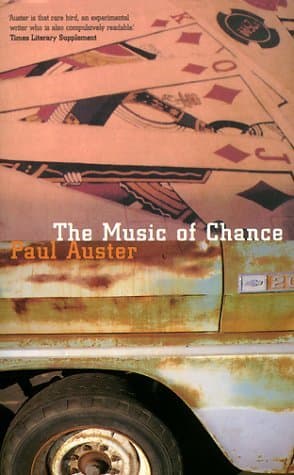
Synopsis
Covers the whole plot, including the ending.
- Difficulty
- Medium
- Pacing
- Slow
- Mood
- Bleak, Philosophical, Existential, Unsettling
- Read it if
- You appreciate existentialist themes, a slow-burn narrative, and a deep exploration of fate, chance, and the absurd.
- Skip it if
- You prefer fast-paced plots, clear moral resolutions, or optimistic stories.
The Music of Chance Plot Summary
Covers the whole plot, including the ending.
The Inheritance and the Open Road
Jim Nashe, a firefighter from Boston, gets a large inheritance from his estranged father. Feeling free, he leaves his job, home, and young daughter, Juliette, without a word. He buys a red Saab and begins an aimless journey across the United States, wanting complete freedom and rejecting his old duties. He spends his days driving, eating in diners, and sleeping in motels, watching the world without joining it. This lasts over a year, during which he spends his inheritance, a process he finds both exciting and frightening as the money shrinks.
A Chance Encounter with Jack Pozzi
With almost no money left, Nashe picks up a young hitchhiker named Jack Pozzi in rural Pennsylvania. Pozzi is a professional gambler, charming but quick-tempered, who has just been beaten and robbed after a bad card game. He tells Nashe about two eccentric millionaires, Flower and Stone, who live in an isolated mansion and host high-stakes poker games. Pozzi believes he has a sure way to win a lot of money from them, and he convinces Nashe to invest his remaining $10,000 as the money for the game, promising to split the winnings. Nashe, drawn by Pozzi's confidence and the chance for a final gamble, agrees.
Arrival at the Mansion and the Game Begins
Nashe and Pozzi drive to the secluded mansion owned by William Flower and Charles Stone. The estate is large and somewhat run-down, with an odd, almost theatrical feel. Flower and Stone are unusual: Flower is cheerful and dramatic, while Stone is quiet and threatening. They welcome Nashe and Pozzi, and the poker game begins. Pozzi plays with intense focus, and at first, his strategy seems to work, as they build a good lead. Nashe, watching, feels a mix of hope and dread, knowing that all his remaining freedom and future depend on this one game.
The Turn of the Cards and the Devastating Loss
The poker game continues for hours, with big swings. Despite Pozzi's early success, the game eventually turns. In a key hand, Pozzi, confident in his strategy, goes all-in, betting Nashe's entire remaining $10,000. Flower and Stone, calm, call his bet. The cards are shown, and Pozzi loses the hand. Nashe and Pozzi are left with nothing. The loss is complete and devastating, leaving Nashe in shock and despair, as his guarded freedom has disappeared in one moment.
The Unconventional Bargain
After their complete loss, Flower and Stone tell Nashe and Pozzi that they owe them $10,000. They propose something unusual: instead of immediate payment, they offer Nashe and Pozzi a chance to work off their debt by building a huge wall using thousands of old, imported stones from a demolished Irish castle. The wall is to be built in a field on their property, a seemingly pointless and enormous task. Nashe, seeing no other choice and trapped, reluctantly agrees to the terms, with Pozzi following his lead, though more openly resentful.
Life as Laborers
Nashe and Pozzi are moved into a small, run-down trailer on the estate and begin their forced labor. They are watched by a stern and quiet foreman named Calvin Murks. The work is physically hard and repetitive, involving lifting and placing countless heavy stones. Nashe finds a strange, almost calming rhythm in the work, while Pozzi struggles with the insult and boredom, his anger growing. Their days are long and tiring, and their lives are stripped of all past freedoms, confined to the task of building a wall.
Pozzi's Desperation and Escape Attempt
As weeks pass, Pozzi's frustration and desperation grow. He cannot adapt to the monotonous, physically draining work and the loss of his old life. He plans an escape, trying to flee the estate at night. Nashe, though understanding Pozzi's situation, knows such an act is pointless and dangerous given their remote location and the implied power of Flower and Stone. Pozzi's escape attempt fails, and he is quickly caught by Murks and other unseen guards, leading to severe results.
Pozzi's Punishment and Deterioration
After his failed escape, Pozzi is brutally beaten and left with bad injuries, including a broken jaw and other internal damage. He is brought back to the trailer, barely able to move or speak, and left for Nashe to care for. This violence shows Flower and Stone's control and the serious consequences of not obeying them. Nashe acts as Pozzi's nurse, tending to his wounds and feeding him, while continuing to work on the wall alone, the weight of Pozzi's suffering adding to his own burden.
Nashe's Solo Labor and Growing Despair
With Pozzi unable to work, Nashe is left to finish the wall by himself. The work becomes even harder and more solitary. He is always aware of Pozzi's silent suffering in the trailer, and the psychological cost of their imprisonment begins to affect him. The wall, once a sign of their debt, now feels like a monument to their lost freedom and the cruelness of their captors. Nashe's initial acceptance of the labor gives way to a deep despair and the realization that his search for freedom has led him to an even deeper form of bondage.
The Completion of the Wall and the Unforeseen Reckoning
After months of hard labor, Nashe finally finishes the huge wall. He expects his release and perhaps Pozzi's, but Flower and Stone do not appear. Instead, Murks tells him that the wall is satisfactory. Nashe, driven by a desperate need for justice and a final act of control, decides to take action. He finds a pistol in the trailer, and in a tense moment, he uses it to confront Murks, demanding to know where Flower and Stone are and the true nature of their debt. The confrontation quickly gets worse, leading to a violent and tragic end.
The Car and the Unknown
After the violent confrontation, Nashe escapes the estate. He takes Flower's expensive car, the same one he had driven to the mansion months ago, now a symbol of both his past mistake and his desperate try for a future. He drives away, leaving behind the finished wall, the injured Pozzi, and the bodies of Murks and possibly others. His destination is unknown, and his future is uncertain, marked by the crimes he has committed and the changes he has gone through. The story ends with Nashe driving into the night, chance still playing a main role in his destiny.
The Music of Chance Characters
Jim Nashe
Protagonist
A former firefighter who abandons his life after an inheritance, seeking ultimate freedom.
Jim Nashe is a man defined by his sudden, radical pursuit of freedom. After inheriting money, he sheds all his previous responsibilities—his job, his home, his daughter—to drive aimlessly across America. He is initially passive, observing life rather than participating, but possesses a deep-seated desire for control over his own destiny. He is quiet, reflective, and capable of both great detachment and profound empathy, as seen in his care for Pozzi. He is drawn to risk but ultimately seeks a clear path, even if it leads to further entanglement.
Relationships: Jack Pozzi (Gambling partner, fellow captive, and later, a dependent whom Nashe cares for.); Juliette (His abandoned daughter, a symbol of his past responsibilities and guilt.); William Flower (One of his captors, an eccentric and theatrical antagonist.); Charles Stone (One of his captors, a quiet and menacing antagonist.); Calvin Murks (The foreman and enforcer of Flower and Stone, ultimately Nashe's victim.)
Jack Pozzi
Supporting
A charismatic but volatile professional gambler who leads Nashe into the high-stakes poker game.
Jack Pozzi is a young, hot-headed professional gambler. He is confident, articulate, and possesses a restless energy, always looking for the next big score. His temper and impulsiveness often lead him into trouble. He represents the allure and danger of chance, and his initial confidence quickly crumbles under the weight of forced labor. He is physically weak compared to Nashe and mentally ill-equipped for the kind of prolonged suffering they endure, making him a foil to Nashe's more stoic endurance.
Relationships: Jim Nashe (Gambling partner and later, his caretaker during his incapacitation.); William Flower (One of the men he gambles against and is indebted to.); Charles Stone (One of the men he gambles against and is indebted to.)
William Flower
Antagonist
One of the eccentric millionaires who traps Nashe and Pozzi.
William Flower is one of the wealthy eccentrics who host the poker game. He is jovial, theatrical, and outwardly friendly, but beneath this facade lies a manipulative and controlling nature. He seems to derive amusement from the power he wields over Nashe and Pozzi, orchestrating their forced labor with a detached, almost artistic sensibility. He is the more vocal and performative of the two millionaires, often speaking in grand, philosophical terms about their unusual arrangement.
Relationships: Charles Stone (His business partner and co-conspirator in the games and the forced labor.); Jim Nashe (His debtor and forced laborer.); Jack Pozzi (His debtor and forced laborer.)
Charles Stone
Antagonist
The quieter, more menacing millionaire who gambles against Nashe and Pozzi.
Charles Stone is the quieter, more imposing of the two millionaires. He is a man of few words, exuding a palpable sense of menace and authority. While Flower handles the more theatrical aspects of their interactions, Stone's presence is a constant, unsettling reminder of the underlying power dynamics. He is the pragmatic and seemingly more dangerous force behind their operation, embodying the cold, unyielding nature of the debt and its consequences. His silence makes him particularly unnerving.
Relationships: William Flower (His business partner and co-conspirator.); Jim Nashe (His debtor and forced laborer.); Jack Pozzi (His debtor and forced laborer.)
Calvin Murks
Supporting
The foreman who oversees Nashe and Pozzi's forced labor.
Calvin Murks is the taciturn and imposing foreman responsible for supervising Nashe and Pozzi's work on the wall. He is a man of few words, communicating mostly through gestures and a stern, watchful presence. He embodies the immediate, physical authority of Flower and Stone, acting as their enforcer and ensuring the laborers comply. He is a brutal figure, responsible for Pozzi's beating, and ultimately becomes the target of Nashe's final, desperate act of rebellion. He is a symbol of the oppressive system they are trapped within.
Relationships: William Flower (His employer.); Charles Stone (His employer.); Jim Nashe (His subordinate and later, his killer.); Jack Pozzi (His subordinate and victim of his violence.)
Juliette
Mentioned
Nashe's young daughter, whom he abandons.
Juliette is Jim Nashe's young daughter, whom he leaves behind when he receives his inheritance. She is rarely mentioned but represents the responsibilities and connections Nashe deliberately severs in his pursuit of absolute freedom. Her existence highlights the moral cost of his actions and the abandonment of his past life. She serves as a symbol of the 'normal' life Nashe rejected and the potential for guilt that lingers beneath his detached exterior.
Relationships: Jim Nashe (Her father, who abandons her.)
The Music of Chance Themes
The Illusion of Freedom vs. True Liberty
The novel explores the complex nature of freedom. Nashe first thinks his inheritance gives him ultimate liberty, letting him abandon all duties and drive aimlessly. However, this 'freedom' is shown to be shallow and ultimately leads to a new kind of enslavement. His aimless wandering is a self-imposed prison, and his gamble for more freedom results in literal physical and psychological confinement. The true liberty he seeks is hard to find, suggesting that real freedom may not be in the absence of duty, but in control and choice, even within limits, or perhaps not at all. The wall itself becomes a monument to this failed search.
“He wanted to keep going, to drive to the end of the road, and when he got there to find another road, and to keep going on that one too.”
Chance, Fate, and Control
Chance is a central, almost real force in the story. Nashe's inheritance is a stroke of chance, and his meeting with Pozzi and the poker game are further examples of its unpredictable power. The novel suggests that while characters make choices, they are often carried along by forces beyond their control. The poker game is the ultimate symbol for this, where one card turn decides their entire future. Even the seemingly random task of building the wall is a result of chance—a random, punishing decision by their captors. The characters try to control their lives, but repeatedly find themselves subject to fate.
“He had never felt so free, so unencumbered by the past. He was the master of his own life now, and the future was an open book.”
Debt and Obligation
The idea of debt goes beyond just money owed. Nashe's initial 'freedom' comes at the cost of abandoning his daughter, creating a moral debt. His financial loss to Flower and Stone then turns into a physical and psychological debt, forcing him into servitude. The building of the wall becomes a clear sign of this debt, a huge task to literally pay for their loss. The novel looks at how debts, both chosen and forced, can strip people of their independence and define their lives, showing the weight of unfulfilled duties and the struggle to reclaim oneself from what is owed.
“They were no longer free men, but something closer to slaves. And the wall, of course, was their master.”
The Nature of Work and Meaning
The forced labor of building the wall explores the nature of work. At first, the work is a brutal, dehumanizing punishment, taking away Nashe and Pozzi's dignity. However, Nashe finds a strange, almost calming rhythm in the physical task, a temporary escape from his despair. The work has no meaning in its purpose—a wall to nowhere—yet it gives structure to their days and a focus to their minds. The novel questions whether meaning can be found even in random, forced labor, or if such work only highlights the lack of true purpose and control.
“The stones were his life now, the only thing that mattered. He worked with them, he thought with them, he dreamed with them.”
Plot Devices & Literary Techniques
The Wall
A monumental, arbitrary structure symbolizing debt, confinement, and the absurd.
The wall is the central symbolic object of the novel. Initially, it represents the physical manifestation of Nashe and Pozzi's debt to Flower and Stone. As the narrative progresses, it transforms into a symbol of their imprisonment, the arbitrary nature of their punishment, and the futility of their labor. The wall's ancient stones and its immense scale evoke a sense of timeless, inescapable burden. It also functions as a psychological barrier, isolating the men from the outside world and from their former selves. The act of building it becomes both a curse and, for Nashe, a strange, almost spiritual discipline that defines his existence in captivity.
The Poker Game
A high-stakes gamble that serves as the inciting incident and a metaphor for chance and fate.
The poker game is the pivotal event that sets the entire plot in motion. It functions as a dramatic inciting incident, transforming Nashe's aimless freedom into immediate, inescapable bondage. Beyond its narrative role, the game is a powerful metaphor for the theme of chance and fate. It highlights the precariousness of human plans and the overwhelming power of a single, unpredictable moment to alter the course of lives. The game also reveals the characters' true natures: Pozzi's impulsiveness, Nashe's desperate gamble for control, and Flower and Stone's detached, manipulative power.
The Red Saab
Nashe's car, symbolizing his initial pursuit of freedom and later his final, desperate escape.
The red Saab is a recurring motif that symbolizes Nashe's journey and his changing relationship with freedom. At the beginning, it represents his newfound liberty and his ability to move wherever he pleases, unburdened by attachments. It is an extension of his desire for an open, unscripted life. Later, when he is trapped, the car becomes a distant memory of that lost freedom. In the novel's climax, when Nashe takes Flower's car (a similar, expensive vehicle), it signifies his desperate, violent reclamation of agency and his return to the road, albeit under vastly different and more criminal circumstances. The car bookends his journey, marking both the beginning and the end of his 'free' periods.
The Inheritance
The initial catalyst for Nashe's journey, representing unearned wealth and its disruptive power.
The inheritance is the initial plot device that triggers Nashe's entire transformation. It is unearned money, arriving unexpectedly, and its sudden appearance disrupts Nashe's ordinary life, pushing him to abandon all his responsibilities. The inheritance symbolizes the seductive but ultimately dangerous illusion of absolute freedom that wealth can offer. It acts as a blank slate, but also a void into which Nashe pours his life, ultimately leading him to a deeper form of entrapment. It sets up the central conflict between the desire for freedom and the unforeseen consequences of severing all ties.
The Music of Chance Quotes
“He had no plans, no prospects, and no money, but he was free. He was a man who had walked away from his life, and in doing so, had become invisible.”
“The world was a place of endless coincidences, and every object, every person, every incident was a link in a chain of events that stretched back to the beginning of time.”
“Money was a kind of fiction, a collective hallucination that held the world together.”
“He understood that the game was rigged, but he also understood that it was the only game in town.”
“The idea of doing nothing for the rest of his life suddenly seemed like the most attractive prospect he had ever encountered.”
“Every man carries his own ruin around inside him.”
“It was as though the world had suddenly shrunk, as though everything outside the fence had ceased to exist.”
“The greatest freedom, he discovered, was the freedom to be forgotten.”
“There was no logic to it, no discernible pattern, just an endless series of random events.”
“He had been playing a game, and now the game was playing him.”
“The past was a foreign country; they did things differently there.”
“Sometimes you have to give up on everything to find out what you really want.”
“The silence was so vast, so profound, that it seemed to absorb all other sounds, all other thoughts.”
“He was an artist of chance, a man who had learned to live in the moment, to embrace the unpredictable.”
Quiz
10 questions on the plot and the characters. Each answer comes with a short explanation.
Question 1
What event initially prompts Jim Nashe to leave Boston and begin his travels?
- He lost his job as a fireman.
- He won a large sum of money in a lottery.
- He received a small inheritance.
- His marriage ended.
Show answer
C. He received a small inheritance. The book states that Jim Nashe came into a small inheritance, which allowed him to leave Boston and pursue a 'life of freedom.'
Question 2
What is the primary motivation for Jim Nashe's initial cross-country journey?
- To find a new career.
- To spend his inheritance until it runs out.
- To escape a past crime.
- To visit various national parks.
Show answer
B. To spend his inheritance until it runs out. Nashe's journey is characterized by 'careening back and forth across the United States, waiting for the money to run out,' indicating his goal was to exhaust his inheritance.
Question 3
What is the occupation of Jack Pozzi, the character Nashe meets?
- A musician
- A card shark/gambler
- A traveling salesman
- A former professional athlete
Show answer
B. A card shark/gambler Jack Pozzi is described as a 'young man with a temper and a plan' who leads Nashe into a poker game, identifying him as a gambler.
Question 4
Against whom do Nashe and Pozzi play the high-stakes poker game?
- A group of professional poker players.
- Two rich eccentrics.
- Pozzi's former gambling associates.
- A couple they met at a roadside diner.
Show answer
B. Two rich eccentrics. The text explicitly states they 'entered a poker game against two rich eccentrics,' who are later revealed to be Flower and Stone.
Question 5
What is the consequence for Nashe and Pozzi after losing the poker game?
- They are arrested for illegal gambling.
- They are forced to work off their debt by building a wall.
- They have to leave the country immediately.
- Pozzi is killed, and Nashe is set free.
Show answer
B. They are forced to work off their debt by building a wall. The premise of the story is that the two men are 'forced to build a wall of fifteenth-century stone' in a Pennsylvania meadow as a consequence of their loss.
Question 6
What type of stone are Nashe and Pozzi forced to build the wall with?
- Locally quarried granite.
- Fifteenth-century stone.
- Modern concrete blocks.
- River stones collected from a nearby stream.
Show answer
B. Fifteenth-century stone. The description clearly states they are forced to build a wall of 'fifteenth-century stone,' highlighting the unusual and perhaps symbolic nature of the task.
Question 7
Which of the following best describes the thematic role of 'chance' in the novel, as suggested by the description?
- A benevolent force guiding characters to their destiny.
- A predictable element that characters can control with skill.
- A shifting and powerful force that dictates outcomes.
- An illusion that characters mistakenly believe influences their lives.
Show answer
C. A shifting and powerful force that dictates outcomes. The description states that in Auster's world, 'chance is a shifting and powerful force,' directly addressing its thematic importance.
Question 8
What specific location are Nashe and Pozzi building the wall?
- In the backyard of a suburban home in New York.
- On a remote island off the coast of Maine.
- In a Pennsylvania meadow.
- Near a construction site in California.
Show answer
C. In a Pennsylvania meadow. The very first sentence of the synopsis specifies the setting: 'In a Pennsylvania meadow, a young fireman and an angry gambler are forced to build a wall.'
Question 9
Despite the 'fiendish bargains and punitive whims,' what qualities are highlighted as offering 'redemption' for Nashe?
- His cunning and ability to manipulate others.
- His sudden acquisition of wealth and power.
- His resolute quest for justice and his capacity for love.
- His acceptance of his fate and abandonment of hope.
Show answer
C. His resolute quest for justice and his capacity for love. The description explicitly states, 'there is redemption, nonetheless, in Nashe's resolute quest for justice and his capacity for love,' highlighting these as his redeeming qualities.
Question 10
What is Jim Nashe's former profession before he receives his inheritance?
- A teacher
- A fireman
- A writer
- A construction worker
Show answer
B. A fireman The synopsis identifies Nashe as 'a young fireman' before he embarks on his journey.
The Music of Chance FAQ
What is the central premise of 'The Music of Chance'?
The novel centers on Jim Nashe, a former fireman who inherits money and embarks on a journey of aimless driving across the U.S. After his money dwindles, he partners with a young gambler, Jack Pozzi, to play a high-stakes poker game against two eccentric millionaires, Flower and Stone, which ultimately leads them into indentured servitude building a wall.
Who are Flower and Stone, and what is their role in the story?
Flower and Stone are the two wealthy, eccentric men who defeat Nashe and Pozzi in a poker game. They are the landowners who demand Nashe and Pozzi build a meticulous wall from fifteenth-century Irish stones as repayment for their gambling debt, effectively trapping them in a bizarre form of servitude.
How does Jim Nashe's inheritance influence his initial actions in the book?
Nashe's inheritance allows him to abandon his conventional life as a fireman and pursue a 'life of freedom,' which manifests as aimless driving across the country. This period of rootless travel is a direct consequence of his newfound wealth, allowing him to escape responsibility until the money runs out.
What is the significance of the wall that Nashe and Pozzi are forced to build?
The wall represents their inescapable debt and the arbitrary power of Flower and Stone. It is a monument to their misfortune, a physical manifestation of their lost freedom, and a Sisyphean task designed to consume their time and labor without clear end, using ancient stones that add to its symbolic weight.
What happens to Jack Pozzi after he attempts to escape?
After Pozzi attempts to escape the compound, he is brutally beaten by Flower and Stone's enforcer, Calvin Murks, and left severely injured. This event highlights the ruthless consequences of defying Flower and Stone, and it forces Nashe to care for his incapacitated partner, deepening his predicament.
Are there any deeper meanings behind the names 'Flower' and 'Stone'?
The names 'Flower' and 'Stone' can be interpreted as representing opposing forces or the dual nature of existence: the ephemeral and the enduring, the organic and the inorganic. They also directly relate to the materials and nature of the wall they force Nashe and Pozzi to build, suggesting their control over both life and inanimate objects.
What is the implied fate of Jim Nashe at the end of the novel?
The novel ends ambiguously with Nashe, having taken Pozzi's place in the car race against Murks, driving off into the night. His fate is left open, suggesting either a tragic end, a final desperate act of defiance, or a continuation of his journey into an unknown future, echoing the themes of chance and consequence.
How does the poker game foreshadow the subsequent events?
The poker game, with its high stakes and the arbitrary nature of the cards, directly foreshadows the larger game of chance that Nashe and Pozzi find themselves in with Flower and Stone. It establishes the theme of unpredictable fate and the sudden reversals of fortune that define their subsequent servitude and struggles.
Is there a significance to the fifteenth-century Irish stones used for the wall?
The ancient Irish stones imbue the wall with a sense of timelessness and historical weight, making the task feel even more monumental and disconnected from modern reality. They suggest a connection to an older, perhaps more brutal, world where debts were paid in long, arduous labor, emphasizing the archaic nature of Flower and Stone's demands.
How does Jim Nashe's 'life of freedom' evolve into servitude?
Nashe's initial 'life of freedom' is an escape from responsibility, but it's also aimless and unsustainable. His gambling debt to Flower and Stone, which forces him to build the wall, transforms this initial, superficial freedom into a literal and psychological servitude, demonstrating how unchecked freedom can lead to its antithesis through the whims of chance.
What psychological impact does building the wall have on Nashe and Pozzi?
Building the wall takes a heavy psychological toll, eroding their sense of self-worth and purpose. For Pozzi, it leads to desperation and a failed escape attempt, resulting in severe injury. For Nashe, it fosters a grim determination but also a growing sense of entrapment and the slow erosion of his will, highlighting the dehumanizing nature of forced labor.
How does Jack Pozzi's personality contrast with Jim Nashe's, and what does this reveal?
Pozzi is hot-headed, impulsive, and prone to anger, driven by a desire for quick wins and immediate gratification. Nashe is more passive, reflective, and resigned, initially seeking escape from responsibility. Their contrasting personalities highlight different responses to adversity and chance, with Pozzi's impulsiveness leading to greater suffering, while Nashe's passivity often prolongs his predicament.
What is the nature of 'redemption' in the context of Nashe's quest for justice and capacity for love?
Redemption for Nashe isn't about escaping his fate but about finding meaning and purpose within it, particularly through his care for the injured Pozzi and his final act of defiance against Murks. His capacity for love is shown in his loyalty to Pozzi, and his quest for justice is a quiet, internal one, culminating in his willingness to risk everything for a final gamble against Murks, even if it leads to his demise.
To what extent is 'chance' truly a shifting and powerful force, or is it merely a reflection of character choices?
While 'chance' is undeniably a powerful force in the novel, dictating the poker game outcome and Nashe's inheritance, it also interacts with character choices. Nashe's decision to drive aimlessly, Pozzi's impulsiveness, and their joint decision to gamble are choices that put them in the path of chance, suggesting a complex interplay where fate and free will are intertwined.
Does the novel offer any clear moral judgments on the actions of Flower and Stone?
The novel portrays Flower and Stone as figures of arbitrary power and cruelty, but it refrains from explicit moral judgments. Their actions are presented as a given, a part of the 'game' that Nashe and Pozzi are forced to play. This ambiguity allows readers to grapple with the nature of power and justice without authorial interference, emphasizing the detached observation of fate.
How does the ending, with Nashe driving off, contribute to the novel's themes?
The ambiguous ending reinforces the novel's themes of chance, freedom, and the unknown. Nashe's final act, taking Pozzi's place in the race, is a desperate gamble that leaves his fate unresolved. It suggests that even in the face of overwhelming odds, there's a final, defiant act of choice, but the outcome remains subject to the unpredictable 'music of chance.'
Is the novel a critique of the American Dream or the pursuit of absolute freedom?
The novel can be interpreted as a critique of unchecked freedom and the superficiality of the American Dream. Nashe's initial pursuit of 'freedom' leads him to aimlessness and ultimately into a more profound form of entrapment, suggesting that true freedom might reside not in escape, but in facing one's responsibilities and making meaningful choices, even under duress.
What role does the character of Calvin Murks play in the narrative?
Calvin Murks serves as the enforcer for Flower and Stone, a silent and intimidating figure who embodies their brutal authority. He is responsible for punishing Pozzi and is the ultimate antagonist in Nashe's final desperate gamble, representing the raw, physical power that keeps Nashe and Pozzi captive.
How does the setting of the Pennsylvania meadow contribute to the novel's atmosphere?
The isolated Pennsylvania meadow, far removed from civilization, creates a sense of detachment and claustrophobia. It becomes a contained world where the arbitrary rules of Flower and Stone hold absolute sway, emphasizing the characters' entrapment and the surreal nature of their forced labor, contrasting sharply with Nashe's earlier cross-country travels.
About the author

Paul Benjamin Auster is an American writer and film director. His notable works include The New York Trilogy (1987), Moon Palace (1989), The Music of Chance (1990), The Book of Illusions (2002), The Brooklyn Follies (2005), Invisible (2009), Sunset Park (2010), Winter Journal (2012), and 4 3 2 1 (2017). His books have been translated into more than forty languages.
Similar books
- Waiting for Godot
Samuel Beckett
3.8 (160k) average on GoodreadsPhilosophyExplores themes of absurdity, waiting, and existential stasis with dark humor.
- The Stranger
Albert Camus
4.1 (3k) average on GoodreadsFantasyFeatures an alienated protagonist confronting the meaninglessness of existence.
- No Country for Old Men
Cormac McCarthy
4.1 (148k) average on GoodreadsThrillerBoth novels explore fate and violence. However, Auster's is less overtly bleak and more focused on the internal existential crisis. McCarthy's characters often possess a brutal agency, differing from Nashe's more passive acceptance of circumstances.
- Catch-22
Joseph Heller
4.0 (723k) average on GoodreadsHistorical FictionBoth depict absurd systems of control. Auster's approach is far more subtle and less satirical. Heller uses overt satire to expose irrationality, while Auster's critique is woven into a narrative of debt and labor without didacticism.
- The Old Man and the Sea
Ernest Hemingway
3.8 (831k) average on GoodreadsLiterary FictionA Cuban fisherman's long struggle with a giant marlin becomes a story of endurance and dignity, now retold for young adults with illustrations, phonetic guides, and writing prompts in Traditional Chinese.
- One Hundred Years of Solitude
Gabriel García Márquez
4.1 (753k) average on GoodreadsLiterary FictionThrough the multi-generational story of the Buendía family, a mythical town deals with the repeating patterns of time, love, and solitude, as the extraordinary mixes with the ordinary.





Enjoyed the summary?
A summary gives you the shape of the book. The book itself has the detail, the examples and the voice.
Find The Music of Chance on AmazonAs an Amazon Associate, BookBrief earns from qualifying purchases. How we're funded