
Synopsis
Covers the whole plot, including the ending.
- Difficulty
- Easy
- Pacing
- Moderate
- Mood
- Whimsical, Humorous, Mysterious, Charming
- Read it if
- You enjoy whimsical, witty mysteries with unique characters and a touch of the absurd, perfect for young readers and adults alike.
- Skip it if
- You prefer straightforward, realistic narratives without fantastical elements or a strong emphasis on wordplay and literary allusions.
The Mysterious Howling Plot Summary
Covers the whole plot, including the ending.
A Most Unusual Arrival
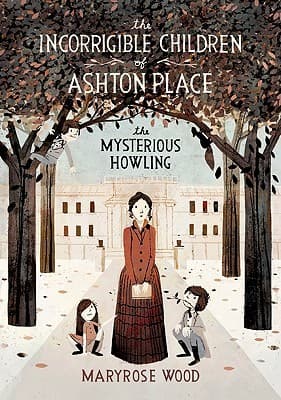
Penelope Lumley, a recent Swanburne Academy graduate, arrives at the isolated Ashton Place, owned by Lord and Lady Ashton. She is hired as a governess and is eager to use her education. She meets her charges: Alexander, Cassiopeia, and Beowulf. Penelope is surprised to find the three children were found living wild in the forest and act like dogs, barking, howling, and chasing squirrels. Lady Constance Ashton explains their origins are unknown, and they call themselves 'The Incorrigibles.' Penelope accepts the challenge of civilizing them.
First Lessons in Civilization
Penelope begins teaching basic human behaviors. She tries to teach Alexander, Cassiopeia, and Beowulf to speak English, use silverware, and walk upright. The children struggle, preferring growls and barks, and often revert to wild instincts, frustrating Penelope and amusing Lady Constance. Penelope discovers their sharp hearing and sense of smell, which she tries to use in their learning. She also starts reading 'The Pilgrim's Progress' to them, hoping to inspire a love for books and provide moral guidance.
The Mysterious Coachman
As Penelope settles in, she notices the strange behavior of Old Timothy, the estate's old coachman. He often appears unexpectedly, watching Penelope and the children from a distance, and seems to have a deep secret. Penelope overhears parts of conversations and notices his intense interest in the Incorrigibles. She also learns he found the children in the woods and brought them to Ashton Place, increasing her suspicions about his connection to their past and the estate's secrets.
Preparations for the Ball
Lady Constance announces the annual holiday ball is coming soon and insists the Incorrigible Children must attend. This puts pressure on Penelope, who must quickly change the children from wild beings into presentable young people. She increases lessons on table manners, social graces, and proper clothes. The children, especially Cassiopeia, resist formal clothing and social rules, leading to funny and frustrating moments as Penelope tries to prepare them for their public debut.
The Howling in the Woods
During their time at Ashton Place, Penelope and the children often hear mysterious howls from the forest at night. These howls seem to affect the Incorrigibles deeply, who often respond with their own barks and whimpers, showing a clear connection to whatever or whoever is in the woods. Penelope is uneasy about these sounds, which reinforce the children's wild nature and suggest there might be other creatures or people like them in the dense forest. The howls add to the mystery of the children's origins.
A Glimpse of the Past
While exploring Ashton Place, Penelope finds a forgotten portrait of a young woman who looks like Cassiopeia. This discovery sparks Penelope's interest and strengthens her belief that the children's past is linked to the estate. She discreetly investigates, gathering clues from old staff and forgotten rooms. The portrait is the first solid evidence that the Incorrigibles might be connected to the Ashton family or the history of Ashton Place, deepening the mystery of their identity.
The Ball and its Complications
The night of the holiday ball arrives. Despite Penelope's efforts, the Incorrigible Children struggle to keep their refined behavior. Alexander tries to dance a schottische, Cassiopeia is fascinated by the decorations, and Beowulf chases a squirrel indoors. Their wild instincts often appear, causing small problems and attracting curious looks from guests. Amidst the chaos, Penelope notices Old Timothy watching the children intently. She also sees a mysterious woman who seems very interested in the Incorrigibles, making the evening more complex.
A Confrontation with Old Timothy
Driven by her growing suspicions, Penelope confronts Old Timothy, asking what he knows about the Incorrigible Children. Timothy is at first evasive, but under Penelope's questions, he reveals bits of information. He hints at a tragic past involving the Ashton family and a secret kept for many years. He implies the children are not just wild animals but have a human connection to the estate. He is reluctant to tell the full truth, fearing consequences or breaking a long-held promise. His revelations only make Penelope more determined to uncover the full story.
The Mysterious Woman
Penelope investigates the mysterious woman she saw at the ball and discovers she is a distant relative of the Ashton family, Mrs. Clarice Ashton. Mrs. Ashton also seems to know more about the Incorrigibles than she says. She shows an unusual interest in the children, especially Cassiopeia. Her presence raises more questions about the children's lineage and the secrets Lord and Lady Ashton are keeping. Penelope suspects Mrs. Ashton might be connected to the children's past or could have important information, making her another piece in the unfolding mystery.
A Glimpse of the Truth
Through her observations, the portrait, Old Timothy's hints, and the mysterious howls, Penelope starts to form a picture, though still incomplete. She concludes that the Incorrigible Children are likely not just abandoned orphans but have a direct, family connection to Ashton Place, possibly even to the Ashton family itself. The howls from the forest suggest other individuals with their wild nature are present, hinting at a larger, hidden community or family. Penelope realizes the true scope of the mystery and what it means for the children's identity.
The Ongoing Mystery
Despite the partial revelations, the full truth of the Incorrigible Children's origins remains unclear. Penelope understands that Lord and Lady Ashton either do not know the full story or are hiding it. Old Timothy has important information but is unwilling to share everything. The howls from the forest continue, a constant reminder of the unanswered questions. Penelope is not discouraged. She is more committed than ever to solving the mystery, not just for herself, but for Alexander, Cassiopeia, and Beowulf, whose true identities and heritage are still hidden at Ashton Place.
The Mysterious Howling Characters
Miss Penelope Lumley
Protagonist
The earnest, intelligent governess of the Incorrigible Children.
Penelope is a fifteen-year-old recent graduate of the Swanburne Academy for Poor Bright Females, instilled with a rigorous education and a strong sense of duty. She is remarkably intelligent, resourceful, and possesses an unwavering optimism, even in the face of the most unusual challenges. Her primary drive is to educate and civilize the Incorrigible Children, believing firmly in the power of knowledge and proper etiquette. She is observant and curious, constantly seeking to understand the mysteries surrounding Ashton Place and her charges.
Relationships: Alexander, Cassiopeia, Beowulf (governess to her charges, developing a deep, protective bond); Lord and Lady Ashton (employer-employee relationship, often strained by their eccentricities and secrets); Old Timothy (initially suspicious, later seeks his knowledge and guidance)
Alexander Incorrigible
Supporting
The eldest of the Incorrigible Children, exhibiting leadership qualities.
Alexander, approximately ten years old, is the most mature and protective of the Incorrigible Children. He often acts as the leader, attempting to keep his younger siblings in line with gentle nips and growls. He is the most amenable to Penelope's lessons, showing flashes of intelligence and a desire to understand human ways, though his wild instincts still frequently surface. He is fiercely loyal to his siblings and possesses a strong sense of observation, often noticing details others miss.
Relationships: Cassiopeia and Beowulf (older brother, protective and guiding); Miss Penelope Lumley (student, forming a bond of trust and respect)
Cassiopeia Incorrigible
Supporting
The middle Incorrigible child, playful and quick to react.
Cassiopeia, around four or five years old, is the most overtly canine of the Incorrigible Children. She is playful, energetic, and prone to barking and biting, though usually not with malicious intent. She is often the most resistant to Penelope's attempts at civilization, preferring to follow her instincts. Despite her wildness, she shows moments of surprising tenderness and curiosity, especially towards new objects or sounds. She is deeply connected to her siblings and the sounds of the forest.
Relationships: Alexander and Beowulf (sister, playful and deeply bonded); Miss Penelope Lumley (student, often challenging but eventually forming a connection)
Beowulf Incorrigible
Supporting
The youngest Incorrigible child, adept at chasing small animals.
Beowulf, the youngest of the Incorrigible Children, is characterized by his alarmingly adept skill at chasing squirrels and other small animals. He is agile, curious, and often follows his older siblings' lead. Like Cassiopeia, he struggles with human conventions and is quick to revert to his animalistic behaviors. He is less vocal than his siblings but demonstrates a keen sense of observation and a strong bond with the natural world. He often provides comic relief with his innocent, wild antics.
Relationships: Alexander and Cassiopeia (younger brother, follows their lead and shares their bond); Miss Penelope Lumley (student, learning through observation and gentle guidance)
Lady Constance Ashton
Supporting
The flighty and somewhat oblivious mistress of Ashton Place.
Lady Constance is the eccentric mistress of Ashton Place. She is fashionable, easily distracted, and generally prefers to ignore unpleasantries. She has a superficial interest in the Incorrigible Children's welfare but delegates all responsibility for their upbringing to Penelope. While outwardly amiable, she seems to be deliberately ignorant of the deeper mysteries surrounding the children and the estate. Her primary concerns often revolve around social events and maintaining appearances, rather than delving into complex family secrets.
Relationships: Lord Ashton (wife, shares a somewhat detached and eccentric marriage); Miss Penelope Lumley (employer, relies on Penelope but often dismisses her concerns)
Lord Ashton
Supporting
The wealthy and equally eccentric master of Ashton Place.
Lord Ashton is the wealthy and somewhat detached master of Ashton Place. He is often preoccupied with his hunting and other gentlemanly pursuits, leaving the management of the children and household largely to Lady Constance and Penelope. He is less outwardly eccentric than his wife but equally unconcerned with the deeper implications of the Incorrigible Children's origins. He represents a figure of established, unexamined wealth and tradition, content to let sleeping dogs lie rather than confront uncomfortable truths.
Relationships: Lady Constance Ashton (husband, shares a detached relationship); Miss Penelope Lumley (employer, largely indifferent to her efforts)
Old Timothy
Supporting
The mysterious, ancient coachman who discovered the Incorrigibles.
Old Timothy is the estate's ancient coachman, a reclusive and enigmatic figure. He is the one who found the Incorrigible Children in the forest and brought them to Ashton Place. He is highly observant, seemingly always present, and possesses a deep knowledge of the estate's history and its secrets. He is initially guarded and reluctant to speak, but he holds crucial information about the children's past, hinting at a connection to the Ashton family. His loyalty is complex, tied to long-held vows and a sense of duty.
Relationships: Miss Penelope Lumley (initially wary, later a source of cryptic information); The Incorrigible Children (their rescuer, holds a secret connection to their origins)
Mrs. Clarice Ashton
Mentioned
A distant relative of the Ashtons, showing unusual interest in the children.
Mrs. Clarice Ashton is a distant relative of the Ashton family who attends the holiday ball. She is observant and takes an unusual interest in the Incorrigible Children, particularly Cassiopeia, suggesting she knows more about their origins than she lets on. Her presence adds another layer of intrigue to the mystery, hinting at a wider familial network with knowledge of the estate's secrets.
Relationships: The Ashton family (distant relative); The Incorrigible Children (shows unusual, unexplained interest)
The Mysterious Howling Themes
Nature vs. Nurture
This theme explores whether the Incorrigible Children's wild behaviors are inborn (nature) or from their upbringing in the forest (nurture). Penelope believes education and socialization (nurture) can change them into proper human beings. Her efforts to teach them language, manners, and social graces show this. However, the children's constant howling, tracking instincts, and dislike of clothes suggest their 'nature' is deeply set, questioning the limits of human influence. The mysterious howls from the forest further highlight their wild origins.
“They are, to be sure, quite wild,” Lady Constance had admitted, “but then, that is what governesses are for, is it not? To tame the wild.”
Identity and Belonging
The Incorrigible Children's unknown parents and wild upbringing create a central question of identity. Are they human children who just lived like animals, or are they fundamentally different? Penelope's effort to civilize them is also an effort to help them discover and accept a human identity. Their attempts to act human, mixed with their natural wildness, show their struggle to find where they belong. The mystery of their origins, hinted at by the portrait and Old Timothy, suggests a deeper, perhaps noble, identity that has been lost or hidden.
““Who are you, really?” Penelope sometimes wondered, watching Alexander, Cassiopeia, and Beowulf chase squirrels with alarming efficiency.”
The Power of Education
Penelope Lumley, from the Swanburne Academy, shows that education can change people. She believes knowledge, books, and proper teaching can improve individuals, even those as wild as the Incorrigibles. Her dedication to teaching them Latin, reading, and social graces reflects her belief that education is key to their humanity and future. Despite the children's initial resistance, Penelope's efforts slowly show results, proving that learning can shape behavior and understanding, even if their wild instincts remain.
“A well-placed Latin verb,” Penelope often thought, “can solve almost any problem.”
Secrets and Deception
Ashton Place is full of secrets and unspoken truths. The mysterious origins of the Incorrigible Children are the main puzzle. Lord and Lady Ashton either do not know the full story or are hiding it. Old Timothy, the coachman, clearly has important knowledge but is bound by a promise of silence or fear. The unexplained howls from the forest and the discovery of the portrait further deepen the feeling that a major truth is hidden. Penelope becomes an accidental detective, slowly uncovering layers of deception that protect the estate's past.
“Ashton Place,” Penelope mused, “was a house built on whispers.”
Plot Devices & Literary Techniques
Feral Children Trope
Children raised in the wild, exhibiting animalistic behaviors.
This device immediately establishes the core mystery and conflict of the story. The Incorrigible Children's animalistic behaviors—howling, chasing, communicating through barks—create both humor and a profound challenge for Penelope. It highlights the 'nature vs. nurture' theme and drives the plot as Penelope attempts to civilize them. The trope also allows for an exploration of what it means to be human, contrasting learned behaviors with innate instincts, and creates a sense of wonder and otherworldliness within the seemingly mundane setting of a grand estate.
The Mysterious Howling
Unexplained howls from the forest that resonate with the children.
The recurring mysterious howling serves as both a plot catalyst and a symbol. It constantly reminds the reader and Penelope of the children's wild origins and the secrets lurking in the surrounding forest. The howls create an atmosphere of suspense and foreshadowing, suggesting the presence of other beings or a deeper connection to the children's past. For the Incorrigibles, the howls are a call from their former life, creating a pull between their developing human identity and their wild instincts, thus driving their internal conflict and hinting at external forces at play.
The Eccentric Aristocracy
Wealthy but peculiar employers who are oblivious to or complicit in secrets.
Lord and Lady Ashton embody this device, providing both comic relief and a source of narrative frustration. Their peculiar habits, disinterest in the children's true welfare, and general obliviousness allow the central mystery to flourish unchecked. By being either ignorant or deliberately evasive, they force Penelope to become the primary investigator, pushing the plot forward through her independent inquiries. Their social standing also provides the setting for events like the ball, creating opportunities for the Incorrigibles' wildness to be highlighted against a backdrop of strict social etiquette.
The Cryptic Confidant
A minor character who holds key information but reveals it slowly and ambiguously.
Old Timothy, the coachman, perfectly fits this device. He is the first person to interact with the Incorrigible Children and holds crucial knowledge about their past. His reluctance to speak directly, instead offering hints and partial truths, builds suspense and forces Penelope to piece together the mystery herself. This device ensures that information is not simply handed to the protagonist, but earned through persistent investigation, making the revelations more impactful and drawing the reader deeper into the puzzle of the children's origins and the secrets of Ashton Place.
The Mysterious Howling Quotes
“There are people who believe that children should be seen and not heard. And there are people who believe that children should be neither seen nor heard. Lady Constance was one of those people.”
“Never underestimate the power of a well-placed comma.”
“Sometimes, the most important things are invisible.”
“A good story, like a good cup of tea, can solve almost anything.”
“Fear, like a bad smell, can cling to you long after the source is gone.”
“It is a truth universally acknowledged, that a single orphan in possession of a good fortune, must be in want of a governess.”
“The world is full of wonders, if only you know where to look.”
“Even the smallest creature can make the loudest noise, if it's in the right place at the right time.”
“Curiosity, like a cat, can lead you into all sorts of interesting places.”
“A secret is like a seed; once planted, it can grow into something unexpected.”
“Sometimes, the best way to find something is to stop looking for it.”
“Manners are like a coat of paint; they can cover a multitude of sins, but they don't change what's underneath.”
“The past is like a tangled ball of yarn; it takes patience to unravel it.”
Quiz
10 questions on the plot and the characters. Each answer comes with a short explanation.
Question 1
What is the name of the academy Miss Penelope Lumley recently graduated from?
- The Ashton Place School of Governance
- The Swanburne Academy for Poor Bright Females
- The Grand Academy for Governesses
- The Lumley Institute for Young Ladies
Show answer
B. The Swanburne Academy for Poor Bright Females Miss Penelope Lumley is a recent graduate of the Swanburne Academy for Poor Bright Females, a key detail about her background.
Question 2
Which of the Incorrigible Children is described as being 'alarmingly adept at chasing squirrels'?
- Alexander
- Cassiopeia
- Beowulf
- Penelope
Show answer
C. Beowulf Beowulf, the middle child, is specifically mentioned as being 'alarmingly adept at chasing squirrels,' highlighting his wild tendencies.
Question 3
What is the primary challenge Miss Penelope Lumley faces when she first begins her position with the Incorrigible Children?
- Teaching them advanced Latin and mathematics
- Helping them overcome their canine tendencies
- Preparing them for a rigorous entrance exam
- Uncovering the mystery of Ashton Place
Show answer
B. Helping them overcome their canine tendencies The synopsis explicitly states that Penelope 'must first help them overcome their canine tendencies' before she can teach them academic subjects.
Question 4
What is the approximate age of Alexander, the eldest of the Incorrigible Children?
- Seven or eight
- Ten or thereabouts
- Twelve or thirteen
- Five or six
Show answer
B. Ten or thereabouts Alexander is described as 'age ten or thereabouts,' indicating his approximate age.
Question 5
Who is Old Timothy in relation to Ashton Place?
- The estate's groundskeeper
- Lady Constance's personal secretary
- The coachman
- A visiting relative
Show answer
C. The coachman Old Timothy is identified as 'the coachman,' and his lurking around corners adds to the mystery of the estate.
Question 6
What event is Miss Penelope Lumley hoping to prepare the Incorrigibles for by teaching them manners and useful phrases?
- A visit from the Queen
- Lady Constance's holiday ball
- A formal dinner with Lord Fredrick
- Their first day at a proper school
Show answer
B. Lady Constance's holiday ball Penelope's goal is to teach them 'table manners and socially useful phrases in time for Lady Constance's holiday ball.'
Question 7
What characteristic does Cassiopeia possess that is described as 'usually worse than her bite'?
- Her growl
- Her bark
- Her howl
- Her scratch
Show answer
B. Her bark Cassiopeia is described as having 'a bark that is (usually) worse than her bite,' highlighting her canine traits.
Question 8
What is one of the academic subjects Miss Penelope Lumley is eager to instruct the children in, besides proper use of globes?
- Algebra
- Latin verbs
- Ancient Greek history
- Natural sciences
Show answer
B. Latin verbs Penelope is 'eager to instruct the children in Latin verbs and the proper use of globes,' showing her academic aspirations for them.
Question 9
The central mystery surrounding the Incorrigible Children revolves around what aspect of their existence?
- Their unusual dietary habits
- Their true identities and origins
- Their resistance to learning new languages
- Their ability to communicate with animals
Show answer
B. Their true identities and origins One of the key mysteries posed is: 'Who are these three wild creatures, and how did they come to live in the vast forests of the estate?' pointing to their origins.
Question 10
What is Miss Penelope Lumley's age at the beginning of the story?
- Eighteen years old
- Twenty-one years old
- Fifteen years old
- Thirteen years old
Show answer
C. Fifteen years old The text explicitly states that Penelope is 'Only fifteen years old,' highlighting her youth for such a challenging role.
The Mysterious Howling FAQ
What is the central premise of 'The Mysterious Howling'?
The book introduces Miss Penelope Lumley, a recent graduate of Swanburne Academy, who takes on the seemingly impossible task of governess to three feral children—Alexander, Cassiopeia, and Beowulf—who behave like wolves. She must civilize them while uncovering the mysteries surrounding their origins at Ashton Place.
Who are the Incorrigible Children and what are their most prominent 'canine' traits?
The Incorrigible Children are Alexander (around ten), Cassiopeia (four or five), and Beowulf (middle age). Alexander nips to maintain order, Cassiopeia barks fiercely, and Beowulf is exceptional at chasing squirrels. They also exhibit howling, sniffing, and a preference for raw meat.
What is Miss Penelope Lumley's background and why is she uniquely suited for her role?
Penelope is a fifteen-year-old graduate of the Swanburne Academy for Poor Bright Females, which instills a strong sense of duty and intellectual curiosity. Her education, optimism, and lack of conventional expectations make her adaptable and determined to help the Incorrigibles, despite their unusual behavior.
Who are Lord and Lady Ashton and what is their attitude towards the Incorrigibles?
Lord Ashton is somewhat detached and preoccupied with his hunting, while Lady Constance is more concerned with appearances and the children's integration into society, particularly for her holiday ball. They are both rather bewildered by the children's condition and largely leave their care to Penelope.
What major event serves as a deadline or goal for Penelope in the first book?
Penelope's immediate goal is to teach the Incorrigible Children enough table manners and socially acceptable phrases to attend Lady Constance's holiday ball. This event acts as a significant milestone for their progress in becoming 'civilized.'
What clues suggest the Incorrigibles' true parentage or origin?
The children's physical appearance (e.g., Alexander's golden eyes), their unusual connection to the forest, and the recurring motif of wolves strongly hint at a connection to the Ashton family lineage or a specific incident involving a governess and a wolf. Old Timothy's suspicious behavior also points to hidden knowledge.
What is the significance of the character Old Timothy, the coachman, and his lurking?
Old Timothy is portrayed as a shadowy figure who frequently observes the children and Penelope, often with a knowing or troubled expression. His lurking suggests he possesses crucial information about the Incorrigibles' past, possibly having been involved in the events that led to them being found in the forest.
How does the book subtly introduce the concept of 'the curse' or a family secret related to wolves?
The narrative includes mentions of a 'family curse' or a legend involving wolves associated with the Ashton estate, often dismissed as folklore. These hints, combined with the children's wolf-like behaviors and Lady Constance's anxieties, lay the groundwork for a supernatural or fantastical explanation for their origins.
What is the significance of the name 'Alexander' for the eldest Incorrigible, given the book's themes?
Alexander, meaning 'defender of mankind,' is ironic given his wolf-like tendencies, yet he also acts as a protector for his younger siblings. This name choice highlights the conflict between his wild nature and the human potential Penelope seeks to cultivate, hinting at his eventual embrace of a more 'human' role.
How does Penelope's upbringing at Swanburne Academy influence her approach to the Incorrigibles?
Swanburne Academy emphasizes logic, education, and finding solutions to problems, regardless of their peculiarity. This rigorous training equips Penelope with an optimistic, analytical mindset and an unwavering belief in the power of education, enabling her to tackle the seemingly impossible task of civilizing the children.
Discuss the psychological impact of the children's 'feral' state on their development and learning.
The Incorrigibles' feral state means they lack basic human communication, social cues, and impulse control. Their instincts are primal, making them initially resistant to structured learning and conventional comfort. Penelope's challenge is to bridge the gap between their innate wildness and the learned behaviors of human society.
How does Penelope's initial naivety evolve throughout her experience with the Incorrigibles?
Penelope begins with an academic, theoretical understanding of her role, but her naivety quickly gives way to practical experience and a deeper empathy for the children. She learns to adapt her teaching methods, understand their unique needs, and recognize the profound mystery surrounding them, moving beyond simple textbook solutions.
What role does empathy play in Penelope's ability to connect with and teach the Incorrigibles?
Penelope's deep empathy allows her to look beyond the children's animalistic behaviors and see their potential for humanity. Instead of punishing their instincts, she seeks to understand them, fostering a bond of trust that is crucial for their learning and development, contrasting with others' fear or dismissal.
How does the book use humor to address the serious themes of identity and 'nature vs. nurture'?
The book employs a dry, witty humor and amusing scenarios (like teaching table manners to children who prefer gnawing) to lighten the serious philosophical debate of nature vs. nurture. This comedic approach makes the children's struggle with their identity and Penelope's efforts more accessible and entertaining.
What philosophical questions does 'The Mysterious Howling' raise about what it means to be human?
The book explores whether humanity is defined by birthright, learned behaviors, or a deeper essence. By presenting children who are biologically human but behave like animals, it prompts reflection on the role of language, culture, and social interaction in shaping one's identity as a 'human being.'
Is the 'schottische' mentioned in the text purely a plot device, or does it hold deeper symbolic meaning?
While the schottische initially serves as a practical, humorous challenge for the Incorrigibles' social integration, it also symbolizes the complex, often arbitrary, rules of human society. Mastering this dance represents their step towards conforming to cultural expectations, highlighting the contrast with their wild freedom.
How does the narrative voice contribute to the book's unique charm and its blend of genres?
The omniscient, slightly formal, and often wryly humorous narrative voice creates a whimsical yet intelligent tone. It allows for direct address to the reader, witty asides, and a sense of shared discovery, blending fantasy, mystery, and historical fiction with a distinctive charm that appeals to young adults and beyond.
What aspects of the historical setting (Victorian era) are most prominent and why?
The Victorian era setting is evident in the strict social etiquette, the role of governesses, the grand country estates, and the prevailing societal views on children and education. This backdrop highlights the 'uncivilized' nature of the Incorrigibles and Penelope's challenging task against a rigid social structure.
Similar books
- Harry Potter and the Sorcerer's Stone
J.K. Rowling
4.5 (7M) average on GoodreadsFantasyRescued from a miserable life under the stairs, an orphaned boy discovers he's a wizard destined for a magical school, where he uncovers a dangerous secret tied to the dark wizard who murdered his parents.
- The Hunger Games
Suzanne Collins
4.3 (6.4M) average on GoodreadsFantasyIn a future where children fight to the death on live television, Katniss Everdeen volunteers for the arena, turning a death sentence into a fight for survival and a spark of rebellion.
- 1984
George Orwell
4.2 (3.1M) average on GoodreadsPoliticsIn a future where surveillance and thought control are absolute, a man's search for truth clashes with the Party, showing that hope can be a form of rebellion.
- Divergent
Veronica Roth
4.2 (2.9M) average on GoodreadsFantasyIn a society divided by virtues, a sixteen-year-old's difference from the norm starts a rebellion that threatens her world.
- The Hobbit, or There and Back Again
J.R.R. Tolkien
4.3 (2.9M) average on GoodreadsFantasyA comfort-loving hobbit named Bilbo Baggins is whisked away by a mischievous wizard and a band of dwarves on an unexpected journey to reclaim stolen treasure from a fearsome dragon, discovering courage and a magical ring along the way.
- Animal Farm
George Orwell
4.0 (2.7M) average on GoodreadsPoliticsA farm animals' rebellion against humans turns into a pig-led dictatorship, showing how power corrupts and revolutionary ideals are betrayed.






Enjoyed the summary?
A summary gives you the shape of the book. The book itself has the detail, the examples and the voice.
Find The Mysterious Howling on AmazonAs an Amazon Associate, BookBrief earns from qualifying purchases. How we're funded