
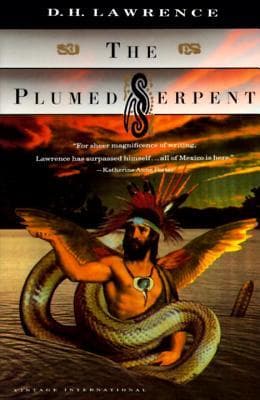
Synopsis
Covers the whole plot, including the ending.
- Difficulty
- Hard
- Pacing
- Slow
- Mood
- Atmospheric, Mystical, Intense, Philosophical
- Read it if
- You're interested in D.H. Lawrence's exploration of spirituality, primitive forces, and the clash of cultures, particularly within a vivid Mexican setting.
- Skip it if
- You prefer fast-paced plots, clear-cut character motivations, or are uncomfortable with themes of submission and male dominance in relationships.
The Plumed Serpent Plot Summary
Covers the whole plot, including the ending.
Arrival in Mexico and Initial Disillusionment
Kate Leslie, a sophisticated Irish widow in her early forties, travels to Mexico with her American cousin, Owen Rhys. She is initially drawn by a vague promise of something different, but her first experiences disappoint her. She attends a bullfight in Mexico City with Owen and Cipriano Viedma, a Mexican general, and is deeply disturbed by its brutality and the crowd's excitement. This initial revulsion extends to the perceived emptiness of the European and American culture she left. She feels a deep spiritual emptiness within herself and in society, leading her to question Western civilization and personal identity. She longs for a deeper, more real connection to life and a sense of belonging.
Encounter with Don Ramón and the Quetzalcoatl Movement
Owen and Kate visit a hacienda owned by Don Ramón Carrasco, a prominent intellectual and landowner. Ramón is a magnetic figure who, disillusioned with Catholicism and Western ideals, tries to revive the ancient Aztec gods, especially Quetzalcoatl, as a new spiritual and nationalistic force for Mexico. He preaches a return to a more primitive, instinctual way of life, focusing on the male principle and a deep connection to the earth. Kate is initially skeptical and even repelled by some of Ramón's ideas, finding them both fascinating and disturbing. However, she is also drawn to his powerful presence and the sense of purpose he offers, which contrasts sharply with her own spiritual emptiness. This meeting marks the start of her involvement with his movement.
The First Ceremony and Kate's Resistance
Kate attends one of Don Ramón's Quetzalcoatl ceremonies, held in a remote place. The ritual involves drumming, chanting, and a deep, almost hypnotic atmosphere meant to call upon the ancient gods. Ramón, dressed in traditional clothing, leads the proceedings, embodying the spirit of Quetzalcoatl. Kate is deeply affected by the primal energy and the participants' collective surrender. While she feels a powerful, almost physical pull toward the experience, she also feels significant inner resistance. Her European intellect and ingrained Christian beliefs clash with the pagan, instinctual nature of the ceremony. She sees the deep effect it has on the Mexican people, who seem to find genuine spiritual release, and begins to question her own resistance to such a deep, non-intellectual faith.
Cipriano's Devotion and Kate's Growing Fascination
General Cipriano Viedma, a stoic and powerful military figure, publicly pledges his loyalty to Don Ramón and the Quetzalcoatl movement. Ramón names Cipriano as the earthly form of Huitzilopochtli, the god of war and the sun, complementing Ramón's role as Quetzalcoatl, the god of wisdom and the morning star. Cipriano's commitment is absolute. Kate observes Cipriano's silent strength and his fierce devotion, which begins to fascinate her. She sees in him a raw, pure masculinity and a connection to ancient, pre-Christian Mexico that both frightens and attracts her. Her initial intellectual dislike for the movement slowly gives way to a more emotional response, especially toward Cipriano.
Ramón's Persuasion and Kate's Internal Conflict
Don Ramón actively tries to draw Kate deeper into the Quetzalcoatl faith. He engages her in long, passionate discussions, explaining the philosophy behind the revival and the need to return to a more primal, intuitive way of being. He challenges her European intellect and her dependence on mental ideas, urging her to surrender to the 'blood-consciousness' of the ancient gods. Kate is conflicted. Her intellect resists what she sees as a step backward, yet her deeper, unfulfilled self longs for the spiritual fulfillment Ramón promises. She struggles with what such a surrender means – a possible loss of her individual identity and the embrace of a belief system that seems foreign to her upbringing. This period is a turning point in her self-discovery.
The Proposal of Marriage to Cipriano
In a surprising turn, Don Ramón proposes that Kate marry General Cipriano Viedma. This suggestion is not about romantic love, but a symbolic union within the new religious order. Ramón sees their marriage as a way for Kate to fully join the Quetzalcoatl movement and find her place within the revived Mexican spiritual landscape. The proposal shocks and confuses Kate. While she is drawn to Cipriano's powerful masculinity, the idea of marrying him, especially under these circumstances, challenges her independent, European identity. She grapples with the implications of such a commitment, questioning whether she can truly surrender herself to a man and a culture so different from her own.
Kate's Reluctant Acceptance and the Wedding
After intense inner debate and more persuasion from Ramón, Kate reluctantly agrees to marry Cipriano. Her decision comes not from conventional love, but a deep, almost desperate longing for spiritual rebirth and a sense of belonging she has never truly found. The wedding is a symbolic, non-Christian ceremony, performed in the style of the new Quetzalcoatl faith. Kate undergoes a ritualistic change, shedding her European clothes and identity, and adopting a more traditional Mexican persona. This act signifies her surrender to the ancient gods and her commitment to the new order. The marriage is initially an unfamiliar and challenging experience, as she navigates a relationship based on instinct rather than intellectual companionship.
Life as Doña Malintzi
After her marriage, Kate takes the name Doña Malintzi, symbolically linking herself with a powerful female figure from Mexican history. She moves to Cipriano's hacienda and begins to adapt to a life very different from her past. Her relationship with Cipriano is based on a deep, unspoken, physical and spiritual connection, not intellectual conversation. She learns to appreciate the rhythms of the land, the simplicity of daily life, and the deep, almost animalistic bond she shares with her husband. Though still battling moments of doubt and longing for her former intellectual life, Kate finds a new sense of peace and fulfillment in this more primal existence, experiencing a rebirth of her sensual and spiritual self. She begins to understand the 'blood-consciousness' Ramón preached.
Ramón's Challenges and the Strength of the Movement
The Quetzalcoatl movement, though gaining support, faces opposition from various groups, including the Catholic Church and political factions. Ramón, as its leader, is sometimes targeted, and there are moments of tension and potential violence. However, the movement remains strong, supported by its followers' fervent belief. Ramón's authority as Quetzalcoatl, and Cipriano's as Huitzilopochtli, stays firm. Kate witnesses the unwavering faith of the Mexican people who have embraced the ancient gods, strengthening her own belief in the deep impact this spiritual revival is having. These external challenges further solidify her commitment to her new life and her husband.
Owen's Departure and Kate's Isolation
Kate's cousin, Owen Rhys, who first came with her to Mexico, feels increasingly distant due to her transformation and full embrace of the Quetzalcoatl movement. He represents the Western, intellectual perspective Kate has largely left behind. He cannot accept the pagan rituals, the submission to primal forces, and Kate's marriage to Cipriano. Unable to understand or accept her new life, Owen eventually decides to leave Mexico. His departure is a significant moment for Kate, as it cuts her last tangible link to her European past and further isolates her within her new, indigenous-influenced existence. This isolation, however, also deepens her commitment to her chosen path, forcing her to rely entirely on her new identity and relationships.
The Nature of Her Marriage to Cipriano
Kate's marriage to Cipriano deepens into a relationship unlike any she has known. It is not based on intellectual conversation or romantic declarations, but on a deep, almost telepathic understanding and a powerful, instinctual bond. Cipriano, as Huitzilopochtli, represents a primal, masculine force, and Kate, as Doña Malintzi, learns to respond to this force in a way that goes beyond her former European self. Their connection is rooted in the shared spiritual purpose of the Quetzalcoatl movement and a deep respect for the earth and its energies. Kate finds a new kind of satisfaction and completeness in this silent, powerful union, discovering parts of herself she never knew existed, especially her capacity for a primal, sensual, and spiritual surrender.
Ramón's Decline and Kate's Resignation
As the story continues, Don Ramón, the charismatic leader, begins to show signs of stress. He experiences periods of illness and emotional fragility, which sometimes weaken his powerful image as Quetzalcoatl. These moments make Kate question the movement's stability and the absolute authority she had once given him. She sees the human vulnerability beneath the divine role. While her faith in the overall spiritual revival remains, her view of Ramón becomes more complex. She begins to understand that the movement's strength also lies in the collective belief and the inherent power of the ancient gods themselves, rather than solely on one man's charisma. This period brings a sense of acceptance but also a deeper, more grounded understanding of her chosen path.
The Enduring Power of the Gods
Despite Ramón's personal challenges and outside opposition, the Quetzalcoatl movement continues to grow, attracting more followers and becoming a significant force in Mexican spiritual life. Kate, as Doña Malintzi and wife of Huitzilopochtli, finds her place firmly within this new order. She has undergone a deep transformation, shedding her old identity and embracing a life connected to the ancient gods and the Mexican land. She has found a sense of purpose and belonging that eluded her in Europe, a spiritual and sensual fulfillment that goes beyond intellectual understanding. The novel ends with Kate's acceptance of her new reality, her commitment to Cipriano, and her belief in the lasting power of the awakened gods to shape Mexico's future and her own soul.
The Plumed Serpent Characters
Kate Leslie
Protagonist
An Irish widow seeking spiritual fulfillment in Mexico.
Kate is a sophisticated, intelligent, and initially disillusioned Irish widow in her early forties. She arrives in Mexico feeling spiritually empty and repulsed by the superficiality of Western society. She is driven by a profound yearning for authenticity, meaning, and a deeper connection to life. Her intellect often clashes with her deeper, instinctual desires, leading to significant internal conflict. She is observant and analytical but ultimately seeks a transcendent experience that reason cannot provide.
Relationships: Owen Rhys (Cousin; represents her European past and intellectualism.); Don Ramón Carrasco (Spiritual mentor and leader, deeply influences her transformation.); Cipriano Viedma (Husband; represents the primal, instinctual masculine and her new spiritual path.)
Don Ramón Carrasco
Antagonist/Supporting
The charismatic Mexican intellectual leading the Quetzalcoatl revival.
Don Ramón is a powerful, charismatic, and visionary Mexican intellectual and landowner. Disillusioned with Catholicism and Western ideals, he spearheads a movement to revive the ancient Aztec gods, particularly Quetzalcoatl, as a new spiritual and nationalistic force for Mexico. He is a magnetic orator, a philosopher of 'blood-consciousness,' and a figure of immense spiritual authority. While advocating for a return to primal instincts, he also exhibits moments of human vulnerability and intellectual struggle.
Relationships: Kate Leslie (Spiritual guide and influencer; sees her as a potential convert and symbolic figure.); Cipriano Viedma (Devoted follower and co-leader; designates him as Huitzilopochtli.)
General Cipriano Viedma
Supporting
The stoic general embodying Huitzilopochtli and Kate's husband.
General Cipriano Viedma is a silent, powerful, and intensely masculine Mexican general. He becomes Don Ramón's most devoted follower, embodying the god Huitzilopochtli, the god of war and the sun. Cipriano represents the raw, instinctual, and deeply rooted masculine energy that Lawrence often idealized. He is a man of few words but immense presence and loyalty. His connection to Kate is primarily physical and spiritual, transcending intellectual discourse.
Relationships: Don Ramón Carrasco (Leader and spiritual mentor; Cipriano is his loyal lieutenant.); Kate Leslie (Husband; their relationship is a central pillar of Kate's transformation.)
Owen Rhys
Supporting
Kate's American cousin, representing Western rationalism.
Owen Rhys is Kate's American cousin, initially accompanying her to Mexico. He serves as a foil to Kate's journey, representing the Western, rational, and somewhat superficial perspective that Kate is trying to escape. He is unable to comprehend or accept Kate's embrace of the Quetzalcoatl movement and its pagan rituals. His presence highlights Kate's increasing alienation from her former life and intellectual milieu. He is a pragmatic and well-meaning but ultimately limited character in the face of the profound spiritual forces at play.
Relationships: Kate Leslie (Cousin; their relationship deteriorates as Kate embraces a new path.)
Juana
Mentioned
A Mexican woman who is a devotee of the Quetzalcoatl movement.
Juana is a minor character, a Mexican woman who is a devout follower of Don Ramón and the Quetzalcoatl movement. She represents the indigenous people who readily embrace the revival of their ancient gods. Her simple, unquestioning faith and her participation in the rituals serve to highlight Kate's initial skepticism and later, her gradual acceptance. Juana embodies the 'blood-consciousness' that Ramón preaches, living a life deeply connected to the land and the ancient spirits.
Doña Carlota
Mentioned
Ramón's wife, a traditional Catholic woman.
Doña Carlota is Don Ramón's wife, a devout Catholic who remains resistant to her husband's Quetzalcoatl movement. She represents the entrenched traditional religious beliefs that Ramón is trying to supplant. Her presence in the background underscores the conflict between the old and new spiritual orders in Mexico. She is a symbol of the established order that Ramón challenges, highlighting the revolutionary nature of his spiritual quest.
Relationships: Don Ramón Carrasco (Wife; their marriage is strained by his spiritual revolution.)
The Plumed Serpent Themes
The Search for Spiritual Fulfillment
The novel explores Kate Leslie's desperate search for meaning and spiritual renewal in a world she sees as spiritually empty. Disillusioned with Western rationalism and Christianity, she is drawn to the primal, pagan spirituality offered by Don Ramón's Quetzalcoatl movement. This theme appears in her inner struggles, her initial repulsion yet eventual surrender to the ancient Mexican gods, and her quest for a 'blood-consciousness' that goes beyond intellect. Her journey from cynicism to a deep, though challenging, spiritual belonging is central to the story, as seen in her embrace of the Quetzalcoatl ceremonies and her marriage to Cipriano.
“What did I care for Europe, or for my own country? Nothing! Nothing! I was going to find my own way, and live my own life, and be myself.”
Primal Masculinity and Femininity
Lawrence explores his ideas on gender roles, focusing on a return to a more primitive, instinctual form of masculinity and femininity. Don Ramón is the wise, spiritual male principle (Quetzalcoatl), while Cipriano is the powerful, silent, and physically strong male (Huitzilopochtli). Kate's transformation into Doña Malintzi involves her surrender to and embrace of a more receptive, instinctual femininity in relation to these male forces. The novel suggests that true fulfillment comes from recognizing and balancing these primal energies, moving past intellectual relationships to a deeper, almost animalistic connection, as shown in Kate's marriage to Cipriano.
“She had wanted to be a queen, but she was only a woman. And a woman needs a man to be a king to her.”
Critique of Western Civilization and Modernity
The novel criticizes Western civilization, especially its focus on intellect, individualism, and Christian morality. Lawrence portrays modern European and American society as spiritually empty, overly rational, and disconnected from nature and primal instincts. Kate's initial disillusionment with bullfights and the superficiality of Mexico City life reflects this criticism. The Quetzalcoatl movement is presented as an answer, a radical alternative that offers a return to a more authentic, blood-and-earth consciousness, rejecting the perceived decay of the West for an ancient, instinctive way of life.
“The white man's world was a failure. It had gone too far in the head, and too little in the blood.”
Cultural and Spiritual Syncretism vs. Revival
The novel looks at the complex relationship between indigenous Mexican spirituality and imported Western religions. Don Ramón's movement is not just a rejection of Catholicism but an attempt to actively revive ancient Aztec gods, though reinterpreted through a modern view. This creates tension between genuine spiritual revival and a form of cultural mixing. Kate's struggle to embrace the Quetzalcoatl faith highlights the challenge of fitting a European intellectual background with a radically different, primal belief system. The novel explores whether a true return to ancient ways is possible or if it inevitably becomes a new, mixed spiritual form.
“No, we don't want to destroy the Church. We want to take the life out of it, and put it into the gods.”
The Power of Myth and Ritual
Lawrence emphasizes the deep psychological and spiritual power of myth and ritual in shaping human experience and society. The Quetzalcoatl ceremonies, with their drumming, chanting, and symbolic representations of gods, are central to the novel. These rituals are not just performances but are designed to create deep, collective emotional and spiritual responses, allowing participants to connect with ancient archetypes and primal energies. Kate's transformation is largely helped by her participation in and eventual surrender to these powerful, transformative rituals, which offer a sense of communal belonging and spiritual transcendence that intellectual thought cannot provide.
“The drum beat on, and the darkness grew heavier, and the sense of the unknown, of the dark god, became more potent.”
Plot Devices & Literary Techniques
Symbolism of the Plumed Serpent
Quetzalcoatl represents the integration of spirit and earth, intellect and instinct.
The Plumed Serpent, Quetzalcoatl, is the central symbolic image of the novel. It represents the union of opposites: the serpent (earth, physicality, instinct) and the plume (sky, spirit, intellect). This symbol embodies Don Ramón's philosophy of 'blood-consciousness'—a holistic way of being that integrates the physical and the spiritual, the primal and the refined. It is the ideal state that Kate Leslie strives for, moving beyond her purely intellectual European self to embrace a more complete, instinctual existence. The revival of Quetzalcoatl symbolizes Mexico's potential for spiritual rebirth and Kate's personal transformation.
The Journey Motif
Kate's physical journey to Mexico mirrors her internal spiritual quest.
Kate Leslie's physical journey from Europe to Mexico serves as a powerful metaphor for her internal spiritual and psychological quest. Her disillusionment with Western civilization drives her to seek something radically different, and Mexico, with its ancient cultures and vibrant landscape, becomes the crucible for her transformation. Each step deeper into the Mexican interior and into the Quetzalcoatl movement reflects her progressive shedding of old identities and her embrace of a new, more primal self. The journey is not just about changing location but about undergoing a profound inner metamorphosis.
Foil Characters
Owen Rhys and Doña Carlota highlight Kate's transformation and the movement's challenges.
Owen Rhys, Kate's American cousin, acts as a foil by representing the Western rationalism and superficiality that Kate is trying to escape. His inability to understand or accept Kate's new life underscores the radical nature of her transformation. Similarly, Doña Carlota, Ramón's devoutly Catholic wife, serves as a foil to Ramón's movement, representing the traditional religious beliefs that the Quetzalcoatl revival seeks to supplant. These characters highlight the profound choices Kate makes and the societal resistance faced by the new spiritual order, emphasizing the depth and significance of the changes occurring.
Mythological Allusions and Reinterpretation
Ancient Aztec myths are reinterpreted to create a new spiritual narrative.
Lawrence extensively uses allusions to ancient Aztec mythology, particularly the figures of Quetzalcoatl and Huitzilopochtli. However, these are not merely historical references; they are actively reinterpreted and embodied by living characters (Ramón as Quetzalcoatl, Cipriano as Huitzilopochtli) to create a new, living mythology. This device allows Lawrence to explore the power of myth in shaping identity and culture, suggesting that ancient gods can be 're-awakened' to provide spiritual guidance in a modern world. It blurs the line between historical myth and contemporary reality, giving the movement a profound, timeless resonance.
The Plumed Serpent Quotes
“The mind is the great bitch.”
“It is not enough to be free from something. One must be free for something.”
“The living, quivering, hot blood of the living world. This is the only god.”
“Men must be gods to one another again.”
“The world is waiting for the great man to come again.”
“There are two ways of knowing: the way of the sun, and the way of the moon. The way of the sun is knowing through the mind, the way of the moon is knowing through the blood.”
“The white man's God is a dead God. He is a God of the mind, not of the blood.”
“To be alive is to be related to the living world.”
“Love is not a feeling, it is a state of being.”
“The greatest pleasure of life is love.”
“The dark gods are coming back.”
“One must be able to stand alone, in the silence of one's own soul.”
“The will of man is the will of God, if man is man enough.”
“The greatest sin is to be dead inside.”
Quiz
10 questions on the plot and the characters. Each answer comes with a short explanation.
Question 1
What is Kate Leslie's primary motivation for staying in Mexico, initially, despite her discomfort with certain aspects of the culture?
- She is pursuing a business venture related to silver mining.
- She is fascinated by the ancient Aztec ruins and wants to study them.
- She feels a deep personal dissatisfaction with European life and is searching for a new meaning.
- She is waiting for her estranged husband to join her.
Show answer
C. She feels a deep personal dissatisfaction with European life and is searching for a new meaning. Kate Leslie is introduced as a woman disillusioned with European society and seeking a more profound, authentic existence, which draws her to Mexico despite its alien nature.
Question 2
Who is Don Ramón Carrasco in the novel?
- A wealthy American expatriate who befriends Kate.
- The leader of a new religious movement based on ancient Mexican gods.
- Kate's Mexican lover, a bullfighter.
- A corrupt government official opposing the new spiritual movement.
Show answer
B. The leader of a new religious movement based on ancient Mexican gods. Don Ramón Carrasco is the central figure of the new spiritual movement, aiming to revive the worship of the ancient Mexican gods, particularly Quetzalcoatl.
Question 3
What is the primary role of the 'gods' in Don Ramón's revived religion?
- To inspire artistic expression and cultural festivals.
- To serve as symbolic representations of human virtues and vices.
- To be embodied by living men who lead the people and reconnect them with elemental forces.
- To provide a historical context for the indigenous people's past struggles.
Show answer
C. To be embodied by living men who lead the people and reconnect them with elemental forces. In Ramón's vision, the gods like Quetzalcoatl and Huitzilopochtli are not abstract deities but living presences embodied by specific men (Ramón and Cipriano) who act as spiritual and political leaders.
Question 4
How does Kate Leslie initially react to the public rituals and ceremonies of Don Ramón's movement?
- She immediately embraces them with complete devotion.
- She finds them barbaric and intellectually dismissible.
- She is repelled by their paganism but also strangely drawn and fascinated.
- She views them as mere political theater without spiritual depth.
Show answer
C. She is repelled by their paganism but also strangely drawn and fascinated. Kate's initial reaction is complex; she is intellectually repulsed by what she perceives as primitive paganism, yet she feels an undeniable, almost hypnotic pull towards the raw, vital energy of the rituals.
Question 5
What significant event marks Kate's deeper commitment to the new Mexican way of life, particularly in relation to Cipriano?
- She marries Cipriano in a traditional Catholic ceremony.
- She is initiated into the movement through a ritualistic 'marriage' to Cipriano, embodying the goddess Malintzi.
- She publicly denounces European values and pledges allegiance to Ramón.
- She actively participates in a political uprising against the Mexican government.
Show answer
B. She is initiated into the movement through a ritualistic 'marriage' to Cipriano, embodying the goddess Malintzi. Kate's 'marriage' to Cipriano, where she takes on the role of Malintzi, is a pivotal moment representing her deeper immersion and submission to the new spiritual and social order.
Question 6
What specific aspect of European culture does Kate Leslie most struggle to abandon or reconcile with the new Mexican spirituality?
- Her love for classical music and literature.
- Her individualistic intellect and sense of personal freedom.
- Her Christian religious upbringing.
- Her attachment to material wealth and comfort.
Show answer
B. Her individualistic intellect and sense of personal freedom. Kate, as a European intellectual, struggles deeply with the required 'annihilation' of her individual ego and intellectual independence, which are central tenets of the Plumed Serpent's call for submission to the elemental and collective.
Question 7
What is the symbolic significance of the 'plumed serpent' (Quetzalcoatl) in Ramón's philosophy?
- It represents the destructive power of nature.
- It symbolizes the union of the earthly (serpent) and the spiritual/heavenly (plumes), representing a balanced, vital consciousness.
- It is a symbol of colonial oppression and the subjugation of indigenous peoples.
- It signifies the triumph of intellect over instinct.
Show answer
B. It symbolizes the union of the earthly (serpent) and the spiritual/heavenly (plumes), representing a balanced, vital consciousness. Quetzalcoatl, the plumed serpent, embodies the fusion of the earthly, instinctual 'serpent' and the aspiring, spiritual 'plumes,' representing a holistic, pre-Christian mode of being that Ramón seeks to restore.
Question 8
How does the novel portray the role of women within the new spiritual order established by Ramón and Cipriano?
- Women are given equal leadership roles and intellectual authority.
- Women are primarily seen as mothers and homemakers, excluded from spiritual leadership.
- Women are expected to be submissive and serve as the 'feminine' principle, embodying the goddesses and complementing the male gods.
- Women are encouraged to pursue independent spiritual paths separate from men.
Show answer
C. Women are expected to be submissive and serve as the 'feminine' principle, embodying the goddesses and complementing the male gods. The novel depicts women, particularly through Kate's experience as Malintzi, in a role of submission and complementation to the male gods, embodying the 'feminine' principle rather than holding independent authority.
Question 9
What is the ultimate fate of General Cipriano Viedma in the narrative?
- He is assassinated by political rivals.
- He becomes the embodiment of Huitzilopochtli and marries Kate as Malintzi.
- He abandons the movement to pursue a military career in Europe.
- He becomes a reclusive mystic, living in solitude.
Show answer
B. He becomes the embodiment of Huitzilopochtli and marries Kate as Malintzi. Cipriano becomes the living embodiment of the god Huitzilopochtli, forming a central partnership with Ramón and marrying Kate, who embodies Malintzi, within the new religious structure.
Question 10
The novel concludes with Kate Leslie feeling what about her situation in Mexico?
- Complete and utter fulfillment, having found her true spiritual home.
- A renewed desire to return to Europe and reclaim her old life.
- A sense of being irrevocably bound to the new life, despite lingering doubts and a feeling of lost individuality.
- Determined to become the sole leader of the movement after Ramón's eventual departure.
Show answer
C. A sense of being irrevocably bound to the new life, despite lingering doubts and a feeling of lost individuality. The ending is ambiguous but suggests Kate is irrevocably tied to her new life, having undergone a profound transformation, yet she retains a sense of her lost individual self and a lingering tension between her European past and her Mexican present.
The Plumed Serpent FAQ
What is the central premise of 'The Plumed Serpent'?
The novel follows Kate Leslie, a disillusioned Irishwoman in Mexico, as she becomes entangled with Don Ramón Carrasco, a charismatic hacendado attempting to revive an indigenous, pre-Christian religion centered on Quetzalcoatl. Kate struggles to reconcile her European intellect with the primal, blood-consciousness appeal of Ramón's movement, ultimately seeking a new form of spiritual and personal fulfillment outside of traditional Western thought.
Who are the main characters and their roles?
Kate Leslie is the protagonist, a widow searching for meaning. Don Ramón Carrasco is the visionary leader attempting to restore the ancient Mexican gods. Don Cipriano Viedma is Ramón's loyal general and a powerful, silent figure who later becomes Kate's lover and husband, embodying the 'dark gods' of Mexico.
What is the significance of the 'new religion' Ramón tries to establish?
Ramón's new religion is a syncretic blend of pre-Columbian beliefs, particularly the worship of Quetzalcoatl and Huitzilopochtli, with a rejection of Christianity's emphasis on universal love and individual salvation. It prioritizes the 'blood-consciousness,' the connection to the earth, the cosmos, and a hierarchical, ritualistic community, aiming to restore a masculine, vital force to Mexico.
How does Kate's relationship with Cipriano evolve?
Kate initially resists Cipriano's silent, powerful presence, finding him alien and unsettling. However, she gradually succumbs to his primal masculinity, seeing him as an embodiment of the 'dark gods' and a pathway to a deeper, non-intellectual connection. Their relationship culminates in a marriage that is less about personal affection and more about a ritualistic, spiritual union aligned with Ramón's new order.
What role does Mexico's landscape and culture play in the novel?
Mexico's vibrant, ancient, and often violent landscape is not merely a setting but a character itself, influencing Kate's transformation. The country's deep indigenous roots, its passionate people, and its rejection of European rationality provide the fertile ground for Ramón's movement and challenge Kate's Western sensibilities, drawing her into a world of primal forces and ritual.
Are there any parallels between Ramón's movement and real-world political or religious movements of Lawrence's time?
While not explicitly stated, Ramón's charismatic leadership, his rejection of modern democracy, and his emphasis on a communal, hierarchical, and emotionally charged new order bear resemblances to the rising fascist movements and totalitarian ideologies gaining traction in Europe during the early 20th century. Lawrence explores the allure and dangers of such movements through Ramón's vision.
How does Lawrence use animal imagery throughout the novel?
Animal imagery, particularly serpents, eagles, and other powerful creatures, is deeply intertwined with the deities and characters. The plumed serpent itself symbolizes the union of earth and sky, mind and body. Cipriano is often described with predatory, bird-like qualities, emphasizing his primal nature, while Kate struggles to shed her 'European' skin and embrace a more instinctual existence.
What is the significance of the names 'Quetzalcoatl' and 'Huitzilopochtli' within the narrative?
Quetzalcoatl represents the plumed serpent, symbolizing wisdom, creation, and the union of spiritual and material. Huitzilopochtli, the hummingbird wizard and god of war, represents the fierce, destructive, and masculine power. Ramón attempts to balance and integrate these two forces, creating a new pantheon that embodies both the creative and assertive aspects of the universe, challenging the singular Christian God.
What is Kate's psychological journey throughout the novel?
Kate undergoes a profound psychological transformation, moving from intellectual disillusionment and a sense of spiritual emptiness to a surrender to 'blood-consciousness' and instinct. She grapples with her European mind's resistance to the irrational and primal, eventually finding a disturbing but potent sense of belonging and power in the subjugation of her intellect to the 'dark gods' and the masculine force represented by Cipriano.
How does the novel explore themes of masculinity and femininity?
The novel presents a stark vision of gender roles, with Ramón and Cipriano embodying a powerful, dominant, and often aggressive masculinity that demands female submission. Kate's journey involves shedding her independent, intellectual femininity to embrace a more subservient, 'dark' feminine role, finding fulfillment in yielding to the male 'gods' and the primal forces they represent. It's a highly controversial depiction of gender dynamics.
What does Kate's ultimate decision to stay in Mexico and marry Cipriano signify for her character?
Her decision signifies a radical rejection of her former European self and an embrace of a new, non-intellectual identity rooted in primal instinct and submission. It's a testament to her profound disillusionment with Western civilization and her desperate search for a vital, meaningful existence, even if it means sacrificing her individuality and intellectual freedom to a powerful, ritualistic order.
How does 'blood-consciousness' contrast with 'mind-consciousness' in the novel?
'Mind-consciousness' represents the Western emphasis on intellect, rationality, and individual thought, which Lawrence often critiques as leading to alienation and spiritual emptiness. 'Blood-consciousness,' conversely, refers to an intuitive, instinctual, and deeply felt connection to the body, the earth, and the collective, a primal knowing that operates outside of rational thought and is central to Ramón's new religion.
Is the novel endorsing the 'new religion' and its values, or is it a critique?
This is a complex and debated question. Lawrence himself seemed to be exploring a genuine alternative to Western modernity, and the novel's powerful prose often makes Ramón's vision compelling. However, the unsettling aspects of the religion—its authoritarianism, the emphasis on submission, and the suppression of individuality—also suggest a critique, or at least a deeply ambivalent exploration of its potential dangers.
How does 'The Plumed Serpent' reflect Lawrence's broader philosophical ideas about modern society?
The novel is a powerful expression of Lawrence's critique of industrialization, materialism, and the over-intellectualization of Western society, which he believed led to a loss of vitality and spiritual connection. He sought a return to more primal, instinctual ways of being, a reconnection with the body and the earth, which Ramón's movement in Mexico attempts to embody as an alternative to European modernity.
To what extent can Kate Leslie be seen as a proxy for D.H. Lawrence's own spiritual and philosophical quest?
Kate often articulates Lawrence's own disillusionment with modern Europe and his longing for a deeper, more vital existence. Her struggle to shed her intellectual skin and embrace a more instinctual way of knowing mirrors Lawrence's lifelong exploration of 'blood-consciousness' and his search for a fulfilling relationship between men and women, and humanity and the cosmos.
Is the ending of the novel optimistic or pessimistic for Kate and for Mexico?
The ending is ambiguously unsettling. For Kate, it represents a radical, if disturbing, form of personal fulfillment and belonging, but at the cost of her former self. For Mexico, the future of Ramón's movement is uncertain; it has gained power but faces ongoing resistance. The novel leaves the reader to ponder whether this new order offers genuine liberation or merely a different form of subjugation, implying a complex and not entirely positive outlook.
How does the novel address the clash between indigenous Mexican culture and European influence?
The novel vividly portrays the clash by having Ramón's movement explicitly reject European (specifically Christian) spiritual and political dominance in favor of a revived indigenous identity. Kate, as a European, embodies this conflict, struggling to shed her ingrained Western perspectives and embrace a worldview that is deeply rooted in Mexican soil and ancient traditions, highlighting the profound cultural chasm.
What is the role of violence and power in Ramón's new religion?
Violence and power are integral to Ramón's vision, particularly through the worship of Huitzilopochtli, the god of war. The movement is established through a forceful rejection of existing authorities, and the rituals often involve a strong element of control and submission. This highlights Lawrence's exploration of the darker, more assertive aspects of human nature and spiritual power, contrasting with passive Christian ideals.
About the author

D.H. Lawrence was a prominent English novelist, poet, playwright, and essayist whose works explored themes of sexuality, industrialization, and the human condition. His most controversial and famous novel, "Lady Chatterley's Lover," challenged societal norms and censorship. Other notable works include "The Rainbow," "Women in Love," and "Sons and Lovers," solidifying his place as a significant figure in modernist literature.
Similar books
- A Passage to India
E.M. Forster
3.7 (70k) average on GoodreadsHistorical FictionExplores cultural clashes and spiritual awakenings in a colonial setting.
- The Golden Bough
James George Frazer
4.0 (8k) average on GoodreadsReferenceOffers a deep dive into comparative mythology and the origins of religious belief, relevant to the novel's themes.
- The Old Man and the Sea
Ernest Hemingway
3.8 (831k) average on GoodreadsLiterary FictionA Cuban fisherman's long struggle with a giant marlin becomes a story of endurance and dignity, now retold for young adults with illustrations, phonetic guides, and writing prompts in Traditional Chinese.
- One Hundred Years of Solitude
Gabriel García Márquez
4.1 (753k) average on GoodreadsLiterary FictionThrough the multi-generational story of the Buendía family, a mythical town deals with the repeating patterns of time, love, and solitude, as the extraordinary mixes with the ordinary.
- The Goldfinch
Donna Tartt
3.9 (720k) average on GoodreadsLiterary FictionHaunted by a tragic explosion and clutching a stolen Dutch masterpiece, a young orphan navigates the opulent drawing rooms of New York and the gritty underbelly of the art world, desperately seeking connection and redemption amidst a life spiraling into crime and obsession.
- Little Fires Everywhere
Celeste Ng
4.1 (713k) average on GoodreadsLiterary FictionIn Shaker Heights, an artist and her daughter move in, and their free-spirited lives clash with a rule-bound matriarch, revealing hidden conflicts beneath a perfect surface.




Enjoyed the summary?
A summary gives you the shape of the book. The book itself has the detail, the examples and the voice.
Find The Plumed Serpent on AmazonAs an Amazon Associate, BookBrief earns from qualifying purchases. How we're funded