
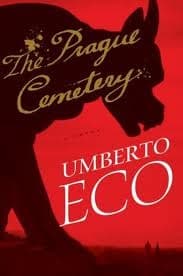
Synopsis
Covers the whole plot, including the ending.
- Difficulty
- Hard
- Pacing
- Moderate
- Mood
- Dark, Cynical, Intellectually Provocative, Historical
- Read it if
- You enjoy complex historical mysteries, unreliable narrators, and a deep dive into the origins of 19th-century European conspiracy theories, particularly those surrounding 'The Protocols of the Elders of Zion.'
- Skip it if
- You prefer straightforward narratives, sympathetic protagonists, or are uncomfortable with graphic descriptions of violence, anti-Semitism, and misogyny.
The Prague Cemetery Plot Summary
Covers the whole plot, including the ending.
The Amnesiac and the Journal
The novel begins in Paris, 1897, with Captain Simone Simonini, an elderly forger, waking up with severe amnesia. He finds a journal on his desk, written in two different hands, one of which he recognizes as his own. This journal becomes his main way to reconstruct his fragmented memories, though he suspects it might be a fabrication meant to mislead him. He starts to read, discovering entries that hint at a life filled with espionage, forgery, and manipulation, but the identity of the other hand, a supposed Abbé Dalla Piccola, remains a mystery. Simonini's first entries show frustration and growing paranoia, as he tries to make sense of the disturbing events described in the journal with his current, blank state, questioning the truth of every word, including his own.
Turin and the Jesuit Plot
The journal details Simonini's youth in Turin, Italy. He recalls his grandfather, a strong anti-Jesuit, who taught him to hate the Society of Jesus and fascinated him with conspiracies. Simonini, a talented forger from a young age, creates his first important forgery: a letter accusing Jesuits of a plot against the state. His grandfather then uses this letter to expose their supposed schemes. This early success establishes his talent and his willingness to use it for manipulation. He describes his disgust for Jews and his developing cynicism about human nature, influenced by his grandfather's prejudices and the political environment of Risorgimento Italy.
The Sicilian Conspiracy and Garibaldi
Simonini's career as an agent and forger begins. Various secret services, including those of Piedmont and France, recruit him to infiltrate revolutionary groups in Sicily. His mission is to cause conflict and create false evidence that discredits Giuseppe Garibaldi and the unification movement. He describes creating false proclamations and letters, using existing political rivalries and prejudices. He sees firsthand the brutal tactics of both revolutionaries and their opponents, which further solidifies his detached and cynical view of the world. His forgeries add to the complex misinformation surrounding the turbulent period of Italian unification.
Paris, the Commune, and Masonic Intrigue
Simonini moves to Paris, a city in political turmoil. He witnesses the Paris Commune and its bloody suppression. Here, he becomes deeply involved with various secret societies and intelligence agencies, often working for multiple sides at once. He details his work forging documents that accuse Freemasons of anti-clerical plots and revolutionary activities, fueling the paranoia of the Catholic Church and conservative groups. His forgeries are so convincing that powerful figures accept them as genuine, showing his significant influence on the political scene, even if his motives are purely mercenary and self-serving.
The Dreyfus Affair and Anti-Semitism
The journal entries show Simonini's important, though often hidden, role in the Dreyfus Affair. He describes creating and spreading forged documents that support the false accusations against Alfred Dreyfus, an innocent Jewish officer, further increasing anti-Semitism in France. His work for various intelligence agencies, often playing them against each other, highlights the deep-seated prejudices and political schemes of the era. Simonini's personal anti-Semitism, inherited from his grandfather and reinforced by his experiences, finds fertile ground in this scandal, allowing him to justify his malicious forgeries and manipulations.
The Devil's Chapel and Black Masses
Mixed with his political forgeries, Simonini's journal details his frequent visits to a run-down chapel in Paris, where he participates in Black Masses. These gatherings, often attended by disillusioned aristocrats, artists, and criminals, involve sacrilegious rituals, sexual orgies, and symbolic acts of rebellion against established religion and morality. Simonini, while not necessarily believing in the demonic, finds a perverse satisfaction in these events. He sees them as a reflection of humanity's inherent corruption and hypocrisy. He observes the participants with a detached, cynical eye, gathering information and occasionally using what he learns for his own purposes.
The Emergence of Dalla Piccola
As Simonini continues to read and write in the journal, the presence of the second hand, that of Abbé Dalla Piccola, becomes more noticeable and unsettling. It gradually becomes clear that Dalla Piccola is not a separate person, but rather Simonini's own fragmented personality, a manifestation of his subconscious. Dalla Piccola represents Simonini's repressed conscience, his hidden desires, and his suppressed memories, particularly those related to his more terrible actions. The two 'voices' engage in a macabre dialogue within the journal, each trying to assert dominance and control the narrative of their shared past, blurring the lines between reality and delusion.
The Protocols of the Elders of Zion
The most chilling revelation in the journal concerns the origin of *The Protocols of the Elders of Zion*. Simonini, or rather Dalla Piccola, describes how he compiled and fabricated this infamous anti-Semitic text. Drawing on existing anti-Jewish stereotypes, Masonic rituals, and revolutionary manifestos, he carefully crafts a document designed to prove a global Jewish conspiracy for world domination. He recounts the cynical pleasure he gets from this act of creation, knowing the immense power such a forgery could have. This act, more than any other, confirms his role as a master manipulator and a spreader of hatred.
The Final Forgery and Delusion
As the journal continues, the difference between Simonini and Dalla Piccola disappears entirely. Simonini's amnesia and Dalla Piccola's fragmented memories merge into a single, delusional narrative. The forger becomes the forged, trapped within the maze of his own creations. He recounts further acts of espionage, bombings, and manipulations, often unsure whether he is the perpetrator or simply an observer. The journal shows his complete psychological breakdown, a descent into madness where his identity is consumed by the very conspiracies he helped to create, leaving him isolated and utterly lost in his own fabricated reality.
The End of the Story (and the Beginning)
The journal entries eventually return to the present day in 1897 Paris, with Simonini's initial state of amnesia. The reader is left to wonder if the entire narrative has been an elaborate fabrication by the unreliable narrator, or a genuine attempt to piece together a horrifying past. The final entries show Simonini still struggling with his fragmented identity, haunted by the atrocities he has committed or witnessed. The novel ends without a clear resolution, emphasizing the cyclical nature of conspiracy, hatred, and self-deception, leaving Simonini's ultimate fate and the true extent of his sanity unclear, a prisoner of his own monstrous creations.
The Prague Cemetery Characters
Captain Simone Simonini (and Abbé Dalla Piccola)
Protagonist/Antagonist (depending on perspective)
A cynical, amnesiac forger and spy, responsible for creating the Protocols of the Elders of Zion.
Simone Simonini is an elderly, amnesiac forger living in late 19th-century Paris. He is a master of disguise and manipulation, hired by various European secret services to create false documents and sow discord. Inheriting a deep-seated anti-clericalism and anti-Semitism from his grandfather, he is driven by a profound cynicism and a detached contempt for humanity. He finds pleasure in creating chaos and exploiting the prejudices of others. His fragmented memory and the presence of his alter ego, Abbé Dalla Piccola, reveal a deeply disturbed psyche, blurring the lines of his identity and sanity. He is a meticulous observer of human folly and a master of deception, both of others and ultimately, of himself.
Relationships: Grandfather Simonini (Influential figure, instilled anti-Jesuit and anti-Semitic prejudices.); Various European Secret Services (Employers and manipulators, whom he also manipulates.); Abbé Dalla Piccola (His alter ego, representing his repressed conscience and darker memories.)
Abbé Dalla Piccola
Aspect of Protagonist/Antagonist
Simonini's alter ego, representing his repressed memories and moral corruption.
Abbé Dalla Piccola is initially presented as a separate character, the other hand writing in Simonini's journal. However, he is gradually revealed to be Simonini's alter ego, a manifestation of his suppressed memories, moral corruption, and perhaps a nascent conscience. Dalla Piccola is more overtly religious, though in a twisted, sacrilegious way, participating in Black Masses. He often recalls events with a different emphasis or adds details that Simonini's conscious mind tries to deny or forget. He is the voice that remembers the most heinous acts, particularly the creation of *The Protocols of the Elders of Zion*, and ultimately merges with Simonini, completing his psychological disintegration.
Relationships: Captain Simone Simonini (His other self, a fragmented aspect of the same individual.)
Grandfather Simonini
Supporting/Influential
A fervent anti-Jesuit and anti-Semite who shaped young Simonini's worldview.
Simonini's grandfather is a pivotal figure in his early life, a fanatical anti-Jesuit who instills in his grandson a deep-seated prejudice against the Society of Jesus and, by extension, other perceived enemies like Jews. He is depicted as a bitter, cynical man who teaches Simonini the art of forgery and manipulation for political ends. His influence is profound, shaping Simonini's worldview and providing the initial impetus for his career in espionage and document fabrication. He represents the origin of Simonini's cynicism and his willingness to exploit societal fears and hatreds.
Relationships: Captain Simone Simonini (Grandfather and primary influencer, mentor in forgery and prejudice.)
Various Secret Service Handlers
Supporting
A rotating cast of anonymous agents who hire Simonini for his forgery and espionage skills.
Throughout the novel, Simonini interacts with a series of unnamed or thinly characterized secret service handlers from various European powers (Piedmontese, French, Prussian, etc.). These figures represent the shadowy, Machiavellian political landscape of 19th-century Europe. They are often cynical, amoral, and willing to use any means necessary to achieve their nation's goals, making them perfect clients for Simonini's talents. They provide him with his assignments, funding, and protection, but also represent the very systems of power and manipulation that he both serves and despises. They are interchangeable, highlighting the impersonal nature of espionage.
Relationships: Captain Simone Simonini (Employers and sources of assignments.)
Alfred Dreyfus
Mentioned/Victim
An innocent Jewish officer unjustly accused of treason, a victim of Simonini's forgeries.
Alfred Dreyfus is a central, though largely unseen, figure in the narrative, serving as a catalyst for Simonini's most impactful anti-Semitic forgeries. A French artillery officer of Jewish descent, Dreyfus is falsely accused of treason, becoming the focal point of a massive political and social scandal in France. Simonini describes his role in creating and disseminating documents that incriminate Dreyfus, fueling the anti-Semitic fervor of the time. Dreyfus represents the innocent victim of systematic prejudice and the insidious power of forged evidence, highlighting the real-world consequences of Simonini's actions.
Relationships: Captain Simone Simonini (Target and victim of Simonini's forgeries.)
Giuseppe Garibaldi
Mentioned/Target
Italian revolutionary leader, a target of Simonini's early forgeries.
Giuseppe Garibaldi is a prominent historical figure mentioned in Simonini's early journal entries. As a key leader in the unification of Italy, he is depicted as a charismatic but controversial figure. Simonini is tasked by various anti-unification forces to forge documents and disseminate propaganda aimed at discrediting Garibaldi and his republican movement. Garibaldi represents the revolutionary spirit that Simonini is paid to undermine, and his presence in the narrative highlights the political turmoil and ideological conflicts of 19th-century Italy that formed the backdrop for Simonini's formative experiences as a forger.
Relationships: Captain Simone Simonini (Target of Simonini's early forgeries and political machinations.)
The Prostitute (various names)
Supporting
A recurring figure in Simonini's life, often involved in Black Masses.
This character appears in various guises throughout Simonini's recollections, often as a prostitute or a participant in the Black Masses he frequents. She represents the underbelly of Parisian society and Simonini's own detached, transactional relationships. She is sometimes a source of information, other times a mere object of his cynical observations. Her presence underscores Simonini's moral decay and his immersion in a world of depravity. She is one of the few recurring human connections, however superficial, in his otherwise solitary and manipulative existence, often serving as a sounding board or a silent witness to his internal struggles.
Relationships: Captain Simone Simonini (Client, occasional confidante, and observer.)
The Narrator (Implied)
Framing Device
The unseen force compiling and presenting Simonini's fragmented journal.
While not a character within the story's events, the implied narrator is the entity responsible for presenting Simonini's fragmented journal to the reader. This narrator is crucial to the novel's structure and themes, as they decide which entries to include, how to present the alternating hands of Simonini and Dalla Piccola, and ultimately, how to frame the unreliable nature of the entire account. The narrator challenges the reader to question the veracity of the text, emphasizing the book's metafictional qualities and its exploration of historical truth vs. fabricated narrative.
The Prague Cemetery Themes
The Construction of History and Truth
The novel carefully shows that history is not a fixed record but a story that is built, often manipulated by powerful people and groups. Simonini, as a master forger, actively creates documents that influence major historical events, from the unification of Italy to the Dreyfus Affair. The novel's structure, with its unreliable narrator and the blending of Simonini's and Dalla Piccola's accounts, makes the reader question the truth of every 'fact' presented. Eco demonstrates that 'truth' can be a manufactured product, easily shaped by prejudice and political goals. The creation of *The Protocols of the Elders of Zion*, a purely fictional document that greatly impacted real history, is the peak of this theme. It shows the destructive power of fabricated truth.
“What is truth? For me, it is merely the most convenient arrangement of facts, real or imagined.”
Anti-Semitism and Conspiracy Theories
Anti-Semitism is a constant and core theme, inherited by Simonini from his grandfather and used throughout his career. The novel shows how anti-Semitic ideas are woven into 19th-century European society, providing fertile ground for conspiracy theories. Simonini actively contributes to this by forging documents that accuse Jews of various plots, ending with the creation of *The Protocols of the Elders of Zion*. Eco exposes the sneaky nature of these theories, showing how they provide easy scapegoats for societal worries and political failures, and how they can be deliberately made to control public opinion and justify persecution. The novel examines the historical origins and spread of one of history's most dangerous conspiracy theories.
“If there is no conspiracy, one must invent it, for men need to believe in something that explains their misfortunes.”
The Fragmentation of Identity and Madness
Simonini's amnesia and the emergence of Abbé Dalla Piccola as his alter ego are central to this theme. The novel explores how a life of deception, moral compromise, and immersion in fabricated realities can lead to a complete breakdown of the self. Simonini's inability to tell the difference between his own memories and the 'facts' he has forged, or between his own voice and Dalla Piccola's, signifies a deep psychological disintegration. His identity becomes a collection of lies and stolen personas, reflecting the fragmented and unreliable nature of the narrative itself. This fragmentation suggests that living a life built on deceit eventually destroys the deceiver, leaving behind an empty, mad shell.
“I am a void, filled with the echoes of others' lies and my own inventions.”
The Nature of Evil and Cynicism
Simonini embodies a specific kind of detached, intellectual evil, driven not by passion but by deep cynicism and hatred of humanity. He views humanity with contempt, seeing people as easily manipulated puppets susceptible to their own prejudices and fears. His actions are often motivated by a desire to prove his own intellectual superiority and to expose the world's hypocrisy. He finds a perverse satisfaction in creating chaos and watching the powerful fall. The Black Masses he attends are not acts of genuine satanism but rather expressions of a nihilistic worldview, where all moral and religious frameworks are seen as mere shams. His evil is systematic, methodical, and rooted in a deep belief in the inherent corruption of human nature.
“Men are not good; they are merely afraid of being caught.”
Metafiction and Unreliable Narration
The entire novel is a metafictional exercise, constantly reminding the reader that they are interacting with a constructed text. The journal format, the two competing narrators (Simonini and Dalla Piccola), and Simonini's explicit statements about forging documents within the narrative all serve to make the idea of a fixed, objective truth unstable. Eco challenges the reader to actively participate in figuring out what is 'real' within the story, blurring the lines between historical fact and fictional fabrication. This theme is important for understanding the book's commentary on how narratives, both historical and literary, are shaped and consumed, and how easily they can be manipulated.
“And if this journal, too, is a forgery? How would you know?”
Plot Devices & Literary Techniques
The Fragmented Journal
A journal written by two hands, one of which is the protagonist's alter ego, used to reconstruct a fragmented past.
The novel's primary plot device is the journal kept by Captain Simone Simonini, which he discovers upon waking with amnesia. The journal is written in two distinct hands, one identified as Simonini's and the other as Abbé Dalla Piccola's. This device allows for an unreliable, multi-layered narration, reflecting Simonini's fragmented memory and the blurring of his identity. It serves as both a source of information and a further layer of deception, as Simonini himself questions its authenticity. The journal's structure mirrors the chaotic and manipulated history it recounts, forcing the reader to constantly question the 'truth' of the narrative.
Amnesia
The protagonist's memory loss, which serves as the catalyst for his journey of self-discovery through his journal.
Simonini's amnesia at the beginning of the novel is a crucial plot device. It provides the initial mystery and impetus for him to delve into the journal, and by extension, for the reader to follow his journey. The amnesia is not merely a narrative hook; it becomes a metaphor for the historical amnesia of society regarding its own manipulated past. It also allows for the gradual revelation of Simonini's horrifying deeds and the emergence of his alter ego, Dalla Piccola, as his memory slowly 'returns' or is 'fabricated' through the act of reading and writing in the journal. It underscores the theme of fragmented identity.
The Unreliable Narrator
The protagonist, Simonini, whose sanity and honesty are constantly in question, making his account untrustworthy.
Simonini is the quintessential unreliable narrator. His profession as a forger, his confessed cynicism, his amnesia, and his eventual descent into what appears to be madness, all contribute to his inherent untrustworthiness. The presence of Dalla Piccola further complicates the narrative, as the reader cannot be sure whose 'voice' they are hearing or if either account is entirely true. This device challenges the reader to become an active participant in interpreting the story, constantly sifting through layers of potential deceit and self-deception. It emphasizes the novel's core theme about the constructed nature of truth and history.
Historical Intertextuality
The weaving of real historical events and figures into a fictional narrative to comment on historical manipulation.
Eco extensively uses historical intertextuality, embedding Simonini's fictional life within a meticulously researched backdrop of real 19th-century European events and figures. From the Risorgimento and Garibaldi to the Paris Commune and the Dreyfus Affair, the novel grounds its fictional conspiracies in actual historical turmoil. This device serves to highlight how easily real events can be manipulated and how fictional forgeries, like *The Protocols of the Elders of Zion*, can have profound real-world consequences. It blurs the lines between fact and fiction, making a powerful statement about the subjective and often fabricated nature of historical 'truth'.
The Prague Cemetery Quotes
“The only thing that really interests me is the truth, and since I know that I cannot find it, I content myself with inventing it.”
“To invent the enemy is to invent the nation. And if you invent the nation, you invent your own identity.”
“A document is a lie that has become credible.”
“The world is not governed by reason but by the imagination.”
“Conspiracies are comforting. They allow us to explain the inexplicable.”
“The greatest secret is that there is no secret.”
“Everything is a text, and every text can be interpreted in multiple ways.”
“Evil is not a force, it is a choice. And sometimes, a very convenient choice.”
“History is a vast cemetery where the past lies buried, but not always dead.”
“To be truly free, one must first understand the chains that bind them.”
“The best way to hide something is to put it in plain sight.”
“The stronger the prejudice, the less reason is needed to support it.”
“Memory is not a record, but a reconstruction.”
“The world is full of signs, but only a few know how to read them.”
Quiz
10 questions on the plot and the characters. Each answer comes with a short explanation.
Question 1
Which historical document, central to anti-Semitic conspiracy theories, is depicted as being forged by the protagonist in 'The Prague Cemetery'?
- The Communist Manifesto
- The Protocols of the Elders of Zion
- The Declaration of the Rights of Man and of the Citizen
- The Treaty of Versailles
Show answer
B. The Protocols of the Elders of Zion The novel explicitly details how Simone Simonini, the protagonist, is involved in the creation and dissemination of 'The Protocols of the Elders of Zion', a notorious anti-Semitic forgery.
Question 2
What is the primary profession of the protagonist, Simone Simonini, throughout much of the novel?
- Journalist
- Lawyer
- Forger and spy
- University professor
Show answer
C. Forger and spy Simonini is primarily a forger, creating documents and identities for various secret services, and often acts as a spy or informant.
Question 3
The narrative structure of 'The Prague Cemetery' primarily revolves around which literary device?
- A series of interconnected short stories
- Multiple third-person perspectives
- A fragmented diary and an unreliable narrator
- Linear historical recounting
Show answer
C. A fragmented diary and an unreliable narrator The novel is presented as a fragmented diary, with the protagonist, Simone Simonini, suffering from amnesia and conversing with an alter ego, making him an unreliable narrator.
Question 4
Which major historical event, involving a Jewish French artillery captain accused of treason, features prominently in the latter part of the novel?
- The Franco-Prussian War
- The Paris Commune
- The Dreyfus Affair
- The Unification of Italy
Show answer
C. The Dreyfus Affair The Dreyfus Affair, a highly publicized political scandal and miscarriage of justice in France, is a key historical backdrop against which Simonini's machinations play out, particularly his involvement in anti-Semitic propaganda.
Question 5
What recurring theme regarding the nature of history and truth is deeply explored through Simonini's actions?
- The triumph of good over evil
- The objective and unchangeable nature of facts
- The constructed and manipulated nature of reality and conspiracy
- The inevitable progress of human society
Show answer
C. The constructed and manipulated nature of reality and conspiracy Simonini's entire career is built on forging documents and creating false narratives, directly illustrating Eco's theme that history and truth can be manipulated and constructed, especially in the context of conspiracies.
Question 6
Which city is NOT one of the primary settings where Simonini's activities take place?
- Turin
- Prague
- London
- Paris
Show answer
C. London The novel primarily takes place in Turin, Prague, and Paris, with Simonini moving between these cities to carry out his various schemes. London is not a central location.
Question 7
What is the name of the mysterious woman who appears in Simonini's life, often acting as a foil or a source of information, and whose identity is often ambiguous?
- Ippolita
- Dina
- Liana
- Beatrice
Show answer
C. Liana Liana is the recurring female character who takes on various guises and roles, often seducing or manipulating Simonini, and whose true allegiance is constantly in question.
Question 8
The novel heavily features secret societies and political factions vying for power and influence. Which two groups are frequently depicted as antagonists or conspirators against each other?
- Communists and Anarchists
- Jesuits and Freemasons
- Royalists and Republicans (in Italy)
- The Carbonari and the Mafia
Show answer
B. Jesuits and Freemasons The novel frequently pits the Jesuits and Freemasons against each other in various conspiracy theories and plots, reflecting real historical tensions and popular conspiracy narratives of the 19th century.
Question 9
How does the novel portray the relationship between anti-Semitism and the political climate of 19th-century Europe?
- As an isolated phenomenon with little political impact
- As a marginal belief held only by extremist fringes
- As a pervasive and politically convenient tool for scapegoating and control
- As a declining prejudice being overcome by enlightenment values
Show answer
C. As a pervasive and politically convenient tool for scapegoating and control The novel explicitly shows how anti-Semitism was deeply embedded in European society and frequently exploited by various political actors and secret services to deflect blame, consolidate power, and fuel conspiracy theories, culminating in the forgery of 'The Protocols'.
Question 10
What literary tradition is Umberto Eco drawing upon by featuring a protagonist who is a master forger and manipulator of historical narratives, often operating in the shadows of major events?
- Pastoral romance
- Gothic horror with a focus on the supernatural
- The picaresque novel and the unreliable narrator
- Social realism depicting working-class struggles
Show answer
C. The picaresque novel and the unreliable narrator Simonini's character, a rogue and trickster who navigates society through deception and often survives by his wits, aligns well with the tradition of the picaresque novel. Combined with his fragmented memory and alter ego, he is also a classic unreliable narrator.
The Prague Cemetery FAQ
What is the central premise of 'The Prague Cemetery'?
'The Prague Cemetery' follows the fragmented memories of Simone Simonini, a cynical and amoral forger, spy, and provocateur, as he navigates the tumultuous 19th-century Europe. The novel explores the idea that many historical conspiracies, both real and fabricated, could be traced back to the manipulations and forgeries of a single, malevolent individual, culminating in the creation of 'The Protocols of the Elders of Zion'.
Who is Simone Simonini and what is his primary role in the narrative?
Simone Simonini is the main character, a multi-faceted identity (including Captain Simonini, Abbé Dalla Piccola, and others) who suffers from amnesia and records his memories in a diary. He is a master forger, an agent provocateur, and an anti-Semite who actively participates in and instigates numerous historical conspiracies, driven by his deep-seated misanthropy and prejudices.
How does Umberto Eco use the concept of multiple narrators or identities in the book?
Eco employs a complex narrative structure where Simonini, due to his amnesia, believes he is two or three different people—Captain Simonini, the Abbé Dalla Piccola, and sometimes a third, more sinister figure. This allows Eco to present conflicting accounts, highlight the unreliability of memory, and emphasize the constructed nature of identity and historical truth, all while maintaining Simonini as the underlying consciousness.
What historical events and conspiracies are prominently featured in the novel?
The novel intricately weaves through major 19th-century events such as the unification of Italy, the Paris Commune, the Dreyfus Affair, and the rise of various secret societies like the Carbonari, Jesuits, and Freemasons. The climax of these conspiracies is Simonini's role in fabricating 'The Protocols of the Elders of Zion', a notorious anti-Semitic text.
What is the significance of the title, 'The Prague Cemetery'?
The title refers to the Old Jewish Cemetery in Prague, a location that Simonini visits and where he experiences a profound sense of foreboding and confirmation of his anti-Semitic delusions. It symbolizes the historical roots of anti-Semitism and serves as a literal and metaphorical 'cemetery' for truths, where fabricated conspiracies are buried and later unearthed to cause real-world harm.
How does the character of Ippolito Nievo connect to Simonini's past?
Ippolito Nievo is a real historical figure, an Italian patriot and writer, whose death by shipwreck is implicated in Simonini's fragmented memories. Simonini, in one of his identities, confesses to tampering with Nievo's ship, suggesting his involvement in a political assassination meant to conceal financial malfeasance related to the unification of Italy.
What role do the Jesuits and Freemasons play in the conspiracies Simonini encounters?
Both the Jesuits and Freemasons are depicted as powerful, secretive organizations that Simonini infiltrates, manipulates, and uses as scapegoats. He forges documents to incriminate them, plays them against each other, and attributes various societal ills to their supposed machinations, reflecting the widespread paranoia about secret societies in the 19th century.
What is the true nature of the 'Protocols of the Elders of Zion' within the novel's narrative?
Within the novel, 'The Protocols of the Elders of Zion' is explicitly revealed as a masterful forgery created by Simonini, piecing together fragments from various anti-Semitic pamphlets, French satirical works (like Maurice Joly's 'Dialogue in Hell Between Machiavelli and Montesquieu'), and his own hateful imaginings. It is presented as the ultimate manifestation of his malevolent genius and a fabrication that takes on a life of its own.
How does Simonini's amnesia contribute to the book's themes?
Simonini's amnesia is crucial; it allows Eco to explore the construction of identity and memory, and how historical narratives can be shaped and reshaped. It also creates a meta-narrative about the unreliability of historical sources, as Simonini himself is a unreliable narrator attempting to piece together 'facts' he himself forged or instigated.
Discuss Simonini's psychological motivations for his extensive forgeries and manipulations.
Simonini is driven by profound misanthropy, a deep-seated anti-Semitism, and a general contempt for humanity. He finds pleasure in deception and control, seeing himself as a puppeteer of history. His actions stem from a desire to validate his prejudices and to assert his intellectual superiority over a world he despises, rather than any specific political ideology beyond his own hatred.
How does Eco portray the psychological impact of conspiracy theories on society through Simonini's actions?
Eco illustrates how easily societies can be swayed by fabricated narratives, especially when they confirm existing prejudices or offer simple explanations for complex problems. Simonini's forgeries demonstrate how a single, well-placed lie can metastasize into widespread paranoia, leading to real-world persecution and violence, such as in the Dreyfus Affair.
What is the significance of food and digestion metaphors in Simonini's narrative?
Simonini's obsession with food, particularly rich and often disgusting dishes, serves as a metaphor for his moral corruption and his 'digestion' of history. He consumes and regurgitates information, fabricating and re-fabricating narratives. His gluttony reflects his insatiable appetite for malice and his disgust for others, linking physical decay with moral decay.
To what extent is 'The Prague Cemetery' a critique of historical revisionism or the manufacturing of history?
The novel is a profound critique, demonstrating how history is not a fixed truth but a narrative often constructed and manipulated by individuals with specific agendas. Through Simonini, Eco exposes the mechanics of how 'facts' can be invented, propagated, and eventually accepted as truth, highlighting the dangers of accepting narratives without critical examination.
How does Eco challenge the reader to distinguish between fact and fiction in the novel?
Eco deliberately blurs the lines by embedding Simonini, a fictional character, within a rich tapestry of actual historical figures, events, and documents. He includes real quotes and forged documents side-by-side, forcing the reader to constantly question the veracity of what they are reading and to recognize the constructed nature of historical accounts.
What message about anti-Semitism does Eco convey through Simonini's character and the 'Protocols'?
Eco powerfully illustrates that anti-Semitism, as embodied by Simonini and the 'Protocols', is not based on any rational truth but on irrational hatred, prejudice, and a desperate need for a scapegoat. By showing the 'Protocols' as a deliberate forgery by a deeply flawed and hateful individual, Eco strips away its false authority and exposes its malicious origins.
How does the novel reflect Umberto Eco's broader interests in semiotics and the power of signs?
The novel is a masterclass in semiotics, exploring how signs (words, documents, symbols) can be manipulated to create meaning, even false meaning, and how these forged signs can have real-world consequences. Simonini is a 'sign-maker' who understands the power of language and symbols to shape perception and instigate action, demonstrating Eco's lifelong fascination with how meaning is constructed and deconstructed.
Is Simonini a sympathetic character at any point, and how does Eco ensure the reader's distance from him?
Simonini is deliberately crafted as an unsympathetic character. His misogyny, anti-Semitism, and general misanthropy are consistently highlighted, making it difficult for the reader to empathize with him. Eco ensures distance by portraying Simonini's internal world as utterly repugnant and by revealing the devastating real-world impact of his forgeries, preventing any romanticization of his 'evil genius'.
What is the significance of the various secret societies (Carbonari, Jesuits, Freemasons) in the context of the novel's themes?
These secret societies represent the historical fascination and paranoia surrounding hidden power structures. Eco uses them to demonstrate how fear of the unknown and the desire for simple explanations can fuel conspiracy theories. Simonini exploits these fears, fabricating connections and plots that feed into existing societal anxieties about shadowy groups controlling world events.
About the author
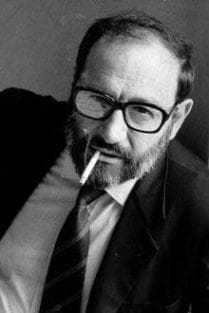
Umberto Eco was an Italian medievalist, philosopher, semiotician, novelist, cultural critic, and political and social commentator. In English, he is best known for his popular 1980 novel The Name of the Rose, a historical mystery combining semiotics in fiction with biblical analysis, medieval studies and literary theory, as well as Foucault's Pendulum, his 1988 novel which touches on similar themes.
Similar books
- Foucault's Pendulum
Umberto Eco
3.9 (60k) average on GoodreadsThrillerExplores the allure and danger of conspiracy theories with a similar intellectual depth and historical scope.
- The Name of the Rose
Umberto Eco
4.1 (301k) average on GoodreadsHistorical FictionCombines historical setting, mystery, and philosophical inquiry, though 'The Prague Cemetery' is darker.
- Wolf Hall
Hilary Mantel
3.9 (166k) average on GoodreadsLiterary FictionWhile both are historical fiction, Mantel's Wolf Hall focuses intensely on character psychology and empathetic portrayal (e.g., Thomas Cromwell), drawing readers into the inner life of its protagonist. Eco's The Prague Cemetery, by contrast, uses its protagonist, Simonini, more as a lens through which to explore intellectual and historical currents, with less emphasis on psychological depth or readerly empathy.
- To Kill a Mockingbird
Harper Lee
4.3 (4.5M) average on GoodreadsHistorical FictionIn the 1930s Jim Crow South, Harper Lee writes about racial injustice, moral growth, and the quiet courage of a lawyer father, Atticus Finch, as seen through his young daughter's eyes.
- The Great Gatsby
F. Scott Fitzgerald
3.9 (3.8M) average on GoodreadsHistorical FictionIn the opulent Roaring Twenties, a mysterious millionaire's lavish parties hide his desperate, tragic pursuit of a lost love, exposing the emptiness within the American Dream.
- Pride and Prejudice
Jane Austen
4.3 (3M) average on GoodreadsHistorical FictionIn a society focused on status and money, Elizabeth Bennet navigates love and pride, challenging Mr. Darcy and social expectations to find true affection.





Enjoyed the summary?
A summary gives you the shape of the book. The book itself has the detail, the examples and the voice.
Find The Prague Cemetery on AmazonAs an Amazon Associate, BookBrief earns from qualifying purchases. How we're funded