
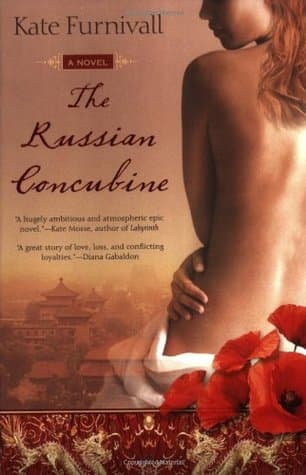
Synopsis
Covers the whole plot, including the ending.
- Difficulty
- Medium
- Pacing
- Moderate
- Mood
- Atmospheric, Romantic, Dangerous, Resilient
- Read it if
- You enjoy sweeping historical romances with high stakes, forbidden love, and a vivid, dangerous setting in 1920s China.
- Skip it if
- You prefer fast-paced thrillers or stories without a strong romantic core, or find historical fiction set during periods of intense political upheaval too heavy.
The Russian Concubine Plot Summary
Covers the whole plot, including the ending.
A Life of Scavenging in Junchow
In Junchow, 16-year-old Lydia Ivanova lives a difficult life with her mother, Valentina. After fleeing Russia's Bolshevik revolution, which killed her father and ended their aristocratic status, Lydia steals food to survive. Valentina, once a refined lady, is now ill, making Lydia their only provider. Their small home in the foreign quarter offers little comfort. Lydia constantly fights hunger, poverty, and the threat of discovery by Chinese authorities or city criminals. Despite the hardship, Lydia is determined to protect her mother.
A Secret Love Amidst Political Turmoil
Lydia often leaves her struggles to meet her secret lover, Chang An Lo. Chang is a charming and idealistic young Chinese Communist freedom fighter, aiming to overthrow Chiang Kai-shek's government. Their love is passionate and all-consuming, offering a break from their harsh lives but also a dangerous vulnerability. They meet in secret, often in secluded parts of Junchow, as their relationship defies the social and political rules of the time. Lydia, a Russian exile, and Chang, a Chinese revolutionary, are an unlikely pair, and their relationship is risky, especially with Chiang Kai-shek's forces closing in on Junchow to eliminate Communists.
The Tsarina's Jewels and Growing Danger
Political tension in Junchow grows as Chiang Kai-shek's Nationalist troops advance. Chang An Lo, involved in the Communist resistance, acquires a collection of priceless jewels belonging to a Russian Tsarina. These jewels are meant as a strategic gift for Chiang Kai-shek's wife, a move to create discord or gain influence within the Nationalist ranks. This possession puts Chang in even greater danger, as Nationalists and other groups would kill for them. Lydia realizes the danger Chang is in, and by extension, the danger she faces by being with him, further complicating their forbidden love.
The Fall of Junchow and a Desperate Escape
Chiang Kai-shek's forces attack Junchow. The city becomes chaotic, with street fighting, executions, and widespread panic. Lydia and Chang, caught in the middle, must flee. They try to escape together but are separated in the confusion and violence. Lydia sees the brutality of the Nationalist soldiers, fearing for Chang's life and her own. She makes desperate choices to survive, navigating the burning streets and terrified people. Junchow's fall marks a turning point, destroying their fragile world and leaving Lydia alone and vulnerable.
Lydia's Journey to Shanghai
After Junchow's destruction, Lydia is alone. With her mother likely dead and Chang's fate unknown, she decides to go to Shanghai, a city rumored to offer opportunities and international protection. The journey is hard and dangerous, exposing Lydia to more hardship, hunger, and exploitation. She relies on her intelligence and resilience, facing betrayal and kindness from strangers. This journey tests her, forcing her to grow up quickly and adapt to a war-torn country, all while hoping for a safer future and a reunion with Chang.
Life in Shanghai's Underbelly
In Shanghai, Lydia finds the city is not the safe place she imagined. She struggles to find work and, facing starvation, is forced into a brothel in the international concession. She becomes a 'Russian concubine,' where her body is her only means of survival. Despite the degradation, Lydia keeps her inner strength and dignity, using her intelligence and observation to navigate the brothel's social dynamics and clients. She learns to understand people, to charm, and to protect herself, always hoping for escape and a better life.
A Glimmer of Hope and Familiar Faces
While at the brothel, Lydia meets various people, some of whom offer insights into the political situation and her past. She learns more about the Tsarina's jewels, realizing their value and the dangerous plot surrounding them. Her interactions help her piece together information, suggesting Chang might still be alive and that the jewels are still important to powerful and ruthless individuals. These encounters rekindle her hope but also pull her deeper into Shanghai's dangerous world of political spying and organized crime.
Reunion and Renewed Danger
Against all odds, Lydia reunites with Chang An Lo in Shanghai. Their reunion is joyful but also overshadowed by ongoing dangers. Chang is still involved in the Communist underground, and his presence in Shanghai means he is constantly hunted. The Tsarina's jewels remain a central issue, attracting powerful figures, including Chiang Kai-shek's agents and criminal groups. Their love, once secret, now becomes a target, as those in power seek to use or eliminate them for political and financial gain.
The Search for the Jewels
Realizing the power and danger of the Tsarina's jewels, Lydia and Chang decide they must secure them, either for the Communist cause or to keep them from falling into the wrong hands. This decision leads them into a high-stakes hunt through Shanghai's underworld. They navigate dangerous alliances, double-crosses, and violent clashes. Lydia's resourcefulness and Chang's revolutionary passion are tested as they race against time and powerful enemies who will stop at nothing to get the jewels, including Chiang Kai-shek's agents and ruthless crime bosses.
Betrayal and Sacrifice
As they get closer to the jewels, Lydia and Chang face betrayals from unexpected sources. Friends become enemies, and loyalties are tested. These betrayals force them to make difficult choices and sacrifices, risking their lives and their love. Lydia's understanding of human nature grows as she sees both cruelty and unexpected courage. The pursuit of the jewels becomes less about wealth and more about survival, justice, and protecting their uncertain future together. The sacrifices they make show the high cost of their love and their involvement in the political struggle.
Confrontation and Resolution
The story ends with a dramatic confrontation with their main enemies. This showdown involves not only the physical fight for the Tsarina's jewels but also a clash of beliefs and personal revenge. Lydia, now a resilient woman, plays a key role, using her intelligence and courage. Chang's dedication to his cause is strong. The resolution is hard-won, with significant losses, but it brings some closure to the immediate threats. The fate of the jewels is decided, and Lydia and Chang's immediate future is shaped by this final conflict.
A Future Uncertain Yet Together
With the immediate dangers gone, Lydia and Chang are changed by their experiences. Their love has survived war, poverty, and betrayal. Their future is still uncertain, as China's political situation remains unstable, and their past actions have left a lasting mark. However, they face this future together, their bond strengthened by shared suffering and devotion. The story ends with a cautious hope for their continued survival and the lasting power of their love in a turbulent world.
The Russian Concubine Characters
Lydia Ivanova
Protagonist
A spirited young Russian exile, forced to steal and survive in war-torn China.
Lydia is a 16-year-old Russian émigré, whose family lost everything in the Bolshevik revolution. Resourceful, intelligent, and fiercely independent, she possesses a strong will to survive. Initially a naive girl in love, circumstances force her to become hardened and pragmatic, learning to navigate the dangerous underworlds of Junchow and Shanghai. Despite the harshness of her life, she retains a core of compassion and an unyielding loyalty, especially to her mother and Chang. She is driven by love, the need for security, and a longing for a life of dignity.
Relationships: Valentina Ivanova (Daughter-mother; Lydia is fiercely protective and responsible for her ailing mother.); Chang An Lo (Star-crossed lovers; their relationship is the central romantic core of the story, enduring immense political and personal obstacles.)
Chang An Lo
Protagonist/Love Interest
A charismatic and idealistic Chinese Communist freedom fighter.
Chang An Lo is a passionate and intelligent young man dedicated to the Communist cause in China. He is brave, charismatic, and deeply committed to fighting for a better future for his people. His idealism is balanced by a pragmatic understanding of the dangers he faces. He deeply loves Lydia, a love that transcends the political and social divides of their world. He is driven by his political convictions and his desire to protect those he cares about, even when it puts him in extreme peril. He carries a significant burden of responsibility for the Tsarina's jewels.
Relationships: Lydia Ivanova (Star-crossed lovers; their relationship is the central romantic core of the story, enduring immense political and personal obstacles.); Chiang Kai-shek (Political adversary; Chang is a Communist fighting against Chiang's Nationalist regime.)
Valentina Ivanova
Supporting
Lydia's ailing mother, a former Russian aristocrat.
Valentina is Lydia's mother, a woman who once lived a life of privilege as a Russian aristocrat. The Bolshevik revolution stripped her of her husband, wealth, and status, leaving her a fragile and often ill exile in China. She is largely dependent on Lydia for survival and often struggles with the harsh realities of their new life. Despite her weakness, she represents Lydia's last tie to her past and a source of maternal love, however diminished by their circumstances. Her presence highlights the profound loss and displacement experienced by Russian émigrés.
Relationships: Lydia Ivanova (Mother-daughter; Valentina is dependent on Lydia, who is fiercely protective and responsible for her mother.)
Chiang Kai-shek
Antagonist (indirect)
The leader of the Nationalist forces, persecutor of Communists.
Chiang Kai-shek is the real-life leader of the Nationalist government in China during the period. In the novel, he serves as an overarching antagonistic force, representing the oppressive regime that Chang An Lo and his fellow Communists are fighting against. His troops are responsible for the violence and chaos in Junchow and the ongoing persecution of Communists throughout China. He is a powerful and ruthless figure whose actions directly impact the lives of Lydia and Chang, driving much of the plot's conflict and danger. He is the ultimate symbol of the political turmoil in China.
Relationships: Chang An Lo (Political adversary; Chang is a Communist fighting against Chiang's Nationalist regime.)
General Tan
Antagonist
A ruthless Nationalist officer pursuing Chang and the jewels.
General Tan is a high-ranking Nationalist officer, loyal to Chiang Kai-shek, who is particularly ruthless in his pursuit of Communists. He becomes a direct antagonist for Lydia and Chang, actively hunting Chang and seeking to recover the Tsarina's jewels. He is cunning, brutal, and represents the direct threat of the Nationalist regime. His presence adds a personal face to the political danger, making the conflict more immediate and terrifying for the protagonists. He is driven by ambition and a desire to enforce his authority.
Relationships: Chang An Lo (Primary pursuer and adversary.); Lydia Ivanova (Indirect target, later a direct target as she aids Chang.)
Madame Mei
Supporting
The shrewd and protective madam of the Shanghai brothel.
Madame Mei is the proprietor of the brothel in Shanghai where Lydia is forced to work. She is a shrewd and pragmatic businesswoman, navigating the dangerous world of Shanghai's underworld with a keen eye for survival and profit. While she profits from Lydia's situation, she also displays a degree of protective care for the girls under her roof, particularly Lydia. She is a complex character, neither purely good nor evil, but a product of her environment. She offers Lydia a strange kind of sanctuary and imparts valuable lessons in survival and observation.
Relationships: Lydia Ivanova (Employer-employee; Madame Mei provides shelter and work, but also exploits Lydia's situation.)
Father Dmitri
Supporting
A Russian Orthodox priest in Shanghai, offering solace to exiles.
Father Dmitri is a Russian Orthodox priest in Shanghai who provides spiritual guidance and a sense of community to the Russian émigré population. He represents a moral compass and a connection to Lydia's cultural heritage. He offers solace and practical help where he can, though his power is limited in the chaotic city. He understands the suffering of his flock and tries to maintain their traditions and faith amidst displacement. He offers Lydia a glimmer of hope and connection to her lost identity.
Relationships: Lydia Ivanova (Spiritual guide and community figure; he offers Lydia comfort and a connection to her heritage.)
Xiao Li
Supporting
A fellow Communist operative and friend to Chang An Lo.
Xiao Li is a fellow Communist operative and a trusted comrade of Chang An Lo. He is loyal, brave, and deeply committed to the revolutionary cause. He provides support and assistance to Chang, often acting as a liaison or backup in dangerous missions. He represents the broader network of resistance fighters and the camaraderie within the Communist movement. His interactions with Chang highlight the shared risks and sacrifices made by those fighting against the Nationalist regime.
Relationships: Chang An Lo (Comrade and friend; they share a common political cause and mutual trust.)
The Russian Concubine Themes
Survival and Resilience
The novel explores survival through Lydia's journey. From stealing food in Junchow to working in a Shanghai brothel, Lydia constantly adapts to harsh situations, showing a strong will to live. Her resourcefulness, intelligence, and inner strength help her navigate a world of poverty, violence, and political unrest. This is clear when Lydia, separated from Chang and having lost her mother, travels alone to Shanghai, relying only on her wits to endure and survive in a new city.
“She had learned to steal, to lie, to charm, to disappear. Survival was a language she now spoke fluently.”
Forbidden Love and Sacrifice
At the story's center is the romance between Lydia, a Russian exile, and Chang An Lo, a Chinese Communist. Their love ignores political boundaries, social norms, and great danger. Their relationship provides both strength and vulnerability, as they risk everything to be together. The theme shows the sacrifices they make—personal safety, family, and even their beliefs—for their love. This is seen in their secret meetings in Junchow and their dangerous reunion in Shanghai, where their very existence together becomes a target for powerful enemies.
“Their love was a whispered secret in a city screaming with war, a fragile flame against a hurricane.”
Displacement and Identity
The experience of being a Russian emigrant in China is a key theme. Lydia and her mother, Valentina, lose their homeland, social status, and cultural identity, forced to adapt to a foreign land. This theme explores the challenges of displacement, the longing for a lost past, and the struggle to create a new identity in a foreign culture. Lydia's journey is both physical and an internal search to understand who she is in this new, harsh reality, balancing her Russian heritage with her life in China. Other Russian exiles, like Father Dmitri, highlight this shared struggle.
“She was Russian by birth, Chinese by circumstance, and a survivor by necessity. Her identity was a tapestry woven from exile and grit.”
Political Turmoil and Corruption
The novel is set in 1928 China, a nation in civil war between Chiang Kai-shek's Nationalists and the Communists. This political unrest is not just background but actively drives the plot, creating danger, corruption, and instability. The hunt for the Tsarina's jewels is tied to political power struggles, spying, and the ruthless tactics used by both sides. The theme shows how ordinary lives are broken by larger political conflicts and how power corrupts, seen in General Tan's brutal actions and the widespread crime in Shanghai's international areas.
“In Junchow, loyalty was bought with bullets, and justice was a word only the powerful dared to speak.”
Plot Devices & Literary Techniques
The Tsarina's Jewels
A collection of priceless gems that serve as a central MacGuffin and catalyst for conflict.
The Tsarina's jewels are a collection of highly valuable gems that Chang An Lo comes into possession of. They function as a classic MacGuffin, driving much of the plot's external conflict. Their immense value makes them a target for various factions—Nationalists, criminal syndicates, and other opportunists—all of whom are willing to kill to acquire them. The jewels symbolize the dangerous intersection of wealth, power, and political intrigue, constantly putting Lydia and Chang in peril and forcing them into a desperate quest to secure or dispose of them. Their existence is the primary external motivator for many of the story's events.
Forced Prostitution / Brothel Setting
A setting and circumstance that highlights Lydia's vulnerability and resilience, serving as a crucible for her transformation.
Lydia's time in the Shanghai brothel, forced into the role of a 'concubine,' is a significant plot device. It serves to deepen her character development, pushing her to the brink of despair while simultaneously forging her resilience and cunning. This setting exposes her to the brutal realities of exploitation but also provides her with a unique vantage point to observe the city's underworld, gather information, and develop survival skills. The brothel acts as a crucible, accelerating her transformation from an innocent girl into a hardened, resourceful woman capable of navigating extreme danger. It underscores the desperation of her situation and the few options available to displaced women.
Separation and Reunion
A recurring narrative pattern that heightens emotional stakes and propels character development.
The repeated pattern of Lydia and Chang's separation and eventual reunion is a key plot device. Their initial separation during the fall of Junchow creates immense emotional tension and propels Lydia's solo journey of survival and self-discovery. The uncertainty of each other's fate fuels their individual motivations and deepens the audience's investment in their love story. Their subsequent reunion in Shanghai, though joyous, immediately reintroduces and intensifies the dangers they face. This device effectively underscores the fragility of their relationship in a chaotic world and provides dramatic peaks and valleys, reinforcing the 'star-crossed' nature of their romance.
The Russian Concubine Quotes
“The wind was a living thing, tearing at her clothes, whipping her hair across her face, but she didn't care. She was free.”
“He looked at her as if she were a miracle, something he had never expected to find in this desolate land.”
“In China, everything had a hidden meaning, a subtle nuance that could mean the difference between life and death.”
“Love, she was learning, could be a dangerous weapon, cutting both ways.”
“The past was a ghost that haunted them all, a shadow they could never quite outrun.”
“Hope was a fragile thing, easily crushed, but impossible to live without.”
“He was a man of contradictions, gentle and fierce, loyal and ruthless.”
“Sometimes, the only way to survive was to pretend you were someone else, someone stronger.”
“The silence of the desert held a thousand secrets, waiting to be unearthed.”
“She was a woman caught between two worlds, two loyalties, two loves.”
“Every step she took was a gamble, every decision a throw of the dice.”
“The taste of freedom was intoxicating, even if it came with a bitter aftertaste of fear.”
“He had seen too much, done too much, to ever truly find peace.”
“To love in such times was a rebellion, a defiant act against the chaos.”
Quiz
10 questions on the plot and the characters. Each answer comes with a short explanation.
Question 1
What is Lydia Ivanova's primary method of obtaining food for herself and her mother?
- She works as a seamstress.
- She receives aid from a local charity.
- She steals to survive.
- Her mother earns money as a tutor.
Show answer
C. She steals to survive. The excerpt explicitly states that Lydia 'must steal to feed herself and her mother, Valentina.'
Question 2
Where is the novel set, according to the provided text?
- 1928 Russia
- 1928 China
- 1917 Russia
- 1920s Europe
Show answer
B. 1928 China The first sentence of the description states, 'A sweeping novel set in war-torn 1928 China.'
Question 3
What is the relationship between Lydia Ivanova and Chang An Lo?
- They are siblings.
- They are star-crossed lovers.
- They are political rivals.
- He is her protector, and she is his ward.
Show answer
B. They are star-crossed lovers. The description refers to their 'star-crossed love story' and 'all-consuming love.'
Question 4
What political group is Chang An Lo associated with?
- Nationalists
- Bolsheviks
- Communists (Reds)
- Monarchists
Show answer
C. Communists (Reds) The text states that Chiang Kai Shek's troops are headed 'to kill Reds like Chang,' and the city is described as 'full of thieves and Communists.'
Question 5
What valuable item does Chang An Lo possess that is intended for the despot's wife?
- A secret map
- The jewels of a tsarina
- Important political documents
- A large sum of money
Show answer
B. The jewels of a tsarina The excerpt states that Chang 'has in his possession the jewels of a tsarina, meant as a gift for the despot's wife.'
Question 6
Why are Lydia and Valentina exiles in China?
- They were economic migrants seeking better opportunities.
- They fled Russia after Bolsheviks murdered most of the Russian elite, including Valentina's husband.
- They were sent to China on a diplomatic mission.
- They were kidnapped and brought to China against their will.
Show answer
B. They fled Russia after Bolsheviks murdered most of the Russian elite, including Valentina's husband. The text explains that Valentina 'numbered among the Russian elite until Bolsheviks murdered most of them, including her husband. As exiles, Lydia and Valentina have learned to survive in a foreign land.'
Question 7
What is the primary danger threatening Lydia and Chang An Lo's relationship?
- Their families disapprove of the match.
- The political conflict between Chiang Kai Shek's troops and Communists threatens their lives from both sides.
- Lydia's mother, Valentina, is trying to arrange a different marriage for her.
- Chang An Lo is secretly married to another woman.
Show answer
B. The political conflict between Chiang Kai Shek's troops and Communists threatens their lives from both sides. The excerpt states, 'Chiang Kai Shek's troops are headed toward Junchow to kill Reds like Chang... The young pair's all-consuming love can only bring shame and peril upon them, from both sides.'
Question 8
What is the implied fate of Valentina's husband?
- He died of natural causes in Russia.
- He was murdered by Bolsheviks in Russia.
- He is missing in China.
- He abandoned his family during the revolution.
Show answer
B. He was murdered by Bolsheviks in Russia. The text mentions that Valentina 'numbered among the Russian elite until Bolsheviks murdered most of them, including her husband.'
Question 9
What is the primary thematic conflict described in the excerpt regarding Lydia and Chang's relationship?
- The conflict between individual desire and family loyalty.
- The conflict between personal love and overwhelming political forces.
- The conflict between wealth and poverty.
- The conflict between different religious beliefs.
Show answer
B. The conflict between personal love and overwhelming political forces. The excerpt highlights that their love faces 'danger and death' from 'both sides' of the political conflict, and 'Those in power will do anything to quell it. But Lydia and Chang are powerless to end it,' emphasizing love against political strife.
Question 10
What does the phrase 'star-crossed love story' imply about Lydia and Chang An Lo's relationship?
- They are from different social classes.
- Their love is destined to overcome all obstacles.
- Their love is fated to end tragically due to external forces beyond their control.
- They have a secret, hidden romance.
Show answer
C. Their love is fated to end tragically due to external forces beyond their control. The term 'star-crossed' typically refers to lovers whose relationship is thwarted by fate or external circumstances, often leading to a tragic end, which is reinforced by the dangers described in the text.
The Russian Concubine FAQ
What is the central conflict driving the plot of 'The Russian Concubine'?
The central conflict revolves around the forbidden love between Lydia Ivanova, a Russian exile struggling to survive, and Chang An Lo, a Chinese Communist freedom fighter. Their relationship is imperiled by the escalating political violence in 1928 Junchow, as Chiang Kai-shek's Nationalist troops close in to eliminate Communists like Chang, while both sides would view their union with disdain and suspicion.
Who are Lydia Ivanova and what is her background?
Lydia Ivanova is a spirited sixteen-year-old Russian exile living in Junchow, China. She comes from a formerly aristocratic family, forced to flee Russia after the Bolsheviks murdered her father and other elites. To survive, Lydia must resort to stealing to provide for herself and her mother, Valentina, in their adopted, often hostile, foreign land.
Who is Chang An Lo and what is his political affiliation?
Chang An Lo is a handsome young Chinese freedom fighter and a Communist. He is deeply involved in the revolutionary movement against Chiang Kai-shek's Nationalist government. His possession of valuable tsarina's jewels, intended as a gift for Chiang Kai-shek's wife, further complicates his already dangerous position.
What role do the tsarina's jewels play in the story?
The tsarina's jewels are a significant plot device, initially intended as a strategic gift from Chang An Lo's Communist faction to Chiang Kai-shek's wife, likely to gain favor or influence. Their existence and Chang's possession of them add a layer of political intrigue and danger, making him a more valuable target for both allies and enemies.
How does the setting of 1928 war-torn China influence the characters' lives?
The setting of 1928 war-torn China creates an atmosphere of constant danger, instability, and desperation, directly impacting Lydia and Chang. The widespread conflict forces Lydia into a life of petty theft for survival and places Chang in mortal peril as a Communist. This volatile environment amplifies the stakes of their forbidden romance.
Are there specific historical figures or events referenced that ground the novel in reality?
Yes, the novel explicitly mentions Chiang Kai-shek, a prominent historical figure and leader of the Nationalist Party (Kuomintang) in China, and his troops. The conflict between the Nationalists and the Communists, a key historical struggle in 1920s China, forms the backdrop for the narrative, grounding the story in actual historical events and political tensions.
What is the significance of Lydia's family background as Russian exiles?
Lydia's background as a Russian exile highlights themes of displacement, loss, and the struggle for identity in a foreign land. Her family's past as part of the Russian elite, now reduced to poverty, underscores the dramatic social upheaval they've experienced and contributes to her resilience and resourcefulness, making her an outsider in Chinese society.
How does the concept of 'shame and peril' manifest for Lydia and Chang?
The 'shame and peril' manifest through the severe social and political repercussions of their love. For Lydia, it could mean further marginalization or even persecution by Chinese authorities or locals who distrust foreigners. For Chang, a relationship with a Russian exile could be seen as a betrayal of his cause, weakening his standing among Communists or making him vulnerable to Nationalist propaganda.
Are there any symbolic elements in the story, such as the 'thieves and Communists' description of Junchow?
The description of Junchow as a city 'full of thieves and Communists, danger and death' serves as more than just a literal setting; it's a symbolic microcosm of the chaotic and morally ambiguous world Lydia inhabits. 'Thieves' represent the desperate struggle for survival and moral compromise, while 'Communists' signify the political upheaval and ideological clashes, both contributing to the pervasive 'danger and death' that defines their existence.
How does Lydia's past as an 'elite' Russian influence her current actions and mindset?
Lydia's past as part of the Russian elite, though now lost, likely instills in her a certain pride and resilience, perhaps a refusal to fully succumb to her dire circumstances. While she steals to survive, her background might also fuel a longing for a different life and contribute to her spirited nature, making her less submissive to her current hardships.
What psychological motivations drive Chang An Lo's commitment to his cause despite the extreme danger?
Chang An Lo's commitment is likely driven by deep ideological conviction, a desire for social justice, and a fervent belief in the Communist cause to liberate China. This strong internal motivation allows him to face extreme danger, viewing his personal risks as necessary sacrifices for a greater national or political goal, even if it means risking his life and love.
How does the 'all-consuming love' between Lydia and Chang affect their individual psychological states?
Their 'all-consuming love' likely provides a powerful emotional anchor and a sense of purpose amidst the surrounding chaos and danger, offering solace and hope. However, it also creates immense psychological pressure, as the constant threat to their relationship adds to their anxiety and fear, making them constantly aware of the profound personal cost of their choices.
What is Valentina's psychological state given her past and present circumstances?
Valentina, having witnessed the murder of her husband and the fall of her family from the Russian elite, likely carries deep trauma and grief. Her present life as an exile, dependent on her daughter's stealing, would contribute to a sense of helplessness and perhaps a lingering fear for their survival, making her cautious and possibly protective of Lydia.
Is the phrase 'powerless to end it' an accurate depiction of their agency or a romantic idealization?
The phrase 'powerless to end it' can be interpreted as both a realistic reflection of their limited agency in a politically turbulent world and a romantic idealization of their bond. While external forces (war, political factions) certainly limit their choices, the intensity of their 'all-consuming love' also suggests an internal compulsion, making it emotionally impossible for them to willingly separate, regardless of the danger.
How does the title 'The Russian Concubine' foreshadow Lydia's potential fate or role?
The title 'The Russian Concubine' immediately suggests a future where Lydia might be forced into a subservient or marginalized role due to her Russian identity and gender, perhaps even becoming a mistress to a powerful figure. It foreshadows potential loss of agency and hints at the difficult choices she may face in a society where women and foreigners held precarious positions.
Does the novel suggest that love can truly transcend political divides and societal expectations?
The initial premise of 'star-crossed love' and their 'all-consuming' passion suggests the novel explores the idea that love *attempts* to transcend political divides and societal expectations. However, the explicit mention of 'shame and peril' and the opposition from 'those in power' indicates that while their love may be personally profound, its ability to truly overcome these formidable external forces remains a central, unresolved question and a major source of dramatic tension.
What kind of ending might readers anticipate given the blend of romance and historical conflict?
Given the blend of intense romance and brutal historical conflict, readers might anticipate an ending that is either tragically poignant, with the lovers separated or one meeting a grim fate, or one that offers a bittersweet resolution where their love survives but at a great personal cost or in exile. A purely 'happily ever after' seems unlikely given the pervasive danger and 'powerless' nature of their situation.
How does the description of Lydia as 'spirited' inform her character arc in a dangerous world?
Lydia's 'spirited' nature suggests she possesses resilience, independence, and perhaps a defiant streak. In a dangerous world where she must steal to survive, this spirit likely fuels her determination and resourcefulness, allowing her to adapt and fight for her existence and her love, rather than passively succumbing to her circumstances. This quality will be crucial for her survival and development.
Similar books
- Shanghai Girls
Lisa See
3.9 (140k) average on GoodreadsHistorical FictionExplores the lives of Chinese women during a tumultuous historical period, with themes of love and survival.
- Pachinko
Min Jin Lee
4.3 (208k) average on GoodreadsLiterary FictionMulti-generational saga of survival and forbidden love amidst political and social upheaval in Asia.
- The Joy Luck Club
Amy Tan
3.9 (598k) average on GoodreadsHistorical FictionWhile Tan's novel focuses on Chinese-American experiences and mother-daughter relationships, both authors excel at creating vivid cultural and historical backdrops. Furnivall, however, centers on the expatriate experience rather than the native Chinese perspective, offering a different lens on the period. Tan's work often delves deeper into generational trauma and cultural identity, whereas Furnivall prioritizes individual romantic struggle within a historical setting.
- Wolf Hall
Hilary Mantel
3.9 (166k) average on GoodreadsLiterary FictionMantel's 'Wolf Hall' is lauded for its meticulous historical research, complex character psychology, and nuanced political intrigue, often drawing on primary sources to reconstruct historical figures. Furnivall's 'The Russian Concubine,' while historically informed, leans more heavily into romantic and adventurous plotlines. Mantel's work is often seen as a benchmark for literary historical fiction due to its depth and intellectual rigor (e.g., The Guardian, 2009), whereas Furnivall's novel is more aligned with popular historical romance, prioritizing emotional engagement over exhaustive historical detail or psychological realism.
- To Kill a Mockingbird
Harper Lee
4.3 (4.5M) average on GoodreadsHistorical FictionIn the 1930s Jim Crow South, Harper Lee writes about racial injustice, moral growth, and the quiet courage of a lawyer father, Atticus Finch, as seen through his young daughter's eyes.
- The Great Gatsby
F. Scott Fitzgerald
3.9 (3.8M) average on GoodreadsHistorical FictionIn the opulent Roaring Twenties, a mysterious millionaire's lavish parties hide his desperate, tragic pursuit of a lost love, exposing the emptiness within the American Dream.




Enjoyed the summary?
A summary gives you the shape of the book. The book itself has the detail, the examples and the voice.
Find The Russian Concubine on AmazonAs an Amazon Associate, BookBrief earns from qualifying purchases. How we're funded