
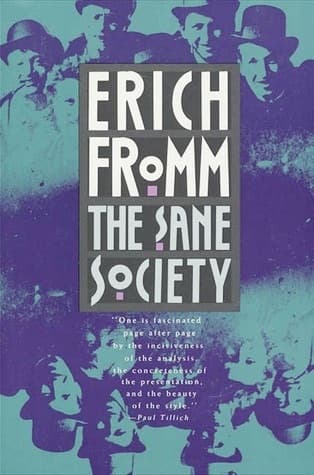
Core Idea
- Difficulty
- Medium
- Read it if
- You are concerned about the psychological and spiritual costs of modern capitalism and consumerism, feel a sense of alienation, or are interested in a humanistic critique of society that integrates psychology, economics, and philosophy.
- Skip it if
- You are looking for practical self-help advice, prefer light reading, or are unwilling to critically examine foundational societal structures from a socialist-humanist perspective.
Key Takeaways from The Sane Society
The Pathology of Normalcy
When society itself is sick, individual sanity becomes conformity to illness.
Fromm questions the usual idea of sanity, arguing that a society can be fundamentally unhealthy even if most of its members seem 'normal' within its boundaries. He introduces 'socially patterned defect,' where common character flaws are seen not as illnesses but as healthy adjustments to an unhealthy culture. Modern capitalist society, with its focus on getting things, separation, and conformity, creates a widespread neurosis. People adapt by developing character traits that fit societal demands—like consumerism, passive receptivity, and an obsession with work—even if these adaptations cause deep psychological distress, loneliness, and a loss of self. True sanity, Fromm suggests, means recognizing and resisting these societal pressures instead of blindly conforming to them.
“The fact that millions of people share the same vices does not make these vices virtues, the fact that they share so many errors does not make the errors to be truths, and the fact that millions of people share the same form of mental pathology does not make these people sane.”
In the book: Fromm critiques the prevailing psychoanalytic view that focuses solely on individual neuroses, arguing that if an entire society promotes character defects, the 'normal' person is merely a well-adjusted patient. He contrasts this with pre-industrial societies where mental illness was often more idiosyncratic, not a mass phenomenon driven by economic structures.
Try this: Question societal norms, especially those that promote endless consumption, competition, and technological distraction. Reflect on how 'normal' behaviors might be contributing to personal unhappiness or a sense of emptiness. Seek out communities or practices that prioritize human connection, creativity, and self-actualization over material gain and status.
Related ideas: social-pathology, alienation, conformity
Alienation: The Core Malady
Modern capitalism estranges humans from their labor, products, self, and fellow beings.
Fromm expands on Marx's idea of alienation, saying it affects every part of modern life. Under industrial capitalism, people are separated from their labor (they don't own their work's tools or products), from the product of their labor (which becomes an external, often meaningless, item), from their human essence (their natural creative and productive nature), and from other people (who become rivals or tools to an end). This process turns people into commodities themselves, valuing their worth based on marketability rather than inherent human qualities. The result is a deep feeling of powerlessness, loneliness, and meaninglessness, pushing people to seek superficial satisfaction or escape through consumerism and mindless entertainment.
“Modern man is alienated from himself, from his fellow men, and from nature. He has been transformed into a commodity, and experiences his life forces as an investment which must bring him a maximum profit under existing market conditions.”
In the book: Fromm points to the factory worker performing repetitive, fragmented tasks, having no connection to the final product or the purpose of their work. He also highlights the alienation in consumer choices, where individuals are presented with an illusion of choice, but are fundamentally passive recipients of pre-packaged experiences and goods.
Try this: Seek work that allows for creativity, autonomy, and a connection to the final outcome. Prioritize genuine human connection over transactional relationships. Engage in activities that foster a sense of mastery and purpose, rather than just passive consumption. Reflect on your consumption habits and their deeper psychological drivers.
Related ideas: capitalism, labor, commodity-fetishism
The Marketing Orientation
We perceive ourselves and others as commodities to be bought and sold.
Fromm describes the 'marketing orientation' as a common personality type in modern society, where people see themselves and others as items for sale. Success is defined not by genuine human qualities like integrity, love, or creativity, but by one's ability to 'sell' oneself—whether in the job market, social groups, or romantic relationships. One's self-worth depends on external approval and perceived market value, leading to a shallow, fake existence. This orientation creates an intense need to change one's personality to fit what is 'in demand,' suppressing real feelings and thoughts. The result is deep insecurity and an inability to form close, real connections, as everyone is constantly evaluating and being evaluated.
“The marketing orientation is rooted in the experience of man as a commodity. Man is not the owner of himself but an employee. He is alienated from himself, because his own value is not based on his intrinsic qualities but on his marketability.”
In the book: Fromm illustrates this with the example of job interviews, where individuals are encouraged to present a polished, marketable persona rather than their authentic self. He also points to the superficiality of advertising and the pressure to conform to popular images of success and attractiveness.
Try this: Focus on developing intrinsic qualities like empathy, critical thinking, and genuine curiosity, rather than solely on external markers of success. Practice authentic self-expression, even if it means going against popular trends. Cultivate relationships based on mutual respect and genuine interest, not on what others can do for you or your social standing.
Related ideas: self-worth, consumerism, authenticity
Escape from Freedom, into Automaton Conformity
Overwhelmed by freedom, many surrender autonomy for the illusion of security.
Building on his earlier work, Fromm repeats that while modern society offers great individual freedom, this freedom can be frightening. Without traditional social structures and meaning, people often feel isolated, anxious, and powerless. Instead of embracing true self-fulfillment, many 'escape from freedom' by giving up their individuality and becoming 'automatons'—conforming to societal expectations, adopting ready-made opinions, and blending in with the crowd. This conformity offers a false sense of security and belonging, but at the cost of one's true self and independent thought. The automaton-conformist becomes a part of the social machine, losing the ability for real love, creativity, and independent judgment, which are signs of a healthy person.
“Modern man, freed from the bonds of pre-individualistic society, has not achieved freedom in the positive sense of the realization of his individual self; that is, the expression of his intellectual, emotional and sensuous potentialities. Freedom, though it has brought him independence and rationality, has made him isolated and, thereby, anxious and powerless.”
In the book: Fromm references the rise of totalitarian regimes as an extreme example of people willingly surrendering freedom for security. He also applies it to everyday life, observing how people uncritically adopt popular opinions or consumer trends, avoiding the discomfort of independent thought.
Try this: Practice critical thinking and question dominant narratives. Actively seek out diverse perspectives and form your own opinions. Cultivate self-awareness and identify areas where you might be conforming out of fear or convenience. Embrace the responsibility that comes with genuine freedom, even if it feels challenging.
Related ideas: totalitarianism, individualism, self-actualization
Human Needs Beyond Materialism
True human flourishing requires more than economic satisfaction; it demands love, relatedness, and meaning.
Fromm argues that modern society's focus on material possessions and economic growth misunderstands basic human needs. Beyond just survival, humans have deep existential needs: for connection (to overcome isolation through love and care), transcendence (to rise above animal existence by creating and destroying), rootedness (to feel at home in the world), a sense of identity (to be unique and distinct), and a frame of orientation (a stable way of understanding the world). When these needs are blocked by an isolating social structure, people suffer from 'existential neuroses.' The pursuit of endless consumption is a poor replacement for these deeper needs, leaving people constantly unfulfilled and searching for meaning in superficial ways.
“The problem of man is not only to be free from something, but to be free to do something. He needs a frame of orientation and an object of devotion. He needs roots, a sense of identity, and a need for effective action.”
In the book: Fromm contrasts the modern emphasis on material wealth with historical societies that prioritized spiritual or communal well-being. He suggests that the rise in mental health issues, despite increased material prosperity, is evidence that fundamental human needs are not being met.
Try this: Prioritize relationships, creative pursuits, and acts of service over material possessions. Actively seek out meaning and purpose in your life beyond your job or consumer habits. Cultivate a sense of belonging in your community and engage in activities that foster genuine connection. Reflect on your core values and how they align with your daily actions.
Related ideas: existentialism, meaning-of-life, relatedness
Biophilous vs. Necrophilous Character
A sane society fosters love for life; a sick one gravitates towards death and destruction.
Fromm introduces 'biophilia' and 'necrophilia' as basic ways of relating to life. Biophilia is the strong love of life and everything alive; it appears as a desire to build, grow, create, and support life. A biophilous person is drawn to growth, development, and life processes. In contrast, necrophilia is the attraction to what is dead, decaying, mechanical, and lifeless; it appears as a desire to control, destroy, and turn living things into objects. While a healthy person and society are biophilous, Fromm argues that parts of modern industrial society, with its focus on efficiency, control, destruction (e.g., in war or environmental exploitation), and reducing humans to cogs in a machine, encourage a necrophilous orientation. This orientation is unhealthy and ultimately self-destructive.
“The biophilous person is primarily attracted to that which is alive and growing; the necrophilous person is attracted to that which is dead, decaying, and mechanical.”
In the book: Fromm cites examples like the love of order and control over spontaneous life, the fascination with death and destruction in media, and the mechanistic view of humans in industrial systems as manifestations of necrophilia. He contrasts this with the joy of gardening, raising children, or creating art as expressions of biophilia.
Try this: Actively cultivate a love for life: engage with nature, nurture relationships, create art, support growth and development in yourself and others. Be critical of systems and ideologies that prioritize control, destruction, or the reduction of living beings to mere objects. Advocate for policies that promote ecological sustainability and human flourishing.
Related ideas: ethics, destruction, creation
Communitarian Socialism as an Alternative
Fromm advocates for a decentralized, humanistic society rooted in active participation and shared responsibility.
Fromm does not just diagnose society's problems; he proposes a drastic alternative: humanistic communitarian socialism. This is not the totalitarian, state-controlled socialism of the Soviet Union, but a decentralized system designed to serve human needs rather than economic growth. It emphasizes active participation in work and government, shared ownership, and a focus on quality over quantity. The goal is to create a society where people can overcome isolation, develop their full potential, and meet their deep human needs for connection, creativity, and identity. This requires fundamental changes in economic organization, political structures, and cultural values, moving away from a profit-driven, consumerist model to one centered on human flourishing and democratic involvement.
“The aim of socialism is man. To liberate man from economic exploitation, from the chains of his society, from himself. The aim of socialism is to make possible the full realization of the individual.”
In the book: Fromm draws inspiration from early socialist thinkers like Robert Owen and critiques both Soviet communism and unbridled capitalism. He points to small-scale communal experiments and democratic workplaces as models for a more humane economic organization.
Try this: Support local economies and cooperative businesses. Advocate for workplace democracy and employee ownership. Engage in community organizing and participate in local governance. Question the assumption that endless economic growth is inherently good, and explore alternative metrics for societal well-being beyond GDP.
Related ideas: socialism, democracy, utopia
Active Participation vs. Passive Consumption
A sane society empowers citizens to be active creators, not just passive recipients.
A main part of Fromm's vision for a sane society is the move from passive consumption to active participation. In modern capitalist democracies, citizens often become passive consumers of goods, services, and political talk. They vote sometimes but have little real power over decisions that shape their lives. Fromm argues that true democracy and mental health require active involvement in all areas: work, community, and politics. This means people actively contributing to decisions, shaping their environment, and expressing their unique creativity. Passive reception, whether in entertainment or politics, creates isolation and powerlessness, while active participation builds a sense of agency, responsibility, and self-worth, which are vital for a healthy person and society.
“Democracy means that man is in charge of himself, that he is not ruled by an external authority, but that he governs himself. This implies that he is responsible for himself, that he is active, not passive.”
In the book: Fromm contrasts the passive role of a TV viewer or a mass-produced consumer with the active engagement of a craftsman or a participant in a town hall meeting. He argues that genuine democracy requires more than just voting; it requires continuous, informed participation.
Try this: Seek out opportunities for active participation in your community, workplace, or local government. Prioritize creative hobbies and active learning over passive entertainment. Question 'expert' opinions and engage in informed debate. Empower yourself and others to be creators and decision-makers, not just consumers.
Related ideas: democracy, empowerment, civic-engagement
The Need for a New Science of Man
Understanding human nature is crucial for designing a society that fosters mental health.
Fromm highlights the critical need for a complete 'science of man' that combines ideas from psychology, sociology, economics, and philosophy. He argues that without a deep understanding of human nature—our basic needs, potentials, and inherent contradictions—we cannot design a truly sane society. This science must be empirical, yet also based on a humanistic philosophy that values human dignity, freedom, and self-realization. It challenges the simplified views of humans as purely economic or biological beings, instead proposing a complex, evolving being with unique existential needs. Such a science would guide us in creating social structures that support, rather than hinder, human flourishing, moving beyond a purely descriptive analysis to a prescriptive one for societal transformation.
“The science of man must be based on a philosophy of man, and this philosophy must be based on an empirical study of man. Only then can we hope to arrive at an understanding of what constitutes the sane society.”
In the book: Fromm criticizes the fragmentation of academic disciplines and the lack of a holistic view of humanity. He argues that current social sciences often describe pathology without offering a vision for health, or they reduce human behavior to simplistic, quantifiable metrics.
Try this: Cultivate interdisciplinary thinking and seek out knowledge that connects different fields of study related to human well-being. Support research that takes a holistic view of human nature and societal impact. Advocate for educational systems that foster critical thinking, empathy, and a deep understanding of human psychology and social dynamics.
Related ideas: human-nature, interdisciplinary, social-science
The Courage to Be Human
Reclaiming our humanity requires active defiance against a dehumanizing system.
Ultimately, Fromm calls for a deep act of individual and collective bravery: the courage to be truly human in a society that often demands conformity, passivity, and isolation. This means resisting the pressure to become just a part of the industrial machine, a passive consumer, or a marketable item. It requires an active commitment to developing one's unique potential, cultivating real love and empathy, engaging in creative and productive work, and participating meaningfully in society. This 'courage to be' is not just about individual psychological health, but also about the collective change of society into one that supports, rather than suppresses, the natural human drive towards growth, freedom, and self-realization. It is a defiant affirmation of life against forces that strip away humanity.
“Man's main task in life is to give birth to himself, to become what he potentially is. The most important product of his effort is his own personality.”
In the book: Fromm draws on existentialist themes, emphasizing the individual's responsibility to create meaning and actualize their potential, even when faced with an absurd or alienating world. He praises those who resist societal pressures to conform, seeing them as beacons of sanity.
Try this: Identify areas in your life where you might be compromising your values for convenience or societal acceptance, and consciously choose to act with integrity. Embrace creativity and self-expression as acts of resistance. Support others who are striving for authenticity and human connection. Engage in dialogue and action that promotes a more humane and just society, even if it feels like a small step.
Related ideas: self-realization, existential-courage, resistance
The Sane Society Quotes
“The marketing orientation is based on the principle that one sells himself, and his 'personality package,' on the market.”
“Mental health is characterized by the ability to love and to create, by the emancipation from incestuous ties, by a sense of identity based on the experience of oneself as the subject and mover of one's own powers.”
“Man is primarily a social being. He cannot live without continuous interaction with others.”
“The danger of the past was that men became slaves. The danger of the future is that men may become robots.”
“If a person loves only another person and is indifferent to all others, his love is not love but a symbiotic attachment, or an enlarged egotism.”
“Not to be able to choose is a sign of lack of freedom.”
“The fact that millions of people share the same vices does not make these vices virtues, the fact that they share so many errors does not make the errors truths, and the fact that millions of people suffer from the same forms of mental pathology does not make these people sane.”
“Modern man has transformed himself into a commodity; he experiences his life energy as an investment with which he should make the highest possible profit, considering his position and the situation on the personality market.”
“The most important function of the family is to transmit the values and ideas of society to the child.”
“Man is born a rebel and must remain one if he is to live.”
“A sane society is one in which there is a maximum of individual freedom and self-realization, not a maximum of things and consumption.”
“The authoritarian conscience is the internalized voice of an authority whom one wants to please and of whom one is afraid.”
“Happiness is not a gift of the gods, but the fruit of our own efforts.”
“The more the individual is 'adjusted,' the less free he is.”
Quiz
10 questions on the main ideas. Each answer comes with a short explanation.
Question 1
Which term does Erich Fromm use to describe the widespread mental unhealthiness prevalent in modern Western society?
- Collective neurosis
- Pathology of normalcy
- Societal psychosis
- Cultural maladjustment
Show answer
B. Pathology of normalcy Fromm introduces the concept of a 'pathology of normalcy' to argue that modern Western culture, despite appearing normal on the surface, fosters conditions that are detrimental to individual mental health.
Question 2
According to Fromm, what is one of the primary alienating effects of modern capitalism that he examines in 'The Sane Society'?
- Increased social mobility
- The commodification of human relationships
- Enhanced individual autonomy
- Greater access to information
Show answer
B. The commodification of human relationships Fromm argues that modern capitalism fosters alienation, partly by transforming human relationships and even individuals themselves into commodities, stripping them of their intrinsic value.
Question 3
What fundamental human needs does Fromm suggest modern society often fails to support, leading to individual mental unhealthiness?
- Security and material wealth
- Power and recognition
- Love and freedom
- Entertainment and leisure
Show answer
C. Love and freedom Fromm concludes 'The Sane Society' by presenting ideas for societal reorganization that would specifically support individuals' mental health and their profound human needs for love and freedom.
Question 4
Fromm's analysis in 'The Sane Society' primarily aims to understand the impact of social systems on what aspect of the individual?
- Physical fitness
- Economic status
- Mental health
- Educational attainment
Show answer
C. Mental health The core of Fromm's work, and explicitly stated as one of his main interests in 'The Sane Society,' is to analyze how social systems affect the mental health of the individual.
Question 5
Which type of societal system does Fromm often discuss as a historical and contemporary alternative to modern capitalism, particularly in its ability to support individual well-being?
- Authoritarian regimes
- Feudalistic monarchies
- Communitarian systems
- Technocratic meritocracies
Show answer
C. Communitarian systems In 'The Sane Society,' Fromm examines historical and contemporary alternatives to modern capitalism, specifically highlighting communitarian systems as potentially more supportive of human needs.
Question 6
When Fromm asks, 'Can a society be sick?' what is his ultimate conclusion presented in the book?
- Only individuals can be sick, not societies.
- Society can be sick, and Western culture exemplifies this with a 'pathology of normalcy'.
- Sickness in society is merely a reflection of individual psychological issues.
- Societies are inherently robust and cannot truly be considered 'sick'.
Show answer
B. Society can be sick, and Western culture exemplifies this with a 'pathology of normalcy'. Fromm directly answers his own question, arguing that a society can indeed be sick, and he posits that Western culture is suffering from a 'pathology of normalcy'.
Question 7
Fromm's proposals for re-organizing economics, politics, and culture are primarily aimed at what overarching goal?
- Maximizing economic output and national security.
- Achieving global uniformity in social structures.
- Supporting the individual’s mental health and profound human needs.
- Establishing a fully automated, post-scarcity society.
Show answer
C. Supporting the individual’s mental health and profound human needs. The culmination of Fromm's work in 'The Sane Society' is to present new ideas for societal reorganization specifically designed to support the mental health of individuals and their fundamental human needs.
Question 8
Which of the following best characterizes Fromm's view on the relationship between the individual and society in 'The Sane Society'?
- Individuals are solely responsible for their mental health, irrespective of societal structure.
- Society is a neutral backdrop, and individual character determines well-being.
- Social systems profoundly impact individual mental health, and a sick society can produce sick individuals.
- The individual's role is to adapt unconditionally to whatever society demands.
Show answer
C. Social systems profoundly impact individual mental health, and a sick society can produce sick individuals. A central tenet of Fromm's argument is that social systems have a profound and direct impact on individual mental health, to the extent that a 'sick' society can foster widespread individual mental unhealthiness.
Question 9
Fromm's concept of 'pathology of normalcy' implies that:
- Mental illness is a rare deviation from a generally healthy societal norm.
- What is considered 'normal' behavior or mental state in a given society can itself be unhealthy or pathological.
- Only individuals who deviate from societal norms are truly sane.
- Pathology is an inherent and unchangeable aspect of all human societies.
Show answer
B. What is considered 'normal' behavior or mental state in a given society can itself be unhealthy or pathological. The 'pathology of normalcy' suggests that societal norms and expected behaviors, while appearing normal, can actually be detrimental to genuine human flourishing and mental health, making the 'normal' state itself pathological.
Question 10
In advocating for a re-organization of society, Fromm is ultimately striving for a society that enables individuals to achieve what state?
- Conformity to established social hierarchies.
- Maximum economic efficiency and technological advancement.
- A state of psychological health and the fulfillment of profound human needs.
- The elimination of all forms of conflict and disagreement.
Show answer
C. A state of psychological health and the fulfillment of profound human needs. Fromm's ultimate aim for societal reorganization is to create a society that actively supports and enables the individual's mental health and the fulfillment of their inherent human needs for love and freedom.
The Sane Society FAQ
What is the core argument of Erich Fromm's 'The Sane Society'?
Erich Fromm argues that modern Western society, particularly under capitalism, can be 'sick' or 'pathological' despite appearing normal. He suggests that this 'pathology of normalcy' alienates individuals and negatively impacts their mental health, leading to widespread unhappiness and a lack of genuine fulfillment.
Does 'The Sane Society' propose a specific political system as a solution?
While Fromm critiques modern capitalism and discusses historical and contemporary alternatives like communitarian systems, he doesn't prescribe a single political system. Instead, he offers new ideas for re-organizing economics, politics, and culture to better support individual mental health and fundamental human needs for love and freedom.
What does Erich Fromm mean by 'pathology of normalcy'?
The 'pathology of normalcy' refers to a societal condition where widespread mental health issues, alienation, and unhappiness are considered normal because they are common within that culture. Fromm argues that a society can be profoundly unhealthy even if most of its members adapt to its dysfunctional norms.
How does 'The Sane Society' differ from purely economic critiques of capitalism?
'The Sane Society' extends beyond purely economic critiques by focusing heavily on the psychological and mental health impacts of capitalism and alienation. Fromm analyzes how social systems affect the individual's inner world, rather than solely focusing on class struggle or material distribution.
Does Fromm believe individual therapy can cure societal sickness?
Fromm implies that while individual therapy can help individuals cope, it cannot fundamentally cure a 'sick' society. He advocates for societal-level changes in economic, political, and cultural structures to address the root causes of widespread alienation and mental unhealth.
What alternatives to modern capitalism does Fromm explore in the book?
Fromm explores various historical and contemporary alternatives to modern capitalism, particularly focusing on communitarian systems. He examines how these systems might better align with human needs for connection, creativity, and genuine freedom, in contrast to the alienating effects of industrial capitalism.
Is 'The Sane Society' still relevant in today's world?
Many readers find 'The Sane Society' highly relevant today, as its themes of alienation, consumerism, and the impact of societal structures on mental health continue to resonate. Fromm's insights into the 'pathology of normalcy' offer a powerful lens through which to examine contemporary social issues.
How does Fromm connect love and freedom to a sane society?
Fromm posits that genuine love and freedom are fundamental human needs that are often thwarted by alienating societal structures. He argues that a truly sane society would be one organized to actively support and foster these profound human needs, rather than suppress them.
What is Fromm's view on the role of culture in a sane society?
Fromm believes that culture plays a crucial role in shaping individual mental health. He advocates for a re-organization of culture that would reinforce humanistic values, encourage critical thinking, and foster genuine connection, rather than promoting conformity or consumerism.
About the author
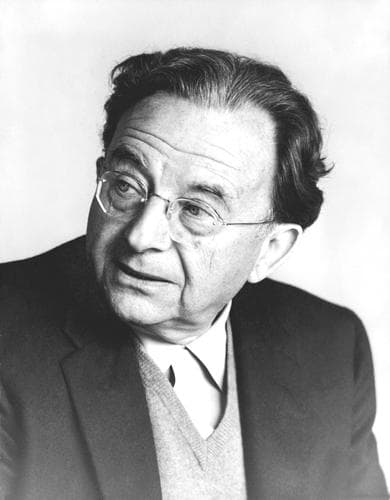
Erich Fromm was a German social psychologist and philosopher known for his exploration of the intersection between psychology and society. His notable works include "Escape from Freedom," which examines the psychological implications of freedom, "The Anatomy of Human Destructiveness," where he analyzes the roots of violence, and "The Sane Society," which critiques modern capitalist society.
Similar books
- Escape from Freedom
Erich Fromm
4.3 (10k) average on GoodreadsPoliticsExplores the psychological mechanisms by which individuals surrender freedom for security, a foundational concept for 'The Sane Society'.
- Man's Search for Meaning
Viktor E. Frankl
4.4 (401k) average on GoodreadsBiographyAddresses the human need for meaning and purpose in a world that can often feel dehumanizing, though from a more existentialist perspective.
- 1984
George Orwell
4.2 (3.1M) average on GoodreadsPoliticsIn a future where surveillance and thought control are absolute, a man's search for truth clashes with the Party, showing that hope can be a form of rebellion.
- Animal Farm
George Orwell
4.0 (2.7M) average on GoodreadsPoliticsA farm animals' rebellion against humans turns into a pig-led dictatorship, showing how power corrupts and revolutionary ideals are betrayed.
- Freakonomics: A Rogue Economist Explores the Hidden Side of Everything
Steven D. Levitt
4.0 (709k) average on GoodreadsBusinessThis book uses economic principles to reveal the surprising incentives behind everything from drug dealing and real estate to cheating teachers and the decline of crime.
- I Am Malala: The Story of the Girl Who Stood Up for Education and Was Shot by the Taliban
Malala Yousafzai
4.1 (419k) average on GoodreadsPoliticsA teenage girl from a Taliban-controlled valley refuses to give up her books, becoming a global voice for education even after an assassination attempt.





Enjoyed the summary?
A summary gives you the shape of the book. The book itself has the detail, the examples and the voice.
Find The Sane Society on AmazonAs an Amazon Associate, BookBrief earns from qualifying purchases. How we're funded