
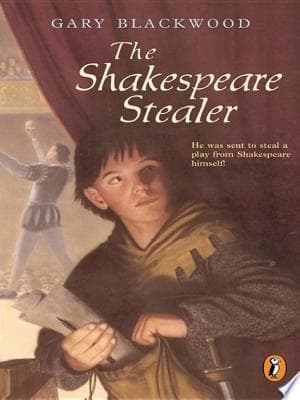
Core Idea
- Difficulty
- Easy
- Read it if
- You enjoy historical fiction set in Elizabethan England, stories about personal transformation, or tales involving the world of theater and Shakespeare.
- Skip it if
- You prefer fast-paced thrillers or dislike historical settings with period-specific language.
Key Takeaways from The Shakespeare Stealer
The Perilous Gift of Shorthand
A unique skill can be both a blessing and a curse, dictating one's fate.
Widge's rare shorthand ability, 'charactery,' is central to his early life and the plot's start. This skill, far from helping him personally, first traps him in a life of being used. His first master makes him copy sermons for money, and his next, more dangerous master, Falconer, uses this talent for stealing plays. This shows how special abilities, without personal control, can become burdens. The story explores the ethical problems of using a gift for illegal reasons and the fight to take back control of one's talents and future, instead of having them dictated by others.
“Widge possessed a peculiar talent, a gift for 'charactery' that marked him for a life of servitude and subterfuge.”
In the book: Widge's initial life under Dr. Bright and his subsequent 'purchase' by Falconer, both driven by the utility of his shorthand for their respective schemes.
Try this: Reflect on your unique skills. Are you using them in ways that align with your values, or are external pressures dictating their application? Seek opportunities to leverage your talents for personal growth and ethical pursuits.
Related ideas: skill-exploitation, autonomy, ethical-dilemmas
Finding Family in Unexpected Places
Belonging can emerge from shared experiences, even amidst deception.
Widge, an orphan passed from one master to another, has never known the comfort or safety of a family. His entry into the Lord Chamberlain's Men at the Globe Theatre is at first only a business deal, a way to an end. But as he spends more time with the actors—sharing meals, rehearsing, and experiencing the friendship of theater life—he starts to form real connections. This unexpected sense of belonging challenges his loyalty to Falconer and highlights the deep human need for connection. The book nicely shows how shared goals and real human interaction can create family ties stronger than blood or duty, even when those interactions begin deceptively.
“He had never known a true family, yet among these players, a sense of belonging began to take root, despite his secret mission.”
In the book: Widge's growing affection for characters like Sander, Chris Beeston, and particularly Mr. Pope, who shows him kindness and mentorship, contrasting sharply with his previous solitary existence.
Try this: Actively seek communities where you feel accepted and valued. Be open to forming connections with people from different backgrounds, as true belonging often arises from shared experiences and mutual respect.
Related ideas: found-family, belonging, community, human-connection
The Transformative Power of Empathy
Understanding others' perspectives can fundamentally alter one's own moral compass.
Widge's first moral understanding comes from survival—he does what he must to avoid punishment. His task to steal 'Hamlet' at first seems no different from copying sermons. However, as he joins the theater company, he starts to see the play not just as words, but as a living performance, a team effort, and a source of deep entertainment and meaning for both actors and audience. He develops empathy for Shakespeare, for the players who put their hearts into their roles, and for the audience whose lives are made richer by the stories. This empathy changes his view of his mission, turning it from a simple task into a serious betrayal, leading him to question and oppose his master.
“To steal a sermon was one thing, but to steal a play, a work of art that brought joy to so many... the implications weighed heavily on his conscience.”
In the book: Widge's internal struggle and growing reluctance to transcribe the play, especially after experiencing the joy and dedication of the actors and witnessing the audience's reaction.
Try this: Before making decisions that impact others, try to understand their perspectives and feelings. Cultivating empathy can lead to more ethical choices and a deeper appreciation for the human experience.
Related ideas: empathy, moral-compass, perspective-taking, ethical-decision-making
The Allure and Illusion of the Stage
Theatre offers both escapism and a mirror to reality, blurring the lines between performance and truth.
The Globe Theatre is shown as a lively, almost magical place where everyday life changes. For Widge, who has lived a grim and lonely existence, the stage is a discovery. He is fascinated by the costumes, the detailed language, the dramatic performances, and how actors take on different personalities. This dive into Elizabethan theater not only gives him a sense of wonder but also teaches him about human nature, storytelling, and the power of illusion. The book shows how theater can be a strong tool for both entertainment and social comment, and how its 'unreality' can often show deeper truths about the human condition than daily life.
“The stage was a world unto itself, where men became women, kings became paupers, and stories came alive with a breath that felt more real than life outside.”
In the book: Widge's initial awe and fascination upon entering the Globe, his observations of the actors' transformations, and his eventual participation in the plays.
Try this: Engage with art forms like theatre, literature, or film. Allow yourself to be transported, and reflect on how these creative expressions can offer new perspectives on life and society.
Related ideas: theatre-magic, illusion-vs-reality, storytelling, art-as-mirror
The Double-Edged Sword of Identity
Assuming a false identity can provide freedom, but at the cost of one's true self.
Widge's journey involves a constant negotiation of identity. At first, his circumstances—an orphan, a servant—define him. When he goes into the Globe, he takes on the role of an eager apprentice, which allows him to observe and learn. But this false identity causes an inner conflict, as he struggles to balance his mission with his growing attachment to the players. The book further explores identity through the actors themselves, who constantly change roles on stage, blurring the lines between their true selves and their characters. Widge's biggest challenge is to drop the identities forced upon him and create his own true self, choosing loyalty and honesty over deceit.
“He was Widge, but he was also 'the new boy,' 'the apprentice,' and for a time, even 'Hamlet.' Each role offered a different skin, a different way to be.”
In the book: Widge's internal monologues about his secret, his fear of exposure, and his eventual decision to reveal his true intentions, leading to his rejection of Falconer's influence.
Try this: Reflect on the different 'roles' you play in your life. Are they authentic to who you are, or are you performing for others? Strive to align your external actions with your internal values to foster a strong sense of self.
Related ideas: identity-crisis, authenticity, role-playing, self-discovery
The Value of Art and Intellectual Property
Creative works hold intrinsic worth, deserving protection from theft and exploitation.
The whole idea of 'The Shakespeare Stealer' centers on the attempted theft of intellectual property—Shakespeare's 'Hamlet.' The book quietly but effectively shows the value of creative works. For Falconer, the play is something to be stolen and profited from. For Shakespeare and the Lord Chamberlain's Men, it is their income, their passion, and a sign of their artistic talent. The story emphasizes the effort and creativity involved in writing and performing plays, making the theft not just a financial crime, but a violation of artistic integrity and a threat to the community built around it. It implicitly argues for protecting and respecting creative efforts.
“A play was not merely words on a page; it was a creation, a livelihood, a piece of someone's very soul.”
In the book: Falconer's ruthless pursuit of the play for his rival company, contrasted with the players' dedication to protecting their work and their pride in performing it.
Try this: Support artists and creators by respecting intellectual property. Purchase original works, give credit where it's due, and understand the value of creativity beyond its monetary price.
Related ideas: intellectual-property, artistic-integrity, creative-value, copyright
Courage in the Face of Fear
True bravery isn't the absence of fear, but the decision to act despite it.
Widge spends much of his early life driven by fear—fear of his masters, fear of punishment, fear of being alone. His first obedience to Falconer's demands comes directly from this fear. However, as his loyalties shift and his conscience awakens, he faces a much greater fear: defying a dangerous man and possibly endangering his new community. His choice to resist Falconer and protect the play is a deep act of courage. This is not a showy, heroic bravery, but a quiet, inner determination to do what is right, even when the personal cost is huge. It shows that courage is often a choice made during a moral struggle.
“His knees knocked, his heart pounded, but a new resolve, foreign and fierce, began to stir within him. He would not be a thief.”
In the book: Widge's internal struggle and ultimate confrontation with Falconer, where he actively chooses to protect his friends and the play, risking his own safety and future.
Try this: Identify situations where fear holds you back from doing what you believe is right. Practice small acts of courage to build your capacity for larger, more significant stands.
Related ideas: bravery, moral-courage, overcoming-fear, inner-strength
The Nuance of Good and Evil
Few characters are purely good or purely evil; motivations often lie in a grey area.
While Falconer is clearly the bad guy, the book avoids making him a simple evil character. His motives, though ruthless, come from a desire for success and perhaps a bitter rivalry in the tough world of Elizabethan theater. Similarly, Widge himself is not an inherently 'good' character at the start; he is a product of his circumstances, capable of deceit and self-preservation. The players, while generally kind, are also human, with their own faults and quirks. This detailed portrayal of characters adds depth and realism, suggesting that human behavior is complex and often driven by a mix of self-interest, ambition, and the desire for connection, rather than simple good-versus-evil ideas.
“Even the villain, he realized, had his reasons, twisted though they might be, born of ambition and a desperate need to succeed.”
In the book: Falconer's backstory hinted at, and the various personalities and occasional squabbles among the Lord Chamberlain's Men, showcasing their human imperfections.
Try this: When evaluating others' actions, try to consider their potential motivations and circumstances, rather than immediately labeling them as 'good' or 'bad.' This fosters understanding and reduces judgment.
Related ideas: moral-ambiguity, character-complexity, human-nature, nuance
The Enduring Legacy of Shakespeare
Beyond the plots, Shakespeare's work reflects timeless human experiences.
Even for a young, uneducated boy like Widge, Shakespeare's 'Hamlet' has a strong impact. While Widge first focuses on copying the words, he gradually becomes absorbed in the story's themes of revenge, madness, and loyalty. The book implicitly celebrates Shakespeare's lasting genius, showing how his plays captivated audiences then and still resonate today. It highlights that Shakespeare's true value lies not just in his historical importance, but in his deep understanding of the human condition, which crosses time and cultural barriers. The play itself becomes a character, a powerful force that shapes the futures of those who interact with it.
“The words, even when he couldn't grasp their full meaning, held a power, a resonance that spoke of things true and eternal.”
In the book: Widge's increasing fascination with the plot and characters of 'Hamlet,' and the palpable excitement and engagement of the audiences at the Globe Theatre.
Try this: Revisit classic literature or art forms that might initially seem intimidating. Look beyond the surface to find universal themes and emotional truths that connect with your own experiences.
Related ideas: shakespearean-legacy, timeless-themes, literary-impact, cultural-heritage
The Unseen Work Behind the Magic
Behind every grand spectacle lies meticulous effort, collaboration, and often, unseen sacrifice.
Widge's time in the Globe Theatre offers a unique behind-the-scenes look, showing the extensive work and dedication needed to bring a play to life. He sees not just the glamorous performances, but also the long rehearsals, the building of sets, the management of costumes, and the coordination of many people. This look backstage demystifies the 'magic' of theater, showing it to be the result of collaborative effort, skill, and sheer hard work. It supports the idea that any impressive outcome, whether artistic or otherwise, is built on a foundation of unseen, often unglamorous, but absolutely essential labor. This insight builds appreciation for the process, not just the finished product.
“He saw the grime, the sweat, the endless rehearsals, the careful crafting of props and costumes—the true engine behind the illusion of the stage.”
In the book: Widge's observations of the actors' daily routines, the stagehands' work, the costume department, and the general operations of the theatre, which he initially overlooked.
Try this: When admiring a finished product or performance, take a moment to consider the unseen effort, teamwork, and persistence that went into its creation. This cultivates a deeper appreciation and respect.
Related ideas: behind-the-scenes, collaboration, work-ethic, process-over-product
The Shakespeare Stealer Quotes
“There are more things in heaven and earth, Horatio, than are dreamt of in your philosophy.”
“A man's true worth is not in the clothes he wears, but in the heart he carries.”
“To thine own self be true, and it must follow, as the night the day, thou canst not then be false to any man.”
“The stage is a mirror, reflecting life back to us, so we might learn from it.”
“Fear is a poor master. It makes slaves of us all.”
“Words are powerful things, Widge. They can build up, or they can tear down.”
“A true friend is a treasure beyond price.”
“One cannot truly appreciate the light until one has known the darkness.”
“It is not where you come from, but where you are going, that truly matters.”
“The greatest theft is to steal a man's hope.”
“Every man has a part to play, no matter how small.”
“Truth, like a good play, will always find its audience.”
“A lie, once told, has a way of growing, until it consumes the teller.”
“Sometimes, the best way to find yourself is to lose yourself in something greater.”
Quiz
10 questions on the main ideas. Each answer comes with a short explanation.
Question 1
What unique skill does Widge possess that makes him valuable to his master and crucial to the plot?
- He is an exceptional swordsman.
- He has a photographic memory.
- He is skilled in shorthand writing.
- He can perfectly mimic voices.
Show answer
C. He is skilled in shorthand writing. Widge's rare talent for shorthand is explicitly mentioned as the reason his master demands he steal 'Hamlet' by transcribing it during a performance.
Question 2
What is the specific play Widge is ordered to steal from Shakespeare's company?
- Romeo and Juliet
- Macbeth
- Hamlet
- A Midsummer Night's Dream
Show answer
C. Hamlet The book description clearly states that Widge's master demands he steal Shakespeare's play 'Hamlet'.
Question 3
Which iconic London theatre does Widge infiltrate to carry out his master's orders?
- The Rose Theatre
- The Globe Theatre
- The Swan Theatre
- The Curtain Theatre
Show answer
B. The Globe Theatre The synopsis mentions Widge working his way into the heart of the Globe Theatre, where Shakespeare's players perform.
Question 4
What is the primary motivation behind Widge's initial attempt to steal the play?
- He wants to become a famous playwright himself.
- He seeks revenge against Shakespeare's company.
- He fears the consequences from his fearsome master if he fails.
- He is offered a large sum of money for the script.
Show answer
C. He fears the consequences from his fearsome master if he fails. The description states, 'His fearsome master has just one demand: steal Shakespeare's play 'Hamlet'--or else. Widge has no choice but to follow orders...', indicating fear of his master as the primary driver.
Question 5
How does Widge gain access and trust within the Globe Theatre company?
- He pretends to be a wealthy patron offering financial support.
- He is hired as an apprentice or stagehand.
- He blackmails one of the actors.
- He is discovered to have a hidden talent for acting.
Show answer
B. He is hired as an apprentice or stagehand. While the synopsis doesn't explicitly state 'apprentice', it notes he 'works his way into the heart of the Globe Theatre', implying he gains a legitimate role within the company, often as an apprentice or stagehand in Elizabethan times, to get close enough to the plays.
Question 6
The book is praised for its 'lively depictions of Elizabethan stagecraft and street life.' What does this suggest about the setting's role in the story?
- The historical period serves only as a backdrop without impacting the plot.
- The details of Elizabethan England are integral to the adventure and atmosphere.
- The setting is largely fictionalized and not historically accurate.
- The story could easily take place in any historical period without significant changes.
Show answer
B. The details of Elizabethan England are integral to the adventure and atmosphere. The reviews highlight the book's richness in 'period details' and 'lively depictions of Elizabethan stagecraft and street life,' indicating the setting is far more than a mere backdrop; it's a vital part of the adventure and character experience.
Question 7
What internal conflict does Widge likely face as he spends more time with Shakespeare's players?
- Whether to betray his new friends or face his master's wrath.
- Choosing between a career as an actor or returning to his old life as an orphan.
- Deciding which Shakespearean play he likes best.
- His desire to become a master playwright versus his lack of talent.
Show answer
A. Whether to betray his new friends or face his master's wrath. As Widge 'works his way into the heart' of the company, he inevitably forms bonds, creating a conflict between his initial mission (stealing the play for his fearsome master) and his growing loyalty/affection for the players. This is a common trope in such 'infiltration' narratives.
Question 8
The book is described as 'full of twists and turns as a London alleyway.' What narrative element does this phrase primarily suggest?
- The story features a complex, non-linear timeline.
- The plot contains numerous unexpected developments and surprises.
- The characters frequently get lost in the city.
- The writing style is convoluted and difficult to follow.
Show answer
B. The plot contains numerous unexpected developments and surprises. The phrase 'twists and turns' in a narrative context refers to unexpected plot developments, reversals, and surprises that keep the reader engaged, much like navigating a winding alleyway.
Question 9
Considering the historical context of Elizabethan England and the nature of theatre at the time, what might be a practical challenge Widge faces in transcribing 'Hamlet' during a live performance?
- The lack of reliable ink and parchment in Elizabethan London.
- The dim lighting, noise, and rapid pace of dialogue during a performance.
- Fear of being recognized by Shakespeare himself, who would know shorthand.
- The constant threat of pickpockets stealing his notes.
Show answer
B. The dim lighting, noise, and rapid pace of dialogue during a performance. Elizabethan theatres were open-air but performances occurred throughout the day, often with natural light, but the sheer noise of the crowd, the speed of actors' delivery, and the difficulty of writing inconspicuously in such an environment would pose significant challenges to accurate shorthand transcription.
Question 10
The book is described as a 'gleeful romp through olde England' and having 'humor and heart.' What does this combination suggest about the overall tone, despite the initial premise of theft and villainy?
- The story is primarily a dark and serious drama with minimal lighthearted moments.
- The underlying themes of friendship and personal growth will likely temper the initial conflict.
- The villainy is so extreme that it becomes comedic.
- The humor is unintentional, arising from the characters' incompetence.
Show answer
B. The underlying themes of friendship and personal growth will likely temper the initial conflict. The phrases 'delightful adventure,' 'humor and heart,' and 'gleeful romp' strongly suggest that while there's an initial conflict involving theft and a fearsome master, the story will ultimately lean towards positive themes like friendship, belonging, and Widge's personal development, making it more than just a crime caper.
The Shakespeare Stealer FAQ
What is 'The Shakespeare Stealer' about?
The Shakespeare Stealer is a historical adventure novel set in Elizabethan England, following an orphan named Widge who possesses a unique talent for shorthand. He is forced by his master to infiltrate the Globe Theatre and steal William Shakespeare's play, Hamlet.
Who is Widge in 'The Shakespeare Stealer'?
Widge is the protagonist of the story, an orphan who has been taught a rare form of shorthand. He is a clever and resourceful boy who finds himself caught between his master's demands and his growing loyalty to the players at the Globe Theatre.
Does Widge succeed in stealing Hamlet?
Widge's journey to steal Hamlet is fraught with challenges and moral dilemmas. While he attempts to fulfill his master's command, his experiences within the Globe Theatre and with Shakespeare's company lead him to question his mission and loyalties.
What historical period does 'The Shakespeare Stealer' depict?
The book is set in Elizabethan England, specifically during the time when William Shakespeare and his acting company, the Lord Chamberlain's Men, were performing at the Globe Theatre in London. It offers rich details of 16th-century life.
How historically accurate is 'The Shakespeare Stealer'?
While a work of fiction, 'The Shakespeare Stealer' is praised for its lively and accurate depictions of Elizabethan stagecraft, street life, and the general atmosphere of the era. Gary Blackwood conducted extensive research to bring the period to life.
What themes are explored in 'The Shakespeare Stealer'?
The novel explores themes of identity, loyalty, morality, the power of theatre, and the search for belonging. Widge's journey forces him to confront his own values and decide where his true allegiance lies.
Is 'The Shakespeare Stealer' suitable for young readers?
Yes, 'The Shakespeare Stealer' is a popular choice for young adult and middle-grade readers. It is an engaging adventure that introduces an important historical era with humor and heart, making it accessible and enjoyable for a younger audience.
How does 'The Shakespeare Stealer' differ from other historical fiction books about Shakespeare?
'The Shakespeare Stealer' stands out by focusing on the unique perspective of a young outsider, Widge, whose primary goal is to steal a play, rather than being a direct biography of Shakespeare. It vividly portrays the behind-the-scenes world of the Globe Theatre and Elizabethan London through his eyes, blending adventure with historical detail.
Similar books
- Chasing Vermeer
Blue Balliett
3.7 (28k) average on GoodreadsChildren'sFeatures young protagonists solving a mystery involving art and intellectual property.
- The Diary of a Young Girl
Anne Frank
4.2 (2.7M) average on GoodreadsBiographyDuring the Nazi occupation, a teenage girl's diary, written from a secret annex, shares observations on humanity, hope, and the wait for freedom.
- Twisted 1. Twisted love
Ana Huang
3.7 (1.7M) average on GoodreadsA quiet billionaire with a difficult past finds his guarded heart opening to the woman he must protect, but their growing passion uncovers dangerous secrets and a shared, traumatic history.
- Eat, Pray, Love
Elizabeth Gilbert
3.6 (1.5M) average on GoodreadsLifestyleA heartbroken writer leaves her conventional life for a year-long global search for pleasure in Italy, spiritual devotion in India, and unexpected love and balance in Bali.
- Night
Elie Wiesel
4.3 (970k) average on GoodreadsBiographyIn the darkness of Auschwitz and Buchenwald, a teenage Elie Wiesel faces the extermination of his family, the loss of his faith, and the lasting scars of humanity's deepest cruelty.
- Steve Jobs
Walter Isaacson
4.1 (957k) average on GoodreadsBusinessSteve Jobs was a visionary who fused creativity and technology to revolutionize six industries and shape our digital world.





Enjoyed the summary?
A summary gives you the shape of the book. The book itself has the detail, the examples and the voice.
Find The Shakespeare Stealer on AmazonAs an Amazon Associate, BookBrief earns from qualifying purchases. How we're funded