
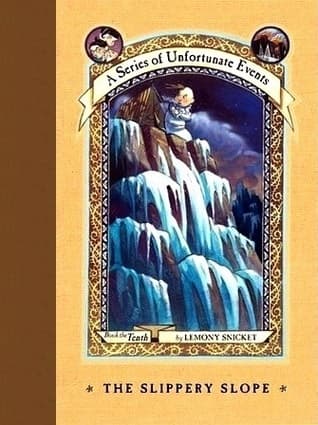
Synopsis
Covers the whole plot, including the ending.
- Difficulty
- Medium
- Pacing
- Moderate
- Mood
- Mysterious, Melancholy, Witty, Suspenseful
- Read it if
- You enjoy clever wordplay, a sense of impending doom, and mysteries that only deepen with each turn of the page.
- Skip it if
- You prefer clear-cut resolutions, happy endings, or stories without a constant, pervasive sense of melancholy.
The Slippery Slope Plot Summary
Covers the whole plot, including the ending.
The Ascent to the Mortmain Mountains
After escaping the Caligari Carnival, the Baudelaire orphans – Violet, Klaus, and Sunny – are separated from the Quagmire triplets. Count Olaf carries the Quagmires away in a caravan, while the Baudelaires cling to the caravan's outside. They eventually fall into a river and manage to get to shore. Knowing they must reach the V.F.D. headquarters in the Mortmain Mountains, they begin their difficult climb. The tough terrain and freezing temperatures are an immediate challenge, and they are aware of the danger Count Olaf and his friends still pose, especially to the Quagmires.
Encountering the Snow Scouts
As the Baudelaires climb the icy slopes, they meet a group of children in white uniforms, called the Snow Scouts. Led by a cheerful man named Bruce, the scouts are on their annual winter camping trip, getting ready for a 'Great Inquisitor' ceremony. The Baudelaires, needing shelter and a way to continue their search for V.F.D., pretend to be new recruits. They quickly learn the Snow Scouts are well-organized, with strict rules and merit badges, but their cheerfulness hides a troubling ignorance of dangers, especially villains like Count Olaf.
The Cave of the Snow Gnats
While with the Snow Scouts, Violet deciphers a secret message left by the Quagmires: 'V.F.D. VIOLET, KLAUS, SUNNY. MORTMAIN MOUNTAINS. VERMILION. FEAR. DESPONDENCY.' This message, along with a map the Quagmires left, leads them to a hidden cave. The cave, however, is not safe; it is dark, damp, freezing, and full of venomous snow gnats. The Baudelaires realize this is a test or a trap, and they must use their intelligence to get through the dangerous place while still looking for clues about V.F.D.
Sunny's Disguise and the Villains' Camp
Sunny, using her climbing skills and a clever disguise, manages to get into Count Olaf's camp, located in a nearby cave. She pretends to be a new, very young helper, earning the trust of Olaf's associates, including the Hook-Handed Man and the Man with a Beard but No Hair and the Woman with Hair but No Beard. Inside the camp, Sunny finds the Quagmire triplets in a birdcage. She overhears Olaf's plans to use the Quagmires to get their fortune and learn V.F.D. secrets, confirming their worst fears about the triplets.
The Toboggan and the Great Inquisitor
Back in the Snow Scouts' cave, Violet and Klaus, with Sunny's information, know they must act fast to rescue their sister and the Quagmires. Violet, the inventor, uses her skills to build a makeshift toboggan from found materials. Klaus, the researcher, checks the Snow Scouts' rulebook for anything that might help their escape or create a distraction. They plan to use the toboggan to go down the mountain quickly and reach Olaf's camp before the Snow Scouts' 'Great Inquisitor' ceremony begins, knowing their absence will soon be noticed.
The Perilous Descent
The Baudelaires begin a dangerous descent down the Mortmain Mountains on their homemade toboggan. The journey is full of danger, as icy slopes and unexpected obstacles threaten to overturn their fragile craft. The Snow Scouts, who discovered their absence, also pursue them, determined to bring them back for the 'Great Inquisitor' ceremony. The children must use all their combined skills – Violet's engineering, Klaus's knowledge, and Sunny's sharp teeth – to navigate the path and outsmart their relentless, though misguided, pursuers.
Reaching the Villains' Camp and the Casserole Dish
Against the odds, the Baudelaires reach Count Olaf's camp. They sneak in, but find the Quagmires are no longer in the birdcage. Instead, they find a mysterious covered casserole dish. The villains are preparing a meal, and the children think the dish might contain a clue or even the Quagmires themselves, in some bad situation. This unexpected event adds more mystery and urgency to their mission; they must uncover the dish's contents without alerting Olaf and his helpers.
The Man with a Beard but No Hair and the Woman with Hair but No Beard
While trying to investigate the casserole dish, the Baudelaires face the Man with a Beard but No Hair and the Woman with Hair but No Beard. These two mysterious figures, high-ranking members of Olaf's group, reveal bits of information about the V.F.D. organization, hinting at a deep split within its ranks. They speak of 'volunteers' and 'villains,' blurring the lines between good and evil. The children realize the conflict is more complex than they first thought, and that not all V.F.D. members share the same goals or methods.
The Great Inquisitor and the Trap
Count Olaf, having expected the Baudelaires' arrival, forces them to take part in the Snow Scouts' 'Great Inquisitor' ceremony. It quickly becomes clear the ceremony is a sham, a trap designed by Olaf to question the children and get information about the V.F.D. sugar bowl, which he believes they have. The Snow Scouts, unaware of Olaf's true intentions, unknowingly help him. The Baudelaires must use their combined intelligence to navigate this dangerous interrogation, protect V.F.D. secrets, and escape Olaf's grasp again.
A Surprising Survivor and the Sugar Bowl
During the chaotic 'Great Inquisitor' ceremony, a surprising event happens. The Baudelaires meet a figure they thought was dead: their guardian, Justice Strauss's sister, Josephine Anwhistle. Josephine, though confused, says she survived the fire and has been hiding. She also speaks of the great importance of the V.F.D. sugar bowl, a mysterious object with vital secrets related to the organization. This revelation deepens the mystery and gives the children a renewed sense of purpose, as they realize the sugar bowl is key to understanding their parents' past and V.F.D.'s true nature.
The Toboggan Escape and the Waterfall
With Josephine's help, the Baudelaires escape Count Olaf again, fleeing on their makeshift toboggan. However, their escape route leads them toward a large waterfall at the edge of the Mortmain Mountains. The children realize they are in a bad situation, with the rushing water threatening to carry them over the edge. They must quickly plan to avoid certain doom, using their cleverness and teamwork to get past this natural obstacle and continue their journey to the V.F.D. headquarters.
The Secret Passage and the Headquarters
Just as they seem doomed to fall over the waterfall, the Baudelaires find a secret passage hidden behind the water. This passage leads them into a hidden cave, which they realize is the entrance to the V.F.D. headquarters. The children feel both relief and worry, knowing they are finally close to finding the truth about their parents and the mysterious organization. However, the headquarters looks abandoned and damaged, suggesting V.F.D. itself may be in disarray, leaving the children with more questions than answers.
The Schism and the Disappearance
Inside the V.F.D. headquarters, the Baudelaires find signs of a major split within the organization. There are signs of conflict and abandonment, suggesting that the volunteers have divided, with some becoming villains. They discover cryptic notes and damaged equipment, indicating a struggle took place. The headquarters is mostly empty, with no sign of their parents or any other volunteers who might help them. This discovery leaves the children feeling more alone than ever, realizing that the organization they hoped would protect them is itself broken and in danger.
The Last Safe Place and the Unanswered Questions
Before leaving the V.F.D. headquarters, the Baudelaires find a final message from their parents, hinting at a 'last safe place' and further stressing the sugar bowl's importance. The message is incomplete and cryptic, leaving the children with more questions than answers. They understand that the sugar bowl holds the key to the entire V.F.D. mystery, but its location and true purpose remain unknown. The children continue their journey, more determined than ever to uncover the truth and protect V.F.D. secrets.
The End of the Slope, The Start of a New Mystery
After escaping Count Olaf and navigating the Mortmain Mountains, the Baudelaire orphans descend to the bottom, leaving the icy peaks behind. They are no closer to finding the Quagmire triplets, and the V.F.D. sugar bowl mystery remains unsolved. However, they have learned about the complex and fractured nature of V.F.D. and the extent of Count Olaf's influence. As they move into an unknown future, they are more determined than ever to find the truth about their parents' past, the organization, and the sugar bowl, which they now understand is central to everything.
Principal Figures
Violet Baudelaire
Protagonist
The eldest Baudelaire, an inventive and resourceful young girl.
Violet is the eldest of the Baudelaire orphans, known for her incredible talent for inventing and her practical problem-solving skills. When faced with a challenge, she ties her hair back with a ribbon, signaling her deep concentration. She is protective of her younger siblings, Klaus and Sunny, and often takes the lead in devising their escape plans. Despite the constant adversity, Violet maintains a resilient and determined spirit, always seeking logical solutions to their impossible predicaments.
Relationships: Klaus Baudelaire (Sister, collaborative partner); Sunny Baudelaire (Sister, caregiver); Count Olaf (Nemesis, tormentor)
Klaus Baudelaire
Protagonist
The middle Baudelaire, a highly intelligent and well-read young boy.
Klaus is the middle Baudelaire, distinguished by his love for books and his encyclopedic knowledge. He has a remarkable memory and can recall vast amounts of information from his reading, which often proves crucial in their escapes. He is the family's researcher and strategist, often finding vital clues in texts or making logical deductions. Klaus is loyal and brave, using his intellect to complement Violet's inventions and Sunny's unique abilities, working tirelessly to protect his sisters.
Relationships: Violet Baudelaire (Brother, collaborative partner); Sunny Baudelaire (Brother, caregiver); Count Olaf (Nemesis, tormentor)
Sunny Baudelaire
Protagonist
The youngest Baudelaire, an infant with surprisingly strong teeth and unique abilities.
Sunny is the youngest Baudelaire, initially communicating in a series of babbles and later in increasingly understandable words. Despite her age, she possesses incredibly sharp teeth, which she uses for biting, climbing, and even lock-picking. She also has a keen sense of observation and often notices details overlooked by her older siblings. Sunny is fiercely loyal and surprisingly brave, contributing significantly to the orphans' survival with her unique, often unexpected, skills.
Relationships: Violet Baudelaire (Sister, caregiver); Klaus Baudelaire (Sister, caregiver); Count Olaf (Nemesis, tormentor)
Count Olaf
Antagonist
The villainous actor relentlessly pursuing the Baudelaire fortune.
Count Olaf is the primary antagonist, a cruel and greedy actor obsessed with acquiring the Baudelaire fortune. He is cunning, manipulative, and relentless, constantly devising new disguises and schemes to capture the orphans. Olaf is often accompanied by his various henchpeople, who are equally incompetent and villainous. He represents the overarching evil in the children's lives, embodying the injustice and misfortune that plagues them at every turn, and is deeply connected to the mysteries of V.F.D.
Relationships: Violet Baudelaire (Nemesis, persecutor); Klaus Baudelaire (Nemesis, persecutor); Sunny Baudelaire (Nemesis, persecutor); Esmé Squalor (Accomplice, romantic partner)
Bruce
Supporting
The overly cheerful and oblivious leader of the Snow Scouts.
Bruce is the leader of the Snow Scouts, an organization of children who embark on an annual winter camping trip. He is perpetually cheerful and enthusiastic, often oblivious to the dangers around him and the true nature of Count Olaf. Bruce adheres strictly to the Snow Scouts' rules and traditions, including their system of merit badges and the 'Great Inquisitor' ceremony. Despite his good intentions, his naivete and rigid adherence to rules inadvertently put the Baudelaires in danger.
Relationships: Snow Scouts (Leader); Baudelaire Orphans (Temporary guardian (unwittingly))
The Man with a Beard but No Hair
Supporting
A mysterious and formidable associate of Count Olaf.
This enigmatic figure is one of Count Olaf's most loyal and dangerous henchpeople. He is known for his distinctive appearance and his intimidating presence. Along with the Woman with Hair but No Beard, he appears to have a deeper understanding of the V.F.D. schism and the organization's secrets than the other henchpeople. He is ruthless and cunning, directly involved in Olaf's schemes to capture the Baudelaires and the Quagmires, and poses a significant threat to the orphans.
Relationships: Count Olaf (Accomplice, subordinate); The Woman with Hair but No Beard (Accomplice)
The Woman with Hair but No Beard
Supporting
A mysterious and formidable associate of Count Olaf.
Another of Count Olaf's most dangerous and loyal associates, she shares a similar enigmatic aura with the Man with a Beard but No Hair. Her distinctive appearance and ruthless demeanor make her a formidable opponent for the Baudelaires. She, too, seems to possess insider knowledge about the V.F.D. organization and its internal conflicts, often hinting at the deeper complexities of the good-versus-evil struggle. She is a key player in Olaf's plans and a constant source of threat to the children.
Relationships: Count Olaf (Accomplice, subordinate); The Man with a Beard but No Hair (Accomplice)
Josephine Anwhistle
Supporting
A surprisingly surviving former guardian of the Baudelaires.
Josephine Anwhistle is the Baudelaires' former guardian, whom they believed to be dead after the events at Lake Lachrymose. Her unexpected reappearance on the Mortmain Mountains is a shocking twist. She is revealed to have survived the leeches and has been living in hiding, though disoriented by her ordeal. Josephine provides crucial, albeit fragmented, information about the V.F.D. organization and the significance of the sugar bowl, offering a glimmer of hope and further deepening the mystery.
Relationships: Baudelaire Orphans (Former guardian); Justice Strauss (Sister)
Quigley Quagmire
Mentioned
A Quagmire triplet, believed to be dead, who reappears in the series.
Quigley Quagmire is one of the Quagmire triplets, previously thought to have perished in a fire. While not physically present with the Baudelaires in this book, his survival is hinted at, and his knowledge of cartography and V.F.D. is central to the Baudelaires' quest. He is a brave and intelligent young man, and his presumed presence in the Mortmain Mountains motivates the Baudelaires to find him and his siblings.
Relationships: Duncan Quagmire (Brother); Isadora Quagmire (Sister); Baudelaire Orphans (Friends, fellow V.F.D. associates)
Themes & Insights
The Nature of Good and Evil
This theme explores how good and evil become unclear, especially within the V.F.D. organization. The Baudelaires meet 'volunteers' who act like villains and discover that V.F.D. itself has split, making it hard to tell allies from enemies. The Snow Scouts, while seemingly good, unknowingly help Count Olaf, showing how good intentions can be used. This challenges the children's simple view of the world, as seen when the Man with a Beard but No Hair and the Woman with Hair but No Beard hint at the complexities of the V.F.D. conflict.
“The world is a vast and complicated place, and there are many people in it who are neither good nor bad but simply confused or misguided.”
The Power of Knowledge and Invention
The Baudelaires constantly use their unique skills – Violet's inventing, Klaus's knowledge, and Sunny's sharp teeth – to get past seemingly impossible problems. Violet building the toboggan and Klaus reading the Quagmires' coded messages are good examples. Their combined skills are their most valuable assets, showing that intelligence and cleverness are stronger than force or money. This theme is key to their survival in the Mortmain Mountains and their ability to outsmart Count Olaf.
“Reading is one way to use your imagination, and it's a very good way, because if you read enough, you can imagine anything.”
The Importance of Family and Loyalty
Despite constant threats and separations, the bond between the Baudelaire orphans stays strong. Their loyalty to each other drives them, motivating them to endure extreme hardships. Sunny going into Olaf's camp to find the Quagmires and Violet and Klaus's desperate efforts to rescue her show their deep family love. This theme highlights that in a world of betrayal and danger, their dedication to one another is their strongest defense and their only true comfort.
“No matter what happens, you will always have each other.”
The Elusiveness of Truth and Answers
Throughout their journey up the Mortmain Mountains, the Baudelaires constantly look for answers about V.F.D., their parents, and the sugar bowl. Each clue they find, such as the Quagmires' message or Josephine's partial revelations, only leads to more questions. The V.F.D. headquarters itself, found in disarray, offers no clear solutions. This theme emphasizes the Baudelaires' struggle to find truth in a world full of mystery, deceit, and incomplete information, making their quest increasingly frustrating and dangerous.
“The truth is like a picture, and it can look very different depending on what angle you look at it from.”
Plot Devices & Literary Techniques
The Secret Message
A cryptic coded message left by the Quagmire triplets for the Baudelaires.
The secret message, 'V.F.D. VIOLET, KLAUS, SUNNY. MORTMAIN MOUNTAINS. VERMILION. FEAR. DESPONDENCY,' left by the Quagmires, serves as a crucial plot device. It guides the Baudelaires' journey up the Mortmain Mountains, providing them with their next objective and a sense of direction. Its cryptic nature also introduces the concept of coded communication within V.F.D., forcing Klaus to use his deciphering skills and deepening the mystery surrounding the organization and its members.
The Deceitful Map
A map that initially seems helpful but contains misleading information.
The map given to the Baudelaires by the Quagmires is a classic example of a deceitful map. While it points them towards the Mortmain Mountains, it also contains deliberately misleading or incomplete information, forcing the children to rely on their intelligence and observation rather than blindly following instructions. This device heightens the sense of danger and uncertainty, as the Baudelaires realize they cannot trust every piece of information they encounter, even from presumed allies, reflecting the V.F.D. schism.
The Snow Scouts and the Great Inquisitor
A seemingly innocent children's organization manipulated by Count Olaf.
The Snow Scouts, led by the oblivious Bruce, and their 'Great Inquisitor' ceremony function as a clever plot device for Count Olaf to trap and interrogate the Baudelaires. The children's innocence and strict adherence to rules are exploited, creating a façade of normalcy that masks a sinister purpose. This device highlights the theme of blurred lines between good and evil, showing how even well-meaning groups can be unwittingly used by villains, and forcing the Baudelaires into a public, dangerous confrontation.
The Covered Casserole Dish
A mysterious object that holds a hidden secret or clue.
The covered casserole dish found in Count Olaf's camp is a classic MacGuffin, acting as a focal point for the Baudelaires' immediate attention and curiosity. Its contents are unknown, leading the children (and the reader) to speculate about what it might contain – perhaps the Quagmires, a secret message, or a vital V.F.D. artifact. This device creates suspense and drives a portion of the plot, as the Baudelaires attempt to uncover its secrets without alerting Olaf, revealing more about his plans.
The Sugar Bowl
A recurring, enigmatic object of immense importance to V.F.D. and Count Olaf.
The sugar bowl, though not directly found or explained in this book, is established as a central and highly significant plot device. Its importance is hinted at by Josephine Anwhistle and in the final message at the V.F.D. headquarters. It serves as a powerful motivator for both the Baudelaires and Count Olaf, driving their actions and quests. The sugar bowl represents the ultimate secret of V.F.D. and the key to understanding the entire series' overarching mystery, ensuring its continued relevance in future books.
The Slippery Slope Quotes
“It is a curious thing, the death of a parent. We are told that it is sad, and that is true. But it is also a curious thing, the way that life goes on.”
“The world is a vast and complicated place, and there are a great many things in it that are not fair.”
“There are some things that cannot be fixed, but there are also some things that can be. And it is important to know the difference.”
“The future is a thing that can be shaped, if you are brave enough to try.”
“It is often the small things, the seemingly insignificant details, that prove to be the most important.”
“Sometimes, the only way to get through a difficult time is to pretend that you are not in a difficult time at all.”
“The greatest treasures are not always found in chests of gold, but in the minds of those who seek them.”
“A secret, once it is told, is no longer a secret. But a secret, once it is kept, can be a heavy burden.”
“Even in the darkest of times, there is always a flicker of hope, however small.”
“It is a rare and precious thing to find someone who understands you, even if they do not always agree with you.”
“The truth, like a slippery slope, can be difficult to grasp and even harder to hold onto.”
“Reading is one of the greatest pleasures in life, and once you have acquired it, no one can ever take it away from you.”
“Sometimes, the most important thing you can do is simply to keep going, even when you feel like giving up.”
Quiz
10 questions on the plot and the characters. Each answer comes with a short explanation.
Question 1
Upon reaching the Mortmain Mountains, where do the Baudelaire orphans initially believe they must go to meet the V.F.D. survivors?
- The Valley of Four-Way Intersection
- The V.F.D. headquarters
- The Last Safe Place
- The Eagle's Nest
Show answer
C. The Last Safe Place The Baudelaires are trying to reach 'The Last Safe Place' in the Mortmain Mountains, as indicated by the coded message and their understanding of the V.F.D.
Question 2
What is the name of the organization of youngsters Count Olaf has recruited to assist him in the Mortmain Mountains?
- The Snow Scouts
- The Mountain Mountaineers
- The V.F.D. Recruits
- The Orphan Alliance
Show answer
A. The Snow Scouts Count Olaf's new henchmen are a group of children called the Snow Scouts, led by the deceitful Carmelita Spats.
Question 3
What item does Sunny Baudelaire use to rappel down the side of the Mortmain Mountains, demonstrating her growing teeth and skills?
- A long rope
- A stack of blankets
- A long strand of her own hair, braided by Violet
- A length of strong licorice rope
Show answer
D. A length of strong licorice rope Sunny uses her strong teeth to rappel down the mountain on a licorice rope, showcasing her unique abilities.
Question 4
What coded message do the Baudelaires decipher from the V.F.D. signal fires, leading them further into the mountains?
- The Last Safe Place is at the top
- The V.F.D. headquarters are compromised
- Meet us at the Eagle's Nest
- The Last Safe Place is not safe
Show answer
D. The Last Safe Place is not safe The Baudelaires decipher the signal fires to reveal the crucial message: 'The Last Safe Place is not safe,' indicating a change of plans.
Question 5
Which character, presumed dead in a previous fire, makes a surprising reappearance in 'The Slippery Slope'?
- Justice Strauss
- Captain Widdershins
- Quigley Quagmire
- Jacquelyn S. Scieszka
Show answer
C. Quigley Quagmire Quigley Quagmire, one of the triplets believed to have perished in the Quagmire fire, is revealed to be alive and a V.F.D. volunteer.
Question 6
What unique skill does Quigley Quagmire possess that proves useful to the Baudelaires in navigating the mountains?
- He is an expert at cryptography and decoding messages.
- He is an expert cartographer and has a photographic memory for maps.
- He is a master of disguise and can infiltrate Olaf's camp.
- He knows every secret V.F.D. handshake and password.
Show answer
B. He is an expert cartographer and has a photographic memory for maps. Quigley's expertise as a cartographer, combined with his eidetic memory, allows him to draw accurate maps from memory, which is crucial for the Baudelaires.
Question 7
What is the primary theme explored through the Baudelaires' decision to join Count Olaf's troupe in disguise, rather than escape immediately?
- The importance of family loyalty.
- The idea that sometimes one must do something wrong for the right reasons.
- The futility of fighting against evil.
- The enduring power of hope.
Show answer
B. The idea that sometimes one must do something wrong for the right reasons. The Baudelaires' decision to infiltrate Olaf's camp, even if it means acting against their moral compass, highlights the theme of 'noble deception' or doing bad things for good reasons, a recurring moral dilemma in the series.
Question 8
What is the significance of the covered casserole dish that the Baudelaires find, which leads them to the location of the V.F.D. headquarters (or lack thereof)?
- It contains a secret message written in invisible ink.
- It is a decoy planted by Count Olaf to mislead them.
- It is a V.F.D. signal, indicating a meeting place, but it's empty.
- It holds the last remaining sugar bowl.
Show answer
C. It is a V.F.D. signal, indicating a meeting place, but it's empty. The covered casserole dish is a V.F.D. signal item, meant to indicate a meeting place. Its emptiness and the surrounding desolate area signify that the V.F.D. headquarters have been destroyed or abandoned.
Question 9
The treacherous journey up the Mortmain Mountains, filled with snow gnats and slippery slopes, serves as a metaphor for what overarching theme in the series?
- The literal dangers of cold weather and high altitudes.
- The Baudelaires' constant uphill battle against adversity and their search for truth.
- The isolation and loneliness of orphanhood.
- The importance of proper climbing equipment.
Show answer
B. The Baudelaires' constant uphill battle against adversity and their search for truth. The 'slippery slope' of the mountains directly symbolizes the Baudelaires' continuous struggle against overwhelming odds and their difficult, often morally ambiguous, path towards uncovering the truth about V.F.D. and their parents.
Question 10
What is the ultimate, disheartening revelation the Baudelaires discover about 'The Last Safe Place' at the end of their arduous ascent?
- It is a secret hideout for Count Olaf.
- It is merely a burnt-down shell of the V.F.D. headquarters, no longer safe.
- It is a trap set by the Volunteers to test their loyalty.
- It is a misdirection, and the true safe place is elsewhere.
Show answer
B. It is merely a burnt-down shell of the V.F.D. headquarters, no longer safe. Despite their efforts, the Baudelaires find that 'The Last Safe Place' is not safe at all; it's the remains of the V.F.D. headquarters, destroyed by fire, leaving them with no immediate refuge.
The Slippery Slope FAQ
What is the primary setting for 'The Slippery Slope' and what immediate challenge do the Baudelaires face there?
The primary setting is the Mortmain Mountains, specifically the treacherous Mount Fraught. The Baudelaires, having been separated from Quigley Quagmire, must navigate the icy, slippery slopes and harsh weather conditions while trying to reunite and find the V.F.D. headquarters.
How do the Baudelaires initially become separated from Quigley Quagmire, and what object facilitates their individual journeys?
The Baudelaires and Quigley are separated when the toboggan they are riding breaks apart on the treacherous Mortmain Mountain slopes. Violet and Klaus fall one way, Sunny another, and Quigley is sent off in a different direction by the current, leaving them to find their way with a grappling hook, a rope, and a toboggan.
Who are the Snow Scouts, and what role do they play in the Baudelaires' adventure on Mount Fraught?
The Snow Scouts are a large group of children led by Carmelita Spats, who are on their way to a 'casserole party' at the V.F.D. headquarters. They initially offer the Baudelaires a ride up the mountain, but quickly turn hostile and unhelpful, ultimately leaving the orphans to fend for themselves after Carmelita's rude behavior.
What is the significance of the 'covered casserole dish' mentioned by Lemony Snicket in the introduction?
The covered casserole dish is the disguise used by Count Olaf and Esmé Squalor to infiltrate the V.F.D. headquarters. It contains the Medusoid Mycelium, a deadly fungus they intend to unleash upon the V.F.D. volunteers at the 'casserole party,' revealing their sinister plan to eliminate their enemies.
How does Sunny Baudelaire's journey differ from Violet and Klaus's, and what unique challenges does she face?
Sunny is separated from her siblings early on and ends up with Count Olaf and his troupe. She is forced to act as his assistant, enduring his cruelty and participating in the Snow Scouts' activities, while also secretly communicating with her siblings through coded messages using the Snow Scouts' activities.
What is the secret message that Lemony Snicket alludes to, and how is it conveyed?
The secret message is the coded communication between Sunny and her siblings. Sunny uses the Snow Scouts' songs and activities, like 'The Song of the Incredibly Deadly Viper,' to convey information about Olaf's plans and her location to Violet and Klaus, who are able to decipher her clues.
Who is the 'surprising survivor of a terrible fire' mentioned in the introduction, and what is their connection to the Baudelaires?
The surprising survivor is Quigley Quagmire, who the Baudelaires believed perished in the Quagmire fire. He is revealed to be alive and working as a V.F.D. volunteer, and his reunion with Violet sparks a significant connection and provides crucial information about the V.F.D.
What is the true nature of the V.F.D. headquarters on Mount Fraught, and why is it so difficult to access?
The V.F.D. headquarters is a hidden, multi-level cave system built into the side of Mount Fraught, known as the 'Secret Headquarters.' It is difficult to access due to the treacherous icy slopes, the need for specific V.F.D. knowledge to navigate, and the constant threat of Count Olaf and the hostile Snow Scouts.
How does the 'deceitful map' play a role in the Baudelaires' journey, and what makes it deceptive?
The 'deceitful map' is the one given to the Snow Scouts, which leads them to the V.F.D. headquarters. It's deceitful because it doesn't reveal the true nature of the headquarters or the dangers within, instead presenting it as merely a location for a party, thus luring unsuspecting volunteers into Olaf's trap.
How does Violet's ingenuity manifest on Mount Fraught, particularly in overcoming environmental obstacles?
Violet's mechanical genius is crucial for survival. She invents a grappling hook and modified snowshoes to navigate the icy slopes, and later devises a way to use the toboggan as a makeshift shelter and transportation, demonstrating her ability to adapt and innovate under pressure.
What psychological impact does their separation have on the Baudelaire siblings, especially in Sunny's case?
The separation deeply distresses all three, but Sunny, being the youngest and alone with Olaf, experiences significant fear and isolation. However, her resilience and cleverness shine through as she devises a way to communicate, demonstrating her growth and determination despite her vulnerable position.
How does Klaus's intellectualism contribute to their survival and understanding of the V.F.D.'s secrets?
Klaus's vast knowledge and research skills are vital for deciphering the coded messages from Sunny and understanding the complex V.F.D. clues. He uses his intelligence to interpret the ambiguous information, allowing them to navigate the mountain and uncover Olaf's plans.
Discuss the theme of trust and betrayal as it is explored through the Snow Scouts and Carmelita Spats.
The Snow Scouts, particularly Carmelita, represent the theme of superficial trust leading to betrayal. The Baudelaires initially hope for help, but Carmelita's self-centeredness and cruelty, coupled with the Scouts' blind obedience, quickly turn them into adversaries, highlighting how easily trust can be misplaced and exploited.
What is the deeper symbolism of the 'slippery slope' itself, beyond the literal treacherous mountain terrain?
The 'slippery slope' symbolizes the increasingly perilous and morally ambiguous path the Baudelaires are forced to tread as they delve deeper into the V.F.D. mystery. It represents the loss of innocence, the difficulty of distinguishing right from wrong, and the constant danger of falling into despair or making irreversible choices.
How does the recurring motif of 'eyes' (e.g., Olaf's tattoo, the spyglass) contribute to the book's themes of surveillance and hidden knowledge?
The 'eyes' motif emphasizes the constant surveillance and the struggle for hidden knowledge. Olaf's eye tattoo signifies his pervasive presence and watchful nature, while the spyglass represents the V.F.D.'s need to observe and gather information, highlighting a world where secrets are paramount and trust is scarce.
What is the moral ambiguity surrounding the actions of the V.F.D. in this book, particularly regarding their 'headquarters'?
The V.F.D.'s moral ambiguity is evident in their hidden headquarters, which, while meant for good, is also a site where a deadly weapon (the Medusoid Mycelium) is stored and where volunteers are gathered under potentially misleading pretenses. This blurs the lines between heroes and villains, suggesting that even 'good' organizations have their flaws.
How does the discovery of Quigley Quagmire challenge the Baudelaires' understanding of loss and family?
Quigley's survival profoundly challenges their understanding of loss, offering a glimmer of hope that others they believed dead might also be alive. It expands their concept of family beyond immediate relatives, as they connect with another orphan who shares a similar tragic past, fostering a new sense of belonging and purpose.
In what ways does 'The Slippery Slope' mark a turning point in the Baudelaires' journey, particularly regarding their agency?
'The Slippery Slope' marks a significant turning point as the Baudelaires actively seek out the V.F.D. and begin to take more control over their destiny, rather than simply reacting to Olaf's schemes. They become more proactive, deciphering clues and making conscious decisions to uncover the truth, asserting their agency in a world that has long controlled them.
About the author
Lemony Snicket is the pen name of author Daniel Handler, known for his children's books featuring dark humor and whimsical storytelling. His series "A Series of Unfortunate Events" includes titles such as The Bad Beginning, The Reptile Room, The Wide Window, The Miserable Mill, The Austere Academy, and The Ersatz Elevator, which follow the misadventures of the Baudelaire orphans. Snicket's work has garnered a significant following and has been adapted into various media, including films and television.
Similar books
- Coraline
Neil Gaiman
4.0 (23k) average on GoodreadsFantasyDark, whimsical, and slightly unsettling tone with a young protagonist facing strange dangers.
- Harry Potter and the Sorcerer's Stone
J.K. Rowling
4.5 (7M) average on GoodreadsFantasyRowling's work, though it introduces dark elements, ultimately resolves with the triumph of good over evil and features a strong sense of hope and belonging. Snicket's narrative, conversely, consistently denies the Baudelaires lasting relief or a safe haven, forcing readers to contend with a more persistent sense of despair and unresolved questions, rather than the clear moral victories found in Harry Potter.
- The Hunger Games
Suzanne Collins
4.3 (6.4M) average on GoodreadsFantasyIn a future where children fight to the death on live television, Katniss Everdeen volunteers for the arena, turning a death sentence into a fight for survival and a spark of rebellion.
- 1984
George Orwell
4.2 (3.1M) average on GoodreadsPoliticsIn a future where surveillance and thought control are absolute, a man's search for truth clashes with the Party, showing that hope can be a form of rebellion.
- Divergent
Veronica Roth
4.2 (2.9M) average on GoodreadsFantasyIn a society divided by virtues, a sixteen-year-old's difference from the norm starts a rebellion that threatens her world.
- The Hobbit, or There and Back Again
J.R.R. Tolkien
4.3 (2.9M) average on GoodreadsFantasyA comfort-loving hobbit named Bilbo Baggins is whisked away by a mischievous wizard and a band of dwarves on an unexpected journey to reclaim stolen treasure from a fearsome dragon, discovering courage and a magical ring along the way.






Enjoyed the summary?
A summary gives you the shape of the book. The book itself has the detail, the examples and the voice.
Find The Slippery Slope on AmazonAs an Amazon Associate, BookBrief earns from qualifying purchases. How we're funded