
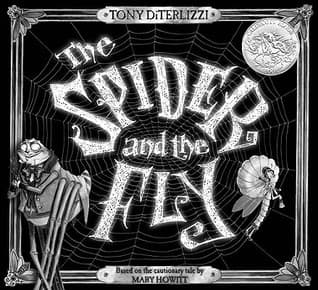
Synopsis
Covers the whole plot, including the ending.
- Difficulty
- Easy
- Pacing
- Moderate
- Mood
- Dark, Cautionary, Atmospheric, Suspenseful
- Read it if
- You enjoy classic cautionary tales with a dark, atmospheric twist, or appreciate children's literature with a strong moral message.
- Skip it if
- You prefer light-hearted stories without a sad or fatalistic ending.
The Spider and the Fly Plot Summary
Covers the whole plot, including the ending.
The Spider's Invitation
The story begins with a well-dressed Spider, shown in a classic film noir style, talking to a delicate, winged Fly. He tries to tempt her into his fancy parlor with an offer of a 'very pretty parlor' and a 'winding stair' to go up. The Spider highlights the beauty and comfort of his home, suggesting she rest there. His words are sweet and inviting, hiding his true predatory goals. The setting is a grand, old mansion, with the Spider's web subtly built into the architecture, hinting at the danger beneath the charm.
The Fly's Initial Refusal
The Fly, though pleased, remembers an old saying and wisely declines the Spider's first invitation. She states that anyone who goes up his winding stair never comes down again, showing she knows the danger, at least a little. Her refusal is polite but firm, showing a hint of self-preservation. The Spider, however, is not stopped by this first rejection and keeps his charming act, already planning his next persuasive move. This interaction sets up the power dynamic and the Fly's risky situation.
An Offer of Refreshment
Not stopping, the Spider changes his approach, offering the Fly 'some provisions' and a 'nice little bed' in his parlor. He pretends to care for her well-being, suggesting she must be tired and hungry from flying. He promises soft sheets and a comfortable rest, appealing to her physical needs. The Spider's words aim to build trust and comfort, drawing the Fly closer to his web. The visuals show the Spider's persistence and the Fly's thought, as she hesitates between caution and temptation.
The Fly's Second Refusal
The Fly, still careful, again refuses the Spider's offer. She mentions that she has heard of his pantry and knows that he never lets his guests leave once they enter. Her words show a deeper understanding of the Spider's true nature and the fate of those who fall for his tricks. Despite her awareness, the Spider continues his relentless pursuit, shifting his methods to more direct flattery. This resistance from the Fly only seems to make the Spider more determined to trap her.
Flattery and Admiration
The Spider, realizing direct appeals to comfort and food are failing, changes his plan to pure flattery. He praises the Fly's 'gauzy wings,' 'brilliant eyes,' and 'gorgeous green and purple hue.' He calls her 'dear friend' and expresses his admiration, trying to appeal to her vanity. His words aim to disarm her caution and make her feel special. The illustrations show the Spider's smooth, persuasive manner and the Fly's subtle reaction to the compliments, showing her guard slowly starting to lower.
An Offer of a Mirror
To make his flattery stronger, the Spider offers the Fly a chance to see her own beauty reflected in his parlor mirror. He suggests that such a 'rich and rare' creature should be able to admire herself. This is a subtle but strong trick, playing directly into the Fly's vanity and wish to see herself as the beautiful creature the Spider describes. The offer of the mirror serves as a direct invitation into his lair, presented as a helpful act rather than a trap. The Fly begins to show signs of being persuaded.
The Fly's Temptation and Approach
Won over by the Spider's sweet words and the promise of seeing her own beauty, the Fly's caution finally fades. She 'fluttered her wings so pretty, and she began to draw nigh.' The flattery has worked, and she is now under the Spider's spell, losing her earlier wariness. The illustrations show the Fly slowly, almost hypnotically, moving closer to the Spider's web, her first resistance completely gone because of the clever predator's words. The trap is now near.
The Fatal Entry
The Fly, completely fooled by the Spider's lies, finally enters his parlor. As she steps inside, the Spider, no longer needing his charming act, quickly grabs her. The atmosphere instantly changes from elegant persuasion to stark horror. The 'parlor' is revealed to be a deadly web, and the Spider's true nature as a predator is shown. This scene marks the sad end of the Spider's manipulation and the Fly's fatal vanity. The illustrations show the moment of capture with dramatic effect, reflecting the classic horror movie inspiration.
The Spider's Feast
Once the Fly is caught, the Spider quickly carries her up his 'winding stair' to his 'dismal den.' He wastes no time in eating her, showing the swift and brutal end to her life. The earlier warnings of others never returning from the parlor are sadly realized. The Spider's victory is complete, and the moral of the story is delivered with harsh finality. The scene is grim, leaving no doubt about the Fly's unfortunate death and the results of giving in to flattery.
The Moral of the Story
The story ends with a direct message to the reader, especially children, warning them against the dangers of flattery and deceit. The narrator advises not to listen to 'idle, silly, flattering words' and to recognize those with 'wicked heart and evil eye.' The moral highlights the importance of judgment and caution when faced with people who use sweet words to hide harmful intentions. It serves as a cautionary tale, strengthening the lessons learned from the Fly's tragic fate, ensuring the reader understands the main message.
Principal Figures
The Spider
Antagonist
A cunning, deceptive predator who uses flattery to ensnare his victims.
The Spider is the embodiment of deceit and manipulative charm. He presents himself as a sophisticated, dapper gentleman, living in a grand, inviting parlor. His primary motivation is to lure unsuspecting prey into his web for sustenance. He is patient, persistent, and highly skilled in psychological manipulation, adapting his tactics from offers of comfort to lavish flattery. He represents the danger of those who hide malicious intent behind sweet words and an appealing facade.
Relationships: The Fly (predator and prey; manipulator and victim)
The Fly
Protagonist
A naive and ultimately vain insect who succumbs to flattery.
The Fly is initially portrayed as cautious and somewhat aware of the dangers posed by the Spider, recalling old sayings about his true nature. However, she is also susceptible to vanity and flattery. Her desire to be seen as beautiful and special ultimately overrides her initial good sense, leading her to her demise. She represents the vulnerability of those who are easily swayed by compliments and fail to see through superficial charm, highlighting the consequences of not heeding warnings.
Relationships: The Spider (prey and predator; victim and manipulator)
The Narrator
Supporting
The voice of warning and moral guidance.
The Narrator is an omniscient presence who guides the reader through the tale, setting the scene, describing the characters' actions and motivations, and ultimately delivering the moral lesson. The Narrator's role is crucial in framing the story as a cautionary tale, directly addressing the audience and imparting wisdom about discerning true intentions from deceptive appearances. The Narrator is the moral compass of the story, ensuring its educational purpose is clear.
Themes & Insights
Deception and Manipulation
The main theme is the Spider's skillful use of deception and manipulation to trick the Fly. He uses sweet words, false promises of comfort, and flattery to hide his predatory intentions. This is clear from his first invitation to his 'pretty parlor' (plot_summary index 1) to his strategic compliments about the Fly's beauty (plot_summary index 5). The Spider's entire interaction is a calculated act to disarm and trap his victim, showing how charm can be a dangerous disguise.
“Will you walk into my parlor?' said the Spider to the Fly; 'Tis the prettiest little parlor that ever you did spy.”
Vanity and Gullibility
The Fly's sad downfall is mostly due to her vanity and gullibility. Despite initial caution and knowing the Spider's reputation (plot_summary index 2, 4), she eventually gives in to his lavish compliments about her beauty (plot_summary index 5). The Spider's offer of a mirror (plot_summary index 6) is the final, irresistible lure that appeals directly to her self-admiration, causing her to ignore her instincts and fall into the trap (plot_summary index 7, 8). This theme warns against letting pride override good judgment.
“Oh no, no!' said the little Fly, 'kind Sir, that cannot be; I've heard what's in your pantry, and I do not wish to see.”
The Danger of Unheeded Warnings
The story highlights the danger of ignoring warnings, both internal and external. The Fly first remembers and states her awareness of the Spider's true nature, saying that those who enter his parlor never return (plot_summary index 2, 4). However, her resolve weakens under the Spider's constant flattery. The story itself warns the reader (plot_summary index 10) not to be swayed by 'idle, silly, flattering words,' reinforcing the idea that ignoring caution can lead to bad results.
“And now, dear little children, who may this story read, To idle, silly, flattering words, I pray you ne'er give heed.”
Predation and Innocence
This theme explores the sharp contrast between the Spider's predatory nature and the Fly's relative innocence (or vulnerability). The Spider represents pure evil hidden in charm, driven by the instinct to consume. The Fly, while not entirely free of vanity, is ultimately outmatched by the Spider's cunning. The story clearly shows the brutal reality of predation when the Fly is finally caught and eaten (plot_summary index 8, 9), serving as a metaphor for how the innocent can become victims of malevolence.
“Then in he dragged her, up his winding stair, Into his dismal den, with none to hear.”
Plot Devices & Literary Techniques
Personification
Animals are given human-like qualities and speech.
The central plot device is the personification of the Spider and the Fly. They are given the ability to speak, reason, and exhibit complex human emotions and behaviors, such as cunning, vanity, and politeness. The Spider is depicted as a dapper, manipulative gentleman, while the Fly is a delicate, susceptible lady. This device allows the abstract concepts of deception and gullibility to be explored through an engaging narrative, making the moral lesson more accessible and memorable, especially for a children's audience.
Allegory
The story serves as a symbolic representation of real-world dangers.
The entire narrative functions as an allegory for the dangers of flattery and the importance of recognizing deceitful intentions in human interactions. The Spider symbolizes manipulative individuals who use charm and sweet talk to exploit others, while the Fly represents those who are vulnerable to such tactics due to vanity or naiveté. The 'parlor' and 'web' symbolize the traps laid by predators, whether literal or figurative, making the story's moral universally applicable beyond the animal kingdom.
Dramatic Irony
The reader is aware of the Spider's true intentions, while the Fly is not.
Dramatic irony is prevalent throughout the story. From the outset, the reader knows the Spider's true, malicious intent to ensnare and devour the Fly, even as the Spider offers seemingly kind invitations and compliments. The Fly, however, is initially cautious but eventually falls prey to the deception. This creates tension and suspense, as the reader anticipates the inevitable tragic outcome, making the Fly's eventual capture all the more poignant and serving to reinforce the cautionary message.
Rhetorical Questions
The Spider uses questions to draw the Fly into conversation and consideration.
The Spider frequently employs rhetorical questions as a manipulative tactic. Phrases like 'Will you walk into my parlor?' or 'How can I do aught but praise your gauzy wings?' are not merely questions seeking information, but rather persuasive tools designed to engage the Fly, disarm her, and subtly guide her thoughts towards accepting his offers. These questions create a conversational dynamic that makes the Spider seem less threatening and more inviting, slowly eroding the Fly's defenses.
The Spider and the Fly Quotes
“'Will you walk into my parlour?' said the Spider to the Fly,”
“'Tis the prettiest little parlour that ever you did spy.”
“The way into my parlour is up a winding stair,”
“And I've many pretty things to show when you are there.”
“'Oh no, no,' said the little Fly, 'to ask me is in vain,”
“For who goes up your winding stair can ne'er come down again.'”
“I'm sure you must be weary, dear, with soaring up so high;”
“Will you rest upon my little bed?' said the Spider to the Fly.”
“I've got a little looking-glass upon my drawing-room shelf,”
“If you'll step in one moment, dear, you shall behold yourself.'”
“At length, up jumped the silly Fly, 'Oh dear, what shall I do?”
“I'll take a peep, but quickly fly away again from you.'”
“He dragged her up his winding stair, into his dismal den,”
“Within his little parlour, but she ne'er came out again!”
“This foolish fly, with flattery's snare, was caught at last, and died.”
Quiz
10 questions on the plot and the characters. Each answer comes with a short explanation.
Question 1
What is the famous opening line spoken by the Spider?
- 'Come on in, little friend,' said the Spider to the Fly...
- 'Will you walk into my parlor,' said the Spider to the Fly...
- 'Such a lovely home I have,' said the Spider to the Fly...
- 'Don't be shy, my dear,' said the Spider to the Fly...
Show answer
B. 'Will you walk into my parlor,' said the Spider to the Fly... The most recognized and quoted first line of the poem is 'Will you walk into my parlor,' said the Spider to the Fly...
Question 2
What is the primary warning Mary Howitt intended to convey to her children through this poem?
- To always be polite to strangers.
- To avoid all insects, especially spiders.
- To be wary of those who use sweet words to hide bad intentions.
- To never enter a stranger's house.
Show answer
C. To be wary of those who use sweet words to hide bad intentions. The poem serves as a warning about individuals who use charming language to conceal their harmful motives, as stated in the book description.
Question 3
What artistic style or genre inspired Tony DiTerlizzi's illustrations for the book?
- Classic fairy tale illustrations from the Victorian era.
- Modern animation and comic book art.
- Classic Hollywood horror movies of the 1920s and 1930s.
- Abstract expressionism.
Show answer
C. Classic Hollywood horror movies of the 1920s and 1930s. The book description explicitly states that Tony DiTerlizzi drew inspiration from 'classic Hollywood horror movies of the 1920s and 1930s'.
Question 4
Which of the following compliments does the Spider *not* use to try and lure the Fly into its parlor?
- Praising the Fly's wings and eyes.
- Offering a comfortable bed for rest.
- Suggesting a grand feast of delicious nectar.
- Mentioning a looking-glass to admire herself.
Show answer
C. Suggesting a grand feast of delicious nectar. While the Spider offers many enticements like a bed and a looking-glass, it does not explicitly offer a 'grand feast of delicious nectar' as a primary lure.
Question 5
Initially, how does the Fly react to the Spider's invitations?
- She immediately accepts, eager for a rest.
- She expresses caution and declines the invitations.
- She asks the Spider to come out and play instead.
- She makes a counter-offer to the Spider.
Show answer
B. She expresses caution and declines the invitations. The Fly initially resists the Spider's advances, stating she knows what happens to those who enter the parlor and never return.
Question 6
What is the crucial turning point where the Fly begins to succumb to the Spider's flattery?
- When the Spider offers her a cup of tea.
- When the Spider praises her beauty and wit excessively.
- When the Spider shows her a hidden treasure.
- When the Spider threatens her with violence.
Show answer
B. When the Spider praises her beauty and wit excessively. The Fly's resistance weakens when the Spider begins to flatter her appearance and intelligence, appealing to her vanity.
Question 7
What happens to the Fly at the very end of the original poem by Mary Howitt?
- She escapes at the last moment, realizing the danger.
- She becomes friends with the Spider.
- She is caught and consumed by the Spider.
- She turns into a spider herself.
Show answer
C. She is caught and consumed by the Spider. The poem ends with the Fly entering the parlor and being trapped and eaten by the Spider, serving as the ultimate consequence of falling for flattery.
Question 8
The Spider's character can be best described as an embodiment of which negative trait?
- Laziness.
- Over-confidence.
- Deceitful manipulation.
- Cowardice.
Show answer
C. Deceitful manipulation. The Spider consistently uses 'sweet words to hide [its] not-so-sweet intentions,' making it a prime example of deceitful manipulation.
Question 9
What specific human vulnerability does the Spider exploit to ensnare the Fly?
- Fear of loneliness.
- Desire for wealth.
- Vanity and susceptibility to flattery.
- Need for shelter.
Show answer
C. Vanity and susceptibility to flattery. The Spider's success comes from its relentless flattery of the Fly's appearance and perceived qualities, directly targeting the Fly's vanity.
Question 10
How does Tony DiTerlizzi's chosen artistic inspiration ('classic Hollywood horror movies of the 1920s and 1930s') enhance the poem's original message?
- It makes the story more humorous and lighthearted.
- It adds a layer of suspense and ominous atmosphere, highlighting the danger.
- It shifts the focus from the moral to the visual aesthetics of the characters.
- It introduces new plot twists not present in the original poem.
Show answer
B. It adds a layer of suspense and ominous atmosphere, highlighting the danger. The 'cinematic spotlight' from classic horror movies would naturally lend a sense of suspense, dread, and heightened danger, thus reinforcing the warning about hidden evil.
The Spider and the Fly FAQ
What is the core message Mary Botham Howitt intended to convey with 'The Spider and the Fly'?
Howitt's primary intention was to warn her children about the dangers of flattery and those who use sweet words and deceptive appearances to hide malicious intentions. She aimed to teach them to be wary of individuals who try to lure them into harmful situations with enticing but ultimately false promises.
How does Tony DiTerlizzi's artistic interpretation enhance or alter the original poem's tone?
DiTerlizzi's art, inspired by classic Hollywood horror movies of the 1920s and 1930s, significantly darkens the tone, making the Spider's manipulation more overtly sinister and the Fly's naivety more tragic. The cinematic style emphasizes the suspense and the predatory nature of the encounter, transforming a cautionary tale into a visual thriller.
Describe the Spider's initial attempts to lure the Fly into its parlor.
The Spider first invites the Fly to its 'parlor,' praising its beauty and offering a comfortable resting place. When the Fly refuses, the Spider then offers a 'pretty little bed' and a look at its 'many pretty things,' including 'curious things' in its pantry, attempting to appeal to the Fly's curiosity and desire for comfort.
What is the ultimate fate of the Fly in the poem?
After repeated refusals, the Fly is eventually swayed by the Spider's flattery, particularly when the Spider praises its 'witty and wise' mind and 'gorgeous wings.' The Fly flies into the parlor and is never seen again, having fallen prey to the Spider's trap and been devoured.
What specific visual cues in DiTerlizzi's illustrations nod to classic Hollywood horror?
DiTerlizzi incorporates elements like dramatic chiaroscuro lighting, exaggerated shadows, art deco architectural details, and character designs reminiscent of creatures from films like 'Frankenstein' or 'Dracula.' The Spider's lair often resembles a gothic mansion, and the Spider itself has a menacing, almost human-like intelligence in its expressions.
Are there any subtle hints about the Spider's true intentions before the Fly enters the parlor?
Yes, the poem mentions 'many curious things' in the Spider's pantry and 'a little space' for the Fly, which, in retrospect, are veiled threats. DiTerlizzi's illustrations often show shadows of previous victims or skeletal remains, making the Spider's true nature more explicit even before the Fly's demise.
Does the poem suggest the Fly had any prior knowledge or warnings about the Spider?
The poem doesn't explicitly state the Fly received prior warnings, but the Fly initially shows wisdom by refusing the Spider's invitations, indicating an inherent wariness or understanding of potential danger. However, this initial caution is ultimately overcome by vanity and the Spider's persistent flattery.
How does the Spider exploit the Fly's psychological vulnerabilities?
The Spider masterfully exploits the Fly's vanity and desire for admiration by showering it with compliments about its beauty, wisdom, and wings. It also appeals to the Fly's curiosity and comfort, creating an irresistible allure that overrides its initial good judgment and fear.
Analyze the Spider's manipulative tactics. What makes them so effective?
The Spider's tactics are effective because they are persistent, varied, and target the Fly's ego. It uses flattery, offers of comfort, and appeals to curiosity, gradually wearing down the Fly's resistance. The Spider also isolates the Fly, preventing external influences from reinforcing its caution.
What psychological state is the Fly in when it finally decides to enter the parlor?
The Fly is in a state of flattered delusion and inflated ego. It has succumbed to the Spider's continuous praise, believing itself to be 'witty and wise' and beautiful enough to warrant such attention, thus lowering its guard and ignoring its own instincts of self-preservation.
What warning does the poem implicitly give to the reader about trusting appearances?
The poem strongly warns that 'sweet words' and enticing invitations can hide 'not-so-sweet intentions.' It teaches that appearances can be deceiving, and one should look beyond superficial charm to discern true motives, especially when someone seems too eager to offer something for nothing.
Could the Fly's decision be interpreted as a metaphor for succumbing to temptation in a broader sense?
Absolutely. The Fly's journey into the parlor can be seen as a metaphor for succumbing to various temptations, whether they be material desires, social pressures, or the allure of flattery, despite knowing the potential negative consequences. It highlights the struggle between self-control and external enticements.
Is there any room for the Spider to be seen as anything other than purely evil?
While the Spider's actions are predatory, from a purely naturalistic perspective, it is simply acting on its instinct for survival. However, the poem's personification and emphasis on its 'subtle art' and 'sweet words' frame it within a moral context, making it difficult to view its deception as anything but malevolent within the story's cautionary framework.
How does the poem's ending reinforce its cautionary message?
The abrupt and final ending, where the Fly is 'never seen again,' provides a stark and unambiguous reinforcement of the cautionary message. It demonstrates the irreversible consequences of falling for flattery and ignoring warnings, leaving no doubt about the danger of the Spider's deceptive nature.
What makes this poem timeless and continually relevant for new generations?
The poem's timelessness stems from its universal theme: the danger of deception and the importance of critical thinking. The human vulnerabilities it explores—vanity, curiosity, and the desire for acceptance—are constant, making its warning about manipulative individuals perennially relevant for children and adults alike.
Are there specific lines in the poem that best encapsulate the Spider's cunning?
The lines 'Oh no, no, thank you, kind sir, for that cannot be; / I've heard what's in your pantry, and I do not wish to see' followed by the Spider's immediate shift to flattery, 'Sweet creature, you're witty and wise,' perfectly illustrate its cunning adaptation and relentless pursuit.
How does the 'parlor' itself function as a symbol in the narrative?
The 'parlor' symbolizes a trap disguised as comfort and hospitality. It represents any enticing but dangerous situation or place designed to lure the unsuspecting. It's a façade of safety that conceals a deadly threat, much like the Spider's sweet words hide its true intentions.
About the author

Mary Botham Howitt was a 19th-century English author known for her contributions to children's literature. She is best known for her poem "The Spider and the Fly," which has been widely published and illustrated. Howitt's works primarily focus on fiction, often exploring moral themes and lessons for young readers.
Similar books
- Stellaluna
Janell Cannon
4.2 (108k) average on GoodreadsFantasyFeatures beautiful illustrations and a focus on nature, though 'The Spider and the Fly' is much darker.
- Harry Potter and the Sorcerer's Stone
J.K. Rowling
4.5 (7M) average on GoodreadsFantasyRescued from a miserable life under the stairs, an orphaned boy discovers he's a wizard destined for a magical school, where he uncovers a dangerous secret tied to the dark wizard who murdered his parents.
- The Hunger Games
Suzanne Collins
4.3 (6.4M) average on GoodreadsFantasyIn a future where children fight to the death on live television, Katniss Everdeen volunteers for the arena, turning a death sentence into a fight for survival and a spark of rebellion.
- 1984
George Orwell
4.2 (3.1M) average on GoodreadsPoliticsIn a future where surveillance and thought control are absolute, a man's search for truth clashes with the Party, showing that hope can be a form of rebellion.
- Divergent
Veronica Roth
4.2 (2.9M) average on GoodreadsFantasyIn a society divided by virtues, a sixteen-year-old's difference from the norm starts a rebellion that threatens her world.
- The Hobbit, or There and Back Again
J.R.R. Tolkien
4.3 (2.9M) average on GoodreadsFantasyA comfort-loving hobbit named Bilbo Baggins is whisked away by a mischievous wizard and a band of dwarves on an unexpected journey to reclaim stolen treasure from a fearsome dragon, discovering courage and a magical ring along the way.





Enjoyed the summary?
A summary gives you the shape of the book. The book itself has the detail, the examples and the voice.
Find The Spider and the Fly on AmazonAs an Amazon Associate, BookBrief earns from qualifying purchases. How we're funded