
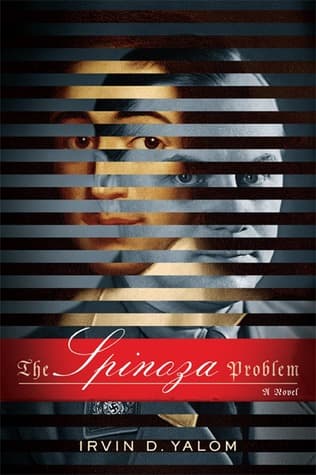
Synopsis
Covers the whole plot, including the ending.
- Difficulty
- Medium
- Pacing
- Moderate
- Mood
- Thought-provoking, Philosophical, Historical, Somber, Introspective
- Read it if
- You enjoy historical fiction that delves into deep philosophical and psychological themes, particularly the intersection of individual thought and historical events.
- Skip it if
- You prefer fast-paced thrillers or lighthearted reads, or are uncomfortable with detailed explorations of anti-Semitism and Nazi ideology.
The Spinoza Problem Plot Summary
Covers the whole plot, including the ending.
The Headmaster's Punishment
In 1908, sixteen-year-old Alfred Rosenberg, a student at a Gymnasium in Reval, Russia, gives a speech filled with anti-Semitic remarks. His headmaster, Dr. Heinrich Blücher, a man of quiet authority, calls Rosenberg into his office. Instead of expulsion, Blücher assigns Rosenberg a unique punishment: he must memorize passages from Goethe's autobiography, 'Poetry and Truth,' specifically those praising the Jewish philosopher Baruch Spinoza. Rosenberg, an admirer of Goethe and a budding anti-Semite, is deeply disturbed by this. He struggles with the idea of his idol revering a Jew, planting the seeds of his lifelong 'Spinoza Problem.'
Spinoza's Excommunication
In 1656 Amsterdam, the young scholar Baruch Spinoza, known for his radical philosophical ideas questioning the nature of God and the divine origin of the Torah, faces growing scrutiny from the Jewish community's rabbinical council. Despite warnings, Spinoza refuses to change his beliefs, which are deemed heretical. He is ultimately excommunicated, a severe banishment that severs all ties with his family, friends, and the only community he has ever known. This event forces Spinoza into a life of isolation, dedicated solely to his philosophical pursuits, supported by a small circle of loyal friends.
Rosenberg's Obsession Deepens
Years later, after World War I, Alfred Rosenberg becomes a prominent figure in the Nazi Party, a close confidant of Adolf Hitler, and a chief ideologue of racial theory. Despite his rise to power and his commitment to anti-Semitism, the 'Spinoza Problem' continues to trouble him. He studies Spinoza's works, not to understand them, but to find flaws and reasons for his hatred, viewing Spinoza as the ultimate intellectual representation of the 'Jewish spirit' he seeks to eradicate. He believes Spinoza's philosophy, though profound, must somehow be 'Jewish' and therefore corrupting.
Spinoza's Philosophical Circle
Following his excommunication, Spinoza moves to Rijnsburg and then Voorburg, supporting himself by grinding lenses. He is not entirely alone. He maintains a small, devoted circle of friends and students, including figures like Jarig Jelles, Simon de Vries, and Lodewijk Meyer, who value his intellect and courage. These individuals provide financial support, intellectual discussion, and emotional comfort, enabling Spinoza to continue his work on his major work, 'Ethics.' These interactions show Spinoza's ability for deep personal connection despite his societal ostracism.
The Nazi Looting of Spinoza's Library
During World War II, as the Nazi regime spreads across Europe, Alfred Rosenberg, now head of the Einsatzstab Reichsleiter Rosenberg (ERR), an organization dedicated to looting cultural property, develops a new part of his Spinoza obsession. He orders his subordinates, particularly a young SS officer named Friedrich Pfister, to find and confiscate Spinoza's personal library, believing it holds the key to understanding and ultimately discrediting the philosopher. This mission, while seemingly absurd during a global war, shows the depth of Rosenberg's pathological fixation and his desire to erase or control Spinoza's legacy.
Spinoza's Love for Clara
Early in his life, while studying Latin and other subjects with the scholar Franciscus van den Enden, Spinoza falls deeply in love with van den Enden's intelligent daughter, Clara Maria. Clara, however, is more drawn to another of her father's students, Dirk Kerckrinck, who offers her a more conventional life and a diamond ring. Spinoza's unrequited love for Clara is a significant emotional experience, shaping his understanding of human passion and perhaps contributing to his later philosophical detachment, yet also revealing a capacity for human connection and vulnerability.
Rosenberg and the Nuremberg Trials
After the defeat of Nazi Germany, Alfred Rosenberg is captured and stands trial at Nuremberg for war crimes and crimes against humanity. During his imprisonment and trial, his 'Spinoza Problem' resurfaces in his thoughts. He continues to struggle with the philosopher's influence on Goethe and the perceived 'Jewishness' of Spinoza's universal philosophy, even as he faces the ultimate consequences of his own hateful ideology. His inability to reconcile his hatred with Spinoza's thought highlights the intellectual and moral emptiness of his anti-Semitic worldview, which ultimately leads to his conviction and execution.
Spinoza's Final Years and Legacy
Spinoza spends his final years in The Hague, continuing his work on 'Ethics,' a treatise that argues for a monistic universe where God and Nature are one, and human freedom is achieved through understanding and reason. Despite suffering from a lung ailment, likely worsened by glass dust from his lens grinding, he remains dedicated to his philosophy. He dies in 1677 at the age of forty-four, leaving behind a body of work that would influence the Enlightenment and subsequent philosophical thought, solidifying his place as one of history's most original and impactful thinkers, posthumously vindicated.
The Search for Spinoza's Synagogue
As part of Rosenberg's directive to locate Spinoza's library, SS officer Friedrich Pfister and his team arrive in Amsterdam. Their mission expands to include finding the synagogue where Spinoza was excommunicated, believing it might contain clues or documents related to the philosopher. This search, conducted amidst the Nazi occupation and persecution of Dutch Jews, shows the perverse nature of Rosenberg's obsession. The historical sites of Spinoza's life become targets of an ideological quest to understand and ultimately negate his Jewish identity and philosophical influence.
Blüher's Enduring Influence
Years after Rosenberg's schooling, Dr. Heinrich Blücher, the headmaster who assigned the Spinoza punishment, continues to follow Rosenberg's rise in the Nazi Party with a heavy heart. He reflects on his youthful attempt to use Goethe and Spinoza to broaden Rosenberg's mind and counter his anti-Semitism. Blücher represents the intellectual and moral opposition to Nazism, a figure who tried to plant seeds of enlightenment in a mind that ultimately chose darkness. His reflections highlight the tragic failure of reason and humanity in the face of ingrained prejudice.
Spinoza's Brother-in-Law and the Cherem
Following Spinoza's excommunication, his family, particularly his sister Rebekah and her husband, struggle with the implications of the ban. All contact with Spinoza is forbidden, and the family faces social ostracism and potential economic hardship within the close-knit Jewish community. This aspect of the narrative shows the personal cost of Spinoza's intellectual integrity, showing how his pursuit of truth directly impacted not only his own life but also the lives of those closest to him, forcing them to choose between familial loyalty and communal adherence.
The Unattainable Library
Despite Alfred Rosenberg's fervent orders and Friedrich Pfister's diligent search, Spinoza's personal library is never found. The historical reality is that Spinoza, living a modest life, did not possess a large, identifiable personal library that could be easily confiscated. This historical fact shows the ultimate futility and misguided nature of Rosenberg's entire 'Spinoza Problem.' His obsessive quest for a tangible representation of Spinoza's 'Jewishness' to destroy is based on a fundamental misunderstanding of Spinoza's essence, which lies not in possessions but in his lasting, universal ideas.
Principal Figures
Baruch Spinoza
Protagonist
The 17th-century Dutch Jewish philosopher excommunicated for his radical ideas.
Spinoza is depicted as a man of profound intellect, unwavering integrity, and quiet dignity. He is driven by an insatiable quest for truth and a desire to understand God and Nature through reason, even if it means sacrificing personal comfort, community, and family ties. He is deeply compassionate but also intellectually resolute, refusing to compromise his philosophical convictions. His life is characterized by isolation and dedication to his work, yet he forms deep, meaningful connections with a select group of friends.
Relationships: Clara Maria van den Enden (Unrequited love interest, intellectual companion); Jarig Jelles (Loyal friend, supporter, intellectual peer); Simon de Vries (Devoted student, financial supporter); Rabbinical Council (Adversaries, persecutors leading to his excommunication)
Alfred Rosenberg
Antagonist
The chief Nazi ideologue obsessed with Spinoza and a fervent anti-Semite.
Rosenberg is portrayed as a deeply insecure, intellectually arrogant, and pathologically anti-Semitic individual. His driving force is a need to rationalize his hatred and elevate his own perceived racial superiority. He is haunted by the 'Spinoza Problem' – the cognitive dissonance of his idol Goethe admiring a Jew – which fuels his lifelong obsession. He is a man consumed by ideology, unable to genuinely engage with ideas that challenge his prejudices, instead twisting them to fit his hateful worldview. He lacks empathy and critical self-reflection.
Relationships: Dr. Heinrich Blüher (Headmaster who challenged his early anti-Semitism); Adolf Hitler (Political leader, object of loyalty and ideological alignment); Friedrich Pfister (Subordinate in the ERR, tasked with Rosenberg's personal quests)
Dr. Heinrich Blüher
Supporting
Rosenberg's discerning headmaster who tries to challenge his nascent anti-Semitism.
Dr. Blüher is a wise, intellectual, and morally upright headmaster. He possesses a keen understanding of human nature and recognizes the dangerous seeds of hatred in young Rosenberg. His actions are driven by a belief in the power of education and enlightenment to counter prejudice. He is a figure of quiet authority and represents the voice of reason and humanism, deeply troubled by the path Rosenberg ultimately takes.
Relationships: Alfred Rosenberg (Student under his tutelage, object of his moral concern)
Clara Maria van den Enden
Supporting
Spinoza's intelligent and spirited love interest.
Clara is depicted as a bright, independent, and vivacious young woman, the daughter of Spinoza's Latin teacher. She is intellectually curious and enjoys engaging in philosophical discussions, matching Spinoza's wit. Her decision to choose a more conventional life with another suitor deeply affects Spinoza, highlighting his human vulnerability and capacity for love, despite his later philosophical detachment.
Relationships: Baruch Spinoza (Object of unrequited love, intellectual companion); Franciscus van den Enden (Father, teacher)
Jarig Jelles
Supporting
A loyal Mennonite merchant and a devoted friend to Spinoza.
Jelles is a kind, devout, and intellectually open-minded individual who becomes one of Spinoza's most trusted friends and supporters. He provides both financial assistance and intellectual companionship, engaging deeply with Spinoza's radical ideas despite his own religious convictions. Jelles represents the possibility of interfaith understanding and the power of genuine friendship.
Relationships: Baruch Spinoza (Close friend, supporter, intellectual peer)
Simon de Vries
Supporting
A wealthy merchant and devoted student of Spinoza.
Simon de Vries is a younger, wealthy student who deeply admires Spinoza's philosophy and offers him generous financial support. He is eager to learn and internalize Spinoza's teachings, demonstrating the profound impact Spinoza had on those who sought his wisdom. His devotion underscores Spinoza's magnetic intellectual presence.
Relationships: Baruch Spinoza (Devoted student, financial benefactor)
Friedrich Pfister
Supporting
The SS officer tasked by Rosenberg to find Spinoza's library.
Pfister is a young, intelligent, and somewhat conflicted SS officer. He is initially a loyal servant of the Nazi regime, but as he delves into Rosenberg's bizarre quest for Spinoza's library, he begins to feel a subtle dissonance. He is a meticulous operative, but his exposure to the intellectual world surrounding Spinoza's legacy hints at a nascent questioning of the ideological fervor he serves.
Relationships: Alfred Rosenberg (Superior officer, giver of bizarre orders)
Goethe
Mentioned
The revered German poet and polymath whose admiration for Spinoza sparks Rosenberg's obsession.
Johann Wolfgang von Goethe is presented as a towering figure of German culture and intellect, revered by Rosenberg. His profound admiration for Spinoza, particularly his concept of God in Nature, serves as the initial catalyst for Rosenberg's 'Spinoza Problem.' Goethe represents the pinnacle of German cultural achievement, making his connection to a Jewish philosopher an unbearable paradox for Rosenberg.
Relationships: Alfred Rosenberg (Idolized figure, source of intellectual torment); Baruch Spinoza (Philosopher admired and studied by Goethe)
Themes & Insights
The Nature of Hatred and Prejudice
The novel explores the roots and forms of hatred, particularly anti-Semitism, through Alfred Rosenberg. It shows how prejudice can be deeply ingrained, resistant to reason, and even fueled by intellectual curiosity twisted to serve a hateful agenda. Rosenberg's 'Spinoza Problem' shows how a mind consumed by hatred seeks to destroy or discredit anything that challenges its preconceived notions, even if it means distorting history and philosophy. His inability to reconcile Goethe's admiration for Spinoza highlights the irrationality at the core of his anti-Semitism, which seeks to categorize and demean rather than understand. This theme is shown in Rosenberg's lifelong obsession with Spinoza, twisting the philosopher's universal ideas into a justification for his own racial theories, and in his quest to eradicate Spinoza's legacy by confiscating his library.
“How could the German genius Goethe have been inspired by a member of a race Rosenberg considers so inferior to his own, a race he was determined to destroy?”
The Pursuit of Truth vs. Ideological Blindness
This theme contrasts Spinoza's commitment to rational inquiry and the pursuit of truth, wherever it may lead, with Rosenberg's ideological blindness and his distortion of truth to fit a predefined narrative. Spinoza sacrifices everything—family, community, comfort—for his philosophical convictions, showing intellectual integrity. Rosenberg, conversely, filters all knowledge through the lens of his anti-Semitic ideology, seeking to validate his hatred rather than to understand. The novel highlights how genuine intellectual curiosity, exemplified by Spinoza, opens minds, while ideological dogma, as seen in Rosenberg, closes them, leading to intellectual and moral decay.
“Freedom is the understanding that God is Nature and that all things are determined by its immutable laws. To achieve freedom, one must understand these laws.”
The Power and Peril of Ideas
The book shows the impact ideas can have, for both good and ill. Spinoza's ideas, though initially condemned, endure to shape modern philosophy and inspire generations towards reason and tolerance. In stark contrast, Rosenberg's hateful ideology, rooted in distorted ideas about race and identity, leads to unimaginable suffering and genocide. The 'Spinoza Problem' itself is an idea—a troubling intellectual paradox—that consumes Rosenberg. The narrative illustrates how ideas, once unleashed, can either elevate humanity or lead to its darkest depths, depending on how they are interpreted and applied, and the moral character of those who embrace them.
“Ideas can be like viruses, taking hold and spreading, sometimes for good, sometimes for ill.”
Isolation and Connection
Both Spinoza and Rosenberg experience forms of isolation, but with vastly different implications. Spinoza's isolation, largely self-imposed after his excommunication for intellectual freedom, allows him to dedicate himself fully to his work, fostering internal connection to truth and finding solace in a small, loyal intellectual community. Rosenberg's isolation, on the other hand, is born of his inability to truly connect with others beyond ideological alignment; his hatred alienates him, and his 'Spinoza Problem' is a solitary torment. The theme explores how external isolation can lead to internal growth or festering prejudice, depending on an individual's inner world and their capacity for genuine human connection.
“All my life, I have sought to understand the world, not to change it. And in that understanding, I have found my freedom.”
Plot Devices & Literary Techniques
The 'Spinoza Problem'
A central cognitive dissonance that drives Alfred Rosenberg's lifelong obsession.
The 'Spinoza Problem' is the core psychological device that propels Rosenberg's character arc. It refers to his inability to reconcile the fact that his German idol, Goethe, deeply admired the Jewish philosopher Baruch Spinoza, whom Rosenberg, as a virulent anti-Semite, viewed as representing an inferior race. This intellectual paradox fuels Rosenberg's obsessive study of Spinoza, not to understand or appreciate, but to find flaws and justifications for his hatred. It serves as a constant, internal torment and a symbol of the irrationality at the heart of his prejudice, highlighting the futility of trying to reconcile profound intellect with deep-seated hatred.
Dual Narrative Structure
Alternating chapters between Spinoza's 17th-century life and Rosenberg's 20th-century story.
The novel employs a dual narrative structure, alternating between the biographical story of Baruch Spinoza's life in 17th-century Amsterdam and the historical fiction narrative of Alfred Rosenberg's life in the 20th century. This device allows for a direct thematic and philosophical comparison between the two men, separated by centuries but linked by the 'Spinoza Problem.' It highlights the parallels in their experiences of isolation and the stark contrasts in their responses to intellectual challenges and societal pressures. The juxtaposition amplifies the themes of truth vs. prejudice and the enduring power of ideas across time.
Historical Intersections
Fictionalized encounters or shared spaces that link the two protagonists.
While Spinoza and Rosenberg are separated by 300 years, the narrative creates fictionalized 'intersections' that symbolically link their lives. These include Rosenberg's men searching for Spinoza's library or his synagogue in occupied Amsterdam. These invented plot points serve as powerful plot devices to underscore Rosenberg's obsessive quest to control or erase Spinoza's legacy, even centuries later. They dramatize the ideological conflict and allow the author to explore the destructive nature of Rosenberg's hatred against the backdrop of Spinoza's enduring philosophical presence.
The Unattainable Object (Spinoza's Library)
Rosenberg's futile quest for Spinoza's personal library.
Rosenberg's order for his SS officer, Friedrich Pfister, to locate and confiscate Spinoza's personal library serves as a symbolic plot device. This quest is ultimately futile, as Spinoza lived a modest life and likely didn't possess a grand, identifiable library. The unattainability of the library underscores the misguided nature of Rosenberg's obsession. He seeks a tangible manifestation of Spinoza's 'Jewishness' to destroy, failing to grasp that Spinoza's true legacy lies in his intangible, universal ideas, which cannot be confiscated or eradicated. It highlights the intellectual bankruptcy of Rosenberg's materialistic approach to philosophy and culture.
The Spinoza Problem Quotes
“The mind is not a substance, but an activity, a process, a becoming.”
“Freedom is not the absence of necessity, but the recognition of it.”
“God, or Nature, is one and the same thing.”
“To understand is to be free.”
“The highest good is the knowledge of God.”
“No one has yet determined what the body can do.”
“If you want the present to be different from the past, study the past.”
“The more you understand yourself, the more you understand others.”
“We are not disturbed by things, but by the views we take of them.”
“The human mind is part of the infinite intellect of God.”
“Sadness decreases the body's power of acting.”
“Each thing, in so far as it is in itself, endeavors to persist in its own being.”
“Only in the quiet of the mind can one truly hear the voice of reason.”
“The greatest good is common to all.”
Quiz
10 questions on the plot and the characters. Each answer comes with a short explanation.
Question 1
What was the initial punishment given to sixteen-year-old Alfred Rosenberg for his anti-Semitic remarks?
- He was expelled from school.
- He was forced to write an apology to the Jewish community.
- He was required to memorize passages about Spinoza from Goethe's autobiography.
- He had to attend a re-education camp.
Show answer
C. He was required to memorize passages about Spinoza from Goethe's autobiography. As punishment, Rosenberg was made to memorize passages about Spinoza from Goethe's autobiography, which unexpectedly introduced him to Spinoza.
Question 2
What was the 'Spinoza problem' that haunted Alfred Rosenberg?
- How Spinoza managed to live without means and in isolation.
- How the German genius Goethe could admire a member of a race Rosenberg considered inferior.
- The philosophical complexities of Spinoza's works.
- The details of Spinoza's excommunication from the Jewish community.
Show answer
B. How the German genius Goethe could admire a member of a race Rosenberg considered inferior. Rosenberg was perplexed by how his idol, Goethe, could admire Spinoza, a Jew, given Rosenberg's own anti-Semitic beliefs.
Question 3
At what age was Baruch Spinoza excommunicated from the Amsterdam Jewish community?
- Sixteen
- Twenty-four
- Thirty-two
- Forty
Show answer
B. Twenty-four Spinoza was excommunicated from the Amsterdam Jewish community in 1656, at the age of twenty-four, due to his unorthodox religious views.
Question 4
What role did Alfred Rosenberg eventually play in the Third Reich?
- He was a military general.
- He was a prominent economist.
- He became an outspoken Nazi ideologue and the main author of racial policy.
- He served as Hitler's personal physician.
Show answer
C. He became an outspoken Nazi ideologue and the main author of racial policy. Rosenberg rose to become an outspoken Nazi ideologue, a faithful servant of Hitler, and the main author of racial policy for the Third Reich.
Question 5
What is the primary contrast explored by Irvin D. Yalom between Spinoza and Rosenberg?
- Their differing views on political leadership.
- Their approaches to scientific discovery.
- The saintly secular philosopher versus the godless mass murderer.
- Their experiences with social isolation.
Show answer
C. The saintly secular philosopher versus the godless mass murderer. Yalom uses his skills as a psychiatrist to explore the inner lives of Spinoza, 'the saintly secular philosopher,' and Rosenberg, 'the godless mass murderer,' highlighting their stark moral and philosophical contrast.
Question 6
How did Spinoza's life circumstances impact his ability to produce his influential works?
- His wealth provided him with ample time for study and writing.
- His political connections granted him access to important libraries.
- Despite living without means and in great isolation, he still produced works that changed the course of history.
- He relied on patronage from the Amsterdam Jewish community.
Show answer
C. Despite living without means and in great isolation, he still produced works that changed the course of history. The text states that 'Though his life was short and he lived without means in great isolation, he nonetheless produced works that changed the course of history,' emphasizing his resilience.
Question 7
The book explores the 'unexpected intersection' of Spinoza's life with Rosenberg's. What is the primary connection that brings these two historically separated figures together in the narrative?
- They both lived in Amsterdam at different times.
- Rosenberg's persistent obsession with Spinoza, initiated by his punishment and Goethe's admiration.
- Spinoza's writings directly influenced Rosenberg's racial policies.
- They were both excommunicated from their respective communities.
Show answer
B. Rosenberg's persistent obsession with Spinoza, initiated by his punishment and Goethe's admiration. The 'Spinoza problem' and Rosenberg's enduring obsession with Spinoza, sparked by Goethe's admiration, create the unexpected intersection between their lives across centuries.
Question 8
What specific characteristic of Goethe made his admiration for Spinoza so problematic for Alfred Rosenberg?
- Goethe's status as a renowned scientist.
- Goethe's German nationality and status as Rosenberg's idol.
- Goethe's known anti-religious sentiments.
- Goethe's influence on the Enlightenment.
Show answer
B. Goethe's German nationality and status as Rosenberg's idol. Rosenberg was particularly disturbed because Goethe, 'his idol,' a 'German genius,' admired Spinoza, a member of a race Rosenberg considered inferior. The conflict arises from Goethe's revered status clashing with Rosenberg's racial ideology.
Question 9
How does the author, Irvin D. Yalom, leverage his professional background in writing this novel?
- He uses his historical expertise to reconstruct past events accurately.
- He employs his skills as a psychiatrist to explore the inner lives and mindsets of the two main characters.
- He utilizes his philosophical training to elaborate on Spinoza's complex theories.
- He applies his experience as a biographer to detail every aspect of their lives.
Show answer
B. He employs his skills as a psychiatrist to explore the inner lives and mindsets of the two main characters. The text explicitly states: 'Using his skills as a psychiatrist, he explores the inner lives of Spinoza, the saintly secular philosopher, and of Rosenberg, the godless mass murderer.'
Question 10
The book's premise suggests a deep psychological conflict within Rosenberg. What is this conflict primarily centered around?
- His struggle between his political ambition and his personal morals.
- The internal contradiction between his anti-Semitic ideology and the admiration of his idol, Goethe, for a Jewish philosopher.
- His desire for power versus his intellectual curiosity.
- His fear of excommunication from the Nazi party.
Show answer
B. The internal contradiction between his anti-Semitic ideology and the admiration of his idol, Goethe, for a Jewish philosopher. The core of Rosenberg's psychological conflict, the 'Spinoza problem,' is the profound cognitive dissonance caused by his anti-Semitic beliefs clashing with his idol Goethe's admiration for a Jew.
The Spinoza Problem FAQ
What is the central 'Spinoza Problem' that plagues Alfred Rosenberg throughout his life?
The central 'Spinoza Problem' for Alfred Rosenberg is his inability to reconcile how his idol, the German genius Goethe, could have deeply admired and been inspired by Baruch Spinoza, a Jewish philosopher. This conflict directly challenged Rosenberg's fervent anti-Semitic ideology, which posited Jews as an inferior race, and fueled his lifelong obsession to understand or discredit this connection.
Who was Baruch Spinoza, and what significant event defined his early life?
Baruch Spinoza was a Jewish seventeenth-century philosopher living in Amsterdam, renowned for his radical, unorthodox religious and philosophical views. A defining event in his early life was his excommunication from the Amsterdam Jewish community in 1656 at the age of twenty-four, which effectively banished him from his world and forced him into isolation, yet allowed him intellectual freedom.
How does the novel connect Spinoza's historical excommunication with Rosenberg's ideological journey?
The novel connects Spinoza's excommunication, a rejection by his community for his beliefs, with Rosenberg's ideological journey by contrasting their responses to ostracization and their impact on history. Spinoza embraced intellectual independence and produced profound philosophical works, while Rosenberg, driven by a desire for belonging and power, became a major architect of racial policy for the Third Reich, ultimately leading to mass destruction.
What role does Goethe's autobiography play in initiating Rosenberg's 'Spinoza Problem'?
Goethe's autobiography plays a pivotal role in initiating Rosenberg's 'Spinoza Problem' when, as a sixteen-year-old, he is forced to memorize passages about Spinoza from it as punishment. This exposure reveals Goethe's profound admiration for Spinoza, creating an irreconcilable cognitive dissonance for Rosenberg, who idolized Goethe but despised Jews.
What specific philosophical concept of Spinoza's is most relevant to the book's exploration of human nature?
Spinoza's concept of 'conatus'—the inherent striving of every being to persist in its own being—is highly relevant to the book's exploration of human nature. It illuminates both Spinoza's relentless pursuit of truth despite adversity and Rosenberg's unyielding drive to establish and maintain his anti-Semitic worldview, even when confronted with contradictory evidence.
Are there any subtle parallels drawn between Spinoza's isolation and Rosenberg's internal struggles?
Yes, subtle parallels are drawn between Spinoza's external isolation after excommunication and Rosenberg's internal intellectual isolation. While Spinoza found freedom and productivity in his solitude, Rosenberg, despite being surrounded by followers, remained internally tormented by the 'Spinoza Problem,' unable to fully integrate or discard the challenge to his core beliefs.
Does the novel hint at any specific historical events where Rosenberg's Spinoza obsession might have influenced a decision?
The novel suggests Rosenberg's Spinoza obsession subtly influenced his relentless pursuit of 'cultural purification' and his determination to eradicate any perceived Jewish influence from German thought. While not directly linking it to a single decision, his deep-seated need to resolve the 'Spinoza Problem' underpinned his radical anti-Semitic policies and propaganda.
What is the significance of Spinoza's lens grinding profession in the context of his philosophy and the novel?
Spinoza's profession as a lens grinder is highly significant. It symbolizes his meticulous pursuit of clarity and truth, much like perfecting a lens to see more clearly. In the novel, it contrasts with Rosenberg's distorted worldview, highlighting Spinoza's commitment to objective reason and his practical, humble existence despite his profound intellectual contributions.
Is there a hidden connection between Spinoza's concept of 'God or Nature' and Rosenberg's atheism?
Yes, there's a subtle, ironic connection. Spinoza's 'God or Nature' posits a pantheistic God equated with the universe, devoid of anthropomorphic qualities, leading to a form of radical immanentism. Rosenberg, a 'godless mass murderer,' also rejected traditional religious dogma, but his atheism led him to create a destructive, man-made ideology, whereas Spinoza's led to a philosophy of interconnectedness and rational acceptance.
How does Yalom use the 'Spinoza Problem' to explore the psychology of cognitive dissonance?
Yalom uses the 'Spinoza Problem' as a prime example of cognitive dissonance, illustrating Rosenberg's profound psychological discomfort arising from holding two contradictory beliefs: his admiration for Goethe and his virulent anti-Semitism. Rosenberg's lifelong struggle to resolve this conflict drives his actions and thoughts, showcasing the powerful and often destructive ways humans attempt to reduce such internal tension.
What psychological defense mechanisms does Rosenberg employ to deal with the 'Spinoza Problem'?
Rosenberg employs several psychological defense mechanisms, primarily denial and rationalization. He denies Spinoza's Jewish identity or attempts to diminish its significance, and he rationalizes his hatred by constructing elaborate theories of racial inferiority. He also projects his own insecurities onto the Jewish people, attempting to destroy what he cannot integrate or understand.
How does Spinoza's approach to emotions differ from Rosenberg's, and what psychological impact does this have?
Spinoza advocated for understanding and mastering emotions through reason, viewing them as natural phenomena to be analyzed, leading to a state of 'blessedness' or intellectual love of God. Rosenberg, conversely, was consumed by unexamined emotions like hatred, envy, and a desire for power, allowing them to dictate his actions and ideology, resulting in profound psychological turmoil and destructive behavior.
In what ways does Spinoza embody Yalom's therapeutic ideals of self-awareness and personal responsibility?
Spinoza embodies Yalom's therapeutic ideals through his profound self-awareness, demonstrated by his rigorous philosophical introspection and his acceptance of the consequences of his beliefs. He takes personal responsibility for his thoughts and actions, choosing to live authentically even in isolation, rather than conforming to societal pressures, reflecting a core tenet of existential therapy.
Does the novel suggest that Rosenberg ever truly resolves his 'Spinoza Problem' before his death?
The novel suggests that Rosenberg never truly resolves his 'Spinoza Problem.' While he meticulously collects and archives information about Spinoza, his inability to reconcile Goethe's admiration with his own anti-Semitism persists as an unresolved internal conflict until his death. His obsession remains a testament to his psychological inability to confront contradictory truths.
What is the novel's ultimate message about the power of philosophy versus ideology?
The novel's ultimate message highlights the enduring power of philosophy, represented by Spinoza's timeless ideas, against the destructive, ephemeral nature of ideology, embodied by Rosenberg's Nazism. Philosophy seeks truth and understanding, fostering individual growth, while ideology often distorts truth, demands conformity, and leads to hatred and mass destruction, ultimately failing to withstand the test of time.
How does Yalom use the dual narrative structure to enhance the book's themes?
Yalom uses the dual narrative structure, alternating between Spinoza's 17th-century life and Rosenberg's 20th-century struggles, to create a powerful thematic contrast. This juxtaposition illuminates the enduring relevance of philosophical inquiry, the destructive nature of unchecked hatred, and the psychological similarities and differences in how individuals confront existential challenges across centuries.
Can the 'Spinoza Problem' be seen as a metaphor for humanity's struggle with prejudice and reason?
Yes, the 'Spinoza Problem' serves as a potent metaphor for humanity's ongoing struggle between entrenched prejudice and the demands of reason. Rosenberg's inability to reconcile his preconceived biases with evidence of Spinoza's genius reflects a broader human tendency to cling to irrational beliefs, even when confronted with rational counter-arguments, highlighting the deep roots of prejudice.
What is the significance of the novel being written by a psychiatrist?
The novel's authorship by a psychiatrist, Irvin D. Yalom, is highly significant as it allows for a profound psychological exploration of both protagonists. Yalom delves into their inner lives, motivations, and defense mechanisms with clinical insight, offering a nuanced understanding of their psychological landscapes and making the characters' internal struggles particularly compelling and believable.
Does the book offer any hope for overcoming deeply ingrained prejudice?
While the book vividly portrays the entrenched nature of Rosenberg's prejudice, it subtly offers hope through the timeless influence of Spinoza's philosophy. Spinoza's emphasis on reason, empathy, and interconnectedness stands as an enduring counter-narrative to hatred, suggesting that intellectual inquiry and a commitment to truth can, over time, challenge and potentially erode deeply ingrained prejudices in individuals and societies.
About the author

Irvin D. Yalom is an American psychiatrist and author known for his contributions to both psychology and literature. His notable works include "The Schopenhauer Cure," which explores themes of existentialism and therapy, and "The Spinoza Problem," a novel that intertwines philosophy with narrative. Yalom's writing often reflects his background in psychiatry, blending psychological insight with fictional storytelling.
Similar books
- Sophie's World
Jostein Gaarder
3.9 (200k) average on GoodreadsFantasyIntroduces complex philosophical concepts through a narrative, making them accessible.
- The Name of the Rose
Umberto Eco
4.1 (301k) average on GoodreadsHistorical FictionHistorical fiction with deep intellectual and philosophical underpinnings, set in a specific historical context.
- The Perks of Being a Wallflower
Stephen Chbosky
4.2 (1.3M) average on GoodreadsPsychologyThrough letters, a shy high school freshman learns to navigate first love, trauma, and self-discovery, stepping off the sidelines and into life.
- Eleanor Oliphant Is Completely Fine
Gail Honeyman
4.3 (708k) average on GoodreadsLiterary FictionA lonely woman's structured life changes when an IT guy and an elderly man help her learn to open her heart.
- One Flew Over the Cuckoo's Nest
Ken Kesey
4.2 (631k) average on GoodreadsPsychologyIn a mind-bending asylum, the boisterous Randle McMurphy wages a defiant war against the tyrannical Nurse Ratched, inspiring his fellow inmates, including the seemingly catatonic Chief Bromden, to reclaim their lost humanity.
- The Bell Jar
Sylvia Plath
4.0 (591k) average on GoodreadsPsychologyIn the suffocating grip of 1950s expectations, a brilliant young woman's descent into mental illness is painted with such vivid, internal clarity that her 'insanity' feels terrifyingly rational and inevitable.





Enjoyed the summary?
A summary gives you the shape of the book. The book itself has the detail, the examples and the voice.
Find The Spinoza Problem on AmazonAs an Amazon Associate, BookBrief earns from qualifying purchases. How we're funded