
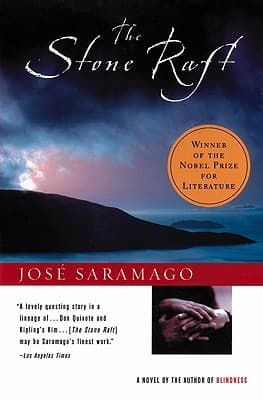
Synopsis
Covers the whole plot, including the ending.
- Difficulty
- Medium
- Pacing
- Slow
- Mood
- Philosophical, Surreal, Meditative, Whimsical, Poignant
- Read it if
- You enjoy philosophical allegories, magical realism, and stories that explore human connection against a backdrop of grand, inexplicable events. Perfect for those who appreciate unique narrative voices and a meditative pace.
- Skip it if
- You prefer fast-paced plots with clear explanations for fantastical occurrences, or if you dislike long, unbroken paragraphs and a lack of traditional dialogue punctuation.
The Stone Raft Plot Summary
Covers the whole plot, including the ending.
The First Cracks and Unexplained Phenomena
The story begins with strange events across the Iberian Peninsula. Joana Carda, a schoolteacher, draws a blue line in the sand that stays put. She also sees an endless thread unravel from a sock. Joaquim Sassa, a retired shepherd, throws a stone into the sea that travels far and silently hits the French coast. Maria Guavaira, a textile worker, feels a deep tremor. José Anaiço, a dog catcher, sees a large flock of starlings cover his car. These odd incidents are the first signs of a major change about to affect the entire peninsula.
The Peninsula Breaks Free
The strange events lead to a big change: the Pyrenees mountains crack open. The Iberian Peninsula, with Spain and Portugal still together, breaks off from Europe. This impossible geological event causes disbelief and panic worldwide as the 'Stone Raft' begins to drift west into the Atlantic Ocean. The initial movement is slow, but soon the separation is clear. International groups and governments are in chaos, trying to understand and respond to this new geographical shift. The people on the peninsula must deal with their new reality, adrift and separate from Europe.
The Five Drawn Together
As the peninsula drifts, the five people who had the initial strange experiences are drawn to each other. Joana Carda feels she must travel south, believing her 'blue line' is connected to the event. Joaquim Sassa, guided by his stone, also heads towards the Pyrenees. Maria Guavaira and José Anaiço, with a dog named Constante, are also led by an unseen force. They meet where the peninsula broke off, forming an unlikely group of five. Their individual, strange experiences—the line, the stone, the tremor, the starlings—become a shared secret, a bond that sets them apart from the confused crowds.
The Journey Begins
The five main characters, with Constante, start traveling across the now-drifting Iberian Peninsula. They are not going to a specific place but exploring their new, isolated world. They see big changes from the separation: altered coastlines, new weather, and the psychological impact on the people. They meet people who react with despair, resignation, or a strange sense of freedom. As they travel, they discuss their unique experiences, trying to understand their connection to the event. The group's dynamic forms, a mix of curiosity, apprehension, and growing friendship.
Encounters and Observations
During their travels, the five main characters observe how different communities and authorities react to the unexpected drift. Governments are disorganized, trying to keep order and talk with the 'outside' world, which sees the peninsula with fear and scientific interest. The group sees both panic and surprising strength among the people. They see people adapting to the new reality, forming new communities, and facing the unknown with different levels of hope and despair. Their unique view, as people seemingly 'chosen' by the event, lets them process the changes differently, often with a detached but deep understanding.
The Search for Meaning
As the 'Stone Raft' continues across the Atlantic, the five main characters explore the mystery of their shared experiences. They guess about why the peninsula detached and why they are connected. Joana's blue line, Joaquim's stone, Maria's tremor, and José's starlings are always part of their talks. They wonder if they are catalysts, witnesses, or guardians of this new land. The dog, Constante, often seems to understand things, guiding them with its quiet presence. Their search for meaning becomes part of their personal journeys, creating a deeper bond between them.
Love and Relationships Blossom
During their long journey, the five main characters become very close. The shared isolation and the profound situation create deep emotional connections. Joana Carda and Joaquim Sassa develop a gentle, intellectual bond, turning curiosity into love. Maria Guavaira and José Anaiço find comfort and affection in each other, their relationship marked by quiet understanding and support. The fifth person, the unnamed 'fifth man' (later called Pedro Orce), remains a bit mysterious but is also part of this developing family. Their relationships show humanity's ability to find connection and love even in extraordinary and isolating circumstances.
The World Reacts and Speculates
The international community reacts with scientific interest, political maneuvering, and dread to the drifting Iberian Peninsula. Scientists suggest theories, politicians debate future scenarios, and military forces watch its path. There are concerns about its impact on shipping, climate, and global stability. Some nations see it as a threat, others as a research opportunity. The 'Stone Raft' becomes a symbol, a topic of endless discussion, and a reminder of nature's unpredictable forces. The novel shows the absurdity and often self-serving nature of global responses to a truly new event.
The Westernmost Point
After months of drifting west, the Iberian Peninsula slows down in the Atlantic, almost stopping. This pause creates new worries and hopes. Is it stopping for good? Will it reverse course or change direction? The main characters, along with everyone else on the peninsula, feel the tension of this uncertainty. They are now farther from Europe than ever, truly isolated. The stillness allows for reflection on their journey and the future. The international community also reacts to this new development, unsure if it means stability or more unpredictable events.
The Return Journey and New Direction
After its temporary stop, the Iberian Peninsula, surprisingly, begins to drift south, then gradually turns east. Its new path points towards the mid-Atlantic ridge and the Azores archipelago. This unexpected change of direction brings back hope and fear. The main characters, now a solid group, continue their journey, now with a purpose: to follow the land wherever it goes. They discuss rejoining Europe or becoming a permanent island nation. The change in direction marks a new phase in the 'Stone Raft's' journey, full of unknown possibilities.
The Azores and the End of the Journey
The Iberian Peninsula continues its eastward drift, heading towards the Azores. The approach of land, even another archipelago, fills the inhabitants with mixed emotions. The main characters, now a cohesive unit, see the final stages of the journey. They reflect on the big changes they and their land have gone through. The story ends with the 'Stone Raft' making contact with the Azores, not a crash but a gentle, almost deliberate merging. This means a new, uncertain future for the peninsula, no longer entirely isolated but also not fully reconnected to its past.
A New Equilibrium
The Iberian Peninsula eventually settles, forming a new, larger landmass with the Azores. Its drifting stops, and a new balance is established. The world slowly accepts this new geographical reality. The five main characters, having shared this extraordinary journey, stay together, their bond strengthened by love and shared experience. They are symbols of strength and adaptation, living witnesses to an impossible event. Their individual quirks and connections to the initial break become part of the peninsula's stories. They show humanity's ability to find meaning, love, and a future even when the very ground beneath their feet changes dramatically.
Principal Figures
Joana Carda
Protagonist
A schoolteacher, whose mysterious blue line in the sand is a harbinger of the event.
Joana Carda is a quiet, observant schoolteacher from a small village. Her initial encounter with the inexplicable – drawing a continuous, indelible blue line in the sand – sets her apart. She is intelligent and introspective, constantly seeking meaning in the unfolding events. Joana represents the intellectual and intuitive aspect of humanity's response to the unknown. She develops a deep, loving relationship with Joaquim Sassa, finding solace and understanding in their shared experiences. Her quest for understanding is a central thread in the narrative.
Relationships: Joaquim Sassa (romantic partner); Maria Guavaira (companion); José Anaiço (companion); Pedro Orce (companion)
Joaquim Sassa
Protagonist
A retired shepherd, whose flung stone travels an impossible distance to France.
Joaquim Sassa is a pragmatic and grounded retired shepherd, whose seemingly simple act of throwing a stone into the sea has extraordinary consequences. He is initially bewildered by his experience but possesses a quiet strength and resilience. Joaquim represents the connection to the land and the elemental forces at play. His down-to-earth nature complements Joana's more intellectual approach. He forms a deep, loving bond with Joana Carda, providing a steady presence amidst the chaos. His journey is one of acceptance and finding profound connection.
Relationships: Joana Carda (romantic partner); Maria Guavaira (companion); José Anaiço (companion); Pedro Orce (companion)
Maria Guavaira
Protagonist
A textile worker who experiences a profound, non-seismic tremor.
Maria Guavaira is a textile worker whose experience of a deep, unsettling tremor in her bed links her to the peninsula's detachment. She is initially more fearful and vulnerable than the others but grows in strength and determination throughout the journey. Maria represents the emotional and visceral response to the cataclysmic event. She finds love and comfort with José Anaiço, forming a stable, supportive relationship. Her journey is one of overcoming fear and finding belonging in an unprecedented world.
Relationships: José Anaiço (romantic partner); Joana Carda (companion); Joaquim Sassa (companion); Pedro Orce (companion)
José Anaiço
Protagonist
A dog catcher whose car is inexplicably covered by a flock of starlings.
José Anaiço is a dog catcher whose strange encounter with an immense flock of starlings marks him as one of the chosen. He is somewhat eccentric and pragmatic, often providing a touch of humor and realism. José represents the common man, dealing with the extraordinary through practical means. He forms a loving relationship with Maria Guavaira, offering her stability and affection. His journey is about finding unexpected companionship and adapting to the absurdities of their new reality, often through the lens of animal behavior.
Relationships: Maria Guavaira (romantic partner); Constante (owner of the dog); Joana Carda (companion); Joaquim Sassa (companion); Pedro Orce (companion)
Pedro Orce (The Fifth Man)
Protagonist
A man who feels an unbearable vibration in his teeth just before the separation.
Pedro Orce is the 'fifth man' of the group, initially unnamed or simply referred to by his role. He experiences an intense, almost physical vibration in his teeth, connected to the Pyrenees' crack. He is often quiet and contemplative, observing the world with a profound sense of awe and sometimes melancholy. Pedro represents a deeper, almost mystical connection to the earth itself. While he doesn't form a romantic pairing within the group, he is an essential, steadying presence, a quiet anchor for the others. His experience is perhaps the most internal and visceral link to the geological event.
Relationships: Joana Carda (companion); Joaquim Sassa (companion); Maria Guavaira (companion); José Anaiço (companion)
Constante
Supporting
A mysterious dog who accompanies José Anaiço and guides the group.
Constante is a stray dog that José Anaiço 'catches' and then adopts, but the dog quickly becomes more than a pet. Constante possesses an uncanny intuition and often seems to guide the group, sensing changes in the land or pointing them in certain directions. The dog acts as a silent, almost mythical presence, a living embodiment of the primal forces at play. Constante represents the animal kingdom's innate connection to the earth and its mysteries, often serving as a silent, all-knowing companion to the human protagonists. Its name, meaning 'constant,' hints at its enduring presence and loyalty.
Relationships: José Anaiço (owner); Joana Carda (companion); Joaquim Sassa (companion); Maria Guavaira (companion); Pedro Orce (companion)
The Narrator
Mentioned
An omniscient, often philosophical and ironic voice guiding the reader.
While not a character in the traditional sense, the unnamed narrator is a distinct and crucial presence in the novel. This omniscient voice frequently interjects with philosophical musings, ironic commentary, and direct addresses to the reader. The narrator often questions the nature of reality, truth, and human perception, blurring the lines between fiction and commentary. This narrative style is characteristic of Saramago, providing a layer of meta-textual analysis that encourages deeper engagement with the story's themes and absurdities. The narrator is a guide, a philosopher, and sometimes a jester.
The Portuguese Prime Minister
Supporting
A figure representing political authority and its struggle to cope with the crisis.
The Portuguese Prime Minister, though not deeply developed as an individual, represents the political establishment's struggle to comprehend and manage the crisis of the drifting peninsula. He is often shown in meetings, grappling with international pressure, internal panic, and the sheer impossibility of the situation. He embodies the limitations of human institutions when faced with forces beyond their control. His reactions and decisions highlight the bureaucratic and often absurd responses to a truly unprecedented event, contrasting sharply with the protagonists' more personal journey.
The Spanish Prime Minister
Supporting
A political leader facing the same crisis as his Portuguese counterpart.
Like the Portuguese Prime Minister, the Spanish Prime Minister serves as a representative of political authority. He is shown navigating the same international pressures and domestic challenges as his Portuguese counterpart, often in joint, equally bewildered meetings. His character underscores the shared fate of Spain and Portugal on the 'Stone Raft' and the universal inadequacy of traditional governance in the face of such an event. He is a symbol of the collective political struggle, mirroring the Portuguese Prime Minister's efforts to maintain control and make sense of the new reality.
Themes & Insights
Identity and Belonging
The novel explores how individual and national identity change when geographical and political anchors are gone. The Iberian Peninsula, separate from Europe, must redefine itself. The main characters, brought together by their unique experiences, form a new kind of family, finding belonging in shared experience and love, not just in places. This theme asks what truly makes a 'homeland' and how identity forms during radical change.
“Perhaps it is only in the face of the definitive that man finds a measure for himself.”
The Absurdity of Existence and Bureaucracy
Saramago uses the fantasy of a drifting peninsula to highlight how absurd human institutions and responses to the inexplicable are. Governments and international bodies are shown as largely ineffective; their attempts to control or explain the event are often comical. This theme critiques bureaucratic processes and political showmanship, showing how they often fail to address basic human needs or truly grasp the implications of extraordinary circumstances, preferring to stick to old rules.
“What is the use of a map when the land itself is moving?”
Love and Human Connection in Crisis
Amid global chaos and geographical change, the novel emphasizes human connection and love. The five main characters, initially strangers, form deep romantic and family bonds as they travel across the 'Stone Raft.' Their relationships show humanity's capacity for intimacy, comfort, and resilience even in the most isolating and confusing situations. This theme suggests that personal relationships are an important anchor when the outside world is unstable, providing meaning and hope.
“And it was then, in the midst of this vastness of water and sky, that they found each other, not by chance, but by some design that had brought them together.”
Humanity's Relationship with Nature
The book explores the delicate and often opposing relationship between humanity and nature. The drifting peninsula is a strong symbol of nature's unpredictable and unconquerable force, making human efforts to control or understand it seem small. The initial strange events experienced by the characters suggest a deeper, almost mystical link between certain individuals and the earth's movements, hinting at an ancient, forgotten harmony. This theme encourages thought on human pride and the need for humility when facing nature's power.
“Perhaps the earth had simply grown tired of being a continent, and had decided to become an island.”
The Power of the Unexplained and the Irrational
Saramago challenges rational thought by focusing the story on an impossible event that defies all scientific and logical explanation. The initial individual experiences of the characters—the blue line, the stone, the tremor, the starlings—are surreal and irrational, yet they start the entire story. This theme celebrates the mystery of existence and the limits of human reason, suggesting that some truths are beyond logical understanding and that the inexplicable can be a source of meaning and transformation.
“It is not always necessary to understand in order to believe.”
Plot Devices & Literary Techniques
Magical Realism
The integration of fantastical elements into an otherwise realistic setting.
The core premise of 'The Stone Raft' – the Iberian Peninsula breaking off and drifting – is a prime example of magical realism. Saramago presents this impossible event, along with the individual, equally inexplicable phenomena experienced by the protagonists, as if it were an ordinary occurrence. The narrative maintains a realistic tone and explores the social, political, and personal consequences of this fantastical event without offering scientific explanations, thereby blurring the line between the real and the miraculous and inviting readers to accept the absurd as part of reality.
Omniscient and Philosophical Narrator
A distinct narrative voice that offers commentary, questions, and insights.
Saramago employs a highly distinctive omniscient narrator who is not merely a storyteller but an active, philosophical presence in the novel. This narrator frequently interjects with his own thoughts, observations, and rhetorical questions, directly addressing the reader and offering ironic commentary on human nature, politics, and the absurdities of the situation. This device creates a meta-narrative layer, guiding the reader's interpretation and encouraging deeper reflection on the themes, rather than simply presenting events objectively.
Lack of Punctuation (Comma-heavy Sentences, No Quotation Marks)
A unique stylistic choice that merges dialogue and narration, creating a continuous flow.
Saramago's signature style, characterized by extremely long, comma-separated sentences and the absence of quotation marks for dialogue, is a crucial plot device. This stylistic choice blurs the boundaries between narration, character thoughts, and spoken words, creating a continuous, stream-of-consciousness flow. It forces the reader to pay close attention to subtle cues to distinguish speakers and thoughts, immersing them deeply in the narrative's rhythm and preventing a detached reading, thereby enhancing the sense of shared experience and the interconnectedness of all elements in the story.
The Five Protagonists' Initial Phenomena
Individual, surreal events that act as catalysts and a mysterious bond.
The five initial, seemingly unrelated, and inexplicable occurrences experienced by Joana, Joaquim, Maria, José, and Pedro (the blue line, the stone, the tremor, the starlings, the teeth vibration) serve as a central plot device. These individual 'signs' are the mysterious force that draws them together and forms the core of their unique connection to the drifting peninsula. They act as both harbingers of the greater event and as a symbolic representation of humanity's varied, intuitive, and often irrational links to the natural world. Their shared secret creates a familial bond and a sense of being 'chosen' witnesses.
The Stone Raft Quotes
“Perhaps it is only by remaining in the same place that we can come to truly understand the world.”
“The only possible meaning of life is to serve humanity.”
“We are all islands, but we need the sea to connect us.”
“What is the use of a map if you don't know where you are going?”
“There are no solutions, only compromises.”
“The world is not a stage, it is a raft.”
“Love is not a feeling, it is a decision.”
“Sometimes the most extraordinary things happen in the most ordinary ways.”
“To be alone is to be free, but also to be lost.”
“The greatest journey is not across land or sea, but into oneself.”
“History is a wound that never truly heals.”
“The future is not something we enter, it is something we create.”
“Even a stone can have a heart, if it is loved enough.”
“We are all searching for something, even if we don't know what it is.”
Quiz
10 questions on the plot and the characters. Each answer comes with a short explanation.
Question 1
What is the initial surreal event that first draws Joana Carda's attention to the impending separation of the Iberian Peninsula?
- All the clocks in her village stop simultaneously at midnight.
- A continuous, indelible line appears on the ground at the border of Portugal and Spain.
- A stone she throws into the sea continues to float on the surface.
- Birds begin flying backward and singing mournful songs.
Show answer
C. A stone she throws into the sea continues to float on the surface. Joana Carda experiences the surreal event of a stone she throws into the sea refusing to sink, which is one of the first inexplicable occurrences signaling the extraordinary changes to come for the peninsula.
Question 2
Which of the following is NOT one of the five main characters who eventually converge on the drifting peninsula?
- Joaquim Sassa
- Maria Guavaira
- José Anaiço
- Pedro Orce
Show answer
B. Maria Guavaira The five main characters are Joana Carda, Joaquim Sassa, José Anaiço, Pedro Orce, and the dog, Constable. Maria Guavaira is not one of them.
Question 3
What unique ability does Pedro Orce discover he possesses after the peninsula begins to drift?
- He can understand the thoughts of animals.
- He can cause the ground to shake with his will.
- He can make an endless thread unravel from his sweater.
- He can feel the tremors and movements of the earth.
Show answer
D. He can feel the tremors and movements of the earth. Pedro Orce, an old man from a village near the Pyrenees, finds he can feel the deep rumblings and movements of the earth, a unique connection to the geological event unfolding.
Question 4
What is the primary reason the five main characters decide to travel together across the drifting peninsula?
- They are mandated by the new government to observe the phenomenon.
- They believe their individual surreal experiences are connected and seek answers together.
- They are searching for a hidden treasure rumored to be on the peninsula.
- They are trying to escape the chaos and find a new home in the interior.
Show answer
B. They believe their individual surreal experiences are connected and seek answers together. The characters are drawn together because each has experienced a personal, inexplicable event (Joana's floating stone, Joaquim's unravelling thread, José's unending chickens, Pedro's tremors, and Constable's bark) that seems linked to the peninsula's separation, prompting them to seek understanding and companionship.
Question 5
What symbolic role does the 'stone raft' itself play in the novel's themes?
- It represents humanity's ultimate triumph over natural disasters.
- It symbolizes isolation, self-discovery, and the arbitrary nature of borders and connections.
- It is a metaphor for the strength of political alliances between nations.
- It signifies a return to a primitive, pre-industrial way of life.
Show answer
B. It symbolizes isolation, self-discovery, and the arbitrary nature of borders and connections. The 'stone raft' symbolizes the unexpected, the breaking of established norms (geographical and political), and the journey of self-discovery for its inhabitants, highlighting themes of isolation, shared destiny, and the artificiality of human-drawn boundaries.
Question 6
What is the primary reaction of the European and international community to the Iberian Peninsula's drift?
- Immediate military intervention to reattach the landmass.
- They attempt to tow it back to Europe using massive ships.
- A mix of scientific bewilderment, political panic, and eventual abandonment or indifference.
- They celebrate it as a new opportunity for global tourism.
Show answer
C. A mix of scientific bewilderment, political panic, and eventual abandonment or indifference. Initially, there is global panic and attempts to understand or control the situation. However, as the drift continues and proves unstoppable, the international community eventually gives up, leaving the peninsula to its fate, reflecting a theme of political impotence in the face of nature.
Question 7
What is the significance of the dog, Constable, joining the group of characters?
- He represents the only character who maintains a logical, rational perspective.
- His inexplicable, unending bark is another of the surreal phenomena linking the group.
- He is a metaphor for the lost innocence of the natural world.
- He guides them to a hidden repository of ancient maps.
Show answer
B. His inexplicable, unending bark is another of the surreal phenomena linking the group. Constable's continuous, inexplicable bark is the fifth surreal event, matching the individual phenomena experienced by the human characters, and thus he becomes an integral, sentient member of their journey and a symbol of the interconnected strangeness.
Question 8
How does the novel portray the concept of national identity and borders once the peninsula detaches?
- It reinforces the importance of national flags and anthems for unity.
- It suggests that national identities are dissolved, leading to a new, unified 'Iberian' identity.
- It leads to increased conflict and civil war between the former nations.
- The characters obsess over recreating the old borders on the new landmass.
Show answer
B. It suggests that national identities are dissolved, leading to a new, unified 'Iberian' identity. With the physical separation from Europe, the traditional borders within the peninsula become meaningless. The characters, and by extension the population, are forced to reconsider their identities, slowly forming a new, shared 'Iberian' identity as they drift together, highlighting the arbitrary nature of national divisions.
Question 9
What is the ultimate, ambiguous destination or fate of the 'stone raft' and its inhabitants at the end of the novel?
- It crashes into the coast of North America, causing global devastation.
- It circles back and reattaches itself to Europe, as if nothing happened.
- It continues to drift aimlessly into the unknown North Atlantic, its future uncertain.
- It transforms into a new, fertile continent, becoming a utopia.
Show answer
C. It continues to drift aimlessly into the unknown North Atlantic, its future uncertain. The novel concludes with the Iberian Peninsula still drifting, its ultimate destination and future unknown. This ambiguity reinforces the themes of unpredictability, the ongoing journey of humanity, and the acceptance of the unknown, rather than providing a neat resolution.
Question 10
Saramago's narrative style in 'The Stone Raft' is characterized by:
- Short, declarative sentences and minimal dialogue.
- Extremely long sentences, run-on dialogue, and a lack of traditional paragraph breaks.
- First-person perspective from each of the five main characters.
- Frequent use of footnotes and academic citations.
Show answer
B. Extremely long sentences, run-on dialogue, and a lack of traditional paragraph breaks. Saramago is renowned for his distinctive prose, featuring very long sentences, often blending dialogue directly into narrative paragraphs without quotation marks, and a unique rhythm that immerses the reader in the flow of thought and conversation.
The Stone Raft FAQ
What is 'The Stone Raft' about?
'The Stone Raft' by José Saramago tells the fantastical story of the Iberian Peninsula detaching from Europe and drifting into the Atlantic Ocean. Amidst this surreal geological event, five seemingly unconnected individuals—Joana Carda, Jose Anaiço, Joaquim Sassa, Maria Guavaira, and Pedro Orce—find themselves drawn together, experiencing strange, shared phenomena that link them to the peninsula's journey.
Why should I read 'The Stone Raft'?
You should read 'The Stone Raft' for its unique blend of magical realism, political allegory, and profound human connection. Saramago's distinctive narrative voice, devoid of traditional punctuation for dialogue, creates an immersive experience, inviting readers to ponder themes of national identity, human destiny, and the arbitrary nature of fate through the lens of an impossible event.
What is the background/setting of 'The Stone Raft'?
The story is set in a contemporary, yet subtly altered, Iberian Peninsula. Initially, it encompasses Spain and Portugal, but its unique setting arises when a mysterious geological fault line causes the entire landmass to break away from the rest of Europe. This newly formed 'island' then begins an unpredictable, slow drift across the North Atlantic Ocean, becoming a setting of isolation and new discovery.
What are the most memorable quotes?
Saramago's prose is rich with memorable observations, often blending the mundane with the profound. One notable idea is the recurring thought that 'the world is full of things that cannot happen.' Another poignant reflection comes from the characters' musings on identity, such as 'We are all made of the same clay, but some of us are baked harder than others,' encapsulating the shared humanity and individual resilience depicted.
What writing style does the author use?
José Saramago employs a highly distinctive and often challenging writing style characterized by long, flowing sentences, a lack of traditional quotation marks for dialogue, and frequent shifts in narrative perspective. He merges the narrator's voice with characters' thoughts and speech, creating an intimate, stream-of-consciousness effect that demands active engagement from the reader.
What minor details add significant meaning?
The seemingly random, localized phenomena experienced by each of the five protagonists—Joana Carda drawing an indelible line on the ground, Jose Anaiço being followed by a perpetually unraveling thread, Joaquim Sassa throwing a stone an impossible distance, Maria Guavaira's flock of starlings, and Pedro Orce's unending tremor—are not just coincidences but subtle manifestations of the peninsula's break, linking them directly to the earth's upheaval and their shared destiny.
What are some subtle foreshadowing moments?
The initial, isolated magical occurrences experienced by each character subtly foreshadow their eventual coming together and their unique connection to the peninsula's fate. For instance, the inexplicable tremor in Pedro Orce's hands, long before the major geological event, hints at his deep, almost seismic, sensitivity to the earth's movements, suggesting a premonition of the rupture.
What unexpected character connections exist?
Beyond their initial, shared magical experiences, the five protagonists form an unexpected, polyamorous connection, evolving into a loving quintet. Their individual searches for meaning and companionship converge, leading to an unconventional romantic and familial bond that defies societal norms and provides mutual support amidst the surreal journey of the drifting peninsula.
What are unspoken character motivations?
Beneath their overt actions, the characters are driven by a profound, unspoken desire for connection and belonging in a world turned upside down. Joana Carda's initial solitary journey, Jose Anaiço's quiet desperation, and Joaquim Sassa's wandering all hint at a longing for purpose and human intimacy that the extraordinary circumstances eventually force them to confront and fulfill together.
What psychological complexities do characters exhibit?
The characters exhibit significant psychological complexities, particularly in their adaptation to the absurd reality of the drifting peninsula. They grapple with existential dread, the redefinition of national identity, and the complete disruption of their personal lives. Their journey forces them to shed conventional societal expectations and embrace a new, fluid understanding of love, family, and purpose, showcasing remarkable psychological resilience and openness.
What are the major emotional turning points?
A major emotional turning point occurs when the five protagonists finally meet and realize the shared nature of their bizarre experiences. This collective understanding transforms their individual bewilderment into a communal quest. Another significant point is their decision to form an unconventional, loving unit, moving beyond mere companionship to a deep, intertwined emotional commitment that redefines their understanding of family and belonging.
How do relationship dynamics evolve?
The relationship dynamics evolve from initial suspicion and individual isolation to a profound, unconventional polyamorous love. The five protagonists, initially strangers, gradually form a deep bond based on shared experience, mutual understanding, and affection. They create their own 'family' unit, adapting to the extraordinary circumstances by redefining traditional relationship structures and finding solace and strength in their collective embrace.
Which parts remain ambiguous or open-ended?
The ultimate cause of the Iberian Peninsula's detachment remains ambiguous, never fully explained by science or magic, leaving its origin a mystery. Furthermore, the final destination of the 'stone raft' is left open-ended, suggesting an ongoing journey rather than a definitive conclusion. Saramago intentionally leaves these grand questions unanswered, emphasizing the human experience within the inexplicable.
What are controversial scenes or decisions?
The most controversial aspect is the formation of the polyamorous relationship among the five protagonists. Their decision to live as a loving quintet, sharing intimacy and companionship, challenges traditional monogamous norms and societal expectations of family structure. This unconventional arrangement, while presented naturally within the narrative, can be a point of debate for readers.
'The Stone Raft' ending explained: how it ends & what it means
The book ends with the Iberian Peninsula still adrift in the Atlantic, its ultimate destination unknown, and the five protagonists firmly established in their unique, loving communal life. The ending signifies that while the grand, geopolitical questions remain unanswered, the human capacity for adaptation, connection, and finding meaning amidst the absurd is paramount. It's an affirmation of human resilience and the creation of new forms of belonging in a world forever changed.
About the author

José de Sousa Saramago, GColSE ComSE GColCa, was a Portuguese writer and recipient of the 1998 Nobel Prize in Literature for his "parables sustained by imagination, compassion and irony [with which he] continually enables us once again to apprehend an elusory reality." His works, some of which can be seen as allegories, commonly present subversive perspectives on historic events, emphasizing the theopoetic human factor. In 2003 Harold Bloom described Saramago as "the most gifted novelist alive in the world today" and in 2010 said he considers Saramago to be "a permanent part of the Western canon", while James Wood praises "the distinctive tone to his fiction because he narrates his novels as if he were someone both wise and ignorant."
Similar books
- One Hundred Years of Solitude
Gabriel García Márquez
4.1 (753k) average on GoodreadsLiterary FictionShares a magical realist tone and epic scope with a focus on interconnected lives.
- Life of Pi
Yann Martel
3.9 (1.3M) average on GoodreadsFantasyFeatures a surreal journey and profound themes of survival, faith, and the human spirit.
- Invisible Cities
Italo Calvino
4.1 (62k) average on GoodreadsFantasyBoth deconstruct concepts of place and identity through fantastical elements. Calvino's work is more fragmented and philosophical, a series of meditations on cities, whereas Saramago's offers a continuous narrative with a specific plot, character development, and a more direct political allegory.
- Harry Potter and the Sorcerer's Stone
J.K. Rowling
4.5 (7M) average on GoodreadsFantasyRescued from a miserable life under the stairs, an orphaned boy discovers he's a wizard destined for a magical school, where he uncovers a dangerous secret tied to the dark wizard who murdered his parents.
- The Hunger Games
Suzanne Collins
4.3 (6.4M) average on GoodreadsFantasyIn a future where children fight to the death on live television, Katniss Everdeen volunteers for the arena, turning a death sentence into a fight for survival and a spark of rebellion.
- 1984
George Orwell
4.2 (3.1M) average on GoodreadsPoliticsIn a future where surveillance and thought control are absolute, a man's search for truth clashes with the Party, showing that hope can be a form of rebellion.




Enjoyed the summary?
A summary gives you the shape of the book. The book itself has the detail, the examples and the voice.
Find The Stone Raft on AmazonAs an Amazon Associate, BookBrief earns from qualifying purchases. How we're funded