
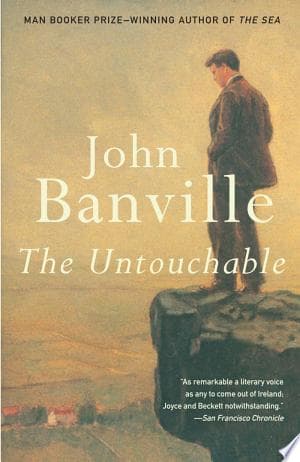
Synopsis
Covers the whole plot, including the ending.
- Difficulty
- Hard
- Pacing
- Slow
- Mood
- Atmospheric, Reflective, Witty, Melancholy, Morally Complex
- Read it if
- You appreciate literary historical fiction with a focus on character study, moral ambiguity, and exquisite prose, particularly if you're fascinated by the Cambridge spy ring and the psychological depth of a double agent.
- Skip it if
- You prefer fast-paced thrillers, clear-cut heroes and villains, or straightforward plots without extensive internal monologue and complex psychological exploration.
The Untouchable Plot Summary
Covers the whole plot, including the ending.
The Unmasking of Victor Maskell
The novel starts with Victor Maskell, an older, disgraced former British intelligence member, thinking about his life after being exposed as a Soviet agent. He lives alone in his country home, dealing with public humiliation and the betrayal of former colleagues and his country. Maskell, once a celebrated art historian and advisor to the Queen, is now isolated and watched. He starts writing his memoirs, to clarify things and to understand the complex loyalties and deceptions that shaped his life. He wonders who finally exposed him, a question that stays with him throughout his story, suggesting a deeper, more personal betrayal than just political defection.
Cambridge Days and Early Recruitment
Maskell looks back at his past, specifically his time at Cambridge University in the 1930s. He describes an active intellectual environment, with discussions about politics, art, and philosophy, set against rising fascism in Europe. Here, he meets a group of young men, including the charming Nick, the intense Louis, and the seemingly harmless Boy. Influenced by these friends and a persuasive figure named 'Professor' (likely based on Anthony Blunt), Maskell gets involved in communist ideas and, eventually, joins Soviet intelligence. He describes his early involvement as an idealistic commitment to a cause he thought would bring a better world, mixed with a youthful thrill of rebellion.
The War Years and Double Life
When World War II starts, Maskell is in a difficult position, working for British intelligence while also giving information to his Soviet contacts. He describes the tension and paranoia of wartime London, the constant fear of being exposed, and the moral compromises he makes. His work involves decrypting enemy messages and analyzing intelligence, giving him access to secret information. He keeps up a careful public image, seeming like a loyal, if somewhat unusual, public servant. During this time, his relationships with his fellow spies, Nick and Louis, become more connected, marked by shared secrets, mutual suspicion, and a strange bond formed in deception. He also starts to explore his sexuality, having secret affairs with men.
Post-War Establishment and Personal Life
After the war, Maskell rises in the British establishment, becoming a respected art historian and eventually an advisor to the Queen. He marries Esther, a sensible and loving woman, and they have children, creating a seemingly normal family life. However, his secret life as a Soviet agent continues, with secret meetings and constant pressure from his contacts. He thinks about the difference between his public image and his hidden identity, the compromises he made in his personal relationships, and the emotional cost of living a lie. His marriage to Esther gives him a fragile sense of normalcy, but it is always overshadowed by his spying, and his true affections are often elsewhere, with men he meets secretly.
The Shifting Sands of Loyalty
As the Cold War gets more intense, Maskell's early idealism about the Soviet Union starts to fade. He sees the brutality of the Stalinist regime and the suppression of dissent, leading to growing disappointment. The friendship he once shared with Nick and Louis also weakens, replaced by suspicion and resentment. He becomes more paranoid that someone in his circle might betray him, or that his contacts might see him as disposable. The moral uncertainty of his actions weighs on him, as he questions the true purpose and effectiveness of his spying. He realizes he may have sacrificed his integrity for a cause that was as flawed as the system he wanted to change.
The Defections and Mounting Pressure
The defections of other members of his spy ring, especially Nick and Louis's dramatic escape to the Soviet Union, shock the British intelligence community and increase the search for remaining agents. Maskell finds himself under more scrutiny, his every move watched, his past carefully examined. He describes the intense tension of this time, the constant fear of exposure, and the elaborate steps he takes to keep his cover. He feels more isolated, unable to confide in anyone, even his wife. The pressure grows, and he starts to suspect that authorities are closing in, but he still hopes his cleverness and connections will protect him.
The Interrogations Begin
Despite the defections, Maskell avoids immediate exposure, largely because of his high position and the establishment's unwillingness to believe one of their own could be a traitor. However, he faces a series of increasingly pointed interviews and interrogations by British intelligence officers, especially the persistent Mr. Craven. These meetings are often disguised as casual talks or administrative reviews, but Maskell understands their real purpose. He uses all his wit and cunning to avoid suspicion, telling elaborate lies and half-truths, always seeming like an innocent victim. He finds a strange pleasure in the intellectual challenge, but the constant pressure affects his mental and emotional state.
The Betrayal and Unmasking
Eventually, the situation tightens, and Maskell is publicly exposed as a Soviet spy. He never clearly says the exact moment or the precise person responsible for his exposure, keeping some ambiguity that suggests a complex, perhaps even self-inflicted, unraveling. The revelation destroys his carefully built life, leading to his immediate dismissal from all his positions, public humiliation, and isolation. He describes the deep sense of loss and disgrace, the end of a lifetime of work and reputation. The unmasking forces him to face the full results of his actions and the damage he caused to his family and those who trusted him. He retreats into a solitary life, thinking about betrayal and loyalty.
Reflections on Identity and Legacy
In his final years, Victor Maskell, now without public honors and living in disgrace, continues to write his memoirs. He uses them to analyze his many identities: Irishman and Englishman, husband and homosexual, loyal citizen and traitor, art lover and spy. He tries to understand who he truly is, beyond the roles he played. He thinks about memory, truth, and fiction, admitting that his story is as much about creating himself as it is about recounting facts. He re-examines his motivations, his relationships, and the political ideals that once drove him, seeking a final understanding of his complex and contradictory life, and the legacy he will leave.
The Untouchable Characters
Victor Maskell
Protagonist
An elderly, disgraced British intelligence officer and art historian, exposed as a Soviet spy.
Victor Maskell is the novel's unreliable narrator, a man of immense intellect, wit, and duplicity. He is a connoisseur of art and language, using both to construct and deconstruct his own reality. Maskell is driven by a complex mix of idealism in his youth, a desire for intellectual engagement, and a profound sense of otherness stemming from his Irish background and homosexuality. He is deeply analytical, constantly examining his own motives and the actions of others, yet he remains elusive, even to himself. His self-awareness is often tinged with a detached irony, making it difficult to discern his true feelings or intentions. He seeks to justify his betrayals while simultaneously acknowledging their moral weight, creating a compellingly contradictory character.
Relationships: Esther (Wife, a stable but ultimately secondary figure in his life); Nick (Fellow Cambridge spy, close friend, and lover, a charismatic and reckless figure); Louis (Fellow Cambridge spy, intellectual friend, and ideological counterpart); Boy (Fellow Cambridge spy, seemingly innocuous but deeply involved); Professor (His enigmatic recruiter at Cambridge, a shadowy mentor figure); Mr. Craven (British intelligence officer who interrogates Maskell, his intellectual sparring partner)
Nick
Supporting
Victor's charismatic and reckless friend from Cambridge, also a Soviet agent.
Nick is one of the most vivid characters in Maskell's recollections, embodying a blend of aristocratic charm, intellectual brilliance, and hedonistic recklessness. He is a central figure in Maskell's early life and espionage career, often acting as a catalyst for Maskell's own involvement. Nick's motivations for spying seem less ideological than Maskell's, driven more by a desire for excitement, a disdain for the establishment, and perhaps a touch of nihilism. He shares an intimate, complicated relationship with Victor, marked by both affection and rivalry. His eventual defection to the Soviet Union is a major turning point in the narrative, increasing the pressure on Maskell.
Relationships: Victor Maskell (Close friend, fellow spy, and lover; a complex, enduring bond); Louis (Fellow spy, part of their Cambridge circle)
Louis
Supporting
Another Cambridge friend and fellow spy, more ideologically driven than Nick.
Louis is portrayed as the more serious, ideologically committed member of the Cambridge spy ring. He is intellectual and intense, driven by a genuine belief in communism and a desire for social justice. While less flamboyant than Nick, Louis possesses a quiet conviction that influences Victor. He represents the more principled, albeit misguided, aspect of their espionage. Like Nick, he eventually defects to the Soviet Union, further isolating Victor and intensifying the hunt for the remaining spies. Maskell's relationship with Louis is characterized by intellectual camaraderie and shared political conviction, though perhaps less personal intimacy than with Nick.
Relationships: Victor Maskell (Intellectual friend and fellow spy); Nick (Fellow spy, part of their Cambridge circle)
Esther
Supporting
Victor Maskell's devoted and long-suffering wife.
Esther is Victor Maskell's wife and the mother of his children. She represents the conventional life Maskell attempts to maintain alongside his secret existence. She is portrayed as a kind, sensible, and patient woman, seemingly unaware of the full extent of Victor's deceptions, particularly his espionage and his homosexuality. Her presence in the narrative highlights Maskell's duplicity and the sacrifices he demands of those around him. While Victor expresses a degree of affection for her, it is clear that she is not the primary focus of his emotional life, serving more as a shield for his public image. Her quiet suffering and eventual disillusionment underscore the personal cost of Victor's betrayals.
Relationships: Victor Maskell (Wife, a relationship built on affection but overshadowed by his secrets)
Boy
Supporting
The youngest and most unassuming member of the Cambridge spy ring.
Boy is the quietest and seemingly least significant member of the Cambridge spy ring, yet his presence is crucial. He is portrayed as unassuming, almost invisible, making him an ideal operative. Maskell often reflects on Boy's seemingly innocent nature, which belies his deep involvement in espionage. Boy's fate, remaining in England and seemingly escaping detection for a longer period, adds another layer of intrigue and suspicion to Maskell's narrative. His character serves to highlight the diverse personalities drawn into the spy world and the varying ways they cope with their double lives.
Relationships: Victor Maskell (Fellow spy, part of their Cambridge circle); Nick (Fellow spy, part of their Cambridge circle); Louis (Fellow spy, part of their Cambridge circle)
Mr. Craven
Supporting
The persistent British intelligence officer investigating the spy ring.
Mr. Craven is the British intelligence officer tasked with investigating the Cambridge spy ring and, eventually, Victor Maskell. He is portrayed as intelligent, patient, and subtly menacing, representing the official forces closing in on Maskell. Their interactions are a series of intellectual duels, with Craven attempting to extract confessions through polite but probing questions, and Maskell skillfully deflecting them with wit and obfuscation. Craven serves as Maskell's foil, the embodiment of the system Maskell betrayed, and his relentless pursuit ultimately leads to Maskell's unmasking. He is a figure of quiet authority and shrewd observation.
Relationships: Victor Maskell (His interrogator and eventual unmasker)
The Professor
Mentioned
The enigmatic figure who recruited Maskell and his friends into espionage.
The Professor is a shadowy and influential figure from Maskell's Cambridge days, responsible for recruiting him and his friends into Soviet espionage. He is presented as charismatic, intellectually formidable, and deeply persuasive, a master manipulator who preys on the idealism and disaffection of young students. Maskell's memories of him are tinged with both admiration and a grudging recognition of his manipulative power. The Professor represents the initial ideological pull of communism and the seductive power of secret societies. While not a constant presence, his influence looms large over Maskell's early decisions and the trajectory of his life.
Relationships: Victor Maskell (Recruiter and mentor in espionage); Nick (Recruiter); Louis (Recruiter); Boy (Recruiter)
Sarah
Supporting
Victor's daughter, who visits him in his disgrace.
Sarah is Victor Maskell's daughter, one of his children with Esther. She makes appearances in Maskell's later life, visiting him in his disgrace. Her presence allows Maskell to reflect on the impact of his actions on his family and the generational divide in understanding his past. She represents a connection to the world outside his isolated existence and forces him to confront the personal consequences of his public shame. Her loyalty and attempts to understand her father, despite his betrayals, offer a glimmer of humanity amidst Maskell's cynical self-analysis.
Relationships: Victor Maskell (Daughter); Esther (Mother)
The Untouchable Themes
Identity and Self-Deception
The novel explores identity through Victor Maskell's many roles: Irish outsider, English gentleman, husband, homosexual, art expert, and spy. Maskell constantly questions who he truly is, often creating stories to justify his actions and combine his conflicting selves. His self-deception is as deep as his deception of others, making his memoir an unreliable attempt to define a self that is always changing. This theme is key to his thoughts on his Irish heritage versus his adopted Englishness, and his public marriage versus his private homosexual life, all contributing to a fragmented sense of self.
“What is a man but a bundle of habits, a collection of tics and mannerisms, a walking, talking, breathing lie?”
Betrayal and Loyalty
Betrayal is at the heart of Maskell's story, including political treason, personal infidelity, and breaking trust. The novel examines the complex reasons for betrayal—idealism, adventure, personal gain, or a deeper psychological need to defy. It also explores loyalty, both to a country, an ideology, or to individuals. Maskell's loyalty to the Soviet cause, however wrong, conflicts with his loyalty to his adopted country and his family. The changing loyalties among the spy ring members, especially between Maskell, Nick, and Louis, show how fragile such bonds are under pressure. The biggest betrayal, for Maskell, might be the one he committed against his true self.
“Betrayal is not an act, it is a process, a slow, insidious corrosion of the soul.”
Truth, Memory, and Narrative
As Maskell writes his memoirs, the novel questions how reliable memory is and how subjective truth is. Maskell is an unreliable narrator, openly admitting to adding or removing details, creating a story that serves his own need for self-justification and understanding. Writing becomes a way for him to build a consistent version of his life, even if that version mixes fact and fiction. This theme shows how personal history is shaped by perspective, desire, and time, making it hard to tell objective truth from subjective interpretation. The reader is constantly asked to question Maskell's account.
“Memory is not a lamp, it is a mirror, reflecting not what was, but what we wish had been.”
Class and Englishness
Maskell's status as an Irishman in the English establishment is a constant theme, adding to his feeling of 'otherness' and perhaps contributing to his willingness to betray the system. The novel shows the details of the British class system, especially within the elite circles of Cambridge and London, which Maskell both joins and dislikes. His observations of the upper classes, their customs, manners, and assumptions of superiority, are often sharp and satirical. This theme explores how social class can shape identity, opportunity, and the perception of loyalty and belonging, influencing Maskell's rebellious side and his cynical view of the establishment.
“I was an Irishman, you see, and therefore, by definition, an outsider, even when I was at the very heart of things.”
Art and Aesthetics
Maskell's job as an art historian and advisor to the Queen is more than just a cover; it is deeply connected to his character and his worldview. Art represents beauty, order, and objective truth that contrasts with the messy, deceptive world of espionage. Maskell's appreciation for art gives him refuge and a way to understand life. He often compares creating art to building his own elaborate deceptions, seeing a certain beauty in the perfect lie. This theme suggests that for Maskell, life is a performance, a carefully created work of art, even if the canvas is stained with betrayal.
“Art, after all, is the only truth that matters, the only one that truly endures.”
Plot Devices & Literary Techniques
Unreliable Narrator
Victor Maskell's subjective and self-serving recounting of events.
The entire novel is narrated by Victor Maskell in his old age, looking back on his life and actions. He openly admits to manipulating facts, omitting details, and shaping his narrative to present himself in a particular light. This device forces the reader to constantly question the veracity of his account, making the 'truth' of the Cambridge spy scandal elusive and subjective. Maskell's wit and intelligence make him a compelling, if untrustworthy, guide through his own convoluted history, blurring the lines between memoir and fiction.
First-Person Retrospection
The story is told entirely from Maskell's reflective viewpoint in his later years.
The narrative unfolds as Maskell writes his memoirs, allowing for extensive introspection, philosophical digressions, and a constant re-evaluation of past events through the lens of age and disgrace. This retrospective approach enables Maskell to comment on his younger self, his motivations, and the consequences of his actions with a detached, often cynical, wisdom. It also permits him to weave together different periods of his life, creating a complex tapestry of memory and interpretation rather than a linear plot.
Intertextuality/Allusion
References to historical figures and literary works, enriching the narrative.
Banville frequently alludes to historical figures (beyond the obvious Cambridge spies themselves, though they are fictionalized) and classic literature, particularly drawing on the works of Proust, Joyce, and other modernist writers. These allusions serve to deepen the intellectual texture of the novel, placing Maskell's story within a broader cultural and historical context. They also highlight Maskell's own erudition and his tendency to view his life through a literary lens, elevating his personal drama to a more universal exploration of human nature and betrayal.
Disguise and Performance
The recurring motif of Maskell's multiple identities and roles.
Maskell's life is a continuous performance, a series of carefully constructed disguises. From his adopted English persona to his public role as an art expert, and his private life as a homosexual man, he constantly shifts roles. This device emphasizes the theme of identity and self-deception, showing how individuals can create and inhabit various 'characters' throughout their lives. The art world, where Maskell excels, itself deals with authenticity and forgery, mirroring his own existence as a master of deception. His 'performance' is both a means of survival and a reflection of his fragmented self.
The Untouchable Quotes
“I am a man of many masks, and none of them fit.”
“History is not what happened, but what is said to have happened.”
“We are all actors in our own tragedies, but we write the scripts as we go along.”
“The past is a foreign country; they do things differently there.”
“Art is the only truth that matters, because it is the only lie that is honest.”
“I have spent my life in the service of two masters, and betrayed them both.”
“Memory is a treacherous thing; it edits and revises without our consent.”
“The greatest sin is not to be found out, but to be forgotten.”
“We are all untouchable in our own way, isolated by our secrets.”
“Love is the one conspiracy from which I have always been excluded.”
“The mirror shows me a stranger, and I have grown accustomed to his face.”
“To spy is to live in a world of shadows, where even the light deceives.”
“I have traded my soul for a handful of secrets, and now I have neither.”
“The truth is a luxury I could never afford.”
Quiz
10 questions on the plot and the characters. Each answer comes with a short explanation.
Question 1
What is Victor Maskell's profession that serves as his public cover during his time as a spy?
- A university professor of history
- An art expert to the Queen
- A diplomat in the Foreign Office
- A journalist for a major newspaper
Show answer
B. An art expert to the Queen Victor Maskell works as an art expert to the Queen, which provides him with a respectable position in British society while he secretly operates as a Russian agent. This role allows him access to elite circles without raising suspicion.
Question 2
Where is Victor Maskell recruited into espionage?
- Oxford University
- During his military service
- Cambridge University
- In Ireland before moving to England
Show answer
C. Cambridge University Maskell is recruited at Cambridge University, mirroring the historical Cambridge Spy Ring. This setting is crucial as it establishes the intellectual and social environment where his double life begins.
Question 3
Which of the following best describes Victor Maskell's complex identity as portrayed in the novel?
- A loyal British patriot who regrets his actions
- A man of manifold doubleness: Irishman and Englishman, husband and lover of men, betrayer and dupe
- A straightforward villain who embraces his role as a spy
- A naive idealist manipulated by others
Show answer
B. A man of manifold doubleness: Irishman and Englishman, husband and lover of men, betrayer and dupe The novel emphasizes Maskell's 'manifold doubleness,' highlighting his conflicting identities and roles. This complexity is central to the book's exploration of loyalty, betrayal, and self-perception.
Question 4
What event triggers Victor Maskell's retrospective narrative in the novel?
- The death of a close friend
- His retirement from public service
- Being unmasked as a Russian agent and subjected to public disgrace
- A personal crisis in his family life
Show answer
C. Being unmasked as a Russian agent and subjected to public disgrace Maskell begins retracing his life after being exposed as a spy, which brings disgrace and forces him to confront his past. This event sets the frame for the novel's exploration of his motivations and actions.
Question 5
How does the novel primarily explore the theme of identity?
- Through Maskell's artistic interpretations of paintings
- By contrasting British and Russian cultural values
- Through Maskell's internal conflicts and dual roles in society
- Via historical accounts of the Cambridge spies
Show answer
C. Through Maskell's internal conflicts and dual roles in society Identity is a key theme, delved into through Maskell's personal struggles with his Irish/English heritage, his sexuality, and his roles as a spy, husband, and father. The novel uses his introspection to question the nature of self.
Question 6
What literary quality is highlighted in reviews of 'The Untouchable,' as mentioned in the book description?
- Its fast-paced action and suspense
- Its use of magical realism and fantasy elements
- Its exquisite menace, biting social comedy, and vertiginous moral complexity
- Its focus on technological advancements of the era
Show answer
C. Its exquisite menace, biting social comedy, and vertiginous moral complexity The description notes the novel's blend of menace, social comedy, and moral complexity, which Banville uses to create a rich, atmospheric narrative that goes beyond simple spy thriller tropes.
Question 7
In the context of the novel, what does the title 'The Untouchable' likely refer to?
- Maskell's physical invulnerability as a spy
- The elite social circles Maskell moves in, which seem above reproach
- A code name for a secret operation
- Maskell's emotional detachment from his family
Show answer
B. The elite social circles Maskell moves in, which seem above reproach The title symbolizes the perceived untouchability of the British establishment and Maskell's position within it, which is ironically undermined by his exposure as a spy. It reflects themes of privilege, secrecy, and fallibility.
Question 8
Which authors is John Banville compared to in the book description for 'The Untouchable'?
- George Orwell and Aldous Huxley
- James Joyce and Samuel Beckett
- Joseph Conrad and John le Carré
- F. Scott Fitzgerald and Ernest Hemingway
Show answer
C. Joseph Conrad and John le Carré Banville is placed in the company of Conrad and le Carré, highlighting the novel's literary depth and its engagement with espionage themes. This comparison underscores its status as both a psychological study and a spy narrative.
Question 9
What aspect of Victor Maskell's personal life adds to the novel's exploration of secrecy and duality?
- His public advocacy for political reforms
- His hidden homosexuality while being a husband and father
- His financial struggles despite his elite position
- His rivalry with other art experts
Show answer
B. His hidden homosexuality while being a husband and father Maskell's concealed homosexuality parallels his secret life as a spy, emphasizing themes of duality and the personal costs of living a double life. This adds depth to his character and the novel's moral inquiries.
Question 10
How does the novel's setting in 'the airless upper regions of the establishment' contribute to its themes?
- It provides a backdrop for adventurous travel scenes
- It symbolizes the suffocating nature of elite society and its hidden corruptions
- It highlights the technological isolation of the Cold War era
- It serves as a metaphor for Maskell's athletic pursuits
Show answer
B. It symbolizes the suffocating nature of elite society and its hidden corruptions The 'airless upper regions' evoke the claustrophobic and insular world of the British elite, where appearances mask deeper betrayals. This setting reinforces themes of secrecy, privilege, and the psychological weight of deception.
The Untouchable FAQ
What is 'The Untouchable' about?
The novel follows elderly Victor Maskell, a former British intelligence officer and art expert to the Queen who has been publicly exposed as a Russian spy. Through his retrospective narration, he recounts his recruitment at Cambridge, his double life within the British establishment, and the complex web of betrayals that led to his disgrace, exploring themes of identity, loyalty, and moral ambiguity.
Why should I read 'The Untouchable'?
It offers a masterful literary exploration of the Cambridge spy ring through the psychologically complex narrator Victor Maskell, blending historical fiction with profound moral questions. Banville's exquisite prose, biting social comedy, and deep character study create a compelling portrait of betrayal and identity that has been praised as one of the best fictional treatments of espionage.
What is the background/setting of 'The Untouchable'?
The novel spans from 1930s Cambridge University, where Maskell is recruited as a Soviet agent, through World War II and the Cold War era in Britain's upper echelons of power. Key settings include Cambridge's academic circles, the art world where Maskell serves as the Queen's expert, and the airless upper regions of the British establishment where he operates as a double agent.
What are the most memorable quotes?
While specific quotes vary by reader, Maskell's reflections on identity are particularly striking: 'I was an Irishman playing at being an Englishman, a homosexual playing at being a husband, a traitor playing at being a patriot.' Another memorable line captures the novel's central tension: 'Betrayal is the only truth that sticks.' These encapsulate the novel's themes of doubleness and moral complexity.
What writing style does the author use?
Banville employs a sophisticated, literary first-person narration through Victor Maskell's voice, characterized by exquisite prose, psychological depth, and social satire. The style blends memoir-like reflection with espionage thriller elements, featuring precise descriptions, biting social comedy, and vertiginous moral complexity that has drawn comparisons to both Joseph Conrad and John le Carré.
What minor details add significant meaning?
Maskell's profession as an art expert to the Queen serves as a subtle metaphor for his entire existence - authenticating fakes while living as one himself. The recurring descriptions of 'airless upper regions' of establishment society physically manifest the suffocating nature of his double life. Even his name 'Maskell' suggests the masks he wears throughout his various identities.
What are some subtle foreshadowing moments?
Early descriptions of Maskell's 'manifold doubleness' - being Irishman and Englishman, husband and lover of men - foreshadow his ultimate role as both betrayer and dupe. His Cambridge recruitment scenes contain veiled references to 'playing parts' that hint at his future espionage career. The art authentication scenes metaphorically foreshadow his later unmasking as an inauthentic member of the establishment.
What unexpected character connections exist?
Maskell's relationships reveal unexpected connections: his position as art expert to the Queen places him at the heart of the establishment he's betraying, while his Cambridge connections link him to both British intelligence and Soviet handlers. The novel suggests his various identities - Irish nationalist, English gentleman, homosexual, family man - aren't separate personas but interconnected aspects of his complex betrayal.
What are unspoken character motivations?
Beneath Maskell's stated political convictions lies an unspoken search for identity and belonging - his Irish background and homosexuality make him an outsider who finds purpose in the secret world of espionage. His betrayal may stem less from ideological commitment than from a deeper need to dismantle the establishment that would never fully accept him, despite his apparent success within it.
What psychological complexities do characters exhibit?
Victor Maskell embodies profound psychological complexity as 'a figure of manifold doubleness' who maintains contradictory identities simultaneously. He experiences his betrayals not as simple treachery but as existential necessities, revealing how espionage becomes intertwined with identity formation. His narration shows how decades of deception have blurred his understanding of his own authentic self, if such a self exists.
What are the major emotional turning points?
Key emotional turning points include Maskell's Cambridge recruitment, where he first embraces his double life; moments of near-discovery that heighten his isolation; the actual unmasking that brings 'a disgrace that is almost a kind of death'; and his retrospective narration where he confronts whether he was ultimately betrayer or dupe. Each represents a layer of emotional and moral reckoning.
How do relationship dynamics evolve?
Maskell's relationships all become compromised by his double life: his marriage exists as cover for his homosexuality, his fatherhood is distant and performative, his homosexual relationships are secretive and dangerous, and his friendships with fellow spies are ultimately transactional. Each relationship evolves toward greater isolation as his various identities increasingly conflict and his betrayals accumulate.
Which parts remain ambiguous or open-ended?
The central ambiguity is whether Maskell was primarily a willing betrayer or an manipulated dupe - his own narration leaves this question unresolved. The identity of who instigated his unmasking remains mysterious ('But at whose instigation?'). The novel also leaves open whether any of Maskell's identities were authentic or all performances, and what redemption, if any, exists for such comprehensive betrayal.
What are controversial scenes or decisions?
Maskell's continued service as the Queen's art expert while actively betraying his country presents a particularly controversial duality. His use of marriage and family as cover for his espionage and homosexuality raises ethical questions about collateral damage. The novel's sympathetic portrayal of a traitor, exploring his psychology without moral condemnation, has been both praised and criticized by readers.
'The Untouchable' ending explained: how it ends & what it means
The novel ends with Maskell in disgrace after his unmasking, reflecting on his life of betrayal. The ending suggests his 'untouchable' status was always illusory - he was ultimately touchable by disgrace, mortality, and self-knowledge. It implies that his various identities and betrayals have left him with no authentic self, only the performance of one, raising questions about whether any identity can survive such comprehensive doubling.
What is the significance of the title 'The Untouchable'?
The title operates on multiple levels: it refers to Maskell's apparent untouchability as a respected member of the establishment who secretly betrays it, his psychological untouchability as someone who maintains emotional distance through his various performances, and the ultimate irony that he becomes 'touchable' through exposure and disgrace. It also comments on the privileged upper classes who consider themselves above ordinary morality.
How does the novel handle historical accuracy versus fiction?
While based on the Cambridge spy ring (particularly Anthony Blunt, who was art advisor to the Queen), Banville creates fictional characters like Victor Maskell to explore psychological and moral dimensions beyond historical record. The novel uses convincing fictional portraits of co-conspirators to examine universal questions of loyalty and identity, prioritizing literary truth over strict historical accuracy while maintaining period authenticity.
What role does sexuality play in Maskell's espionage?
Maskell's homosexuality in a repressive era makes him vulnerable to blackmail and creates natural affinity for secret lives, but also provides authentic human connection amidst his deceptions. It represents another layer of his 'manifold doubleness' - as a homosexual playing husband - and illustrates how marginalized identities can be exploited by intelligence services while also motivating rebellion against oppressive social structures.
How does the novel explore Irish versus English identity?
Maskell's Irish background fundamentally shapes his relationship to England - as an Irishman playing Englishman, he maintains critical distance from the establishment he serves and betrays. This duality reflects historical tensions and suggests his espionage might be partly motivated by anti-colonial sentiment, though the novel complicates this with his genuine appreciation of English culture and his ultimate status as outsider to both communities.
About the author

William John Banville is an Irish novelist, short story writer, adapter of dramas and screenwriter. Though he has been described as "the heir to Proust, via Nabokov", Banville himself maintains that W. B. Yeats and Henry James are the two real influences on his work.
Similar books
- Tinker Tailor Soldier Spy
John le Carré
4.1 (107k) average on GoodreadsFictionExplores the psychological toll and moral ambiguities of espionage within the British intelligence world.
- Atonement
Ian McEwan
4.4 (70) average on GoodreadsFeatures beautiful, intricate prose and a deep dive into character psychology amidst historical events and secrets.
- The Human Factor
Graham Greene
3.9 (8k) average on GoodreadsLiterary FictionDelves into the inner life of a British intelligence officer who becomes a double agent, exploring themes of loyalty and betrayal.
- The Old Man and the Sea
Ernest Hemingway
3.8 (831k) average on GoodreadsLiterary FictionA Cuban fisherman's long struggle with a giant marlin becomes a story of endurance and dignity, now retold for young adults with illustrations, phonetic guides, and writing prompts in Traditional Chinese.
- One Hundred Years of Solitude
Gabriel García Márquez
4.1 (753k) average on GoodreadsLiterary FictionThrough the multi-generational story of the Buendía family, a mythical town deals with the repeating patterns of time, love, and solitude, as the extraordinary mixes with the ordinary.
- The Goldfinch
Donna Tartt
3.9 (720k) average on GoodreadsLiterary FictionHaunted by a tragic explosion and clutching a stolen Dutch masterpiece, a young orphan navigates the opulent drawing rooms of New York and the gritty underbelly of the art world, desperately seeking connection and redemption amidst a life spiraling into crime and obsession.





Enjoyed the summary?
A summary gives you the shape of the book. The book itself has the detail, the examples and the voice.
Find The Untouchable on AmazonAs an Amazon Associate, BookBrief earns from qualifying purchases. How we're funded