
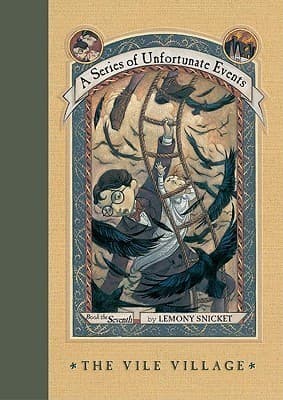
Synopsis
Covers the whole plot, including the ending.
- Difficulty
- Easy
- Pacing
- Fast
- Mood
- Melancholy, Suspenseful, Witty, Absurdist
- Read it if
- You enjoy dark humor, clever wordplay, and a series of unfortunate events where children outsmart inept adults.
- Skip it if
- You prefer happy endings and straightforward plots without constant peril and moral ambiguity.
The Vile Village Plot Summary
Covers the whole plot, including the ending.
Arrival at the Village of Fowl Devotees
After escaping their last guardian, Violet, Klaus, and Sunny Baudelaire are sent by Mr. Poe to the Village of Fowl Devotees (V.F.D.), a town run by strict rules and an Elder Council. Their new guardianship is unusual; the entire village is meant to care for them, which immediately makes Klaus suspicious. The village is obsessed with its many crows, which migrate daily, and its strict rules. The children are given a rundown shack to live in and assigned chores, quickly realizing their new home offers little comfort or safety, and that the villagers distrust outsiders.
The Mysterious 'Jacques Snicket'
While living in V.F.D., the Baudelaires meet Jacques Snicket, a kind man researching the village's history. To their dismay, Jacques looks a lot like Count Olaf, with a unibrow and an eye tattoo on his ankle. Despite the physical similarities, Jacques acts completely differently, confusing the children. He says he is part of a secret organization and warns them about a conspiracy. Before he can say more, the village authorities arrest him for breaking a rule against 'suspicious looking people,' after Count Olaf, disguised as Detective Dupin, points him out.
Jacques's Demise and the Baudelaires' Framing
Jacques Snicket is found dead in the village's fountain, having fallen from the high clock tower. Count Olaf, still disguised as Detective Dupin, immediately accuses the Baudelaire orphans of his murder, saying they pushed him. The villagers, easily swayed and already suspicious of the children, believe Olaf's made-up story. The Baudelaires, despite pleading their innocence and trying to explain Olaf's true identity, are quickly arrested and locked in the 'Deluxe Cell,' a small, uncomfortable cage for criminals. Their situation becomes serious as they realize Olaf has again manipulated a community to further his evil plans.
Investigation and Rule-Breaking
Imprisoned, the Baudelaires realize they must prove their innocence and expose Count Olaf. Klaus, always the researcher, notices odd details about the village's rules, especially Rule #283: 'No person shall be allowed to remove a single crow from the village.' He also finds a coded message hidden in a newspaper article about Jacques's death, which reads 'Baudelaire orphans are innocent. Check the fountain.' This message, left by Jacques, shows he knew he was in danger. The children realize they need to investigate the fountain, but escaping their cell and navigating the rule-obsessed village without getting caught is a big challenge.
Escape and the Fountain Clue
Using their combined skills, the Baudelaires escape the Deluxe Cell. Violet, with her inventive skills, makes a makeshift lock-picking device, while Sunny's sharp teeth help gnaw through restraints. They go to the fountain, where Klaus carefully examines the area. He finds a broken piece of a spyglass and a note from Jacques, confirming he was investigating the village and its V.F.D. connection, and that Count Olaf was involved. This evidence further shows Olaf is responsible for Jacques's death and that the village's rules are being misused.
The Trial and Count Olaf's Manipulation
The Baudelaires are brought to trial. Count Olaf, still disguised as Detective Dupin, acts as the prosecutor, and the Council of Elders serves as the jury. The trial is a complete joke, designed to convict the children. Olaf presents fake evidence and manipulates the villagers, playing on their fear and rule-following. The children try to present their evidence – the broken spyglass and Jacques's note – but Olaf dismisses it. The villagers, fooled by Olaf's charm and their own bias, are ready to condemn the Baudelaires, making their situation seem hopeless.
Violet's Invention and the Truth Revealed
During the trial, Violet realizes the broken spyglass could expose Olaf. She cleverly rebuilds it and, using its reflective surface, reveals Olaf's unibrow, which he had painted over. The villagers gasp as Olaf's true face is shown. Klaus then presents Jacques's note, proving Olaf's involvement in the murder. However, the village council, still holding to their absurd rules, declares that while Olaf is indeed Count Olaf, the children are still guilty of breaking Rule #283 by removing a crow, upholding their conviction on a technicality.
The Crow Chase and the Rule of Crows
Despite exposing Olaf, the Baudelaires are still found guilty. They realize their only option is to escape. Remembering Rule #283, which forbids harming the crows, Violet plans. They release the village's entire crow population, causing chaos and confusion. The children grab onto the legs of the migrating crows, using them to fly away from the village. Count Olaf, angry at their escape, chases them in a vehicle, but the children evade him, soaring into the sky with the birds, leaving the confused villagers and enraged Olaf behind.
The Great Unknown
The Baudelaire orphans, clinging to the legs of the migrating crows, escape the Village of Fowl Devotees. They eventually land safely, far from Count Olaf and the misguided villagers. However, their relief is short-lived. They are again alone, without a guardian, and no closer to finding the full truth about V.F.D. or their parents' past. As they walk away, they know Jacques Snicket was a good man, a member of the secret organization, and a victim of Count Olaf, strengthening their resolve to continue seeking answers and safety.
The Vile Village Characters
Violet Baudelaire
Protagonist
The inventive eldest Baudelaire sibling.
Violet is the eldest of the Baudelaire orphans, known for her extraordinary talent in inventing and tinkering. When deep in thought or about to invent something, she ties her hair back with a ribbon. She is protective of her younger siblings, Klaus and Sunny, and often takes on a leadership role in their escape plans. Her quick thinking and engineering skills are crucial for the children's survival in the face of Count Olaf's schemes.
Relationships: Klaus Baudelaire (protective older sister, intellectual partner); Sunny Baudelaire (doting older sister, caregiver); Count Olaf (arch-nemesis, victim of his schemes)
Klaus Baudelaire
Protagonist
The intelligent middle Baudelaire sibling with a love for books.
Klaus is the middle Baudelaire child, an avid reader with an eidetic memory. His vast knowledge, acquired from countless books, often provides crucial information and insights that help the siblings uncover clues and understand complex situations. He is the researcher and analyst of the group, always seeking to understand the 'why' behind events. His intelligence is a constant asset, though he sometimes struggles with the practical application of his knowledge.
Relationships: Violet Baudelaire (intellectual partner, younger brother); Sunny Baudelaire (caring older brother); Count Olaf (arch-nemesis, victim of his schemes)
Sunny Baudelaire
Protagonist
The youngest Baudelaire sibling with surprisingly sharp teeth.
Sunny is the youngest Baudelaire orphan, initially communicating primarily through a series of babbles that only her siblings can understand. As the series progresses, her vocabulary expands. Her most notable trait is her incredibly sharp teeth, which she uses to bite through various objects, often proving unexpectedly useful in tight situations. Despite her age, Sunny contributes significantly to the siblings' escapes with her unique abilities and often perceptive observations.
Relationships: Violet Baudelaire (younger sister, cared for); Klaus Baudelaire (younger sister, cared for); Count Olaf (arch-nemesis, victim of his schemes)
Count Olaf
Antagonist
The villainous actor relentlessly pursuing the Baudelaire fortune.
Count Olaf is the primary antagonist of the series, a greedy and cruel actor who relentlessly pursues the Baudelaire orphans' vast inheritance. He is a master of disguise, frequently adopting new personas to infiltrate the children's lives and trick unsuspecting adults. In V.F.D., he disguises himself as Detective Dupin, a seemingly competent but ultimately corrupt investigator. His defining features include a unibrow and a tattoo of an eye on his ankle, which the children often use to identify him.
Relationships: Baudelaire Orphans (arch-nemesis, target of his schemes); Jacques Snicket (murderer of Jacques); Mr. Poe (manipulates Mr. Poe and other adults)
Mr. Poe
Supporting
The well-meaning but incompetent banker in charge of the Baudelaire fortune.
Mr. Poe is the banker in charge of the Baudelaire fortune and the children's guardian placement. Despite his good intentions, he is consistently oblivious to Count Olaf's disguises and the children's pleas, often making decisions that inadvertently put the orphans in further danger. He is a symbol of adult incompetence and bureaucracy within the series. In V.F.D., he sends the children to a village with a highly unusual and problematic guardianship arrangement.
Relationships: Baudelaire Orphans (ineffective guardian, responsible for their placement)
Jacques Snicket
Supporting
A kind and mysterious man, member of V.F.D., and Lemony Snicket's brother.
Jacques Snicket is a kind and intelligent man who arrives in V.F.D. and immediately connects with the Baudelaire orphans. He bears a striking resemblance to Count Olaf, with a unibrow and an eye tattoo, leading to initial confusion. However, his benevolent nature and his knowledge of the secret organization V.F.D. quickly set him apart. He is revealed to be Lemony Snicket's brother and is actively investigating the village and Count Olaf. He is tragically murdered, and his death is framed upon the Baudelaires.
Relationships: Baudelaire Orphans (temporary ally, source of information); Count Olaf (victim of Olaf's murder); Lemony Snicket (brother)
The Council of Elders
Supporting
The governing body of the Village of Fowl Devotees.
The Council of Elders are the collective leaders of the Village of Fowl Devotees. They are elderly, rigid, and strictly adhere to the village's numerous and often absurd rules, known as the 'Rules of V.F.D.' They are easily manipulated by Count Olaf (as Detective Dupin) due to their blind faith in authority and their inability to see beyond superficial appearances. Their incompetence and adherence to trivial rules over justice lead to the Baudelaires' wrongful conviction.
Relationships: Baudelaire Orphans (unjust judges, incompetent guardians); Count Olaf (easily manipulated by Olaf)
Detective Dupin
Mentioned
Count Olaf's disguise in the Village of Fowl Devotees.
Detective Dupin is Count Olaf's disguise in the Village of Fowl Devotees. Under this persona, Olaf appears as a seemingly competent and authoritative detective, complete with a trench coat and a fedora. He cleverly paints over his unibrow to hide his identity and uses his acting skills to convince the villagers and the Council of Elders that he is a legitimate investigator. He successfully frames the Baudelaires for Jacques Snicket's murder and manipulates the trial proceedings.
Relationships: Count Olaf (an alias for Olaf); Baudelaire Orphans (accuser, persecutor); Village of Fowl Devotees (manipulates the villagers)
The Vile Village Themes
Incompetence of Adults
Adult incompetence continues to endanger the Baudelaire children. Mr. Poe's decision to send them to the Village of Fowl Devotees, with its odd communal guardianship, immediately puts them in danger. The Council of Elders, with their rigid adherence to senseless rules, are easily fooled by Count Olaf's disguise as Detective Dupin. They fail to see through his obvious deception even when the children present clear evidence. This theme shows the children's constant need to rely on their own intelligence and resourcefulness to survive, as the adults around them consistently fail to protect them.
“It is a curious thing, but very often good and sensible people are not able to perceive the truth, even when it is staring them in the face.”
The Dangers of Blind Obedience
The Village of Fowl Devotees shows the dangers of blind obedience to rules. The villagers prioritize their many, often illogical, 'Rules of V.F.D.' over common sense, justice, and human compassion. This rigid adherence allows Count Olaf, disguised as Detective Dupin, to manipulate the entire community. They readily believe his made-up story about the Baudelaires' guilt and will not consider any evidence that goes against their rules or trust in authority figures. This theme highlights how a society can become unjust and dangerous when critical thinking is suppressed in favor of unquestioning compliance.
“It is a sad truth, but one that must be acknowledged, that the rules of the world are not always fair, and that justice is not always served.”
Identity and Disguise
Identity and disguise are central to the story, especially with Count Olaf's repeated ability to fool adults. In V.F.D., he successfully acts as Detective Dupin, a seemingly legitimate authority figure, by simply painting over his unibrow. The confusion grows with the arrival of Jacques Snicket, who shares physical features with Olaf but is morally his opposite. This contrast shows how easily appearances can be deceiving and how hard it is for the children to convince adults of Olaf's true identity, forcing them to rely on their own deductive skills to tell friend from foe.
“It is a curious thing, the way a person's appearance can be so misleading.”
The Power of Knowledge and Invention
Throughout their ordeal, the Baudelaire orphans consistently use their unique talents – Violet's inventiveness, Klaus's knowledge, and Sunny's sharp teeth – to overcome problems. Klaus deciphers Jacques's coded message and finds clues about the fountain. Violet invents a device to escape their cell and later rebuilds the spyglass to expose Olaf. Sunny's biting skills help in their escape. This theme emphasizes that despite their youth and vulnerability, their combined intellectual and practical skills are their most powerful tools for survival against incompetent adults and Count Olaf's schemes.
“There is no such thing as a problem that cannot be solved, if one only has enough information.”
Plot Devices & Literary Techniques
Red Herring
A misleading clue or character used to distract the audience and characters.
The character of Jacques Snicket serves as a significant red herring. His physical resemblance to Count Olaf (unibrow, eye tattoo) initially leads the Baudelaires, and the reader, to suspect him of being Olaf in disguise. This misdirection is crucial in building suspense and confusion, making Olaf's actual disguise as Detective Dupin more effective. It also highlights the Baudelaires' constant vigilance and their struggle to discern truth from deception, as they must learn to look beyond superficial similarities to judge character.
Deus ex Machina (subverted)
An unexpected power or event saving a seemingly hopeless situation (often with a twist).
The use of the migrating crows to escape the village could be seen as a subversion of a Deus ex Machina. While the crows appear suddenly and provide a means of escape, their utility is directly tied to a specific village rule (Rule #283) that the children cleverly exploit. It's not an entirely random, out-of-nowhere solution but rather a resourceful use of existing circumstances and rules, demonstrating the children's ingenuity rather than a purely miraculous intervention. It provides a fantastical element to their escape, yet it's grounded in the established world.
The Unreliable Narrator
The story is told by a narrator whose credibility is questionable.
Lemony Snicket, as the narrator, consistently warns the reader against continuing the story due to its bleakness and unpleasantness. He frequently interjects with his personal opinions, historical anecdotes, and definitions, often lamenting the tragic fate of the Baudelaires. This device creates a unique tone, adding a layer of meta-commentary and dark humor. It also serves to heighten the sense of dread and inevitability, making the Baudelaires' struggles feel even more poignant as the narrator himself seems powerless to change their misfortunes.
The MacGuffin
An object or device that serves merely as a trigger for the plot.
The Baudelaire fortune, while not directly pursued in this book, continues to function as the ultimate MacGuffin. It is the underlying motivation for Count Olaf's relentless pursuit of the children, driving the entire series' plot. In 'The Vile Village,' Olaf's immediate goal is to frame the children for murder to gain access to their inheritance, even if indirectly. The fortune's existence shapes every decision and every danger the children face, serving as the constant, overarching trigger for their misfortunes.
The Vile Village Quotes
“There are many things in the world that are not good for children to know about, and even if they are good for children to know about, there are many people in the world who would rather children not know about them.”
“It is a sad but true fact that sometimes the most important information is hidden in the most unlikely places.”
“If you are a person who has ever had a secret, then you know that a secret can be a very dangerous thing.”
“The world is a vast and complicated place, and there are many people in it who are not what they seem.”
“Even the most ordinary events can lead to the most extraordinary complications.”
“It is a curious thing, but the more you try to avoid a certain type of person, the more often you seem to run into them.”
“Sometimes, the only way to get through a very bad day is to remember that you have gotten through very bad days before.”
“The expression 'the truth will out' is a phrase that means that no matter how hard people try to hide the truth, it will eventually become known.”
“It is a truth universally acknowledged that a single man in possession of a good fortune must be in want of a wife, but it is not a truth universally acknowledged that a single man in possession of a bad fortune must be in want of a disguise.”
“The worst kind of fear is the kind that makes you afraid of yourself.”
“Libraries are full of ideas—perhaps the most dangerous and powerful of all weapons.”
“It is often said that the first step is the hardest, but this is not always true. Sometimes the second step is the hardest, or the third, or the seventy-ninth.”
“The only thing that can console a person who has just been wronged is the knowledge that they are not alone.”
Quiz
10 questions on the plot and the characters. Each answer comes with a short explanation.
Question 1
Upon arriving at the village, what is the first rule the Baudelaire orphans are told about the crows?
- They must never feed the crows.
- They must never disturb the crows during their migration.
- They must never touch the crows.
- They must never, under any circumstances, approach the crows.
Show answer
D. They must never, under any circumstances, approach the crows. The first and most emphasized rule the Baudelaires learn upon entering the Village of Fowl Devotees is to never approach the crows, as it is believed to bring bad luck.
Question 2
What is the name of the woman who is supposedly murdered, leading to Count Olaf's 'arrest'?
- Jacquelyn
- Justice Strauss
- Jacques Snicket
- Count Omar
Show answer
D. Count Omar Count Olaf, disguised as Detective Dupin, stages the 'murder' of Jacques Snicket, whom he pretends is a man named Count Omar, to frame the Baudelaires.
Question 3
What is the primary reason the Baudelaires are sent to live in the Village of Fowl Devotees?
- It is a safe haven for orphans.
- It is the only place left that will take them.
- They have relatives living there.
- They are seeking information about V.F.D.
Show answer
B. It is the only place left that will take them. The Baudelaires are sent to the Village of Fowl Devotees because, after many misfortunes, it is the last place listed in Mr. Poe's files that will accept them under the 'It Takes a Village' program.
Question 4
What unique feature do the villagers possess that makes it difficult for the Baudelaires to distinguish Count Olaf's disguises?
- They all wear identical clothing.
- They all have distinct, unusual voices.
- They all wear strange hats that cover most of their faces.
- They are all extremely near-sighted.
Show answer
C. They all wear strange hats that cover most of their faces. The villagers of V.F.D. wear strange, pointed hats that obscure much of their faces, making it easier for Count Olaf and his associates to blend in and for the Baudelaires to miss crucial details.
Question 5
What is the name of the 'detective' who arrives in the village and is actually Count Olaf in disguise?
- Detective Spike
- Detective Dupin
- Detective Poe
- Detective Gumshoe
Show answer
B. Detective Dupin Count Olaf disguises himself as 'Detective Dupin,' a character whose name is a nod to Edgar Allan Poe's famous detective, C. Auguste Dupin.
Question 6
What 'punishment' do the Baudelaires face after being accused of Jacques Snicket's murder?
- They are banished from the village immediately.
- They are forced to work in the crow fields indefinitely.
- They are sentenced to be burned at the stake.
- They are locked in the village jail for life.
Show answer
C. They are sentenced to be burned at the stake. After being framed for murder, the Baudelaires are sentenced by the villagers to be burned at the stake, a truly grim and unjust punishment.
Question 7
What is the significance of the letters 'V.F.D.' in the context of the village?
- They stand for 'Very Friendly Denizens'.
- They are the initials of the village founder.
- They are an acronym for 'Village of Fowl Devotees', but also hint at a larger organization.
- They refer to the 'Vigilant Fire Department'.
Show answer
C. They are an acronym for 'Village of Fowl Devotees', but also hint at a larger organization. The letters V.F.D. are explicitly stated to stand for 'Village of Fowl Devotees' for the village itself, but the broader series context, and hints within this book, suggest they represent a secret organization, V.F.D.
Question 8
How do the Baudelaires ultimately escape their unjust sentence in the village?
- They are rescued by Mr. Poe and the authorities.
- They convince the villagers of their innocence through logical argument.
- They use a disguise and a clever ruse involving the crows to flee with Count Olaf and his troupe.
- They are freed by a sympathetic villager.
Show answer
C. They use a disguise and a clever ruse involving the crows to flee with Count Olaf and his troupe. The Baudelaires disguise themselves as Count Olaf's troupe members and escape by riding in his car, which is pulled by the migrating crows, making their escape seem like Olaf's grand exit.
Question 9
What is the primary role of the Council of Elders in the Village of Fowl Devotees?
- To educate the children of the village.
- To enforce the village's strict and often illogical rules.
- To manage the village's financial affairs.
- To coordinate the crow migrations.
Show answer
B. To enforce the village's strict and often illogical rules. The Council of Elders are the primary enforcers of the village's numerous and often absurd rules, and they are responsible for upholding the village's traditions, no matter how illogical.
Question 10
What crucial piece of evidence does Klaus discover that links Jacques Snicket to the V.F.D. organization?
- A photograph of Jacques with their parents.
- A tattoo of an eye on Jacques's ankle, matching Count Olaf's.
- A coded message left in Jacques's belongings.
- A distinctive V.F.D. pin on Jacques's lapel.
Show answer
C. A coded message left in Jacques's belongings. Klaus discovers a coded message or notes in Jacques Snicket's belongings that suggest he was part of the V.F.D. organization, indicating that his death is part of a larger, more complex conspiracy.
The Vile Village FAQ
What is the basic premise of the Baudelaires' time in the Village of Fowl Devotees?
The Baudelaire orphans are sent to live in the theocratic Village of Fowl Devotees (V.F.D.) under the care of the entire village, governed by a strict set of rules, particularly those concerning crows. They soon discover that Count Olaf is hiding in plain sight as Detective Dupin, attempting to frame them for murder and steal their fortune once again.
Who is Jacques Snicket, and what is his significance to the story?
Jacques Snicket is Lemony Snicket's brother and a member of V.F.D. He arrives in the village to meet with the Baudelaires but is murdered by Count Olaf, who then frames the orphans for the crime. His death is a pivotal event, leading to the Baudelaires' arrest and the escalation of their troubles.
How do the Baudelaires attempt to prove their innocence against the murder charges?
Violet, Klaus, and Sunny try to use their individual skills: Violet attempts to build a device to reveal Olaf's disguise, Klaus uses his research skills to find loopholes in the village laws and uncover evidence, and Sunny uses her sharp teeth to bite through ropes. Despite their efforts, the mob mentality and Olaf's manipulation make it nearly impossible.
What is the role of the Incredibly Deadly Viper in this book?
The Incredibly Deadly Viper, a snake previously encountered by the Baudelaires, is found near Jacques Snicket's body. The villagers, misled by Count Olaf, believe it to be the murder weapon, further implicating the Baudelaires. However, it is actually harmless and later helps the orphans escape.
What is the 'Deluxe Cell' and how does it feature in the plot?
The 'Deluxe Cell' is a primitive, uncomfortable prison cell in the Village of Fowl Devotees where the Baudelaire orphans are incarcerated after being falsely accused of Jacques Snicket's murder. It symbolizes the injustice they face and the village's misguided form of justice.
What is the significance of the acronym V.F.D. in this specific book?
In 'The Vile Village,' V.F.D. initially stands for 'Village of Fowl Devotees,' referencing the village's obsession with crows. However, it is later revealed that Jacques Snicket was also a member of the secret organization V.F.D., linking the village to the wider mystery of the Baudelaire parents and the secret society.
How do the Quagmires' couplets connect to the wider V.F.D. mystery?
The Quagmire triplets, who briefly communicate with the Baudelaires through couplets, reveal the crucial phrase 'V.F.D. means Voluntary Factual Dispatch' and hint at a headquarters. This information is vital for the Baudelaires, as it provides a new clue about the secret organization and where to find their friends.
What clues does the newspaper headline provide about the larger V.F.D. conspiracy?
The newspaper headline 'V.F.D. Members Found' hints at the discovery of other members of the secret organization. This suggests that the Baudelaires are not alone in their search for V.F.D. and that more information about the group's activities and members is becoming public.
What is the implied fate of the Quagmire triplets at the end of the book?
The Quagmire triplets, held captive in a caravan, are last seen being taken away by Count Olaf and his associates in a hot air balloon. Their fate is left ambiguous, implying they are still in danger and setting up their continued role in the series' overarching mystery.
How does the village's obsession with crows reflect the dangers of collective delusion?
The villagers' extreme devotion to the C.A.W. (Council of Adults' Welfare) and their rules regarding crows makes them easily manipulated by Count Olaf. Their collective delusion prevents them from seeing the obvious truth about Olaf's disguise and the Baudelaires' innocence, demonstrating how groupthink can override logic and compassion.
Analyze Violet's internal conflict regarding her role as the eldest sibling in this book.
Violet struggles with the immense responsibility of protecting her siblings while facing an entire village that believes them guilty. Her usual ingenuity is hampered by the overwhelming injustice, leading to moments of frustration and despair, but ultimately strengthening her resolve to find a way out for her family.
How does Klaus's reliance on facts and logic clash with the irrationality of the villagers?
Klaus's attempts to use legal precedents and factual evidence to prove their innocence are completely ineffective against the villagers' emotional responses and adherence to arbitrary rules. This highlights his frustration with a world that often prioritizes mob mentality and superstition over reason.
What psychological impact does the constant threat of Count Olaf have on Sunny?
Despite her young age, Sunny demonstrates remarkable resilience and courage. The constant threat forces her to contribute her unique skills, like biting, more actively. Her fear is often masked by her determination to help her siblings, showing a developing sense of agency and protectiveness.
Discuss the moral ambiguity of the Baudelaires' escape from the village.
The Baudelaires' escape involves them burning down the village's administration building, an act that, while necessary for their freedom, is destructive. This action blurs the lines between right and wrong, forcing them to adopt morally questionable tactics to survive, reflecting the 'end justifies the means' dilemma in their desperate situation.
Is the Village of Fowl Devotees a true utopia or a dystopia, and why?
Despite its initial appearance as a safe, communal living situation, the Village of Fowl Devotees is a dystopia. Its rigid rules, lack of individual thought, and susceptibility to manipulation by figures like Count Olaf create an oppressive environment where justice is easily perverted and innocent people are persecuted, far from any ideal utopia.
What is the thematic significance of the 'very strange hats' mentioned in the synopsis?
The 'very strange hats' worn by the villagers symbolize their conformity and the absurdity of their strict, nonsensical rules. They represent the villagers' willingness to blindly follow tradition and authority, even when it leads to illogical and harmful outcomes, highlighting the theme of unquestioning obedience.
How does the character of Hector represent a different kind of adult helper for the Baudelaires?
Hector is a kind and well-meaning but ultimately timid guardian who struggles to stand up to the village elders. Unlike previous guardians, he genuinely cares for the children but lacks the courage and assertiveness to protect them effectively, showcasing the limitations of good intentions without action.
What does the ending, with the Baudelaires becoming fugitives, imply about their future?
The Baudelaires becoming fugitives signifies a major turning point, pushing them further into a life of danger and self-reliance. It implies they can no longer trust adult figures or institutions for help and must now actively pursue the V.F.D. mystery on their own terms, embracing a more proactive and perilous journey.
About the author
Lemony Snicket is the pen name of author Daniel Handler, known for his children's books featuring dark humor and whimsical storytelling. His series "A Series of Unfortunate Events" includes titles such as The Bad Beginning, The Reptile Room, The Wide Window, The Miserable Mill, The Austere Academy, and The Ersatz Elevator, which follow the misadventures of the Baudelaire orphans. Snicket's work has garnered a significant following and has been adapted into various media, including films and television.
Similar books
- The Mysterious Benedict Society
Trenton Lee Stewart
4.2 (123k) average on GoodreadsFantasyFeatures clever children solving mysteries and facing eccentric villains.
- Coraline
Neil Gaiman
4.0 (23k) average on GoodreadsFantasyBlends dark fantasy with a child protagonist in a strange and unsettling world.
- Harry Potter and the Sorcerer's Stone
J.K. Rowling
4.5 (7M) average on GoodreadsFantasyRescued from a miserable life under the stairs, an orphaned boy discovers he's a wizard destined for a magical school, where he uncovers a dangerous secret tied to the dark wizard who murdered his parents.
- The Hunger Games
Suzanne Collins
4.3 (6.4M) average on GoodreadsFantasyIn a future where children fight to the death on live television, Katniss Everdeen volunteers for the arena, turning a death sentence into a fight for survival and a spark of rebellion.
- 1984
George Orwell
4.2 (3.1M) average on GoodreadsPoliticsIn a future where surveillance and thought control are absolute, a man's search for truth clashes with the Party, showing that hope can be a form of rebellion.
- Divergent
Veronica Roth
4.2 (2.9M) average on GoodreadsFantasyIn a society divided by virtues, a sixteen-year-old's difference from the norm starts a rebellion that threatens her world.






Enjoyed the summary?
A summary gives you the shape of the book. The book itself has the detail, the examples and the voice.
Find The Vile Village on AmazonAs an Amazon Associate, BookBrief earns from qualifying purchases. How we're funded