
Synopsis
Covers the whole plot, including the ending.
- Difficulty
- Medium
- Pacing
- Slow
- Mood
- Atmospheric, Melancholy, Erotic, Reflective
- Read it if
- You appreciate subtle, psychological exploration of desire, guilt, and legacy in a traditional Japanese setting.
- Skip it if
- You prefer fast-paced plots, clear moral boundaries, or explicit emotional resolution.
Thousand Cranes Plot Summary
Covers the whole plot, including the ending.
The Tea Ceremony and Mrs. Ota
Kikuji Mitani, a young man still dealing with his parents' recent deaths, attends a traditional tea ceremony. Mrs. Ota, his deceased father's former mistress, hosts the ceremony. Kikuji vaguely remembers her from childhood and finds her unsettling yet interesting. At the ceremony, Kikuji meets Yukiko Inamura, a young woman with a 'thousand cranes' furoshiki, brought by Mrs. Ota as a potential bride for Kikuji. The air is heavy with history and past relationships, especially his father's affairs, which Mrs. Ota represents. Kikuji feels an immediate, if complicated, attraction to both women, but for different reasons.
A Night with Mrs. Ota
After the tea ceremony, Kikuji feels drawn to Mrs. Ota. Their shared history and his father's lingering presence create a strange closeness. One evening, Mrs. Ota visits Kikuji at his house, ostensibly to return a borrowed item. Their talk quickly becomes personal, touching on their grief and complex relationship with Kikuji's father. Overcome by desire, curiosity, and shared sorrow, Kikuji and Mrs. Ota spend the night together. This act creates a bond that is both passionate and guilty, further involving Kikuji in his father's past.
Fumiko's Intervention and Mrs. Ota's Decline
Soon after their intimate encounter, Mrs. Ota's daughter, Fumiko, approaches Kikuji. Fumiko, a severe woman, is deeply affected by her mother's past relationship with Kikuji's father and now by her mother's affair with Kikuji. She expresses disapproval and a protective feeling over her mother, hinting at the shame and pain these relationships caused. Meanwhile, Mrs. Ota's health declines quickly. The emotional distress and her past, combined with her current affair with Kikuji, seem to affect her, leading to a visible decline.
Mrs. Ota's Death and Kikuji's Guilt
Mrs. Ota dies suddenly, leaving Kikuji with guilt and regret. He feels responsible for her death, believing their affair and its emotional stress contributed to it. The lingering scent of her perfume in his house and the memory of her touch haunt him. Her death not only ends their physical connection but also intensifies Kikuji's internal struggle, forcing him to face the results of his desires and the destructive patterns inherited from his father. He is left adrift, burdened by loss and unresolved emotional ties.
Fumiko's Confession and Shared Burden
After Mrs. Ota's death, Fumiko seeks out Kikuji. She reveals a shocking truth: she, too, had a relationship with Kikuji's father, confessing he was her first lover. This changes Kikuji's view of his father and Fumiko. It creates an unexpected and dark bond between them, as they both share the intimate, complex legacy of the deceased man. This shared secret brings them closer, not out of romantic love, but from a mutual understanding of their entangled pasts and the peculiar burden they carry, connecting them through desire and regret from a common source.
The Persistence of Chikako
Throughout these events, Chikako, another of Kikuji's father's former mistresses, remains a persistent presence in Kikuji's life. She has a large birthmark on her breast, which Kikuji remembers from childhood. Chikako is a domineering woman who openly disapproves of Kikuji's involvement with Mrs. Ota and later Fumiko. She sees herself as guarding Kikuji's family honor and tries to push him towards a more 'suitable' match, often mentioning Yukiko. Her constant interference adds tension to Kikuji's already complicated emotional life, representing societal judgment and the inescapable past.
Kikuji's Growing Attraction to Fumiko
Despite the unconventional nature of their shared past, Kikuji feels more attracted to Fumiko. Their mutual connection to his father, and now to Mrs. Ota's death, binds them uniquely. He is drawn to her severe beauty and intense emotions, seeing echoes of both his father and Mrs. Ota in her. Their interactions become more intimate, marked by a silent understanding and a mix of remorse and desire. This attraction is not simple romance but a complex entanglement rooted in shared trauma and the lingering shadows of their parents' lives, leading to further emotional complexity.
Fumiko's Rejection of the Tea Utensils
Fumiko takes a decisive step to distance herself from the past by rejecting her mother's valuable tea ceremony utensils. She offers them to Kikuji with detachment, as if wanting to erase the memories. This act symbolizes her desire to cut ties with her mother's lingering influence and her own painful history. For Fumiko, these cherished objects, once central to her mother's identity and the ceremonies that entangled their lives, now represent a burden she wants to shed, showing her struggle for independence from her family's complicated legacy.
The Unattainable Yukiko
Throughout his relationships with Mrs. Ota and Fumiko, Kikuji continues to consider Yukiko Inamura as a potential partner. Yukiko, with her 'thousand cranes' furoshiki, represents purity and a more conventional, untainted future. Chikako actively tries to arrange a match, seeing Yukiko as the ideal bride. However, Kikuji's actions and deep involvement with Mrs. Ota and Fumiko make a genuine connection with Yukiko difficult. She remains an idealized figure, a symbol of a life Kikuji might have had, but which his current circumstances seem to deny him.
Fumiko's Disappearance
Just as Kikuji's relationship with Fumiko deepens and becomes more charged with unspoken desires and shared burdens, Fumiko suddenly disappears. She leaves no note or explanation, simply vanishing. Her abrupt departure leaves Kikuji confused and abandoned. He is left alone to deal with his unresolved feelings for her, the lingering guilt from Mrs. Ota's death, and the inescapable legacy of his father's affairs. Fumiko's disappearance marks a turning point, leaving Kikuji isolated and thinking about the destructive patterns that define his romantic life, forever bound by the past.
Principal Figures
Kikuji Mitani
Protagonist
A young man entangled in the lingering affairs of his deceased father.
Kikuji is a young man in his late twenties, still reeling from the recent deaths of his parents. He is somewhat passive, easily swayed by the women in his life, particularly those connected to his father's past. He struggles with a sense of guilt, desire, and confusion, often drawn to women who embody the complicated legacy of his family. He seeks connection but finds himself caught in a web of destructive patterns, unable to fully escape the shadow of his father's philandering. He is sensitive and introspective, yet lacks the agency to break free from his circumstances.
Relationships: Mrs. Ota (Lover, his father's former mistress); Fumiko (Lover, Mrs. Ota's daughter, his father's former lover); Yukiko Inamura (Prospective bride, symbol of purity); Chikako (His father's former mistress, meddling figure)
Mrs. Ota
Supporting
Kikuji's father's former mistress, with whom Kikuji has an affair.
Mrs. Ota is a middle-aged woman, elegant but with a certain world-weariness. She carries the weight of her past as Kikuji's father's mistress, a relationship that profoundly shaped her life. She is emotionally vulnerable and drawn to Kikuji, perhaps seeing in him a connection to her lost love or a chance for a new, albeit complicated, intimacy. Her delicate nature and her lingering attachment to the past make her susceptible to emotional turmoil, ultimately leading to her tragic demise. She embodies the sensual nostalgia and regret that permeate the narrative.
Relationships: Kikuji Mitani (Lover); Kikuji's Father (Former lover); Fumiko (Daughter)
Fumiko
Supporting
Mrs. Ota's daughter, who shares a complex past with Kikuji's father and later with Kikuji.
Fumiko is a severe, almost stark young woman, marked by the shame and pain of her mother's affair with Kikuji's father, and her own secret intimate relationship with him. She possesses a strong will and a desire to break free from the past, though she is inevitably drawn into its complexities. Her cold exterior hides deep emotional wounds and a fierce sense of protectiveness, particularly over her mother's memory. She is both a victim and a participant in the destructive cycle of relationships, ultimately seeking an escape from the entangled legacies.
Relationships: Kikuji Mitani (Lover, shares a complex past with his father); Mrs. Ota (Mother); Kikuji's Father (Former lover)
Yukiko Inamura
Supporting
A pure and innocent potential bride for Kikuji, representing an untainted future.
Yukiko is a young woman introduced as a potential bride for Kikuji. She is characterized by her innocence, purity, and a delicate demeanor, symbolized by her 'thousand cranes' furoshiki. She represents an escape from the tainted past and the complicated relationships that plague Kikuji. While Kikuji is intermittently drawn to her as an ideal, her presence highlights his inability to fully embrace a conventional, unburdened future due to his entanglements. She remains somewhat elusive and serves more as a symbol than a fully realized character, embodying a path not taken.
Relationships: Kikuji Mitani (Potential bride); Chikako (Advocate for her marriage to Kikuji)
Chikako
Supporting
Kikuji's father's other former mistress, a meddling and outspoken figure.
Chikako is a forceful and somewhat grotesque woman, marked by a prominent birthmark on her breast. She was another of Kikuji's father's mistresses and maintains a strong, almost proprietorial, interest in Kikuji's life. She is outspoken, judgmental, and meddlesome, openly disapproving of Kikuji's choices and advocating for a more 'suitable' match like Yukiko. Chikako represents the lingering, unpleasant aspects of the past, a constant reminder of the family's complicated history and the societal expectations that Kikuji struggles against. She embodies a kind of vulgarity that contrasts sharply with the delicate aesthetics of the tea ceremony.
Relationships: Kikuji Mitani (Object of her meddling and matchmaking attempts); Kikuji's Father (Former lover); Yukiko Inamura (Advocates for her marriage to Kikuji)
Kikuji's Father
Mentioned
The deceased patriarch whose philandering casts a long shadow over the narrative.
Though deceased before the story begins, Kikuji's father is a central, pervasive force in the novel. His numerous affairs, particularly with Mrs. Ota and Chikako, and later revealed with Fumiko, define the emotional landscape and relationships of the living characters. He represents a legacy of unchecked desire and emotional entanglement that Kikuji struggles to escape. His presence is felt through the memories of the women he loved and the patterns of behavior he inadvertently passed down to his son. He is the catalyst for the complex web of desire, guilt, and regret that unfolds.
Relationships: Kikuji Mitani (Son); Mrs. Ota (Former mistress); Chikako (Former mistress); Fumiko (Former lover)
Themes & Insights
The Burden of the Past
The novel is filled with the weight of past relationships and decisions, especially those of Kikuji's deceased father. Kikuji cannot escape his father's legacy, becoming involved with his father's former mistresses, Mrs. Ota and Chikako, and even Mrs. Ota's daughter, Fumiko, who also had a relationship with his father. This theme is clear in Kikuji's guilt after Mrs. Ota's death, and Fumiko's struggle to discard her mother's tea utensils, symbolizing her wish to break free from inherited burdens. The past is not just remembered; it actively shapes the present, creating a cycle of desire and regret.
“The past had not died; it was still alive, still twisting and turning in the present.”
Destructive Desire and Incestuous Undertones
Desire in 'Thousand Cranes' often involves complications, guilt, and a subtle sense of incest. Kikuji's attraction to Mrs. Ota, his father's former mistress, and later to Fumiko, who was also his father's lover, creates a disturbing pattern. This is not overt incest but an emotional mirroring that blurs familial and romantic lines. The relationships are driven by a yearning for connection, but also by a subconscious desire to re-enact or understand the father's past. This is clear in Kikuji's affair with Mrs. Ota and the later revelation of Fumiko's past with his father, creating a tangled web of forbidden attractions that lead to tragic outcomes.
“He felt a dark, sweet tremor, a sense of having stepped into a forbidden garden.”
Beauty, Purity, and Corruption
The novel contrasts the beauty and purity of the tea ceremony with the corrupting influence of human desire and the tarnished nature of the characters' relationships. The delicate 'thousand cranes' furoshiki and the revered tea utensils represent aesthetic perfection and tradition. However, this beauty is constantly set against the messy realities of the characters' lives – Chikako's birthmark, the illicit affairs, and the lingering shame. Yukiko, with her 'thousand cranes' motif, embodies purity, but Kikuji's inability to connect with her shows how his world has been corrupted by the past, making true purity unattainable for him.
“The tea ceremony was a fragile vessel, holding both beauty and the shadows of human weakness.”
Loss and Grief
Grief is a constant theme throughout the novel, stemming from the literal deaths of Kikuji's parents and Mrs. Ota, and also from the loss of innocence and the inability to escape past traumas. Kikuji's initial grief over his parents' deaths sets the stage for his later entanglements, as he seeks solace and connection in problematic ways. Mrs. Ota's death leaves Kikuji with deep guilt and a sense of irreplaceable loss. The characters are always mourning something – a lost love, a lost past, or a lost chance for a simpler life – contributing to the novel's melancholic tone.
“A sadness that was not only for her, but for all the things that could never be.”
Plot Devices & Literary Techniques
Tea Ceremony
A recurring setting and symbol of tradition, beauty, and ritual.
The tea ceremony serves as a central plot device, providing the initial setting where Kikuji meets Mrs. Ota and Yukiko. It is a highly ritualized event that embodies Japanese aesthetic principles of purity, simplicity, and harmony. Ironically, these ceremonies become the backdrop for illicit desires, complicated relationships, and the exposure of human flaws. The tea utensils themselves, passed down through generations, symbolize the weight of tradition and the inescapable past, even as characters like Fumiko try to discard them to break free. It highlights the tension between ideal beauty and human imperfection.
The 'Thousand Cranes' Furoshiki
A symbolic motif representing purity, hope, and an unattainable ideal.
The 'thousand cranes' furoshiki, carried by Yukiko Inamura, is a powerful symbol. Cranes in Japanese culture represent longevity, good fortune, and purity. The motif on Yukiko's scarf immediately sets her apart as an embodiment of innocence and a potential, untainted future for Kikuji. It contrasts sharply with the sordid and complicated relationships he finds himself in. The furoshiki represents a vision of a harmonious, traditional life that Kikuji seems unable to grasp, serving as a constant reminder of what he might have, but ultimately cannot attain, due to his entanglement in the past.
The Birthmark
A physical detail symbolizing imperfection, the past, and Chikako's unpleasant nature.
Chikako's prominent birthmark on her breast serves as a physical manifestation of imperfection and the unpleasant aspects of the past. For Kikuji, it's a childhood memory that resurfaces, linking Chikako directly to his father's affairs and the less refined side of his family's history. It contrasts sharply with the delicate beauty associated with the tea ceremony and the pure image of Yukiko. The birthmark symbolizes the indelible marks left by past actions and relationships, suggesting a kind of inherited or persistent flaw that cannot be hidden or erased, much like the lingering influence of his father's philandering.
The Tea Utensils
Objects that embody tradition, inherited legacy, and emotional baggage.
The tea utensils, particularly those belonging to Mrs. Ota, are more than mere objects; they are vessels of history and emotion. They represent a tangible link to the past, embodying the aesthetic traditions of the tea ceremony but also the personal histories of those who used them. Fumiko's desire to discard her mother's utensils symbolizes her attempt to shed the emotional baggage and the tainted legacy of her mother's and her own past. These objects become powerful symbols of inherited burdens and the struggle to either embrace or reject the weight of tradition and family history.
Thousand Cranes Quotes
“Living as we do in a world of sorrows, we are apt to be moved by the smallest things.”
“The feeling of a woman's skin, the smell of her hair, the sound of her voice—these things are not to be forgotten easily.”
“There are some things in life that are not meant to be spoken, only felt.”
“A beautiful thing, if it is to be remembered, must be destroyed.”
“The tea ceremony is a ritual of purification, but it is also a ritual of remembrance.”
“He felt as if he were being drawn into a dark, bottomless well, and he did not resist.”
“Perhaps the most beautiful things in life are those that are broken.”
“The past is like a dream, but it is a dream from which we can never truly awaken.”
“The sight of her hands, so delicate and yet so strong, filled him with a strange mixture of desire and fear.”
“Love, he thought, was a kind of sickness, a fever that consumed one's very being.”
“Even in the darkest of times, there is always a glimmer of hope, a faint light that guides us forward.”
“The smell of fresh tea leaves reminded him of his father, and of all the things that had been lost.”
“Silence, sometimes, was more eloquent than any words.”
“He felt as though he were merely a spectator in his own life, watching events unfold without truly participating.”
Quiz
10 questions on the plot and the characters. Each answer comes with a short explanation.
Question 1
What is the primary setting where Kikuji first encounters Mrs. Ota after his parents' deaths?
- A formal dinner party
- A traditional tea ceremony
- His family's ancestral home
- A public garden
Show answer
B. A traditional tea ceremony Kikuji encounters Mrs. Ota, his father's former mistress, at a traditional tea ceremony, an event central to the novel's themes and atmosphere.
Question 2
Who is Mrs. Ota in relation to Kikuji's father?
- His distant cousin
- His former business partner
- His former mistress
- His childhood friend
Show answer
C. His former mistress Mrs. Ota is introduced as Kikuji's father's former mistress, a relationship that deeply influences the novel's unfolding events.
Question 3
What is Kikuji's initial reaction to Mrs. Ota's 'indelicate nature'?
- He is immediately attracted to her.
- He is indifferent.
- He is appalled by it.
- He finds it amusing.
Show answer
C. He is appalled by it. Initially, Kikuji is described as being 'appalled by her indelicate nature' before succumbing to passion.
Question 4
Which of these themes is NOT explicitly mentioned as converging around the tea ceremony in the book's description?
- Death
- Jealousy
- Ambition
- Attraction
Show answer
C. Ambition The description states 'Death, jealousy, and attraction convene around the delicate art of the tea ceremony,' but ambition is not listed.
Question 5
What is the primary force that 'binds the living to the dead' in the story, according to the description?
- Financial obligations
- Religious rituals
- Almost sensual nostalgia
- Shared dreams
Show answer
C. Almost sensual nostalgia The text describes the story as one of 'desire, regret, and the almost sensual nostalgia that binds the living to the dead.'
Question 6
Beyond Mrs. Ota, to whom do Kikuji's attachments 'soon extend'?
- His mother's sister
- Mrs. Ota's daughter
- A childhood friend
- Another tea ceremony participant
Show answer
B. Mrs. Ota's daughter The synopsis explicitly states that Kikuji's 'attachments soon extend' to Mrs. Ota's daughter, complicating the already tragic situation.
Question 7
What is the significance of the 'Thousand Cranes' in the title, as suggested by the context of the book?
- It refers to a specific type of tea used in the ceremonies.
- It symbolizes a large flock of birds Kikuji observes.
- It is a pattern often found on traditional tea bowls or kimonos, representing beauty and perhaps a sense of fragile hope or legacy.
- It is the name of the tea house where most events occur.
Show answer
C. It is a pattern often found on traditional tea bowls or kimonos, representing beauty and perhaps a sense of fragile hope or legacy. While not explicitly stated in the summary, 'Thousand Cranes' is a common motif in Japanese art and culture, often appearing on textiles like kimonos or tea ceremony implements, symbolizing longevity, peace, and good fortune, yet in this context, it often highlights a poignant contrast with the characters' troubled lives.
Question 8
The consequences of Kikuji's passion with Mrs. Ota are described as 'tragic and unforeseen.' For whom do these consequences extend beyond the two lovers?
- Kikuji's deceased parents
- The master of the tea ceremony
- Mrs. Ota's daughter
- Kikuji's business associates
Show answer
C. Mrs. Ota's daughter The description states the consequences are 'not just for the two lovers, but also for Mrs. Ota’s daughter, to whom Kikuji’s attachments soon extend.'
Question 9
How is the art of the tea ceremony depicted in the context of the novel's themes?
- As a casual social gathering with little underlying meaning.
- As a setting where every gesture is imbued with profound meaning, intertwining with the characters' complex emotions.
- As a distraction from the characters' personal problems.
- As a purely aesthetic practice, separate from human drama.
Show answer
B. As a setting where every gesture is imbued with profound meaning, intertwining with the characters' complex emotions. The description emphasizes that 'every gesture is imbued with profound meaning' within the delicate art of the tea ceremony, suggesting its deep connection to the characters' internal and external conflicts.
Question 10
Given the central themes of desire, regret, and nostalgia, what specific emotion is Kikuji likely grappling with regarding his father's past and his own actions?
- Unbridled joy and contentment.
- A sense of detached observation.
- A complex mix of inherited desires and a struggle to define his own moral path, often influenced by the past.
- Complete rejection of all past influences.
Show answer
C. A complex mix of inherited desires and a struggle to define his own moral path, often influenced by the past. The novel highlights 'desire, regret, and the almost sensual nostalgia that binds the living to the dead,' suggesting Kikuji is not merely repeating his father's patterns but is deeply enmeshed in a struggle with inherited desires and the consequences of his own choices, shaped by the past.
Thousand Cranes FAQ
What is the central premise of 'Thousand Cranes'?
The novel revolves around Kikuji, a young man grappling with the legacy of his deceased parents, who becomes entangled in a series of complex and often destructive relationships with women connected to his father's past, particularly Mrs. Ota and her daughter, Fumiko, all set against the backdrop of traditional Japanese tea ceremonies.
Who are the primary female characters Kikuji interacts with?
Kikuji primarily interacts with Mrs. Ota, his deceased father's former mistress, and her daughter, Fumiko. He also has a brief, unsettling encounter with Chikako, another of his father's former mistresses, whose prominent birthmark is a recurring visual detail.
How does the tea ceremony function within the narrative?
The tea ceremony is more than just a setting; it acts as a symbolic framework, embodying tradition, beauty, and ritual, while simultaneously highlighting the characters' inability to escape their pasts and the disruptive nature of their desires. The tea bowls themselves often carry symbolic weight, linking characters and generations.
What is the significance of the title 'Thousand Cranes'?
The title refers to a pattern on a furoshiki (wrapping cloth) that Kikuji observes, which is associated with Fumiko. Cranes symbolize longevity and good fortune, but in the context of the story, they ironically highlight the fragility and impermanence of the relationships and the tragic outcomes.
What is the nature of Kikuji's relationship with Mrs. Ota?
Kikuji's relationship with Mrs. Ota is a brief, intense, and somewhat incestuous affair, driven by a complex mix of curiosity, inherited desire, and a search for connection to his deceased father. Their intimacy is marked by a sense of shared guilt and a melancholic awareness of its impropriety.
What is the symbolic meaning of the 'Shino tea bowl' and its crack?
The Shino tea bowl, inherited by Mrs. Ota from Kikuji's father, symbolizes the fractured relationships and the emotional damage passed down through generations. Its crack represents the imperfections and brokenness of the characters' lives and their inability to truly heal or escape their pasts.
How does Chikako, the woman with the birthmark, serve as a foil to Mrs. Ota and Fumiko?
Chikako represents a more traditional, perhaps even grotesque, manifestation of Kikuji's father's past, embodying a less idealized or romanticized form of his indiscretions. Her physical imperfection and rigid adherence to propriety starkly contrast with Mrs. Ota's sensual allure and Fumiko's delicate beauty, highlighting different facets of desire and regret.
What is the significance of the repeated motif of 'ink stains' or 'smudges'?
The 'ink stains' or 'smudges' often symbolize the indelible marks of the past and the emotional residue left by previous relationships. They represent the lingering guilt, shame, and the inescapable influence of the deceased, particularly Kikuji's father, on the living characters.
How does Kikuji's passivity contribute to the narrative's tragic events?
Kikuji's pervasive passivity and indecisiveness prevent him from forging genuine connections or taking control of his life. He drifts from one woman to another, allowing himself to be led by circumstance and inherited desires, which ultimately leads to a cycle of loss and heartbreak for himself and those around him.
Analyze Mrs. Ota's psychological state and motivations for pursuing Kikuji.
Mrs. Ota is driven by a profound sense of loneliness, nostalgia, and a desire to relive a connection to Kikuji's father. Her pursuit of Kikuji is a melancholic attempt to recapture a lost past and perhaps find absolution or an extension of her former lover through his son, leading to her tragic end.
What role does guilt play in the characters' psychological landscapes?
Guilt is a pervasive force, particularly for Kikuji, who feels guilty about his affair with Mrs. Ota and later about his treatment of Fumiko. Mrs. Ota also carries guilt from her past with Kikuji's father. This guilt often manifests as self-destructive behavior and an inability to find peace or happiness.
How does Fumiko's character arc reflect the destructive nature of inherited burdens?
Fumiko's arc is tragic; she tries to escape the shadow of her mother's past and her father's legacy but is ultimately drawn into a similar cycle of unrequited love and abandonment with Kikuji. Her desperation to purify herself and Kikuji, often through symbolic acts, underscores the heavy burden she carries.
Is Kikuji a sympathetic character, or is he merely a victim of circumstance?
Kikuji is a complex character who elicits both sympathy and frustration. While he is certainly influenced by the circumstances and legacies of his parents, his profound passivity and inability to make decisive choices or take responsibility for his actions prevent him from being purely a victim, contributing to the tragedy.
How does the novel explore themes of purity and defilement?
The novel constantly contrasts the pristine ritual of the tea ceremony with the 'defiled' or 'impure' nature of the characters' relationships. Fumiko, in particular, is obsessed with purifying herself and Kikuji, seeing their connections as tainted by the past, which ultimately drives her desperate actions.
What is the ultimate fate of Fumiko, and what does it signify?
Fumiko ultimately disappears after a final, desperate attempt to connect with Kikuji and cleanse their shared past, leaving behind a note suggesting she may have taken her own life. Her disappearance signifies the final, tragic consequence of the entangled relationships and the inability to escape the haunting legacy of the past.
Does the novel offer any sense of redemption or resolution for Kikuji?
The novel offers little in the way of redemption or clear resolution for Kikuji. By the end, he remains isolated, haunted by the women he has lost, and seemingly trapped in a cycle of regret and longing. The ending is ambiguous, suggesting a continued state of emotional paralysis rather than liberation.
How does the setting of post-war Japan subtly influence the narrative?
While not overtly political, the post-war setting subtly informs the novel's melancholic tone and the characters' sense of loss and disorientation. The traditional tea ceremony represents a clinging to past cultural values amidst a changing world, mirroring the characters' struggle to reconcile tradition with their chaotic desires.
What is the implication of Mrs. Ota's 'delicate nature' mentioned in the synopsis?
The synopsis's mention of Mrs. Ota's 'indelicate nature' initially sets up a contrast with the refined tea ceremony, but it's quickly subverted. Her 'indelicate' frankness and sensuality are precisely what draw Kikuji in, representing a break from the rigid decorum expected, yet ultimately leading to tragic consequences.
About the author
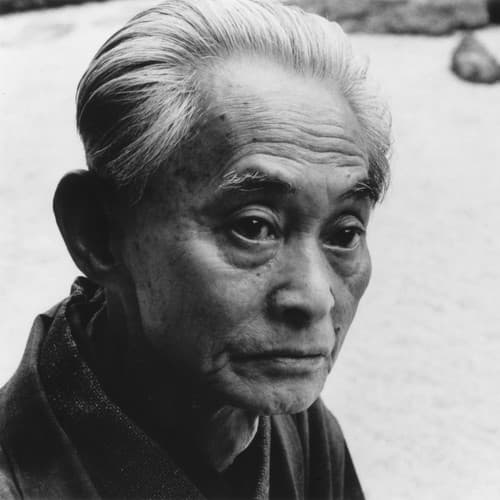
Yasunari Kawabata was a Japanese novelist and short story writer whose spare, lyrical, subtly shaded prose works won him the Nobel Prize in Literature in 1968, the first Japanese author to receive the award. His works have enjoyed broad international appeal and are still widely read.
Similar books
- The Master of Go
Yasunari Kawabata
3.8 (4k) average on GoodreadsFictionShowcases Kawabata's precise prose and deep engagement with traditional Japanese arts and their symbolic meaning.
- The Makioka Sisters
Jun'ichirō Tanizaki
4.0 (6k) average on GoodreadsHistorical FictionOffers a detailed look at traditional Japanese society, family dynamics, and the complexities of romance and duty.
- Spring Snow
Yukio Mishima
4.2 (12k) average on GoodreadsHistorical FictionWhile both explore aristocratic Japanese society and doomed romance, Thousand Cranes is more internalized and psychologically focused on the aftermath of moral transgressions, whereas Spring Snow has a more overt theatricality and philosophical grandiosity.
- The Tale of Genji
Murasaki Shikibu
4.0 (539) average on GoodreadsFantasyThousand Cranes presents a starkly different vision of love and desire. Genji celebrates the aesthetic pursuit of beauty and love within a highly ritualized courtly world, often with an underlying sadness, but Thousand Cranes portrays love as frequently tainted, destructive, and inextricably linked to guilt and sorrow, reflecting a modern, post-war sensibility.
- The Hunger Games
Suzanne Collins
4.3 (6.4M) average on GoodreadsFantasyIn a future where children fight to the death on live television, Katniss Everdeen volunteers for the arena, turning a death sentence into a fight for survival and a spark of rebellion.
- The Great Gatsby
F. Scott Fitzgerald
3.9 (3.8M) average on GoodreadsHistorical FictionIn the opulent Roaring Twenties, a mysterious millionaire's lavish parties hide his desperate, tragic pursuit of a lost love, exposing the emptiness within the American Dream.


Enjoyed the summary?
A summary gives you the shape of the book. The book itself has the detail, the examples and the voice.
Find Thousand Cranes on AmazonAs an Amazon Associate, BookBrief earns from qualifying purchases. How we're funded