
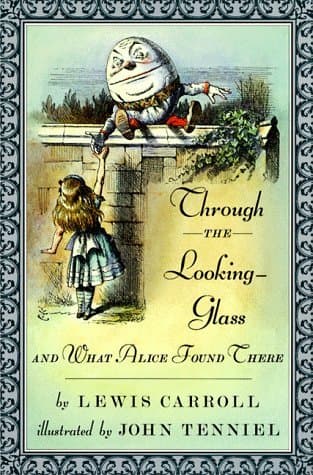
Synopsis
Covers the whole plot, including the ending.
- Difficulty
- Medium
- Pacing
- Variable
- Mood
- Whimsical, Absurd, Dreamlike, Humorous
- Read it if
- You enjoy whimsical, nonsensical adventures with wordplay and philosophical undertones, or are a fan of 'Alice's Adventures in Wonderland'.
- Skip it if
- You prefer linear plots with clear stakes and logical progression, or find surrealism frustrating.
Through the Looking-Glass and What Alice Found There Plot Summary
Covers the whole plot, including the ending.
Through the Looking-Glass House
Alice, a curious young girl, plays with her kittens, Kitty and Snowdrop, and a black queen chess piece in her cozy drawing-room. She wonders about the world on the other side of the looking-glass and, to her surprise, steps through the mirror's surface as if it were a soft curtain. She finds a room identical to her own but reversed, where the clock runs backward and the books are printed in mirror-writing. She then finds a poem, 'Jabberwocky', which she can only read by holding it up to the mirror, and considers the strange nature of this new reality before going into a garden.
The Garden of Live Flowers
Upon entering the garden, Alice is amazed to find that the flowers can talk. She talks with a Tiger-lily, a Rose, and other flowers, who are rather rude and opinionated. They tell her that the trees also talk. Suddenly, the Red Queen appears, growing rapidly in size. The Red Queen, stern and imperious, explains to Alice that the entire landscape is laid out like a giant chessboard and that Alice herself is a pawn. She instructs Alice on the rules of Looking-Glass chess, telling her that if she can reach the eighth square, she will become a Queen.
The Train Journey and Tweedledum and Tweedledee
Alice tries to follow the Red Queen but finds herself continually brought back to where she started. She eventually boards a train that jumps over streams and through a forest, with nonsensical conversations among the passengers. After the train ride, she meets Tweedledum and Tweedledee, two round, identical brothers who quote poetry, including 'The Walrus and the Carpenter'. They warn her about a dream in which she is a figure, and then have a brief, absurd battle before a monstrous crow frightens them away, leaving Alice to continue her journey.
Wool and Water
Alice next meets the White Queen, who is incredibly forgetful and lives life backward, remembering future events but not past ones. The White Queen offers Alice a job as her 'maid,' but their conversation is full of riddles and non-sequiturs. The White Queen then inexplicably turns into a Sheep, and Alice finds herself in a shop. The shop is filled with impossible objects that disappear or change shape as she tries to grasp them. She eventually buys an egg, which promptly rolls away.
Humpty Dumpty
The egg Alice bought rolls to a wall, where it turns into Humpty Dumpty. Humpty Dumpty, perched precariously, is an arrogant and pedantic egg-man who believes he can define words as he pleases, famously explaining the meaning of 'Jabberwocky' to Alice. He boasts about his unbirthday present and his unique understanding of language. Despite his pronouncements, Alice worries about his inevitable fall. He dismisses her concerns, but his eventual tumble is hinted at, prompting Alice to move on.
The Lion and the Unicorn
Alice encounters the Lion and the Unicorn, two creatures in a perpetual battle for the crown, as described in a nursery rhyme. After their fight, they are served plum cake, which must be cut and then distributed before it is passed around. Alice then meets the White King's messengers, Haigha (the March Hare) and Hatta (the Hatter from Wonderland), who are peculiar and prone to making strange observations. The White King himself observes everything and takes notes, seemingly unaware of Alice's presence.
It's My Own Invention!
Alice continues her journey and encounters the White Knight, a bumbling but kind-hearted figure who constantly falls off his horse. He rides a horse that wears anklets to prevent it from biting his ankles, and his helmet is covered in a birdcage. The Knight explains various 'inventions' of his, all of which are impractical and absurd, such as a pudding that would be good for swallowing. He sings a long, melancholic song about an old man and a fish. He escorts Alice to the final brook, which she must cross to become a Queen.
Queen Alice
Alice finally crosses the last brook and is crowned Queen, completing her chess journey. She is immediately joined by the Red Queen and the White Queen, who subject her to a bizarre and nonsensical 'examination' that leaves her utterly confused. They lead her to a grand banquet in her honor. However, the feast quickly descends into chaos. The food, particularly the leg of mutton and the plum pudding, begins to talk and refuse to be eaten, and the other guests engage in increasingly absurd behavior.
Shaking
The chaos at the banquet intensifies. The guests throw things, the candles grow tall, and the Red Queen's behavior becomes increasingly aggressive and overbearing. Alice, overwhelmed by the pandemonium and the Red Queen's imperious demands, can no longer tolerate the nonsense. She grabs the Red Queen, whom she perceives as the source of all the trouble, and begins to shake her violently, determined to end the madness that has consumed the feast and the entire Looking-Glass world.
Which Dreamed It?
Alice continues to shake the Red Queen until she wakes up in her own armchair, holding her black kitten, Kitty. She realizes that her entire journey through the Looking-Glass was a vivid dream, and that Kitty was the Red Queen all along. She recounts her adventures to Kitty and Snowdrop, trying to piece together the events. The book concludes with Alice pondering a question: who was dreaming whom? Was it she who dreamed the Red King, or did the Red King dream her, as Tweedledum and Tweedledee suggested?
Principal Figures
Alice
Protagonist
A curious and imaginative young girl who journeys through the Looking-Glass.
Alice is a sensible, polite, and imaginative young girl, often bewildered but rarely truly frightened by the absurdities she encounters. She tries to apply logic to illogical situations, which often leads to frustration. She is driven by curiosity and a desire to understand the strange world around her, even as it defies all reason. Despite her youth, she possesses a strong sense of justice and politeness, which she attempts to uphold in the face of widespread rudeness.
Relationships: Red Queen (antagonistic, authoritative); White Queen (befuddled, confusing); Tweedledum and Tweedledee (puzzling acquaintances); Humpty Dumpty (brief, frustrating encounter); White Knight (kind, protective, but equally absurd)
Red Queen
Antagonist/Supporting
An imperious and fast-running chess piece who guides/hinders Alice.
The Red Queen is a stern, bossy, and often rude figure. She represents authority and the rigid rules of the Looking-Glass world, particularly the chess game. She is known for her ability to run incredibly fast but remain in the same place, embodying the idea of constant effort without progress. She delights in confusing Alice with illogical pronouncements and tests, challenging Alice's understanding of logic and social norms. She is a force of chaos and order simultaneously.
Relationships: Alice (authoritative, challenging); White Queen (rival, counterpart)
White Queen
Supporting
A scatterbrained Queen who lives life backward.
The White Queen is the Red Queen's counterpart, but she is far more befuddled and forgetful. She famously lives her life backward, remembering future events but not past ones, leading to many nonsensical conversations. She is prone to sudden transformations and dramatic exclamations, often needing Alice's help to manage simple tasks. Despite her disarray, she is generally more benign than the Red Queen, though equally confusing.
Relationships: Alice (confusing, demanding help); Red Queen (rival, counterpart)
Tweedledum and Tweedledee
Supporting
Identical, quarrelsome brothers who recite poetry and debate.
Tweedledum and Tweedledee are two fat, identical brothers who are prone to quoting long poems, particularly 'The Walrus and the Carpenter.' They engage in petty squabbles and often try to confuse Alice with their circular logic and warnings about dreams. They are a personification of childish arguments and the absurdity of pointless conflict. Their most significant contribution is the idea that Alice might be merely a figure in the Red King's dream, challenging her very existence.
Relationships: Alice (puzzling, argumentative); Each other (quarrelsome brothers)
Humpty Dumpty
Supporting
An arrogant egg-man who believes he controls the meaning of words.
Humpty Dumpty is an incredibly arrogant and pedantic egg-like creature who sits on a wall. He prides himself on his unique ability to define words as he chooses, believing that words mean whatever he wants them to mean. He is a satirical representation of linguistic philosophy and the arbitrary nature of language. Despite his intellectual arrogance, his physical fragility is a constant source of tension, foreshadowing his inevitable fall.
Relationships: Alice (didactic, condescending)
White Knight
Supporting
A kind but clumsy knight who constantly falls off his horse.
The White Knight is a gentle, well-meaning, but utterly incompetent figure. He is constantly falling off his horse and has a collection of absurd inventions, none of which are practical. Despite his clumsiness, he is protective of Alice and escorts her to the final brook. He embodies a romantic, chivalrous ideal twisted into comedic absurdity, offering a moment of genuine, albeit clumsy, kindness in the chaotic world.
Relationships: Alice (kindly, protective escort)
Talking Flowers
Mentioned/Supporting
Opinionated and often rude sentient flowers in the garden.
The Talking Flowers are the first inhabitants Alice encounters in the Looking-Glass garden. They are highly opinionated, gossipy, and often rude, particularly the Tiger-lily and the Rose. They introduce Alice to the idea that everything in this world is alive and can speak, but their conversations are typically unhelpful and self-absorbed. They serve to immediately establish the whimsical and often impolite nature of the Looking-Glass world.
Relationships: Alice (argumentative, gossipy)
Kitty (the black kitten)
Mentioned/Supporting
Alice's kitten, who is imagined as the Red Queen.
Kitty is Alice's black kitten, who she is playing with at the beginning and end of the book. In Alice's dream, Kitty is implicitly transformed into the Red Queen. Kitty represents Alice's domestic reality and serves as a tangible link between the dream world and the waking world. Her transformation into the Red Queen highlights the imaginative origins of Alice's adventures.
Relationships: Alice (pet, inspiration for dream character)
Themes & Insights
Logic and Illogic
The central theme involves the constant clash between Alice's logical, real-world understanding and the illogic of the Looking-Glass world. Characters like the Red Queen and Humpty Dumpty deliberately twist language and reason, forcing Alice to confront a reality where rules are arbitrary or reversed. This is clear when Alice tries to follow the Red Queen's instructions, only to find herself back where she started, or when Humpty Dumpty declares that words mean 'just what I choose them to mean.' The book challenges the reader's own assumptions about order and sense.
“Now, here, you see, it takes all the running you can do, to keep in the same place. If you want to get somewhere else, you must run at least twice as fast as that!”
Identity and Reality
Alice's journey constantly questions her own identity and the reality of her experiences. Tweedledee and Tweedledum's assertion that Alice is merely a figure in the Red King's dream disturbs her, making her wonder if she is truly real or just an illusion. This theme ends with Alice's final question, 'Which dreamed it?', leaving the reader to ponder the subjective nature of reality and the thin line between dreams and waking life. The mirror itself symbolizes this duality, reflecting a reversed, yet strangely familiar, version of her world.
“You know very well you're not real.”
Language and Meaning
Lewis Carroll, a logician, explores the flexibility and arbitrary nature of language throughout the book. Humpty Dumpty's insistence on controlling the meaning of words ('When I use a word, it means just what I choose it to mean—neither more nor less.') is a prime example. The 'Jabberwocky' poem, initially incomprehensible but later 'translated' by Humpty Dumpty, shows how context and interpretation shape understanding. Conversations are often filled with puns, riddles, and non-sequiturs, showing how language can be both a tool for communication and a source of confusion.
“When I use a word,' Humpty Dumpty said in rather a scornful tone, 'it means just what I choose it to mean—neither more nor less.”
Childhood and Adulthood
The book can be read as an exploration of the transition from childhood to the complexities of the adult world. Alice, a child, tries to navigate a world populated by adult-like figures (the Queens, Humpty Dumpty) who often behave in childish, illogical, or tyrannical ways. Her attempts to bring order and politeness to the chaotic Looking-Glass inhabitants reflect a child's struggle to understand and adapt to the often-unreasonable rules and behaviors of the adult world. Her eventual frustration and action against the Red Queen symbolize a child's rebellion against arbitrary authority.
“It's a poor sort of memory that only works backwards.”
Plot Devices & Literary Techniques
The Chess Game Metaphor
The entire story is structured as a game of chess.
The Looking-Glass world is explicitly laid out as a giant chessboard, with Alice as a pawn. Her journey from the second square to the eighth square, where she becomes a Queen, provides the overarching structural framework for the narrative. Each major encounter and location can be mapped to a move or a square on the board, giving a sense of progression and purpose to Alice's seemingly random adventures. This device adds a layer of intellectual playfulness, connecting the whimsical narrative to a rigid, logical game.
Mirror Imagery and Reversal
The core conceit of the world being a reverse reflection.
The entire premise of the story—Alice stepping through a looking-glass—establishes a world that is a literal and metaphorical reversal of her own. This manifests in various ways: clocks running backward, books with mirror-writing, and characters who live life backward (like the White Queen). This device creates an immediate sense of disorientation and wonder, challenging common perceptions of reality and order. It allows Carroll to explore paradoxes and the nature of opposites, enriching the philosophical undertones of the narrative.
Nonsense Verse and Puns
Poetry and wordplay that defy conventional meaning.
Carroll frequently employs nonsense verse, most famously 'Jabberwocky,' and an abundance of puns and wordplay. This device creates humor and contributes to the overall illogic of the Looking-Glass world. The poems often sound meaningful but are largely devoid of literal sense, or their meaning is arbitrarily assigned, as with Humpty Dumpty. This highlights the theme of language and meaning, demonstrating how words can be manipulated or enjoyed for their sound and rhythm rather than strict semantic content.
Dream as Narrative Frame
The entire adventure is presented as a vivid dream.
The story begins with Alice musing about the looking-glass world and ends with her waking up, revealing the entire adventure to have been a dream. This device allows for the complete suspension of disbelief, justifying all the fantastical and illogical events. It also introduces the philosophical question of 'Which dreamed it?', blurring the lines between the dreamer and the dreamed, and adding a layer of meta-narrative complexity to the story. The dream frame absolves the narrative of needing internal consistency, while still exploring profound ideas.
Through the Looking-Glass and What Alice Found There Quotes
“The time has come,’ the Walrus said, ‘To talk of many things: Of shoes—and ships—and sealing-wax—Of cabbages—and kings—And why the sea is boiling hot—And whether pigs have wings.”
“It seems very pretty,” she said when she had finished it, “but it’s rather hard to understand!”
“If you think we’re wax-works,” he said, “you ought to pay, you know.”
“The question is,” said Humpty Dumpty, “which is to be master—that’s all.”
“Why, sometimes I’ve believed as many as six impossible things before breakfast.”
“When I use a word,” Humpty Dumpty said, in rather a scornful tone, “it means just what I choose it to mean—neither more nor less.”
““It’s a poor sort of memory that only works backwards,” the Queen remarked.”
“Contrariwise,” continued Tweedledee, “if it was so, it might be; and if it were so, it would be; but as it isn’t, it ain’t. That’s logic.”
“Here, you see, it takes all the running you can do, to keep in the same place. If you want to get somewhere else, you must run at least twice as fast as that!”
“A slow sort of country!” said the Queen. “Now, here, you see, it takes all the running you can do, to keep in the same place.”
“Take care of the sense, and the sounds will take care of themselves.”
“I don’t know what you mean by ‘glory’,” Alice said. Humpty Dumpty smiled contemptuously. “Of course you don’t—till I tell you. I meant ‘there’s a nice knock-down argument for you!’”
“It’s a poor life this, if you can’t make a joke now and then.”
“The rule is, jam to-morrow and jam yesterday—but never jam to-day.”
Quiz
10 questions on the plot and the characters. Each answer comes with a short explanation.
Question 1
What object does Alice first pass through to enter the Looking-Glass world?
- A magical wardrobe
- A rabbit hole
- A mirror on the mantelpiece
- A secret garden gate
Show answer
C. A mirror on the mantelpiece Alice enters the fantastical world by stepping through the mirror above her fireplace, which serves as the portal to the Looking-Glass world.
Question 2
Which game's rules and pieces primarily govern the structure and characters of the Looking-Glass world?
- Checkers
- Chess
- Go
- Poker
Show answer
B. Chess The entire journey of Alice through the Looking-Glass is structured like a game of chess, with Alice starting as a pawn and progressing to become a queen.
Question 3
What peculiar characteristic do the flowers exhibit in the Looking-Glass garden?
- They sing lullabies
- They can talk
- They change colors rapidly
- They move around on their own
Show answer
B. They can talk Upon entering the garden, Alice discovers that the flowers can speak, engaging her in conversation and offering her advice.
Question 4
Which character famously recites the poem 'Jabberwocky' to Alice?
- The White Rabbit
- Humpty Dumpty
- The Mad Hatter
- The March Hare
Show answer
B. Humpty Dumpty Humpty Dumpty explains the meaning of the words in the 'Jabberwocky' poem to Alice, after she finds the poem in a book and struggles to understand it.
Question 5
What is unique about the concept of time in the Looking-Glass world, particularly noted by the White Queen?
- Time moves backward
- Time is completely stopped
- Time only exists in the present moment
- Time can be sped up or slowed down at will
Show answer
A. Time moves backward The White Queen famously tells Alice about 'living backwards,' remembering future events, which highlights the topsy-turvy nature of time in this world.
Question 6
What do Tweedledee and Tweedledum fight over?
- A crown
- A beautiful butterfly
- A rattle
- A piece of cheese
Show answer
C. A rattle Tweedledee and Tweedledum are about to have a battle over a broken rattle, a classic example of their childish squabbles.
Question 7
Alice's journey through the Looking-Glass world is designed to mimic the moves of which chess piece?
- Knight
- Rook
- Pawn
- Bishop
Show answer
C. Pawn Alice begins as a White Pawn and her goal is to reach the eighth square to become a Queen, following the progression of a pawn in chess.
Question 8
What is the primary philosophical concept explored through the mirror imagery and reversed world in the book?
- The nature of dreams versus reality
- The relativity of language and meaning
- The inevitability of growing up
- The importance of logical reasoning
Show answer
B. The relativity of language and meaning The Looking-Glass world constantly plays with reversed logic, inverted language, and the arbitrary nature of definitions, highlighting the relativity of meaning and how language shapes perception.
Question 9
What does Alice discover about the Red King near the end of her adventure, which causes her concern?
- He is actually the Jabberwock
- He is dreaming her entire adventure
- He is planning to imprison her
- He is an illusion created by the White Queen
Show answer
B. He is dreaming her entire adventure Tweedledee and Tweedledum tell Alice that the Red King is dreaming, and if he wakes up, she will cease to exist, implying her entire adventure is merely part of his dream.
Question 10
What happens to the Looking-Glass world and its inhabitants when Alice 'checks' the Red Queen and becomes a Queen herself?
- Everything transforms into a grand feast
- The world instantly dissolves into mist
- All the characters freeze in place
- Alice is transported back to Wonderland
Show answer
A. Everything transforms into a grand feast Upon reaching the eighth square and becoming a Queen, Alice finds herself at a grand banquet where many of the characters she met appear, before the scene descends into chaos and she wakes up.
Through the Looking-Glass and What Alice Found There FAQ
What is the basic premise of "Through the Looking-Glass"?
Alice, a young girl, steps through a mirror above her fireplace and finds herself in an inverted world where everything is a reflection, and the landscape is laid out like a giant chessboard. She embarks on a journey across this board, encountering various peculiar characters and situations as she tries to reach the eighth square to become a Queen.
How does the looking-glass world differ fundamentally from Alice's own world?
The looking-glass world operates on principles opposite to Alice's reality; for example, books are written in mirror-writing, time often runs backward, and logic is frequently inverted. This creates a disorienting and often nonsensical experience for Alice, where cause and effect are not always straightforward.
Who are some of the key characters Alice encounters on her journey?
Alice meets a wide array of memorable characters, including the Red Queen and White Queen, who guide her through the chessboard, the argumentative Tweedledee and Tweedledum, the philosophical Humpty Dumpty, and the absent-minded White Knight. Each character presents Alice with unique challenges or riddles.
What is the significance of the chessboard motif throughout the book?
The entire looking-glass world is structured as a chessboard, with Alice starting as a Pawn and aiming to reach the eighth square to be crowned a Queen. This motif dictates her journey, the rules she must follow (like moving two squares on her first move), and the encounters she has, making the narrative a literal game of chess.
What happens when Alice finally reaches the eighth square?
Upon reaching the eighth square, Alice is indeed crowned a Queen, as promised. This event triggers a chaotic, celebratory banquet where the guests behave nonsensically, leading Alice to become frustrated and eventually shake the Red Queen, which causes the entire looking-glass world to shatter and her to wake up.
What is the hidden connection between the Jabberwocky poem and the White Knight's song?
Both the Jabberwocky poem and the White Knight's song are examples of Carroll's brilliant use of portmanteau words and nonsense verse, creating a sense of whimsical disorientation. The Jabberwocky, which Alice encounters in her dream, is a fearsome creature, while the White Knight's song, though equally nonsensical, reflects his endearing, if clumsy, nature.
How does Carroll use the concept of mirror imagery beyond just the physical looking-glass?
Carroll extends mirror imagery to language and logic, where words are reversed or meaning is inverted, and situations often reflect or parody events from Alice's own world. For instance, the 'living flowers' that speak are a reflection of her own garden, but with an added, unsettling sentience.
What is the subtle political commentary or satire present in the interactions between the Queens?
The Red and White Queens, while guiding Alice, often engage in absurd, authoritative, and contradictory pronouncements, which can be interpreted as a subtle satire of political figures or the arbitrary nature of power. Their constant bickering and illogical rules reflect a world governed by whims rather than reason.
How does Alice's age and maturity influence her journey compared to her first adventure?
Alice is slightly older and perhaps a bit more assertive in this sequel, demonstrating a greater capacity for questioning and challenging the illogical behavior she encounters. While still a child, she shows more self-possession and less fear, engaging in debates rather than simply observing in awe.
What psychological themes does Humpty Dumpty's discussion of words and meaning explore?
Humpty Dumpty's insistence that words mean 'just what I choose them to mean' explores themes of linguistic relativism, the arbitrary nature of language, and the power of interpretation. This challenges Alice's understanding of communication and highlights the subjective nature of reality within the looking-glass world.
How does Alice's frustration with the illogical nature of the looking-glass world reflect a child's developing understanding of logic?
Alice's increasing frustration, culminating in her shaking the Red Queen, reflects a child's natural inclination towards order and logic as they develop. Her journey through a world devoid of consistent rules can be seen as a metaphorical challenge to her developing cognitive framework, pushing her to confront the absurd.
What is the psychological impact of time running backward or being fluid in this world?
The fluid and often backward flow of time (e.g., the White Queen remembering things before they happen) creates a sense of disorientation and anxiety for Alice, disrupting her understanding of causality and memory. This challenges her perception of a linear reality and forces her to adapt to a world where past, present, and future are not distinct.
Is the entire adventure a dream, and what are the implications if it is?
The book explicitly concludes with Alice waking up and pondering whether the Red King was part of her dream, strongly suggesting the entire adventure was a dream. If so, it implies that the fantastical world is a construct of her subconscious, allowing for a deeper exploration of her inner thoughts and anxieties without real-world consequences.
What is the deeper meaning behind the White Knight's character and his farewell to Alice?
The White Knight, often seen as a gentle and somewhat clumsy figure, represents kindness, impractical invention, and perhaps a nostalgic reflection of Carroll himself. His poignant farewell to Alice, though brief, signifies a moment of genuine connection and tenderness amidst the chaos, suggesting the value of innocent goodness.
How does the ending, with Alice waking up, contribute to the overall message or theme of the book?
The ending reinforces the idea that the looking-glass world is a temporary, imaginative escape, allowing Alice to process complex ideas about logic, language, and identity. Waking up brings her back to reality, but presumably with new insights, suggesting that even nonsensical experiences can offer valuable lessons about the world and oneself.
Some argue this sequel is more profound than *Alice's Adventures in Wonderland*. What aspects support this claim?
Many argue this sequel is more profound due to its more structured narrative (the chess game), deeper exploration of linguistic philosophy through characters like Humpty Dumpty, and its more complex engagement with concepts of time and identity. The mirror-world premise also offers a richer allegorical framework for philosophical inquiry.
What role does the Red Queen play in Alice's journey, and how does she represent a challenge to Alice's understanding of the world?
The Red Queen acts as both a guide and an antagonist, constantly pushing Alice forward while simultaneously presenting her with illogical rules and demanding behavior. She embodies the arbitrary authority and nonsensical logic of the looking-glass world, forcing Alice to constantly adapt and question her own assumptions about how things should work.
Is there a specific moral lesson or takeaway from Alice's journey through the looking-glass?
While not overtly didactic, the book subtly encourages critical thinking, adaptability, and the embrace of imagination. Alice's journey teaches her to navigate absurdity, challenge arbitrary rules, and find her own sense of logic amidst chaos, suggesting the importance of intellectual curiosity and resilience in the face of the unfamiliar.
About the author
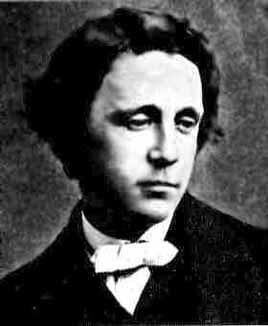
Charles Lutwidge Dodgson, better known by his pen name Lewis Carroll, was an English author, poet and mathematician. His most notable works are Alice's Adventures in Wonderland (1865) and its sequel Through the Looking-Glass (1871). He was noted for his facility with word play, logic, and fantasy. His poems Jabberwocky (1871) and The Hunting of the Snark (1876) are classified in the genre of literary nonsense.
Similar books
- Alice's Adventures in Wonderland
Lewis Carroll
4.0 (245k) average on GoodreadsFantasyThe direct predecessor, sharing characters, themes, and Carroll's unique style of logic and nonsense.
- The Phantom Tollbooth
Norton Juster
4.2 (242k) average on GoodreadsFantasyFeatures a young protagonist entering a fantastical land filled with wordplay, puns, and personified abstract concepts.
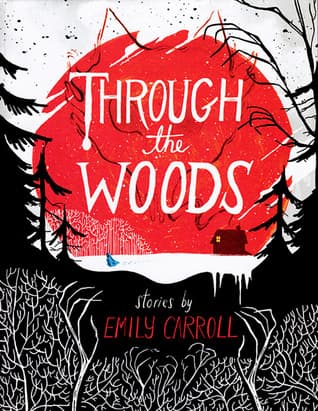
- Through the Woods
Emily Carroll
3.9 (60k) average on GoodreadsFantasyNot a direct thematic match, but shares a similar surname and a journey into a strange, unsettling, and dreamlike landscape with a young female protagonist, though much darker in tone.
- Peter Pan
J.M. Barrie
4.0 (277k) average on GoodreadsFantasyThrough the Looking-Glass offers a more intellectually demanding and linguistically complex fantasy world compared to Peter Pan. While both feature imaginative escapes, Barrie's narrative is generally more accessible to younger audiences, focusing on clear adventure and emotional themes of childhood, whereas Carroll delves deeper into philosophical paradoxes and wordplay, requiring more active interpretation from the reader. Peter Pan's magic is often more overt and less reliant on decoding symbolic structures.
- The wonderful Wizard of Oz
L. Frank Baum
4.0 (370k) average on GoodreadsFantasyCompared to The Wonderful Wizard of Oz, Through the Looking-Glass is less focused on a clear quest narrative and moral development. Baum's work presents a more straightforward journey with explicit lessons about courage, brains, and heart, while Carroll's sequel is more abstract, prioritizing the exploration of logical puzzles and the arbitrary nature of language over a direct character arc or a cohesive, goal-oriented plot. The humor in Oz is often more situational and character-driven, whereas Carroll's humor is deeply embedded in linguistic cleverness and paradox.
- Harry Potter and the Sorcerer's Stone
J.K. Rowling
4.5 (7M) average on GoodreadsFantasyRescued from a miserable life under the stairs, an orphaned boy discovers he's a wizard destined for a magical school, where he uncovers a dangerous secret tied to the dark wizard who murdered his parents.


Enjoyed the summary?
A summary gives you the shape of the book. The book itself has the detail, the examples and the voice.
Find Through the Looking-Glass and What Alice Found There on AmazonAs an Amazon Associate, BookBrief earns from qualifying purchases. How we're funded