

Core Idea
- Difficulty
- Hard
- Read it if
- You are interested in foundational texts of existentialism, post-modern thought, and radical critiques of Western morality and religion. You enjoy philosophical parables and poetic language, and are prepared to engage with challenging, dense ideas about human potential, self-overcoming, and the creation of new values.
- Skip it if
- You prefer straightforward, systematic philosophical arguments over allegorical and aphoristic styles. You are easily offended by anti-religious sentiments or find concepts like the 'Will to Power' and 'Übermensch' inherently off-putting without extensive contextualization. You seek light reading or a clear, prescriptive guide to life.
Key Takeaways from Thus Spake Zarathustra
The Death of God and the Rise of Man
Humanity must forge its own values in a godless universe.
Nietzsche, through Zarathustra, declares the 'death of God.' This is not a literal claim about God's end, but an observation about the decline of traditional religious belief and its moral systems in Western society. For centuries, God guaranteed truth, morality, and purpose. With this foundation weakened by science, secularism, and critical thought, humanity faces a void. This realization brings not freedom, but a great responsibility: to create new values, meanings, and purposes without divine authority. It asks humanity to grow up, to stand alone, and to become the creators of their own fate, rather than passively accepting old beliefs. This 'death' marks a major shift, requiring a re-evaluation of everything once considered sacred.
“God is dead. God remains dead. And we have killed him. How shall we comfort ourselves, the murderers of all murderers? What was holiest and mightiest of all that the world has yet owned has bled to death under our knives: who will wipe this blood off us? What water is there for us to clean ourselves?”
In the book: Zarathustra's initial descent from the mountains and his encounter with the old hermit, followed by his subsequent pronouncement to the crowd, directly introduces the 'death of God' parable. This sets the stage for the rest of the work, which explores the implications of this monumental shift.
Try this: Reflect on the values and moral codes you adhere to. Are they inherited, or have you actively chosen and affirmed them? Identify areas where you can take greater personal responsibility for creating meaning and purpose in your life, rather than relying on external authorities or societal norms.
Related ideas: nihilism, secularism, existentialism
The Übermensch: Overcoming Humanity
Strive to transcend current human limitations and create a higher self.
The Übermensch, often translated as 'Overman' or 'Superman,' is a key, often misunderstood, idea in Zarathustra. It does not mean a genetically superior race or a tyrannical leader, but an ideal of human excellence that goes beyond common morality and embraces life. The Übermensch creates values, is self-controlled, and moves past basic instincts and herd mentality to make their own way. This involves a strict process of self-improvement, rejecting passive acceptance of fate, and actively shaping one's character and destiny. It is a goal for humanity to evolve beyond its current state, accepting suffering, danger, and solitude as steps towards self-perfection and the creation of new, life-affirming values after God's death. It is a bridge, not a final stop.
“Man is a rope stretched between the animal and the Übermensch – a rope over an abyss. A dangerous crossing, a dangerous wayfaring, a dangerous looking-back, a dangerous shuddering and standing still. What is great in man is that he is a bridge and not a goal: what can be loved in man is that he is an overture and a going-under.”
In the book: Zarathustra's extensive speeches on the Übermensch, particularly in the prologue and various sermons, illustrate this concept. His description of man as a 'rope stretched between the animal and the Übermensch' vividly portrays the transitional nature of humanity.
Try this: Identify an area in your life where you feel constrained by external expectations or your own ingrained habits. How can you challenge these limitations and actively cultivate a stronger, more independent self? Consider what values you genuinely affirm, rather than just passively accept.
Related ideas: self-overcoming, will-to-power, individuation
The Three Metamorphoses
The spiritual journey from burden-bearer to free creator.
Nietzsche describes a path for the spirit through three stages: the camel, the lion, and the child. The camel represents the spirit that carries heavy burdens—duties, traditions, moral rules, and accepted truths. It is humble, obedient, and accepts suffering without question. The lion then appears, rebelling against these 'thou shalts.' It seeks freedom, destroying old values and challenging authorities, roaring 'I will!' instead of 'I shall.' However, the lion destroys but does not yet create. The final stage is the child, representing innocence, forgetting, and a 'new beginning.' The child is a pure 'yes-sayer,' able to create new values and affirm life without resentment or old biases. This change is not necessarily linear for everyone but shows the steps needed to break free from dogma and become a self-governing, life-affirming person.
“Through three metamorphoses of the spirit do I designate to you the way to the Übermensch: how the spirit becometh a camel, and the camel a lion, and the lion at last a child.”
In the book: Zarathustra's first discourse, 'Of the Three Metamorphoses,' explicitly details this progression, using the vivid animal metaphors to describe the spiritual evolution necessary for achieving the Übermensch.
Try this: Where are you currently in these metamorphoses? Are you still carrying heavy burdens (camel)? Are you in a rebellious phase, rejecting old norms (lion)? Or are you able to create new values and embrace life with childlike innocence and affirmation (child)? Identify one 'thou shalt' you can challenge and one 'I will' you can affirm.
Related ideas: spiritual-development, value-creation, self-liberation
Will to Power: Life's Driving Force
All existence is fundamentally driven by an urge for growth and mastery.
Nietzsche describes the 'Will to Power' not as simple domination over others, but as the basic, inner drive behind all life. It is an expansive force, a desire for growth, overcoming, self-mastery, and the creation of new values. This 'will' is not just a will to survive (as Schopenhauer suggested), but a will to thrive, to influence, to give form and meaning to chaos. For humans, it shows up as the desire to create, to excel, to master oneself and one's surroundings. It is a constant effort, an inner fire that pushes people past their current state. Embracing the Will to Power means actively facing life's challenges, rather than passively accepting them, and finding joy in the process of becoming and overcoming.
“Wherever I found a living thing, there I heard also the speech of obedience. Whatever lives, obeys. And this is the second thing: he who cannot obey himself is commanded. Such is the nature of living things. But this is the third thing that I heard: that commanding is more difficult than obeying. And not only because the commander bears the burden of all who obey, and this burden easily crushes him. Where there is life, there is will: but not will to live, but will to power!”
In the book: Zarathustra's discourse 'Of Self-Overcoming' explicitly outlines the Will to Power, arguing that even acts of self-sacrifice or obedience are ultimately manifestations of a desire for a particular kind of power (e.g., power over oneself, or power through spiritual influence).
Try this: Observe your own motivations. Beyond basic survival, what drives your actions? How do you seek to grow, overcome challenges, or exert creative influence in your life? Identify an area where you can more consciously align with your inner 'will to power' to achieve a personal goal.
Related ideas: self-mastery, vitalism, autonomy
Eternal Recurrence: The Ultimate Test
Live each moment as if you would joyfully relive it infinitely.
The idea of Eternal Recurrence is presented as the most challenging affirmation of life. It is a thought experiment: imagine that every moment of your life, every joy, sorrow, and decision, will repeat exactly, forever. This is not a scientific idea but a moral test of one's love for existence. If one could fully embrace this idea, willing to relive every detail, it means a complete affirmation of life, no resentment toward suffering, and a deep acceptance of fate. It makes people live each moment with such intensity and purpose that they would want its endless return, thus overcoming nihilism and creating a joyful, self-affirming existence. It demands ultimate responsibility for one's actions and life.
“What, if some day or night a demon were to steal after you into your loneliest loneliness and say to you: 'This life as you now live it and have lived it, you will have to live once more and innumerable times more; and there will be nothing new in it, but every pain and every joy and every thought and sigh and everything unutterably small or great in your life will have to return to you, all in the same succession and sequence – even this spider and this moonlight between the trees, and even this moment and I myself.' The question in each and every thing, 'Do you desire this once more and innumerable times more?' would lie upon your actions as the greatest weight! Or how well disposed would you have to become to yourself and to life to crave nothing more fervently than this ultimate eternal confirmation and seal?”
In the book: Though introduced in 'The Gay Science,' Zarathustra repeatedly grapples with the 'heaviest thought' of eternal recurrence, particularly in the later parts of the book, culminating in Zarathustra's own struggle and eventual acceptance of it.
Try this: Consider a recent decision or experience. If you knew you had to relive it exactly, infinitely, would you still make the same choice or experience it in the same way? Use this thought experiment to motivate more conscious, intentional living and to cultivate a deeper appreciation for your present moments.
Related ideas: amor-fati, nihilism-overcoming, life-affirmation
Beyond Good and Evil: Transvaluation of Values
Question inherited moral categories to create new, life-affirming values.
Zarathustra questions the usual 'good and evil' split, arguing that many traditional moral systems, especially those from Judeo-Christian ethics, come from resentment, weakness, and a denial of life. He calls for a 'transvaluation of all values,' meaning a critical re-evaluation of what society calls 'good' and 'bad.' Often, what is 'good' promotes conformity, pity, and the suppression of strong, individual drives, while 'evil' might simply be the expression of a strong, creative, and powerful will. The Übermensch, then, does not just ignore morality but actively creates new values that affirm life, are courageous, and aim for growth and self-improvement, rather than pity, guilt, or herd conformity. This is a risky task, as it means standing alone against established norms.
“Indeed, I have often laughed at the weaklings who thought themselves good because they had no claws.”
In the book: Zarathustra's many parables and speeches, such as 'Of the Adder's Bite' or 'Of the Pale Criminal,' demonstrate his critique of conventional morality and his call for individuals to become creators of their own values.
Try this: Identify a moral principle or societal 'good' that you adhere to without much thought. Question its origins: does it genuinely serve life and growth, or does it stem from fear, resentment, or a desire for conformity? Consider what values you would create if you were the sole legislator of morality for your own life.
Related ideas: master-morality, slave-morality, moral-relativism
The Spirit of Gravity: The Weight of the Past
Shake off the burdens of tradition, guilt, and resentment.
The 'spirit of gravity' is a metaphor for all that holds humanity down: the weight of history, tradition, dogmatic beliefs, guilt, and resentment. It represents the psychological and cultural forces that keep people from becoming light, free, and creative. This spirit is the enemy of the Übermensch, always whispering that nothing new is possible, that all values are fixed, and that change is useless. Overcoming the spirit of gravity requires a deep act of self-liberation, a willingness to shed old burdens, to laugh at what is sacred, and to dance freely. It means affirming the present and future, rather than being tied to the past, and finding joy in lightness and movement.
“But the spirit of gravity, my devil and archenemy, that is the one who says: 'all things have stood, all things are established, all things are eternal.'”
In the book: Zarathustra frequently speaks of his battle with the 'spirit of gravity,' and his desire for lightness and dance. His own physical and spiritual struggles throughout the book symbolize the effort required to overcome this weight.
Try this: What 'weights' are you carrying from your past or from societal expectations? Identify one belief, grudge, or obligation that feels heavy and explore how you might 'lighten' your spirit by challenging or releasing it. Cultivate more joy and playfulness in your daily life.
Related ideas: ressentiment, nihilism, self-liberation
Solitude and Creation
True creation and self-overcoming demand withdrawal from the 'herd.'
Zarathustra often highlights the need for solitude for deep thought and creation. The 'herd'—society with its common opinions, shallow values, and demands for conformity—hinders individual growth and the rise of the Übermensch. True self-improvement and the creation of new values cannot happen amidst the noise and distractions of the crowd. Solitude provides space for self-reflection, for questioning old beliefs, and for developing one's unique view and will. It is not an escape from life, but a necessary retreat to gather strength, refine one's vision, and eventually return to humanity with new gifts. The creator must first be a hermit, a wanderer in the mountains of thought.
“Flee, my friend, into your solitude! I see you deafened by the din of the great men, and stung by the stings of the little ones. Forest and rock know how to be silent with you. Be like the tree that you love, the broad-branched one: it is silent and listens.”
In the book: Zarathustra's initial eleven-year solitude in the mountains, his subsequent return to man, and his frequent retreats back into solitude throughout the book exemplify this principle.
Try this: How much genuine solitude do you allow yourself? Schedule dedicated time each week for quiet reflection, creative pursuit, or simply being alone with your thoughts, free from external influence and digital distractions. Use this time to clarify your values and aspirations.
Related ideas: individualism, non-conformity, introspection
The Path of Laughter and Dance
Embrace joy, lightness, and playfulness as affirmations of life.
Unlike the serious, often guilt-ridden morality of traditional thought, Zarathustra promotes a path of laughter and dance. Laughter signals liberation, a joyful rejection of the 'spirit of gravity,' and an affirmation of life's playfulness. Dance symbolizes lightness, freedom, and the ability to move through existence without being burdened by dogma or resentment. It expresses the body's wisdom and counters rigid intellect. The Übermensch is not a somber ascetic but a joyful creator who embraces life with enthusiasm, finding beauty and meaning even in suffering, and celebrating existence through movement and mirth. This lightness is a deep act of overcoming.
“I would believe only in a God who could dance. And when I saw my Devil, I found him serious, thorough, profound, and solemn: it was the spirit of gravity – through him all things fall.”
In the book: Zarathustra frequently speaks of dancing and laughter, often in opposition to the 'spirit of gravity.' His own moments of joy and his encouragement for his disciples to laugh and dance illustrate this theme.
Try this: How can you incorporate more laughter, playfulness, and physical expression into your daily life? Challenge the notion that seriousness is always superior. Find ways to approach challenges with a lighter heart and a sense of joy, rather than grim determination.
Related ideas: joy, playfulness, aestheticism
The Last Man: The Danger of Mediocrity
Beware of societal complacency and the aversion to struggle and greatness.
Zarathustra warns against the 'Last Man,' a figure representing humanity's decline into complacent mediocrity. The Last Man is marked by comfort, security, shallow happiness, and a dislike for any struggle, suffering, or great ambition. He has removed all danger, passion, and striving for greatness, content with a life of small pleasures and conformity. This figure is the opposite of the Übermensch, showing a humanity that has lost its ability for creation, self-improvement, and the pursuit of higher values. Nietzsche sees this as a serious danger, a possible end where humanity becomes tame and lacks any meaningful purpose beyond simple existence. It is a strong warning against the tempting comfort of nihilism and herd mentality.
“Alas! The time is coming when man will no longer shoot the arrow of his longing beyond man, and the string of his bow will have unlearned to whir! I tell you: one must still have chaos in oneself to give birth to a dancing star. I tell you: you have still chaos in yourselves. Alas! The time is coming when man will no longer give birth to a star. Alas! The time of the most contemptible man is coming, he that is no longer able to despise himself. Behold! I show you the Last Man.”
In the book: Zarathustra's first public speech to the townspeople, where he introduces the concept of the Übermensch, is met with misunderstanding and the people's desire for the 'Last Man' – a symbol of their comfortable complacency.
Try this: Evaluate areas in your life where you might be settling for comfort over growth. Are you avoiding challenges or aspirations due to fear or a desire for an easy life? Identify one area where you can embrace discomfort and striving to avoid becoming a 'Last Man.'
Related ideas: conformity, mediocrity, nihilism
Thus Spake Zarathustra Quotes
“Man is a rope, tied between beast and overman — a rope over an abyss.”
“What is great in man is that he is a bridge and not an end.”
“God is dead. God remains dead. And we have killed him.”
“And if you gaze long into an abyss, the abyss also gazes into you.”
“That which does not kill us makes us stronger.”
“One must still have chaos in oneself to give birth to a dancing star.”
“Verily, I say unto you: a man must have chaos in him to give birth to a dancing star.”
“The greatest weight — What if a demon were to steal after you into your loneliest loneliness and say to you: 'This life as you now live it and have lived it, you will have to live once more and innumerable times more'?”
“There are still peoples and herds, but not with us, my brethren: there are states. A state? What is that? Well then! Open your ears, for now I will speak to you about the death of peoples.”
“Not by wrath does one kill, but by laughter.”
“Of all that is written, I love only what a person has written with his blood. Write with blood, and you will find that blood is spirit.”
“Many a one who threw off his fetters, merely threw off his value.”
“And life itself told me this secret: 'Behold,' it said, 'I am that which must always overcome itself.'”
“Joy is not a matter of choice, but of destiny.”
Quiz
10 questions on the main ideas. Each answer comes with a short explanation.
Question 1
Which of the following concepts is explicitly mentioned as being central to 'Thus Spake Zarathustra' and first introduced in 'The Gay Science'?
- The Apollonian and Dionysian
- The Will to Power
- The eternal recurrence of the same
- Resentment (Ressentiment)
Show answer
C. The eternal recurrence of the same The text states that 'the eternal recurrence of the same,' the parable on the 'death of God,' and the 'prophecy' of the Übermensch were first introduced in The Gay Science and are central ideas in Zarathustra.
Question 2
According to the text, what specific geographical location is associated with Nietzsche's initial conception of the eternal recurrence, the central idea of Zarathustra?
- Rapallo, on two roads
- The shores of Lake Silvaplana in the Upper Engadine
- The summit of the Alps at 6,000 feet
- A specific location mentioned in Ecce Homo
Show answer
B. The shores of Lake Silvaplana in the Upper Engadine The text explicitly states that the idea of eternal recurrence 'occurred to him by a 'pyramidal block of stone' on the shores of Lake Silvaplana in the Upper Engadine'.
Question 3
How many parts was 'Thus Spake Zarathustra' originally planned to have, and how many did Nietzsche ultimately compose?
- Planned for three, composed three
- Planned for three, composed four
- Planned for four, composed four
- Planned for six, composed four
Show answer
B. Planned for three, composed four The text states, 'Although Part Three was originally planned to be the end of the book... Nietzsche subsequently decided to write an additional three parts; ultimately, however, he composed only the fourth part.' This means he planned for three, then six, but composed four (the original three plus the additional fourth).
Question 4
According to Nietzsche's comments in 'Ecce Homo', approximately how long did it take him to complete each part of 'Thus Spake Zarathustra'?
- Several months
- No more than ten days
- Approximately one year
- A few weeks
Show answer
B. No more than ten days Nietzsche commented in Ecce Homo that for the completion of each part: 'Ten days sufficed; in no case, neither for the first nor for the third and last, did I require more'.
Question 5
What is the German word-play example provided in the text that literally means 'down-going' but is used to mean 'setting' (as of the sun)?
- Übergang
- Übermensch
- Untergang
- Also sprach
Show answer
C. Untergang The text states, 'An example is Untergang, literally 'down-going' but used in German to mean 'setting' (as of the sun), which Nietzsche pairs with its opposite Übergang (going over or across)'.
Question 6
When was the fourth part of 'Thus Spake Zarathustra' initially made available to the public in a widely distributed edition?
- Immediately after its composition in 1885
- As part of a single volume with the first three parts in 1887
- In March 1892, when all four parts were reprinted as a single volume
- Only after Nietzsche's death, as it remained entirely private
Show answer
C. In March 1892, when all four parts were reprinted as a single volume The text states, 'The fourth part remained private after Nietzsche wrote it in 1885; a scant forty copies were all that were printed... In March 1892, the four parts were finally reprinted as a single volume.'
Question 7
The note '6,000 feet beyond man and time' is presented as evidence for what specific aspect of 'Thus Spake Zarathustra's' conception?
- The difficulty of translating Nietzsche's word-play
- The profound philosophical nature of the Übermensch concept
- The connection between the book's ideas and Nietzsche's writing of 'The Gay Science'
- The influence of Elisabeth Förster-Nietzsche on the book's structure
Show answer
C. The connection between the book's ideas and Nietzsche's writing of 'The Gay Science' The text states, 'Thus Spoke Zarathustra was conceived while Nietzsche was writing The Gay Science; he made a small note, reading '6,000 feet beyond man and time,' as evidence of this.'
Question 8
What is the primary challenge for translators of 'Thus Spake Zarathustra' highlighted by the text, related to its original German?
- The use of archaic German vocabulary
- The philosophical density of the concepts
- The extensive word-play, especially with 'über' and 'unter' prefixes, which is hard to replicate
- The varying interpretations of key terms like 'Übermensch'
Show answer
C. The extensive word-play, especially with 'über' and 'unter' prefixes, which is hard to replicate The text explicitly states, 'The original text contains a great deal of word-play. An example of this is the use of words beginning über ('over' or 'above') and unter ('down' or 'below'), often paired to emphasise the contrast, which is not always possible to bring out in translation, except by coinages.'
Question 9
The title 'Thus Spoke Zarathustra: A Book for All and None' suggests a particular intended audience or reception. What does 'A Book for All and None' imply about Nietzsche's view of his work?
- It is universally accessible and meant for everyone without exception.
- It contains truths applicable to all, yet only a select few will truly comprehend or appreciate it.
- It is a work of fiction that should not be taken seriously by anyone.
- It is a book written for philosophers only, and not for the general public.
Show answer
B. It contains truths applicable to all, yet only a select few will truly comprehend or appreciate it. The phrase 'A Book for All and None' suggests a paradox: it is 'for all' in its universal themes and insights, yet 'for none' in that its depth and challenge mean it won't be easily understood or accepted by most, implying a select readership capable of grasping its profound and often unconventional ideas.
Question 10
Which of the following figures is credited by the text with introducing Thomas Common's early translation of 'Thus Spake Zarathustra'?
- Friedrich Nietzsche himself, in 'Ecce Homo'
- Elisabeth Förster-Nietzsche
- The publisher of the single volume in 1887
- Thomas Common, as the translator
Show answer
B. Elisabeth Förster-Nietzsche The text states, 'Elisabeth Förster-Nietzsche in the introduction of Thomas Common's early translation of the book.'
Thus Spake Zarathustra FAQ
What is the main theme of Thus Spake Zarathustra?
The book explores various philosophical concepts through the allegorical figure of Zarathustra, including the 'eternal recurrence of the same,' the 'death of God,' and the 'prophecy' of the Übermensch, challenging traditional morality and values.
Who is Zarathustra in Nietzsche's book?
Zarathustra is a fictional prophet-like figure created by Nietzsche, inspired by the ancient Persian prophet Zoroaster. He serves as Nietzsche's mouthpiece for articulating radical philosophical ideas and challenging conventional wisdom.
What does Nietzsche mean by the 'death of God'?
The 'death of God' signifies the decline of traditional religious and metaphysical foundations for morality and meaning in Western society. It's a statement about the loss of absolute values and the challenge this poses to humanity.
Does the concept of the Übermensch promote superiority of one group over another?
No, the Übermensch (Overman or Superman) is an ideal for individual self-overcoming and the creation of new values, not a racial or social hierarchy. It represents humanity's potential to transcend its current limitations and achieve a higher state of being.
How is 'Thus Spake Zarathustra' different from other philosophical texts?
Unlike traditional academic philosophy, 'Thus Spake Zarathustra' is written in a poetic, allegorical, and aphoristic style, resembling a scripture or a saga. This unique literary approach makes it both challenging and profoundly influential.
What is the 'eternal recurrence of the same'?
The 'eternal recurrence' is a thought experiment proposing that all events in the universe will recur an infinite number of times in the exact same way. Nietzsche presents it as a test of one's will to affirm life, suggesting we should live each moment as if we would desire its eternal return.
Is 'Thus Spake Zarathustra' difficult to read for beginners in philosophy?
Due to its dense poetic language, allegorical nature, and profound philosophical depth, 'Thus Spake Zarathustra' can be challenging for new readers. It often benefits from secondary readings or introductory guides to fully grasp its complex ideas.
How long did it take Nietzsche to write the book?
Nietzsche composed 'Thus Spake Zarathustra' in four parts between 1883 and 1885, with each part taking him approximately ten days to complete. The full work was then published between 1883 and 1891.
About the author
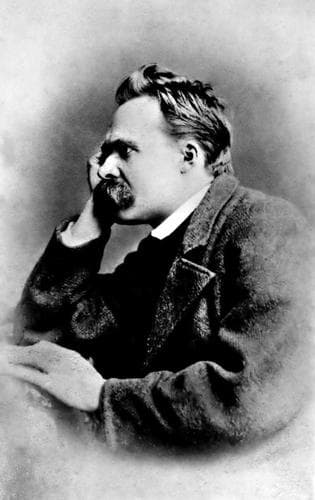
Friedrich Nietzsche was a German philosopher active in the late 19th century, known for his critiques of traditional moral values and religion. His notable works include "Thus Spoke Zarathustra," "Beyond Good and Evil," and "On the Genealogy of Morals," which explore themes of individualism, power, and the nature of existence. Nietzsche's writings have had a profound influence on modern philosophy and literature.
Similar books
- Beyond Good and Evil
Friedrich Nietzsche
4.0 (67k) average on GoodreadsPsychologyExpands on many of Zarathustra's themes, providing a more direct philosophical treatise on morality and truth.
- The Myth of Sisyphus
Albert Camus
4.2 (25k) average on GoodreadsPhilosophyExplores the absurdity of existence and the human response to a world without inherent meaning, resonating with the 'Death of God' theme.
- Being and Time
Martin Heidegger
4.0 (20k) average on GoodreadsPsychologyHeidegger, deeply influenced by Nietzsche, also explores questions of existence, authenticity, and the nature of being. However, while Zarathustra provides a prophetic vision of human self-overcoming and the creation of new values, Heidegger's Being and Time is a more rigorous, phenomenological investigation into the meaning of 'Being' itself, focusing on the structures of Dasein's (human existence's) being-in-the-world and its relation to time and death. Nietzsche's work is prescriptive and poetic, while Heidegger's is descriptive and analytical, though both ultimately challenge traditional metaphysics.
- The Diary of a Young Girl
Anne Frank
4.2 (2.7M) average on GoodreadsBiographyDuring the Nazi occupation, a teenage girl's diary, written from a secret annex, shares observations on humanity, hope, and the wait for freedom.
- Twisted 1. Twisted love
Ana Huang
3.7 (1.7M) average on GoodreadsA quiet billionaire with a difficult past finds his guarded heart opening to the woman he must protect, but their growing passion uncovers dangerous secrets and a shared, traumatic history.
- Eat, Pray, Love
Elizabeth Gilbert
3.6 (1.5M) average on GoodreadsLifestyleA heartbroken writer leaves her conventional life for a year-long global search for pleasure in Italy, spiritual devotion in India, and unexpected love and balance in Bali.



Enjoyed the summary?
A summary gives you the shape of the book. The book itself has the detail, the examples and the voice.
Find Thus Spake Zarathustra on AmazonAs an Amazon Associate, BookBrief earns from qualifying purchases. How we're funded