
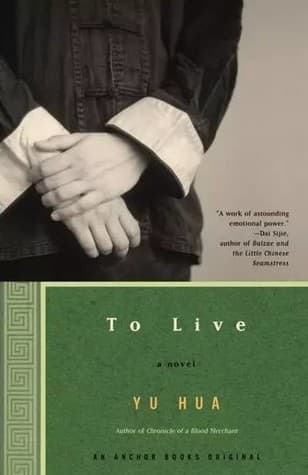
Synopsis
Covers the whole plot, including the ending.
- Difficulty
- Medium
- Pacing
- Moderate
- Mood
- Melancholy, Resilient, Reflective, Somber
- Read it if
- You appreciate profound, character-driven historical fiction that explores themes of resilience, loss, and the human spirit against the backdrop of significant historical events in China.
- Skip it if
- You prefer fast-paced plots or shy away from stories with a heavy emphasis on tragedy and suffering.
To Live Plot Summary
Covers the whole plot, including the ending.
The Gambler's Downfall
Fugui Xu, the spoiled son of a wealthy landlord in rural China, lives a life of indulgence. He gambles away his family's fortune at the local casino and goes to brothels, upsetting his wife, Jiazhen, and his parents. His father warns him repeatedly, but Fugui does not listen. He loses all the family's land and their ancestral home to a gambler named Long'er. This loss forces Fugui's family, including his pregnant wife and young daughter, Fengxia, into poverty. They move into a dilapidated hut and work as tenant farmers on what was once their own land.
A Father's Demise and a New Beginning
Soon after losing everything, Fugui's father dies of shame and anger, lamenting his son's recklessness. Fugui, changed by his father's death and their new life, begins to work the land as a tenant farmer. His wife, Jiazhen, gives birth to their son, Youqing. Despite their poverty, Fugui finds some happiness in honest work and his family. Their struggles continue, however. One day, while visiting his sick mother, Fugui is forced into the Nationalist Army, leaving his family to manage during a time of civil war.
The Horrors of Civil War
Fugui spends several years as a soldier in the Nationalist Army, fighting the Communists. He sees the brutal realities of war, many deaths, starvation, and exposure. He becomes friends with another conscript, Chunsheng, who later becomes a high-ranking officer in the Communist army. Communist forces capture Fugui, but they spare him because he is a peasant. He is eventually released and begins the long journey home, carrying memories of the conflict and a strong desire to see his family.
A Changed Homeland and Family Reunion
After years away, Fugui returns to his village, which has changed under Communist rule. He finds his mother has died, and his wife, Jiazhen, and their children, Fengxia and Youqing, are barely surviving. Jiazhen is sick and frail from years of hardship. Fengxia, their daughter, became deaf and mute after a severe fever, a result of their poverty and lack of medical care. Despite the sadness and new challenges, the family is reunited, and Fugui, now a humble man, works hard to care for them.
The Great Leap Forward and Its Toll
The family endures the Great Leap Forward. During this time, their village shares resources, and food becomes scarce due to agricultural policies and famine. Fugui's family, like many others, struggles with hunger. Their son, Youqing, dies. He is killed accidentally while donating blood for the district chief's wife, who is giving birth. The chief's wife is Chunsheng's wife. The doctor takes too much blood, and Youqing collapses and dies on the way home, leaving Fugui and Jiazhen heartbroken.
Fengxia's Marriage and Short-Lived Happiness
As Fengxia gets older, her deafness and muteness make it hard for her to find a husband. Fugui and Jiazhen worry about her future. A kind and hardworking man named Erxi, who has a limp, enters their lives. Erxi leads a construction team in the city. He falls in love with Fengxia and treats her with care. Their wedding brings a rare moment of joy to the family. Fugui and Jiazhen are happy to see their daughter settled and loved, hopeful for her future with Erxi.
Another Loss: Fengxia's Death
Fengxia becomes pregnant, and the family looks forward to the birth of her child. However, complications arise during childbirth. Despite the doctors' efforts, Fengxia has a severe hemorrhage and dies, leaving behind her newborn son, Kugen. The family is again sad. Fugui, Jiazhen, and Erxi are devastated by her loss, especially after the short happiness her marriage brought. Erxi, despite his sorrow, raises their son, Kugen, with quiet determination, keeping Fengxia's memory alive.
The Cultural Revolution and Chunsheng's Fate
The Cultural Revolution brings more upheaval and persecution to China. Fugui's family, though not directly targeted, sees the chaos. During this time, Fugui learns of the tragic fate of his former comrade, Chunsheng, who had risen to a high position in the Communist Party. Chunsheng is denounced as a 'capitalist roader' and publicly humiliated. Unable to bear the shame, Chunsheng commits suicide. Before his death, he visits Fugui and Jiazhen, offering them money as a final gesture of friendship and apology for Youqing's death, which they refuse.
Jiazhen's Passing and Erxi's Burden
After years of illness and hardships, Jiazhen's health worsens. She dies peacefully at home, leaving Fugui as the sole surviving member of his immediate family, besides his son-in-law Erxi and grandson Kugen. Fugui is very sad about losing his wife, who stayed with him through all their troubles. Erxi, a devoted son-in-law, continues to support Fugui and raise Kugen, showing quiet strength in the face of misfortune, becoming Fugui's remaining family connection.
Kugen's Early Demise
Tragedy strikes again when Fugui's grandson, Kugen, also dies young. Kugen, living with Erxi, is left in Fugui's care for a time. During this period, Kugen gets sick after eating too many beans, which he ate quickly because he was hungry and not used to such a treat. Despite Fugui's attempts to save him, Kugen dies. This final loss leaves Fugui alone, having outlived his entire family. His son-in-law, Erxi, also dies in an accident shortly after Kugen, leaving Fugui with no human family members left.
The Old Man and His Ox
In his old age, Fugui lives alone, farming his small plot of land. His only companion is an old ox, which he names 'Fugui' as if the ox embodies the spirit of his own life. He talks to the ox, telling stories of his family, his past, and the joys and sorrows he has experienced. Despite the suffering and loss, Fugui finds dignity and appreciation for the simple act of living. He has come to terms with his past and accepts his present, showing a sense of endurance and the will to live.
To Live Characters
Fugui Xu
Protagonist
A man transformed from a spoiled landlord's son to a resilient peasant.
Fugui begins as a reckless, spoiled youth addicted to gambling and brothels, squandering his family's fortune. This initial downfall marks the beginning of his transformation. Through the hardships of civil war, famine, and the deaths of his entire family, he evolves into a humble, resilient, and deeply empathetic man. He endures unimaginable suffering but maintains a profound attachment to life, finding dignity in manual labor and simple existence. His journey is a testament to the human capacity for endurance and the acceptance of fate.
Relationships: Jiazhen (Long-suffering, devoted wife); Fengxia (Daughter, mute and deaf, beloved); Youqing (Son, dies young); Long'er (Man who wins Fugui's land, later executed); Chunsheng (Comrade in war, later high-ranking official and friend); Erxi (Son-in-law, devoted and kind); Kugen (Grandson, dies young)
Jiazhen
Supporting
Fugui's devoted and long-suffering wife.
Jiazhen is Fugui's wife, a woman of immense patience, loyalty, and quiet strength. She endures Fugui's early recklessness, the family's fall into poverty, and the subsequent deaths of all their children and grandson with profound sorrow but unwavering resilience. Her health deteriorates over the years due to hardship and grief, but she remains a steadfast presence in Fugui's life, providing emotional support and embodying the spirit of endurance. Her love for her family is her guiding force.
Relationships: Fugui Xu (Husband, whom she loves despite his flaws); Fengxia (Daughter); Youqing (Son)
Fengxia
Supporting
Fugui and Jiazhen's deaf and mute daughter.
Fengxia is Fugui and Jiazhen's daughter, who becomes deaf and mute after a severe fever in childhood, a consequence of their poverty. Despite her disabilities, she is portrayed as a kind, gentle, and hardworking young woman. Her marriage to Erxi brings a brief period of happiness and hope to the family, only for it to be tragically cut short by her death during childbirth. Her life embodies the vulnerability of the innocent in times of hardship and the fleeting nature of joy.
Relationships: Fugui Xu (Father); Jiazhen (Mother); Erxi (Devoted husband); Kugen (Son)
Youqing
Supporting
Fugui and Jiazhen's energetic son, who dies young.
Youqing is Fugui and Jiazhen's spirited and kind-hearted son. He is a lively boy, full of energy and eagerness to help his family. His death is one of the most tragic events in the novel, occurring accidentally while donating blood for the district chief's wife, a consequence of the desperate circumstances during the Great Leap Forward. His early demise highlights the precariousness of life and the arbitrary nature of suffering during a tumultuous historical period, deeply affecting his parents.
Relationships: Fugui Xu (Father); Jiazhen (Mother); Chunsheng's wife (Recipient of his blood, indirectly causing his death)
Erxi
Supporting
Fugui's kind and devoted son-in-law.
Erxi is Fengxia's husband, a man with a limp who works in construction. He is characterized by his kindness, diligence, and unwavering devotion to Fengxia and, later, to his son Kugen and his in-laws, Fugui and Jiazhen. He accepts Fengxia's disabilities without hesitation and provides her with love and security. After Fengxia's death, he takes on the responsibility of raising Kugen and supporting Fugui, embodying loyalty and quiet strength until his own accidental death.
Relationships: Fengxia (Wife, whom he deeply loves); Kugen (Son); Fugui Xu (Father-in-law); Jiazhen (Mother-in-law)
Kugen
Supporting
Fugui's grandson, who also dies young.
Kugen is the son of Fengxia and Erxi, and Fugui's grandson. He is a young child whose life, like many others in the story, is marked by hardship and tragically cut short. His death, caused by eating too many beans due to hunger, is the final blow to Fugui's family, leaving him utterly alone. Kugen represents the continuing cycle of suffering and the vulnerability of the youngest generation in a world plagued by poverty and misfortune.
Relationships: Fengxia (Mother); Erxi (Father); Fugui Xu (Grandfather, caretaker at the time of his death)
Chunsheng
Supporting
Fugui's comrade from the Civil War, who rises in the Communist Party.
Chunsheng is a fellow conscript Fugui befriends during the Civil War. He later joins the Communist army and rises to a high-ranking position. His wife is the district chief's wife for whom Youqing donates blood. During the Cultural Revolution, he is persecuted and ultimately commits suicide. His character serves as a parallel to Fugui's, showing a different trajectory under historical change, and he carries the burden of indirect responsibility for Youqing's death, though Fugui forgives him.
Relationships: Fugui Xu (War comrade and friend); Youqing's death (Indirectly responsible for)
Long'er
Mentioned
The cunning gambler who takes Fugui's family fortune.
Long'er is the man who wins all of Fugui's family land and property through gambling. He represents the immediate catalyst for Fugui's downfall and the family's plunge into poverty. Years later, during the early Communist era, Long'er is executed as a landlord, a stark example of the shifting fortunes and harsh justice of the revolutionary period. His fate serves as a grim reminder of how quickly power and status can be reversed.
Relationships: Fugui Xu (Gambling opponent, takes his land)
Fugui (the ox)
Supporting
Fugui's final companion in his old age.
The old ox, named Fugui by the protagonist, becomes Fugui's sole companion in his extreme old age. The ox is a symbol of endurance, hard work, and the simple, uncomplaining acceptance of fate. Fugui converses with the ox, sharing his life story and memories, effectively using the animal as a silent confidant. The ox represents the bond between man and nature, and the quiet dignity found in the most basic forms of life, mirroring Fugui's own journey of survival.
Relationships: Fugui Xu (Owner and close companion)
To Live Themes
Endurance and the Will to Live
The most prominent theme is the human capacity for endurance in the face of suffering and loss. Fugui outlives his entire family—his parents, wife, children, and grandson—and witnesses historical upheaval, yet he continues to live, finding dignity in simply existing. His conversations with his ox, named Fugui, in his old age, show an acceptance of life's brutal realities and a quiet appreciation for its continuation, even in solitude. This theme appears in his stoic acceptance of each new tragedy.
“What is important is not what happened, but how to live on.”
The Impact of Historical Change on the Individual
The novel shows how major historical events—the Chinese Civil War, the Great Leap Forward, and the Cultural Revolution—directly impact ordinary people. Fugui's personal tragedies often connect with these political upheavals, from his conscription into the Nationalist Army to Youqing's death during the Great Leap Forward. The story shows how individuals are powerless against the forces of history, yet they must adapt and survive, often at a high personal cost.
“He said that a person's life is just a few decades, and it's over in a flash, like a dream.”
Family and Loss
Family is central to Fugui's life, and losing his loved ones forms the emotional core of the story. Each death—his parents, Fengxia, Youqing, Jiazhen, Erxi, and Kugen—is a deep blow, stripping him of connection and hope. These losses are not just plot points; they are deeply felt, shaping Fugui's character and his view of life. The theme explores the deep bonds within a family and the devastating impact of their dissolution, leaving Fugui alone but holding their memories dear.
“I often think that if Jiazhen were still alive, she would be beside me, looking at these children, and she would definitely be smiling.”
Redemption and Transformation
Fugui's journey is one of personal transformation. He starts as a selfish, irresponsible landlord's son, wasting his family's wealth. His downfall, caused by gambling, forces him into poverty and labor. Through suffering, he loses his arrogance and gains humility, compassion, and resilience. This change is not sudden but a gradual process shaped by hardship, leading him to quiet dignity and acceptance in his old age. His redemption is in his ability to simply 'live on'.
“I've thought it over, and people should live for the sake of living, not for anything else.”
The Absurdity of Fate and Suffering
The novel shows the arbitrary nature of the suffering Fugui and his family endure. Deaths happen not from dramatic battles but from accidents or unintended consequences of societal policies: Youqing's death from blood donation, Fengxia's from childbirth, Kugen's from eating too many beans. This randomness shows a sense of fatalism, where life's events are largely beyond individual control. The story suggests that life is not fair, and tragedies often strike without reason, demanding only endurance from those left behind.
“The more you live, the more you realize that people are just like animals, living for the sake of living.”
Plot Devices & Literary Techniques
Framed Narrative
An unnamed folklorist interviews old Fugui, who narrates his life story.
The story of Fugui Xu is told through a framed narrative. An unnamed folklorist, who is collecting folk songs, encounters an elderly Fugui in the countryside and sits with him as he recounts his entire life story. This device allows for a reflective, retrospective tone, filtered through Fugui's own memory and perspective. It also provides a sense of authenticity and intimacy, making the reader feel like a direct listener to his incredible tale of survival and loss, lending a conversational and oral history quality to the narrative.
First-Person Retrospective Narration (Fugui's Voice)
Fugui's past is recounted from his elderly, reflective perspective.
Within the framed narrative, the bulk of the novel is told in Fugui's first-person voice as he looks back on his life. This allows for deep insight into his personal experiences, emotions, and philosophical reflections. His voice is simple, direct, and often tinged with a blend of resignation and quiet humor. The retrospective nature means that events are processed through the lens of a survivor, emphasizing themes of endurance and the acceptance of fate, rather than immediate, raw emotion, giving his tragedies a weathered, philosophical quality.
Symbolism of the Ox
The ox represents resilience, endurance, and the simple act of living.
In his extreme old age, Fugui's sole companion is an old ox, which he names 'Fugui'. The ox symbolizes the protagonist's own journey and characteristics: hard work, resilience, and an uncomplaining acceptance of one's lot. The ox is a creature of the land, embodying the peasant's connection to the earth and the cycle of life and death. Fugui's conversations with the ox are a poignant representation of his solitude and his profound connection to the simple, enduring aspects of life itself, mirroring his own will to live.
Ironic Reversal of Fortune
Fugui's initial downfall leads to his moral ascent, while Long'er's gain leads to his demise.
The novel employs ironic reversal of fortune, particularly with Fugui and Long'er. Fugui, initially wealthy, loses everything and is forced into poverty, which paradoxically leads to his moral transformation and a deeper appreciation for life. Conversely, Long'er, who gains Fugui's wealth, eventually faces execution as a landlord under the new Communist regime. This device highlights the unpredictable nature of fate and the shifting social hierarchies during China's tumultuous 20th century, suggesting that material wealth does not guarantee happiness or survival.
To Live Quotes
“A man’s life is like a long road, and you never know what’s around the next bend.”
“People live for the sake of living itself, not for anything outside of living.”
“If you want to live a long life, you have to learn to endure.”
“In this world, there’s nothing that can’t be endured, and nothing that can’t be let go.”
“A person’s greatest misfortune is not poverty or illness, but having no one to share life with.”
“Life is like a play, and we are all actors on the stage.”
“The dead are gone, but the living must keep on living.”
“Wealth is like water in your hands—it slips through your fingers no matter how tightly you hold on.”
“In times of famine, a grain of rice is worth more than a piece of gold.”
“A man’s worth is not measured by what he has, but by what he endures.”
“The sun rises and sets, and life goes on, no matter what.”
“Sometimes, living is the hardest thing of all.”
“Memory is a burden, but it’s also what keeps us human.”
“In the end, all we have is the story of how we lived.”
Quiz
10 questions on the plot and the characters. Each answer comes with a short explanation.
Question 1
What is the primary reason Fugui loses his family's wealth at the beginning of the novel?
- He invests it in a failed business venture
- He gambles it away in dens and spends it in brothels
- It is confiscated by the Nationalist Army
- He donates it to support the Communist cause
Show answer
B. He gambles it away in dens and spends it in brothels Fugui starts as a spoiled landlord's son who squanders the family fortune through reckless gambling and visits to brothels, leading to his family's ruin and his eventual transformation.
Question 2
Which army forcibly conscripts Fugui, separating him from his family for years?
- The Communist Army
- The Japanese Army
- The Nationalist Army (Kuomintang)
- A local warlord's militia
Show answer
C. The Nationalist Army (Kuomintang) During the Chinese Civil War, Fugui is captured and forced to serve in the Nationalist Army, where he witnesses the horrors of war before eventually deserting and returning home.
Question 3
What animal becomes Fugui's companion in his final years, symbolizing his resilience?
- A dog
- A horse
- An ox
- A goat
Show answer
C. An ox In the novel's conclusion, Fugui is left with an ox as his sole companion, representing his enduring spirit and the simple, hard-earned peace he finds after a life of suffering.
Question 4
How does Fugui's son, Youqing, die in the story?
- He is killed in battle during the Civil War
- He dies from illness due to malnutrition
- He is crushed by a collapsing wall during the Great Leap Forward
- He dies from excessive blood donation to save a county head's wife
Show answer
D. He dies from excessive blood donation to save a county head's wife Youqing's death is a tragic irony: he is forced to donate too much blood to save the wife of a local official during the Great Leap Forward, highlighting the absurdities and cruelties of the era.
Question 5
What major historical event does Fugui and his family endure after the Civil War, leading to further hardships?
- The Opium Wars
- The Cultural Revolution
- The Sino-Japanese War
- The Qing Dynasty's collapse
Show answer
B. The Cultural Revolution The Cultural Revolution brings intense political persecution and social upheaval to Fugui's life, causing more suffering and loss, as depicted in the latter part of the novel.
Question 6
What symbolizes Fugui's transformation from a reckless youth to a humble peasant?
- His acquisition of a new house
- His marriage to a wealthy woman
- His shift from gambling to farming as honest work
- His enlistment in the army
Show answer
C. His shift from gambling to farming as honest work After losing everything, Fugui repents and becomes a farmer, embracing a simple, hardworking life that marks his moral redemption and resilience.
Question 7
Why was 'To Live' initially banned in China upon its publication?
- It contained explicit sexual content
- It criticized traditional Chinese values
- It portrayed the harsh realities of 20th-century Chinese history too candidly
- It promoted anti-government propaganda
Show answer
C. It portrayed the harsh realities of 20th-century Chinese history too candidly The novel's unflinching depiction of suffering during events like the Civil War and Cultural Revolution was deemed too critical by authorities, leading to its initial ban before it gained recognition as an influential work.
Question 8
What role does Fugui's wife, Jiazhen, play in his life throughout the novel?
- She abandons him after he loses their wealth
- She serves as a symbol of unwavering loyalty and endurance alongside him
- She becomes a political activist during the Cultural Revolution
- She dies early in the story, leaving him to raise their children alone
Show answer
B. She serves as a symbol of unwavering loyalty and endurance alongside him Jiazhen stands by Fugui through all his trials, embodying resilience and familial love, and her presence highlights the theme of enduring human connections amid adversity.
Question 9
How does the novel use Fugui's personal losses to comment on broader historical themes?
- By showing how individual suffering is often overshadowed by national progress
- By illustrating how political ideologies consistently improve people's lives
- By depicting personal tragedies as direct consequences of China's turbulent 20th-century history
- By emphasizing the importance of wealth accumulation for survival
Show answer
C. By depicting personal tragedies as direct consequences of China's turbulent 20th-century history Fugui's story intertwines with events like the Civil War and Cultural Revolution, using his hardships to critique the impact of historical upheavals on ordinary people and the resilience required to endure them.
Question 10
In what way does Fugui's narrative style as an older man recounting his life affect the novel's tone?
- It makes the story feel like a heroic epic of triumph
- It adds a sense of detachment and irony, softening the brutality of his experiences
- It creates a fast-paced, action-oriented plot
- It focuses solely on political commentary without emotional depth
Show answer
B. It adds a sense of detachment and irony, softening the brutality of his experiences Fugui tells his story with a matter-of-fact, sometimes ironic voice as an old man, which contrasts with the tragedies he describes, highlighting his acceptance and the novel's theme of finding meaning in survival.
To Live FAQ
What is 'To Live' about?
'To Live' follows the life of Fugui, a former wealthy landlord's son who loses everything through gambling and must rebuild his life as a peasant. The novel chronicles his journey through China's turbulent 20th century, including the Civil War, Great Leap Forward, and Cultural Revolution, as he endures the deaths of his entire family while maintaining his will to survive.
Why should I read 'To Live'?
This novel offers a powerful, human-scale perspective on modern Chinese history through one man's extraordinary resilience. Yu Hua's unflinching yet compassionate portrayal of suffering and survival provides profound insights into the Chinese experience during political upheavals, making it both historically significant and emotionally resonant.
What is the background/setting of 'To Live'?
The story spans from the 1940s to the 1970s, moving through rural China's transformation during the Civil War between Nationalists and Communists, the establishment of the People's Republic, the Great Leap Forward's famine, and the Cultural Revolution's political persecutions. The agricultural village setting reflects China's shift from traditional to communist society.
What are the most memorable quotes?
Key quotes include Fugui's reflection 'A person's life is like the seasons: spring, summer, autumn, winter' and his repeated mantra 'We have to live, we have to live' when facing tragedies. The ox's naming scene where Fugui calls it after himself symbolizes his identification with endurance, while his final words 'I'm still alive' encapsulate the novel's theme.
What writing style does the author use?
Yu Hua employs stark, minimalist prose with matter-of-fact narration that contrasts with the emotional weight of events. The style is deceptively simple, using repetition and understatement to amplify tragedy, while incorporating dark humor and folk storytelling elements through Fugui's retrospective narration to an unnamed listener.
What minor details add significant meaning?
The recurring motif of Fugui's shadow puppet theater represents both his lost aristocratic past and his storytelling function. The ox's gradual aging parallels Fugui's own decline, while small objects like the family's cooking pot symbolize continuity amid loss. Fugui's repeated counting of family deaths creates a rhythmic structure of accumulating grief.
What are some subtle foreshadowing moments?
Early scenes of Fugui's father dying after he loses the family house foreshadow later generational tragedies. Jiazhen's illness during pregnancy hints at her eventual death from软骨病 (软骨病). Young Youqing's love for sheep presages his death while caring for the commune's animals, and Fengxia's muteness subtly predicts her vulnerability.
What unexpected character connections exist?
Chunsheng, who becomes Fugui's Nationalist Army comrade, later reappears as a Communist official who accidentally causes Youqing's death. Long Er, who wins Fugui's house gambling, ends up executed as a landlord during land reform, mirroring what might have been Fugui's fate. The doctor who fails to save Fengxia during childbirth connects to medical shortages during the Cultural Revolution.
What are unspoken character motivations?
Fugui's transformation stems from unspoken guilt over destroying his family's legacy and causing his father's death. Jiazhen's loyalty despite Fugui's early betrayal reflects traditional Confucian wifely devotion. Chunsheng's suicide reveals unacknowledged trauma from causing Youqing's death, while Fugui's attachment to the ox represents his need for companionship after outliving everyone.
What psychological complexities do characters exhibit?
Fugui displays survivor's guilt alongside remarkable resilience, finding meaning in mere existence. Jiazhen embodies stoic endurance despite chronic illness and loss. Youqing's earnest responsibility contrasts with his premature death, while Fengxia's muteness creates inner richness unexpressed verbally. The ox becomes a psychological mirror for Fugui's own stubborn will to live.
What are the major emotional turning points?
Fugui losing his family fortune and father's death begins his transformation. Jiazhen's return after his gambling disaster establishes their enduring bond. Youqing's death from overdonating blood to the pregnant wife of official Chunsheng marks irreversible tragedy. Fengxia's death in childbirth and Jiazhen's subsequent death leave Fugui completely alone, culminating in his solitary existence with only the ox.
How do relationship dynamics evolve?
Fugui and Jiazhen's marriage transforms from transactional to deeply bonded through shared suffering. Fugui's relationship with his children shifts from neglectful to fiercely protective. His dynamic with Chunsheng moves from wartime camaraderie to complicated guilt after Youqing's death. Ultimately, Fugui's relationship with the ox replaces human connections, symbolizing his reduced but persistent engagement with life.
Which parts remain ambiguous or open-ended?
The identity of Fugui's listener/narratee is never revealed, leaving the storytelling context mysterious. Whether Fugui finds meaning beyond mere survival remains ambiguous. The novel doesn't explicitly judge historical events, leaving interpretation of political systems open. Fugui's final psychological state—whether content or merely enduring—is subtly portrayed without definitive resolution.
What are controversial scenes or decisions?
The scene where Youqing dies from forced blood donation to a Communist official's wife critiques political privilege. Fugui's initial gambling spree and treatment of Jiazhen portray unflattering masculinity. The Cultural Revolution scenes showing doctors' persecution were controversial in China. Fugui's passive acceptance of tragedies rather than rebellion challenges heroic narratives.
'To Live' ending explained: how it ends & what it means
The novel ends with elderly Fugui buying an old ox, naming it after himself, and working alongside it in fields. This symbolizes his identification with simple endurance and cyclical nature of life. The ending suggests that survival itself becomes Fugui's triumph, with the ox representing both his last companion and his own stubborn will to persist despite overwhelming loss.
How does the novel portray historical events?
Historical events are filtered through personal experience rather than political analysis—the Civil War appears through Fugui's conscription and desertion, the Great Leap Forward through famine deaths, and the Cultural Revolution through persecution of doctors. This approach emphasizes human cost over ideological conflict, showing how ordinary people navigate political upheavals beyond their control.
What is the significance of the title 'To Live'?
The title encapsulates the novel's central theme: that mere survival constitutes a profound achievement amid historical catastrophe. For Fugui, living becomes an active verb requiring daily effort after losing everything. The Chinese title '活着' (Huózhe) emphasizes the continuous present tense of existence, suggesting life as process rather than achievement.
How does Fugui's character develop throughout the novel?
Fugui transforms from a selfish, irresponsible gambler to a responsible family man, then to a survivor who endures unimaginable losses. His development isn't toward wisdom or happiness but toward acceptance—learning to appreciate small moments of life despite cumulative tragedy. His values shift from material wealth to human connections, then finally to basic existence itself.
What role does fate or chance play in the story?
Chance events repeatedly alter Fugui's life—winning then losing at gambling, surviving battles while others die, encountering Chunsheng at key moments. Yet these random events occur within deterministic historical forces like war and political campaigns. This tension between individual chance and historical determinism creates the novel's tragic structure, where personal choices matter but are overwhelmed by larger forces.
About the author

Yu Hua is a Chinese author known for his impactful fiction that often explores themes of life and suffering. His notable works include "To Live," which reflects on the struggles of ordinary people in China, "Chronicle of a Blood Merchant," a story about the human condition and sacrifice, and "Brothers," a tale of familial bonds set against the backdrop of societal change.
Similar books
- The Good Earth
Pearl S. Buck
4.0 (223k) average on GoodreadsHistorical FictionExplores the life of a Chinese peasant family enduring hardship and change.
- A Fine Balance
Rohinton Mistry
4.3 (129k) average on GoodreadsLiterary FictionFollows multiple characters through personal and political turmoil in a developing nation, with a focus on resilience.
- Brothers
Yu Hua
4.3 (187) average on GoodreadsHistorical FictionAnother powerful novel by the same author, depicting the lives of two brothers through China's societal changes.
- Balzac and the Little Chinese Seamstress
Dai Sijie
3.6 (56k) average on GoodreadsHistorical FictionDai Sijie's novel, also set during the Cultural Revolution, shares with To Live the experience of individuals caught in vast political currents. However, Balzac and the Little Chinese Seamstress offers a more romanticized and ultimately optimistic perspective, focusing on the transformative power of forbidden Western literature and intellectual awakening amidst 're-education.' While To Live emphasizes the brutal physical and emotional toll of the era, showcasing relentless loss and the sheer will to survive, Dai Sijie's narrative, though acknowledging hardship, highlights intellectual rebellion and the enduring spirit of art. Yu Hua's depiction of suffering is far more direct and unsparing, making To Live a bleaker, yet arguably more profound, commentary on the human cost of political extremism.
- To Kill a Mockingbird
Harper Lee
4.3 (4.5M) average on GoodreadsHistorical FictionIn the 1930s Jim Crow South, Harper Lee writes about racial injustice, moral growth, and the quiet courage of a lawyer father, Atticus Finch, as seen through his young daughter's eyes.
- The Great Gatsby
F. Scott Fitzgerald
3.9 (3.8M) average on GoodreadsHistorical FictionIn the opulent Roaring Twenties, a mysterious millionaire's lavish parties hide his desperate, tragic pursuit of a lost love, exposing the emptiness within the American Dream.





Enjoyed the summary?
A summary gives you the shape of the book. The book itself has the detail, the examples and the voice.
Find To Live on AmazonAs an Amazon Associate, BookBrief earns from qualifying purchases. How we're funded