
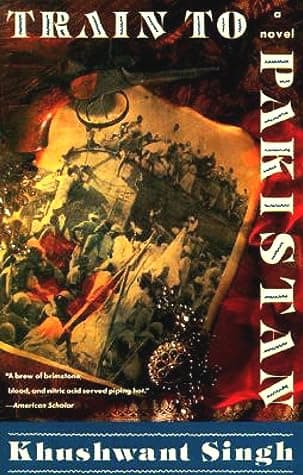
Synopsis
Covers the whole plot, including the ending.
- Difficulty
- Medium
- Pacing
- Moderate
- Mood
- Somber, Tragic, Reflective, Intense
- Read it if
- You want a raw, unflinching look at the human cost of the Partition of India, told through a micro-lens.
- Skip it if
- You prefer narratives with clear-cut heroes and villains, or shy away from graphic depictions of violence.
Train to Pakistan Plot Summary
Covers the whole plot, including the ending.
Mano Majra: A Village Untouched
The novel opens by introducing Mano Majra, a remote village on the border of India and Pakistan. Sikhs and Muslims have lived together peacefully for generations, sharing a gurdwara and a mosque, and relying on the rhythm of the trains for their sense of time. Life is simple, marked by agricultural seasons and daily routines. Juggut Singh, known as Jugga, a local dacoit (bandit) with a criminal record, has a secret affair with Nooran, a Muslim girl. Their relationship, though disapproved, reflects the village's underlying tolerance. This initial calm contrasts sharply with the coming violence of the Partition of India, which has not yet reached their isolated community.
The Murder of Lala Ram Lal
One night, a gang of dacoits, led by Malli, murders Lala Ram Lal, the village moneylender, and robs his house. The murder is brutal, and the dacoits escape. The police, led by Inspector Iqbal Singh, arrive to investigate. Because of his past and his presence near the crime scene, Juggut Singh is immediately suspected and arrested. The police also arrest Iqbal, a foreign-educated Sikh social worker who just arrived in Mano Majra, mistakenly believing him to be a Muslim League agent or communist agitator due to his urban look and political interests. These arrests disturb the village's peace and bring in outside authority and suspicion.
Iqbal's Arrest and Reflection
Iqbal, a young, educated Sikh man, arrives in Mano Majra to do social work and perhaps awaken political awareness among villagers. However, his sophisticated appearance and the timing of his arrival make him suspicious to the police, who are already on high alert due to escalating communal violence elsewhere. He is arrested shortly after Jugga, and both are held in the local lock-up. During his imprisonment, Iqbal thinks about how useless his political ideals are against such raw, unthinking violence and the deep prejudices now appearing. He feels detached and helpless, questioning his ability to change the situation.
The Ghost Train Arrives
The first real sign of the Partition's horror reaches Mano Majra as a 'ghost train.' This train, usually a symbol of routine and connection, arrives silently. Its wagons are filled with the mutilated bodies of Sikhs massacred in Pakistan. The sight of the dead, along with their looted belongings, deeply shocks the villagers. This event destroys their illusion of safety and isolation, planting seeds of fear, anger, and a desire for revenge among the Sikh population, and fear among the Muslims. Mano Majra's innocence is lost, replaced by the grim reality of communal violence.
Rising Tensions and Communal Divide
After the ghost train, the communal harmony in Mano Majra quickly worsens. Sikh refugees from Pakistan start arriving, bringing terrible stories of atrocities against their community. These stories fuel the anger and desire for retribution among local Sikhs, who begin to view their Muslim neighbors with suspicion and hostility. The traditional bonds of friendship and shared life start to break. The Muslims, in turn, become fearful, sensing the change in atmosphere and expecting attacks. The village is no longer peaceful but a small example of the larger, violent conflict.
The Evacuation of Muslims
As tensions rise and the government struggles to keep order, an official decision is made to evacuate all Muslims from Indian villages to refugee camps, from where they will eventually go to Pakistan. This order reaches Mano Majra, forcing Muslim residents, who have lived there for centuries, to leave their homes and possessions. It is a heartbreaking scene, as families prepare to leave, carrying only what they can. Sikhs watch, some with regret, others with grim satisfaction or indifference. This forced migration marks the end of Mano Majra's diverse community and further solidifies the communal divide.
The Plan for Revenge
After the Muslim evacuation, a group of angry young Sikh men from Mano Majra and nearby areas, inflamed by stories of violence against Sikhs and urged on by a visiting Sikh leader, plan a brutal act of revenge. They plan to ambush a train carrying Muslim refugees from India to Pakistan, specifically targeting the one that will carry the former Muslim residents of Mano Majra. Their gruesome plan involves using a rope to trip passengers as the train crosses a bridge, making them fall into the river below, where others will be waiting to kill them. This plot shows the depth of hatred that has consumed the region.
Nooran's Fate and Jugga's Release
While Jugga and Iqbal are still in custody, Nooran visits Jugga in jail and tells him she is pregnant with his child. This news adds a personal aspect to the unfolding tragedy for Jugga. Meanwhile, the police, having failed to find concrete evidence against Jugga for the moneylender's murder and needing to deal with the escalating communal violence, release him. Iqbal is also released. Jugga is now free, but unaware of the specific, horrific plan made by the Sikh youths against the train carrying his beloved Nooran and the other Muslim villagers to Pakistan.
Iqbal's Moral Dilemma
Upon his release, Iqbal learns about the planned massacre of Muslims on the upcoming train. He is horrified by the plot's barbarity and feels he must intervene. However, he is an outsider, an intellectual, and recognizes his helplessness against the immense power of communal frenzy. He struggles with whether to risk his life to stop the mob, or if such an attempt would be useless and self-destructive. His internal conflict highlights how reason and individual morality can be paralyzed in the face of mass hysteria and violence.
Jugga's Sacrifice
As the train carrying Muslim refugees approaches the bridge where the ambush is planned, Jugga, having learned of the plot, realizes Nooran is on that train. Overcoming his past and his fears, he rushes to the bridge. The Sikh youths have strung a thick rope across the tracks to trip passengers. In a desperate act of love and self-sacrifice, Jugga climbs the steel span of the bridge, hacking at the rope with his kirpan (Sikh dagger). He cuts through most of the rope, but the train is too close. He is shot by the mob, but with his last bit of strength, he severs the final strands, allowing the train to pass safely. He saves hundreds of lives, including Nooran's, at the cost of his own.
Train to Pakistan Characters
Juggut Singh (Jugga)
Protagonist
A local dacoit who finds redemption through love and sacrifice.
Jugga is a large, physically imposing Sikh man, known in Mano Majra as a 'budmash' (bad character) due to his criminal record and association with dacoity. Despite his rough exterior, he possesses a deep capacity for love and loyalty, particularly towards Nooran. He is initially portrayed as an outcast, but his actions reveal a moral core stronger than many 'respectable' villagers. His love for Nooran transcends religious and social barriers, making him an unlikely hero.
Relationships: Nooran (Lover, carrying his child); Meet Singh (Village Headman, often disapproving but respectful)
Nooran
Supporting
A young Muslim girl in love with Jugga, whose fate is intertwined with the village's exodus.
Nooran is a young, beautiful Muslim girl from Mano Majra, deeply in love with Juggut Singh. Her relationship with Jugga is a quiet symbol of the communal harmony that once existed in the village. She becomes pregnant with Jugga's child, adding a layer of personal tragedy and urgency to their story amidst the backdrop of Partition. Her vulnerability and her forced departure from her home represent the plight of countless displaced individuals.
Relationships: Juggut Singh (Lover, father of her unborn child)
Iqbal Singh
Supporting
An educated, urban Sikh social worker who becomes an observer of the unfolding tragedy.
Iqbal is a foreign-educated Sikh, possibly a communist or social worker, who arrives in Mano Majra with intentions of political activism. He is an intellectual and an outsider, representing modern, urban India. His initial arrest and subsequent release place him in a position to observe the escalating violence with a detached, analytical perspective. He grapples with his conscience and the futility of his ideals in the face of irrational hatred, ultimately choosing not to intervene directly in the planned massacre.
Relationships: Juggut Singh (Fellow prisoner, an unlikely acquaintance); Deputy Commissioner (Authority figure he interacts with during his arrest)
Meet Singh
Supporting
The Granthi (priest) of the Mano Majra Gurdwara and a respected village elder.
Meet Singh is the Granthi, the reader of the holy scriptures, at the village gurdwara. He is a respected elder in the Sikh community and a symbol of traditional religious authority and the initial communal harmony. He witnesses the gradual erosion of peace in Mano Majra with a heavy heart, struggling to maintain order and understanding amidst the rising tide of hatred. He represents the older generation's values and their helplessness in the face of unprecedented violence.
Relationships: Mullah Imam Baksh (Fellow religious leader, friend); Juggut Singh (Often disapproving of Jugga's conduct)
Mullah Imam Baksh
Supporting
The Imam of the Mano Majra mosque and a counterpart to Meet Singh.
Imam Baksh is the Mullah of the village mosque, a respected figure in the Muslim community and a close friend to Meet Singh. He embodies the long-standing interfaith harmony of Mano Majra. His forced evacuation with the other Muslims highlights the tragic impact of Partition on individual lives and communities. He represents the Muslim perspective of fear and displacement, as well as the initial trust that was betrayed.
Relationships: Meet Singh (Fellow religious leader, friend); Nooran (Her father)
Deputy Commissioner (D.C.)
Supporting
The British-Indian administrator responsible for maintaining order in the district.
The Deputy Commissioner is the highest-ranking official in the district, responsible for law and order. He represents the colonial administration's attempts, often futile, to control the escalating communal violence during Partition. He is pragmatic and somewhat detached, focused on official procedures and maintaining a semblance of authority, even as the situation spirals out of control. His character highlights the limitations of administrative power against a tide of religious fanaticism.
Relationships: Iqbal Singh (Interrogator and authority figure during Iqbal's arrest)
Sub-Inspector
Supporting
The local police officer in charge of investigations in Mano Majra.
The Sub-Inspector is the local police officer responsible for investigating the murder of Lala Ram Lal and maintaining order in Mano Majra. He is pragmatic and often cynical, quick to accuse Juggut Singh due to his criminal reputation. He represents the bureaucratic and often corrupt face of law enforcement, more concerned with closing cases and following orders than with true justice or understanding the complex communal dynamics.
Relationships: Juggut Singh (Arresting officer, accuser); Iqbal Singh (Arresting officer, interrogator)
Malli
Antagonist
The leader of the dacoit gang who murders Lala Ram Lal.
Malli is the leader of the gang of dacoits responsible for the murder of Lala Ram Lal. He is a minor but significant character, as his actions indirectly lead to Jugga's initial arrest and set the stage for the police presence in Mano Majra. He represents the criminal underworld that exists alongside the 'respectable' village life, and his initial act of violence is a precursor to the larger, communal violence that later engulfs the region.
Relationships: Lala Ram Lal (His victim)
Train to Pakistan Themes
The Brutality of Partition
The novel clearly shows the devastating human cost of the 1947 Partition of India. It goes beyond political talk to show the raw, senseless violence that erupted between communities that once lived peacefully. The 'ghost train' arriving in Mano Majra, filled with massacred bodies, is a stark symbol of this brutality. The forced displacement of Muslims from their homes and the subsequent revenge plot by Sikh youths highlight how quickly humanity can turn savage when driven by hatred and fear. The story emphasizes the loss of innocence and the deep wounds inflicted on everyone.
“The summer of 1947 was not like other Indian summers. Even the weather had a different feel. It was not as hot as usual, and the dust storms were less frequent. But the air was heavy with an undefinable something, which the villagers called 'kali hawa'—the black wind.”
Communal Harmony and Its Erosion
Khushwant Singh first shows Mano Majra as an ideal village where Sikhs and Muslims have lived in deep harmony for centuries, sharing resources, traditions, and daily life. This harmony is clear in the friendship between Granthi Meet Singh and Mullah Imam Baksh, and even in the forbidden love between the Sikh Jugga and Muslim Nooran. However, this peace is fragile and quickly breaks under the external pressure of Partition. The arrival of refugee trains and inflammatory rumors systematically destroy trust, replacing it with suspicion, fear, and eventually, a desire for revenge. The theme explores how easily deep communal bonds can be shattered by political and religious extremism.
“Muslims and Sikhs have always lived together in Mano Majra. The village is like a family. We have no quarrels.”
Love and Sacrifice Amidst Hatred
At the novel's heart is the lasting love between Juggut Singh and Nooran. This love stands as a powerful contrast to the widespread hatred and violence. Their relationship, at first forbidden, becomes a symbol of hope and humanity. Jugga's ultimate act of self-sacrifice, where he risks and loses his life to save the train carrying Nooran and other Muslims, goes beyond the communal animosity. This theme shows how individual acts of compassion and love can defy the dehumanizing forces of war. It suggests that even in the darkest times, the human spirit's capacity for good can prevail, offering a glimmer of redemption.
“He thought of Nooran, who was on that train. He had to save her. He had to save them all.”
The Failure of Law and Order
The novel critically examines how ineffective and often corrupt the state was in controlling communal violence. The police are shown as either inept, like the Sub-Inspector who falsely arrests Jugga and Iqbal, or overwhelmed, like the Deputy Commissioner who struggles to keep control. Law and order completely break down as the violence grows, leaving individuals and communities vulnerable. The justice system fails to protect the innocent or punish the truly guilty, adding to the atmosphere of lawlessness and despair. This theme underscores the devastating results when state authority collapses and mob rule takes over.
“The police were helpless. They were just as confused as the villagers. They had no idea what to do.”
Plot Devices & Literary Techniques
The Train
A central symbol representing connection, time, and ultimately, the devastating impact of Partition.
The train is a multi-faceted symbol in 'Train to Pakistan.' Initially, it represents the routine and rhythm of life in Mano Majra, with villagers setting their clocks by its passing. It signifies connection to the outside world. However, it quickly transforms into a harbinger of death and destruction, first as the 'ghost train' carrying massacred bodies, then as the vehicle for forced displacement of Muslims, and finally as the target for a revenge massacre. It embodies both the hope of passage and the horror of the journey, becoming a powerful metaphor for the irreversible changes brought by Partition.
The Bridge
A physical and symbolic crossing point where destinies converge.
The railway bridge over the Sutlej River serves as a critical geographical and symbolic locus in the novel. It is the point where the trains pass, marking the boundary between one state and another, and eventually, between life and death. The bridge becomes the site of the planned massacre and Jugga's heroic sacrifice. Symbolically, it represents a threshold—the crossing from peace to violence, from life to death, and for Jugga, from a life of crime to one of ultimate redemption. It is where the forces of hatred and love clash in a climactic confrontation.
The Moneylender's Murder (Lala Ram Lal)
A catalyst that introduces external authority and sets the initial plot in motion.
The murder of Lala Ram Lal, the village moneylender, by Malli's gang acts as a crucial inciting incident. While seemingly disconnected from the larger Partition narrative, this event directly leads to the arrest of Juggut Singh and Iqbal. Their imprisonment removes them from the immediate village dynamics, allowing the communal tensions to escalate in their absence. It also brings the police into Mano Majra, introducing an external authority figure that further disrupts the village's insular peace and foreshadows the larger societal breakdown.
The Monsoon
A natural cycle that contrasts with the unnatural human-made chaos.
The monsoon season serves as a recurring backdrop, symbolizing the natural order of life and the cyclical nature of time, contrasting sharply with the chaotic and unnatural violence of Partition. The arrival of the monsoon is typically a time of renewal and growth, but in the novel, it coincides with the escalating human tragedy. The rain often accompanies significant events, like the arrival of the ghost train or the mounting tensions, underscoring the disjunction between the predictable rhythms of nature and the unpredictable savagery of human conflict. It provides a timeless, indifferent witness to human folly.
Train to Pakistan Quotes
“The summer of 1947 was not like other Indian summers. It was a particularly hot summer, and a particularly dry one. And the people of India were particularly hot and dry.”
“Hindus are like that. If they are not exploiting someone, they feel lost.”
“The only thing that gave him a feeling of importance was the uniform of a police sub-inspector.”
“Religion is not important. The important thing is to be a good man.”
“For the first time, the people of Mano Majra felt that they were not Hindus or Sikhs or Muslims, but just people.”
“There are no good men, there are no bad men. There are only men.”
“The bullets were not hitting anyone in particular. They were just hitting people.”
“He knew that he was going to die. But he also knew that he was going to save her.”
“The partition of India was not just a political division, it was a division of hearts.”
“A country divided by religion, a people united by sorrow.”
“What is the use of being alive if you cannot live with dignity?”
“The world was going mad. And Mano Majra, a tiny village, was caught in the madness.”
“The police were there to maintain law and order, but they were also part of the problem.”
“Life, like a train, has its stations. Some are happy, some are sad. Some are permanent, some are temporary.”
Quiz
10 questions on the plot and the characters. Each answer comes with a short explanation.
Question 1
Which specific village is the primary setting for the events in 'Train to Pakistan'?
- Lahore
- Amritsar
- Mano Majra
- Delhi
Show answer
C. Mano Majra The novel explicitly states that Mano Majra is the 'only remaining oasis of peace' and the primary setting where the story unfolds.
Question 2
What event signals the arrival of the civil war's horrors in the peaceful village of Mano Majra?
- A political rally is held by the Indian National Congress.
- A 'ghost train' arrives, loaded with the bodies of thousands of refugees.
- British officials announce the partition directly to the villagers.
- A local argument between a Sikh and a Muslim escalates into violence.
Show answer
B. A 'ghost train' arrives, loaded with the bodies of thousands of refugees. The introduction clearly states that 'the 'ghost train' arrives, a silent, incredible funeral train loaded with the bodies of thousands of refugees, bringing the village its first taste of the horrors of the civil war.'
Question 3
Who are the two main characters whose love story 'endured and transcends the ravages of war'?
- Hukum Chand and Meet Singh
- Juggut Singh and Nooran
- Iqbal Singh and Haseena
- Rao Sahib and Pammi
Show answer
B. Juggut Singh and Nooran The novel focuses on the love between Juggut Singh, a Sikh boy, and Nooran, a Muslim girl, as a central theme amidst the partition.
Question 4
What is the primary reason for the initial arrest of Juggut Singh and Iqbal Singh?
- They were caught smuggling goods across the new border.
- They were involved in an altercation at the local gurdwara.
- They were suspected of the murder of the local moneylender, Ram Lal, and subsequent dacoity.
- They were found spreading anti-government propaganda.
Show answer
C. They were suspected of the murder of the local moneylender, Ram Lal, and subsequent dacoity. Juggut Singh and Iqbal Singh are both arrested and implicated, albeit wrongly in Iqbal's case, in the murder of Ram Lal and the associated robbery that occurs early in the novel.
Question 5
What is the significance of the train in the novel's title and plot?
- It symbolizes the modernization and progress India was undergoing.
- It represents the only reliable mode of transportation for goods and services.
- It becomes a symbol of the partition's violence, carrying both refugees and corpses, and serving as a focal point for communal tension.
- It is merely a backdrop for the daily lives of the villagers.
Show answer
C. It becomes a symbol of the partition's violence, carrying both refugees and corpses, and serving as a focal point for communal tension. The train is a powerful symbol, initially a regular part of Mano Majra's life, but then transformed into a harbinger of death and a stage for the novel's climax, embodying the brutal reality of partition.
Question 6
What is the profession of Hukum Chand, a prominent character in the novel?
- He is the village moneylender.
- He is the sub-inspector of police.
- He is a prominent political activist.
- He is the head priest of the gurdwara.
Show answer
B. He is the sub-inspector of police. Hukum Chand is the sub-inspector of police, responsible for maintaining law and order in Mano Majra and investigating the initial murder.
Question 7
How do the Sikh and Muslim residents of Mano Majra initially coexist before the partition's full impact reaches them?
- They live in separate, segregated parts of the village with minimal interaction.
- They frequently engage in minor disputes and rivalries, but no major conflict.
- They have lived together peacefully for hundreds of years, sharing a communal life.
- Their interactions are primarily economic, with little social mixing.
Show answer
C. They have lived together peacefully for hundreds of years, sharing a communal life. The introduction explicitly states Mano Majra is a place 'where Sikhs and Muslims have lived together in peace for hundreds of years' before the partition.
Question 8
What is the ultimate fate of Juggut Singh at the end of the novel?
- He successfully flees to Pakistan with Nooran.
- He is arrested and imprisoned for his past crimes.
- He sacrifices his life to save the train carrying Muslims to Pakistan from being attacked by a Sikh mob.
- He converts to Islam and settles in Mano Majra.
Show answer
C. He sacrifices his life to save the train carrying Muslims to Pakistan from being attacked by a Sikh mob. In a heroic and tragic act, Juggut Singh uses his body to cut the rope that would have derailed the train, allowing it to pass safely into Pakistan, but costing him his life.
Question 9
The novel explores the theme of the arbitrary nature of national borders and identity. How does the character of Iqbal Singh, the educated social worker, contribute to this theme?
- He actively campaigns for the creation of new, more defined borders.
- His cynical and intellectual perspective highlights the absurdity and destructiveness of dividing people based on religion and political lines.
- He successfully unites the villagers under a common national identity, transcending religious divides.
- He represents the traditional, unmoving stance of the rural population against change.
Show answer
B. His cynical and intellectual perspective highlights the absurdity and destructiveness of dividing people based on religion and political lines. Iqbal Singh, with his outsider's perspective and intellectual musings, often voices the futility and tragic consequences of the partition, questioning the very basis of these new, arbitrary divisions and identities.
Question 10
What ultimately drives the communal violence in Mano Majra, transforming peaceful neighbors into enemies?
- Long-standing economic rivalries between the two communities.
- The arrival of external agitators and the escalating news of violence from other regions, which breeds fear and suspicion.
- A direct order from the British government for villagers to take sides.
- A sudden, spontaneous outbreak of religious fervor among the youth.
Show answer
B. The arrival of external agitators and the escalating news of violence from other regions, which breeds fear and suspicion. The violence in Mano Majra is not internal but is instigated by outsiders and the chilling news of atrocities happening elsewhere, which poisons the minds of the villagers and forces them to choose sides.
Train to Pakistan FAQ
What is the central historical event depicted in 'Train to Pakistan'?
'Train to Pakistan' is set against the backdrop of the 1947 Partition of India, specifically focusing on the communal violence and displacement that erupted between Hindus, Sikhs, and Muslims. The novel illustrates how this large-scale historical event impacted individual lives and communities, particularly in remote villages like Mano Majra.
Where does the story primarily take place, and what is its significance?
The story primarily takes place in Mano Majra, a fictional village on the border between India and Pakistan. It's significant because, for centuries, Sikhs and Muslims there have coexisted peacefully, serving as an initial microcosm of harmony that is tragically shattered by the external forces of Partition.
Who are the main characters, and what are their roles in the narrative?
The main characters include Juggut Singh (Juggut or Jugga), a local Sikh dacoit, and Nooran, a Muslim girl with whom he is in love. Hukum Chand, the sub-inspector, and Iqbal Singh, a Western-educated social worker, also play significant roles, representing different facets of authority and idealism amidst the chaos.
What is the 'ghost train' and how does its arrival impact Mano Majra?
The 'ghost train' is a train arriving from Pakistan, silently carrying the massacred bodies of thousands of Sikh and Hindu refugees. Its arrival shatters Mano Majra's peaceful existence, introducing the villagers to the brutal reality of communal violence and sowing seeds of suspicion and fear among its previously harmonious inhabitants.
How does the novel explore the theme of love amidst violence?
The novel explores love through the relationship between Jugga and Nooran, a Sikh man and a Muslim woman. Despite the escalating communal hatred and the societal pressures that arise during the Partition, their love endures, ultimately culminating in Jugga's heroic sacrifice to save the Muslim refugees, including Nooran, from an attack.
What is the significance of the character of Iqbal Singh?
Iqbal Singh is a Western-educated, agnostic social worker or political activist who comes to Mano Majra. He represents an outsider's perspective and the intellectual's struggle to comprehend and respond to the irrational communal violence, often finding his ideals powerless against the unfolding tragedy.
How does the author use the recurring imagery of trains throughout the novel?
Trains are a central motif, evolving from symbols of connection and routine to harbingers of death and destruction (the ghost train) and finally, instruments of forced migration. They underscore the relentless, mechanical nature of the Partition's impact, transporting both victims and perpetrators, and ultimately becoming a tool for both destruction and a desperate escape.
What role does the character of Hukum Chand play in the escalating tension?
Hukum Chand, the sub-inspector, initially tries to maintain order and investigate the murder of the moneylender, but he is largely ineffective against the rising communal fervor. He represents the failing state machinery and the moral compromises made by individuals in authority when faced with overwhelming societal breakdown, often prioritizing self-preservation or bureaucratic protocol over true justice.
How does the novel subtly critique the political rhetoric surrounding the Partition?
The novel critiques political rhetoric by showing its disconnect from the ground reality in Mano Majra. While politicians debate borders and ideologies, the villagers are caught in a violent struggle they often don't fully understand, highlighting how abstract political decisions have devastating, concrete consequences for ordinary people.
How does the novel portray the psychology of mob mentality?
The novel vividly portrays mob mentality through the transformation of Mano Majra's villagers. Initially peaceful, they are gradually swayed by rumors, external influences, and fear, leading them to participate in or condone violence against their former neighbors. This shows how individual moral compasses can be overridden by collective hysteria and group pressure.
What psychological impact does the arrival of the 'ghost train' have on the villagers?
The arrival of the 'ghost train' instills profound trauma and dehumanization. It transforms abstract news of violence into a tangible, horrifying reality, stripping away the villagers' sense of security and trust. This experience sows deep-seated fear and a desire for revenge, fundamentally altering their psychological landscape.
How do characters like Jugga and Nooran cope with the psychological stress of living in a rapidly changing, violent environment?
Jugga and Nooran cope by clinging to their personal bond and the hope of their future together, which becomes a refuge from the external chaos. While others succumb to fear or hatred, their love provides a psychological anchor, allowing them to resist the dehumanizing pressures of the conflict, culminating in Jugga's ultimate self-sacrifice for Nooran.
What is the psychological journey of Hukum Chand through the story?
Hukum Chand undergoes a psychological journey from detached, cynical bureaucrat to a man increasingly disturbed by the violence, yet largely impotent to stop it. He grapples with his conscience and the moral ambiguities of his position, often resorting to alcohol and prostitutes to numb his growing despair and the realization of his own complicity or helplessness.
Is the ending of 'Train to Pakistan' ultimately hopeful or tragic?
The ending is a complex blend of tragedy and a glimmer of hope. Jugga's heroic sacrifice is undeniably tragic, representing a profound loss. However, his selfless act ensures the survival of the Muslim refugees, including Nooran, suggesting that individual acts of humanity can transcend the pervasive hatred, offering a fragile hope for the future.
How does the novel challenge simplistic narratives of good versus evil in communal conflicts?
The novel challenges simplistic narratives by portraying the moral ambiguities and complexities of the Partition. It shows how ordinary people, regardless of their religion, can be driven to commit atrocities, while also highlighting acts of courage and compassion from unexpected sources, preventing easy categorization of 'good' and 'evil' based solely on religious identity.
What is the significance of the title 'Train to Pakistan'?
The title 'Train to Pakistan' is profoundly symbolic. It refers to the physical trains that carried refugees (and often their dead) during the Partition, but also metaphorically represents the irreversible journey towards division, violence, and the forced displacement of millions, marking a point of no return for the subcontinent.
Does the novel assign blame for the Partition violence?
The novel largely avoids assigning singular blame, instead depicting the violence as a complex outcome of political decisions, communal rumors, and human weakness exacerbated by fear and desperation. It focuses more on the devastating consequences for ordinary people caught in the crossfire rather than pinpointing specific culprits, implying a collective tragedy.
How does Khushwant Singh use irony throughout the novel?
Singh employs irony to highlight the absurdity and tragedy of the situation, such as the initial peaceful coexistence in Mano Majra contrasting sharply with its violent end. The 'civilized' discussions of politicians juxtaposed with the barbaric acts of the villagers, and the sub-inspector's attempts at justice while engaging in morally questionable behavior himself, also serve as powerful ironic commentaries.
About the author

Khushwant Singh was an Indian author, lawyer, diplomat, journalist, and politician, known for his contributions to English literature. His notable works include "Train to Pakistan," which explores the impact of the Partition of India, and "Delhi," a narrative that captures the city's history and culture. Singh's writing often reflects themes of love, loss, and the complexities of Indian society.
Similar books
- A Fine Balance
Rohinton Mistry
4.3 (129k) average on GoodreadsLiterary FictionExplores the human impact of political turmoil in India with a focus on ordinary lives.
- The Shadow Lines
Amitav Ghosh
3.9 (7k) average on GoodreadsLiterary FictionExamines themes of memory, identity, and the lingering effects of Partition.
- To Kill a Mockingbird
Harper Lee
4.3 (4.5M) average on GoodreadsHistorical FictionIn the 1930s Jim Crow South, Harper Lee writes about racial injustice, moral growth, and the quiet courage of a lawyer father, Atticus Finch, as seen through his young daughter's eyes.
- The Great Gatsby
F. Scott Fitzgerald
3.9 (3.8M) average on GoodreadsHistorical FictionIn the opulent Roaring Twenties, a mysterious millionaire's lavish parties hide his desperate, tragic pursuit of a lost love, exposing the emptiness within the American Dream.
- Pride and Prejudice
Jane Austen
4.3 (3M) average on GoodreadsHistorical FictionIn a society focused on status and money, Elizabeth Bennet navigates love and pride, challenging Mr. Darcy and social expectations to find true affection.
- Angels & Demons
Dan Brown
3.9 (2.7M) average on GoodreadsThrillerA Harvard symbologist races through Rome's ancient sites, deciphering cryptic clues to unmask the Illuminati and stop a vengeful plot to destroy the Vatican with a stolen antimatter weapon.




Enjoyed the summary?
A summary gives you the shape of the book. The book itself has the detail, the examples and the voice.
Find Train to Pakistan on AmazonAs an Amazon Associate, BookBrief earns from qualifying purchases. How we're funded