
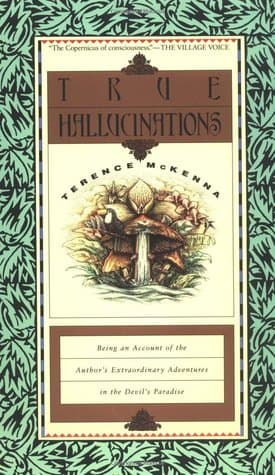
Core Idea
- Difficulty
- Hard
- Read it if
- You are fascinated by psychedelic experiences, speculative philosophy, alternative theories of time and consciousness, or the intersection of ethnobotany, mysticism, and science. You enjoy narrative memoirs that delve deep into subjective, mind-altering journeys and their profound philosophical implications.
- Skip it if
- You prefer empirically grounded science, are uncomfortable with detailed accounts of drug-induced altered states, or find highly speculative, non-linear philosophical discourse challenging or unconvincing. This book is not for those seeking conventional memoir or objective scientific analysis.
Key Takeaways from True Hallucinations
The Archaic Revival
Reconnecting with ancient shamanic practices as a path to planetary healing.
McKenna believes modern society suffers from a spiritual illness, a disconnect from nature and our inner selves. He argues that ancient shamanic cultures, especially those using psychedelic plants, held keys to a more balanced life. The 'Archaic Revival' is his idea for society to return to these basic ways of seeing reality, focusing on direct spiritual experience, ecological awareness, and bringing altered states of consciousness back into culture. He thinks this revival is essential for the planet's survival, offering a solution to industrial civilization's destructive habits and a path to collective spiritual awakening.
“The Archaic Revival is a clarion call to re-embrace the shamanic worldview, to heal the rift between humanity and nature, and to reawaken our collective connection to the numinous.”
In the book: McKenna's entire Amazonian journey, particularly his experiences with ayahuasca and psilocybin, serve as the foundational evidence. He points to the ecological wisdom of indigenous tribes and their respectful relationship with plant teachers as a model for the West.
Try this: Explore ethnobotanical literature and history. Consider responsible, guided experiences with entheogens (where legal) to gain personal insight. Engage in practices that foster a deeper connection to nature, such as forest bathing or permaculture. Support indigenous rights and traditional ecological knowledge.
Related ideas: archaic-revival, shamanism, ethnobotany
The Strophariad and the Mushroom
Psilocybin mushrooms as a catalyst for human evolution and consciousness.
McKenna gives psilocybin mushrooms (Stropharia cubensis) an important role in the development of human consciousness and language. He called this the 'Stoned Ape' theory. While not fully detailed in this memoir, the book vividly shows his deep experiences with these fungi. He describes the mushroom as a conscious entity, a 'teacher' that provides information, creates synesthesia, and dissolves ego boundaries, leading to direct encounters with archetypes and new insights. His experiences in La Chorrera, in particular, highlight the mushroom's ability to create states of hyper-dimensional awareness and communicate complex ideas beyond normal language.
“The mushroom is not merely a drug; it is a teacher, a guide, a sentient entity capable of communicating profound truths about the universe and our place within it.”
In the book: Chapters 19 and 20, 'The Coming of the Strophariad' and 'The Hawaiian Connection,' detail his personal and collective experiences with psilocybin. His descriptions of 'machine elves' and the 'logos' are direct results of these encounters.
Try this: Approach altered states with reverence and a set intention for learning. Research the historical and cultural significance of psilocybin. Engage in deep introspection and journaling after such experiences (if undertaken responsibly and legally) to integrate insights.
Related ideas: psilocybin, stoned-ape-theory, entheogens
The Logos and Hyper-Dimensionality
Direct experience of a conscious, communicating principle underlying reality.
A repeated theme in McKenna's Amazonian journey is the direct understanding of the 'Logos'—a universal, self-expressing, and often visual language or intelligence he found during his deepest psychedelic states. This Logos appeared as 'machine elves,' quickly changing fractal patterns, or a clear sense of information being downloaded into his mind. He sees this not as mere hallucination, but as a glimpse into a higher dimension of reality, where information and meaning are perceived in their rawest form, beyond the limits of linear thought and language. This experience deeply shaped his understanding of communication and reality itself.
“The Logos is not merely an idea; it is a living, breathing, communicating intelligence that can be directly apprehended in states of profound psychedelic ecstasy.”
In the book: His descriptions in 'A Violet Psychofluid,' 'The Opus Clarified,' and 'In the Vortex' are replete with encounters with the Logos, characterized by rapid-fire visual and auditory information, often described as 'self-transforming, self-dribbling, self-illuminating jewel-like structures.'
Try this: Practice meditation and mindfulness to cultivate heightened awareness. Explore non-linear thinking and creative expression. Be open to experiences that challenge conventional notions of reality and communication. Read about theories of consciousness and information.
Related ideas: logos, hyperdimensionality, consciousness
Time Wave Zero and Novelty Theory
A fractal model of time predicting an accelerating increase in novelty.
While not fully detailed in its mathematical complexity, the start of McKenna's 'Time Wave Zero' and 'Novelty Theory' is tied to his psychedelic experiences, especially the 'I Ching' insights from his La Chorrera experiment. He suggests that time is not linear but fractal, marked by an accelerating increase in 'novelty'—the density of interconnectedness, complexity, and unique events. This theory proposes that history is moving towards a singularity, a point of infinite novelty, which he initially linked to December 21, 2012. The book shows how these deep altered states gave him a unique way to see historical patterns and future paths.
“History is the shockwave of eschatology. It is the unfolding of a process that is moving toward a point of infinite novelty, a singularity at the end of time.”
In the book: Chapters 10, 'More on the Opus,' and 11, 'The Experiment at La Chorrera,' describe the intellectual ferment and 'I Ching' calculations that led to the initial formulation of his time theory, born from his intense psychedelic insights.
Try this: Study fractal geometry and complex systems theory. Reflect on historical patterns of innovation and societal change. Consider how personal and collective experiences of time might be non-linear. Avoid dogmatic adherence to specific end dates, focusing instead on the underlying concept of accelerating change.
Related ideas: time-wave-zero, novelty-theory, eschatology
The Amazon as a Living Library
The rainforest as a repository of immense biological and spiritual wisdom.
McKenna shows the Amazon Basin not just as a setting for his adventures, but as a dynamic, conscious entity, a 'living library' of unmatched biodiversity and ethnobotanical knowledge. His search for psychoactive plants came from a deep respect for the rainforest's wisdom, seeing its plants as teachers and its indigenous people as guardians of ancient secrets. He regrets the destruction of this vital ecosystem, knowing that with every lost species, humanity loses valuable potential insights into medicine, consciousness, and sustainable living. His story is a powerful, if indirect, call for conservation, framed by the deep spiritual lessons he learned from its depths.
“The Amazon is not just a collection of trees and animals; it is a vast, interconnected intelligence, a living library of solutions to biological and spiritual problems.”
In the book: The entire journey, from 'Into the Devil's Paradise' to 'At Play in the Fields of the Lord,' is an exploration of the Amazon's botanical wonders and the indigenous knowledge surrounding them, particularly regarding ayahuasca and psilocybin.
Try this: Support rainforest conservation efforts. Learn about ethnobotanical research and traditional plant medicines. Advocate for sustainable practices and indigenous rights. Spend time in nature to cultivate a deeper appreciation for biodiversity.
Related ideas: ethnobotany, amazon-conservation, biodiversity
The Role of the Shaman
The shaman as a cartographer of consciousness and bridge to other realities.
McKenna's personal journey reflects the role of a shaman, though he is a self-taught, Westernized one. He sees the shaman as a key figure in society, one who deliberately enters altered states of consciousness to gather information, heal, and guide their community. Unlike Western science, which dissects and analyzes, the shamanic approach involves direct, hands-on engagement with the unknown. McKenna's own experiences with powerful plant teachers turned him into a 'cartographer of consciousness,' providing detailed accounts of his inner voyages and the 'alien' intelligences he met. He tries to bridge the gap between mystical experience and empirical understanding for his readers.
“The shaman is not a priest or a guru; they are a scientist of the spirit, a voyager who maps the unseen dimensions of reality for the benefit of their community.”
In the book: His interactions with indigenous shamans (though briefly mentioned) and his own deep dives into psychedelic states, particularly in chapters like 'A Brush with the Other' and 'In the Vortex,' illustrate this role of the voyager and interpreter of non-ordinary reality.
Try this: Study comparative religion and anthropology, particularly shamanic traditions. Cultivate intuition and symbolic thinking. Understand that altered states are not just recreational but can be profound learning environments when approached with respect and intention. Seek out modern 'guides' or therapists who understand psychedelic integration.
Related ideas: shamanism, altered-states, consciousness-exploration
Language as a Psychedelic Product
The idea that language itself emerged from psychedelic experiences.
While often linked to his 'Stoned Ape' theory, McKenna's memoir implies that language, and the very structure of human thought, was greatly influenced by psychedelic experiences. He describes how the Logos he encountered felt like a direct, visual, and auditory stream of information, a 'proto-language' that bypassed normal syntax. This suggests that early humans, experiencing similar things through entheogens, might have been prompted to develop complex symbolic communication to describe these ineffable experiences. His own difficulties in describing his visions highlight the limits of conventional language and the potential origins of its more abstract forms.
“Language is not merely a tool for communication; it is a psychedelic artifact, a direct product of our ancestors' encounters with mind-altering plants.”
In the book: The intense synesthesia and direct information transfer described during his peak psychedelic experiences, particularly in 'A Violet Psychofluid' and 'The Opus Clarified,' where he perceives 'meaning' as a directly felt, visual, and auditory phenomenon, provides experiential evidence for this idea.
Try this: Reflect on the power and limitations of language. Experiment with different forms of communication beyond words, such as art, music, or non-verbal cues. Consider the evolutionary origins of human cognition and creativity. Explore linguistic anthropology.
Related ideas: language-evolution, synesthesia, cognitive-origins
The Nature of Reality and Belief
Challenging conventional notions of objective reality through subjective experience.
McKenna consistently questions the Western scientific paradigm's claim to be the only way to understand reality. His psychedelic experiences repeatedly show that 'reality' is far more complex, subjective, and changeable than commonly thought. He suggests that our everyday consensus reality is just one possible 'channel' of perception, and that psychedelics allow access to other, equally valid, or even more fundamental, channels. This doesn't mean everything experienced is 'real' in a conventional sense, but that the experience itself is deeply real and offers valid insights into consciousness and existence, making us rethink what 'truth' and 'belief' mean.
“Reality is not a fixed, objective construct, but a fluid, mutable landscape that can be re-perceived and re-negotiated through the lens of altered consciousness.”
In the book: Throughout the book, particularly in chapters like 'A Conversation Over Saucers' and 'Say What Does It Mean?', McKenna grapples with the implications of his experiences, questioning the nature of what he saw and heard, and how it relates to 'ordinary' reality. The sheer intensity and consistency of his visions, across multiple experiences, challenge simple dismissals as mere fantasy.
Try this: Cultivate a healthy skepticism towards dogmatic beliefs, both scientific and spiritual. Explore philosophical concepts like idealism and solipsism. Engage in practices that expand your perception, such as lucid dreaming or sensory deprivation. Be open to the idea that your personal reality is constructed and can be deconstructed.
Related ideas: subjective-reality, epistemology, consciousness-studies
The Transformative Power of Crisis
Profound personal and collective crises as catalysts for growth and insight.
McKenna's Amazonian journey was not just a series of pleasant trips; it was a deep, often frightening, dive into the unknown, full of psychological and physical challenges. The 'experiment at La Chorrera,' in particular, pushed him and his companions to their limits, blurring the lines between sanity and madness. Yet, it was precisely in these moments of intense crisis and confusion that the most profound insights were gained, leading to his most important theories. He suggests that both individually and collectively, humanity often needs a significant 'unhinging' or crisis to break free from old ideas and accept radically new understandings.
“Sometimes, you have to be completely unhinged to truly see the hinges of the universe.”
In the book: The intense, often overwhelming and disorienting experiences described in 'The Experiment at La Chorrera' and 'In the Vortex,' where the group faced extreme psychological pressure and existential questioning, directly led to the breakthroughs in their understanding of time and the Logos.
Try this: View personal challenges not just as obstacles, but as opportunities for profound learning and transformation. Embrace discomfort and uncertainty as potential catalysts for growth. Reflect on historical periods of crisis and their role in societal evolution. Develop resilience and practices for navigating intense experiences.
Related ideas: personal-transformation, crisis-as-opportunity, psychological-resilience
The End of History and the Human Future
The potential for a collective, consciousness-driven evolution beyond current human limitations.
McKenna's story, especially in later chapters, hints at a radical future for humanity. Influenced by his Time Wave Zero theory and insights from his psychedelic explorations, he envisions an 'end of history' not as an apocalypse, but as a transition into a hyper-connected, high-novelty state of being. This future involves a collective awakening to our true potential, perhaps helped by entheogens, leading to an intuitive understanding of the universe and conscious participation in our own evolution. He suggests that humanity is close to becoming something entirely new, moving beyond its current biological and psychological limits.
“We are standing at the edge of history, at the brink of a new kind of human being, one capable of directly apprehending the universe and steering its own evolution.”
In the book: His discussions in 'Say What Does It Mean?' and 'The Coming of the Strophariad' about the potential for human consciousness to evolve, and his broader theories of accelerating novelty leading to a singularity, all point to this optimistic yet radical vision for the future.
Try this: Engage in critical thinking about technological and spiritual evolution. Consider the ethical implications of consciousness-altering substances and practices. Foster global cooperation and collective problem-solving. Cultivate a long-term, visionary perspective on humanity's potential.
Related ideas: posthumanism, collective-consciousness, future-of-humanity
True Hallucinations Quotes
“The cost of sanity in this society is a certain level of alienation.”
“Nature is not our enemy, to be raped and conquered. Nature is ourselves, to be cherished and explored.”
“The world is not made of atoms, it is made of stories.”
“Psychedelics are illegal not because a loving government is concerned that you may jump out of a third-story window. Psychedelics are illegal because they dissolve opinion structures and cultural models.”
“The Archaic Revival is a call to break through the conditioning of history and to return to an archaic state of mind, one that is more in tune with nature and the collective unconscious.”
“Culture is not your friend.”
“Ego is a structure built around a wound.”
“The mushroom is a tool for the shaman, the psychonaut, the explorer of inner space.”
“The alien is not 'out there,' but 'in here.'”
“If the doors of perception were cleansed, everything would appear to man as it is, infinite.”
“We are not to be saved by the government or by science or by a new religion. We are to be saved by ourselves, by our own consciousness, by our own awakening.”
“The syntactical nature of reality, the real secret of magic, is that the world is made of words. And if you know the words, you can make of the world whatever you choose.”
“History is the nightmare from which we are trying to awaken.”
“Only in a world of illusion is it possible to speak of truth.”
“The universe is a 'novelty-generating engine.'”
Quiz
10 questions on the main ideas. Each answer comes with a short explanation.
Question 1
Which specific Amazonian location is central to McKenna's psychedelic experiments and the 'Experiment at La Chorrera'?
- Iquitos
- La Chorrera
- Manaus
- Leticia
Show answer
B. La Chorrera The 'Experiment at La Chorrera' is explicitly named in the chapter titles, indicating this specific location in the Amazon Basin as central to his experiences.
Question 2
What type of psychoactive plant is most prominently featured in McKenna's Amazonian adventures, particularly in relation to the 'Coming of the Strophariad'?
- Ayahuasca
- Psilocybin mushrooms (Stropharia cubensis)
- Peyote
- Salvia divinorum
Show answer
B. Psilocybin mushrooms (Stropharia cubensis) Chapter 19, 'The Coming of the Strophariad,' directly refers to the Stropharia genus of psilocybin mushrooms, which were central to the 'Experiment at La Chorrera' and McKenna's theories.
Question 3
Which city serves as an 'interlude' in McKenna's travels, as indicated by a chapter title?
- London
- Kathmandu
- San Francisco
- Rio de Janeiro
Show answer
B. Kathmandu Chapter 6 is titled 'Kathmandu Interlude,' clearly marking this city as a break in his main Amazonian narrative.
Question 4
McKenna frequently discusses a complex theoretical framework he developed regarding time and mind. What is the name he often uses for this overarching theoretical concept, as hinted by chapter titles like 'The Opus Clarified' and 'More on the Opus'?
- The Archaic Revival
- The Timewave Zero
- The Opus
- The Great Work
Show answer
C. The Opus Chapters 8 and 10 are titled 'The Opus Clarified' and 'More on the Opus,' directly referring to his ongoing theoretical development throughout the book.
Question 5
McKenna describes experiencing a peculiar substance or phenomenon during his psychedelic journeys, referred to as a specific color and state. What is this described as in one of the chapter titles?
- A crimson plasma
- A cerulean gas
- A violet psychofluid
- An emerald mist
Show answer
C. A violet psychofluid Chapter 7 is titled 'A Violet Psychofluid,' directly naming this specific experience or substance encountered by McKenna.
Question 6
What is the primary method McKenna and his companions used to explore altered states of consciousness during their Amazonian expedition, as detailed in the book?
- Sensory deprivation tanks
- Meditation and shamanic trance induction
- Ingestion of naturally occurring psychoactive plants
- Synthesized laboratory compounds
Show answer
C. Ingestion of naturally occurring psychoactive plants The book explicitly details his adventures with psychoactive plants in the Amazon Basin, which is the core method of their exploration.
Question 7
Beyond personal experience, McKenna often connects his psychedelic insights to broader environmental concerns. What 'down-to-earth reason' does the preface mention he provides?
- Advocating for space colonization
- Promoting technological singularity
- Preserving the planet
- Developing new economic models
Show answer
C. Preserving the planet The preface explicitly states that McKenna provides 'plenty of down-to-earth reasons for preserving the planet,' linking his experiences to ecological concerns.
Question 8
McKenna's narrative often blurs the line between subjective experience and objective reality. The preface describes his Amazonian episode as potentially 'either a profoundly psychotic episode or a galvanizing glimpse into' what?
- The origins of human language
- The true nature of time & mind
- An alien visitation
- The future of artificial intelligence
Show answer
B. The true nature of time & mind The preface directly poses the dichotomy: 'Either a profoundly psychotic episode or a galvanizing glimpse into the true nature of time & mind,' highlighting the philosophical stakes of his journey.
Question 9
McKenna frequently alludes to the concept of communication with non-human intelligences or entities during his psychedelic states. Which chapter title most directly hints at this theme of extraterrestrial or hyperdimensional communication?
- A Brush with the Other
- A Conversation Over Saucers
- In the Vortex
- Waltzing the Enigma
Show answer
B. A Conversation Over Saucers Chapter 9, 'A Conversation Over Saucers,' and Chapter 15, 'A Saucer Full of Secrets,' directly evoke the imagery of UFOs and potential communication with non-human intelligences, a recurring theme in McKenna's work.
Question 10
The book is a blend of genres. What specific combination of genres is listed in the description for 'True Hallucinations'?
- Science Fiction, Horror, Romance
- History, Political Science, Economics
- Lifestyle, Biography, Memoir, Science, Philosophy
- Self-help, Business, Spirituality
Show answer
C. Lifestyle, Biography, Memoir, Science, Philosophy The genre list provided in the prompt explicitly states: 'Lifestyle, Biography, Memoir, Science, Philosophy,' capturing the multifaceted nature of the book.
True Hallucinations FAQ
What is 'True Hallucinations' about?
'True Hallucinations' is Terence McKenna's memoir recounting his experiences with psychoactive plants in the Amazon Basin, exploring themes of mind, time, and the nature of reality through a highly personal and philosophical lens. It blends adventure, scientific inquiry, and profound speculation.
Does Terence McKenna advocate for drug use in 'True Hallucinations'?
While the book deeply explores McKenna's personal experiences with psychedelics, it primarily serves as a narrative and philosophical inquiry into consciousness rather than a direct advocacy for drug use. He recounts his adventures and the insights they purportedly provided, inviting readers to consider their implications.
What is the 'Timewave Zero' theory mentioned in the book?
The 'Timewave Zero' theory, developed by McKenna, proposes a fractal pattern of novelty in the universe, suggesting that significant events and increasing complexity accelerate towards a final, infinitely novel singularity. While not explicitly detailed in the provided chapters, it's a core concept associated with his work.
How is 'True Hallucinations' different from other psychedelic memoirs?
'True Hallucinations' distinguishes itself through McKenna's unique blend of erudition, philosophical depth, and highly articulate storytelling, elevating his personal experiences into a broader speculative inquiry about human consciousness and the universe. It often delves into historical, mythological, and scientific contexts more deeply than many other memoirs.
What is the significance of 'La Chorrera' in the book?
La Chorrera is a pivotal location in the Amazon Basin where McKenna and his companions undertake a significant 'experiment,' involving intense engagement with psychoactive plants. This experience forms the core of the book's most profound and challenging explorations into altered states of consciousness and reality.
Does 'True Hallucinations' offer practical advice for spiritual growth?
While the book is rich with philosophical insights and personal revelations that may inspire introspection, it is not a self-help guide offering direct practical advice for spiritual growth. Instead, it presents McKenna's journey and interpretations as a catalyst for readers' own contemplation.
What is the 'Strophariad'?
The 'Strophariad' refers to a collective consciousness or intelligence that McKenna speculates is associated with the psilocybin mushroom (genus Psilocybe, often specifically Stropharia cubensis). He explores the idea that these fungi are not merely chemical agents but conduits to an ancient, alien intelligence.
Is 'True Hallucinations' considered a work of science or philosophy?
'True Hallucinations' is best categorized as a work that bridges memoir, philosophy, and speculative science. While it recounts personal experiences, McKenna frames them within broad philosophical questions and attempts to derive scientific or cosmological implications from his psychedelic encounters.
How does McKenna's perspective on nature differ from traditional environmentalism?
McKenna's perspective on nature, particularly through the lens of 'True Hallucinations,' often emphasizes the sacred and intelligent aspects of the natural world, particularly fungi and plants, suggesting they hold keys to understanding consciousness and humanity's place in the cosmos. This adds a mystical and experiential layer to traditional environmental concerns.
About the author

Terence McKenna was an American ethnobotanist and advocate for the exploration of altered states of consciousness. He is known for his writings on psychedelics, shamanism, and the nature of reality, with "True Hallucinations" being one of his notable works that explores his experiences and insights in these areas.
Similar books
- The Doors of Perception
Aldous Huxley
3.9 (12k) average on GoodreadsPsychologyExplores the philosophical and spiritual implications of psychedelic experiences with a literary and intellectual approach.
- Eat, Pray, Love
Elizabeth Gilbert
3.6 (1.5M) average on GoodreadsLifestyleA heartbroken writer leaves her conventional life for a year-long global search for pleasure in Italy, spiritual devotion in India, and unexpected love and balance in Bali.
- Wild: From Lost to Found on the Pacific Crest Trail
Cheryl Strayed
4.0 (615k) average on GoodreadsLifestyleAfter losing her mother and her marriage, a young woman impulsively hikes over a thousand miles of the Pacific Crest Trail alone, finding strength and healing in the unforgiving wilderness.
- Into Thin Air: A Personal Account of the Mount Everest Disaster
Jon Krakauer
4.2 (395k) average on GoodreadsLifestyleOn May 10, 1996, ambition and a sudden, violent storm turned Mount Everest into a deadly trap, leaving Jon Krakauer to tell the harrowing story of a disaster that took lives and shattered climbers' dreams.
- On The Road
Jack Kerouac
3.6 (349k) average on GoodreadsLifestyleDean Moriarty and Sal Paradise go on a wild, cross-country trip with jazz, drugs, and a desperate search for meaning on America's post-war roads.
- A Walk in the Woods: Rediscovering America on the Appalachian Trail
Bill Bryson
4.1 (346k) average on GoodreadsLifestyleBill Bryson humorously describes his ill-prepared yet insightful attempt to hike the Appalachian Trail, meeting unique characters and the raw beauty of the wilderness.





Enjoyed the summary?
A summary gives you the shape of the book. The book itself has the detail, the examples and the voice.
Find True Hallucinations on AmazonAs an Amazon Associate, BookBrief earns from qualifying purchases. How we're funded