
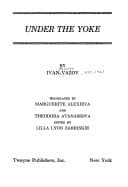
Core Idea
- Difficulty
- Medium
- Read it if
- You are interested in historical fiction exploring national liberation movements, the psychological impact of occupation, or the interplay of love and revolution in a 19th-century European context.
- Skip it if
- You prefer fast-paced thrillers or are disinclined towards detailed historical narratives with a large cast of characters and a focus on internal struggles and societal dynamics over individual action.
Key Takeaways from Under the Yoke
The Illusion of Tranquility
Beneath a calm surface, a nation seethes, preparing for liberation.
Vazov shows how the long Ottoman occupation, while appearing to keep order, only suppressed the Bulgarian desire for freedom. It did not end it. The novel opens with a calm surface in Byala Cherkva – daily routines, market activities, religious observances – yet this peace is fragile and fake. This 'calm' is a shared performance, a way to survive, beneath which a strong current of unhappiness, national pride, and a desperate wish for self-rule exists. Ognyanov's arrival acts as a trigger, showing how easily this calm can break, revealing the deep revolutionary spirit waiting to erupt. It is a strong statement about a people's enduring spirit against oppressive rule.
“The apparent calm in the Bulgarian village was but the deceptive stillness before a storm, a thin veil over the simmering fires of rebellion.”
In the book: The initial descriptions of Byala Cherkva, where life appears to go on as usual despite the Ottoman presence, contrasted sharply with the secret meetings and whispered conspiracies that quickly emerge following Ognyanov's return.
Try this: Leaders and individuals should look beyond apparent compliance or silence in oppressed groups; true sentiment often lies hidden, waiting for a spark. Understanding the underlying grievances is crucial for anticipating or preventing larger conflicts.
Related ideas: national-identity, resistance, oppression
Love Amidst Revolution
Personal affections intertwine with national struggle, adding complexity and stakes.
'Under the Yoke' is not just a historical account of rebellion; it is also a look at human relationships under extreme pressure. The growing romance between Boicho Ognyanov and Rada Господина is constantly overshadowed and shaped by the coming uprising. Their love is not a distraction from the cause but a part of it, providing personal motivation, comfort, and great vulnerability. Vazov uses this relationship to make the struggle human, showing how political events deeply affect personal lives, and how love can be both a source of strength and a potential weakness when one's heart is divided between personal happiness and national duty. It makes the story more than a historical record.
“In times of great upheaval, even the most private of hearts finds its beat inextricably linked to the pulse of the nation.”
In the book: The secret meetings between Ognyanov and Rada, often interrupted or complicated by revolutionary activities, and the emotional toll the constant threat of discovery takes on their relationship.
Try this: When facing grand societal challenges, acknowledge that personal bonds and emotional well-being are not separate from the struggle but deeply integrated, influencing motivation and resilience. Support these connections.
Related ideas: romance, sacrifice, human-element
The Spectrum of Patriotism
Not all respond to oppression with the same fervor; motivations are diverse and often conflicting.
Vazov avoids showing Bulgarian patriotism in only one way. Instead, he presents many different responses to Ottoman rule and the call for rebellion. From the passionate, dedicated revolutionaries like Ognyanov and Kando, who will sacrifice everything, to the careful intellectuals, the practical villagers more focused on daily survival, and even the outright collaborators motivated by fear or personal gain, the novel captures the complexity of human motivation during a national crisis. This variety shows that 'patriotism' is not a single emotion but a concept with many sides, influenced by personal situations, courage, fear, and moral belief. It challenges simple ideas of heroes and villains, showing the messy reality of collective action.
“Among a people yearning for freedom, there are those who light the fuse, those who stand ready with water, and those who merely observe the blaze.”
In the book: The varying levels of commitment among the conspirators, the hesitant support from some villagers, and the explicit betrayal by characters like Kiryak, driven by personal vendettas or fear of Ottoman reprisal.
Try this: When mobilizing for a cause, understand that not everyone will share the same level of commitment or motivation. Tailor appeals and strategies to address diverse concerns and foster broader participation, while also being vigilant against internal dissent.
Related ideas: collaboration, courage, collective-action
The Psychological Burden of Resistance
The fight for freedom takes a heavy toll, mentally and emotionally, on its participants.
Beyond the physical dangers of rebellion, Vazov explores the deep psychological impact on the revolutionaries. Characters like Ognyanov constantly deal with paranoia, the fear of betrayal, the huge pressure of leadership, and the moral problems in their actions. The constant watchfulness, the need for secrecy, and the awareness of the brutal results of failure create an atmosphere of intense psychological stress. This internal struggle is as important as the external conflict, showing how the fight for freedom is not just about battles and strategies but also about enduring great mental and emotional stress. It adds a layer of tragic realism to the heroism shown.
“The weight of a nation's fate, when carried by a few, grinds not only at the body but at the very sinews of the soul.”
In the book: Ognyanov's recurring nightmares, his moments of despair and doubt, and the constant tension he experiences regarding the loyalty of those around him, particularly after the betrayal.
Try this: In high-stakes, long-term endeavors, recognize and address the psychological toll on individuals. Implement support structures and foster open communication to mitigate burnout and maintain mental well-being.
Related ideas: trauma, paranoia, leadership-burden
The Role of Education and Culture
National identity and the seeds of revolution are nurtured through shared heritage and knowledge.
Vazov quietly but strongly emphasizes the role of education, literature, and cultural preservation in building national consciousness and fueling the revolutionary spirit. Through characters like Rada, the teacher, and Ognyanov, who often recites poetry and mentions Bulgarian history, the novel suggests that the fight for physical freedom is deeply connected with keeping cultural identity. The Bulgarian language, folk traditions, and historical memory become tools against assimilation and a way to unite the people. This shows that true liberation is not just political but also cultural, requiring a reclaiming and celebration of one's heritage to strengthen a shared purpose and identity against an oppressor.
“Where books are read and songs are sung in one's own tongue, there the spirit of a nation can never be truly extinguished.”
In the book: Rada's dedication to teaching Bulgarian history and language in her school, and Ognyanov's use of patriotic poetry to inspire and rally the villagers.
Try this: When building movements or fostering community, prioritize cultural and educational initiatives that reinforce shared identity, history, and values. These are often the most enduring foundations for collective action and resilience.
Related ideas: cultural-identity, language-preservation, historical-memory
The Inevitability of Betrayal
Internal treachery is a constant threat, often more devastating than external enemies.
A repeated and painful theme in 'Under the Yoke' is the constant threat of betrayal from within the Bulgarian community itself. Vazov realistically shows how fear, personal grudges, jealousy, or the promise of reward can lead individuals to turn against their own people and the cause. The character of Kiryak shows this internal decay, highlighting that the fight for freedom is rarely a clean, united front against an obvious enemy. These acts of treachery cause not only strategic damage but also deep psychological wounds, reducing trust and creating paranoia among the revolutionaries. It shows the tragic truth that internal divisions and weaknesses can be as, if not more, destructive than the power of the oppressor.
“The sharpest blade is not always wielded by the enemy without, but by the hand of a supposed brother within.”
In the book: Kiryak's betrayal of the conspirators, leading to arrests and the unraveling of parts of the revolutionary network, driven by personal animosity towards Ognyanov.
Try this: In any high-stakes collective endeavor, anticipate and guard against internal conflicts and potential betrayals. Build robust vetting processes, foster strong communal trust, and address grievances openly to minimize vulnerabilities.
Related ideas: treachery, trust, internal-conflict
The Role of the Common People
The success of a revolution hinges on the quiet, often unheroic, support of the populace.
While the novel features important leaders and heroic figures, Vazov always remembers the role played by the ordinary Bulgarian villagers. Their quiet acts of resistance – providing shelter, sharing information, offering food, or simply staying silent when questioned by Ottomans – are the lifeblood of the rebellion. These are not grand, dramatic gestures but essential, everyday contributions that collectively support the movement. The novel demonstrates that a revolution cannot succeed with just a few charismatic leaders; it needs the silent or active support of the wider population, whose small acts of courage and solidarity form the base upon which larger actions are built. It is a tribute to the quiet strength of the masses.
“The grandest movements are but whispers until the voices of the many lend them thunder.”
In the book: The numerous instances where villagers provide refuge for Ognyanov, hide weapons, or spread news through informal networks, often at great personal risk, despite not being formal members of the revolutionary committee.
Try this: When building a movement, never underestimate the power of broad-based, decentralized support. Empowering and acknowledging the contributions of ordinary individuals is key to long-term sustainability and success.
Related ideas: grassroots-movement, solidarity, collective-resilience
The Moral Ambiguity of Violence
Revolutionary struggle forces difficult choices, blurring lines between right and wrong.
Vazov does not shy away from showing the brutal realities and moral compromises that come with armed rebellion. While the cause of freedom is right, the methods used by the revolutionaries sometimes involve violence, deception, and the sacrifice of innocent lives. The novel implicitly asks questions about the cost of freedom and whether the ends justify the means. Characters must make hard decisions, and the story acknowledges the grim necessity of certain actions while still highlighting their tragic nature. This moral uncertainty adds depth and realism, preventing a simple 'good vs. evil' story and forcing the reader to face the hard choices made by those fighting for liberation.
“In the crucible of revolution, the hands that strike for freedom are often stained with acts that would, in peace, be deemed unforgivable.”
In the book: The revolutionaries' discussions about the necessity of violence against Ottoman officials or Bulgarian collaborators, and the subsequent psychological impact of these actions on those involved.
Try this: When pursuing significant societal change, be prepared to confront and discuss the ethical implications of chosen strategies. Acknowledge that difficult choices may lead to unintended consequences and moral compromises.
Related ideas: ethics, just-war, consequences-of-war
The Enduring Spirit of Hope
Despite setbacks and despair, the belief in eventual freedom persists.
Even as the rebellion faces crushing setbacks, betrayals, and great suffering, a thread of hope runs through 'Under the Yoke'. This hope is not naive optimism but a deep belief in the eventual victory of justice and freedom. It is what keeps the characters going through their darkest moments, allowing them to endure torture, loss, and the apparent failure of their first efforts. Vazov suggests that true national spirit is defined not by immediate victories, but by the strong belief in a future where one's people are free. This lasting hope becomes a spiritual force, showing the human capacity for resilience even when faced with overwhelming odds, ensuring that the struggle, though perhaps delayed, is never truly given up.
“Even in the darkest hour, when all seems lost, the ember of hope, once fanned, can ignite a new dawn.”
In the book: Despite the tragic conclusion of the April Uprising as depicted, the final scenes and the resilience of characters like Ognyanov and Rada, even in their ultimate fates, suggest that the seed of freedom has been firmly planted and will eventually bear fruit.
Try this: In long-term struggles, cultivate and communicate a vision of eventual success, even in the face of adversity. Hope is a critical resource for maintaining morale and commitment over extended periods.
Related ideas: resilience, optimism, perseverance
Under the Yoke Quotes
“Freedom, brothers, is not a gift, but a right that is bought with blood!”
“The Bulgarian, when he decides to die, knows no fear.”
“Hope, even in the darkest hour, is the last thing that abandons man.”
“The greatest prison is not the one with iron bars, but the one built by fear in the human soul.”
“A nation that forgets its past is condemned to repeat it.”
“The spark of rebellion, once lit, cannot be extinguished by any amount of water.”
“True strength lies not in the sword, but in the spirit.”
“Every drop of blood spilled for freedom waters the tree of liberty.”
“The yoke of slavery may bend the back, but it can never break the will.”
“Even a small candle can defy the greatest darkness.”
“The heart of the patriot beats not for himself, but for his people.”
“To live without freedom is to die a thousand times.”
“The dream of liberty, once awakened, can never truly sleep again.”
Quiz
10 questions on the main ideas. Each answer comes with a short explanation.
Question 1
Boicho Ognyanov escapes from a prison in which specific location before returning to Bulgaria?
- Istanbul
- Sofia
- Diarbekir
- Plovdiv
Show answer
C. Diarbekir The novel explicitly states that Boicho Ognyanov escapes from a prison in Diarbekir before returning to the Bulgarian town of Byala Cherkva.
Question 2
What is the name of the Bulgarian town where Boicho Ognyanov returns to take part in the rebellion?
- Varna
- Byala Cherkva
- Ruse
- Burgas
Show answer
B. Byala Cherkva The synopsis clearly states that Ognyanov returns to the Bulgarian town of Byala Cherkva.
Question 3
What primary political situation does 'Under the Yoke' depict?
- The Russian occupation of Bulgaria
- The Austro-Hungarian influence in the Balkans
- The Ottoman rule of Bulgaria
- The struggle for Bulgarian independence from Serbia
Show answer
C. The Ottoman rule of Bulgaria The book's description explicitly states it depicts 'the Ottoman rule of Bulgaria'.
Question 4
Which of the following best describes the general mood in the Bulgarian village under Ottoman rule, as portrayed in the novel?
- Open defiance and constant skirmishes
- Superficial tranquillity masking quiet preparations for an uprising
- Complete submission and hopelessness
- Indifference to political events
Show answer
B. Superficial tranquillity masking quiet preparations for an uprising The description states, 'The tranquillity in a Bulgarian village under Ottoman rule is only superficial: the people are quietly preparing for an uprising.'
Question 5
Beyond the political conflict, what other key aspect of the characters' lives does the novel explore?
- Their professional careers and economic ventures
- Their personal drama, emotions, motives, and relationships
- Their detailed family histories and genealogies
- Their culinary traditions and daily routines
Show answer
B. Their personal drama, emotions, motives, and relationships The plot 'portrays the personal drama of the characters, their emotions, motives for taking part in or standing against the rebellion, betrayal and conflict.'
Question 6
Boicho Ognyanov's return to Byala Cherkva is primarily motivated by what goal?
- To reclaim his family's lost fortune
- To seek revenge on those who imprisoned him
- To take part in the impending rebellion
- To reunite with his family in safety
Show answer
C. To take part in the impending rebellion He 'returns to the Bulgarian town of Byala Cherkva to take part in the rebellion.'
Question 7
What range of character interactions does Boicho Ognyanov encounter upon his return to Byala Cherkva?
- Only new acquaintances and strangers
- Only family members and childhood friends
- Old friends, enemies, and the love of his life
- Exclusively Ottoman officials and soldiers
Show answer
C. Old friends, enemies, and the love of his life Upon his return, 'he meets old friends, enemies, and the love of his life,' indicating a complex network of relationships.
Question 8
The novel explores not only participation in the rebellion but also what opposing stance from some characters?
- Indifference to the political situation
- Active support for the Ottoman regime
- Standing against the rebellion, often involving betrayal and conflict
- Advocacy for peaceful negotiation only
Show answer
C. Standing against the rebellion, often involving betrayal and conflict The plot portrays 'motives for taking part in or standing against the rebellion, betrayal and conflict,' indicating opposition to the uprising.
Question 9
As 'the most famous piece of classic Bulgarian literature,' what does 'Under the Yoke' primarily serve as for Bulgarian culture?
- A historical dictionary of the Ottoman Empire
- A foundational literary work reflecting a crucial period of national identity
- A guide to Bulgarian folk dances and music
- A philosophical treatise on existentialism
Show answer
B. A foundational literary work reflecting a crucial period of national identity Being 'the most famous piece of classic Bulgarian literature' that depicts Ottoman rule and preparations for an uprising, it inherently serves as a foundational work for national identity and historical memory.
Question 10
The 'tranquillity' mentioned in the village is described as 'superficial.' What does this imply about the true state of affairs among the Bulgarian people?
- They were genuinely content with Ottoman rule.
- Their outward calm concealed deep-seated discontent and clandestine revolutionary activities.
- The Ottoman authorities were unaware of any unrest.
- The village was an isolated exception to widespread rebellion.
Show answer
B. Their outward calm concealed deep-seated discontent and clandestine revolutionary activities. The phrase 'superficial tranquillity' followed by 'the people are quietly preparing for an uprising' directly implies that the outward calm hides underlying revolutionary fervor and discontent.
Under the Yoke FAQ
What is 'Under the Yoke' about?
'Under the Yoke' is a classic Bulgarian novel by Ivan Vazov, published in 1888. It vividly portrays life in a Bulgarian village under Ottoman rule, focusing on the quiet preparations and mounting tension leading up to a national uprising.
Who is Boicho Ognyanov?
Boicho Ognyanov is the central protagonist of 'Under the Yoke'. He is a revolutionary who escapes from prison and returns to his hometown, Byala Cherkva, to actively participate in and lead the Bulgarian rebellion against the Ottoman Empire.
Does 'Under the Yoke' depict a true historical event?
While 'Under the Yoke' is a work of fiction, it is deeply rooted in the historical context of the Bulgarian National Revival and the April Uprising of 1876 against Ottoman rule. It captures the spirit, struggles, and aspirations of the Bulgarian people during that period.
What themes are explored in 'Under the Yoke'?
The novel explores profound themes such as patriotism, freedom, love, sacrifice, betrayal, and the complex human emotions involved in a fight for national liberation. It delves into the personal dramas intertwined with the larger political struggle.
How does 'Under the Yoke' differ from other historical novels of its time?
'Under the Yoke' stands out for its deep psychological portrayal of characters and its nuanced depiction of the diverse motivations behind participation or opposition to the rebellion, rather than simply presenting a heroic narrative. It offers a rich tapestry of village life and individual struggles.
Is 'Under the Yoke' suitable for readers unfamiliar with Bulgarian history?
Absolutely. While knowledge of Bulgarian history enriches the reading experience, the novel's universal themes of oppression, resistance, and human spirit make it accessible and compelling for any reader interested in historical fiction and character-driven narratives.
What is the significance of the title 'Under the Yoke'?
The title 'Under the Yoke' directly refers to the long period of Ottoman subjugation over Bulgaria, symbolizing the burden and oppression endured by the Bulgarian people. It sets the stage for the narrative of their struggle for liberation from this 'yoke'.
Are there any film or television adaptations of 'Under the Yoke'?
Yes, 'Under the Yoke' has been adapted into a film. The most notable adaptation is the 1952 Bulgarian film directed by Dako Dakovski, which remains a significant work in Bulgarian cinema.
Similar books
- War and Peace
Leo Tolstoy
4.1 (265k) average on GoodreadsHistorical FictionEpic scope, intertwining personal lives with major historical events and national struggles.
- The Three Musketeers
Alexandre Dumas
4.1 (274k) average on GoodreadsHistorical FictionAdventure, patriotism, and resistance against an oppressive power, though in a different historical context.
- Germinal
Emile Zola
4.2 (29k) average on GoodreadsHistorical FictionDepicts the struggles of an oppressed populace and the build-up to a desperate, violent uprising.
- The Diary of a Young Girl
Anne Frank
4.2 (2.7M) average on GoodreadsBiographyDuring the Nazi occupation, a teenage girl's diary, written from a secret annex, shares observations on humanity, hope, and the wait for freedom.
- Twisted 1. Twisted love
Ana Huang
3.7 (1.7M) average on GoodreadsA quiet billionaire with a difficult past finds his guarded heart opening to the woman he must protect, but their growing passion uncovers dangerous secrets and a shared, traumatic history.
- Eat, Pray, Love
Elizabeth Gilbert
3.6 (1.5M) average on GoodreadsLifestyleA heartbroken writer leaves her conventional life for a year-long global search for pleasure in Italy, spiritual devotion in India, and unexpected love and balance in Bali.



Enjoyed the summary?
A summary gives you the shape of the book. The book itself has the detail, the examples and the voice.
Find Under the Yoke on AmazonAs an Amazon Associate, BookBrief earns from qualifying purchases. How we're funded