
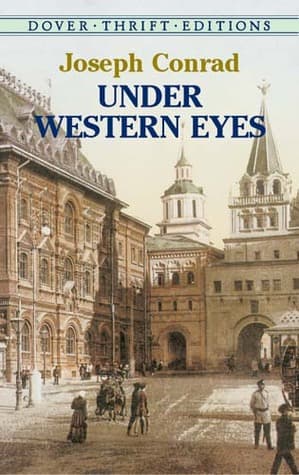
Synopsis
Covers the whole plot, including the ending.
- Difficulty
- Medium
- Pacing
- Moderate
- Mood
- Introspective, Suspenseful, Philosophical, Melancholy
- Read it if
- You appreciate psychological depth, moral dilemmas, and the complexities of political intrigue set against a historical backdrop.
- Skip it if
- You prefer fast-paced action or clear-cut heroes and villains.
Under Western Eyes Plot Summary
Covers the whole plot, including the ending.
The Assassination and the Unwilling Accomplice
Victor Haldin, a fellow student and known revolutionary, enters Razumov's St. Petersburg apartment. He confesses to assassinating the repressive Minister of State, Mr. de P—-. Haldin needs a place to hide and a way to escape. He trusts Razumov, a bright but apolitical philosophy student. Razumov, who wants a respectable career in the Russian government, is horrified. He feels his future is unfairly threatened by Haldin's act. Overwhelmed and fearing involvement, Razumov agrees to help Haldin, though he worries about what this means for his own life.
The Betrayal and Its Immediate Aftermath
Razumov cannot find a reliable coachman for Haldin. In a state of moral conflict, he seeks advice from Prince K—-, a high-ranking official he hopes will protect his career. However, K—- is not available, leaving Razumov feeling alone. In a moment of panic and wanting to clear his name and secure his future, Razumov decides to go to General T—-, the head of the secret police. He reveals Haldin's location, leading to Haldin's quick arrest. Razumov immediately feels a deep sense of unease and guilt, a heavy burden that will stay with him.
A Life Undone and a New Path
Haldin is executed. This deeply troubles Razumov, even though his betrayal remains unknown to revolutionary groups. Razumov's academic career, which he had carefully built, is subtly undermined by the authorities, who now see him as a useful tool rather than a promising scholar. General T—- tells Razumov he is now 'marked' by the state, not as a suspect, but as an asset. He is given a new, secret mission: to join the Russian revolutionary exile community in Geneva and report on their activities, specifically to gather information about Haldin's family and his revolutionary associates.
Arrival in Geneva and New Encounters
Razumov travels to Geneva and quickly becomes part of the Russian exile community. He meets Peter Ivanovitch, a respected but self-serving revolutionary, and Sophia Antonovna, an older, more practical revolutionary. His main target, however, is Natalia Haldin, Victor's sister, and their mother, who live in Geneva and mourn Victor's death. Razumov must gain their trust, knowing he is responsible for Victor's death. His inner conflict grows as he sees Natalia's genuine grief and her belief in her brother's cause.
The Weight of Deception
Razumov skillfully joins the revolutionary groups, presenting himself as a sympathetic student who knew Victor Haldin in St. Petersburg. He visits the Haldin home often, drawn to Natalia's intelligence and integrity, which contrasts with his own deceit. Natalia, still seeking answers about her brother's last days, finds comfort in Razumov's presence, believing him to be a true friend of Victor. Razumov's guilt weighs heavily as he listens to Natalia talk about her brother's ideals and the injustice of his death, knowing he caused it.
Mikulin's Suspicions
General Mikulin, the Russian Consul-General in Geneva, oversees Razumov's mission. Mikulin is a clever and experienced intelligence officer who quickly realizes Razumov is not a true revolutionary. He notices Razumov's discomfort and small inconsistencies. While he does not fully uncover Razumov's past betrayal, he understands that Razumov is a man with a secret, a state tool rather than a genuine convert to the revolutionary cause. Mikulin's watchful presence adds more pressure and anxiety to Razumov's already difficult life.
The Arrival of Nikita Necator
The arrival of Nikita Necator, a violent revolutionary known as 'the killer of spies,' frightens the exile community. Necator is the man who executed the coachman Razumov tried to contact for Haldin, making him a direct link to Razumov's past actions. His presence is a constant threat, as Razumov fears Necator might discover his role in Haldin's capture. This new danger increases Razumov's paranoia and inner pressure, making his double life even more risky.
The Confession to Natalia
Razumov's inner struggle reaches its breaking point. The hypocrisy of his situation, his growing feelings for Natalia, and the weight of his secret become too much. In an emotional scene, Razumov confesses everything to Natalia Haldin: his betrayal of her brother, Victor, and his role as a spy for the Russian government. He gives her a written confession, detailing the events that led to Victor's arrest and execution. Natalia is devastated, her world shattered by the truth about the man she trusted.
The Revolutionary Tribunal
After confessing to Natalia, Razumov gives his written confession to the assembled revolutionary exiles. He stands before them, without his lies, and publicly admits his role in Victor Haldin's capture and death. The revolutionaries, especially Nikita Necator, are furious. As Razumov leaves the meeting, Necator confronts him. In a brutal act of revenge, he strikes Razumov with a pickaxe, rupturing his eardrums and making him deaf. This violent act is the revolutionaries' swift judgment for his betrayal.
A Broken Man's Redemption
Razumov, now permanently deaf and physically broken, returns to Russia. He is no longer useful to the authorities and is abandoned by them. Despite his physical suffering and the ruin of his ambitions, a strange peace settles over him. He has shed the burden of his lies and faced the results of his actions. He finds some redemption in his final act of truth-telling, even though it cost him everything. He lives out his remaining days quietly, cared for by a kind older woman, reflecting on the moral choices that shaped his life.
Under Western Eyes Characters
Kirylo Sidorovitch Razumov
Protagonist
A brilliant but apolitical student whose life is irrevocably altered by an act of betrayal.
Razumov is a highly intelligent philosophy student in St. Petersburg, an orphan who has meticulously built a life for himself through hard work and academic excellence. He yearns for a stable, respectable career within the Russian bureaucracy and is deeply committed to self-preservation and order. He is initially apolitical, viewing revolutionaries with disdain. His defining characteristic is his profound internal conflict, torn between self-interest and a nascent sense of moral integrity. He is a man who craves recognition and a place in society, and his betrayal of Haldin is driven by a desperate fear of losing everything he has worked for.
Relationships: Victor Haldin (fellow student, initial trust, then betrayer); Natalia Haldin (object of affection and profound guilt, eventual confessor); General T---- (official who manipulates him into spying); General Mikulin (observant Russian Consul-General in Geneva, his handler); Sophia Antonovna (revolutionary figure, initially sympathetic, later recipient of his confession)
Victor Haldin
Catalyst/Supporting
The idealistic revolutionary whose assassination sets the entire plot in motion.
Victor Haldin is a charismatic and deeply committed revolutionary, driven by a fervent belief in liberty and a hatred of the autocratic Tsarist regime. He embodies the passionate, often reckless, idealism of the Russian revolutionary movement. His assassination of the Minister of State is a decisive act, born of conviction. He places implicit trust in Razumov, seeing him as a fellow spirit, a testament to his own naive and optimistic view of humanity. His death, though occurring early in the novel, casts a long shadow over Razumov and the entire narrative, serving as the constant reminder of Razumov's original sin.
Relationships: Kiryl Razumov (trusted friend, then betrayed by him); Natalia Haldin (devoted sister); Mrs. Haldin (grieving mother)
Natalia Haldin
Supporting
Victor Haldin's intelligent and idealistic sister, who becomes a focus of Razumov's mission and guilt.
Natalia Haldin is a young woman of profound integrity, intelligence, and a quiet idealism that mirrors her brother's, though perhaps more reflective and less impulsive. She is deeply devoted to Victor and his ideals, and her grief over his death drives her to seek truth and understanding. She is initially drawn to Razumov, finding comfort in his supposed connection to Victor, and she embodies the moral purity that Razumov has lost. Her earnestness and genuine goodness make Razumov's deception all the more agonizing, and her reaction to his confession is a pivotal moment in his moral reckoning.
Relationships: Victor Haldin (beloved brother); Kiryl Razumov (initially trusted friend, then the man who betrayed her brother); Mrs. Haldin (devoted daughter)
General T----
Supporting
The shrewd and cynical head of the secret police who recruits Razumov.
General T—- is a cold, calculating, and highly effective operative of the Tsarist secret police. He represents the oppressive and manipulative power of the state. He sees individuals not as people, but as tools to be used for the preservation of order. He understands Razumov's ambition and fear, exploiting them to turn him into a spy. He is devoid of sentimentality and embodies the pragmatic ruthlessness of authority, caring only for results. His actions set Razumov on his path of deception and ultimately lead to his downfall.
Relationships: Kiryl Razumov (manipulator and handler)
General Mikulin
Supporting
The observant Russian Consul-General in Geneva who subtly understands Razumov's compromised position.
General Mikulin is the Russian Consul-General in Geneva, responsible for overseeing Razumov's mission. He is a more subtle and psychologically astute figure than General T—-. Mikulin possesses a keen understanding of human nature and the complexities of deception. He senses Razumov's internal turmoil and the weight of his secret, without necessarily knowing the full truth. He represents a more nuanced and watchful aspect of state power, one that observes and understands rather than simply commands. His famous line, 'Where are you going, Kirylo Sidorovitch?' highlights his awareness of Razumov's unstable position.
Relationships: Kiryl Razumov (handler, subtle interrogator)
Peter Ivanovitch
Supporting
A revered but self-serving and hypocritical revolutionary figure in Geneva.
Peter Ivanovitch is a prominent Russian revolutionary émigré, revered by his followers as a heroic figure. However, he is depicted as largely self-absorbed, enjoying the adulation of his disciples while contributing little of substance to the cause. He is a symbol of the revolutionary movement's potential for vanity and hypocrisy, using his reputation to live a comfortable life while others suffer. He represents the less admirable aspects of the revolutionary camp, contrasting sharply with the genuine idealism of Victor and Natalia Haldin.
Relationships: Tekla (devoted assistant); Kiryl Razumov (initially a new recruit to his circle)
Sophia Antonovna
Supporting
A pragmatic and experienced female revolutionary, a foil to Peter Ivanovitch.
Sophia Antonovna is an older, more experienced, and pragmatic revolutionary. Unlike Peter Ivanovitch, she is less concerned with personal glory and more with the practical realities of the movement. She possesses a keen understanding of human character and the dangers inherent in their cause. She is a figure of quiet strength and dedication, offering a more grounded and realistic perspective on the revolutionary struggle. She is one of the first to sense the depth of Razumov's internal conflict and ultimately receives his confession with a degree of understanding.
Relationships: Kiryl Razumov (initially a suspicious observer, later a confidante); Natalia Haldin (sympathetic comrade)
Nikita Necator
Antagonist
A brutal and fanatical revolutionary, known as 'the killer of spies.'
Nikita Necator is a terrifying and ruthless figure within the revolutionary movement, known for his extreme violence and his role in executing traitors. He embodies the dark, unforgiving side of revolutionary justice. His presence in Geneva immediately raises the stakes for Razumov, as Necator is the physical embodiment of the consequences of betrayal. He is a man of action, driven by a visceral hatred for the state and its agents. His brutality serves as a stark warning and ultimately delivers the physical punishment for Razumov's confession.
Relationships: Kiryl Razumov (punisher and executioner)
Under Western Eyes Themes
Betrayal and its Consequences
The main theme is Razumov's initial betrayal of Victor Haldin and its lasting effects on his mind and life. This betrayal comes from self-preservation and a fear of political involvement, but it leads to a crushing guilt that isolates him. The novel shows how one moral compromise can ruin a life, forcing Razumov into a web of deceit that becomes unbearable. The confession, though physically damaging, offers a kind of freedom from this inner pain, showing that betrayal's effects are not just external but deeply internal.
“A man's most important possession is his conscience.”
The Nature of Revolution and Autocracy
Conrad explores the complexities of both the Tsarist government and the revolutionary movement. The government is shown as oppressive, cynical, and manipulative, using people like Razumov as tools (General T----, General Mikulin). The revolutionaries are shown with idealism (Victor, Natalia) but also flaws: Peter Ivanovitch's vanity, Nikita Necator's brutal fanaticism. The novel suggests that both extremes, without limits, cause suffering and moral compromise. It questions the idea that either side has a monopoly on truth or justice, showing the human cost of political extremism.
“All Europe is a black pit of treachery and revolt.”
Identity and Self-Deception
Razumov's journey deeply explores identity. He first defines himself by his academic success and his desire for a respectable career, trying to stay out of political turmoil. However, his betrayal forces him to create a false identity as a revolutionary supporter. This deception leads to severe inner conflict, blurring who he truly is. His final confession is an attempt to reclaim his real self, even if it means destroying the fabricated one. The novel suggests that living a lie ultimately corrupts and fragments a person, making true peace impossible.
“He was a man who had lost his way in life and was looking for it in his own soul.”
Moral Isolation and Solitude
Razumov is always shown as a solitary person, an orphan who relies only on himself. His act of betrayal pushes him into even deeper moral isolation. He cannot confide in anyone, neither the authorities who exploit him nor the revolutionaries he deceives. This isolation is both a result and a cause of his suffering, as he carries the heavy burden of his secret alone. Even when he forms connections, especially with Natalia, the underlying deception prevents true closeness, highlighting the deep loneliness that comes with a life built on lies. His eventual confession, while exposing him, paradoxically offers a way out of this deep solitude.
“He was a man whom no one knew.”
Plot Devices & Literary Techniques
The Unreliable Narrator (The Teacher of Languages)
A framing device that filters the story through a detached, Western European perspective.
The entire story is presented through the perspective of an unnamed, elderly English 'Teacher of Languages' in Geneva. He is not a direct participant in most events but reconstructs Razumov's story from his diary and conversations with Natalia Haldin and other émigrés. This creates a layer of distance and interpretation, influencing how the reader perceives the 'Russian soul' and the events. The teacher's 'Western eyes' provide a lens through which the complex and often alien (to him) Russian political landscape and moral dilemmas are viewed, adding a critical, sometimes judgmental, but ultimately empathetic perspective.
The Diary/Confession
Razumov's personal journal, serving as a primary source of his internal torment and eventual truth.
Razumov's diary is a crucial plot device, serving both as a narrative tool and a symbol of his internal struggle. It is through these writings that the 'Teacher of Languages' gains insight into Razumov's true thoughts, fears, and the agonizing process of his moral reckoning. The diary is not just a record; it becomes Razumov's confidant, a space where he grapples with his guilt. Ultimately, a part of it transforms into his written confession, a tangible manifestation of his decision to embrace truth, making it the instrument of his redemption and downfall.
Irony of Fate
The cruel twist of destiny that forces an apolitical man into the heart of political intrigue.
The 'irony of fate' is a recurring device, particularly in Razumov's initial entanglement. He is an apolitical student, meticulously planning a life of order and stability, only to have a revolutionary literally burst into his room and shatter his world. His desperate attempt to preserve his future through betrayal ironically leads him directly into the very political intrigue he sought to avoid, forcing him to become a spy. This device highlights the capriciousness of destiny and how seemingly small decisions can have monumental, unforeseen consequences, trapping individuals in circumstances beyond their control.
Symbolism of Deafness
Razumov's physical deafness after his confession symbolizes his detachment and internal peace.
Razumov's loss of hearing after being struck by Nikita Necator is a powerful symbolic act. On one level, it is a brutal punishment for his betrayal. On another, it symbolizes his detachment from the chaotic and often deceptive 'noise' of the world – both the political machinations of the state and the revolutionary rhetoric. His deafness, ironically, brings him a strange form of internal peace and clarity. Having confessed and faced the consequences, he no longer needs to listen to the lies or the demands of others; he is finally free to exist within the quietude of his own truth, albeit a painful one.
Under Western Eyes Quotes
“A man’s most critical moments are not those that he thinks are so, but those that he is unaware of.”
“The most successful crime is that which is never discovered. The most successful life is that which is never questioned.”
“The moral problem of an event is not in the event itself, but in the mind confronting it.”
“History is a tale, for the most part, of men who were not good enough.”
“Words, as is well known, are the great foes of reality.”
“Action is the first great teacher of the world.”
“The greatest joy of a man is to find himself in a position where he has to do something.”
“He who looks too long into an abyss, the abyss also looks into him.”
“There are no perfectly safe confidences.”
“The world is a bad place, but it is not bad enough to be hopeless.”
“To be perfectly truthful, one must be perfectly alone.”
“A man’s most secret thoughts are not his own, but belong to the spirit of his time.”
“The thought of a man’s brain is a thing of the past; the feeling of his heart is a thing of the future.”
“Every act of betrayal is a confession of weakness.”
Quiz
10 questions on the plot and the characters. Each answer comes with a short explanation.
Question 1
What is the name of the student who assassinates a public official and seeks refuge with Razumov?
- Tekla
- Haldin
- Mikulin
- Peter Ivanovitch
Show answer
B. Haldin Victor Haldin is the student revolutionary who assassinates a public official and then seeks refuge with Razumov, setting the central conflict in motion.
Question 2
What is Razumov's initial ambition before he becomes entangled in the revolutionary conspiracy?
- To become a celebrated poet
- To join the Russian navy
- To pursue a career in the czarist bureaucracy
- To lead a peasant uprising
Show answer
C. To pursue a career in the czarist bureaucracy Razumov's primary goal at the beginning of the novel is to establish a successful career within the czarist bureaucracy, seeking stability and recognition.
Question 3
Which country serves as the primary setting for the revolutionary exiles Razumov is sent to spy on?
- France
- Germany
- Switzerland
- England
Show answer
C. Switzerland After his betrayal, Razumov is dispatched by the authorities to Geneva, Switzerland, to spy on the exiled Russian revolutionaries.
Question 4
What is the central moral dilemma Razumov faces throughout the novel?
- His desire for personal wealth versus his loyalty to his family
- His preoccupation with decency and accountability versus the truths of human integrity and moral strength
- His love for a woman versus his commitment to political revolution
- His academic ambitions versus his physical limitations
Show answer
B. His preoccupation with decency and accountability versus the truths of human integrity and moral strength The novel explicitly states that Razumov's character study 'hauntingly reveals Razumov's preoccupation with questions of decency and accountability when confronted by the equally powerful truths and values of human integrity and moral strength,' which is his core moral conflict.
Question 5
Who is Natalia Haldin?
- Razumov's fiancée
- The sister of the assassinated public official
- Haldin's sister, whom Razumov is sent to spy on
- A leader of the revolutionary movement
Show answer
C. Haldin's sister, whom Razumov is sent to spy on Natalia Haldin is Victor Haldin's sister. Razumov is tasked by the authorities to spy on her and her mother in Geneva, deepening his entanglement.
Question 6
What is the immediate consequence for Razumov after he betrays Haldin?
- He is immediately promoted within the bureaucracy.
- He is imprisoned for his involvement.
- He is dispatched on a mission to spy on Haldin's family.
- He flees Russia to start a new life.
Show answer
C. He is dispatched on a mission to spy on Haldin's family. After betraying Haldin, Razumov is not rewarded with a promotion or imprisoned; instead, the authorities send him on a mission to spy on Haldin's sister and mother among the exiles.
Question 7
What is the primary narrative device used in 'Under Western Eyes' to tell Razumov's story?
- First-person narration by Razumov himself
- An omniscient narrator with direct access to all characters' thoughts
- The perspective of a retired English teacher living in Geneva, who acts as a sort of editor/commentator of Razumov's journal
- A series of letters exchanged between Razumov and his mentor
Show answer
C. The perspective of a retired English teacher living in Geneva, who acts as a sort of editor/commentator of Razumov's journal Conrad employs the unique narrative device of an unnamed, retired English teacher in Geneva who pieces together Razumov's story, primarily through Razumov's journal, adding an external, 'Western' perspective to the 'Russian' soul.
Question 8
What deeper theme does Razumov's betrayal of Haldin and subsequent mission explore regarding Russian society?
- The inevitable triumph of revolutionary ideals over oppression.
- The corrupting influence of power and the moral ambiguity of political systems, particularly the czarist regime and the revolutionary counter-movement.
- The importance of individual freedom above all else.
- The simplicity of choosing between good and evil in a time of crisis.
Show answer
B. The corrupting influence of power and the moral ambiguity of political systems, particularly the czarist regime and the revolutionary counter-movement. Razumov's journey highlights the moral compromises and the pervasive corruption inherent in both the oppressive czarist system and the often ruthless tactics of the revolutionaries, leading to a complex exploration of moral ambiguity in political turmoil.
Question 9
How does Razumov ultimately reveal his betrayal to Natalia Haldin and the other revolutionaries?
- He writes an anonymous letter to the authorities confessing his double agency.
- He directly confesses to Natalia, then to the entire group of revolutionaries, writing down his confession.
- He commits an act of sabotage that exposes his true allegiances.
- He is caught by the authorities with incriminating evidence.
Show answer
B. He directly confesses to Natalia, then to the entire group of revolutionaries, writing down his confession. Driven by guilt and a desire for moral reckoning, Razumov ultimately confesses his betrayal to Natalia Haldin, and later to the revolutionary group, by writing down his full confession.
Question 10
What is the significance of the title 'Under Western Eyes'?
- It refers to the fact that the story is primarily set in Western Europe.
- It highlights the perspective through which the Russian events are recounted, often by the English teacher, emphasizing a non-Russian interpretation of Russian 'soul' and politics.
- It suggests that Razumov is constantly under surveillance by Western intelligence agencies.
- It alludes to the Western philosophical texts that influenced Russian revolutionaries.
Show answer
B. It highlights the perspective through which the Russian events are recounted, often by the English teacher, emphasizing a non-Russian interpretation of Russian 'soul' and politics. The title 'Under Western Eyes' refers to the narrative framework where a retired English teacher, a Westerner, interprets and presents the deeply Russian story and characters, offering an outsider's perspective on the complex political and moral landscape of Russia.
Under Western Eyes FAQ
What is the central conflict Razumov faces early in the novel after Haldin's assassination of Minister de P-?
Razumov is thrust into a moral and existential crisis when Victor Haldin, the assassin, seeks refuge in his room. He grapples with the choice between protecting a fellow student who committed a political murder and safeguarding his own carefully cultivated academic future and aspirations within the czarist bureaucracy, ultimately leading to his betrayal of Haldin.
Who is Sophia Antonovna and what role does she play among the revolutionaries in Geneva?
Sophia Antonovna is an older, highly respected, and almost maternal figure among the Russian revolutionaries in Geneva. She acts as a central figure in their community, offering a sense of stability, historical perspective, and a critical, experienced eye on their activities and new arrivals, including Razumov.
How does Prince K- contribute to Razumov's predicament and his subsequent actions?
Prince K- is the high-ranking official Razumov first approaches for advice after Haldin's confession. Instead of offering genuine counsel, Prince K- misinterprets Razumov's visit as an attempt to associate with the revolutionary act, effectively closing off any legitimate path for Razumov and pushing him further towards the betrayal of Haldin.
What is the significance of Razumov's 'confession' to Nathalie Haldin in Geneva?
Razumov's confession to Nathalie Haldin is the climax of his internal struggle and his mission. He reveals his betrayal of her brother, Victor Haldin, driven by an overwhelming need for truth and a desperate hope for absolution, despite knowing it will destroy his carefully constructed life and her perception of him.
What happens to Razumov after his confession to Nathalie and the revolutionaries?
Immediately after his confession, Razumov is severely beaten by Nikita, also known as Necator, the 'executioner' of the revolutionary group, resulting in his deafness and severe injuries. He is then left to return to Russia, where he eventually dies after being run over by a tram, living out his final years in a state of physical and moral ruin.
How does the English teacher, the narrator, frame the story and what is his primary limitation?
The English teacher, a detached and observant individual, frames the story by presenting Razumov's diary and letters, along with his own observations of the Russian revolutionary exiles in Geneva. His primary limitation is his 'Western eyes' – his inability to fully comprehend the deeply complex and often contradictory Russian psyche and political landscape, leading to a sometimes analytical but ultimately external perspective.
What recurring symbolic image is associated with Razumov's isolation and internal conflict?
The recurring image of Razumov alone in his room, often gazing out at the snow-covered St. Petersburg, symbolizes his profound isolation and the cold, unyielding nature of his internal conflict. This imagery emphasizes his lack of genuine connection and his intellectual detachment from both the state and the revolutionaries.
What is the significance of the name 'Necator' given to Nikita?
The name 'Necator' is Latin for 'murderer' or 'slayer,' fittingly given to Nikita, the brutal enforcer and 'executioner' of the revolutionary group. This pseudonym highlights his violent nature and his role in dispensing revolutionary 'justice,' particularly in his vicious assault on Razumov.
How does Razumov's orphan status influence his actions and motivations?
Razumov's orphan status instills in him a deep-seated desire for recognition, stability, and a legitimate place in society. Lacking familial ties, his identity and self-worth become inextricably linked to his academic success and his potential career within the czarist bureaucracy, making Haldin's intrusion an existential threat to his very being.
Discuss the psychological impact of Razumov's betrayal on his conscience throughout the novel.
Razumov's betrayal of Haldin immediately triggers a profound and relentless psychological torment. He is haunted by guilt, isolation, and a sense of moral corruption, which manifests as sleeplessness, internal monologues, and a desperate need for absolution. This internal suffering ultimately drives him towards his confession.
How does Razumov's perception of 'freedom' evolve or devolve throughout his ordeal?
Initially, Razumov views freedom as the unhindered pursuit of his academic and career ambitions, free from political entanglement. After his betrayal and his involvement with the revolutionaries, he comes to see freedom more as an escape from the burden of his secret, a desperate longing for truth and the release that only a full confession can offer, even if it means his ruin.
In what ways do Razumov's actions demonstrate a struggle between individualism and collective ideology?
Razumov is a staunch individualist, focused on his personal advancement and intellectual purity, which clashes dramatically with the collective, self-sacrificing ideology of the revolutionaries. His betrayal is an attempt to preserve his individual path, yet he is ultimately consumed by the collective forces of both the state and the revolution, losing his individuality in the process.
Is Razumov a hero, a villain, or a victim? Justify your interpretation.
Razumov defies simple categorization. He acts as a villain through his betrayal of trust, yet he is also a victim of circumstance, caught between a repressive state and violent revolutionaries. His eventual confession and suffering lend him a tragic, almost heroic quality in his pursuit of moral truth, making him a complex figure who embodies elements of all three.
How does Conrad use the concept of 'Western eyes' to critique or comment on understanding Russian political realities?
Conrad uses the 'Western eyes' of the English teacher to highlight the inherent difficulty of outsiders truly grasping the complexities, contradictions, and profound moral dilemmas within Russian political life. The teacher's well-meaning but often naive interpretations underscore the cultural and ideological chasm, suggesting that some truths are only accessible from within.
What is the novel's stance on the effectiveness or morality of political revolution?
The novel portrays political revolution as a morally ambiguous and often brutal endeavor, fraught with internal conflicts, hypocrisy, and violence, as exemplified by characters like Nikita. While it acknowledges the revolutionaries' grievances, it ultimately questions whether their methods lead to genuine progress or merely perpetuate a cycle of suffering and betrayal, leaving the reader with a deeply pessimistic view.
To what extent does Razumov achieve redemption through his confession and subsequent suffering?
Razumov's confession offers him a form of spiritual redemption by unburdening his conscience and aligning himself with truth, even at the cost of his physical well-being and life. While he does not gain societal forgiveness or a peaceful end, his suffering is presented as a profound act of moral atonement, suggesting that inner integrity can be reclaimed even in utter ruin.
How does Conrad use irony in Razumov's initial desire for a 'regular life' and his ultimate fate?
Conrad employs bitter irony in Razumov's initial ambition for a predictable, orderly life within the bureaucracy, only for him to become irrevocably entangled in the very political chaos he sought to avoid. His meticulous planning leads to his complete ruin, highlighting the unpredictable and destructive power of fate and moral choices in a turbulent world.
What is the symbolic significance of Razumov's deafness after Nikita's assault?
Razumov's deafness is profoundly symbolic. It represents his complete isolation from society and from the very 'voices' of both the state and the revolution that shaped his fate. It signifies his final detachment from the world, leaving him in a silent, internal realm where he can only confront the echoes of his past actions.
About the author
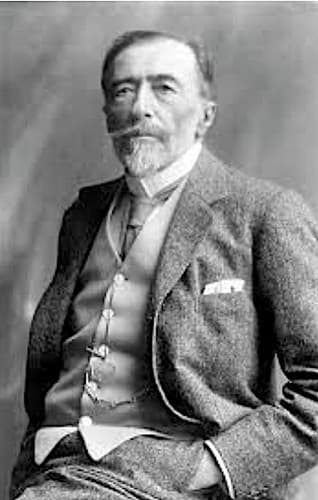
Joseph Conrad was a Polish-British novelist and short story writer. He is regarded as one of the greatest writers in the English language; though he did not speak English fluently until his twenties, he came to be regarded a master prose stylist who brought a non-English sensibility into English literature. He wrote novels and stories, many in nautical settings, that depict crises of human individuality in the midst of what he saw as an indifferent, inscrutable and amoral world.
Similar books
- The Secret Agent
Joseph Conrad
3.6 (19k) average on GoodreadsThrillerAnother Conrad novel delving into political espionage and moral ambiguity.
- Darkness at Noon
Arthur Koestler
4.0 (26k) average on GoodreadsPoliticsExamines the psychological torment of political betrayal and ideological conflict.
- The Spy Who Came in from the Cold
John le Carré
4.1 (77k) average on GoodreadsThrillerWhile le Carré's novel is a quintessential Cold War spy thriller, Under Western Eyes can be seen as a precursor in its cynical and morally ambiguous portrayal of espionage. Both authors strip away the glamour of intelligence work to reveal its brutal realities and the toll it takes on individuals. However, le Carré's focus is on the operational and strategic aspects of intelligence agencies and the ideological battle between East and West, whereas Conrad's novel is more concerned with the internal moral landscape of a single individual caught between competing loyalties and the profound personal cost of political maneuvering in an earlier revolutionary context.
- To Kill a Mockingbird
Harper Lee
4.3 (4.5M) average on GoodreadsHistorical FictionIn the 1930s Jim Crow South, Harper Lee writes about racial injustice, moral growth, and the quiet courage of a lawyer father, Atticus Finch, as seen through his young daughter's eyes.
- The Great Gatsby
F. Scott Fitzgerald
3.9 (3.8M) average on GoodreadsHistorical FictionIn the opulent Roaring Twenties, a mysterious millionaire's lavish parties hide his desperate, tragic pursuit of a lost love, exposing the emptiness within the American Dream.
- Pride and Prejudice
Jane Austen
4.3 (3M) average on GoodreadsHistorical FictionIn a society focused on status and money, Elizabeth Bennet navigates love and pride, challenging Mr. Darcy and social expectations to find true affection.





Enjoyed the summary?
A summary gives you the shape of the book. The book itself has the detail, the examples and the voice.
Find Under Western Eyes on AmazonAs an Amazon Associate, BookBrief earns from qualifying purchases. How we're funded