
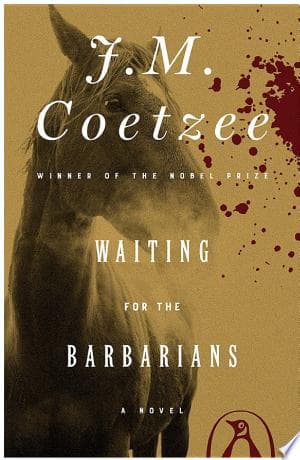
Synopsis
Covers the whole plot, including the ending.
- Difficulty
- Medium
- Pacing
- Slow
- Mood
- Bleak, Reflective, Thought-provoking, Stark
- Read it if
- You appreciate allegorical literary fiction that explores themes of colonialism, justice, and moral complicity, with a stark, philosophical tone.
- Skip it if
- You prefer fast-paced plots with clear resolutions, or find bleak, introspective narratives challenging.
Waiting for the Barbarians Plot Summary
Covers the whole plot, including the ending.
Arrival of Colonel Joll
The Magistrate, an aging man who has peacefully governed a small frontier settlement for decades, lives a quiet life of routine and archaeology. His world is suddenly disturbed by the arrival of Colonel Joll of the Third Bureau, a special unit of the Empire's civil administration. Joll's purpose is to investigate the 'barbarian problem' and interrogate local barbarian prisoners. He brings a chilling aura of authority and an unsettling disregard for justice, immediately setting up a makeshift prison and beginning brutal interrogations. The Magistrate watches Joll's methods, which include torture, with growing unease and a sense of foreboding about the Empire's changing nature.
The Torture of Prisoners
Colonel Joll and his subordinate, Warrant Officer Mandel, begin interrogating captured barbarian prisoners. The Magistrate is horrified by the casual cruelty and systematic torture, particularly the blinding of one old man and the mutilation of others. He cannot intervene directly, but the brutality deeply disturbs his long-held sense of order and justice. This exposure to the Empire's ruthless efficiency in getting information, regardless of truth or humanity, marks a significant change in his view of his own role and the Empire he serves, shattering his comfortable acceptance.
The Barbarian Girl
Among the prisoners tortured by Joll's men is a young barbarian girl, left with broken ankles and partially blinded. After Joll leaves, the Magistrate takes the girl into his care. He is driven by pity, guilt, and a new desire to make up for the Empire's cruelty. He washes her, cares for her injuries, and tries to understand her silence and pain. Their interactions are marked by a deep language barrier and her lingering trauma, yet the Magistrate feels an inexplicable connection and responsibility towards her, often massaging her damaged feet.
The Journey to Return the Girl
Driven by a strong need to correct a wrong and perhaps to understand the barbarians better, the Magistrate decides to personally return the young barbarian girl to her people. He undertakes a dangerous journey into the desolate frontier lands, traveling for days through harsh terrain with only a few companions. This is both an act of defiance against the Empire's policies and a personal quest. During the journey, he faces suspicion from the girl's people and the harsh realities of the untamed land, solidifying his detachment from the Empire's 'civilized' world.
Return and Arrest
After successfully returning the barbarian girl, the Magistrate returns to his settlement, expecting some official reprimand but not the severity he encounters. He is immediately arrested by Warrant Officer Mandel, who has taken over command in Joll's absence. The Magistrate is accused of consorting with the enemy, treason, and aiding barbarians. His comfortable life shatters as he is stripped of authority, imprisoned, and subjected to the same kind of humiliation and arbitrary justice he had only observed before, though less brutally.
Imprisonment and Humiliation
Imprisoned in his own barracks, the Magistrate is subjected to public humiliation and arbitrary punishment by Mandel and his soldiers. He is forced to perform menial tasks, deprived of basic comforts, and made a spectacle for the townspeople who now view him with suspicion or hostility. His former authority and respect vanish completely. This period of imprisonment forces him to confront his own vulnerability and the true nature of the Empire's power, which operates through fear and absolute control, even over its loyal servants.
The Arrival of the Barbarians
As the Magistrate remains in prison, rumors of barbarian movements and potential attacks on the frontier settlement grow. The Empire's soldiers, now under Mandel's command, become increasingly paranoid and brutal in their treatment of anyone suspected of collusion. The townspeople live in fear, and the military presence tightens its grip. The 'barbarian threat,' once a distant idea, becomes a real and terrifying reality, ironically fueled by the Empire's own aggressive policies and the fear it instills.
The Torture of the Barbarian Prisoners (again)
Colonel Joll unexpectedly returns to the settlement, now with more soldiers, to address the growing 'barbarian crisis.' He immediately resumes his brutal interrogations of newly captured barbarian prisoners, using even more extreme methods than before. The Magistrate, still imprisoned, sees these atrocities again, but this time with a deeper understanding of the cycle of violence and the Empire's self-destructive nature. He sees the terror in the eyes of the prisoners and recognizes the same fear and pain he experienced during his own detention.
The Empire's Retreat
Following a particularly brutal interrogation and public execution of several barbarian prisoners by Joll's men, the Empire's forces suddenly decide to abandon the frontier settlement. Convinced of an impending barbarian invasion, Joll orders a full retreat, leaving the townspeople to fend for themselves. The Magistrate, now released from prison but still without authority, watches as the soldiers depart in a chaotic and undignified manner, taking everything of value and leaving the settlement vulnerable and desolate. This abandonment shows how hollow the Empire's claims of protection were.
The Magistrate's New Role
With the Empire's forces gone, the Magistrate, though still officially disgraced, is the only figure left with any leadership. He tries to restore order among the remaining townspeople, who are now vulnerable and confused. He organizes patrols, distributes food, and tries to build a sense of resilience. Despite the looming threat of the barbarians and the complete breakdown of the Imperial system, the Magistrate finds a new purpose in caring for his people, facing the unknown future with a quiet dignity that contrasts sharply with the Empire's recent panicked retreat. He teaches the children to read, offering a small sign of hope.
Waiting for the Barbarians Characters
The Magistrate
Protagonist
The aging, contemplative administrator of a frontier settlement.
The Magistrate is an elderly man who has served the Empire for decades, governing a remote frontier outpost with a gentle hand and a love for archaeology. He is initially complacent, comfortable in his routine and detached from the Empire's grander machinations. His internal world is rich, marked by introspection and a quiet pursuit of knowledge. He values justice and order, but his understanding of these concepts is shattered by Colonel Joll's arrival. He is driven by a growing conscience and a profound sense of empathy that leads him to defy the Empire.
Relationships: Colonel Joll (Antagonistic; Joll represents the Empire's brutal authority which the Magistrate comes to oppose.); The Barbarian Girl (Caretaker and empathetic connection; she is a catalyst for his moral awakening.); Warrant Officer Mandel (Victim of Mandel's cruelty and authority during his imprisonment.)
Colonel Joll
Antagonist
A cold, calculating officer of the Empire's Third Bureau.
Colonel Joll is the embodiment of the Empire's ruthless efficiency and detached cruelty. He is an interrogation specialist who operates without emotion, believing that pain is a tool to extract truth. His signature dark glasses obscure his eyes, symbolizing his lack of empathy and his inability or refusal to truly 'see' his victims as human. He represents the bureaucratic evil of the Empire, driven by an unquestioning loyalty to its methods and an absolute conviction in its superiority over the 'barbarians.'
Relationships: The Magistrate (Opponent of the Magistrate's moral code; Joll is the agent of the Magistrate's suffering.); Warrant Officer Mandel (Superior officer; Mandel imitates Joll's methods and ideology.)
The Barbarian Girl
Supporting
A young barbarian woman, brutalized by the Empire's soldiers.
The Barbarian Girl is a silent, traumatized victim of the Empire's cruelty, left with broken ankles and partially blinded after torture. She represents the innocent suffering inflicted by the Empire and serves as a powerful symbol of the 'other' that the Empire seeks to subjugate. Her physical and psychological wounds are a constant reminder of the violence she endured. Despite her silence, her presence profoundly affects the Magistrate, acting as a catalyst for his moral awakening and his eventual defiance.
Relationships: The Magistrate (Recipient of his care and empathy; she sparks his conscience.)
Warrant Officer Mandel
Supporting
Colonel Joll's brutal and sadistic subordinate.
Warrant Officer Mandel is Colonel Joll's loyal and equally cruel subordinate. He is a more overtly sadistic figure than Joll, enjoying the exercise of power and the infliction of pain. He takes pleasure in humiliating the Magistrate during his imprisonment, mirroring Joll's methods but with a more personal, vindictive edge. Mandel represents the lower-level functionaries of the Empire who enthusiastically carry out its oppressive policies, often with a greater degree of personal malice.
Relationships: Colonel Joll (Subordinate and imitator; he strives to emulate Joll's authority.); The Magistrate (Jailer and tormentor during the Magistrate's imprisonment.)
The Old Man (Barbarian Prisoner)
Mentioned
An early victim of Joll's torture, blinded during interrogation.
This unnamed old barbarian man is one of the first prisoners interrogated by Colonel Joll and his men. He is blinded during the torture, an act that deeply disturbs the Magistrate and serves as an early sign of the Empire's escalating brutality. He represents the vulnerability of the barbarians and the senseless cruelty of the Empire's methods, setting the stage for the Magistrate's moral crisis.
The Townspeople
Supporting
The inhabitants of the frontier settlement, caught between the Empire and the barbarians.
The townspeople are the ordinary citizens of the frontier settlement, initially living under the Magistrate's benign rule. Their lives are disrupted by the arrival of the Imperial forces and the subsequent fear of barbarian invasion. They are largely passive, often fearful and opportunistic, quickly turning against the Magistrate when he falls from grace. They represent the masses who are easily swayed by authority and fear, highlighting the fragility of moral conviction in the face of state power. They eventually look to the Magistrate for leadership after the Empire abandons them.
Relationships: The Magistrate (Initially obedient subjects, then scornful accusers, finally reliant on his leadership.)
Waiting for the Barbarians Themes
Imperialism and Colonialism
The novel is an allegory for imperialism's destructive nature. The Empire, a faceless entity, asserts dominance through fear, torture, and an 'us vs. them' mentality against the 'barbarians.' It shows how colonial powers create and demonize an 'other' to justify expansion and brutality. Colonel Joll's methods and the Empire's abandonment of the frontier settlement illustrate the self-serving and unsustainable nature of such regimes, which prioritize control and perceived security over justice and human dignity. Joll tortures prisoners to 'protect' the Empire, but his actions only escalate conflict.
“'Empire has located its existence outside the metropolitan heartland, in the borderlands, on the frontier. The frontier is its life, its purpose, its meaning. It will be there, and it will be barbarian, long after the people of the metropolis have ceased to believe in it.'”
Justice vs. Law
A central conflict is the clash between personal moral justice and the state's arbitrary, often cruel, laws. The Magistrate, initially a loyal servant of the Empire's law, realizes that the Empire's 'justice' is merely a tool for control and oppression, lacking true fairness or humanity. His act of returning the barbarian girl is a rejection of the Empire's law in favor of a higher, personal sense of justice and empathy. Joll's torture is legal under Imperial decree, but the Magistrate's compassionate care is deemed treasonous.
“'I was a magistrate, I was not a soldier. I had no training in the law of war. I was not even sure that there was such a law.'”
The Other and Xenophobia
The novel explores how societies create and demonize an 'other' (the 'barbarians') to justify violence and maintain power. The Empire's propaganda paints the barbarians as an existential threat, despite little evidence. This dehumanization allows figures like Joll and Mandel to inflict horrific torture without guilt. The Magistrate's journey to return the barbarian girl and his imprisonment highlight the dangers of challenging this constructed 'other' and the xenophobia that underpins imperial ideology. Fear of the unknown 'barbarians' drives the Empire's brutal policies.
“'The enemy is out there, beyond the walls. That is the truth of the situation. And the barbarians are not human, they are not like us.'”
Moral Awakening and Conscience
The Magistrate undergoes a moral awakening throughout the story. Initially accepting and involved, his exposure to Colonel Joll's brutality forces him to confront the true nature of the Empire he serves. His empathy for the tortured barbarian girl and his act of defiance are driven by a reawakened conscience. This theme explores the individual's responsibility to resist injustice, even at great personal cost, and the process of shedding comfortable illusions to face harsh truths. His decision to return the girl is the key moment of this awakening.
“'I was the man who had been a magistrate, and who had chosen to be a man instead.'”
Power and Authority
The novel dissects how power and authority work, especially how they are abused and maintained through fear. The Empire's authority is absolute, unquestioning, and backed by brutal force, as shown by Colonel Joll. The Magistrate initially has a gentler form of authority, but this is quickly overridden by the military's might. The story shows how easily power can corrupt and how individuals, like Mandel, can become instruments of oppression. The public humiliation of the Magistrate demonstrates the Empire's need to assert power over even its loyal servants to maintain control.
“'There is no law here but my law.'”
Plot Devices & Literary Techniques
Allegory
The narrative functions as a symbolic representation of broader political and ethical conflicts.
The entire novel operates as an allegory for the dynamics of imperialism, colonialism, and the oppression of an 'other.' The unnamed Empire and 'barbarians' prevent specific historical identification, allowing the themes to resonate universally. The Magistrate's moral struggle symbolizes the individual's conscience confronting state brutality. This device allows Coetzee to explore complex philosophical questions about power, justice, and human nature without being tied to a particular historical event, making the story timeless and applicable to various contexts of oppression.
First-Person Narration
The story is told exclusively through the perspective of the Magistrate, providing intimate insight into his internal struggle.
The use of first-person narration allows the reader to experience the Magistrate's moral awakening and his internal conflict directly. We witness his initial complacency, his growing unease, and his eventual defiance through his own thoughts and observations. This perspective emphasizes his isolation and the subjective nature of his experience, making his transformation more impactful. It also highlights the psychological toll of witnessing and enduring state-sanctioned violence, grounding the abstract allegorical elements in a deeply personal human experience.
Symbolism of the Barbarian Girl's Feet
The Magistrate's repeated washing and massaging of the barbarian girl's injured feet symbolizes his attempt at atonement and empathy.
The Magistrate's ritualistic care for the barbarian girl's broken feet is a powerful symbol of his compassion, guilt, and desire for atonement. Her injured feet represent the wounds inflicted by the Empire, and his gentle ministrations are an attempt to heal those wounds, both literally and figuratively. This act is intimate and vulnerable, contrasting sharply with the Empire's brutality. It signifies his rejection of the Empire's dehumanization of the 'other' and his embrace of shared humanity, becoming a physical manifestation of his moral shift.
The Absence of Names for the Empire and Barbarians
The deliberate lack of specific names for the warring factions enhances the allegorical nature of the story.
By referring to the main powers as simply 'the Empire' and 'the barbarians,' Coetzee universalizes the conflict. This anonymity prevents readers from associating the narrative with any single historical event or specific cultural group, thereby amplifying its allegorical power. It allows the novel to speak to any situation where a dominant power demonizes an 'other' to justify its actions, making the themes of oppression, xenophobia, and moral complicity resonate across different times and places. It forces the reader to confront the abstract concepts rather than specific historical details.
Waiting for the Barbarians Quotes
“I was not made for the great world. I am an observer, not a participant.”
“One thought alone preoccupies me: that we are waiting for the barbarians. It is a phrase that has been current among us for as long as I can remember.”
“Empire has nothing in common with love.”
“There is no way of knowing whether you have achieved your aim or not. The only thing you can be certain of is that you have acted.”
“I too am a barbarian.”
“What has made it impossible for us to live in time like fish in water, like birds in air, like children on a summer's day?”
“The crime of which I am accused is that I have lived here, in this outpost, on the frontier.”
“Civilization begins with the sword and ends with the sword.”
“The barbarians are not going to come. It's an illusion we created for ourselves.”
“Pain is truth; all else is subject to doubt.”
“I am a man who likes to sleep in his own bed.”
“The greatest evil is not done by evil men, but by good men who are too weak to resist evil.”
“We are like children who have been told a story, and now we must live it out.”
“I am not a torturer. I am a man of peace.”
Quiz
10 questions on the plot and the characters. Each answer comes with a short explanation.
Question 1
What is the Magistrate's primary role at the beginning of the novel?
- A military general defending the frontier.
- The administrator of a frontier settlement.
- A historian documenting barbarian cultures.
- An interrogation expert for the Empire.
Show answer
B. The administrator of a frontier settlement. The Magistrate is introduced as the long-serving administrator of a small frontier settlement, managing its affairs for decades.
Question 2
Who are Colonel Joll and his men, and what is their primary objective when they arrive at the frontier?
- Archaeologists seeking ancient barbarian artifacts.
- Diplomats negotiating a peace treaty with the barbarians.
- Interrogation experts investigating barbarian threats.
- Engineers tasked with building new frontier defenses.
Show answer
C. Interrogation experts investigating barbarian threats. Colonel Joll arrives with his men, described as interrogation experts, to investigate and extract information from alleged barbarian prisoners, initiating a period of torture.
Question 3
What prompts the Magistrate's initial 'quixotic act of rebellion' against the Empire?
- He discovers a plot by Colonel Joll to overthrow the Empire.
- He witnesses the Empire's cruel and unjust treatment of barbarian prisoners.
- He falls in love with a barbarian woman and decides to defect.
- He finds evidence that the barbarians are not planning an attack.
Show answer
B. He witnesses the Empire's cruel and unjust treatment of barbarian prisoners. The Magistrate's sympathy for the victims of the Empire's torture, particularly the young barbarian woman, directly leads to his first acts of defiance.
Question 4
What does the Magistrate do with the young barbarian woman after she is interrogated and left partially blind and lame?
- He sends her back to her people immediately with a message.
- He takes her into his home, cares for her, and eventually attempts to return her to her people.
- He secretly helps her escape to another Empire outpost.
- He hands her over to another group of Imperial soldiers for further questioning.
Show answer
B. He takes her into his home, cares for her, and eventually attempts to return her to her people. The Magistrate takes the injured barbarian woman into his care, nurses her back to health, and embarks on a journey to return her to her own people, an act seen as treason by the Empire.
Question 5
The novel is described as an allegory of 'the war between oppressor and oppressed.' How is this theme primarily conveyed through the Magistrate's experience?
- By showing the barbarians successfully overthrowing the Empire.
- By depicting the Magistrate's shift from an agent of the Empire to a victim of its oppression.
- By focusing solely on the barbarians' suffering without Imperial interaction.
- By presenting a balanced view of both sides, with neither being clearly oppressed or oppressor.
Show answer
B. By depicting the Magistrate's shift from an agent of the Empire to a victim of its oppression. The Magistrate, initially a loyal servant of the oppressive Empire, becomes a victim of its cruelty and injustice, experiencing imprisonment and torture, thus embodying the shift from oppressor (by complicity) to oppressed.
Question 6
What is the Magistrate's fate after his return from attempting to deliver the barbarian woman?
- He is promoted for his diplomatic efforts.
- He is immediately executed for treason.
- He is imprisoned, tortured, and publicly humiliated before being released back to his post.
- He is banished to a distant, uninhabited island.
Show answer
C. He is imprisoned, tortured, and publicly humiliated before being released back to his post. Upon his return, the Magistrate is arrested, subjected to torture and public humiliation by Imperial soldiers, and then ironically returned to his post as the Empire's grip weakens.
Question 7
What is the significance of the Magistrate's recurring dreams and his interest in the 'barbarian' artifacts and language?
- They represent his desire to fully assimilate into barbarian culture.
- They symbolize his attempts to understand the 'other' and challenge the Empire's dehumanizing narrative.
- They are merely hobbies, distractions from his administrative duties.
- They indicate his secret alliance with the barbarian leaders.
Show answer
B. They symbolize his attempts to understand the 'other' and challenge the Empire's dehumanizing narrative. The Magistrate's studies and dreams of the barbarians represent his intellectual and emotional effort to bridge the divide created by the Empire, seeking to understand them beyond the official propaganda, which is a key thematic element.
Question 8
How does the Empire's perception of the 'barbarian threat' evolve throughout the novel, and what does this reveal about the Empire itself?
- The threat is proven to be real and imminent, justifying the Empire's actions.
- The threat is largely manufactured or exaggerated by the Empire to justify its expansion and control.
- The barbarians become allies, and the Empire shifts its focus to internal conflicts.
- The threat diminishes as the barbarians voluntarily retreat from the frontier.
Show answer
B. The threat is largely manufactured or exaggerated by the Empire to justify its expansion and control. The Empire's 'barbarian threat' is shown to be largely a construction, used to justify its militarism, control over its own people, and cruel treatment of perceived enemies, rather than a genuine, imminent danger.
Question 9
After his public humiliation, why does the Magistrate remain in the settlement, despite the Empire's growing instability and the impending 'barbarian' arrival?
- He is physically unable to leave due to his injuries and old age.
- He feels a sense of duty to protect the remaining civilians, even if he despises the Empire.
- He is waiting for a chance to exact revenge on Colonel Joll.
- He believes the barbarians will offer him a position of power if he stays.
Show answer
B. He feels a sense of duty to protect the remaining civilians, even if he despises the Empire. Despite his personal suffering and disillusionment with the Empire, the Magistrate chooses to stay and try to maintain order and protect the remaining townspeople, demonstrating a complex sense of responsibility beyond loyalty to the regime.
Question 10
What is the ultimate irony of the Empire's preparations for war with the barbarians by the end of the novel?
- The barbarians join forces with the Empire against a common enemy.
- The Empire's actions to combat the 'barbarian' threat lead to its own internal decay and eventual collapse without a major battle.
- The barbarians retreat, rendering all the Empire's efforts pointless.
- The war is fought and won by the Empire, but at an unbearable cost.
Show answer
B. The Empire's actions to combat the 'barbarian' threat lead to its own internal decay and eventual collapse without a major battle. The Empire's obsessive focus on the 'barbarian threat' and its brutal methods ultimately undermine its own authority and stability, leading to its internal disintegration and abandonment of the frontier, rather than a decisive external conflict.
Waiting for the Barbarians FAQ
What is the central premise of 'Waiting for the Barbarians'?
The novel centers on an unnamed Magistrate, a loyal servant of the Empire, who governs a frontier settlement. His comfortable routine is shattered by the arrival of Colonel Joll and his interrogation squad, forcing the Magistrate to confront the Empire's brutal treatment of 'barbarian' prisoners and his own complicity in the system.
Who is Colonel Joll and what role does he play in the story?
Colonel Joll is a high-ranking officer from the Empire's Third Bureau, specializing in 'security' and interrogation. He represents the cold, calculating, and brutal face of imperial power, employing torture and psychological manipulation to extract confessions and instill fear, ultimately disrupting the Magistrate's complacent existence.
What act of rebellion does the Magistrate commit that leads to his downfall?
The Magistrate commits an act of rebellion by taking pity on a blind barbarian girl who was tortured by Colonel Joll's men. He takes her into his home, cares for her, and eventually undertakes a perilous journey to return her to her people, an act seen by the Empire as aiding the enemy.
How does the Magistrate's perception of the 'barbarians' change throughout the novel?
Initially, the Magistrate views the barbarians as a distant, abstract threat, or simply as subjects to be managed. His interaction with the tortured barbarian girl humanizes them for him, leading to profound empathy and a realization that the true barbarity lies within the Empire's actions, not the 'enemy' it creates.
What is the significance of the Magistrate's obsession with the barbarian girl's eyes and blindness?
The barbarian girl's blindness symbolizes the Empire's willful ignorance and its inability to 'see' the humanity of its victims. The Magistrate's attempts to understand her blindness, and his fascination with her scarred eyes, represent his own awakening to the truth and his struggle to confront the horrific realities he previously overlooked.
Are the 'barbarians' ever truly seen or understood in the novel?
No, the 'barbarians' largely remain an abstract concept or a feared 'other' throughout the book, even for the Magistrate. While he develops empathy for the tortured girl, the novel intentionally keeps their culture and identity vague, emphasizing that the 'barbarian' is primarily a construct used by the Empire to justify its oppression.
What is the role of the archaeological digs and the ancient tablets the Magistrate studies?
The Magistrate's archaeological digs and studies of ancient tablets represent his attempt to connect with a deeper history and perhaps find meaning outside the Empire's immediate concerns. They serve as a contrast to the present barbarity, suggesting cycles of history and the transient nature of empires, while also hinting at a past where different peoples coexisted.
How does the novel explore the concept of complicity?
The novel deeply explores complicity through the Magistrate's character, who, for decades, peacefully administered the frontier post, tacitly enabling the Empire's existence and policies. His gradual awakening forces him to confront his own passive involvement in a system built on injustice, highlighting that inaction can be as culpable as direct participation.
Is the Magistrate's rebellion ultimately successful or futile?
The Magistrate's rebellion is arguably futile in terms of changing the Empire's trajectory or saving himself from persecution, as he is arrested and tortured. However, it is successful on a personal level, as it represents his moral awakening and reclamation of his humanity, even if it leads to his social and physical ruin.
What is the significance of the recurring dream of the bird trapped in his room?
The dream of the trapped bird symbolizes the Magistrate's own confinement, both physically within the settlement and psychologically within the Empire's ideology. It reflects his growing unease and sense of being trapped by circumstances, foreshadowing his eventual attempt to break free and his subsequent capture.
How does the setting of the frontier fort contribute to the novel's themes?
The isolated frontier fort serves as a microcosm of imperial power, far from the capital but still enforcing its will. Its remoteness allows the Empire's brutality to unfold with little oversight, while also highlighting the psychological toll of living on the edge of civilization, constantly anticipating an unseen enemy.
What is the Empire's primary motivation for its actions against the 'barbarians'?
The Empire's primary motivation appears to be the maintenance and expansion of its power, fueled by paranoia and a constructed narrative of an external threat. The 'barbarians' provide a convenient enemy to rally against, justify military spending, and consolidate internal control through fear.
How does the novel challenge traditional notions of heroism?
The novel challenges heroism by presenting the Magistrate not as a classic, valiant hero, but as an ordinary man who initially fails to act. His 'heroism' emerges from a quiet, deeply personal moral awakening and an act of empathy, rather than grand gestures or military prowess, leading him to suffer rather than triumph.
What is the 'Third Bureau' and why is it significant?
The Third Bureau is the Empire's intelligence and security arm, responsible for internal policing and dealing with perceived threats. It is significant because it embodies the insidious, bureaucratic nature of state-sponsored oppression, operating with clinical efficiency and cold detachment, as exemplified by Colonel Joll.
What happens to the Magistrate after his return from the barbarian lands?
Upon his return, the Magistrate is arrested, imprisoned, and subjected to public humiliation and torture by the Empire's soldiers, who accuse him of treason and consorting with the enemy. He is stripped of his authority and left in disgrace, though he eventually regains some semblance of his former life in a diminished capacity.
Does the novel offer any hope for overcoming oppression?
The novel offers a bleak outlook on overcoming systemic oppression, as the Empire's machinery of control seems relentless and self-perpetuating. However, it implicitly suggests hope lies in individual moral courage and empathy, as demonstrated by the Magistrate's personal transformation, even if such acts do not dismantle the larger system.
How does the Magistrate's relationship with the barbarian girl evolve?
Their relationship evolves from one of pity and care to a complex bond of shared suffering and understanding. Initially, he is her protector, but through their journey, she becomes a symbol of his conscience and a catalyst for his transformation, making their connection deeply personal and transformative for him.
What is the ultimate message or allegory of 'Waiting for the Barbarians'?
The novel serves as a powerful allegory for the universal conflict between oppressor and oppressed, critiquing imperialism, the abuse of power, and the dehumanization of the 'other.' It suggests that true barbarity often resides within the seemingly civilized, and that moral courage is essential in confronting state-sanctioned injustice.
About the author

John Maxwell Coetzee OMG is a South African and Australian novelist, essayist, linguist, translator and recipient of the 2003 Nobel Prize in Literature. He is one of the most critically acclaimed and decorated authors in the English language. He has won the Booker Prize (twice), the CNA Prize (thrice), the Jerusalem Prize, the Prix Femina étranger, and The Irish Times International Fiction Prize, and holds a number of other awards and honorary doctorates.
Similar books
- Lord of the Flies
William Golding
3.7 (2.3M) average on GoodreadsYoung AdultExplores human nature and the breakdown of civilization in a confined setting.
- Disgrace
J. M. Coetzee
3.8 (87k) average on GoodreadsLiterary FictionAnother Coetzee novel with a morally complex protagonist grappling with societal collapse and personal humiliation in post-apartheid South Africa.
- The Trial
Franz Kafka
4.0 (235k) average on GoodreadsLiterary FictionFeatures an individual caught in a dehumanizing, bureaucratic system with an elusive sense of justice.
- The Stranger
Albert Camus
4.1 (3k) average on GoodreadsFantasyBoth explore individual alienation and confrontation with an indifferent system. However, Coetzee's novel is more explicitly political and allegorical, focusing on the pathology of empire, whereas Camus's protagonist, Meursault, is characterized by a profound sense of existential apathy and detachment.
- Things Fall Apart
Chinua Achebe
3.7 (288k) average on GoodreadsHistorical FictionAchebe provides a powerful, insider's perspective on the devastating impact of colonialism on an indigenous society, meticulously portraying pre-colonial life. Coetzee, in contrast, offers a critical outsider's view from within the colonial apparatus, focusing on the psychological and moral decay of the colonizer. Achebe voices the colonized; Coetzee dissects the colonizer's psyche.
- The Old Man and the Sea
Ernest Hemingway
3.8 (831k) average on GoodreadsLiterary FictionA Cuban fisherman's long struggle with a giant marlin becomes a story of endurance and dignity, now retold for young adults with illustrations, phonetic guides, and writing prompts in Traditional Chinese.





Enjoyed the summary?
A summary gives you the shape of the book. The book itself has the detail, the examples and the voice.
Find Waiting for the Barbarians on AmazonAs an Amazon Associate, BookBrief earns from qualifying purchases. How we're funded