
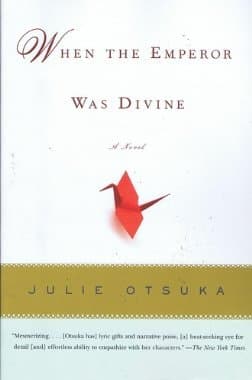
Synopsis
Covers the whole plot, including the ending.
- Difficulty
- Easy
- Pacing
- Slow
- Mood
- Melancholy, Haunting, Reflective, Understated
- Read it if
- You want a poignant, understated, and deeply impactful story about the human cost of historical injustice, particularly the Japanese American internment. Perfect for those who appreciate sparse prose and emotional depth.
- Skip it if
- You prefer novels with strong plot momentum, explicit emotional expression, or a clear, detailed resolution for individual characters. This book focuses more on collective experience and internal impact.
When the Emperor Was Divine Plot Summary
Covers the whole plot, including the ending.
The White Dog and the Evacuation Order
In Berkeley, California, a mother of two, whose husband has been taken by the FBI, sees a white dog watching her house. She gets a Civilian Exclusion Order, Public Proclamation No. 3, which says all people of Japanese ancestry must leave the West Coast. She has to get her family ready for an unknown place, selling or giving away most things, including their dog. They pack what they can carry into two suitcases each. The mother tells her children to act like 'good Americans' and not attract attention, trying to keep things normal despite the fear.
The Journey to the Assembly Center
The family, now just the mother, daughter, and son, gets on a crowded train with other Japanese Americans, going inland. The daughter sees the changing scenery and armed guards through the window, feeling confused and afraid. She notices people avoiding eye contact and whispering, trying to understand what they did wrong. The train ride is long and uncomfortable, with the smell of urine and soldiers. They are taken to a former racetrack, the Tanforan Assembly Center, where they get a horse stall, still smelling of manure, as their temporary home.
Life in the Desert Camp
The son describes life in the Topaz War Relocation Center in the Utah desert. Conditions are harsh: rows of barracks, communal bathrooms, constant dust storms, and no privacy. He goes to school, plays baseball, and sees the daily life of the camp, including food rationing and arbitrary rules. The children try to adjust, finding ways to entertain themselves, but the underlying tension and constant reminder of confinement are always there. He notices changes in his mother, who tries to stay dignified but grows tired and distant.
The Loyalty Questionnaire and Divided Loyalties
In the camp, the government gives a 'loyalty questionnaire' to all internees 17 and older. Questions 27 and 28, asking if they would serve in the U.S. armed forces and give up allegiance to the Japanese Emperor, cause deep disagreements. Many, especially older Issei, find the questions insulting or impossible to answer truthfully without betraying their heritage or risking statelessness. Some answer 'no-no,' becoming 'non-aliens' and facing more segregation. The mother, though not questioned directly, sees the conflict and division in the community as friends and neighbors argue over their answers.
The End of the War and Release
As World War II ends, the internment camps close. The family gets notice of their release, but going home seems hard. They receive a small amount of money and a train ticket, but no real help to rebuild their lives. Many internees face hostility and discrimination when they return to their old communities, finding their homes vandalized or taken. The family struggles with deciding whether to go back to Berkeley or start somewhere new, dealing with fear of renewed prejudice and the loss of everything they had.
Return to a Changed Home
The family returns to their house in Berkeley, finding it ransacked and neglected. Their belongings are gone, replaced by strangers' furniture, and the garden is overgrown. Neighbors avoid them or look with pity. The children find it hard to go back to school, facing stares and whispers. The mother tries to bring back normalcy, but the trauma of internment has left a mark. They live with quiet watchfulness, always aware of their race and the chance of renewed prejudice, trying to reclaim their old lives in a society that now sees them differently.
The Father's Return and Silence
After more than four years, the father is released and returns home. He looks different; he is thinner, older, and his eyes hold a deep, sad silence. He rarely talks about his experiences in the internment camps or the detention centers where he was held. His silence creates distance in the family. The children, now older, find it hard to connect with him, and the mother struggles to bridge the emotional gap. His presence is a constant reminder of their shared suffering, yet he remains a mystery.
Living with the Unspoken Past
The family tries to rebuild their lives in Berkeley, but the internment's effects are deep. The children grow up trying to erase their Japanese identity, using American customs and names, and avoiding anything that might remind people of their past. The mother works hard to keep the family going, but her spirit is subdued. The father stays mostly silent, his trauma showing in quiet habits and distant looks. The weight of their shared experience, though rarely talked about, shapes their every interaction and decision. This creates a lasting sense of loss, shame, and a struggle for identity in a country that betrayed them.
Principal Figures
The Mother
Protagonist
A resilient Japanese American woman navigating her family's internment.
The unnamed mother is the stoic matriarch of the family. She is practical, resourceful, and deeply committed to protecting her children. Initially, she tries to maintain a sense of normalcy and dignity amidst the chaos of evacuation, instructing her children to blend in and be 'good Americans.' Throughout the internment, she endures hardship with quiet strength, but the experience gradually erodes her spirit, leaving her weary and cautious. Her internal struggles are often conveyed through her observations and small acts of defiance or resignation.
Relationships: The Father (Husband, separated by internment, then emotionally distant); The Daughter (Child, whom she tries to protect and guide); The Son (Child, whom she tries to protect and guide)
The Father
Supporting
The family patriarch, interned separately and returning profoundly changed.
The unnamed father is the first to be taken by the FBI, separated from his family before their internment. His absence is a constant presence throughout much of the novel. When he finally returns, he is a shadow of his former self—physically diminished and emotionally withdrawn. He rarely speaks about his experiences, his silence becoming a barrier between him and his family. His trauma is profound and uncommunicated, representing the deep psychological scars inflicted by unjust imprisonment.
Relationships: The Mother (Wife, with whom he struggles to reconnect); The Daughter (Child, with whom he has a strained relationship); The Son (Child, with whom he has a strained relationship)
The Daughter
Protagonist
The elder child, observing and internalizing the injustices of internment.
The unnamed daughter is a sensitive and observant child. Her perspective in the second chapter captures the confusion, fear, and dawning realization of injustice during the train journey to the assembly center. She notices details—the armed guards, the changing landscape, the avoidance of eye contact by strangers. She internalizes the shame and stigma of her Japanese heritage, later trying to conform to American ideals by changing her name and hiding her past. Her experiences reflect the loss of innocence and the struggle for identity.
Relationships: The Mother (Child, seeking guidance and protection); The Father (Child, struggling to understand his silence); The Son (Sibling, sharing the experience of internment)
The Son
Protagonist
The younger child, adapting to camp life while losing his sense of self.
The unnamed son provides the perspective for the third chapter, detailing life within the Topaz internment camp. He tries to make sense of his new reality, playing baseball, attending school, and observing the routines of camp life. He is more outwardly adaptable than his sister but also internalizes the shame and confusion. He is a witness to the indignities, such as the communal latrines and the constant dust. His narrative highlights the efforts of children to find normalcy in abnormal circumstances, even as their identities are being reshaped.
Relationships: The Mother (Child, seeking comfort and stability); The Father (Child, bewildered by his father's transformation); The Daughter (Sibling, sharing the experience of internment)
The White Dog
Mentioned
A silent observer symbolizing the family's impending displacement and loss.
The white dog is a symbolic presence at the beginning of the novel, watching the family's house before they receive the evacuation order. It represents the watchful, often indifferent, gaze of the outside world on the Japanese American community. The family is forced to give the dog away, symbolizing the loss of their possessions, their home, and their sense of security. Its brief appearance underscores the theme of innocent lives disrupted and the arbitrary nature of their forced removal.
The Neighbor Who Buys the Piano
Supporting
A white neighbor who benefits from the family's forced sale of possessions.
This unnamed neighbor represents the opportunistic and sometimes indifferent attitude of some white Americans during the internment period. She buys the family's piano for a fraction of its value, highlighting the economic exploitation faced by Japanese Americans forced to sell their belongings quickly. Her interaction with the mother underscores the power imbalance and the lack of empathy from some within the community, even as the family faces immense hardship.
Relationships: The Mother (Acquaintance, representing the opportunistic outside world)
The Guards
Mentioned
Symbols of surveillance and confinement during internment.
The guards are not individual characters but a collective presence that represents the authority and surveillance of the U.S. government. They are seen on the train, around the camps, and are a constant reminder of the internees' loss of freedom and their status as prisoners. Their presence evokes fear and humiliation, reinforcing the feeling of being watched and controlled.
Mrs. Sasaki
Mentioned
An elderly internee who succumbs to the harsh conditions of the camp.
Mrs. Sasaki is an elderly woman who dies in the Topaz camp. Her death, attributed to 'heart failure,' symbolizes the devastating physical and emotional toll of internment, particularly on the vulnerable. Her story highlights the inadequate medical care and the harsh living conditions that contributed to suffering and death within the camps. She is a quiet reminder of the human cost of the government's policies.
Relationships: The Family (Fellow internee, her death impacts the community)
Bill Susuki
Mentioned
A 'no-no boy' who refuses the loyalty questionnaire, symbolizing defiance.
Bill Susuki is mentioned as one of the 'no-no boys' who answers 'no' to the loyalty questions 27 and 28, thus refusing to serve in the U.S. military and forswear allegiance to the Japanese Emperor. He represents the internees who chose defiance over conformity, facing further segregation and punishment for their stance. His choice highlights the impossible dilemma faced by many Japanese Americans and the deep divisions within the community regarding loyalty.
Relationships: The Family (Fellow internee, representing a different response to oppression)
Themes & Insights
Identity and Self-Discovery
The novel shows how internment changes Japanese American identity. Characters struggle with their dual heritage, feeling neither fully Japanese nor fully American. The children change their names, try to erase their past, and distance themselves from their culture to fit in. This shows the psychological trauma of forced assimilation. The father's silence upon his return shows a loss of self that cannot be fully recovered. The mother's quiet endurance shows a different way of dealing with a fractured identity. The entire family struggles with who they are in a country that betrayed them.
“We were not Japanese. We were not white. We were, in the eyes of the government, 'non-aliens.'”
Loss and Displacement
Loss is in every part of the family's experience, both physical and emotional. They lose their home, possessions, and security during evacuation. The internment camps are a physical displacement, but also an emotional and cultural one. The father's long absence and later silence show a loss of family unity and emotional connection. Even when they return, they find their home vandalized and their community changed. They lose trust in their country and their pre-war innocence. The book shows the lasting effect of these losses.
“We had been gone only three years but it was as if we'd been gone a lifetime. Nothing was the same.”
Silence and Unspoken Trauma
Silence is a main theme, showing the characters' difficulty and inability to talk about their trauma. The father's deep silence upon his return is the most striking example. It means his experience is too painful or complex to put into words. The mother often shows her feelings through actions, not words. The children learn to suppress their questions and emotions. This collective silence creates distance in the family and community. It suggests that the wounds of internment are so deep they defy language, leading to unspoken suffering and unresolved grief for future generations.
“He never spoke of the camps. He never spoke of his time away. He never spoke of anything.”
Prejudice and Discrimination
The novel explores racial prejudice and institutional discrimination. The evacuation order, based only on ancestry, is the most clear act of prejudice. The family experiences discrimination through hostile stares, low prices for their belongings, and being excluded when they return to Berkeley. The loyalty questionnaire further shows the government's discriminatory policies, forcing Japanese Americans to prove their allegiance in a way no other group had to. The book shows how deep prejudice can be, causing widespread suffering and taking away basic rights.
“We were the enemy. We were the face of the enemy. We were the yellow peril.”
Resilience and Adaptation
Despite the great hardships, the characters show resilience and adaptability. The mother carefully prepares for evacuation, trying to give her children a sense of normalcy. The children, especially the son, find ways to adapt to the harsh camp environment, creating games and routines. When they return, the family tries to rebuild their lives, facing discrimination with quiet determination. Their ability to endure, even with injustice and loss, shows the strength of the human spirit. But this resilience often comes with a cost, like quiet suffering and suppressed feelings.
“You must be a good American. You must not do anything to make them notice you.”
Plot Devices & Literary Techniques
Multiple First-Person Perspectives
Each chapter uses a different unnamed family member's 'I' voice.
Otsuka employs a unique narrative structure where each of the five chapters is told from the first-person perspective of a different, unnamed family member: the mother, the daughter, the son, and finally, a collective 'we' for the family's return and the father's perspective. This allows the reader to experience the internment from diverse angles, highlighting the individual and collective impact of the trauma. The lack of specific names universalizes their experience, making them representative of many Japanese American families, while the distinct voices offer intimate insights into their unique struggles and coping mechanisms.
Anaphora and Repetition
The repeated use of phrases creates a rhythmic, incantatory effect.
Otsuka frequently uses anaphora, the repetition of a word or phrase at the beginning of successive clauses, and other forms of repetition. This creates a rhythmic, almost hypnotic quality to the prose, mimicking the monotonous and inescapable nature of camp life and the pervasive fear. For example, lists of things they did or saw, or questions they asked, often begin with the same phrase. This device emphasizes the collective experience, the sheer volume of indignities, and the way trauma can loop in the mind, reinforcing the sense of shared fate and the enduring psychological impact of internment.
Symbolism of the White Dog
The dog represents innocence, surveillance, and loss.
The white dog that watches the family's house at the beginning of the novel serves as a powerful symbol. It represents the watchful, often anonymous, gaze of the outside world on the Japanese American community, hinting at the surveillance and judgment they are about to face. The family's forced decision to give the dog away symbolizes the loss of their home, their possessions, their sense of normalcy, and their innocence. Its whiteness can also be interpreted as a symbol of the dominant white society from which they are excluded, despite their American citizenship.
The Loyalty Questionnaire
A government document that creates deep divisions and moral dilemmas.
The loyalty questionnaire, particularly questions 27 and 28, functions as a critical plot device that exposes the impossible bind faced by Japanese Americans. It forces internees to choose between conflicting loyalties, effectively demanding they betray their heritage or face further punishment. This device highlights the absurdity and cruelty of the government's policies, as well as the deep divisions it created within the Japanese American community, leading to the designation of 'no-no boys' and further segregation. It underscores the theme of fractured identity and the systemic injustice of the internment.
Unnamed Characters
The family members are referred to only by their roles (mother, daughter, son, father).
By not giving her characters individual names, Otsuka universalizes their experience. They become archetypes, representing not just one family but the countless Japanese American families who endured internment. This artistic choice emphasizes the collective trauma and the dehumanizing effect of being stripped of individual identity and reduced to a racial category by the government. It invites the reader to see them as 'everyfamily,' making the story's emotional impact broader and more resonant, highlighting that this could have happened to anyone in their position.
When the Emperor Was Divine Quotes
“The dog was the first to go. He was a mutt, part terrier, part shepherd, with a little bit of something else thrown in.”
“They told us to bring only what we could carry. One suitcase each. No pets. No cameras. No radios. No Japanese-English dictionaries.”
“We were American citizens, but we were being treated like foreigners, like criminals.”
“The wind never stopped. It blew across the desert, carrying dust and sand into our barracks, into our clothes, into our hair, into our food.”
“We were not allowed to speak Japanese. We were not allowed to sing Japanese songs. We were not allowed to read Japanese books.”
“My father used to say that a man is only as good as his word. But his word meant nothing here.”
“We learned to live with less. Less space. Less privacy. Less hope.”
“After a while, we stopped looking in the mirror. We didn't want to see the strangers we had become.”
“The war ended, but our war did not. Our war was just beginning.”
“We were supposed to forget. We were supposed to move on. But how could we forget when our lives had been turned upside down?”
“My mother never talked about it. My father never talked about it. My brother never talked about it. We just lived with it.”
“Sometimes I think we were all just waiting. Waiting to be told what to do. Waiting to be told where to go. Waiting to be told who we were.”
“And when the emperor was divine, we were dirt.”
Quiz
10 questions on the plot and the characters. Each answer comes with a short explanation.
Question 1
Which family member receives the initial evacuation order in the novel's first chapter?
- The father
- The mother
- The daughter
- The son
Show answer
B. The mother The first chapter, titled 'Evacuation Order No. 19', is told from the mother's perspective as she prepares the family for relocation after receiving the order.
Question 2
What is the primary mode of transportation for the family on their journey to the internment camp?
- Bus
- Car
- Train
- Boat
Show answer
C. Train The second chapter is told from the daughter's point of view, specifically describing the long and uncomfortable train ride to the internment camp.
Question 3
Which setting is prominently featured in the son's chapter?
- A bustling city street
- A desert encampment
- A crowded school classroom
- A quiet suburban neighborhood
Show answer
B. A desert encampment The third chapter focuses on the son's experiences within the internment camp, which is described as a 'desert encampment' in the book's synopsis.
Question 4
How long is the father held in captivity before his release?
- Less than a year
- Approximately two years
- More than four years
- Over ten years
Show answer
C. More than four years The book's synopsis explicitly states the father's 'bitter release after more than four years in captivity,' highlighting the extended duration of his absence.
Question 5
What primary emotion does the novel convey through its 'unrelenting economy and suppressed emotion'?
- Outrage and open rebellion
- Joy and liberation
- Resignation and quiet suffering
- Nostalgia and sentimentality
Show answer
C. Resignation and quiet suffering The synopsis describes the novel as having 'unrelenting economy and suppressed emotion,' and 'arrestingly understated,' which points to themes of quiet suffering and resignation rather than overt emotional displays.
Question 6
The novel uses a 'single family' to illustrate the 'deracination' of Japanese Americans. What does 'deracination' primarily refer to in this context?
- The process of becoming more deeply rooted in one's culture.
- The act of physically moving from one place to another.
- The uprooting or displacement, both physical and emotional, from one's native environment or culture.
- The rapid growth and development of a new community.
Show answer
C. The uprooting or displacement, both physical and emotional, from one's native environment or culture. The synopsis defines deracination as 'both physical and emotional,' indicating the profound uprooting and displacement experienced by Japanese Americans during internment, losing their homes, livelihoods, and sense of belonging.
Question 7
Upon returning home, what challenge do the family members likely face, given the historical context and the novel's themes?
- Immediate reintegration into their former lives with no lasting consequences.
- Finding their property completely undisturbed and waiting for them.
- Dealing with lingering prejudice, economic hardship, and the psychological impact of their internment.
- A warm and immediate welcome from all their former neighbors.
Show answer
C. Dealing with lingering prejudice, economic hardship, and the psychological impact of their internment. The chapter on the family's return home, combined with the 'bitter release' of the father and the overall themes of hardship and deracination, strongly suggests they would face significant challenges like prejudice, economic struggle, and trauma, rather than an easy return.
Question 8
The novel is described as a 'small tour de force' due to its 'unrelenting economy and suppressed emotion.' How does this stylistic choice impact the reader's experience?
- It makes the story feel overly sentimental and manipulative.
- It creates a detached, unemotional narrative that is hard to connect with.
- It heightens the emotional impact by forcing the reader to infer the characters' unspoken pain and resilience.
- It focuses solely on historical facts, neglecting character development.
Show answer
C. It heightens the emotional impact by forcing the reader to infer the characters' unspoken pain and resilience. The 'unrelenting economy and suppressed emotion' mean that emotions are not explicitly stated but are deeply felt by the reader through the understated prose, making the story more haunting and impactful as the reader infers the characters' internal struggles.
Question 9
Each of the five chapters is executed from a 'different point of view.' What effect does this narrative structure have on the reader's understanding of the internment experience?
- It makes the narrative disjointed and difficult to follow.
- It provides a comprehensive, multi-faceted understanding of how the internment affected different family members individually.
- It prevents the reader from forming a strong connection with any single character.
- It primarily focuses on the external political events rather than personal experiences.
Show answer
B. It provides a comprehensive, multi-faceted understanding of how the internment affected different family members individually. By shifting perspectives (mother, daughter, son, family, father), Otsuka allows the reader to experience the internment through multiple lenses, highlighting the varied and individual impacts on each family member, thus creating a more comprehensive understanding.
Question 10
The title 'When the Emperor Was Divine' subtly hints at a complex relationship between Japanese Americans and their identity during wartime. What does the 'Emperor' likely symbolize in this context?
- The American president as the ultimate authority.
- The idealized concept of freedom and democracy.
- A distant, revered, and potentially misunderstood figure that became a point of contention and suspicion for Japanese Americans in the US.
- A fictional character representing absolute evil.
Show answer
C. A distant, revered, and potentially misunderstood figure that became a point of contention and suspicion for Japanese Americans in the US. During WWII, the Emperor of Japan was a central figure of Japanese identity and loyalty, but for Japanese Americans, this became a source of suspicion and forced declarations of loyalty to the US, highlighting the impossible position they were in. The title alludes to this complex, often tragic, aspect of their identity and loyalty.
When the Emperor Was Divine FAQ
What is 'When the Emperor Was Divine' about?
Julie Otsuka's novel follows an unnamed Japanese American family forced to evacuate their home in Berkeley, California, and relocate to internment camps during World War II. It chronicles their experiences through five distinct perspectives: the mother, the daughter, the son, the family's collective return home, and finally, the father's release and return.
Why should I read 'When the Emperor Was Divine'?
You should read this book for its unique, understated portrayal of the Japanese American internment experience. Otsuka uses precise, evocative language to convey the profound emotional and physical deracination of a family, offering a deeply personal and often overlooked perspective on a significant historical event.
What is the background/setting of 'When the Emperor Was Divine'?
The book is set in the United States during World War II, specifically in Berkeley, California, before the family's forced removal, and then in various internment camps, including one in the Utah desert. The historical context is Executive Order 9066, which led to the forced relocation and incarceration of Japanese Americans.
What writing style does the author use?
Julie Otsuka employs a spare, precise, and often collective first-person plural narration, particularly in later chapters. Her style is characterized by its crystalline intensity, understatement, and an almost journalistic recounting of details, which collectively evoke suppressed emotion and the dehumanizing effects of internment.
What minor details add significant meaning?
The repeated observations of small, everyday objects, like the mother's meticulous packing list or the daughter's fascination with the camp's dust, emphasize the loss of normalcy and the attempt to cling to identity amidst displacement. The family's dog, left behind and never mentioned again, subtly highlights the sudden, absolute rupture of their lives.
What are some subtle foreshadowing moments?
Early descriptions of the family's careful adherence to American customs and their attempts to blend in, such as the children's perfect English and the mother's garden, subtly foreshadow the profound shock and injustice of their eventual internment, revealing that their 'Americanness' offered no protection.
What unexpected character connections exist?
While not 'unexpected' in a plot twist sense, the connection between the family and the unnamed white woman who buys their dog reveals a brief, almost transactional moment of 'normal' interaction that underscores the racial and social divide. The shared experience of internment also creates an unspoken, powerful bond among the Japanese American community within the camps.
What are unspoken character motivations?
The mother's unwavering focus on practical matters like packing and maintaining appearances masks a deep, unexpressed trauma and a desperate need to protect her children from the full weight of their situation. The children's silence often stems from a desire to avoid burdening their parents and an internalized shame about their identity.
What psychological complexities do characters exhibit?
The characters exhibit a profound sense of internalized shame and a struggle with identity. The children, particularly, grapple with being perceived as the 'enemy' despite being American-born, leading to a complex psychological landscape of suppressed anger, confusion, and a quiet resilience.
What are the major emotional turning points?
A major turning point is the moment the family is forced to abandon their family dog, symbolizing the irreversible loss of their former lives. Another is the father's eventual return, which, instead of being a joyous reunion, is marked by awkwardness, silence, and the palpable emotional distance created by his incarceration.
How do relationship dynamics evolve?
The family's dynamics shift from a relatively stable, though patriarchal, structure to one where the mother becomes the primary protector and decision-maker. The children mature rapidly, often taking on adult responsibilities. Most significantly, the relationship between the parents is irrevocably altered by the father's internment, resulting in a profound emotional chasm.
Which parts remain ambiguous or open-ended?
The novel intentionally leaves much unsaid, particularly regarding the inner thoughts and feelings of the characters. The father's experiences in the camp, beyond his initial arrest, are left largely to the reader's imagination, as is the full extent of his trauma and what he endured.
What are controversial scenes or decisions?
The most 'controversial' aspect, though presented factually, is the government's decision to intern innocent Japanese American citizens. Within the narrative, the father's unelaborated arrest and the family's quiet compliance, driven by fear and social pressures, highlight the profound injustice and lack of agency they faced.
'When the Emperor Was Divine' ending explained: how it ends & what it means
The novel ends with the father's return home after more than four years. He is a changed man, emaciated and silent, and the family struggles to reconnect with him and each other. The final chapter, narrated from the father's perspective, is a fragmented, almost stream-of-consciousness monologue that reveals his struggle to remember his identity and the psychological scars of his internment, suggesting that while physically free, he remains imprisoned by his trauma and the injustice he suffered.
Similar books
- Pachinko
Min Jin Lee
4.3 (208k) average on GoodreadsLiterary FictionExplores the generational impact of discrimination and displacement on a Korean family in Japan, with a similar focus on resilience and the search for identity.
- The Buddha in the Attic
Julie Otsuka
3.6 (43k) average on GoodreadsLiterary FictionAnother novel by Otsuka using collective voice to explore the experiences of Japanese immigrant women in America.
- To Kill a Mockingbird
Harper Lee
4.3 (4.5M) average on GoodreadsHistorical FictionIn the 1930s Jim Crow South, Harper Lee writes about racial injustice, moral growth, and the quiet courage of a lawyer father, Atticus Finch, as seen through his young daughter's eyes.
- The Great Gatsby
F. Scott Fitzgerald
3.9 (3.8M) average on GoodreadsHistorical FictionIn the opulent Roaring Twenties, a mysterious millionaire's lavish parties hide his desperate, tragic pursuit of a lost love, exposing the emptiness within the American Dream.
- Pride and Prejudice
Jane Austen
4.3 (3M) average on GoodreadsHistorical FictionIn a society focused on status and money, Elizabeth Bennet navigates love and pride, challenging Mr. Darcy and social expectations to find true affection.
- Angels & Demons
Dan Brown
3.9 (2.7M) average on GoodreadsThrillerA Harvard symbologist races through Rome's ancient sites, deciphering cryptic clues to unmask the Illuminati and stop a vengeful plot to destroy the Vatican with a stolen antimatter weapon.





Enjoyed the summary?
A summary gives you the shape of the book. The book itself has the detail, the examples and the voice.
Find When the Emperor Was Divine on AmazonAs an Amazon Associate, BookBrief earns from qualifying purchases. How we're funded