
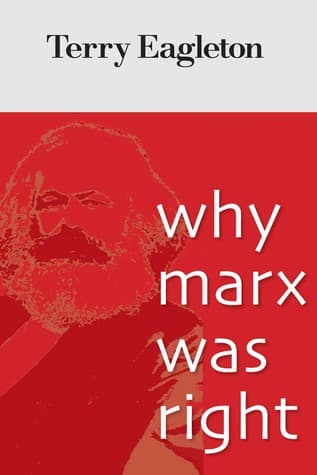
Core Idea
- Difficulty
- Medium
- Read it if
- You are curious about what Marxism actually entails beyond common stereotypes, or you want a concise, intellectual defense of Marx's core ideas and their continued relevance in the 21st century.
- Skip it if
- You are looking for an introductory text to Marxist theory from scratch, or you are completely closed off to re-evaluating any aspect of Marxist thought, or you prefer purely historical accounts without contemporary political arguments.
Key Takeaways from Why Marx Was Right
Marxism is Not Totalitarianism
Distinguishing Marx's vision from Stalinist atrocities.
One common criticism against Marxism is its supposed link to totalitarian regimes like the Soviet Union and Maoist China. Eagleton refutes this, arguing that these historical examples distort Marx's original thought, rather than being its logical result. Marx envisioned a classless society achieved through worker emancipation, stressing democratic control and individual growth, not a centralized, authoritarian state. The atrocities committed by these regimes came from specific historical, economic, and political conditions, often marked by backwardness and external threats, not from Marxist theory. To link Marx with Stalin is like blaming Jesus for the Spanish Inquisition; it ignores the vast gap between the original ideas and their later, corrupted interpretations. Marx himself criticized state power and bureaucratic control, advocating for a 'free association of producers.'
“Marxism is a critique of capitalism, not a blueprint for a utopian society, and certainly not an endorsement of Stalinist totalitarianism.”
In the book: Eagleton highlights that Marx's writings explicitly condemn censorship and advocate for freedom of the press, contrasting sharply with the repressive nature of Stalinist states. He also points out that many of these 'Marxist' states arose in predominantly agrarian societies, a context Marx never anticipated for a socialist revolution, which he believed would emerge from advanced capitalism.
Try this: When evaluating political ideologies, differentiate between the foundational theories and their historical implementations. Avoid guilt-by-association fallacies, and critically examine the specific conditions that lead to authoritarian outcomes, rather than attributing them solely to the ideology itself. Understand that a theory's misapplication does not inherently invalidate its core tenets.
Related ideas: totalitarianism, stalinism, authoritarianism, historical-materialism
Beyond Economic Determinism
Marx's nuanced view of base and superstructure.
Another common error is that Marxism reduces all human activity, culture, politics, and thought to mere reflections of economic forces. Eagleton clarifies that while Marx saw the 'economic base' (modes of production) as fundamental, he never argued for a simple, one-way determinism where the 'superstructure' (law, politics, religion, art, philosophy) is just a passive mirror. Instead, he understood the relationship as complex and interactive. The superstructure can influence the base, within certain limits. Cultural practices, political movements, and ideological struggles are not just secondary effects; they have their own relative independence and can actively shape history. To suggest otherwise ignores Marx's own extensive writings on art, literature, and philosophy, which show a sophisticated understanding of their independent importance and power to change things.
“Marxists do not believe that everything is reducible to economics. They believe that economics is ultimately determinant in the last instance, but that the 'last instance' may never arrive.”
In the book: Eagleton cites Engels's later clarifications on historical materialism, which acknowledged that the superstructure can react back upon the economic base. He also points to Marx's own engagement with classical literature and philosophy, demonstrating a deep appreciation for culture beyond its economic utility.
Try this: When analyzing social phenomena, avoid simplistic cause-and-effect explanations. Recognize that multiple factors — economic, cultural, political, and ideological — interact in complex ways. Understand that 'ultimate determination' does not mean 'sole determination' or 'immediate determination.' Seek out the interplay and feedback loops between different societal components.
Related ideas: economic-determinism, base-superstructure, historical-materialism, dialectics
Capitalism's Internal Contradictions
The inherent instability and self-destructive tendencies of the capitalist system.
Eagleton argues that Marx's most lasting insights are in his analysis of capitalism's inherent contradictions and its tendency toward crisis. Capitalism, driven by the pursuit of profit, constantly changes its production methods, creating immense wealth but also poverty, inequality, and instability. The system requires constant expansion, leading to boom-and-bust cycles, overproduction, and financial crises. The very mechanisms that make capitalism dynamic—competition, technology, globalization—also create problems by producing a vast, alienated working class and concentrating wealth. Marx saw that capitalism's drive to treat labor as a commodity would undermine its own foundations, as the system relies on the very people it exploits to consume its products, leading to a basic imbalance.
“The very forces that capitalism unleashes, the productive powers it generates, are precisely what threaten to bring it down.”
In the book: Eagleton points to the 2008 financial crisis as a stark contemporary example of capitalism's inherent instability and its tendency towards self-destruction through speculative bubbles and unregulated markets, mirroring Marx's predictions of escalating crises.
Try this: Critically analyze economic news and policies, looking beyond superficial explanations for crises. Understand that economic downturns are not merely 'glitches' but often stem from fundamental structural issues within capitalism itself, such as the drive for profit over social need, and the inherent conflict between capital and labor. Consider the long-term implications of economic policies on wealth distribution and social stability.
Related ideas: capitalism, crisis-theory, alienation, class-struggle
The End of History is Not Here
Marx's rejection of historical determinism and teleology.
Contrary to popular belief, Marx was not a simple historical determinist who believed in an inevitable, linear progression toward communism. Eagleton stresses that Marx saw history as a process driven by class struggle and human action, not by some mystical, pre-ordained fate. While he identified certain trends and contradictions in historical development, he never suggested that socialism was a guaranteed outcome. The future, for Marx, depended on human action, political organization, and the conscious efforts of the working class. The idea that history has a fixed 'end point,' whether capitalist or communist, misunderstands Marx's interactive approach, which stresses ongoing conflict and transformation rather than a final, static state. The 'end of history' idea, often linked to liberal triumph, is opposite to Marx's dynamic view of societal evolution.
“Marx did not believe in an inevitable, pre-ordained march of history towards a socialist utopia. He saw history as open-ended, shaped by human struggle and contingency.”
In the book: Eagleton highlights Marx's emphasis on revolutionary practice and the need for class consciousness, demonstrating that societal change requires active human intervention, not passive waiting for an inevitable future. He also references Marx's writings on various historical possibilities and the role of chance.
Try this: Reject fatalistic views of history and recognize the power of collective action to shape the future. Understand that social change is not automatic but requires conscious effort, organization, and struggle. Avoid assuming that current political or economic systems are permanent or 'the end of history.' Actively engage in shaping societal outcomes.
Related ideas: historical-determinism, teleology, human-agency, class-struggle, dialectical-materialism
Ethics and Justice in Marx
Uncovering the moral core behind Marx's critique of capitalism.
Despite the common idea that Marx was purely a 'scientific' analyst without ethical concerns, Eagleton argues that Marx's entire project is based on a strong moral vision and a commitment to justice. His critique of capitalism comes not just from its economic inefficiencies but, more importantly, from its dehumanizing effects: alienation, exploitation, and the denial of human potential. Marx condemned capitalism for reducing people to instruments of profit, for breaking up communities, and for stifling creativity and self-realization. His vision of communism was not just an economic arrangement but a society where individuals could truly develop their full potential, free from class and exploitation. The 'scientific' analysis exposed the mechanisms of injustice, making the moral need for change even more urgent.
“Marx's work is saturated with a passionate sense of moral outrage at the injustices and inhumanity of capitalism.”
In the book: Eagleton points to Marx's early writings on alienation, particularly in the *Economic and Philosophic Manuscripts of 1844*, which vividly describe the psychological and spiritual damage inflicted by capitalist labor. He also references Marx's consistent condemnation of poverty and inequality.
Try this: When evaluating economic and political systems, look beyond purely quantitative metrics (like GDP) to consider their ethical implications and impact on human dignity, well-being, and social justice. Recognize that a truly just society requires addressing systemic exploitation and alienation, not just providing welfare. Connect economic analysis with a moral framework.
Related ideas: alienation, exploitation, justice, ethics, human-flourishing
The Revolutionary Potential of the Proletariat
Why Marx saw the working class as the agent of transformative change.
Marx's focus on the proletariat as the agent of revolutionary change is often misunderstood as a romantic idealization. Eagleton clarifies that this was not based on moral superiority, but on a careful analysis of the working class's unique position within capitalism. The proletariat, without ownership of the means of production and forced to sell its labor, has no interest in maintaining the capitalist system. Also, its collective nature, brought together in factories and workplaces, offers the potential for organized resistance and solidarity. Unlike previous revolutionary classes, the proletariat's liberation would not involve creating a new form of exploitation, but rather abolishing class distinctions entirely, thus paving the way for universal emancipation. Their struggle is not just for themselves but for the liberation of all humanity from class society.
“The working class, by virtue of its very position within capitalism, is the only class capable of universal emancipation, for its liberation entails the liberation of all.”
In the book: Eagleton refers to Marx's analysis in *The Communist Manifesto*, which identifies the proletariat as the only truly revolutionary class under capitalism due to its lack of private property and its collective experience of exploitation, making it a universal class.
Try this: Understand that social change often originates from those most directly impacted by systemic injustices. Look for collective movements and organized labor as potential drivers of significant societal transformation. Recognize that true liberation for one group often requires dismantling structures that oppress all, even if indirectly.
Related ideas: proletariat, class-struggle, revolution, emancipation, class-consciousness
Beyond Utopia: A Practical Critique
Marx's realism contrasted with utopian socialist visions.
Many dismiss Marxism as an impractical, utopian fantasy. Eagleton argues the opposite: Marx criticized utopian socialism, which he saw as detached from the real conditions of class struggle and historical development. Unlike utopian socialists who proposed ideal societies from scratch, Marx sought to understand the inherent dynamics of capitalism and identify the real-world forces that could lead to its transformation. His vision of communism was not a detailed plan for a perfect society, but rather the 'real movement which abolishes the present state of things.' It was a practical, materialist response to capitalism's contradictions, not an abstract ideal. He believed that the conditions for a post-capitalist society were already being created within capitalism itself, through the development of productive forces and the formation of a conscious working class. His work was a scientific analysis of real trends, not a speculative fantasy.
“Marx was no utopian dreamer. His critique of capitalism was rooted in a materialist understanding of history and a practical assessment of existing social forces.”
In the book: Eagleton contrasts Marx's approach with that of utopian socialists like Robert Owen or Charles Fourier, who designed elaborate, self-contained communities. Marx, in contrast, focused on analyzing the existing capitalist mode of production and the class relations it generated.
Try this: When envisioning societal change, ground your ideas in a realistic assessment of current material conditions, power structures, and existing social forces. Avoid designing abstract 'perfect' systems without considering the practical steps and agents of change. Understand that radical transformation often emerges from the contradictions of the present, not from external ideals.
Related ideas: utopian-socialism, scientific-socialism, materialism, realpolitik, praxis
The Relevance of Alienation
How capitalism detaches us from our labor, products, species-being, and each other.
Marx's concept of alienation remains relevant today. Eagleton explains how capitalism alienates individuals from four key aspects: the product of their labor (they don't own or control what they make), the act of labor itself (work becomes a means to an end, not fulfilling), their human nature (their creative, social essence is suppressed), and from other human beings (competition replaces cooperation). In modern society, this appears as meaningless jobs, consumerism as a substitute for real fulfillment, increasing social isolation despite hyper-connectivity, and a pervasive sense of powerlessness in the face of vast economic forces. This is not just dissatisfaction but a structural condition inherent to a system where labor is a commodity and profit dictates human activity. The gig economy, automation, and the erosion of worker rights only intensify these forms of alienation, making Marx's diagnosis strikingly accurate.
“Alienation is not just a psychological state, but a fundamental structural feature of capitalist production, where human activity becomes an alien power over us.”
In the book: Eagleton directly references Marx's detailed analysis of alienation in the *Economic and Philosophic Manuscripts of 1844*. He implicitly connects this to modern phenomena like precarious work, the rise of mental health issues linked to job dissatisfaction, and the increasing sense of disconnect in consumer-driven societies.
Try this: Reflect on how your work and consumption habits contribute to or mitigate alienation. Advocate for workplaces that prioritize worker autonomy, creativity, and meaningful contribution. Critically evaluate societal structures that commodify human activity and promote isolation. Seek out ways to reconnect with your creative essence and foster genuine community.
Related ideas: alienation, commodification, exploitation, species-being, labor
Socialism as Radical Democracy
Marx's vision for a truly democratic and self-governing society.
A common misrepresentation of Marxism is that it advocates for a single, centralized state that controls all aspects of life. Eagleton counters this, arguing that Marx's vision of socialism (and communism) was about expanding democracy beyond politics into economic and social areas. He envisioned a society where the means of production are collectively owned and democratically managed by the workers, leading to true self-governance. This is far from state bureaucracy; it is about empowering individuals and communities to collectively determine their own lives and productive activities. The state, for Marx, was an instrument of class rule that would 'wither away' in a truly classless society, replaced by a free association of producers. This implies a radical decentralization of power and a real participatory democracy, very different from the top-down models seen in 'state socialist' regimes.
“For Marx, socialism was not about state ownership of everything, but about the radical democratization of production and social life.”
In the book: Eagleton points to Marx's analysis of the Paris Commune, which he lauded as a model of workers' self-governance and direct democracy, rather than a centralized state apparatus. He also emphasizes Marx's critique of bureaucracy and the state as an oppressive force.
Try this: Challenge definitions of democracy that are limited to electoral politics. Consider how democratic principles can be extended to economic decision-making, workplace governance, and community control over resources. Advocate for decentralized, participatory forms of organization rather than centralized, bureaucratic ones. Recognize that true self-determination requires economic as well as political freedom.
Related ideas: democracy, socialism, communism, state-withering, paris-commune
Marx's Enduring Critique of Capitalism
Why Marx's analysis of capitalism remains vital today.
Ultimately, Eagleton's main point is that Marx's lasting legacy lies in his critique of capitalism, a system whose fundamental dynamics and contradictions he accurately diagnosed. Even if one disagrees with his proposed solutions, his analysis of exploitation, alienation, class struggle, and capitalism's instability remains a powerful way to understand global challenges today. From financial crises and widening inequality to environmental destruction driven by endless growth, many modern problems resonate with Marx's insights. Eagleton asserts that ignoring Marx means ignoring the most incisive critique of the system that shapes our world, leaving us less equipped to understand its failings and imagine alternatives. Marx forces us to confront uncomfortable truths about power, wealth, and human freedom under capitalism, making his work essential for anyone seeking to understand or change the world.
“The relevance of Marx is not that he offered a perfect solution, but that he provided the most profound and devastating critique of the system we still inhabit.”
In the book: Eagleton frequently references the ongoing relevance of Marx's predictions regarding globalization, financial crises, and the concentration of wealth, demonstrating how these modern phenomena validate aspects of his critique.
Try this: Engage with Marx's ideas not as dogma, but as a critical tool for analyzing contemporary society. Use his framework to question dominant narratives about economics, politics, and social progress. Even if you don't fully embrace Marxism, recognize its value in exposing the structural inequalities and systemic problems within capitalism, fostering a more nuanced and critical perspective on the world.
Related ideas: capitalism-critique, class-struggle, exploitation, alienation, contemporary-relevance
Why Marx Was Right Quotes
“Marxism, by contrast, is a critique of capitalism, not a model for some future society.”
“The true measure of all wealth is the disposable time of society.”
“Capitalism will not be overthrown by a mass of starving workers with nothing to lose but their chains.”
“Marxism is not a theory of inevitable historical progress.”
“Freedom, for Marx, is not the absence of constraint, but the capacity for self-realisation.”
“Socialism is not about abolishing private property tout court, but about abolishing private ownership of the means of production.”
“The point is not just to interpret the world, but to change it.”
“It is not consciousness that determines life, but life that determines consciousness.”
“The greatest revolutions are not those that change the government, but those that change the way people think.”
“Capitalism, for Marx, is a system that constantly revolutionizes its own means of production.”
“The ruling ideas of each age have ever been the ideas of its ruling class.”
“Marx thought that capitalism would eventually run out of steam, not because it was inefficient, but because it was too efficient.”
“Marxism is not just about poverty; it's about power.”
“The state is not a neutral arbiter but an instrument of class rule.”
Quiz
10 questions on the main ideas. Each answer comes with a short explanation.
Question 1
Eagleton argues that one common objection to Marxism is that it inevitably leads to political tyranny. How does he typically counter this argument?
- By asserting that Marx himself advocated for dictatorial regimes.
- By distinguishing Marx's theoretical ideas from the later totalitarian practices carried out in his name.
- By claiming that capitalism is inherently more tyrannical than any Marxist state.
- By demonstrating that all historical communist states were, in fact, truly democratic.
Show answer
B. By distinguishing Marx's theoretical ideas from the later totalitarian practices carried out in his name. Eagleton consistently separates Marx's original theories and intentions from the distorted interpretations and brutal practices of regimes like Stalin's Soviet Union, arguing that these were not true expressions of Marxism but rather perversions of it.
Question 2
What is one of the primary reasons Eagleton gives for why 'Marxism is not dead and done with'?
- Because most modern economies are already fully socialist.
- Because capitalism continues to experience significant crises and inequalities that Marx's analysis helps to understand.
- Because academic interest in Marx has never waned.
- Because all major political parties now openly endorse Marxist principles.
Show answer
B. Because capitalism continues to experience significant crises and inequalities that Marx's analysis helps to understand. Eagleton highlights the ongoing relevance of Marx's critique of capitalism, especially in light of the system's inherent instability, crises, and its tendency to generate profound social inequalities, making Marx's insights still pertinent.
Question 3
According to Eagleton, how does Marx primarily view human nature, countering the idea that humans are inherently selfish and greedy?
- As fixed and unchangeable, always driven by self-interest.
- As entirely determined by biological factors, irrespective of society.
- As fluid and shaped by historical and social conditions, with a potential for solidarity and creative fulfillment.
- As inherently evil, requiring strong authoritarian control.
Show answer
C. As fluid and shaped by historical and social conditions, with a potential for solidarity and creative fulfillment. Eagleton explains that Marx saw human nature not as static but as profoundly shaped by the material and social conditions of existence, believing that under different conditions (e.g., beyond capitalism), people could realize their potential for collective well-being and creative labor.
Question 4
Eagleton addresses the criticism that Marxism 'reduces everything to the economic.' How does he clarify Marx's actual stance on the economy's role?
- By stating that Marx believed only economic factors influence society, with no role for culture or politics.
- By explaining that while the economy is foundational, Marx also recognized the significant, albeit mediated, influence of non-economic factors like culture, politics, and ideology.
- By arguing that Marx completely ignored economic factors in favor of purely philosophical ones.
- By claiming Marx believed the economy was irrelevant to social change.
Show answer
B. By explaining that while the economy is foundational, Marx also recognized the significant, albeit mediated, influence of non-economic factors like culture, politics, and ideology. Eagleton argues against the 'vulgar Marxist' interpretation, clarifying that Marx saw the economy as the 'base' or foundation, but acknowledged that the 'superstructure' of culture, politics, and ideology also has a relative autonomy and can influence the base in complex ways.
Question 5
When addressing the objection that Marxism is a 'form of historical determinism,' how does Eagleton typically respond regarding Marx's view of historical change?
- He agrees, stating that Marx believed history would unfold automatically regardless of human action.
- He explains that Marx saw human agency and struggle as crucial drivers of historical change, operating within specific material conditions but not predetermined by them.
- He argues that Marx had no theory of history whatsoever.
- He claims Marx believed divine intervention was the sole determinant of historical outcomes.
Show answer
B. He explains that Marx saw human agency and struggle as crucial drivers of historical change, operating within specific material conditions but not predetermined by them. Eagleton emphasizes that Marx saw history as a process driven by class struggle and human practice (praxis), not as an inevitable, mechanistic unfolding. While material conditions set limits and possibilities, human action and consciousness are essential for revolutionary change.
Question 6
Eagleton counters the idea that Marxism is 'utopian' or idealistic. How does he frame Marx's vision of a communist society?
- As a detailed blueprint for a perfect society, ignoring practical constraints.
- As a practical possibility emerging from the contradictions and material conditions of capitalism itself, rather than an abstract ideal.
- As a return to a primitive, pre-industrial form of communal living.
- As an impossible dream that Marx himself did not take seriously.
Show answer
B. As a practical possibility emerging from the contradictions and material conditions of capitalism itself, rather than an abstract ideal. Eagleton stresses that Marx's vision of communism was not a fanciful ideal but a concrete possibility arising from the productive forces and social relations developed under capitalism. It was about resolving capitalism's inherent contradictions and realizing its potential for human liberation.
Question 7
One common criticism Eagleton addresses is that Marxism is 'out of date' in the post-industrial, globalized world. How does he assert its continued relevance?
- By arguing that Marx predicted the internet and advanced technology directly.
- By demonstrating how Marx's analysis of capitalism's inherent tendencies towards globalization, crisis, and exploitation remains highly pertinent despite technological and structural changes.
- By suggesting that modern society should simply revert to 19th-century economic models.
- By claiming that Marx's theories are only applicable to agrarian societies.
Show answer
B. By demonstrating how Marx's analysis of capitalism's inherent tendencies towards globalization, crisis, and exploitation remains highly pertinent despite technological and structural changes. Eagleton argues that Marx's fundamental insights into the dynamics of capitalist accumulation, class struggle, alienation, and globalization are still crucial for understanding contemporary global capitalism, even if the specific manifestations have changed.
Question 8
Eagleton tackles the idea that Marxists are 'advocates of violent revolution.' While acknowledging Marx's views on class struggle, what nuance does Eagleton introduce regarding the path to communism?
- He states that Marx believed all change must come through peaceful, parliamentary means exclusively.
- He explains that Marx recognized the potential for different paths, including peaceful transitions in certain democratic contexts, but also understood that ruling classes rarely surrender power without resistance.
- He argues that Marx considered violence to be an end in itself, rather than a means.
- He claims Marx explicitly condemned all forms of political action.
Show answer
B. He explains that Marx recognized the potential for different paths, including peaceful transitions in certain democratic contexts, but also understood that ruling classes rarely surrender power without resistance. Eagleton points out that while Marx understood that the entrenched power of the bourgeoisie often necessitated revolutionary overthrow, he also considered the possibility of peaceful transitions in countries with robust democratic institutions, demonstrating a pragmatic rather than dogmatically violent stance.
Question 9
How does Eagleton differentiate Marx's concept of 'equality' from a crude notion of everyone being the same, a common misinterpretation?
- By arguing that Marx was not interested in equality at all, only in economic efficiency.
- By explaining that Marx's vision of equality was about the equal right to self-realization and freedom from exploitation, allowing for diverse individual development, rather than uniformity.
- By stating that Marx believed in the natural superiority of certain individuals.
- By claiming Marx's ideal society would enforce strict conformity in all aspects of life.
Show answer
B. By explaining that Marx's vision of equality was about the equal right to self-realization and freedom from exploitation, allowing for diverse individual development, rather than uniformity. Eagleton clarifies that Marx's goal was not a leveling down to sameness, but rather the creation of social conditions where every individual could equally develop their unique capacities and talents, free from the constraints of class, exploitation, and alienation.
Question 10
Eagleton frequently uses wit and humor in his writing. Which of the following best describes how he employs this stylistic choice in 'Why Marx Was Right'?
- To trivialize complex Marxist concepts and make them less serious.
- To mock Marx's original ideas and undermine their credibility.
- To make the text more engaging and accessible to a wider audience, while also sharply critiquing opponents and exposing the absurdity of common anti-Marxist prejudices.
- To distract the reader from the political arguments being made.
Show answer
C. To make the text more engaging and accessible to a wider audience, while also sharply critiquing opponents and exposing the absurdity of common anti-Marxist prejudices. Eagleton's 'familiar wit, humor, and clarity' are explicitly mentioned in the book description as tools to attract a broad audience. He uses humor not to diminish Marx but to enliven the arguments, expose the often-illogical nature of anti-Marxist critiques, and make challenging ideas more palatable and persuasive.
Why Marx Was Right FAQ
Does Marxism inevitably lead to political tyranny and totalitarian regimes?
Terry Eagleton argues that the historical examples often cited as Marxist tyrannies are gross distortions of Marx's original thought. He contends that Marx himself was a fierce critic of state power and that these regimes arose from specific historical circumstances and interpretations, rather than being an inherent outcome of Marxist theory.
What is historical materialism, and how does it relate to Marx's view of history?
Historical materialism is Marx's theory that the primary determinant of historical development is the economic base of society, specifically the mode of production. Eagleton clarifies that this doesn't imply a rigid determinism but rather emphasizes the crucial role of material conditions in shaping social relations, politics, and culture.
How is Marx's critique of capitalism different from modern socialist or social democratic movements?
Eagleton distinguishes Marx's radical critique, which aims for a fundamental transformation of the capitalist system, from reformist social democratic approaches that seek to ameliorate capitalism's excesses within its existing framework. Marx envisioned a society beyond wage labor and private ownership of the means of production, not just a more regulated capitalism.
Does Marxism reduce all human motivations and social phenomena to purely economic factors?
Eagleton refutes the common accusation that Marxism is economically reductionist. He explains that while Marx placed significant emphasis on economic structures, he also recognized the complex interplay of culture, ideology, politics, and individual agency, viewing them as deeply intertwined with, but not solely determined by, the economic base.
Is the idea of a communist utopia still relevant or achievable in the 21st century?
Eagleton addresses the utopian aspect of communism by clarifying that Marx envisioned a society of genuine human flourishing and freedom, not a perfect, static state. He suggests that while the specific path remains debated, the underlying aspiration for a more just and equitable world, free from exploitation, remains highly relevant.
How does Terry Eagleton's defense of Marx compare to other contemporary critiques or defenses of Marxism?
Eagleton's approach is characterized by its accessible language, wit, and direct engagement with common misconceptions, distinguishing it from more academic or polemical analyses. He focuses on clarifying Marx's original ideas against prevalent misrepresentations, rather than offering a new theoretical framework for Marxism.
Does Marx's theory of class struggle still apply in modern, complex societies?
Eagleton argues that while the nature of class and work has evolved, the fundamental dynamics of class power and conflict inherent in capitalism persist. He contends that the division between those who own and control capital and those who must sell their labor remains a crucial lens for understanding contemporary social and economic inequalities.
What practical implications does understanding Marx's true ideas have for addressing current global crises?
Eagleton suggests that a proper understanding of Marx provides a powerful analytical framework for comprehending the root causes of contemporary crises, such as economic inequality, financial instability, and environmental degradation, which he links to the inherent logic of capitalism. It offers a critical perspective for imagining alternative futures.
About the author

Terry Eagleton is a British literary theorist and critic known for his work in cultural theory and Marxist criticism. In his book "Why Marx Was Right," he defends Marxist ideas and addresses common misconceptions about Marx's theories. Eagleton's writings often explore the intersections of literature, politics, and philosophy.
Similar books
- 1984
George Orwell
4.2 (3.1M) average on GoodreadsPoliticsIn a future where surveillance and thought control are absolute, a man's search for truth clashes with the Party, showing that hope can be a form of rebellion.
- Animal Farm
George Orwell
4.0 (2.7M) average on GoodreadsPoliticsA farm animals' rebellion against humans turns into a pig-led dictatorship, showing how power corrupts and revolutionary ideals are betrayed.
- Freakonomics: A Rogue Economist Explores the Hidden Side of Everything
Steven D. Levitt
4.0 (709k) average on GoodreadsBusinessThis book uses economic principles to reveal the surprising incentives behind everything from drug dealing and real estate to cheating teachers and the decline of crime.
- I Am Malala: The Story of the Girl Who Stood Up for Education and Was Shot by the Taliban
Malala Yousafzai
4.1 (419k) average on GoodreadsPoliticsA teenage girl from a Taliban-controlled valley refuses to give up her books, becoming a global voice for education even after an assassination attempt.
- Atlas Shrugged
Ayn Rand
3.7 (354k) average on GoodreadsPoliticsIn a dystopian America where innovators vanish, a brilliant heiress races to uncover the truth behind the disappearing industrialists and the enigmatic John Galt, who vows to stop the world's progress.
- The Art of War
Sun Tzu
4.0 (330k) average on GoodreadsBusinessLearn ancient strategies for outsmarting rivals, whether on the battlefield or in the boardroom.






Enjoyed the summary?
A summary gives you the shape of the book. The book itself has the detail, the examples and the voice.
Find Why Marx Was Right on AmazonAs an Amazon Associate, BookBrief earns from qualifying purchases. How we're funded