
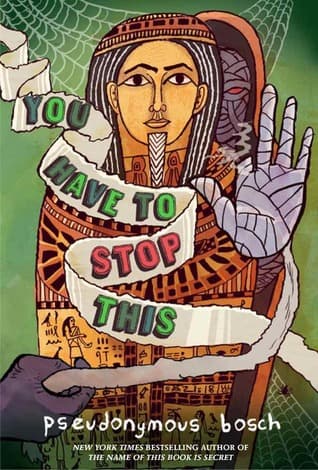
Synopsis
Covers the whole plot, including the ending.
- Difficulty
- Easy
- Pacing
- Fast
- Mood
- Whimsical, Mysterious, Humorous, Adventurous
- Read it if
- You enjoy meta-narratives, witty humor, and a blend of mystery and fantasy, especially as the conclusion to a beloved series.
- Skip it if
- You dislike authorial intrusions, fourth-wall breaks, or stories that don't take themselves too seriously.
You Have to Stop This Plot Summary
Covers the whole plot, including the ending.
The Mummy's Finger
The story begins with Cass, Max-Ernest, and Yo-Yoji on a class trip to a natural history museum. Cass accidentally breaks a finger off a valuable mummy. This draws the attention of Dr. L and Dr. M, the museum's unusual curators, who are later revealed to be part of the evil Midnight Sun. To make up for the damage, the three children are forced into an 'internship' with the doctors, doing mostly small tasks and watching their strange behavior. This incident immediately puts them back into the world of the Secret, as the doctors seem more interested in something hidden in the museum than the mummy itself.
The Disappearance of Dr. L
During their forced internship, Dr. L mysteriously disappears from the museum, leaving only a strange message and a trail of suspicion. Cass, Max-Ernest, and Yo-Yoji are immediately blamed for her disappearance, making them fugitives. This forces them to run, trying to clear their names and find out what happened to Dr. L, which they believe is connected to the larger Secret conspiracy. Their investigation leads them to think that the Midnight Sun is actively working against them, and that Dr. L may have been harmed by their plans.
The Whispering Society
Desperate for help and on the run, the children turn to the Whispering Society, a good organization that protects the Secret. They meet the Society's leader, Ms. Mauvais, and other members, including the mysterious Lord Pharaoh. With the Society, they learn more about the history of the Secret and the ongoing fight with the Midnight Sun. They also see familiar faces, including the bad Ms. Perumal, now a reluctant helper, and the ever-present Pseudonymous Bosch, who keeps narrating and giving strange warnings.
Journey to Egypt... or Not?
Following clues about the mummy and Dr. L's disappearance, the trio goes on a journey that seems to take them to Egypt. However, this journey is unclear, with signs that it might be a dream, a hallucination, or a clever trick. They find themselves in a land of pyramids, hieroglyphs, and ancient tombs, always chased by agents of the Midnight Sun. This 'Egyptian' setting serves as a symbolic place for their search to find the last parts of the Secret, making them question what is real and what the world around them is like.
The Living Dead
In the 'Egyptian' setting, Cass, Max-Ernest, and Yo-Yoji encounter what seem to be living mummies and old, booby-trapped tombs. These meetings are both scary and confusing, further blurring the lines between real and imagined. They must use their intelligence and teamwork to get through these dangerous situations, all while trying to figure out the true meaning of the mummy's curse and its link to the Secret. These challenges test their bravery and show how much they depend on each other as they go deeper into the mystery.
The Midnight Sun's Trap
As their 'Egyptian' adventure continues, the children slowly realize that their entire journey has been a complex trap, carefully planned by the Midnight Sun. They discover that the 'Egypt' they are in is not a real place but a very advanced, immersive illusion designed to get the Secret from them. Dr. M, now revealed as the true mastermind, controls their environment and what they perceive, using their own desire to find the Secret against them. This discovery is a turning point, changing their goal from finding out to escaping and resisting.
The Nature of the Secret
Through several reveals and a direct talk with Dr. M, the children finally begin to understand what the Secret really is. It is not a single object or piece of information, but a complex idea that includes the power of storytelling, the importance of imagination, and the subjective nature of truth. The Secret is a way of seeing the world, a method of understanding its mysteries through wonder and doubt. This deep understanding challenges what they previously thought and redefines their quest.
The Author's Intervention
As the plot gets more intense and the children face their greatest danger, Pseudonymous Bosch, the narrator, becomes a more active, almost physical part of the story. He steps in directly, offering warnings, advice, and even physical help, blurring the line between author and character. His fight to stay anonymous and keep his chocolate becomes tied to the children's search. This meta-narrative element shows the power of storytelling and the author's role in shaping reality, especially since the Secret itself deals with the nature of stories.
Confrontation with Dr. M
The climax shows Cass, Max-Ernest, and Yo-Yoji directly confronting Dr. M, who reveals her full plan to control the Secret for her own evil goals. She plans to use the power of stories to manipulate reality and remove wonder and mystery from the world. The children must use all their combined intelligence, their understanding of the Secret, and unexpected help from allies to stop her. This battle is not just physical but also a clash of ideas: the Midnight Sun's desire for control versus the Whispering Society's protection of mystery.
The Resolution of the Secret
In the end, Dr. M is defeated, and the immediate danger to the Secret is gone. The children, having faced their fears and understood the deep meaning of the Secret, choose to protect it by letting it remain a mystery. They realize that the Secret's true power is in its ambiguity and the endless possibilities it offers. They understand that the 'ending' is not a final conclusion but an ongoing journey of discovery and imagination, ensuring that the world stays a place of wonder and magic.
A New Beginning
After the dramatic events, Cass, Max-Ernest, and Yo-Yoji return to their seemingly ordinary lives, but they are changed forever. They carry the knowledge of the Secret, understanding its importance and their role in protecting it. While the immediate danger has passed, they know that the world is full of hidden wonders and ongoing mysteries. Their bond is stronger than ever, and they are now more observant, imaginative, and appreciative of the subtle magic that exists just beneath the surface of everyday life, ready for whatever new adventures might come.
You Have to Stop This Characters
Cass
Protagonist
A pragmatic and somewhat clumsy girl with a heightened sense of intuition.
Cass, short for Cassandra, is the practical and often skeptical member of the trio. She has a unique ability to sense things, often manifested as a 'funny feeling' in her gut, which guides them through dangerous situations. Despite her initial reluctance and occasional clumsiness, she possesses a deep loyalty to her friends and a strong moral compass. Her pragmatic nature often clashes with Max-Ernest's imaginative leaps, but her grounded perspective is crucial for their survival and problem-solving. She values truth and justice, even if it means facing uncomfortable realities.
Relationships: Max-Ernest (Best friend, intellectual partner, balances his imagination with her pragmatism); Yo-Yoji (Best friend, relies on his calm demeanor and artistic insight); Pseudonymous Bosch (Recipient of his warnings and pleas, somewhat exasperated by his intrusions)
Max-Ernest
Protagonist
An intelligent, verbose, and imaginative boy fascinated by words and facts.
Max-Ernest is a walking encyclopedia of facts, often sharing them at inopportune moments. He is highly intelligent, verbose, and possesses a boundless imagination that often leads him to elaborate theories and creative solutions. He is fascinated by words, their origins, and their hidden meanings, which proves invaluable in deciphering clues related to the Secret. Despite his occasional social awkwardness, he is brave and fiercely loyal, always ready to defend his friends. His optimism and belief in the extraordinary are infectious.
Relationships: Cass (Best friend, balances her pragmatism with his imagination); Yo-Yoji (Best friend, respects his calm wisdom and artistic perspective); Pseudonymous Bosch (A fellow lover of words and stories, often engages with his narrative style)
Yo-Yoji
Protagonist
A calm, observant, and artistic boy with a talent for music and a mysterious past.
Yo-Yoji is the quietest and most observant of the trio. He often expresses himself through his music, playing his violin, which sometimes holds clues or creates atmospheric effects. He possesses a calm demeanor and a keen eye for detail, often noticing things that Cass and Max-Ernest miss. His mysterious past, hinted at throughout the series, adds to his enigmatic aura. He is a loyal and steady friend, providing a grounding presence for the more excitable Cass and Max-Ernest. His artistic sensibility often provides unique insights into the nature of the Secret.
Relationships: Cass (Best friend, provides calm support to her pragmatism); Max-Ernest (Best friend, offers a quiet balance to his verbosity and theories); Pseudonymous Bosch (A subject of his observations, sometimes a source of subtle narrative influence)
Pseudonymous Bosch
Narrator/Supporting
The enigmatic author of the series, struggling to maintain his anonymity and chocolate supply.
Pseudonymous Bosch is the self-aware narrator of the series, frequently breaking the fourth wall to address the reader directly. He is obsessed with maintaining his anonymity and has a deep love for chocolate. He presents himself as a reluctant storyteller, constantly warning the reader about the dangers of knowing the Secret. As the series progresses, he becomes more involved in the narrative, eventually becoming a semi-character who interacts with the protagonists. He embodies the theme of storytelling itself, highlighting its power and its potential dangers.
Relationships: Cass, Max-Ernest, Yo-Yoji (Observer and chronicler of their adventures, sometimes an indirect guide or warning voice); The Reader (Directly addresses and manipulates, creating a meta-narrative relationship)
Dr. M
Antagonist
The ruthless and manipulative leader of the Midnight Sun, seeking to control the Secret.
Dr. M is the primary antagonist of the series and the cunning leader of the Midnight Sun. She is highly intelligent, manipulative, and utterly ruthless in her pursuit of the Secret, believing it should be controlled and weaponized rather than protected. She uses elaborate deceptions and psychological tactics to achieve her goals, often preying on the children's desires and fears. Her motivations stem from a desire for order and control, seeing mystery and imagination as dangerous and chaotic forces that need to be eradicated. She views the Secret as a tool for power.
Relationships: Cass, Max-Ernest, Yo-Yoji (Arch-nemesis, constantly trying to trick and capture them for the Secret); Dr. L (Former partner, whom she betrays)
Dr. L
Supporting
An eccentric museum curator and reluctant member of the Midnight Sun, with a hidden agenda.
Dr. L initially appears as an eccentric and somewhat bumbling museum curator, seemingly allied with Dr. M. However, her character is more complex, and she is revealed to be a reluctant member of the Midnight Sun, possibly acting as a double agent or having her own agenda. Her disappearance early in the book sets the main mystery in motion. She represents the internal conflict within organizations, showing that not all members are fully committed to the same cause. Her ultimate fate and true loyalties remain somewhat ambiguous, adding to the mystery.
Relationships: Dr. M (Partner in the museum, later revealed to be her victim/adversary); Cass, Max-Ernest, Yo-Yoji (Their initial supervisor, her disappearance leads to their framing)
Ms. Mauvais
Supporting
The calm and wise leader of the Whispering Society.
Ms. Mauvais is the dignified and insightful leader of the Whispering Society, the organization dedicated to protecting the Secret. She provides guidance and refuge to Cass, Max-Ernest, and Yo-Yoji, explaining the broader conflict between the Society and the Midnight Sun. She embodies wisdom and a deep understanding of the Secret's true nature, advocating for its preservation as a source of wonder rather than power. Her presence offers a beacon of hope and knowledge amidst the chaos, representing the forces of good in the ongoing struggle.
Relationships: Cass, Max-Ernest, Yo-Yoji (Mentor and protector, provides refuge and information); Lord Pharaoh (Colleague in the Whispering Society)
Ms. Perumal
Supporting
A former antagonist turned reluctant ally, with a flair for the dramatic.
Ms. Perumal is a recurring character who began as an antagonist, a member of the Midnight Sun, but has since become a reluctant ally to the children. She is known for her dramatic flair, her love of disguise, and her sometimes questionable methods. Despite her past allegiances, she demonstrates a surprising capacity for loyalty and a growing concern for the children's well-being. Her presence adds a layer of unpredictable humor and unexpected assistance, showcasing the nuanced nature of good and evil within the series.
Relationships: Cass, Max-Ernest, Yo-Yoji (Former captor, now a grudging ally who occasionally helps them); Pseudonymous Bosch (A character in his narrative, often the subject of his dramatic descriptions)
Lord Pharaoh
Supporting
A mysterious and ancient member of the Whispering Society.
Lord Pharaoh is a mysterious and ancient member of the Whispering Society, often presented with an aura of deep wisdom and historical significance. His connection to ancient knowledge and his cryptic pronouncements add to the allure and complexity of the Secret. He represents the long lineage of those who have protected the Secret throughout history. His presence reinforces the idea that the Secret is something ancient and timeless, transcending individual lives and generations. He is a quiet but powerful force within the Whispering Society.
Relationships: Ms. Mauvais (Colleague in the Whispering Society); Cass, Max-Ernest, Yo-Yoji (A source of ancient wisdom and guidance)
You Have to Stop This Themes
The Nature of Storytelling and Truth
This theme explores how stories shape our view of reality and how truth is subjective. The narrator, Pseudonymous Bosch, constantly reminds readers that the story is made up, blurring the lines between fiction and reality. The Secret itself is revealed not as a single fact, but as the power of stories and imagination. The 'Egyptian' journey, later shown to be an illusion, shows how strong stories can create their own reality. This theme encourages critical thinking about the information we take in and the stories we choose to believe, showing their power to both inform and mislead.
“A secret is meant to stay secret, after all. And now we've come to this: the fifth and final (I swear!) book in my saga of secrets.”
The Importance of Imagination and Wonder
The book supports the value of imagination and keeping wonder alive in a world that often tries to label and explain everything. The Midnight Sun, especially Dr. M, represents the wish to control and remove mystery, reducing everything to cold facts. In contrast, the Whispering Society and the main characters fight to protect the unknown, understanding that it encourages creativity, curiosity, and a sense of magic. The children's ability to believe in the extraordinary, even when faced with logical explanations, is key to their success and their grasp of the Secret. This theme suggests that real understanding comes not just from knowing facts, but from embracing possibilities beyond them.
“Some things are better left a mystery. Not because they're dangerous, but because the unknown is where wonder truly lives.”
The Power of Friendship and Teamwork
The strong bond between Cass, Max-Ernest, and Yo-Yoji is central to their ability to overcome challenges. Each character brings unique strengths to the group – Cass's intuition and practicality, Max-Ernest's intellect and imagination, and Yo-Yoji's calm observation and artistic insight. They constantly rely on each other, balancing their individual quirks and supporting each other through fear and doubt. Their combined abilities help them solve clues, escape traps, and ultimately understand the complex nature of the Secret. This theme highlights that working together and mutual respect are more powerful than individual genius, especially against overwhelming odds.
“Together, they were more than the sum of their parts, a living riddle that even the Midnight Sun could not solve.”
The Conflict Between Order and Chaos (or Control and Freedom)
This theme explores the basic conflict between the Midnight Sun's desire for absolute control and the Whispering Society's commitment to keeping freedom and the natural order of things, including the freedom to wonder and imagine. Dr. M wants to impose a rigid, fact-based reality, getting rid of ambiguity and mystery, which she sees as chaos. The Whispering Society, however, understands that true order includes the unpredictable and the unknown, allowing for growth and discovery. The fight for the Secret is ultimately a battle over whether humanity will live in a world dictated by absolute truths or one enriched by endless possibilities.
“The Midnight Sun believes that all secrets must be revealed, controlled, and ultimately, destroyed. We believe they must be protected.”
Plot Devices & Literary Techniques
Fourth Wall Break
The narrator directly addresses the reader, commenting on the story and his own role.
Pseudonymous Bosch, the narrator, frequently breaks the fourth wall, directly addressing the reader with warnings, pleas, and commentary about the narrative itself. This device serves multiple purposes: it adds a meta-fictional layer, reminding the reader that they are engaging with a story; it enhances the sense of mystery and danger, as Bosch often warns against uncovering the Secret; and it creates a unique, intimate relationship between the author and the audience. It also allows Bosch to inject his personality, humor, and chocolate-related anxieties directly into the narrative, blurring the lines between author and character.
Red Herring
Misleading clues or plot points designed to divert the reader's attention.
The narrative is replete with red herrings, particularly regarding the nature of the Secret and the location of the children's adventure. The 'Egyptian' journey is the most prominent example, initially presented as a real physical journey to Egypt, complete with ancient tombs and living mummies. This elaborate deception is later revealed to be a sophisticated illusion created by the Midnight Sun. These red herrings keep the reader guessing, mirroring the characters' own confusion and challenging their assumptions about what is real and what is not, reinforcing the theme of subjective truth and the power of narrative manipulation.
The MacGuffin (The Secret)
A plot device that drives the story forward, though its true nature is ambiguous.
The Secret itself functions as a MacGuffin for much of the series. It is the central object of desire and conflict for both the Whispering Society and the Midnight Sun, driving the plot and motivating the characters' actions. However, its true nature remains elusive and constantly redefined, especially in this final book. The Secret is not a tangible object or a simple piece of information, but rather a complex concept encompassing storytelling, imagination, and the unknown. This ambiguity allows the story to explore deeper philosophical themes about truth and wonder, rather than just focusing on a physical quest.
Unreliable Narrator
The narrator's credibility is intentionally questionable, adding to the mystery.
Pseudonymous Bosch is an inherently unreliable narrator. He constantly warns the reader not to read the book, expresses fear for his own safety and chocolate supply, and frequently interjects with personal opinions and dramatic pronouncements. His self-serving comments and occasional evasions make the reader question how much of what he says is true, or if he is intentionally obscuring facts. This device enhances the mystery surrounding the Secret and the events of the story, forcing the reader to actively interpret the narrative and consider alternative perspectives, aligning with the book's theme of subjective truth.
You Have to Stop This Quotes
“The secret is that the secret isn't what you think it is. And that's the secret.”
“There are some things in this world that are best left unknown, and then there are other things that are best left unknown until the exact right moment.”
“Sometimes the best way to get to the truth is to follow the lies.”
“It's a strange thing, a secret. It can feel like a burden, but it can also feel like a treasure.”
“The real magic, you see, isn't in what you find, but in what you're looking for.”
“Every story has a beginning, a middle, and an end. But not necessarily in that order.”
“You can't truly understand something until you've tried to make sense of it yourself.”
“Fear is a powerful ingredient. It can make you do things you never thought you'd do, and it can stop you from doing things you know you should.”
“The world is full of things that seem impossible until someone does them.”
“Sometimes, the best way to hide something is to put it right out in the open.”
“A good question is often more important than a good answer.”
“Even the most ordinary things can become extraordinary if you look at them the right way.”
“The past isn't just something that happened; it's something that continues to happen.”
“To truly know a story, you must not only read it, but also feel it, taste it, and perhaps, even smell it.”
Quiz
10 questions on the plot and the characters. Each answer comes with a short explanation.
Question 1
What object does Cass accidentally break off a priceless mummy at the natural history museum?
- Its nose
- Its toe
- Its finger
- Its ear
Show answer
C. Its finger Cass's initial 'crime' that leads to the trio working for the curator is breaking a finger off a mummy.
Question 2
Who are the three main protagonists who must clear their names after being blamed for a tragedy?
- Cass, Max-Ernest, and Owen
- Cass, Yo-Yoji, and Melanie
- Cass, Max-Ernest, and Yo-Yoji
- Max-Ernest, Yo-Yoji, and Ms. Perumal
Show answer
C. Cass, Max-Ernest, and Yo-Yoji The core trio throughout the series, Cass, Max-Ernest, and Yo-Yoji, are the ones who embark on this final adventure.
Question 3
What is the primary motivation for the trio's journey to a land of pyramids and tombs, beyond clearing their names?
- To find a hidden treasure
- To rescue a kidnapped friend
- To discover the Secret
- To stop a global warming crisis
Show answer
C. To discover the Secret The overarching goal of the entire series, and a key motivation for their journey in this book, is to finally discover 'the Secret'.
Question 4
What is the narrator's biggest concern regarding the 'Secret' being discussed by readers?
- That readers will spoil the ending for new readers
- That his chocolate supply is in danger
- That his identity will be revealed
- That the book sales will decline
Show answer
B. That his chocolate supply is in danger The narrator explicitly states that his 'life—and chocolate supply—is in the greatest danger yet' because the Secret is being discussed.
Question 5
Who does the trio go to work for after Cass's 'crime' at the museum?
- The museum director
- The mummy exhibit's curator
- A private investigator
- A history professor
Show answer
B. The mummy exhibit's curator To atone for breaking the mummy's finger, Cass and her friends are forced to work for the curator of the mummy exhibit.
Question 6
The book description hints that the land the trio travels to, described with 'majestic pyramids, dusty tombs, mysterious hieroglyphs, and the walking dead,' might be 'much stranger' than Egypt. What does this suggest about the setting?
- It's a historical recreation of ancient Egypt.
- It's a metaphor for a different kind of journey.
- It's a fantastical or altered version of Egypt, or a completely different, mysterious location.
- It's a modern city with Egyptian architecture.
Show answer
C. It's a fantastical or altered version of Egypt, or a completely different, mysterious location. The phrase 'Or somewhere much stranger...' strongly implies that the setting, while resembling Egypt, will have a fantastical, magical, or otherwise unconventional twist, fitting the series' genre.
Question 7
What is the implied consequence for the narrator if the 'Secret' continues to be discussed by readers?
- He will lose his publishing contract.
- He will be forced to write another book in the series.
- His life is in 'greatest danger yet'.
- He will run out of ideas for future stories.
Show answer
C. His life is in 'greatest danger yet'. The narrator explicitly states, 'now my life—and chocolate supply—is in the greatest danger yet' due to the Secret being discussed, implying a serious, life-threatening consequence.
Question 8
The book description includes the phrase 'I always feared this day would come. A secret is meant to stay secret, after all.' What thematic element does this opening line emphasize?
- The inevitability of change and growing up.
- The conflict between revealing and concealing information.
- The importance of honesty in all situations.
- The narrator's personal anxieties about public speaking.
Show answer
B. The conflict between revealing and concealing information. This line directly sets up the central theme of the series, which revolves around the nature of secrets, why they exist, and the consequences of their revelation.
Question 9
Given the series' title ('The Secret Series') and the narrator's plea to 'stop this,' what is the most likely 'this' the narrator is referring to for the readers?
- Reading the book too quickly.
- Discussing or revealing the nature of 'the Secret'.
- Buying too many copies of the book.
- Criticizing the book's plot.
Show answer
B. Discussing or revealing the nature of 'the Secret'. The narrator's entire persona is built around guarding 'the Secret'. His plea, 'you have to stop this!', is directed at readers who are 'reading and talking about it,' implying he wants them to stop trying to uncover or discuss the Secret itself.
Question 10
The book is described as the 'fifth and final (I swear!) book in my saga of secrets.' What does the parenthetical '(I swear!)' suggest about the narrator's relationship with the series and its readers?
- He is genuinely tired of writing and wants to move on.
- He has a playful, self-aware, and slightly unreliable narrative voice that interacts directly with the audience.
- He is under pressure from his publisher to end the series.
- He is making a legal commitment to conclude the story.
Show answer
B. He has a playful, self-aware, and slightly unreliable narrative voice that interacts directly with the audience. The 'I swear!' is a classic meta-narrative wink, indicating a playful, interactive narrator who directly addresses the reader and acknowledges the series' history, often with a hint of dramatic exaggeration or tongue-in-cheek unreliability.
You Have to Stop This FAQ
What initial incident sets the plot in motion for Cass, Max-Ernest, and Yo-Yoji?
The adventure begins when Cass accidentally breaks a finger off a priceless mummy during a class trip to the local natural history museum. This act of vandalism forces her and her friends to work for the mummy exhibit's curator as atonement, inadvertently drawing them into a larger mystery.
Who is the 'curator' they work for, and what happens to them?
Cass, Max-Ernest, and Yo-Yoji are forced to work for the mummy exhibit's curator. Shortly after they begin their atonement, tragedy strikes the curator, and the trio is blamed for the incident, compelling them to clear their names.
Where do the protagonists travel to uncover the truth and find the Secret?
To clear their names and discover the Secret, the trio embarks on a journey deep into a land of majestic pyramids, dusty tombs, mysterious hieroglyphs, and the walking dead. This destination is implied to be Egypt, or somewhere even stranger.
What is the primary goal of Cass, Max-Ernest, and Yo-Yoji on their journey?
Their primary goal is twofold: to clear their names after being blamed for the tragedy involving the curator, and more importantly, to finally discover the elusive 'Secret' that has been central to the entire series.
Who is the narrator, Pseudonymous Bosch, and what is his role in this final book?
Pseudonymous Bosch is the meta-narrator of the series, constantly breaking the fourth wall. In this final installment, he expresses fear that the Secret is about to be fully revealed, putting his life and chocolate supply in danger, and he actively pleads with the reader to 'stop this.'
What is the significance of the 'walking dead' mentioned in the synopsis?
The 'walking dead' likely refers to ancient mummies or resurrected figures, a common trope in Egyptian-themed mysteries. This element adds a layer of supernatural danger and mystery to the trio's quest, hinting at the fantastical nature of their journey beyond mere historical exploration.
How does the broken mummy finger connect to the broader Secret?
The broken mummy finger is not just a random act of vandalism; it serves as the catalyst that directly involves Cass and her friends with the curator and the mummy exhibit. This incident is the initial thread that unravels a larger conspiracy, ultimately leading them closer to the Secret, possibly by revealing a hidden message or mechanism within the exhibit itself.
What previous events or characters from the Secret Series might resurface in this finale?
Given it's the final book, it's highly probable that key antagonists like the evil Dr. L and Ms. Mauvais, or allies such as the Midnight Sun or the Terces Society, will make significant appearances. The culmination of the series demands a resolution to long-standing character arcs and factional conflicts, possibly revealing their ultimate connection to the Secret.
How does Cass's accidental vandalism reflect her character development throughout the series?
Cass often acts impulsively, driven by curiosity and a desire to understand, which sometimes leads to unintended consequences. This accidental vandalism is consistent with her character, showcasing her ability to inadvertently stumble into major plot points and her role as a primary catalyst for the group's adventures, often out of a genuine, if sometimes clumsy, engagement with the world.
What psychological impact does being blamed for a tragedy have on the protagonists?
Being falsely accused and blamed for a tragedy would likely create a strong sense of injustice and urgency for Cass, Max-Ernest, and Yo-Yoji. This pressure would fuel their determination to clear their names, fostering a deeper bond and reliance on each other while also increasing their motivation to uncover the true culprits and the Secret.
How does Max-Ernest's analytical and often anxious personality contribute to solving the mystery?
Max-Ernest's analytical mind and extensive, if sometimes random, knowledge allow him to piece together clues and understand complex information. His anxiety, while often a source of humor, also makes him cautious and observant, leading him to notice details others might miss, which is crucial for navigating the dangers of tombs and deciphering hieroglyphs.
What role does Yo-Yoji's unique perspective and skills play in the trio's success?
Yo-Yoji often brings a different perspective, sometimes artistic or philosophical, and possesses unique skills that complement Cass's impulsiveness and Max-Ernest's intellect. His calm demeanor and ability to think outside the box, possibly involving his musical talents or observational skills, are likely vital for overcoming challenges in the mysterious land.
What is the deeper meaning behind Pseudonymous Bosch's plea for readers to 'stop this'?
Bosch's plea is a meta-commentary on the nature of secrets and storytelling. It suggests that revealing the Secret entirely might diminish its power or the magic of the narrative. It also playfully implies that the act of readers engaging with and discussing the Secret puts the narrator, a fictional construct, in 'danger,' blurring the lines between fiction and reality.
How might the 'Secret' itself be interpreted in the context of the entire series' themes?
The 'Secret' could be interpreted as a literal hidden truth, but also metaphorically as the mysteries of life, the power of imagination, or the importance of friendship and discovery. Given the series' meta-narrative, it might even be a secret about storytelling itself, or the connection between author and reader, culminating in a profound revelation about the nature of their fictional world.
Is the 'Egypt? Or somewhere much stranger...' line simply a plot device, or does it hint at a deeper thematic twist?
This line strongly hints at a thematic twist beyond a simple change of scenery. It suggests that the 'Egypt' they encounter might not be the historical location, but rather a metaphorical or even fantastical realm, perhaps a construct of the Secret itself. This could imply that the 'strangeness' lies in the magical or psychological reality they uncover, rather than just geographical displacement.
How does the children's mystery genre influence the potential nature of the 'Secret' and its reveal?
In children's mystery, the 'Secret' is often something profound but ultimately understandable and empowering, rather than deeply cynical or violent. The reveal is likely to offer a sense of wonder, closure, and a moral lesson, emphasizing themes of courage, friendship, and the power of knowledge, consistent with the age group's sensibilities.
What kind of resolution can readers expect for the overarching battle between the Midnight Sun and the Terces Society?
As the series finale, readers can expect a definitive, though possibly ambiguous, resolution to the conflict between the Midnight Sun and the Terces Society. This might involve one side triumphing, a truce, or the revelation that their conflict was based on a misunderstanding of the true Secret, leading to a new understanding of their purpose.
How does the narrator's constant breaking of the fourth wall impact the reader's understanding of 'truth' within the story?
The narrator's fourth-wall breaks constantly challenge the reader to question the narrative's reality, blurring the lines between fiction and non-fiction. This encourages a meta-awareness, where 'truth' in the story isn't just about plot facts, but also about the nature of stories, secrets, and the reader's active role in constructing meaning.
Similar books
- Chasing Vermeer
Blue Balliett
3.7 (28k) average on GoodreadsChildren'sInvolves young protagonists solving an art-related mystery with quirky elements.
- Harry Potter and the Sorcerer's Stone
J.K. Rowling
4.5 (7M) average on GoodreadsFantasyRescued from a miserable life under the stairs, an orphaned boy discovers he's a wizard destined for a magical school, where he uncovers a dangerous secret tied to the dark wizard who murdered his parents.
- The Hunger Games
Suzanne Collins
4.3 (6.4M) average on GoodreadsFantasyIn a future where children fight to the death on live television, Katniss Everdeen volunteers for the arena, turning a death sentence into a fight for survival and a spark of rebellion.
- 1984
George Orwell
4.2 (3.1M) average on GoodreadsPoliticsIn a future where surveillance and thought control are absolute, a man's search for truth clashes with the Party, showing that hope can be a form of rebellion.
- Divergent
Veronica Roth
4.2 (2.9M) average on GoodreadsFantasyIn a society divided by virtues, a sixteen-year-old's difference from the norm starts a rebellion that threatens her world.
- The Hobbit, or There and Back Again
J.R.R. Tolkien
4.3 (2.9M) average on GoodreadsFantasyA comfort-loving hobbit named Bilbo Baggins is whisked away by a mischievous wizard and a band of dwarves on an unexpected journey to reclaim stolen treasure from a fearsome dragon, discovering courage and a magical ring along the way.





Enjoyed the summary?
A summary gives you the shape of the book. The book itself has the detail, the examples and the voice.
Find You Have to Stop This on AmazonAs an Amazon Associate, BookBrief earns from qualifying purchases. How we're funded