

Core Idea
- Difficulty
- Medium
Key Takeaways from A New Earth
The Ego's Tyranny
Understanding how our identification with the ego fuels suffering and dysfunction.
Tolle says human suffering comes from identifying with the ego. This false self is made of thoughts, emotions, and external things like possessions, status, roles, and beliefs. This ego-driven mind constantly seeks validation, control, and separation, which leads to ongoing dissatisfaction, conflict, and anxiety. The ego always feels it's 'not enough' and feeds the 'pain-body,' a collection of old emotional pain. Recognizing this identification is the first step toward freedom. It lets us observe the ego's actions instead of being controlled by them. This insight helps us shift control from outside events to our inner awareness.
“The primary cause of unhappiness is never the situation but your thoughts about it.”
In the book: Tolle frequently uses the metaphor of 'the pain-body' to describe the energetic accumulation of past emotional trauma that the ego feeds on and perpetuates.
Try this: Practice observing your thoughts and emotional reactions without judgment, recognizing them as products of the ego rather than your true self. Ask: 'What is the ego trying to gain or protect here?'
Awakening to Presence
The transformative power of living in the 'Now' as the antidote to ego-driven suffering.
The book's main solution to ego-identification is to wake up to the present moment. Tolle states that true consciousness, or 'presence,' exists outside of linear time (past and future), which are just mental ideas. By fully living in the 'Now,' we stop the ego's constant mental chatter, its focus on what was or will be, and its creation of problems that don't exist in the current moment. This state of presence is not just an intellectual idea but a felt experience of inner calm and openness. It lets us see reality directly, without the ego's filters. This is the book's strongest idea, offering a way to inner peace.
“The present moment is all you ever have. Make the Now the primary focus of your life.”
In the book: Tolle describes how focusing on sensory input (e.g., the feeling of breath, sounds, sights) can anchor one in the present moment, illustrating a practical technique for achieving presence.
Try this: Consciously bring your attention to your breath, the sounds around you, or the sensations in your body throughout the day. When you find your mind wandering to past regrets or future anxieties, gently bring it back to the present.
Beyond Happiness and Unhappiness
Discovering a deeper state of joy and peace that transcends emotional dualities.
Tolle argues that chasing 'happiness' through the ego is pointless. It always depends on outside events and eventually leads to unhappiness. Instead, he points to a deeper state of 'joy' or 'peace' that comes from within, regardless of outside conditions. This state is not an emotion but an underlying awareness, a basic part of our true nature that appears when the ego's hold lessens. It is a recognition of life's inherent aliveness and sacredness. This view challenges common ideas of well-being, suggesting that true fulfillment is not about getting positive experiences but about moving past the need for them.
“True happiness is not a state of mind, but a state of being.”
In the book: Tolle recounts how even in challenging situations, one can access an underlying peace by accepting the 'isness' of the moment, detaching from the mind's resistance.
Try this: Instead of striving for happiness, practice acceptance of 'what is' in any given moment, even uncomfortable ones. Notice the underlying sense of aliveness that persists beneath emotional fluctuations.
The Purpose of Suffering
How suffering can be a catalyst for spiritual awakening and the dissolution of the ego.
Tolle does not promote suffering, but he suggests it serves an evolutionary purpose: to awaken humanity. When the ego's control and gratification methods fail, and the pain-body becomes unbearable, it creates a turning point. This breakdown can force someone to question their ego-identification and look for a deeper truth beyond the mind's ideas. Suffering, especially intense suffering, can be a 'grace' that breaks the false self, opening a door to presence and conscious awareness. This idea can be difficult for some, as it redefines pain not as something to avoid, but as a potential teacher. However, Tolle distinguishes between unavoidable pain and self-imposed suffering (resisting pain).
“All true suffering is caused by resistance to what is.”
In the book: Tolle's own spiritual awakening, detailed in 'The Power of Now,' began after a period of intense mental suffering, illustrating this principle directly.
Try this: When facing difficult situations, instead of resisting or complaining, try to observe your internal reaction. Ask yourself if there's an opportunity for surrender and acceptance, rather than fighting against 'what is.'
Inner and Outer Purpose
Distinguishing between the universal purpose of awakening and individual life roles.
Tolle describes two kinds of purpose: inner and outer. The 'inner purpose' is the same for all humans: to awaken to consciousness, be fully present, and align with life's deeper intelligence. This is not something to achieve later but is available 'Now.' The 'outer purpose' refers to individual goals, roles, and actions in the world (e.g., career, relationships, creative projects). He stresses that the outer purpose becomes truly effective only when it aligns with and flows from the inner purpose. Without this alignment, external achievements often lead to emptiness and dissatisfaction. This difference helps clarify what genuine fulfillment means.
“Your primary purpose is to be here, fully and consciously.”
In the book: Tolle explains how an artist, for example, might create beautiful work from an egoic desire for fame, or from a deep inner wellspring of presence and creativity, with vastly different internal experiences.
Try this: Before engaging in any activity, pause and consciously connect with your inner state. Ask: 'Am I doing this from a place of presence and alignment, or from egoic striving?'
Relationships as Spiritual Practice
How conscious relationships can accelerate awakening and dissolve the ego.
Tolle sees close relationships not just as sources of pleasure or companionship, but as strong drivers for spiritual growth. He explains how relationships often trigger the pain-body and reveal ego patterns (e.g., control, judgment, neediness). However, if both partners can use these triggers to observe their ego, practice presence, and take responsibility for their inner state instead of reacting unconsciously, the relationship becomes a spiritual practice. This means accepting the partner's 'otherness,' letting go of expectations, and loving unconditionally. This is a challenging but ultimately freeing way to view human connection.
“The most important spiritual practice is to be present in your relationships.”
In the book: Tolle describes how a partner's criticism can be met with an awareness of one's own triggered pain-body, rather than an automatic defensive reaction, leading to a conscious response instead of an unconscious one.
Try this: In moments of conflict or tension in a relationship, pause before reacting. Observe the emotions and thoughts arising within you. Can you choose presence over egoic defense?
The Collective Awakening
Humanity's potential shift from egoic consciousness to a new Earth.
Tolle applies his individual teachings globally, suggesting humanity is at a turning point, undergoing a collective spiritual awakening. The ego's dysfunction, seen in global conflicts, environmental damage, and widespread suffering, is pushing humanity to a point where a basic shift in consciousness is becoming necessary for survival. He envisions a 'new Earth' emerging from enough individuals who awaken to presence, moving beyond their egoic patterns. This shift is an evolutionary need, leading to a more harmonious and conscious way of living on the planet. While inspiring, the timing and method of this collective shift remain somewhat vague.
“A new heaven and a new earth are not a hope but a certainty.”
In the book: Tolle points to the increasing awareness of ecological crises and global conflicts as evidence of the ego's destructive peak, which could catalyze a collective awakening.
Try this: Recognize that your personal awakening contributes to the collective shift in consciousness. Engage in conscious actions that reflect your awakened state, however small they may seem.
The Inner Body as a Portal
Connecting with the energy field of the inner body to deepen presence.
Beyond just observing thoughts, Tolle introduces connecting with the 'inner body' – the subtle energy field that animates the physical form. By focusing conscious attention on the body's sensations, one can bypass constant mental chatter and deepen their experience of presence. This practice grounds consciousness, anchors it in the 'Now,' and offers a direct way to the underlying 'Being' that is our true essence. He suggests the inner body is a direct link to the universal life force, and regular connection with it can dissolve the pain-body and strengthen conscious awareness. This is a practical and often overlooked part of his teaching.
“Your body is the most incredible vehicle for awakening.”
In the book: Tolle encourages regularly focusing on the feeling of aliveness in one's hands, feet, or the entire body as a means to disengage from thought and enter presence.
Try this: Take a few minutes each day to close your eyes and feel the subtle energy or aliveness throughout your body, particularly in your hands and feet. Let your awareness rest there.
Beyond Form and Name
Recognizing our true identity as consciousness itself, prior to any manifestation.
Tolle's ultimate teaching points to our true identity as formless consciousness, a deeper 'I Am' that comes before all mental and physical forms. The ego, in contrast, gets its identity from 'form' – thoughts, roles, possessions, and external labels. Awakening involves shifting from identifying with these temporary forms to recognizing oneself as the eternal, unchanging awareness that observes them. This 'unmanifested' dimension is the source of all life and creativity, and connecting with it brings a deep sense of peace and wholeness. This is perhaps his most abstract idea, needing a significant change in how one views themselves.
“You are not your thoughts, emotions, or identity. You are the awareness that is aware of them.”
In the book: Tolle often uses the analogy of the 'space' in which all objects appear, suggesting that consciousness is the space in which all thoughts and forms arise.
Try this: Practice disidentifying from your thoughts and emotions by simply observing them. Recognize that you are the awareness that is watching, not the thoughts themselves.
The Art of Conscious Doing
Bringing presence to everyday tasks, transforming them into spiritual practice.
Tolle emphasizes that spiritual awakening is not just for meditation retreats or specific spiritual practices; it should be part of daily life. By bringing conscious attention – presence – to everyday tasks (e.g., washing dishes, walking, waiting in line), these activities become opportunities for deeper awareness. This 'conscious doing' keeps the mind from drifting into egoic thought patterns and anchors one in the present moment, giving even simple actions a sense of sacredness and purpose. This practical approach makes his philosophy accessible and usable for anyone, regardless of their lifestyle.
“Whatever you do, do it with attention. Do it with presence.”
In the book: Tolle suggests that even a simple task like waiting can be an opportunity for presence, rather than a cause for impatience or frustration, by simply observing the waiting itself.
Try this: Choose one routine daily activity (e.g., brushing your teeth, making coffee) and commit to doing it with full, conscious attention, noticing every sensation and movement.
Quiz
10 questions on the main ideas. Each answer comes with a short explanation.
Question 1
What is the primary focus of Eckhart Tolle's "A New Earth"?
- Achieving financial success through mindfulness.
- Transcending the ego-based state of consciousness.
- Developing advanced meditation techniques.
- Understanding the history of spiritual movements.
Show answer
B. Transcending the ego-based state of consciousness. The book's core message is about moving beyond our ego-driven consciousness to achieve personal happiness and global peace.
Question 2
According to the book, what is the root cause of dysfunction such as anger, jealousy, and unhappiness?
- External circumstances and societal pressures.
- A lack of spiritual enlightenment.
- Attachment to the ego.
- Unresolved childhood trauma.
Show answer
C. Attachment to the ego. Tolle posits that our identification with and attachment to the ego is what creates these negative emotional states.
Question 3
How does "A New Earth" differ in format from its predecessor, "The Power of Now"?
- "A New Earth" is a collection of poems, while "The Power of Now" is a novel.
- "A New Earth" is a traditional narrative with anecdotes, while "The Power of Now" was a Q&A handbook.
- Both books are written in a similar Q&A format.
- "A New Earth" is a scientific study, while "The Power of Now" is a philosophical treatise.
Show answer
B. "A New Earth" is a traditional narrative with anecdotes, while "The Power of Now" was a Q&A handbook. The text explicitly states that "The Power of Now" was a Q&A handbook, and "A New Earth" is written as a traditional narrative.
Question 4
What does Tolle suggest is the key to ending conflict and suffering throughout the world?
- Global economic reform and equitable resource distribution.
- Political unification and international treaties.
- Transcending our ego-based state of consciousness.
- Technological advancements and artificial intelligence.
Show answer
C. Transcending our ego-based state of consciousness. The book argues that the collective egoic consciousness is the source of global conflict, and its transcendence is the path to peace.
Question 5
The book describes the ego as a source of dysfunction. What does it mean for consciousness to be "ego-based" in Tolle's context?
- Consciousness is solely focused on physical survival.
- Consciousness is identified with thoughts, possessions, and the false self-image.
- Consciousness is limited to rational and logical thinking.
- Consciousness is entirely dependent on external validation.
Show answer
B. Consciousness is identified with thoughts, possessions, and the false self-image. An ego-based consciousness, as described by Tolle, is one where an individual's sense of self is primarily derived from their thoughts, mental labels, possessions, and a constructed self-image, rather than their true being.
Question 6
What is the ultimate goal of awakening to a "new state of consciousness" as presented in the book?
- To gain supernatural powers.
- To achieve perfect mental control.
- To follow the path to a truly fulfilling existence.
- To become a recognized spiritual leader.
Show answer
C. To follow the path to a truly fulfilling existence. The book presents this awakening as the means to discover a life that is genuinely satisfying and meaningful.
Question 7
The book is described as a "spiritual manifesto for a better way of life." What does this imply about its intended impact?
- It aims to provide a strict set of rules for daily living.
- It seeks to inspire a fundamental transformation in how individuals perceive and live their lives.
- It is a historical document detailing the evolution of spiritual thought.
- It offers practical advice for career advancement.
Show answer
B. It seeks to inspire a fundamental transformation in how individuals perceive and live their lives. A manifesto suggests a declaration of principles and intentions, aiming to guide and inspire a profound shift in perspective and behavior.
Question 8
Eckhart Tolle's "A New Earth" is the follow-up to which bestselling inspirational book?
- The Stillness Speaks
- Practicing the Power of Now
- The Power of Now
- Stillness: The Essence of the Spiritual Path
Show answer
C. The Power of Now The book description explicitly mentions "The Power of Now" as the previous bestselling work by Eckhart Tolle.
Question 9
What is the approximate sales figure mentioned for "The Power of Now" in the description?
- 500,000 copies
- 1 million copies
- 2 million copies
- 5 million copies
Show answer
C. 2 million copies The text states, "The highly anticipated follow-up to the 2,000,000 copy bestselling inspirational book, 'The Power of Now.'"
Question 10
The book suggests that transcending the ego is essential not only for personal happiness but also for what broader global outcome?
- Achieving universal technological singularity.
- Establishing a unified global government.
- Ending conflict and suffering throughout the world.
- Creating a sustainable global economy.
Show answer
C. Ending conflict and suffering throughout the world. The description explicitly links the transcendence of the ego to the potential for ending global conflict and suffering.
A New Earth FAQ
What is the main message of Eckhart Tolle's A New Earth?
A New Earth's central message is about transcending our ego-based state of consciousness. Tolle argues that our attachment to the ego is the root cause of personal unhappiness and global conflict, and that awakening to a higher consciousness is the key to both individual fulfillment and world peace.
How does A New Earth differ from The Power of Now?
While 'The Power of Now' was structured as a Q&A handbook, 'A New Earth' is written in a traditional narrative style. It expands on the concepts of presence and ego, offering anecdotes and philosophical insights in a more accessible, storytelling format.
What is the role of the ego in A New Earth?
Tolle describes the ego as a false sense of self, built on identification with possessions, status, and the past. He explains how this egoic identification creates dysfunction, leading to negative emotions like anger, jealousy, and unhappiness.
What does Eckhart Tolle mean by 'awakening to a new earth'?
Awakening to a new earth signifies a shift in consciousness away from the ego and towards a state of presence and interconnectedness. It's about recognizing your true spiritual nature beyond the limitations of the ego.
How can reading A New Earth help me find my life's purpose?
The book suggests that by detaching from the ego and embracing presence, you can access a deeper sense of purpose. This purpose isn't necessarily tied to external achievements but rather to living in alignment with your true being.
Is A New Earth a religious book?
While deeply spiritual, 'A New Earth' is not tied to any specific religion. Tolle draws from various spiritual traditions and philosophies to present universal truths about consciousness and the human condition.
What are the benefits of transcending the ego according to the book?
Transcending the ego leads to inner peace, emotional freedom, and a reduction in suffering. It also fosters greater compassion and understanding, contributing to more harmonious relationships and a more peaceful world.
Who is the target audience for A New Earth?
The book is for anyone seeking greater happiness, peace, and meaning in their lives. It's particularly relevant for those interested in spirituality, psychology, and personal transformation, and those who enjoyed 'The Power of Now'.
Does A New Earth offer practical steps for spiritual awakening?
Yes, while presented narratively, the book offers profound insights and guidance on how to recognize egoic patterns, cultivate presence, and shift your state of consciousness towards greater awareness and fulfillment.
How does the book connect individual awakening to global change?
Tolle posits that collective suffering stems from the collective ego. Therefore, individual awakening and the dissolution of egoic identification are presented as the fundamental pathway to transforming societal conflict and creating a better world.
About the author
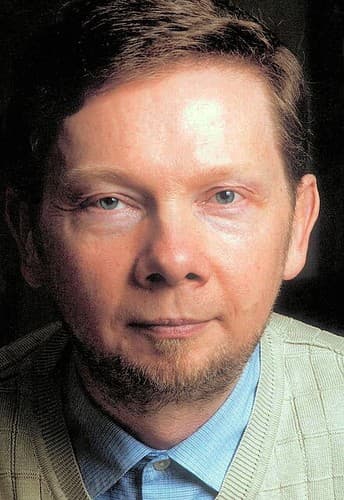
Eckhart Tolle is a spiritual teacher and author renowned for his profound insights into consciousness and personal transformation. His bestselling works, including "The Power of Now" and "A New Earth," have guided millions worldwide toward greater presence and inner peace. Tolle's teachings emphasize the importance of living in the present moment and transcending the ego for spiritual enlightenment.
Similar books
- The Power of Now: A Guide to Spiritual Enlightenment
Eckhart Tolle
4.1 (211k) average on GoodreadsPsychologyWhile 'A New Earth' expands on the concepts of ego and collective consciousness, 'The Power of Now' is more foundational and singularly focused on the immediate experience of presence and transcending thought. 'A New Earth' feels like the next logical step for readers who have absorbed the lessons of 'The Power of Now,' offering a broader societal and evolutionary perspective on awakening.
- Man's Search for Meaning
Viktor E. Frankl
4.4 (401k) average on GoodreadsBiographyFrankl's work, while also addressing purpose and meaning, does so from a profoundly different, existential, and psychological perspective rooted in extreme suffering. While Tolle suggests transcending the ego to find purpose, Frankl argues that meaning can be found even in the most dire circumstances, through choice and responsibility. Tolle focuses on inner stillness and presence, whereas Frankl emphasizes proactive meaning-making and overcoming adversity. Both offer paths to a richer life, but Tolle's is more about shedding, Frankl's more about building.
- The Perks of Being a Wallflower
Stephen Chbosky
4.2 (1.3M) average on GoodreadsPsychologyThrough letters, a shy high school freshman learns to navigate first love, trauma, and self-discovery, stepping off the sidelines and into life.
- Eleanor Oliphant Is Completely Fine
Gail Honeyman
4.3 (708k) average on GoodreadsLiterary FictionA lonely woman's structured life changes when an IT guy and an elderly man help her learn to open her heart.
- One Flew Over the Cuckoo's Nest
Ken Kesey
4.2 (631k) average on GoodreadsPsychologyIn a mind-bending asylum, the boisterous Randle McMurphy wages a defiant war against the tyrannical Nurse Ratched, inspiring his fellow inmates, including the seemingly catatonic Chief Bromden, to reclaim their lost humanity.
- The Bell Jar
Sylvia Plath
4.0 (591k) average on GoodreadsPsychologyIn the suffocating grip of 1950s expectations, a brilliant young woman's descent into mental illness is painted with such vivid, internal clarity that her 'insanity' feels terrifyingly rational and inevitable.





Enjoyed the summary?
A summary gives you the shape of the book. The book itself has the detail, the examples and the voice.
Find A New Earth on AmazonAs an Amazon Associate, BookBrief earns from qualifying purchases. How we're funded