BookBrief Logo
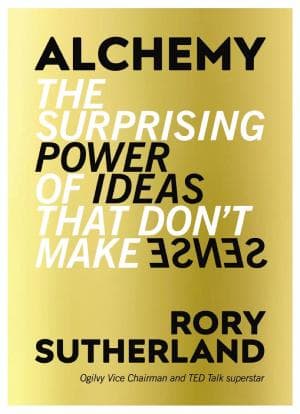
Alchemy
Add to Your Library

Sign in to save this book to your reading lists

"Alchemy" Summary

"Alchemy" explores the transformational power of unconventional thinking to solve complex problems and drive innovation in business and life.

Estimated read time: 5 min read

One Sentence Summary

"Alchemy" explores the transformational power of unconventional thinking to solve complex problems and drive innovation in business and life.

Introduction

"Alchemy" by Rory Sutherland is an intriguing exploration into the world of behavioral economics and psychology. It challenges conventional thinking and emphasizes the importance of creativity in problem-solving. Sutherland, a renowned advertising executive, presents the idea that logical reasoning often falls short in understanding human behavior. Instead, he advocates for embracing the irrational and unpredictable nature of people to achieve breakthrough results.

Author's Expertise and Credibility

Rory Sutherland is Vice Chairman of Ogilvy UK, a leading advertising and marketing agency. His extensive experience in the industry provides him with unique insights into consumer behavior. Sutherland is known for his engaging talks on behavioral economics, and his expertise is well-regarded in the field. His book, "Alchemy," draws on years of practical experience and theoretical knowledge.

Core Concepts and Ideas

Summary of Main Ideas

Sutherland argues that logical solutions are not always the most effective. He suggests that embracing irrationality can lead to innovative breakthroughs. The book presents the idea that human behavior often defies logic, and understanding this can unlock creative solutions. Sutherland emphasizes the importance of psychological insights in business and marketing strategies.

Importance of the Topic

The book is significant because it challenges traditional problem-solving methods. In a world dominated by data and analytics, "Alchemy" highlights the value of human intuition and creativity. It encourages readers to look beyond numbers and embrace the unpredictable aspects of human nature. This approach is particularly relevant in marketing, where understanding consumer behavior is crucial.

Chapter-by-Chapter Summary

Introduction

Summary

Sutherland introduces the concept of "Alchemy" as a metaphor for creative problem-solving. He argues that logic and reason are not always effective in understanding human behavior.

Key Takeaways

  • Embrace irrationality for innovative solutions.
  • Logic is not always the best guide.

Chapter 1: The Logic Trap

Summary

Sutherland discusses the limitations of logic and data-driven decision-making. He explains how over-reliance on rational thinking can hinder creativity.

Key Takeaways

  • Logic can limit creative thinking.
  • Understand the limitations of data.

Chapter 2: The Importance of Context

Summary

The author emphasizes the role of context in shaping human behavior. He explains that people often make decisions based on their environment rather than logic.

Key Takeaways

  • Context influences behavior.
  • Consider environmental factors in decision-making.

Chapter 3: Psychological Insights

Summary

Sutherland explores various psychological principles that affect decision-making. He highlights the importance of understanding these insights in marketing.

Key Takeaways

  • Psychological principles are crucial in marketing.
  • Understand consumer psychology for effective strategies.

Chapter 4: The Power of Perception

Summary

The author discusses how perception can shape reality. He explains how marketers can use perception to influence consumer behavior.

Key Takeaways

  • Perception can alter reality.
  • Use perception to influence decisions.

Chapter 5: The Role of Emotions

Summary

Sutherland delves into the role of emotions in decision-making. He argues that emotions often drive behavior more than rational thought.

Key Takeaways

  • Emotions play a crucial role in decision-making.
  • Appeal to emotions in marketing strategies.

Chapter 6: The Art of Storytelling

Summary

The author highlights the power of storytelling in influencing behavior. He explains how narratives can engage and persuade audiences effectively.

Key Takeaways

  • Storytelling is a powerful tool.
  • Use narratives to engage consumers.

Chapter 7: Embracing Uncertainty

Summary

Sutherland encourages readers to embrace uncertainty and unpredictability. He argues that accepting the unknown can lead to creative breakthroughs.

Key Takeaways

  • Embrace uncertainty for innovation.
  • Accept unpredictability in problem-solving.

Chapter 8: Challenging Assumptions

Summary

The author discusses the importance of challenging assumptions and conventional wisdom. He explains how questioning norms can lead to new insights.

Key Takeaways

  • Question assumptions for new insights.
  • Challenge conventional wisdom.

Practical Applications

Sutherland's insights can be applied in various fields, particularly in marketing and business strategy. By understanding the psychological factors that drive behavior, marketers can create more effective campaigns. Embracing creativity and intuition can lead to innovative products and services. Businesses can benefit from challenging the status quo and exploring unconventional solutions.

Supporting Evidence and Examples

Throughout the book, Sutherland provides numerous real-life examples and case studies. These illustrate how embracing irrationality and creativity can lead to successful outcomes. He draws on his experience in advertising to showcase the power of unconventional thinking. These examples serve as evidence of the book's core concepts in action.

Critical Insights

"Alchemy" offers a refreshing perspective on problem-solving and decision-making. Sutherland's insights challenge traditional approaches and encourage readers to think differently. However, some may argue that the book's ideas lack empirical support. While the emphasis on creativity is compelling, it may not always be practical in data-driven environments.

Reader's Benefits

Readers of "Alchemy" can expect to gain a deeper understanding of human behavior. The book provides valuable insights into consumer psychology and marketing strategies. It encourages readers to embrace creativity and intuition in problem-solving. By challenging conventional thinking, readers can unlock new opportunities for innovation.

Conclusion

"Alchemy" by Rory Sutherland is a thought-provoking exploration of behavioral economics and creativity. It challenges traditional problem-solving methods and highlights the importance of understanding human behavior. Sutherland's insights are valuable for marketers, business leaders, and anyone interested in psychology. Readers are encouraged to delve deeper into the book to discover its full potential. By embracing the unpredictable nature of human behavior, "Alchemy" offers a pathway to innovative solutions.

Alchemy FAQ

  1. What is the main theme of the book 'Alchemy'?

    The main theme of 'Alchemy' revolves around transformation and the pursuit of knowledge and enlightenment, often through mystical or symbolic means.

  2. Who is the target audience for 'Alchemy'?

    The book 'Alchemy' is typically aimed at readers interested in philosophy, mysticism, and the history of science, as well as those curious about the allegorical aspects of alchemy.

  3. Does 'Alchemy' provide historical context about the practice?

    Yes, 'Alchemy' often includes historical context about the practice, exploring its origins, evolution, and influence on modern science and culture.

  4. How does 'Alchemy' connect with modern-day science?

    The book draws parallels between ancient alchemical practices and modern-day scientific processes, highlighting how past beliefs and experiments have contributed to current scientific understanding.

  5. Is 'Alchemy' more focused on scientific or mystical aspects?

    While 'Alchemy' delves into both scientific and mystical aspects, it tends to emphasize the symbolic and philosophical interpretations of alchemy more than the empirical scientific practices.

  6. What kind of transformation is discussed in 'Alchemy'?

    In 'Alchemy', transformation is discussed both in a literal sense, such as turning base metals into gold, and in a metaphorical sense, such as personal and spiritual enlightenment.

  7. Does the book 'Alchemy' include any notable historical figures?

    Yes, 'Alchemy' often references notable historical figures who practiced or were influenced by alchemy, such as Paracelsus, Isaac Newton, and Carl Jung.

  8. Are there any practical applications of alchemy explored in the book?

    While the book may touch upon practical applications, the focus is generally on the theoretical and philosophical aspects rather than detailed practical instructions.

  9. What is the significance of symbols in 'Alchemy'?

    Symbols in 'Alchemy' are significant as they represent various elements, processes, and philosophical ideas, serving as a means to convey deeper meanings and insights.

  10. Does 'Alchemy' address the cultural impact of alchemy?

    Yes, 'Alchemy' often addresses the cultural impact by exploring how alchemical ideas and practices have influenced art, literature, and cultural beliefs throughout history.