
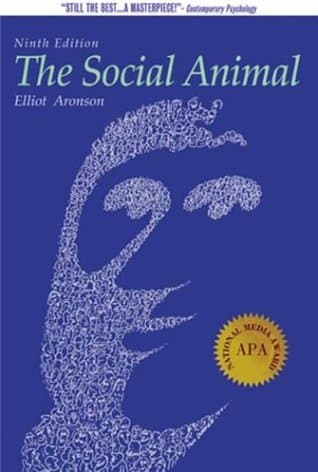
Core Idea
- Difficulty
- Medium
- Read it if
- You want a comprehensive, accessible, and engaging introduction to the core concepts and seminal experiments of social psychology, and how they explain everyday human behavior and societal phenomena.
- Skip it if
- You are looking for a highly specialized or advanced academic text on a niche area of social psychology, or prefer books with a primary focus on neuroscience or clinical psychology.
Key Takeaways from The Social Animal
The Power of Self-Justification
Humans rationalize their actions to maintain a positive self-image, often leading to irrational behavior.
Cognitive dissonance is a strong force that makes people change their attitudes or beliefs to match their past actions, especially when those actions are voluntary and have big effects. This is not just about small inconsistencies; it is a basic way to maintain self-esteem. When we put time, effort, or suffer for something, we tend to value it more, even if facts suggest it is not worth it. This self-justification can lead to a 'slippery slope' where small initial decisions are explained away, opening the door for more extreme behaviors that would have seemed impossible at first. Understanding this process helps explain how people become stuck in belief systems, political views, or even cults, often against their own long-term interests.
“When people are induced to do something that is inconsistent with their beliefs, they will change their beliefs to reduce the discomfort caused by the inconsistency.”
In the book: Aronson details classic experiments, such as the 'initiation' studies, where participants who underwent a severe initiation to join a group rated the group as more attractive than those who underwent a mild or no initiation, even when the group was objectively boring. This demonstrated their justification for the effort and discomfort.
Try this: When making significant decisions, especially those involving effort or sacrifice, pause and critically evaluate the objective value of the outcome, rather than just justifying the effort. Be wary of situations where you're asked to make small, seemingly innocuous commitments that could lead to larger, less desirable ones through self-justification.
Related ideas: cognitive-dissonance, self-esteem, rationalization
The Allure of Conformity
The pressure to fit in can override individual judgment, even when the group is demonstrably wrong.
Humans are social animals, and the need to belong is very strong. This often shows up as conformity, where people adjust their behavior, attitudes, or beliefs to fit group standards. Aronson points out that conformity is not always bad; it is necessary for social unity. However, it becomes a problem when it stops critical thinking or leads to harmful results. Two main reasons drive conformity: informational influence (believing the group has better information) and normative influence (wanting to be liked and to avoid rejection). The power of the group can be so great that people will ignore their own senses or moral compass rather than stand out, showing a basic conflict between individual freedom and social belonging.
“Most of us are not as independent as we think we are. The desire to be liked and accepted can lead us to conform to group norms, even when those norms contradict our own perceptions.”
In the book: The classic Asch conformity experiments, where participants were asked to judge the length of lines. Despite obvious visual evidence, many conformed to the incorrect answers given by confederates, demonstrating the powerful pull of normative influence.
Try this: Cultivate environments where dissenting opinions are not only tolerated but encouraged. Before making a decision based on group consensus, independently verify information and consider the potential for groupthink. Actively seek out diverse perspectives to challenge your own assumptions.
Related ideas: groupthink, social-influence, normative-influence
Obedience to Authority: A Dangerous Default
Individuals are disturbingly willing to follow orders from authority figures, even when those orders conflict with their conscience.
The Milgram experiments clearly show how people can be destructively obedient. Aronson explains how situations, not bad intentions, can make ordinary people cause harm when given orders. Key factors include the authority figure's perceived legitimacy, the gradual increase of commands, and the spreading of responsibility. People tend to enter an 'agentic state,' where they see themselves as tools carrying out someone else's will, giving up personal moral responsibility. This phenomenon helps explain historical atrocities, from genocides to daily ethical mistakes in organizations, showing how fragile individual moral resistance can be when faced with powerful authority.
“The most frightening aspect of the obedience experiments is not that people are inherently evil, but that ordinary people, simply doing their jobs, and without any particular hostility on their part, can become agents in a terrible destructive process.”
In the book: The Milgram obedience experiments, where participants administered what they believed were increasingly painful electric shocks to a 'learner' on the instruction of an experimenter, despite the learner's protests.
Try this: Develop a strong internal moral compass and be prepared to question authority, especially when asked to do something that feels ethically wrong. Understand that 'just following orders' is not a valid excuse for unethical behavior. Foster a culture in organizations where subordinates are empowered to speak up against questionable directives.
Related ideas: milgram-experiment, agentic-state, diffusion-of-responsibility
The Fundamental Attribution Error
We overemphasize dispositional factors and underestimate situational ones when explaining others' behavior.
The fundamental attribution error (FAE) is a common bias where we explain others' actions mainly by their personal traits (personality, intelligence, moral character) while ignoring the strong influence of outside, situational factors. For example, if someone cuts us off in traffic, we quickly call them a 'jerk,' instead of thinking they might be rushing to an emergency. On the other hand, when explaining our own behavior, we tend to credit our successes to ourselves and our failures to outside factors (the actor-observer bias). This bias leads to judgmental attitudes, a lack of empathy, and makes it harder to accurately understand and predict human behavior, fueling stereotypes and conflict.
“When we observe others, we are prone to explain their behavior in terms of their personality traits, even when powerful situational forces are at play. We tend to see the person, not the situation, as the primary cause.”
In the book: Studies where participants read essays advocating for or against a particular viewpoint. Even when told the essay writer was assigned the position, participants still inferred the writer's true beliefs aligned with the essay, demonstrating a failure to account for the situational constraint.
Try this: Before judging someone's behavior, consciously consider the external circumstances they might be facing. Practice 'putting yourself in their shoes' to empathize with their situation. When evaluating others, look for patterns across various situations rather than making snap judgments based on single incidents.
Related ideas: attribution-bias, actor-observer-bias, empathy
The Psychology of Prejudice
Prejudice is a complex interplay of cognitive biases, social learning, and motivational factors, not just individual malice.
Aronson sees prejudice as more than just individual bigotry; it is a deeply rooted social phenomenon. He explains how stereotypes (mental shortcuts), emotional parts (hostility, fear), and behavioral discrimination combine to form prejudice. Key factors include ingroup/outgroup dynamics (favoring one's own group), economic and political competition, and the scapegoat theory. The book shows how conforming to social norms, even without openly agreeing, can continue prejudice. Understanding the psychological roots, such as 'blaming the victim' or the 'just-world hypothesis,' is important for seeing how prejudice lasts and how well-meaning people can unknowingly contribute to discriminatory systems. It is a serious look at how deeply ingrained biases can be.
“Prejudice is a hostile or negative attitude toward a distinguishable group of people, based solely on their membership in that group.”
In the book: The 'jigsaw classroom' technique, developed by Aronson, where students from diverse backgrounds must cooperate to learn material, significantly reduced prejudice and improved academic performance in desegregated schools by fostering interdependence and empathy.
Try this: Actively challenge your own stereotypes and biases. Seek out diverse perspectives and engage in cooperative activities with people from different backgrounds. Advocate for policies and practices that promote intergroup contact and reduce competition between groups. Be aware of the 'just-world hypothesis' and resist the urge to blame victims of systemic injustice.
Related ideas: stereotypes, discrimination, ingroup-outgroup, jigsaw-classroom
Interpersonal Attraction: The Lure of Similarity and Proximity
We are drawn to those who are similar to us and those we frequently encounter.
Aronson looks at what brings people together, stressing that attraction is not purely mysterious but often follows predictable psychological patterns. Proximity, or simply being exposed to someone, greatly increases the chance of attraction—we tend to like what is familiar. Similarity, whether in attitudes, values, interests, or even looks, also plays a key role; we seek agreement for our own beliefs and feel more comfortable with those who are like us. While physical attractiveness is a factor, its importance is often shaped by the 'matching hypothesis,' where people tend to pair with others of similar attractiveness. This analysis makes attraction clearer, showing the subtle yet strong forces that shape our social connections and relationships.
“The single best predictor of whether two people will become friends or lovers is physical proximity. The closer people live or work, the more likely they are to interact, and the more likely they are to become attracted to each other.”
In the book: The Westgate housing project study, where residents were most likely to form friendships with those living physically closest to them, even if their interests differed. Also, studies showing that people rate faces they've seen multiple times (mere exposure) as more attractive.
Try this: If you want to build relationships, actively seek out opportunities for frequent, positive interaction with others. Engage in activities that genuinely reflect your interests, as this increases the chance of meeting similar-minded individuals. Be open to meeting people outside your immediate social circle, but understand the natural pull towards familiarity.
Related ideas: mere-exposure-effect, matching-hypothesis, propinquity-effect
The Empathy-Altruism Hypothesis
True altruism exists, driven by genuine empathy for another's distress.
While many theories of helping behavior focus on selfish reasons (reducing one's own distress, gaining social rewards), Aronson presents strong evidence for the empathy-altruism hypothesis. This theory states that when we truly feel empathy—the ability to understand another's feelings—we are motivated to help purely for the other person's benefit, without expecting personal gain. This challenges a purely cynical view of human nature and suggests a capacity for true selflessness. Understanding this difference is vital for creating a more caring society, as it suggests that developing empathy, rather than just appealing to self-interest, can strongly drive prosocial behavior and collective well-being.
“When we feel empathy for a person, we will attempt to help that person for purely altruistic reasons, regardless of what we have to gain.”
In the book: Studies where participants were given the option to escape a distressing situation (e.g., watching someone suffer). When empathy was high, participants helped even when they could easily escape, suggesting they weren't just trying to alleviate their own discomfort.
Try this: Actively practice empathy by trying to understand others' perspectives and feelings. When you encounter someone in need, consciously focus on their distress rather than your own potential discomfort. Support initiatives and education that foster empathy and compassion in individuals and communities.
Related ideas: altruism, prosocial-behavior, empathy
The Bystander Effect: Silence in Numbers
The more people present during an emergency, the less likely any individual is to help.
The bystander effect clearly shows how social situations can stop helping behavior. Aronson explains that this happens mainly because of three psychological processes: diffusion of responsibility (each person feels less responsible when others are present), pluralistic ignorance (looking to others for clues and wrongly thinking their inaction means no emergency exists), and evaluation apprehension (fear of looking foolish). This effect highlights the critical role of perception and social influence in emergencies. It is a powerful, surprising finding that challenges the idea that 'there is safety in numbers' and emphasizes the importance of individual action in a crisis.
“The greater the number of bystanders who witness an emergency, the less likely any one of them is to help.”
In the book: The tragic case of Kitty Genovese, who was murdered while 38 witnesses reportedly did nothing. Subsequent laboratory experiments confirmed the effect, showing that participants were less likely to report smoke entering a room when others were present and inactive.
Try this: If you are in an emergency, or witness one, do not assume others will act. Take direct action. If you need help, single out one person ('You in the red shirt, please call 911!') to counteract diffusion of responsibility. If you witness a potential emergency, break the pluralistic ignorance by explicitly stating your concern or asking if help is needed.
Related ideas: diffusion-of-responsibility, pluralistic-ignorance, bystander-intervention
Propaganda and Persuasion: The Art of Influence
Persuasion is a nuanced process influenced by the source, message, and audience characteristics.
Aronson discusses the psychology of persuasion, separating it from outright manipulation but acknowledging the fine line. He outlines key factors that affect how well persuasive communication works: the source's credibility and attractiveness, the message's nature (e.g., one-sided vs. two-sided arguments, fear appeals), and the audience's characteristics (e.g., intelligence, self-esteem, prior commitment). He stresses the importance of the peripheral versus central routes to persuasion; the first relies on surface cues, while the second involves thoughtful consideration of arguments. Understanding these mechanisms is important for navigating a world full of advertising, political messages, and social influence attempts, helping people become better consumers of information and more effective communicators.
“When it comes to persuasion, it is not simply what is said, but who says it, to whom, and under what circumstances.”
In the book: Studies demonstrating that highly credible sources (e.g., experts) are more persuasive, especially when the audience is not highly involved. Also, the effectiveness of fear appeals is shown to be curvilinear: too little fear doesn't motivate, too much can paralyze or lead to denial.
Try this: When evaluating information, always consider the source's credibility and potential biases. Don't be swayed by superficial cues like attractiveness or popularity. For important decisions, engage in central route processing: critically evaluate the logical arguments and evidence presented, rather than relying on emotional appeals or endorsements.
Related ideas: persuasion, credibility, elaboration-likelihood-model, fear-appeals
The Social Animal's Imperfect Logic
Human behavior is often driven by irrational needs and biases, despite our capacity for reason.
Throughout the book, Aronson consistently returns to the idea that humans, while capable of deep reason, are often swayed by emotional needs, social pressures, and mental shortcuts that lead to irrational, biased, and sometimes self-destructive behaviors. From self-justification to conformity, from prejudice to the bystander effect, our decisions are rarely purely logical. Instead, they are deeply influenced by the desire to maintain a good self-image, to belong, to obey authority, and to simplify a complex world using mental shortcuts. This main idea is important: truly understanding human behavior requires acknowledging and studying these 'imperfections' rather than assuming perfect rationality. It is a call for humility and a basis for creating more effective social changes.
“We are not always rational animals. We are rationalizing animals.”
In the book: The synthesis of all preceding takeaways – cognitive dissonance, conformity, obedience, attribution errors, and prejudice – collectively demonstrate the pervasive influence of non-rational factors in human decision-making and behavior.
Try this: Cultivate self-awareness to recognize your own biases and irrational tendencies. Approach societal problems with an understanding of human psychological limitations, designing solutions that account for these rather than assuming ideal behavior. Practice critical thinking and actively seek out information that challenges your preconceived notions.
Related ideas: cognitive-bias, irrationality, human-nature, heuristics
The Social Animal Quotes
“Human beings are not, for the most part, cool, rational information-processing machines.”
“People who do crazy things are not necessarily crazy.”
“The greater the price we pay for something, the more we tend to like it.”
“If you want someone to do a favor for you, ask them to do a small one first.”
“We tend to like people who like us.”
“One of the most powerful determinants of whether we like another person is whether we perceive them as similar to us.”
“Prejudice is a hostile or negative attitude toward a distinguishable group of people, based solely on their membership in that group.”
“The best way to reduce prejudice is to get members of different groups to work together on common goals.”
“We often make inferences about the causes of people's behavior.”
“People are far more easily influenced than they think they are.”
“People tend to like things that are familiar to them.”
“The less justification there is for an act, the greater the dissonance.”
“Aggression is intentional behavior aimed at causing either physical or psychological pain.”
“People will alter their attitudes to conform to the attitudes of people they like.”
Quiz
10 questions on the main ideas. Each answer comes with a short explanation.
Question 1
According to Aronson in 'The Social Animal', what is the primary reason people often conform in ambiguous situations, even when they might privately disagree?
- They want to assert their individuality against the group.
- They believe the group has more accurate information (informational social influence).
- They are trying to rebel against authority figures.
- They are inherently aggressive and enjoy conflict.
Show answer
B. They believe the group has more accurate information (informational social influence). Aronson emphasizes that informational social influence is a key driver of conformity in ambiguous situations, where individuals look to others as a source of information to resolve uncertainty.
Question 2
Which of the following describes the 'fundamental attribution error' as discussed by Aronson?
- The tendency to attribute our own successes to internal factors and our failures to external factors.
- The tendency to overestimate the extent to which people's behavior is due to internal, dispositional factors and to underestimate the role of situational factors.
- The tendency to attribute the behavior of out-group members to external factors.
- The tendency to underestimate the influence of personality traits on behavior.
Show answer
B. The tendency to overestimate the extent to which people's behavior is due to internal, dispositional factors and to underestimate the role of situational factors. The fundamental attribution error is a core concept in social psychology, highlighting our common bias to overlook situational influences when explaining others' behavior, instead attributing it to their personality.
Question 3
Aronson discusses the 'jigsaw classroom' as a practical application of social psychology. What is its primary goal?
- To encourage individual competition among students.
- To increase conformity to teacher instructions.
- To reduce prejudice and increase cooperation among diverse student groups.
- To promote rote memorization of facts.
Show answer
C. To reduce prejudice and increase cooperation among diverse student groups. The jigsaw classroom is a cooperative learning technique designed to reduce prejudice and foster intergroup cooperation by making students interdependent on each other for learning.
Question 4
In the context of cognitive dissonance, Aronson argues that people are most likely to experience dissonance when they engage in a behavior that is:
- Consistent with their attitudes and beliefs.
- Counter to their attitudes and beliefs, and they feel a high degree of personal responsibility for the action.
- Neutral and has no significant consequences.
- Performed under strong external coercion.
Show answer
B. Counter to their attitudes and beliefs, and they feel a high degree of personal responsibility for the action. Aronson's discussion of cognitive dissonance emphasizes that the feeling of discomfort is strongest when a person acts inconsistently with their beliefs and feels they freely chose to do so, leading to a need to reduce this discomfort by changing attitudes or behavior.
Question 5
Aronson explains that one of the most effective ways to change a person's deeply held prejudice is to:
- Force them to attend diversity training sessions.
- Expose them to counter-attitudinal information through lectures.
- Engage them in sustained, cooperative, interdependent interaction with members of the out-group under conditions of equal status.
- Punish them for expressing prejudiced views.
Show answer
C. Engage them in sustained, cooperative, interdependent interaction with members of the out-group under conditions of equal status. Consistent with the contact hypothesis and exemplified by the jigsaw classroom, Aronson argues that meaningful, cooperative interaction under specific conditions is crucial for reducing prejudice.
Question 6
Which social psychology phenomenon is best illustrated by the Milgram experiment on obedience to authority, as discussed in 'The Social Animal'?
- The bystander effect.
- Cognitive dissonance.
- The power of situational forces on individual behavior.
- The foot-in-the-door technique.
Show answer
C. The power of situational forces on individual behavior. The Milgram experiment is a classic example used by Aronson to demonstrate the profound influence of situational factors and authority figures on human behavior, often overriding personal moral standards.
Question 7
Aronson details the 'gain-loss theory' of attraction. What does it propose about how we perceive others?
- We are most attracted to people who consistently praise us.
- We are most attracted to people who initially dislike us but then come to like us (a 'gain').
- We are most attracted to people who are consistently critical of us.
- We are most attracted to people who are similar to us in every way.
Show answer
B. We are most attracted to people who initially dislike us but then come to like us (a 'gain'). The gain-loss theory suggests that a 'gain' in positive regard (someone who initially dislikes us then comes to like us) is more rewarding than constant positive regard, leading to greater attraction.
Question 8
Aronson argues that 'propaganda' is distinct from 'education' primarily because:
- Propaganda always uses emotional appeals, while education uses logical ones.
- Propaganda is always delivered through mass media, while education is not.
- Education is the impartation of knowledge, while propaganda is the systematic dissemination of a given doctrine or allegations reflecting the views and interests of a specific group, often with a manipulative intent.
- Education is objective, while propaganda is subjective.
Show answer
C. Education is the impartation of knowledge, while propaganda is the systematic dissemination of a given doctrine or allegations reflecting the views and interests of a specific group, often with a manipulative intent. Aronson draws a crucial distinction between education and propaganda, highlighting that education aims to inform and enable critical thinking, while propaganda aims to persuade and often manipulate, serving specific interests.
Question 9
When discussing the psychology of terrorism and religious cults, Aronson emphasizes that a key factor in radicalization and commitment is often:
- A sudden, dramatic conversion experience that happens overnight.
- A gradual, escalating series of commitments and small acts, often involving cognitive dissonance reduction.
- The inherent evil nature of the individuals involved.
- Extreme financial incentives offered by the group.
Show answer
B. A gradual, escalating series of commitments and small acts, often involving cognitive dissonance reduction. Aronson explains that radicalization is rarely a sudden event but rather a process of 'foot-in-the-door' commitments, where small initial actions lead to greater justification and deeper involvement, reducing cognitive dissonance along the way.
Question 10
Aronson frequently uses the concept of 'self-justification' to explain various human behaviors. What is its core mechanism?
- The tendency to blame others for our mistakes.
- The desire to maintain a positive self-image and reduce the discomfort (dissonance) caused by acting in ways inconsistent with our beliefs or values.
- The ability to accurately assess our own strengths and weaknesses.
- The process of objectively evaluating evidence before making a decision.
Show answer
B. The desire to maintain a positive self-image and reduce the discomfort (dissonance) caused by acting in ways inconsistent with our beliefs or values. Self-justification is central to Aronson's exploration of cognitive dissonance. It's the psychological process by which we rationalize our decisions and behaviors to ourselves, particularly when they conflict with our self-perception, to reduce internal discomfort.
The Social Animal FAQ
What is social psychology according to 'The Social Animal'?
'The Social Animal' introduces social psychology as the scientific study of how people's thoughts, feelings, and behaviors are influenced by the actual, imagined, or implied presence of others. It explores the powerful impact of social situations on individual behavior and perception.
Does conformity still play a significant role in modern society?
Yes, 'The Social Animal' extensively demonstrates that conformity remains a powerful force in modern society, influencing everything from fashion and political views to group decision-making and ethical behavior. The book provides examples of how individuals often adjust their beliefs or actions to align with group norms, even in the digital age.
How is 'The Social Animal' different from other introductory psychology textbooks?
'The Social Animal' distinguishes itself through its compelling narrative style, making complex social psychological concepts accessible and engaging. Unlike more traditional textbooks, it uses vivid storytelling, real-world examples, and a focus on human behavior's patterns and motives to illustrate research findings, rather than just presenting them.
What is the bystander effect and how does it relate to real-world events?
The bystander effect, as explained in the book, is a social psychological phenomenon where individuals are less likely to offer help to a victim when other people are present. 'The Social Animal' uses real-world tragedies and research to illustrate how diffusion of responsibility and pluralistic ignorance contribute to this effect in various emergencies.
Does advertising effectively manipulate consumer behavior?
'The Social Animal' explores how advertising leverages principles of social influence, such as persuasion, conformity, and emotional appeals, to shape consumer behavior. It analyzes various advertising techniques and their psychological underpinnings, demonstrating their often subtle yet powerful impact on purchasing decisions.
What role does cognitive dissonance play in human decision-making?
Cognitive dissonance, a core concept in the book, describes the mental discomfort experienced by a person who simultaneously holds two or more contradictory beliefs, ideas, or values. 'The Social Animal' illustrates how people are motivated to reduce this dissonance, often by changing their attitudes or behaviors, which significantly impacts decision-making and rationalization.
How can understanding social psychology improve interpersonal relationships?
By understanding the principles of social psychology presented in 'The Social Animal,' such as attraction, prejudice, conformity, and communication, individuals can gain insights into their own and others' behaviors. This knowledge can foster empathy, improve conflict resolution, and build stronger, more effective interpersonal connections.
Does obedience to authority still pose a threat in contemporary society?
'The Social Animal' highlights the enduring power of obedience to authority, drawing on classic experiments and real-world events to show how individuals can be compelled to act against their own conscience. The book argues that understanding the psychological mechanisms behind obedience is crucial for recognizing and mitigating its potential dangers in various societal contexts.
What are some practical applications of the concepts discussed in 'The Social Animal'?
The concepts in 'The Social Animal' have wide practical applications, including understanding and addressing prejudice, designing more effective public health campaigns, improving group dynamics in organizations, and fostering ethical behavior. It provides tools to critically analyze social situations and make informed decisions.
About the author

Elliot Aronson is an American social psychologist known for his contributions to the understanding of human behavior and social dynamics. He is the author of "The Social Animal," which explores the complexities of social influence and interpersonal relationships. Aronson's work has significantly impacted the fields of psychology and education.
Similar books
- Influence: The Psychology of Persuasion
Robert B. Cialdini
4.2 (101k) average on GoodreadsBusinessExplores the psychological principles behind persuasion and compliance, echoing Aronson's themes of social influence.
- The Perks of Being a Wallflower
Stephen Chbosky
4.2 (1.3M) average on GoodreadsPsychologyThrough letters, a shy high school freshman learns to navigate first love, trauma, and self-discovery, stepping off the sidelines and into life.
- Eleanor Oliphant Is Completely Fine
Gail Honeyman
4.3 (708k) average on GoodreadsLiterary FictionA lonely woman's structured life changes when an IT guy and an elderly man help her learn to open her heart.
- One Flew Over the Cuckoo's Nest
Ken Kesey
4.2 (631k) average on GoodreadsPsychologyIn a mind-bending asylum, the boisterous Randle McMurphy wages a defiant war against the tyrannical Nurse Ratched, inspiring his fellow inmates, including the seemingly catatonic Chief Bromden, to reclaim their lost humanity.
- The Bell Jar
Sylvia Plath
4.0 (591k) average on GoodreadsPsychologyIn the suffocating grip of 1950s expectations, a brilliant young woman's descent into mental illness is painted with such vivid, internal clarity that her 'insanity' feels terrifyingly rational and inevitable.
- The Subtle Art of Not Giving a F*ck: A Counterintuitive Approach to Living a Good Life
Mark Manson
3.9 (530k) average on GoodreadsBusinessEmbrace your flaws and stomach life's lemons, because true happiness isn't about relentless positivity, but about choosing what truly matters to give a f*ck about.






Enjoyed the summary?
A summary gives you the shape of the book. The book itself has the detail, the examples and the voice.
Find The Social Animal on AmazonAs an Amazon Associate, BookBrief earns from qualifying purchases. How we're funded