
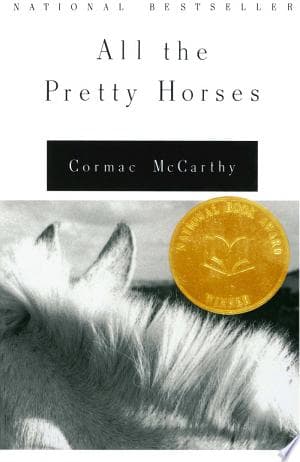
Synopsis
Covers the whole plot, including the ending.
- Difficulty
- Medium
- Pacing
- Moderate
- Mood
- Melancholy, Epic, Philosophical, Stark, Poetic
- Read it if
- You appreciate sparse, lyrical prose, explorations of fate and violence, and a coming-of-age story set against the stark beauty of the American-Mexican borderlands.
- Skip it if
- You prefer fast-paced plots, clear-cut morality, or explicit emotional exposition; the violence and philosophical musings might be challenging.
All the Pretty Horses Plot Summary
Covers the whole plot, including the ending.
The End of an Era
In 1949, sixteen-year-old John Grady Cole lives on his grandfather's ranch in San Angelo, Texas. When his grandfather dies, John Grady learns his mother, who lives separately and has remarried, plans to sell the ranch. This news devastates him; the ranch represents his heritage and the only life he has known. He tries to appeal to his mother's lawyer, but the decision is final. Feeling lost and disappointed with the changing American West, John Grady decides to leave Texas. He seeks a life where horses and traditional values still matter, looking to Mexico as a place of opportunity and adventure. He tells his best friend, Lacey Rawlins, about his plan.
Journey South
John Grady Cole and Lacey Rawlins, both sixteen, pack their few belongings, saddle their horses, and head for Mexico. Their journey starts with youthful hope as they explore the vast, wild land. Along the way, they meet a younger boy, Jimmy Blevins, riding a magnificent but nervous horse. Blevins is clearly disturbed, carrying a pistol and speaking strangely. Despite their concerns about his unstable nature, John Grady and Rawlins reluctantly let Blevins join them. This is partly out of responsibility and partly because Blevins seems to have nowhere else to go. This decision adds a risky element to their otherwise peaceful travels.
Blevins's Troubles
During a severe thunderstorm, lightning strikes Jimmy Blevins. His horse bolts and disappears, along with his pistol. Deeply upset and convinced he will die without his horse, Blevins becomes agitated and insists they go back to search for it. John Grady and Rawlins, though worried about the delay and danger, agree to help him. They eventually find the horse and pistol, but Blevins's reckless and violent actions during the retrieval, including shooting a man he believes stole his items, attract unwanted attention. Fearing the consequences, John Grady and Rawlins are forced to leave Blevins behind.
Hacienda de la Purísima
John Grady and Rawlins continue south and arrive at a large, successful hacienda, La Purísima, owned by Don Héctor Rocha y Villarreal. They impress Don Héctor with their expert horsemanship and are hired as vaqueros. John Grady quickly proves to be an exceptional horse trainer, earning the respect of other vaqueros and Don Héctor. Life at the hacienda is pleasant, a return to the traditional cowboy life John Grady values. He thrives there, feeling a sense of belonging and purpose he lost in Texas. This time is a brief, almost perfect part of their adventure.
Forbidden Romance
While working at La Purísima, John Grady meets Alejandra, Don Héctor's beautiful and cultured daughter. Despite their large social and economic differences, and the clear understanding that a relationship would be forbidden, John Grady and Alejandra are drawn to each other. Their romance unfolds in secret, with hidden meetings and stolen moments. Alejandra, educated and worldly, appeals to John Grady in a new way. Their affair, though passionate, is dangerous. Don Héctor's strict moral code and his family's societal expectations make their relationship a risky violation. This secret love affair becomes central to John Grady's emotional life at the hacienda.
The Arrest
The peaceful life at La Purísima ends when Mexican authorities suddenly arrest John Grady and Rawlins. They are accused of murder and other crimes. They soon realize these charges come from Blevins's earlier violent actions and his return to the hacienda to get his pistol. Don Héctor, despite his previous respect for John Grady, abandons them, unwilling to risk his family's reputation. Stripped of their horses and belongings, John Grady and Rawlins are thrown into a brutal Mexican prison, facing harsh conditions and constant danger. Their arrest marks a dramatic shift from freedom to extreme confinement and peril.
Prison Ordeal
Inside the prison, John Grady and Rawlins face extreme violence, corruption, and the constant threat of death. Other prisoners target them, forcing them into brutal fights for survival. Rawlins is badly wounded in an attack. John Grady, to protect himself and his friend, kills several men in self-defense. The experience is terrifying, taking away their innocence and showing them the darkest parts of human nature. They see Blevins, also imprisoned, taken away and executed by the corrupt captain. This time in prison changes John Grady deeply, hardening him and forcing him to face the world's harsh realities.
Release and Betrayal
Through Alejandra's great-aunt, Alfonsa, John Grady and Rawlins are eventually released from prison, though Rawlins is still very ill. Alfonsa reveals she paid a large bribe for their freedom but makes it clear that John Grady must never see Alejandra again. John Grady manages to meet Alejandra one last time. She confirms that her family's honor and her own future are most important. Despite her lingering feelings, she tells him they cannot be together. This conversation, full of regret and the weight of their different worlds, marks the definite end of their romance, leaving John Grady heartbroken and alone.
Reclaiming What's Lost
After Rawlins returns to Texas, John Grady, still affected by Alejandra's rejection and the injustice of his imprisonment, decides he cannot leave Mexico until he gets back what was stolen from him: his and Rawlins's horses and Blevins's pistol, which he feels responsible for. He confronts the corrupt captain who oversaw their imprisonment and Blevins's execution. Through cleverness, negotiation, and implied threats, John Grady manages to get back the horses and the pistol. This act shows his resilience and determination to correct wrongs, reclaiming some of his lost honor.
The Return to Texas
With the horses he got back, John Grady begins his long journey back to Texas. The ride is solitary and thoughtful, a sharp contrast to his hopeful departure. He meets various people along the way; some are kind, others suspicious. He shares his story with a judge, who listens with skepticism and understanding. John Grady's experiences in Mexico have matured him, but they have also left him with deep scars. He has lost his innocence, his love, and some of his belief in a romanticized West. He returns to a world that has changed irreversibly, both within himself and in his home landscape, now without the ranch he once cherished.
Principal Figures
John Grady Cole
Protagonist
A sixteen-year-old Texan cowboy seeking a life of authenticity in Mexico.
John Grady is a stoic and principled young man, deeply connected to the land and the traditional cowboy way of life. He possesses an innate skill with horses, a strong sense of honor, and a capacity for profound love. Driven by a yearning for a world where horses and integrity still hold value, he leaves Texas for Mexico. He is observant, reflective, and often quiet, but capable of decisive and violent action when pushed to his limits. His moral compass guides him, even in the face of immense adversity and corruption. He is an idealist, initially, but is forced to confront brutal realities.
Relationships: Lacey Rawlins (Best friend and traveling companion); Alejandra (Forbidden lover, daughter of his employer); Jimmy Blevins (Troubled traveling companion, whose actions indirectly lead to John Grady's imprisonment); Don Héctor Rocha y Villarreal (Employer and Alejandra's father); Alfonsa (Alejandra's great-aunt, who orchestrates his release from prison)
Lacey Rawlins
Supporting
John Grady's pragmatic best friend and traveling companion.
Rawlins is John Grady's closest friend, a loyal but more cautious and pragmatic counterpart. He shares John Grady's love for horses and the open road but possesses a stronger sense of self-preservation and a more cynical view of the world. He is often the voice of reason, warning John Grady against impulsive decisions, especially concerning Blevins. Despite his reservations, he remains steadfastly loyal to John Grady, enduring the same hardships in prison. His experiences in Mexico, particularly the brutality of prison, leave him deeply traumatized and eager to return home.
Relationships: John Grady Cole (Best friend and traveling companion); Jimmy Blevins (Disliked and feared traveling companion)
Alejandra
Supporting
Don Héctor's beautiful, educated daughter and John Grady's forbidden love interest.
Alejandra is a striking and intelligent young woman, representing a world of wealth, culture, and social convention that is both alluring and ultimately inaccessible to John Grady. She is educated in Europe, sophisticated, and independent-minded, yet deeply bound by her family's honor and the strictures of Mexican society. She genuinely loves John Grady but understands the impossibility of their relationship due to their differing social statuses. Her decision to end their affair, though painful, reflects her adherence to her family's expectations and her own sense of duty, ultimately sacrificing personal desire for social standing.
Relationships: John Grady Cole (Forbidden lover); Don Héctor Rocha y Villarreal (Father); Alfonsa (Great-aunt, who acts as a powerful figure in her life)
Jimmy Blevins
Supporting
A disturbed and volatile young boy who briefly travels with John Grady and Rawlins.
Blevins is a young, emotionally unstable boy who joins John Grady and Rawlins on their journey south. He is characterized by his profound paranoia, his skill with a pistol, and his almost mystical connection to his horse. His past is shrouded in mystery, hinted at by his fear and aggression. His erratic behavior, particularly his violent retrieval of his stolen horse and pistol, sets in motion the chain of events that leads to John Grady and Rawlins's imprisonment. He is ultimately a tragic figure, a victim of his own demons and the harsh justice of the Mexican frontier, serving as a catalyst for much of the novel's conflict and tragedy.
Relationships: John Grady Cole (Brief traveling companion, later linked by shared imprisonment); Lacey Rawlins (Brief traveling companion, disliked by Rawlins)
Don Héctor Rocha y Villarreal
Supporting
The wealthy, honorable, but socially rigid owner of La Purísima hacienda.
Don Héctor is a powerful and respected landowner, a man of old-world charm and strict moral principles. He values honor, tradition, and skilled horsemanship, which is why he initially hires John Grady and Rawlins. However, his sense of family honor and social standing outweighs any personal affection or loyalty he might feel. When John Grady and Rawlins are accused of crimes, he quickly distances himself, prioritizing his family's reputation over their welfare. He embodies the rigid social hierarchy of Mexico, which ultimately proves to be an insurmountable barrier for John Grady's aspirations and his relationship with Alejandra.
Relationships: John Grady Cole (Employer, later estranged); Alejandra (Father); Alfonsa (Alejandra's great-aunt, a respected family figure)
Alfonsa (Alejandra's Great-Aunt)
Supporting
A wise, powerful, and deeply traditional matriarch of Alejandra's family.
Alfonsa is a formidable and insightful woman, a matriarch who holds significant influence within her family. Despite her physical frailty, she possesses a keen intellect and a deep understanding of the world's complexities and human nature. She is a woman of immense pride and adheres strictly to the codes of honor and social order. She orchestrates John Grady's release from prison, not out of kindness, but to protect her family's reputation and ensure Alejandra's future. Her conversation with John Grady reveals her philosophical depth and her unwavering belief in the inherent limitations imposed by social class and destiny.
Relationships: Alejandra (Great-aunt and mentor-like figure); John Grady Cole (Benefactor, but also the one who enforces the end of his relationship with Alejandra)
The Captain (Mexican Police Captain)
Antagonist
A corrupt and brutal Mexican police officer.
The Captain is a symbol of the pervasive corruption and arbitrary justice in Mexico. He is the official who arrests John Grady and Rawlins, oversees their imprisonment, and orchestrates Blevins's execution. He is cruel, opportunistic, and indifferent to human suffering, embodying the dark side of authority. His actions are driven by personal gain and a complete disregard for due process. John Grady's confrontation with him to retrieve his horses and Blevins's pistol represents a small victory against the overwhelming forces of injustice.
Relationships: John Grady Cole (Antagonist, captor, and later confronted by John Grady); Jimmy Blevins (Executioner)
The Judge
Mentioned
A sympathetic listener whom John Grady encounters on his return journey.
The Judge is an older, wise man John Grady encounters on his way back to Texas. He listens patiently to John Grady's incredible and often harrowing story, offering a rare moment of empathy and understanding. He represents a glimmer of traditional American justice and decency, contrasting sharply with the corrupt Mexican authorities. His presence allows John Grady to verbalize his experiences, giving the reader insight into the protagonist's emotional state and the profound impact of his journey.
Relationships: John Grady Cole (Confidant and listener)
Themes & Insights
The End of the American West and Lost Innocence
The novel shows the fading time of the traditional cowboy and the closing of the frontier. John Grady's journey begins with the sale of his family ranch, which symbolizes the end of a way of life. Mexico at first offers a romantic escape, a chance to live the cowboy ideal. However, the brutal realities of prison and losing Alejandra force John Grady to face the truth: innocence and idealism cannot survive unharmed. He returns to Texas a changed man, having seen and taken part in violence, losing his youthful innocence, and facing a world where his values are becoming obsolete.
“What he loved in horses was what he loved in men, the blood and the heat of them, the something that was beyond all training and all restraint.”
Justice vs. Law
McCarthy often compares formal legal systems with a more basic, often violent, form of justice. In Mexico, John Grady and Rawlins face a corrupt legal system where accusations are random, and innocence means nothing. Blevins is executed without a fair trial. John Grady, however, follows his own code of justice. He takes matters into his own hands to get back his and Rawlins's horses and Blevins's pistol from the corrupt captain. This act, though outside the law, is deeply moral for John Grady. It highlights the novel's question of whether true justice can exist in a world without fair laws.
“The world is not a place where people are paid for their good intentions.”
Fate and Free Will
The characters, especially John Grady and Alfonsa, often discuss fate and whether people truly control their lives. Alfonsa believes in an almost predetermined path, influenced by family and circumstances, suggesting John Grady's love for Alejandra was always doomed. John Grady, however, consistently makes choices that move him forward, even into danger. This shows a strong will to shape his own life and seek his own justice. The novel suggests a complex interaction: outside forces may dictate circumstances, but individual character and choices ultimately define one's response.
“The world is not a game of cards. You are not dealt a hand and then you play it. There is a deck of cards, yes, but you are not dealt a hand. You are dealt a hand and then you play it, yes. But you also play the cards of others. And you play the cards of God.”
Love and Loss
The romance between John Grady and Alejandra is key to the novel's emotional heart. Their love is passionate and real but ultimately fails due to huge social and cultural barriers. Losing Alejandra leaves John Grady heartbroken. It represents the painful truth that love alone cannot overcome deep societal divisions. This theme extends to the loss of the ranch, Rawlins's innocence, and Blevins's tragic death. The novel portrays love as a powerful, transforming force, but also one vulnerable to the world's harsh realities, often ending in deep and lasting sorrow.
“He knew that in the end, it was not the world that was in question but his own heart.”
Plot Devices & Literary Techniques
Journey Motif
A physical and spiritual journey into the unknown.
The literal journey from Texas to Mexico and back serves as the central structural element of the novel. This physical journey mirrors John Grady's spiritual and psychological transformation. As he travels south, he encounters different landscapes, cultures, and moral complexities, which strip away his innocence and force him to confront the harsh realities of life. The return journey is one of reflection and reckoning, marking his coming-of-age and his understanding of the world's unforgiving nature. The journey is not just about reaching a destination but about the profound changes experienced along the way.
Foreshadowing
Subtle hints and warnings of future danger and tragedy.
McCarthy employs subtle foreshadowing throughout the narrative, often through the landscape itself or the dialogue of minor characters. The initial encounter with Blevins, and Rawlins's immediate apprehension about him, hints at the trouble he will bring. The stark, often brutal descriptions of the Mexican landscape and the casual mentions of violence by the vaqueros subtly prepare the reader for the darker events to come. Alfonsa's philosophical discussions about fate also foreshadow the predetermined end of John Grady's relationship with Alejandra, creating a sense of impending doom that permeates the narrative.
Symbolism of Horses
Horses represent freedom, purity, and a vanishing way of life.
Horses are central to John Grady's identity and symbolize the purity, freedom, and traditional values he seeks. They represent the last vestiges of the untamed West and a connection to a more authentic existence. John Grady's exceptional skill with horses signifies his innate goodness and his understanding of a natural order. The loss of the horses, their eventual reclamation, and the very act of riding across vast landscapes are all deeply symbolic of John Grady's quest for identity, his struggles with injustice, and his enduring connection to a world that is rapidly disappearing. They are both tools and spiritual companions.
The Corrupt Justice System
A pervasive force of arbitrary power and violence in Mexico.
The Mexican justice system functions as a major plot device, driving the conflict and shaping John Grady's experiences. It is portrayed as arbitrary, violent, and deeply corrupt, contrasting sharply with John Grady's inherent sense of fairness. His imprisonment, the unjust accusations, and Blevins's execution are direct consequences of this system. This device forces John Grady to adapt, to fight for survival, and ultimately to seek his own form of justice outside of official channels, highlighting the novel's themes of morality and the harsh realities of the world.
All the Pretty Horses Quotes
“He knew that what was born in him was a geologic fault in the earth itself and he felt a kinship with it and he knew that it was his to bear.”
“The world of men is a hard school, and what it teaches is a hard lesson.”
“Scars have the strange power to remind us that our past is real.”
“He thought that in the beauty of the world were hid a secret which would explain for him all things that were dark, and that he would be able to find it.”
“The wind was a cold ghost on the plain.”
“It was a good horse and it was a good country and they were good men. And the world was all of a piece.”
“What he loved in horses was what he loved in men, the blood and the heat of them.”
“But a man's at odds to know what to do. Every which way you look at it you lose.”
“He understood that the world was a thing of blood and of fire and that they were but playthings in it.”
“The closest he'd come to human law was the law of the horse.”
“He stood for a long time watching the country and the slow darkening of the sky and he thought that perhaps the world had been made for this.”
“He thought that the only thing that could be said of love was that it was a fierce and beautiful thing, and that it was a thing to be endured.”
“There is no such thing as a last ride. There is only the ride you are on.”
“He saw that the world was not a thing to be known but a thing to be endured.”
Quiz
10 questions on the plot and the characters. Each answer comes with a short explanation.
Question 1
What significant event prompts John Grady Cole to leave his home in Texas at the beginning of the novel?
- His girlfriend breaks up with him unexpectedly.
- His father dies, leaving him without an inheritance.
- His mother decides to sell the family ranch.
- He is accused of a crime he didn't commit.
Show answer
C. His mother decides to sell the family ranch. John Grady Cole leaves Texas because his mother decides to sell the family ranch, ending the only life he has ever known.
Question 2
Who are John Grady Cole's two initial companions on his journey to Mexico?
- Jimmy Blevins and Emilio Perez
- Lacey Rawlins and Jimmy Blevins
- Duena Alfonsa and Captain de la Peña
- Armando and the Charro
Show answer
B. Lacey Rawlins and Jimmy Blevins John Grady Cole is accompanied by Lacey Rawlins and later by Jimmy Blevins as they journey south into Mexico.
Question 3
What skill does John Grady Cole possess that earns him respect and work at the Mexican hacienda of Don Héctor Rocha y Villarreal?
- His ability to speak fluent Spanish.
- His exceptional talent for breaking and training horses.
- His knowledge of cattle breeding and ranch management.
- His skill with a rifle and hunting.
Show answer
B. His exceptional talent for breaking and training horses. John Grady Cole's profound connection to horses and his exceptional ability to break and train them is what impresses Don Héctor and secures him work.
Question 4
What is the primary reason Jimmy Blevins becomes separated from John Grady and Rawlins, leading to his later tragic fate?
- He gets lost in a sandstorm and cannot find his way back.
- He is spooked by a thunderstorm and rides off alone, losing his horse and gun.
- He decides to return to Texas after an argument with Rawlins.
- He is captured by Mexican federales for a minor offense.
Show answer
B. He is spooked by a thunderstorm and rides off alone, losing his horse and gun. During a severe thunderstorm, Blevins' horse bolts, and he rides off, losing his horse and gun, which sets in motion the events leading to his capture and death.
Question 5
What is the name of the woman John Grady Cole falls in love with at the hacienda?
- María Elena
- Sofia
- Alejandra
- Isabella
Show answer
C. Alejandra John Grady Cole falls in love with Alejandra, Don Héctor's daughter, a forbidden romance that ultimately leads to his imprisonment.
Question 6
What is the main theme explored through John Grady Cole's journey across the border into Mexico?
- The triumph of modern industrialism over traditional ways of life.
- The inevitable corruption of innocence and the harsh realities of the world.
- The importance of family ties and returning to one's roots.
- The ease with which one can escape the past and reinvent oneself.
Show answer
B. The inevitable corruption of innocence and the harsh realities of the world. A central theme is the loss of innocence and the confrontation with a brutal world where dreams are often paid for in blood, contrasting John Grady's romantic ideals with harsh reality.
Question 7
Why are John Grady Cole and Lacey Rawlins imprisoned in the Mexican jail, specifically the Saltillo prison?
- They are caught attempting to smuggle horses across the border.
- They are falsely implicated in a murder committed by Jimmy Blevins.
- They are arrested for having an affair with Alejandra.
- They are accused of rustling cattle from a neighboring ranch.
Show answer
B. They are falsely implicated in a murder committed by Jimmy Blevins. They are arrested and imprisoned in Saltillo, accused of being accomplices to Jimmy Blevins' crimes, specifically the murders he committed to retrieve his lost gun.
Question 8
Who intervenes to secure John Grady Cole's release from prison, and what is the condition of this release?
- Don Héctor intervenes, on the condition that John Grady never sees Alejandra again.
- Alejandra's grandaunt, Duena Alfonsa, intervenes, on the condition that Alejandra never sees John Grady again.
- The American ambassador intervenes, on the condition that John Grady returns immediately to the U.S.
- A wealthy rancher pays a bribe, with no specific conditions attached.
Show answer
B. Alejandra's grandaunt, Duena Alfonsa, intervenes, on the condition that Alejandra never sees John Grady again. Duena Alfonsa, Alejandra's grandaunt, arranges John Grady's release, but only after Alejandra agrees to sever all ties with him, a decision that profoundly impacts both of them.
Question 9
What is the significance of the 'pretty horses' in the novel's title and its broader meaning?
- They represent the material wealth and status John Grady hopes to achieve in Mexico.
- They symbolize the fading romantic ideals, freedom, and a way of life that is being lost to modernity.
- They are a literal reference to the specific breed of horses John Grady trains for Don Héctor.
- They represent the untamed, dangerous aspects of the Mexican wilderness.
Show answer
B. They symbolize the fading romantic ideals, freedom, and a way of life that is being lost to modernity. The 'pretty horses' symbolize a romanticized, untamed past and a way of life that is increasingly vanishing, mirroring John Grady's own struggle to hold onto his ideals in a changing world.
Question 10
After his release, John Grady Cole undertakes a dangerous mission to retrieve what specific items belonging to him and his companions?
- Their saddles, money, and the deed to the ranch.
- Their horses, guns, and money from the Captain.
- Alejandra's locket and a letter from Rawlins.
- His family bible and a map of his return route.
Show answer
B. Their horses, guns, and money from the Captain. John Grady, driven by a strong sense of justice and his code, risks his life to recover their stolen horses, guns, and money from the corrupt Captain who had them imprisoned.
All the Pretty Horses FAQ
What is the central premise of 'All the Pretty Horses'?
The novel follows sixteen-year-old John Grady Cole, who, after his family's ranch is sold, decides to leave Texas with his best friend Lacey Rawlins to seek a new life working with horses in Mexico. Their journey quickly devolves into a harsh reality of violence and imprisonment, challenging their romanticized notions of the West.
Who are the main characters accompanying John Grady Cole on his journey to Mexico?
John Grady Cole is initially accompanied by his best friend, Lacey Rawlins, a pragmatic and cautious young man. They are later joined by Jimmy Blevins, a younger, troubled boy who is prone to bad luck and impulsive decisions, ultimately leading to tragic consequences for them all.
What significant event leads to John Grady Cole's imprisonment in Encantada?
John Grady, Rawlins, and Blevins are arrested and imprisoned in Encantada after being framed for murder by Duena Alfonsa's cousin and Captain Salazar. The false accusation is a direct consequence of John Grady's affair with Alejandra and the complex political machinations within her family.
How does John Grady Cole's relationship with Alejandra de la Rocha evolve?
John Grady falls deeply in love with Alejandra, the beautiful and aristocratic daughter of the hacienda's owner, Don Héctor Rocha y Villarreal. Their passionate but forbidden romance is a central conflict, ultimately leading to their separation due to societal pressures and Duena Alfonsa's intervention.
What is the ultimate fate of John Grady Cole by the end of the novel?
John Grady, after enduring severe hardship, imprisonment, and loss, manages to return to Texas. He reclaims his horses and attempts to find a place for himself, but he carries the profound scars of his experiences in Mexico, forever changed by the violence and disillusionment he encountered.
What is the significance of the 'pretty horses' in the title beyond their literal presence?
The 'pretty horses' symbolize John Grady's idealized vision of the cowboy life and a vanishing world of purity and freedom. They represent his deep connection to nature and a sense of purpose, but also the beautiful, yet ultimately fragile, dreams that are shattered by the harsh realities of Mexico.
How does the character of Duena Alfonsa influence the plot and John Grady's fate?
Duena Alfonsa, Alejandra's great-aunt, is a key antagonist who orchestrates the separation of John Grady and Alejandra. Her cynical worldview, shaped by her own tragic past, leads her to believe that their love is unsustainable and that John Grady is an unsuitable match, prioritizing family honor and social standing.
What is the role of the recurring motif of blood and violence throughout the narrative?
Blood and violence are pervasive, serving as stark reminders of the brutal reality lurking beneath the beautiful landscapes and romantic ideals. They symbolize the cost of innocence, the inherent dangers of the world, and the way dreams are 'paid for in blood,' fundamentally altering the characters and their perceptions.
Explain the significance of the knife fight in prison for John Grady Cole.
The knife fight is a pivotal moment that forces John Grady to confront extreme violence and kill another man to survive. This act marks a profound loss of innocence, transforming him from an idealistic youth into a hardened individual capable of brutality, a necessary adaptation to the brutal world of the prison.
How does John Grady Cole's stoicism and quiet nature contribute to his psychological profile?
John Grady's stoicism masks a deep inner world and a profound connection to the land and horses. His quietness allows him to observe and internalize experiences, but also makes him vulnerable to manipulation and misunderstanding, as he often struggles to articulate his feelings or defend himself verbally.
Discuss the psychological impact of Blevins's death on John Grady and Rawlins.
Blevins's execution, which John Grady witnesses, is a deeply traumatic event that shatters any remaining illusions of justice or mercy. It forces both John Grady and Rawlins to confront the ultimate fragility of life and the inherent cruelty of the world, contributing to their profound disillusionment and sense of helplessness.
How does the concept of fate versus free will manifest in the characters' journeys?
The novel often suggests a powerful sense of fate, with characters seemingly drawn into unavoidable tragic circumstances, particularly Blevins. However, John Grady's persistent choices to pursue Alejandra and reclaim his horses highlight an enduring belief in free will, even in the face of overwhelming odds and predetermined outcomes.
What psychological changes does John Grady undergo from the beginning to the end of the novel?
John Grady transforms from an idealistic, naive young man who believes in a romanticized version of the West into a hardened, traumatized survivor. He loses his innocence, confronts his capacity for violence, and gains a grim understanding of human cruelty, though his core integrity and connection to horses remain.
Is 'All the Pretty Horses' an optimistic or pessimistic novel about the American West and human nature?
While it portrays moments of beauty and connection, the novel is largely pessimistic, depicting the American West as a vanishing ideal and human nature as inherently prone to violence and corruption. It suggests that innocence is inevitably lost and dreams are often shattered by harsh reality, offering little hope for a truly idyllic existence.
How does the novel explore the theme of a vanishing way of life?
The sale of John Grady's family ranch at the outset symbolizes the end of a traditional cowboy way of life in Texas, pushing him to seek it anew in Mexico. The narrative continually highlights the erosion of these old values and skills, replaced by modernization and a more brutal, less honorable world.
What is the significance of the novel's sparse dialogue and extensive descriptive passages?
McCarthy's sparse dialogue emphasizes the characters' internal struggles and the limitations of language in conveying deep emotion or complex truths. The rich, evocative descriptions, conversely, immerse the reader in the landscape, making it a character in itself and highlighting the beauty and brutality of the natural world.
Does John Grady truly achieve redemption or simply endure his suffering?
John Grady's journey is less about traditional redemption and more about endurance and survival. While he reclaims his horses and maintains his integrity, he doesn't find absolution from his suffering or the violence he witnessed and participated in. He carries his trauma, suggesting a stoic acceptance rather than a triumphant redemption.
How does the novel critique romantic notions of adventure and the 'cowboy' ideal?
The novel deconstructs the romanticized 'cowboy' ideal by juxtaposing John Grady's initial innocence and dreams with the brutal realities of Mexico. It shows that seeking adventure can lead to violence, betrayal, and profound loss, demonstrating that the allure of freedom often comes with a steep, bloody price.
About the author
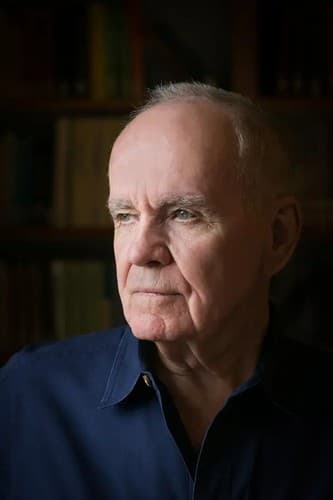
Cormac McCarthy was an American writer who authored twelve novels, two plays, five screenplays, and three short stories, spanning the Western and postapocalyptic genres. He was known for his graphic depictions of violence and his unique writing style, recognizable by a sparse use of punctuation and attribution. McCarthy is widely regarded as one of the greatest American novelists.
Similar books
- Blood Meridian
Cormac McCarthy
4.2 (227k) average on GoodreadsFictionShares McCarthy's distinctive prose, bleak themes, and violent setting in the American West.
- Lonesome Dove
Larry McMurtry
4.5 (149k) average on GoodreadsHistorical FictionAnother epic Western focusing on cowboys, journeys, and the end of an era, though with a different tone.
- The Old Man and the Sea
Ernest Hemingway
3.8 (831k) average on GoodreadsLiterary FictionFeatures a stoic protagonist facing overwhelming natural forces and an exploration of dignity and struggle.
- One Hundred Years of Solitude
Gabriel García Márquez
4.1 (753k) average on GoodreadsLiterary FictionThrough the multi-generational story of the Buendía family, a mythical town deals with the repeating patterns of time, love, and solitude, as the extraordinary mixes with the ordinary.
- The Goldfinch
Donna Tartt
3.9 (720k) average on GoodreadsLiterary FictionHaunted by a tragic explosion and clutching a stolen Dutch masterpiece, a young orphan navigates the opulent drawing rooms of New York and the gritty underbelly of the art world, desperately seeking connection and redemption amidst a life spiraling into crime and obsession.
- Little Fires Everywhere
Celeste Ng
4.1 (713k) average on GoodreadsLiterary FictionIn Shaker Heights, an artist and her daughter move in, and their free-spirited lives clash with a rule-bound matriarch, revealing hidden conflicts beneath a perfect surface.





Enjoyed the summary?
A summary gives you the shape of the book. The book itself has the detail, the examples and the voice.
Find All the Pretty Horses on AmazonAs an Amazon Associate, BookBrief earns from qualifying purchases. How we're funded