
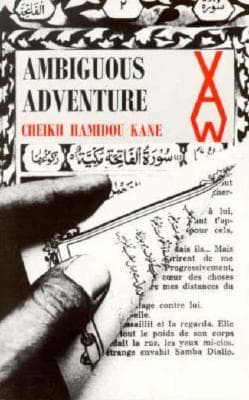
Synopsis
Covers the whole plot, including the ending.
- Difficulty
- Medium
- Read it if
- You are interested in post-colonial African literature, philosophical novels exploring identity and faith, or narratives that delve into the clash between traditional spirituality and Western modernity. This book is for those who appreciate deep introspection and a melancholic tone.
- Skip it if
- You prefer fast-paced plots, light reading, or books with clear, optimistic resolutions. If you are not keen on philosophical discussions about faith, reason, and cultural alienation, this might not be for you.
Ambiguous Adventure Quotes
“The school was the last rampart of your ancestors, but you have thrown it down. The new school has taken its place. From it you will learn to build and to destroy.”
“We are the hybrids, children of a double birth, with a double nature, who feel in our innermost selves the conflict of these two worlds.”
“God is not the light. He is the sun which gives the light, and the moon which gives the night.”
“To conquer is to love. To love is to die. We die to ourselves to be reborn in the other.”
“The word is a living thing, a breath, a light, a sound, a song, a silence, an echo, a shadow, a presence, an absence, a memory, a forgetting.”
“I am not a country. I am a man. And if you want to understand me, you must understand my soul, not my frontiers.”
“The West is the left hand of God. The East is the right hand of God. And man is the heart of God.”
“We are walking towards God, but we are walking on the road of men.”
“The problem is not to choose between two gods, but to choose the God who is in both.”
“What are we going to do with our hands, if they are no longer able to touch the earth?”
“The path of knowledge is a path of suffering.”
“We have seen the triumph of the machine over the spirit, of matter over the soul.”
“To be oneself, one must be the other. To be the other, one must be oneself.”
“The most difficult thing is to be a man, not a Muslim, not a Christian, not a Jew, but a man.”
Quiz
10 questions on the plot and the characters. Each answer comes with a short explanation.
Question 1
What is the name of the protagonist in Cheikh Hamidou Kane's 'Ambiguous Adventure'?
- Samba Diallo
- Salif Keita
- Moustapha Diop
- Amadou Bâ
Show answer
A. Samba Diallo Samba Diallo is the central character whose spiritual and intellectual journey forms the core of 'Ambiguous Adventure'.
Question 2
Before traveling to France, Samba Diallo receives his initial religious education from whom?
- The Grand Master
- His father, the Chief
- Thierno
- The Knight
Show answer
C. Thierno Thierno, a devout and revered teacher, is responsible for Samba Diallo's rigorous early Islamic education, instilling in him a profound spiritual foundation.
Question 3
What primary philosophical conflict does Samba Diallo grapple with during his time in France?
- The conflict between capitalism and socialism
- The conflict between scientific materialism and spiritual faith
- The conflict between individualism and communalism
- The conflict between tradition and modernity in political systems
Show answer
B. The conflict between scientific materialism and spiritual faith Samba Diallo's 'ambiguous adventure' largely revolves around the profound tension between the rational, scientific, and often materialistic worldview of the West and his deeply ingrained spiritual and religious heritage.
Question 4
The 'Diallobé' in the novel refers to:
- The name of the French university Samba attends
- The name of Samba Diallo's extended family
- The name of the West African community/nation from which Samba originates
- A specific Sufi order in Senegal
Show answer
C. The name of the West African community/nation from which Samba originates The Diallobé is the fictional West African community or nation, rich in spiritual tradition, from which Samba Diallo hails, representing the 'kingdom of men' where God is present.
Question 5
What symbolic object does the Knight of the Diallobé suggest Samba Diallo should 'carry' to France?
- A copy of the Qur'an
- The spiritual heritage and essence of the Diallobé
- A diplomatic letter from his father
- A traditional Senegalese garment
Show answer
B. The spiritual heritage and essence of the Diallobé The Knight advises Samba to carry the 'ashes' of their ancestors, symbolizing the spiritual and cultural heritage of the Diallobé, urging him not to lose his identity amidst Western influences.
Question 6
Upon his return to the Diallobé, what is Samba Diallo's primary internal struggle concerning his place in his society?
- He struggles to adapt to the lack of modern amenities he became accustomed to in France.
- He feels a profound detachment and inability to fully reconnect with the spiritual certitude of his past, having been exposed to Western rationalism.
- He is pressured to take over his father's political role but prefers a life of scholarship.
- He struggles to implement the scientific advancements he learned in France to benefit his community.
Show answer
B. He feels a profound detachment and inability to fully reconnect with the spiritual certitude of his past, having been exposed to Western rationalism. Samba's internal conflict upon his return is his profound alienation; he can no longer fully embrace the simple, unwavering faith of his childhood, nor can he fully discard it, leaving him in a state of spiritual limbo.
Question 7
What is the ultimate fate of Samba Diallo in the novel?
- He becomes a prominent political leader in the Diallobé.
- He returns to France to pursue a career in academia.
- He is killed by the Fool, a madman who perceives him as abandoning the path of God.
- He successfully reconciles his Western education with his spiritual roots and becomes a revered teacher.
Show answer
C. He is killed by the Fool, a madman who perceives him as abandoning the path of God. Samba Diallo is tragically killed by the Fool, a character who embodies unreasoning faith and sees Samba's intellectual journey as a betrayal of their spiritual heritage, highlighting the devastating consequences of his 'ambiguous adventure'.
Question 8
The 'New Man' concept discussed by the Grand Master refers to:
- A fully Westernized African who has abandoned all traditional ties.
- An individual who can synthesize the best of both Western and African cultures and philosophies.
- An individual who has lost his spiritual center due to exposure to Western materialism, embodying a fragmented existence.
- A revolutionary leader who will free Africa from colonial rule.
Show answer
C. An individual who has lost his spiritual center due to exposure to Western materialism, embodying a fragmented existence. The Grand Master fears the creation of a 'new man' who, having been educated in the West, loses his spiritual essence and becomes a 'man of two worlds' belonging to neither, a fragmented being without a soul.
Question 9
Which of the following best describes the role of the Most Royal Lady in the novel?
- She is a staunch defender of traditional Islamic education and resists Western influence at all costs.
- She is the primary advocate for sending Samba Diallo to the Western school, believing it is necessary for the survival of their people.
- She represents the voice of the younger generation, eager for rapid modernization.
- She is Samba Diallo's mother and tries to prevent him from leaving for France.
Show answer
B. She is the primary advocate for sending Samba Diallo to the Western school, believing it is necessary for the survival of their people. The Most Royal Lady, Samba's aunt, is a pragmatic and visionary leader who, despite her deep spiritual roots, understands the necessity of Western education for the survival and future of the Diallobé, even if it means risking spiritual loss.
Question 10
The novel's title, 'Ambiguous Adventure,' primarily refers to:
- The uncertain outcome of France's colonial project in Senegal.
- Samba Diallo's journey to the West, which brings both knowledge and spiritual confusion, ultimately leading to a loss of identity.
- The mysterious nature of Sufi mysticism that Samba explores.
- The unpredictable challenges of establishing an independent African nation.
Show answer
B. Samba Diallo's journey to the West, which brings both knowledge and spiritual confusion, ultimately leading to a loss of identity. The 'ambiguous adventure' is Samba Diallo's personal and intellectual journey to the West, which, while offering new knowledge and opportunities, simultaneously threatens his spiritual identity and leaves him caught between two worlds, unable to fully belong to either.
Ambiguous Adventure FAQ
What is the central theme of 'Ambiguous Adventure' by Cheikh Hamidou Kane?
'Ambiguous Adventure' explores the profound clash between traditional African Islamic culture and Western secular education, and the resulting spiritual and existential dilemmas faced by individuals caught between these two worlds. It delves into the nature of identity, faith, and progress.
Who is Samba Diallo in 'Ambiguous Adventure'?
Samba Diallo is the protagonist of the novel, a brilliant young man from a noble Islamic family in Senegal. He is sent to France for Western schooling, embodying the internal conflict and spiritual journey of someone navigating the complexities of colonial influence and cultural assimilation.
Does 'Ambiguous Adventure' offer a clear resolution to the conflict between Islam and Western thought?
The novel deliberately avoids offering a simple resolution, instead emphasizing the enduring ambiguity and painful choices inherent in reconciling differing worldviews. It portrays the struggle as an ongoing internal and societal challenge, rather than one with an easy answer.
What is the significance of the 'Diallobé' in the book?
The Diallobé represent the traditional, deeply spiritual Islamic society in Senegal from which Samba Diallo originates. They embody a rich cultural heritage and a profound spiritual connection to their land and faith, providing a stark contrast to the materialistic values of the West.
How does 'Ambiguous Adventure' differ from other post-colonial African novels?
'Ambiguous Adventure' distinguishes itself by focusing more intensely on the philosophical and spiritual crisis of the individual rather than solely on political oppression or social critique. While sharing post-colonial themes, its introspective and existential depth sets it apart.
What role does the 'Most Royal Lady' play in Samba Diallo's journey?
The Most Royal Lady is a powerful and influential figure among the Diallobé who initially advocates for sending Samba Diallo to Western schools, believing it is necessary for their people's survival and adaptation. She represents a pragmatic but deeply conflicted perspective on embracing change.
Does 'Ambiguous Adventure' criticize Western education?
The novel presents a nuanced view of Western education, acknowledging its practical benefits and intellectual stimulation while also critiquing its potential to alienate individuals from their spiritual roots and traditional values. It explores both the opportunities and the profound losses it entails.
What is the 'ambiguity' referred to in the title?
The 'ambiguity' refers to the uncertain and often painful path of navigating between two conflicting cultures and worldviews without fully belonging to either. It highlights the protagonist's spiritual limbo and the lack of clear answers in his quest for identity and meaning.
Is 'Ambiguous Adventure' a good starting point for understanding African philosophy?
Yes, it is an excellent starting point, as it deeply engages with questions of identity, modernity, tradition, and spirituality from an African perspective. It offers profound insights into the intellectual and emotional challenges faced during the post-colonial era.
About the author

Cheikh Hamidou Kane is a Senegalese novelist, known for his seminal work "Ambiguous Adventure" (L'Aventure ambiguë). This novel, published in 1961, explores the cultural and spiritual clashes faced by Africans during the colonial era. Kane's writing is celebrated for its philosophical depth and nuanced portrayal of identity in a rapidly changing world.
Similar books
- Things Fall Apart
Chinua Achebe
3.7 (288k) average on GoodreadsHistorical FictionExplores the devastating impact of colonialism on traditional African society and culture.
- The Wretched of the Earth
Frantz Fanon
4.2 (17k) average on GoodreadsPoliticsOffers a profound analysis of colonialism's psychological and social effects on the colonized.
- Season of Migration to the North
Tayeb Salih
3.7 (20k) average on GoodreadsHistorical FictionDeals with themes of cultural clash, identity crisis, and the return of an educated African to his homeland.
- Eat, Pray, Love
Elizabeth Gilbert
3.6 (1.5M) average on GoodreadsLifestyleA heartbroken writer leaves her conventional life for a year-long global search for pleasure in Italy, spiritual devotion in India, and unexpected love and balance in Bali.
- Educated
Tara Westover
4.5 (796k) average on GoodreadsBiographyRaised in the Idaho mountains by fundamentalist survivalists, a young woman forges her own path to education, battling fierce family loyalty and personal demons to discover a world beyond her isolated upbringing.
- The Poisonwood Bible
Barbara Kingsolver
4.1 (659k) average on GoodreadsLiterary FictionA zealous missionary's rigid faith clashes with the Belgian Congo's wilderness and people, unraveling his family through the eyes of his five unforgettable women.



Enjoyed the summary?
A summary gives you the shape of the book. The book itself has the detail, the examples and the voice.
Find Ambiguous Adventure on AmazonAs an Amazon Associate, BookBrief earns from qualifying purchases. How we're funded