
Synopsis
Covers the whole plot, including the ending.
- Difficulty
- Medium
- Pacing
- Moderate
- Mood
- Dark, Thought-provoking, Oppressive, Cautionary, Philosophical
- Read it if
- You are interested in classic dystopian literature, political allegories, and explorations of totalitarianism, propaganda, and the corruption of power. You enjoy thought-provoking, cautionary tales.
- Skip it if
- You prefer lighthearted, optimistic stories, or find themes of oppression, despair, and the complete loss of individual freedom too bleak.
Animal Farm / 1984 Plot Summary
Covers the whole plot, including the ending.
Animal Farm: The Rebellion Begins
On Manor Farm, the animals suffer under the cruel and neglectful farmer, Mr. Jones. One night, the old boar, Old Major, gathers the animals. He shares a dream of a world free from human tyranny, where animals live equally. He teaches them 'Beasts of England,' a revolutionary song, and urges them to rebel. After Old Major's death, the pigs Napoleon and Snowball lead the animals in a rebellion against Mr. Jones when he forgets to feed them. They drive him off the farm, destroy symbols of human oppression, and rename the property 'Animal Farm.' They establish the Seven Commandments of Animalism as their rules.
Animal Farm: Early Days and the Rise of Pig Leadership
After the rebellion, the animals work hard to harvest crops, achieving a record yield. Snowball, an articulate and idealistic pig, organizes the farm, sets up committees, and tries to teach the animals to read and write. Napoleon, a cunning and ruthless pig, shows little interest in Snowball's committees. Instead, he secretly educates a litter of nine puppies. The Seven Commandments are painted on the barn wall, with 'All animals are equal' as the main rule. However, the pigs quickly claim intellectual superiority, taking the milk and apples for themselves, saying it is needed for their brainwork.
Animal Farm: Snowball's Expulsion and Napoleon's Consolidation of Power
The differences between Snowball and Napoleon grow, especially over building a windmill. Snowball passionately supports it as a way to mechanize the farm and improve life. Napoleon strongly opposes it. During a debate about the windmill's future, Napoleon releases the nine dogs he trained. They violently chase Snowball off the farm. With Snowball gone, Napoleon ends debates and creates a pig-only committee to run the farm, with himself as the leader. He immediately announces the windmill will be built, claiming it was his idea all along. Squealer, his propagandist, convinces the other animals.
Animal Farm: The Windmill and Increasing Oppression
The animals start the hard task of building the windmill. They work longer hours and face severe food shortages, all while being told it is for Animal Farm's good. Boxer, the loyal and hardworking cart-horse, inspires everyone, always saying 'I will work harder' and 'Napoleon is always right.' Napoleon begins trading with human farmers, which violates the original commandments, and moves into the farmhouse. Squealer constantly manipulates the animals' memories and changes the Seven Commandments to justify the pigs' growing privileges and actions, such as sleeping in beds and drinking alcohol. He blames all problems on the absent Snowball.
Animal Farm: Betrayal and the Final Transformation
After years of hard work, the windmill is finished, but the animals' lives have not improved; they are worse. Boxer, weakened by overwork, collapses while hauling stone. Napoleon promises to send him to a veterinary hospital, but the animals realize too late that Boxer is being sent to the knackers. Squealer quickly explains away the incident with lies. The pigs grow fatter and more human-like. They walk on two legs, carry whips, and wear clothes. The Seven Commandments are replaced by one rule: 'All Animals Are Equal, But Some Animals Are More Equal Than Others.' In the final scene, the pigs host a dinner with human farmers. The other animals, looking from pig to man and from man to pig, cannot tell them apart, showing the revolution's complete corruption.
1984: Winston's Discontent and Rebellion of the Mind
Winston Smith, a low-ranking member of the Outer Party in Airstrip One (formerly London), lives in a society monitored by the Party and Big Brother. He works at the Ministry of Truth, changing historical records to fit the Party's current story. Winston is deeply unhappy with the Party's control over truth, history, and individual thought. He starts a secret diary, an act of thoughtcrime punishable by death. He remembers a time before the Party's absolute rule and wants to understand and resist the regime. He feels a mix of fascination and fear towards O'Brien, an Inner Party member he suspects might share his rebellious thoughts.
1984: The Affair with Julia
Winston's life changes when he gets a note from Julia, a young woman from the Fiction Department, saying 'I love you.' They begin a secret affair, meeting in hidden places, mainly a rented room above Mr. Charrington's antique shop in the prole district. Julia rebels against the Party's rules on personal freedom and sex, but she is more interested in personal satisfaction than large-scale political revolution. Their relationship gives Winston great joy and a sense of shared humanity. This strengthens his resolve to fight the Party, even though they know discovery means torture and death.
1984: Joining the Brotherhood and O'Brien's Betrayal
Winston believes O'Brien is part of the legendary Brotherhood, an underground resistance movement against the Party, so he approaches him. O'Brien welcomes Winston and Julia into what seems to be the Brotherhood. He gives Winston a copy of 'The Theory and Practice of Oligarchical Collectivism,' supposedly written by Emmanuel Goldstein, the Party's enemy. This book explains the true nature of the Party's power and perpetual war. However, their secret activities and meetings in Mr. Charrington's room are discovered. Mr. Charrington reveals himself to be a member of the Thought Police, and Winston and Julia are arrested and taken to the Ministry of Love.
1984: Torture and Re-education in the Ministry of Love
In the Ministry of Love, Winston is subjected to physical and psychological torture, overseen by O'Brien. O'Brien reveals he is a loyal Party member and a master interrogator. He explains that the Party's only goal is power, and Winston must be 'cured' of his rebellious thoughts. Winston confesses to many crimes, but his spirit remains unbroken as long as he loves Julia and believes in objective truth. He endures beatings, starvation, and sleep deprivation, slowly losing his sense of self and reality, yet he holds onto some resistance.
1984: Room 101 and Winston's Final Betrayal
Winston is brought to Room 101, the ultimate torture chamber, where people face their worst fears. For Winston, this is rats. As a cage of starving rats is brought near his face, he screams, begging O'Brien to torture Julia instead of him. This act of betrayal, sacrificing his love for Julia to save himself, shatters his last bit of resistance and humanity. After his 're-education,' Winston is released, a hollow person, completely brainwashed. He sits in the Chestnut Tree Cafe, a broken man, having learned to love Big Brother, his spirit crushed.
Animal Farm / 1984 Characters
Winston Smith
Protagonist
A disillusioned Outer Party member who secretly rebels against the Party's totalitarian rule.
Winston Smith is a thirty-nine-year-old employee at the Ministry of Truth, tasked with altering historical records. He is a thoughtful and introspective man who secretly despises the Party's manipulation of truth, history, and individual freedom. His rebellion begins with keeping a diary, then progresses to a love affair with Julia, and a desire to join the Brotherhood. He yearns for a past where objective truth and genuine human connection existed, making him an anomaly in his society. His journey is one of increasing defiance, followed by brutal suppression and psychological destruction.
Relationships: Julia (lover and co-conspirator); O'Brien (perceived ally, then torturer and ideological adversary); Big Brother (omnipresent, oppressive leader (symbolic))
Julia
Supporting
Winston's pragmatic and rebellious lover, who defies the Party through personal gratification.
Julia is a young, dark-haired woman who works in the Fiction Department at the Ministry of Truth. Unlike Winston, her rebellion against the Party is personal and sensual rather than intellectual or ideological. She seeks pleasure and freedom from the Party's puritanical rules, enjoying illicit sex, acquiring black market goods, and subverting Party doctrine in small, practical ways. She is less concerned with overthrowing the Party or understanding its philosophy, preferring to live for the moment. Her pragmatism and zest for life offer Winston a temporary escape from his despair, but her loyalty, like Winston's, ultimately breaks under torture.
Relationships: Winston Smith (lover and co-conspirator)
O'Brien
Antagonist
A powerful Inner Party member and Winston's torturer, who embodies the Party's ideology.
O'Brien is a mysterious and charismatic Inner Party member whom Winston initially believes to be a fellow rebel and member of the Brotherhood. He is highly intelligent, sophisticated, and utterly ruthless. O'Brien reveals himself to be a loyal Party operative and Winston's interrogator and torturer in the Ministry of Love. He meticulously breaks Winston down, not just physically, but psychologically, explaining the Party's true motives for power and its ability to control reality. He represents the Party's ultimate triumph over the individual mind and its capacity for cruelty and ideological indoctrination.
Relationships: Winston Smith (captor, torturer, ideological opponent); Big Brother (loyal servant and enforcer)
Big Brother
Antagonist
The omnipresent, symbolic leader of the Party, whose image dominates Oceania.
Big Brother is the figurehead of the Party and the totalitarian government of Oceania. He is constantly depicted on posters and telescreens, with the slogan 'BIG BROTHER IS WATCHING YOU.' Although his actual existence is never confirmed, his image and presence are used to inspire fear, loyalty, and unquestioning obedience among the populace. He symbolizes the Party's absolute power, surveillance, and control over every aspect of life. Big Brother is not a single person but rather the embodiment of the Party's collective, all-seeing authority, a psychological tool to enforce conformity.
Relationships: Winston Smith (ultimate oppressor); O'Brien (figurehead for O'Brien's power)
Napoleon
Antagonist
A cunning and ruthless pig who seizes absolute power on Animal Farm.
Napoleon is a large, fierce-looking Berkshire boar who, along with Snowball, initially leads the animal rebellion. He is characterized by his ambition, ruthlessness, and cunning. From the outset, Napoleon is more interested in power than in the ideals of Animalism. He uses propaganda (via Squealer), violence (via his dog army), and manipulation to consolidate his control, expelling Snowball and systematically dismantling the principles of the revolution. He represents Joseph Stalin and the totalitarian elements of the Soviet regime, transforming Animal Farm into a brutal dictatorship where the pigs exploit other animals.
Relationships: Snowball (rival, then exiled enemy); Squealer (propagandist and loyal enforcer); Boxer (exploited loyal worker); The other animals (subjects to be controlled and exploited)
Snowball
Supporting
An idealistic and intelligent pig who advocates for the betterment of Animal Farm.
Snowball is a clever, eloquent, and more idealistic pig than Napoleon. He is enthusiastic about spreading Animalism and improving the animals' lives, organizing committees, and proposing the construction of a windmill to mechanize the farm. He genuinely believes in the principles of the revolution and strives for equality and education among the animals. However, his intellectual prowess and oratorical skills are no match for Napoleon's brute force and political cunning. He represents Leon Trotsky, an intellectual revolutionary who was eventually expelled and demonized by Stalin.
Relationships: Napoleon (rival); Boxer (respected by Snowball for his loyalty)
Boxer
Supporting
A strong, loyal, and hardworking cart-horse who embodies the exploited working class.
Boxer is an enormous, dedicated, and incredibly strong cart-horse whose unwavering loyalty and work ethic are central to the success of Animal Farm. His personal maxims are 'I will work harder' and 'Napoleon is always right.' He is not highly intelligent but possesses immense physical strength and a good heart. He represents the exploited working class (proletariat) of the Soviet Union, who tirelessly serve the regime out of patriotism and belief in the cause, only to be betrayed and discarded when they are no longer useful. His fate is one of the most tragic examples of the pigs' tyranny.
Relationships: Clover (close friend); Napoleon (object of unwavering, yet misguided, loyalty); Squealer (manipulated by Squealer's propaganda)
Squealer
Supporting
Napoleon's propagandist, who manipulates language to control the other animals.
Squealer is a small, fat pig with a talent for persuasive speech and a habit of skipping from side to side when arguing, making him highly convincing. He serves as Napoleon's chief propagandist, constantly twisting facts, rewriting history, and justifying the pigs' increasingly tyrannical actions and privileges to the other animals. He uses fear-mongering (e.g., 'Jones will come back!'), logical fallacies, and emotional appeals to control the narrative and keep the animals subservient. Squealer represents the propaganda machine and state-controlled media used by totalitarian regimes to maintain power.
Relationships: Napoleon (loyal and indispensable subordinate); The other animals (manipulator and deceiver)
Old Major
Supporting
The visionary boar whose dream inspires the animal rebellion.
Old Major is a wise and benevolent prize-winning boar who, at the beginning of 'Animal Farm,' convenes a meeting of all the animals to share his dream of a world free from human oppression. He articulates the core principles of Animalism, identifying man as the enemy and urging the animals to rebel and establish a society of equality. He teaches them the song 'Beasts of England.' Although he dies early in the story, his ideas and vision serve as the initial spark and ideological foundation for the revolution. He represents Karl Marx and Vladimir Lenin, the ideological founders of communism.
Relationships: Napoleon and Snowball (inheritors of his ideology)
Mr. Jones
Antagonist
The neglectful and cruel farmer of Manor Farm, overthrown by the animals.
Mr. Jones is the original human owner of Manor Farm. He is a habitually drunken and neglectful farmer who often forgets to feed his animals and treats them cruelly. His incompetence and cruelty directly lead to the animal rebellion. After being driven off the farm, he makes a few failed attempts to reclaim it. Mr. Jones represents the last Tsar of Russia, Nicholas II, and the decadent, oppressive old order that was overthrown by the Russian Revolution.
Relationships: The animals (oppressor)
Animal Farm / 1984 Themes
Totalitarianism and Oppression
Both novels show the oppressive nature of totalitarian regimes. In '1984,' the Party, led by Big Brother, controls every part of life: thought (Thought Police), history (Ministry of Truth), and relationships. It uses constant surveillance and fear. In 'Animal Farm,' Napoleon's regime changes from an idealistic rebellion into a brutal dictatorship. The pigs oppress other animals with force, propaganda, and the erosion of their rights. Both works show how power, once held, can crush individual liberty and maintain control through terror and manipulation.
“If you want a picture of the future, imagine a boot stamping on a human face—for ever.”
The Manipulation of Truth and History
A main theme in both books is how totalitarian states control reality by manipulating truth and history. In '1984,' Winston's job at the Ministry of Truth involves constantly rewriting historical documents, news articles, and statistics to match the Party's current story, ensuring the past serves the present. The Party also uses 'doublethink' to make people accept contradictory ideas. Similarly, in 'Animal Farm,' Squealer continually changes the Seven Commandments and revises the animals' memories of events, like Snowball's role in the Battle of the Cowshed or the pigs' early sacrifices, to justify Napoleon's actions and keep the idea of a fair society alive.
“Who controls the past controls the future: who controls the present controls the past.”
The Corruption of Ideals
'Animal Farm' is an allegory for the corruption of revolutionary ideals. The initial vision of Animalism, based on equality and freedom from human oppression, is systematically twisted by the pigs, especially Napoleon. The Seven Commandments are slowly changed until they are meaningless, ending with 'All Animals Are Equal, But Some Animals Are More Equal Than Others.' The dream of a utopian society becomes a tyranny worse than Mr. Jones's. In '1984,' though not a direct revolution, the Party's origins are hinted at as a movement that promised a better future but delivered perpetual war and absolute control. This shows how noble goals can be twisted into tools of oppression.
“All animals are equal, but some animals are more equal than others.”
The Power of Language and Propaganda
Both novels highlight the role of language and propaganda in maintaining totalitarian control. In '1984,' Newspeak, the Party's engineered language, aims to remove words linked to rebellion or independent thought, making such concepts unthinkable. Slogans like 'WAR IS PEACE, FREEDOM IS SLAVERY, IGNORANCE IS STRENGTH' are everywhere. In 'Animal Farm,' Squealer is a master of propaganda, using persuasive but deceptive words to convince the other animals, justify the pigs' privileges, and demonize Snowball. He uses fear (the return of Jones) and appeals to loyalty ('Napoleon is always right') to manipulate the animals, showing how language can be used to control perception and reality.
“The greatest enemy of truth is very often not the lie—deliberate, contrived, and dishonest—but the myth—persistent, persuasive, and unrealistic.”
The Erosion of Individuality and Freedom
Both books explore how totalitarian rule systematically destroys individual identity and personal freedom. In '1984,' Winston struggles to keep his inner self, his memories, and his ability for independent thought and emotion, which the Party wants to erase. Love, sex, and family bonds are controlled or suppressed. In 'Animal Farm,' the animals lose their freedom to speak, question, and even remember the revolution's original ideals. They become a collective, exploited workforce, their individuality lost to the state's demands. Both stories show the psychological cost of living without personal autonomy.
“Freedom is the freedom to say that two plus two make four. If that is granted, all else follows.”
Plot Devices & Literary Techniques
Allegory
Animal Farm as a symbolic representation of the Russian Revolution and the rise of Stalinism.
'Animal Farm' functions as a political allegory, where the characters and events directly parallel historical figures and occurrences of the Russian Revolution and the early Soviet Union. Mr. Jones represents Tsar Nicholas II, Old Major is Karl Marx/Lenin, Napoleon is Joseph Stalin, Snowball is Leon Trotsky, and Boxer symbolizes the exploited working class. The farm's transformation from a revolutionary ideal to a totalitarian state mirrors the corruption of the Soviet communist experiment, allowing Orwell to critique real-world political developments through a simplified, animal fable format.
Dystopian Setting
The creation of a grim, oppressive future world to critique societal dangers.
'1984' is a seminal work of dystopian fiction, presenting a terrifying future society (Oceania) characterized by extreme totalitarianism, constant surveillance (telescreens), psychological manipulation, and perpetual war. This bleak setting serves as a warning against the dangers of unchecked government power, technological control, and the erosion of individual freedoms. The grim atmosphere, impoverished living conditions, and ever-present threat of the Thought Police amplify the sense of fear and hopelessness that pervades Winston's world, making the Party's control feel absolute and inescapable.
Symbolism (Big Brother / The Windmill)
Objects and figures imbued with deeper political and social meaning.
Both novels utilize powerful symbols. In '1984,' Big Brother is not just a leader but a ubiquitous symbol of the Party's omnipresent surveillance, unquestionable authority, and psychological control. His image reinforces the idea that 'BIG BROTHER IS WATCHING YOU,' inducing fear and conformity. In 'Animal Farm,' the windmill initially symbolizes the promise of a better, easier life through hard work and technological advancement. However, as it is built and rebuilt under increasingly harsh conditions and ultimately benefits only the pigs, it becomes a symbol of the animals' endless, exploited labor and the broken promises of the revolution, a monument to their enslavement rather than their liberation.
Psychological Torture and Brainwashing
The systematic breaking down of an individual's will and identity.
In '1984,' the Ministry of Love employs sophisticated psychological torture and brainwashing techniques to break Winston's spirit and force him to conform to Party ideology. This goes beyond physical pain, aiming to alter his thoughts, memories, and even his perception of reality, culminating in Room 101 where he is confronted with his deepest fear, leading him to betray Julia. This device illustrates the Party's ultimate goal: not just obedience, but complete ideological conversion and the annihilation of independent thought, demonstrating the terrifying power of a totalitarian state over the human mind.
Propaganda and Slogans
The use of repetitive, manipulative language to control public opinion.
Both novels heavily rely on propaganda and catchy, misleading slogans to shape public perception and maintain control. In 'Animal Farm,' Squealer's constant revision of history, fear-mongering about Mr. Jones's return, and the repetitive 'Four legs good, two legs bad' (later 'Four legs good, two legs better!') are crucial in manipulating the less intelligent animals. In '1984,' the Party's slogans like 'WAR IS PEACE, FREEDOM IS SLAVERY, IGNORANCE IS STRENGTH' and 'BIG BROTHER IS WATCHING YOU' are ubiquitous, designed to instill contradictory beliefs and unquestioning loyalty, demonstrating how simplified, repeated messages can override critical thinking and shape collective consciousness.
Animal Farm / 1984 Quotes
“All animals are equal, but some animals are more equal than others.”
“War is peace. Freedom is slavery. Ignorance is strength.”
“Four legs good, two legs bad.”
“Who controls the past controls the future. Who controls the present controls the past.”
“Man is the only creature that consumes without producing.”
“If you want a picture of the future, imagine a boot stamping on a human face—forever.”
“The creatures outside looked from pig to man, and from man to pig, and from pig to man again; but already it was impossible to say which was which.”
“Big Brother is watching you.”
“No one believes more firmly than Comrade Napoleon that all animals are equal. He would be only too happy to let you make your decisions for yourselves. But sometimes you might make the wrong decisions, comrades, and then where should we be?”
“Doublethink means the power of holding two contradictory beliefs in one's mind simultaneously, and accepting both of them.”
“The only good human being is a dead one.”
“In the end the Party would announce that two and two made five, and you would have to believe it.”
“I do not understand why we are in such a hurry. What we have we can hold.”
“The past was erased, the erasure was forgotten, the lie became truth.”
Quiz
10 questions on the plot and the characters. Each answer comes with a short explanation.
Question 1
In 'Animal Farm', which animal creates the original philosophy of Animalism that inspires the rebellion?
- Napoleon the pig
- Snowball the pig
- Old Major the boar
- Squealer the pig
Show answer
C. Old Major the boar Old Major is the prize Middle White boar who delivers the speech that inspires the animals to rebel against Mr. Jones. His vision of a society where animals are free from human tyranny forms the basis of Animalism.
Question 2
In '1984', what is the name of the secret revolutionary organization that Winston Smith joins?
- The Resistance
- The Proles
- The Brotherhood
- The Inner Party
Show answer
C. The Brotherhood Winston joins The Brotherhood, a secret organization dedicated to overthrowing the Party, after being contacted by O'Brien, who he believes is a fellow revolutionary.
Question 3
What is the final, single commandment that remains on the barn wall at the end of 'Animal Farm'?
- All animals are equal
- Four legs good, two legs bad
- All animals are equal, but some animals are more equal than others
- No animal shall kill any other animal
Show answer
C. All animals are equal, but some animals are more equal than others The pigs gradually alter the Seven Commandments of Animalism to justify their privileges. By the end, only this paradoxical commandment remains, highlighting the corruption of the revolution's ideals.
Question 4
In '1984', what is the name of the language created by the Party to eliminate unorthodox thoughts?
- Oldspeak
- Doublespeak
- Newspeak
- Partyspeak
Show answer
C. Newspeak Newspeak is the official language of Oceania, designed to diminish the range of thought by reducing the vocabulary. Words like 'thoughtcrime' are created, while others are eliminated to make rebellious ideas literally unthinkable.
Question 5
In 'Animal Farm', which event leads to Snowball's expulsion from the farm?
- He is caught collaborating with Mr. Jones
- He loses a debate about building a windmill
- Napoleon's dogs chase him off after he presents his windmill plans
- The animals vote him out for being too idealistic
Show answer
C. Napoleon's dogs chase him off after he presents his windmill plans During a meeting where Snowball presents his plans for a windmill to improve the farm, Napoleon calls in nine ferocious dogs he has raised in secret, who chase Snowball off the farm. This marks Napoleon's violent takeover.
Question 6
What is the significance of Room 101 in '1984'?
- It is where Winston first meets Julia
- It contains the telescreens that monitor citizens
- It is the torture chamber where prisoners face their worst fear
- It is the headquarters of The Brotherhood
Show answer
C. It is the torture chamber where prisoners face their worst fear Room 101 is the final step in the Ministry of Love's torture process. Each prisoner is confronted with their own worst fear—for Winston, it is rats—to break their spirit and enforce loyalty to the Party.
Question 7
In 'Animal Farm', what do the pigs start doing that blatantly violates the principles of Animalism?
- Walking on two legs
- Eating the same food as the other animals
- Allowing Mr. Jones to return
- Sharing power with the other animals
Show answer
A. Walking on two legs The pigs gradually adopt human behaviors, culminating in walking on two legs. This directly contradicts the original commandment 'Four legs good, two legs bad,' symbolizing their complete transformation into the oppressive humans they once rebelled against.
Question 8
In '1984', what is the ultimate test of Winston's loyalty to Big Brother after his torture?
- He must betray Julia by claiming he never loved her
- He must confess to crimes he did not commit
- He must genuinely love Big Brother
- He must join the Thought Police
Show answer
C. He must genuinely love Big Brother After extensive torture and brainwashing, Winston's breaking point comes when he must not just obey, but sincerely love Big Brother. In the end, he achieves this, showing the Party's total control over mind and emotion.
Question 9
Which character in 'Animal Farm' is specifically described as being good at convincing the other animals to accept the pigs' changes?
- Boxer the horse
- Benjamin the donkey
- Mollie the mare
- Squealer the pig
Show answer
D. Squealer the pig Squealer is the pig who serves as Napoleon's propagandist. He uses persuasive speeches and manipulated statistics to justify the pigs' actions, such as taking the milk and apples, altering the commandments, and blaming Snowball for problems.
Question 10
What philosophical concept in '1984' is exemplified by the Party's ability to hold two contradictory beliefs simultaneously?
- Doublethink
- Thoughtcrime
- Memory hole
- Facecrime
Show answer
A. Doublethink Doublethink is the act of simultaneously accepting two mutually contradictory beliefs as correct, often in indoctrination. For example, the Party claims 'War is Peace' while engaging in perpetual war, and citizens must believe both to avoid thoughtcrime.
Animal Farm / 1984 FAQ
What is 'Animal Farm / 1984' about?
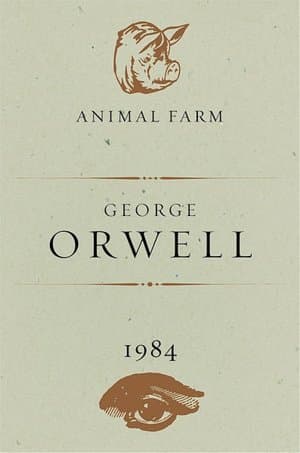
This edition contains two of Orwell's most famous political allegories. 'Animal Farm' is a satirical fable about farm animals who overthrow their human owner to establish an egalitarian society, only to see it devolve into a tyrannical regime led by pigs like Napoleon and Snowball. '1984' depicts a dystopian future where the Party, led by Big Brother, controls every aspect of life in Oceania through surveillance and thought control, following protagonist Winston Smith's doomed rebellion.
Why should I read 'Animal Farm / 1984'?
These novels are essential for understanding 20th-century political thought and remain profoundly relevant today. Orwell masterfully explores how power corrupts, how language manipulates reality, and how totalitarian systems destroy individuality. The combination offers both the accessible animal allegory of 'Animal Farm' and the chilling psychological depth of '1984'.
What is the background/setting of these novels?
'Animal Farm' is set on an English farm that becomes Animal Farm after the animals' revolution, directly allegorizing the Russian Revolution and Stalinist Soviet Union. '1984' takes place in a dystopian 1984 in London, now part of the superstate Oceania, which is perpetually at war and governed by the Party's totalitarian ideology.
What are the most memorable quotes?
From 'Animal Farm': 'All animals are equal, but some animals are more equal than others.' From '1984': 'War is peace. Freedom is slavery. Ignorance is strength.' and 'Big Brother is watching you.' These phrases encapsulate the novels' themes of corrupted ideals and doublethink.
What writing style does Orwell use?
Orwell employs clear, direct prose with a journalistic tone, making complex political ideas accessible. 'Animal Farm' uses simple fable-like storytelling with animal characters, while '1984' features dense psychological realism and invented concepts like Newspeak and doublethink to create its oppressive atmosphere.
What minor details add significant meaning in 'Animal Farm'?
The changing commandments on the barn wall, particularly the evolution from 'No animal shall sleep in a bed' to 'No animal shall sleep in a bed with sheets,' show how the pigs incrementally corrupt the revolution's principles. The animals' fading memories of Mr. Jones symbolize how historical truth becomes malleable under tyranny.
What are subtle foreshadowing moments in '1984'?
Winston's initial diary entry 'DOWN WITH BIG BROTHER' immediately marks him for destruction. The antique glass paperweight he buys symbolizes the fragile past he tries to preserve, and its shattering later mirrors the destruction of his private world. O'Brien's early comment that they 'shall meet in the place where there is no darkness' becomes ironically literal in the Ministry of Love.
What unexpected character connections exist between the novels?
Both novels feature intellectual characters who become complicit in the systems they critique: Squealer in 'Animal Farm' uses propaganda like the pigs' constant revisions of history, paralleling the Party's manipulation of records in '1984.' Napoleon's cult of personality mirrors Big Brother's, though Napoleon is physically present while Big Brother may be fictional.
What are unspoken character motivations in 'Animal Farm'?
Napoleon's true motivation isn't animal equality but personal power, shown when he secretly raises guard dogs and eliminates Snowball. Boxer's blind loyalty stems from his simple-minded devotion to the cause, making him vulnerable to exploitation despite his strength. The sheep's mindless chanting of 'Four legs good, two legs bad' reflects how masses can be manipulated through repetition.
What psychological complexities does Winston Smith exhibit?
Winston harbors both intellectual rebellion and deep-seated conformity, shown through his secret diary and his job at the Ministry of Truth rewriting history. His relationship with Julia is as much about political defiance as personal connection, and his eventual betrayal of her reveals how totalitarianism can break even the strongest individual will.
What are the major emotional turning points in '1984'?
Winston's decision to begin his diary marks his first act of rebellion. His love affair with Julia creates a brief sanctuary of humanity. Their capture by the Thought Police begins the destruction of their bond. Winston's final betrayal of Julia in Room 101, when he screams 'Do it to Julia!', represents the complete triumph of the Party over individual loyalty.
How do relationship dynamics evolve in 'Animal Farm'?
Initially, all animals are united against Mr. Jones. Gradually, the pigs establish themselves as leaders, then as a privileged class. The working animals like Boxer and Clover remain loyal even as they're exploited. By the end, the pigs openly ally with humans, completing their transformation into the very oppressors they overthrew.
Which parts remain ambiguous or open-ended?
In '1984,' whether Big Brother actually exists as a person or is purely a symbolic construct is never clarified. The fate of Julia after Winston's betrayal is left unknown. In 'Animal Farm,' whether the other animals will ever mount another revolution remains unanswered, though the final scene suggests they're too broken to try.
What are controversial scenes or decisions in these novels?
The pigs' execution of animals who confess to being traitors in 'Animal Farm' mirrors Stalin's purges and raises questions about revolutionary violence. In '1984,' Winston's ultimate betrayal of Julia is deeply disturbing, as it shows the Party's ability to destroy love itself. Some readers debate whether Winston's final love for Big Brother represents genuine conversion or psychological destruction.
'1984' ending explained: how it ends & what it means
Winston, completely broken after torture in the Ministry of Love, sits in a café where he finally loves Big Brother. The Party has eradicated his ability to think independently or maintain human connections. The ending demonstrates totalitarianism's ultimate victory: not just controlling actions, but reshaping inner consciousness until rebellion becomes unthinkable.
'Animal Farm' ending explained: how it ends & what it means
The novel ends with the pigs walking upright, wearing clothes, and playing cards with neighboring human farmers. The other animals watch through the window, unable to tell pigs from humans anymore. This completes the cycle of corruption, showing that the revolution has produced a new ruling class identical to the old one, with the famous final line highlighting the hypocrisy of 'equality.'
How does language manipulation feature in both novels?
In 'Animal Farm,' the pigs gradually alter the Seven Commandments to justify their privileges, such as changing 'No animal shall drink alcohol' to 'No animal shall drink alcohol to excess.' In '1984,' Newspeak is designed to eliminate rebellious thoughts by reducing vocabulary, and the Ministry of Truth constantly revises historical records to match Party propaganda.
What role does historical revisionism play?
Both novels show how regimes control the past to control the present. In 'Animal Farm,' the pigs claim Snowball was always a traitor and that Napoleon's plans were originally his. In '1984,' Winston's job is to alter newspaper archives so the Party appears always correct, exemplified by his task to delete an 'unperson' from history entirely.
How do the novels differ in their portrayal of resistance?
'Animal Farm' shows collective resistance initially succeeding then being co-opted, while '1984' depicts individual resistance as ultimately futile. The animals' revolution creates a new tyranny, whereas Winston's rebellion ends with his complete psychological defeat. Both suggest that without constant vigilance, any revolutionary ideal can be corrupted.
What is the significance of the proles in '1984'?
The proles (proletariat) make up 85% of Oceania's population but are considered unimportant by the Party. Winston initially sees them as potential agents of change because they retain human emotions and aren't monitored as closely, but they remain apathetic. Their portrayal suggests that mass populations can be controlled through distraction and minimal welfare rather than direct oppression.
About the author
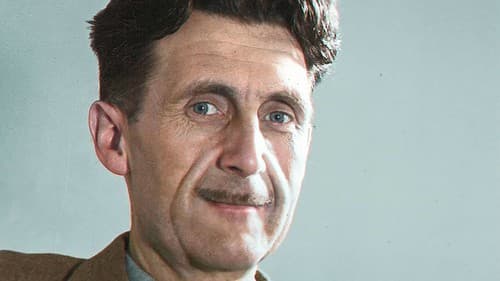
Eric Arthur Blair, better known by his pen name George Orwell, was an English novelist, essayist, journalist, and critic. His work is characterised by lucid prose, social criticism, opposition to totalitarianism, and support of democratic socialism.
Similar books
- Brave New World
Aldous Huxley
4.0 (1.4M) average on GoodreadsFantasyExplores a different, yet equally chilling, form of dystopian control through pleasure and conditioning.
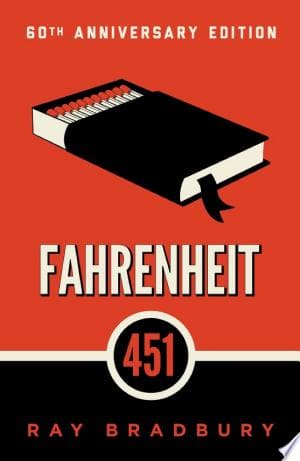
- Fahrenheit 451
Ray Bradbury
4.0 (1.7M) average on GoodreadsFantasyFeatures a protagonist rebelling against a totalitarian society that suppresses knowledge and individual thought.
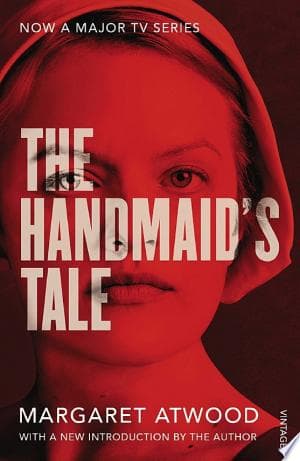
- The Handmaid's Tale
Margaret Atwood
4.1 (1.5M) average on GoodreadsFantasyPresents a feminist dystopia with themes of oppression, surveillance, and loss of freedom.
- 1984
George Orwell
4.2 (3.1M) average on GoodreadsPoliticsIn a future where surveillance and thought control are absolute, a man's search for truth clashes with the Party, showing that hope can be a form of rebellion.
- Animal Farm
George Orwell
4.0 (2.7M) average on GoodreadsPoliticsA farm animals' rebellion against humans turns into a pig-led dictatorship, showing how power corrupts and revolutionary ideals are betrayed.
- Freakonomics: A Rogue Economist Explores the Hidden Side of Everything
Steven D. Levitt
4.0 (709k) average on GoodreadsBusinessThis book uses economic principles to reveal the surprising incentives behind everything from drug dealing and real estate to cheating teachers and the decline of crime.




Enjoyed the summary?
A summary gives you the shape of the book. The book itself has the detail, the examples and the voice.
Find Animal Farm / 1984 on AmazonAs an Amazon Associate, BookBrief earns from qualifying purchases. How we're funded