

Synopsis
Covers the whole plot, including the ending.
- Difficulty
- Medium
- Pacing
- Moderate
- Mood
- Thought-provoking, philosophical, defiant, stark
- Read it if
- you're interested in dystopian fiction, philosophical tales about individualism vs. collectivism, or a concise introduction to Ayn Rand's objectivist philosophy.
- Skip it if
- you dislike philosophical allegories, objectivist themes, or stories with a strong focus on political and social commentary over character development.
Anthem Plot Summary
Covers the whole plot, including the ending.
The World of Collectivism
Equality 7-2521, a street-sweeper, lives in a society where Councils control all aspects of life. Individuality is gone, and citizens are given names like 'Equality 7-2521' and 'International 4-8818'. He writes in a stolen journal, which is forbidden, detailing his life and observations. From an early age, he felt different. His intelligence and curiosity set him apart from others. He was punished for these differences, especially for his interest in science and his preference for certain tasks. His job as a street sweeper is a demotion, given his intelligence. This was meant to curb his rebellious spirit and keep him subservient to the group. This section shows the oppressive atmosphere and Equality's defiance.
The Secret Tunnel
While sweeping streets, Equality 7-2521 finds an entrance to an abandoned subway tunnel from the Unmentionable Times. He keeps this discovery a secret, an act of defiance against society's rules. He starts spending hours there each day, pretending to be ill to miss his duties. In the tunnel, he explores his forbidden curiosity, collecting artifacts and doing simple scientific experiments. This secret place becomes his laboratory and a sign of his growing independence. He begins to understand the past, slowly uncovering forgotten knowledge and skills, all while fearing the severe punishment if the Councils found his secret.
Forbidden Fascination
During his street-sweeping duties, Equality 7-2521 sees Liberty 5-3000, a woman working in the fields, and is immediately drawn to her. This attraction is a serious sin, as individuals cannot choose partners or feel personal affection. The Council of Eugenics arranges all pairings. He renames her 'The Golden One' in his thoughts. Despite society's rules, they exchange glances and eventually forbidden words. Their interactions, though brief and secret, spark a connection. Liberty 5-3000 also seems to have an independent spirit and a beauty that makes her stand out, much like Equality. Their mutual recognition of each other's individuality strengthens Equality's defiance.
The Discovery of Electricity
Through his solitary experiments in the tunnel, Equality 7-2521 rediscovers electricity. He carefully studies and rebuilds a simple electric light bulb from the Unmentionable Times, eventually making it produce light. This discovery, a technological leap beyond anything known in his society, fills him with pride and purpose. He understands the implications of his invention, realizing it could change the primitive, candle-lit world. However, he also knows the danger of showing such an individual achievement to a society that condemns personal ingenuity or progress not approved by the Councils.
Presenting the Invention
Equality 7-2521 decides to present his invention, the electric light, to the World Council of Scholars during their annual meeting. He believes that despite the risks, the usefulness and brilliance of his discovery will make them accept it, and him. He carefully plans his presentation, hoping to show how his invention can banish darkness and improve everyone's lives. This act is a desperate gamble, a hope that his individual genius can overcome the group's rules. He imagines a future where his light brightens their world, not understanding how much the Council fears anything new or individually created.
The Whipping and Escape
Before he can present his invention, Equality 7-2521 is caught for returning late to the Home of the Street Sweepers. This happened because of his long work in the tunnel. He refuses to say where he was or what he was doing to the Council, which leads to severe punishment. He is whipped repeatedly, enduring the pain without revealing his secret or his invention. Despite the torture, his spirit is unbroken. He eventually escapes from the Palace of Corrective Detention, driven by the desire to share his light with the World Council of Scholars. His escape directly rejects the group's authority and shows his strong will and commitment to his discovery.
Rejection by the Council
Equality 7-2521 bursts into the World Council of Scholars meeting, proudly presenting his electric light. The Council members are not impressed but horrified. They condemn his invention as a product of individual thought, a violation of their rules, and a threat to their order. They fear his light could disrupt the candle-making industry and question their authority. They threaten to destroy his invention and punish him for daring to think and create alone. Their rejection is complete. It shows how irrational and fearful of progress their society is, crushing Equality's hope for acceptance and confirming his status as an outcast.
Flight into the Uncharted Forest
Devastated by the Council's rejection, Equality 7-2521 flees into the Uncharted Forest, a forbidden wilderness beyond society's limits. This act is the ultimate rebellion, completely cutting ties with his past life. He expects wild beasts and starvation, but finds a strange sense of freedom. To his surprise, Liberty 5-3000 follows him. She also defied the group to find him. She declares her love and loyalty, choosing to share his exile. Their reunion in the wilderness symbolizes their shared rejection of the group and their embrace of individual love and freedom, strengthening their resolve to face the unknown together.
The House from the Unmentionable Times
As they go deeper into the Uncharted Forest, Equality 7-2521 and Liberty 5-3000 discover a small, abandoned house from the Unmentionable Times. It is filled with artifacts and books from the past, foreign to their upbringing. They are struck by the idea of individual living, finding separate beds and personal belongings. This discovery affects them deeply, revealing a forgotten way of life centered on individual choice and private property. They begin to read the books, slowly learning the history of a world where 'I' existed. The house becomes their sanctuary and a symbol of the individualistic past they want to reclaim.
The Rebirth of 'I'
Through his readings in the house, Equality 7-2521 finally finds the lost word 'I.' This discovery is huge. It breaks the mental chains that tied him to the group. He understands that his entire life has been a struggle to define himself as an individual, and this word is the key to his identity. He renames himself Prometheus, the bringer of light and fire, symbolizing his role in rediscovering individualism. He renames Liberty 5-3000 Gaea, the mother of the earth, recognizing her strength and her future role in having free children. This marks their full embrace of individualism and their commitment to building a new, free society.
Building a New World
Prometheus, now fully an individual, decides to reclaim the knowledge and values of the Unmentionable Times. He plans to return to the city, gather his friends—International 4-8818 and others who secretly share his independent spirit—and bring them to his new sanctuary in the Uncharted Forest. His goal is to build a new society based on individualism, where each person is free to think, create, and live for themselves. He imagines a future where the lost word 'I' will again be celebrated, and humanity will progress through individual effort and freedom, rather than the oppression of collectivism.
Anthem Characters
Equality 7-2521 / Prometheus
Protagonist
The individual who reclaims 'I' in a collectivist society.
Equality 7-2521 is a tall, intelligent, and rebellious street-sweeper living in a dystopian collectivist society. From a young age, he possesses an insatiable curiosity and an independent spirit that sets him apart from his 'brothers.' He secretly conducts scientific experiments, rediscovers electricity, and eventually flees to the Uncharted Forest. He is driven by a profound desire for knowledge, self-expression, and personal achievement, which are considered sins in his world. His journey is one of self-discovery and the reclamation of individual identity.
Relationships: Liberty 5-3000 / Gaea (lover and intellectual partner); International 4-8818 (friend and fellow individualist); The World Council of Scholars (antagonistic authority)
Liberty 5-3000 / Gaea
Supporting
The beautiful field worker who shares Equality's independent spirit.
Liberty 5-3000 is a young woman who works in the fields, distinguished by her golden hair and defiant spirit. She is called 'The Golden One' by Equality 7-2521, and she reciprocates his forbidden affection. She shares his disdain for the collective's rules and exhibits a strong, independent will. She ultimately chooses to follow Equality into the Uncharted Forest, demonstrating her unwavering loyalty and commitment to individual freedom. She embodies beauty, strength, and a nascent individualism, serving as a vital companion and emotional anchor for Equality.
Relationships: Equality 7-2521 / Prometheus (lover and intellectual partner)
International 4-8818
Supporting
Equality's friend who struggles with his own individuality.
International 4-8818 is Equality 7-2521's friend and fellow street-sweeper. He possesses a talent for drawing and a sense of humor that are considered inappropriate in their collectivist society. While he recognizes Equality's unique spirit and is somewhat sympathetic to his forbidden activities, he lacks the courage to fully defy the Councils himself. He is torn between his innate desire for individual expression and the ingrained fear of punishment. His character highlights the internal struggle faced by many in their society who feel the stirrings of individuality but are too afraid to act on them.
Relationships: Equality 7-2521 / Prometheus (friend)
Union 5-3992
Supporting
A brother who often cries without reason.
Union 5-3992 is one of Equality 7-2521's fellow street-sweepers. He is described as a 'queer' brother who often bursts into tears without apparent reason. His behavior is a subtle manifestation of suppressed individuality and emotional distress within the collective. He represents the silent suffering and psychological toll that the collectivist system takes on its citizens, who are denied the right to express personal feelings or pursue individual happiness. His unexplained sorrow underscores the inherent unhappiness of a life devoid of personal meaning and choice.
The World Council of Scholars
Antagonist
The ultimate authority on knowledge, vehemently opposed to individual thought.
The World Council of Scholars is the highest intellectual authority in the collectivist society, responsible for all scientific and technological decisions. They are depicted as old, fearful, and dogmatic, clinging rigidly to the established order and condemning any form of individual innovation or progress not sanctioned by the collective. Their primary goal is to maintain the status quo and suppress any ideas that might challenge their authority or the principles of collectivism. They represent the collective's fear of the unknown, fear of change, and the suppression of human intellect.
Relationships: Equality 7-2521 / Prometheus (antagonistic authority)
The Council of Vocations
Antagonist
The authority that assigns life mandates.
The Council of Vocations is the governing body responsible for assigning every individual their life's profession. They deliberately assign Equality 7-2521, despite his superior intellect, to the menial job of street-sweeper, aiming to curb his individualistic tendencies. This Council embodies the collective's control over personal destiny and its efforts to suppress any talents or desires that do not conform to societal norms. They represent the arbitrary and oppressive nature of the collectivist system, denying individuals the right to choose their own path or pursue their passions.
Relationships: Equality 7-2521 / Prometheus (antagonistic authority)
The Golden One
Supporting
Equality's personal name for Liberty 5-3000.
The Golden One is the forbidden, private name Equality 7-2521 bestows upon Liberty 5-3000. This act of naming is itself an act of profound individualism and affection, as personal names and individual relationships are banned. The name reflects her striking appearance – her golden hair – and her unique, radiant spirit that sets her apart from others. It symbolizes Equality's personal connection to her, his recognition of her specialness, and his growing defiance against a society that seeks to make everyone uniform and nameless. This name is a secret shared between them, a symbol of their burgeoning love and rebellion.
Relationships: Equality 7-2521 / Prometheus (lover)
The Transgressor of the Unspeakable Word
Supporting
A martyr for the word 'I'.
The Transgressor of the Unspeakable Word is a legendary figure from Equality 7-2521's childhood memories. This man was publicly burned at the stake for uttering the forbidden word 'I'. His execution deeply impacts young Equality, who is drawn to the serene confidence in the man's eyes during his death. The Transgressor serves as a prophetic figure, a martyr for individualism, whose sacrifice foreshadows Equality's own journey. He represents the ultimate price of individual thought in this society and inspires Equality to seek the truth behind the forbidden word, laying the groundwork for his own rebellion.
Relationships: Equality 7-2521 / Prometheus (inspirational figure)
Anthem Themes
Individualism vs. Collectivism
This is the main theme of 'Anthem.' It explores the conflict between an individual's right to exist for themselves and the idea that everyone must serve the group. Rand argues that true progress, happiness, and morality come from individual thought and ambition. Collectivism, in contrast, leads to stagnation, oppression, and the loss of human potential. Equality's journey challenges the group, showing the value and power of the 'I' over the 'we.' The novel states that sacrificing individual identity for the group ultimately harms both the person and society.
“It is a sin to think words no others think and to speak words no others speak.”
The Power of Reason and Discovery
The novel supports reason as the main tool for human survival and progress. Equality's rediscovery of electricity through independent thought and science shows that rational inquiry is better than simply obeying tradition and group rules. His invention of the light bulb, a product of individual intellect, contrasts sharply with his society's stagnant, primitive technology, which is controlled by the Councils' irrational fear. The theme highlights that human advancement comes from the courage to observe, question, and innovate, not from group agreement or superstition.
“We are nothing. Mankind is all. By the grace of our brothers are we allowed our lives. We exist but through them and for them.”
Love and Freedom
Anthem explores the idea that real love can only exist between free, independent people. In the collectivist society, relationships lack personal choice and affection. They are just biological functions or communal duties. Equality's forbidden love for Liberty 5-3000 is a powerful act of rebellion. It shows that genuine connection and passion come from individual desire and mutual recognition of self-worth. Their shared journey to freedom allows their love to grow, suggesting that love is not about sacrificing oneself, but about affirming one's highest values found in another.
“For the word 'We' must never be spoken, save by one's choice and as a second thought.”
The Importance of Self-Esteem and Pride
The novel argues that self-esteem and pride in one's achievements are vital for a fulfilling life. In Equality's society, pride is a sin, and all accomplishments belong to the group. Equality's secret joy and pride in his invention of the light bulb, despite society's condemnation, emphasize this theme. His eventual declaration of 'I' is an assertion of his worth and the right to be proud of his existence and creations. Rand suggests that denying individuals the right to self-esteem leads to a life of mediocrity and emptiness.
“I am. I think. I will.”
The Danger of Conformity and Groupthink
Anthem clearly shows the destructive results of unquestioning conformity and suppressing individual thought for group harmony. The collectivist society, driven by fear of deviance and a desire for uniformity, has gone backward technologically and intellectually. The Councils' rejection of Equality's light, despite its clear benefits, shows how groupthink and fear of change can stop progress and lead to irrational decisions. The novel warns against giving up one's independent judgment to the majority, illustrating how this leads to intellectual stagnation, tyranny, and the weakening of the human spirit.
“We are one in all and all in one. There are no men but only the great WE, One, indivisible and forever.”
Plot Devices & Literary Techniques
First-Person Journal Narration
Equality's secret diary as the narrative voice.
The entire story is told through the perspective of Equality 7-2521, written in a journal he secretly keeps. This device allows the reader direct access to his forbidden thoughts, emotions, and intellectual discoveries, emphasizing his individuality in a society that denies it. The use of 'we' in his early narration, even when referring to himself, subtly underscores the pervasive influence of collectivism, making his eventual discovery and embrace of 'I' all the more powerful. It highlights the internal conflict and the gradual awakening of his individual consciousness.
Symbolism of Light and Darkness
Light representing knowledge, freedom; darkness representing ignorance, oppression.
Light (specifically electric light) symbolizes knowledge, reason, progress, and individual brilliance. Equality's rediscovery of electricity and creation of the light bulb is a literal and metaphorical illumination, bringing truth and advancement into a world steeped in ignorance and primitive technology. Darkness, conversely, represents the collectivist society's intellectual stagnation, oppression, and fear of new ideas. The candle-lit world of the collective signifies their backwardness, while Equality's light offers the promise of a brighter, more enlightened future, both literally and philosophically.
The Uncharted Forest
A symbol of freedom, the unknown, and a new beginning.
The Uncharted Forest is a forbidden wilderness beyond the boundaries of the collectivist cities, shrouded in fear and mystery. It serves as a powerful symbol of freedom, the unknown, and a fresh start. For Equality and Liberty, fleeing into the forest is an act of ultimate defiance, severing ties with their oppressive past. It becomes their sanctuary, a place where they can discover themselves, explore the remnants of the past (the house), and begin to build a new life based on individual liberty. The forest represents the vast potential and terrifying freedom that lies outside the confines of collective control.
The Lost Word 'I'
The ultimate symbol of individualism and self-identity.
The word 'I' is the central symbolic and thematic core of the novel. It represents the concept of individual selfhood, personal identity, and the moral right to exist for one's own sake. Its loss in the collectivist society signifies the complete eradication of individualism, where all citizens are forced to refer to themselves and others only as 'we.' Equality's rediscovery of this word is the climax of his intellectual and spiritual journey, marking his complete liberation and the realization of his true nature as an independent being. It is the 'sacred word' upon which a new, free civilization can be built.
The Unmentionable Times
A historical backdrop representing the individualistic past.
The 'Unmentionable Times' refer to the era before the collectivist society, a period where individualism, technology, and freedom flourished. This past is deliberately suppressed and demonized by the Councils, who present it as a time of great evil and destruction. The remnants of this era—the subway tunnel, the electric light, and the house in the forest—serve as tangible links to a forgotten history. This device provides a historical context for the dystopian present and offers Equality the clues and inspiration to rediscover lost knowledge and values, demonstrating that the individualistic past holds the key to the future.
Anthem Quotes
“It is the Age of the Great Rebirth. The Unmentionable Times are gone. The box of forbidden words is burned. The past is a curse. The street is our home.”
“We are the chosen. We are the best. We are the men of the Unmentionable Times.”
“The word 'I' is forbidden. It is the worst of all words. It is the meaning of all evil. It is the sin against the Collective.”
“We are the living. We are the dead. We are the children of the same mother. We are the brothers of the same father.”
“The greatest evil is the evil of intention. The greatest sin is the sin of thought.”
“We thought that we had no minds of our own. We thought that we had no will of our own. We thought that we had no selves of our own.”
“My happiness is not the goal. My happiness is not the purpose of my life. My purpose is to serve the Collective.”
“The light of the sky is not ours. The light of the sun is not ours. The light of the stars is not ours. All light belongs to the Collective.”
“The greatest good is the good of the Collective. The greatest virtue is the virtue of the Collective.”
“We are one. We are many. We are the same. We are the world.”
“We are not born. We are created. We are not individuals. We are parts of the whole.”
“The street is our home. The Collective is our family. The laws are our will. The future is our destiny.”
“We saw the sky. We saw the stars. We saw the sun. We saw the light. And we knew. We knew that we were free.”
“We are a word. We are a number. We are a name. We are a life. We are a soul. We are a god.”
Quiz
10 questions on the plot and the characters. Each answer comes with a short explanation.
Question 1
What is the primary theme explored in Ayn Rand's novel 'Anthem'?
- The dangers of unchecked technological advancement
- The importance of collectivism and societal harmony
- The struggle for individualism against oppressive collectivism
- The exploration of a post-apocalyptic wasteland
Show answer
C. The struggle for individualism against oppressive collectivism The novel 'Anthem' centers on Equality 7-2521's fight against a collectivist society that suppresses individual thought and identity, ultimately rediscovering the word 'I'.
Question 2
In the society depicted in 'Anthem', what is a fundamental aspect of daily life for the citizens?
- Personal choice and freedom of expression
- Decisions made by committees and living in collectives
- Competitive pursuit of personal goals
- Emphasis on individual achievement and recognition
Show answer
B. Decisions made by committees and living in collectives The society in 'Anthem' is characterized by a complete lack of individualism, where all decisions are made by committees and people live in collectives.
Question 3
What forbidden act does Equality 7-2521 commit that leads to him being marked for death?
- Falling in love with the woman of his choice
- Discovering electricity
- Thinking and choosing for himself, and rediscovering 'I'
- Questioning the authority of the World Council
Show answer
C. Thinking and choosing for himself, and rediscovering 'I' Equality 7-2521's ultimate sin in the collectivist society is his assertion of individuality, his independent thought, and his rediscovery of the concept of 'I'.
Question 4
What invention or discovery does Equality 7-2521 make that is considered a significant advancement?
- The printing press
- Electricity
- The steam engine
- The wheel
Show answer
B. Electricity Equality 7-2521 rediscovers and harnesses the power of electricity, a discovery that is considered a great sin in his society.
Question 5
The society in 'Anthem' is described as living in the 'dark ages of the future'. What does this imply about their technological and societal progress?
- They have advanced far beyond modern technology but lost historical knowledge.
- They have regressed technologically and lost many fundamental discoveries.
- They are on the cusp of a new technological revolution.
- Their society is technologically equivalent to the ancient past.
Show answer
B. They have regressed technologically and lost many fundamental discoveries. The phrase 'dark ages of the future' suggests a regression in knowledge and technology, where fundamental discoveries like electricity have been lost and individual thought is suppressed.
Question 6
What does the word 'sinful' mean in the context of Equality 7-2521's society?
- Any action that benefits the collective.
- Any deviation from the mandated collective will.
- Any act of personal ambition or desire.
- Any thought that is not approved by the Council.
Show answer
B. Any deviation from the mandated collective will. In Equality 7-2521's world, the concept of 'sinful' is tied to any form of individualism, personal desire, or thought that deviates from the collective norm and the decisions of the committee.
Question 7
What is the ultimate value that Equality 7-2521 rediscovers and cherishes?
- The collective good
- The power of innovation
- The individual self ('I')
- The pursuit of knowledge for its own sake
Show answer
C. The individual self ('I') The most profound discovery for Equality 7-2521 is the lost and holy word 'I', representing the rediscovery and affirmation of the individual self.
Question 8
Which of Ayn Rand's later novels is 'Anthem' considered a predecessor to?
- The Virtue of Selfishness
- The Fountainhead and Atlas Shrugged
- We the Living
- Night of the Jabberwock
Show answer
B. The Fountainhead and Atlas Shrugged The provided text explicitly states that 'Anthem' is a clear predecessor to Ayn Rand's later masterpieces, 'The Fountainhead' and 'Atlas Shrugged'.
Question 9
The society in 'Anthem' has wiped out all traces of individualism. What does this suggest about their societal structure and values?
- They prioritize personal freedom and self-expression above all else.
- They believe that individual differences lead to conflict and societal breakdown.
- They have embraced a form of anarcho-capitalism.
- They value creativity and innovation as the highest societal ideals.
Show answer
B. They believe that individual differences lead to conflict and societal breakdown. The complete eradication of individualism implies a deep-seated belief within this society that individual differences are detrimental and that conformity to the collective is essential for stability and order.
Question 10
Equality 7-2521's journey from being 'marked for death' to rediscovering the word 'I' represents a philosophical arc from:
- Atheism to religious devotion
- Ignorance to enlightenment, and from collectivism to individualism
- Poverty to wealth
- Submission to rebellion without self-discovery
Show answer
B. Ignorance to enlightenment, and from collectivism to individualism Equality 7-2521's narrative arc is one of emerging from the enforced ignorance and conformity of his society ('dark ages') to a personal enlightenment and the profound realization and embrace of his individual identity ('I').
Anthem FAQ
What is Ayn Rand's novel Anthem about?
Anthem is a dystopian novella by Ayn Rand set in a future society where individualism has been eradicated. The protagonist, Equality 7-2521, lives in a collectivist world and rediscovers the concept of 'I' and individual thought.
What is the main theme of Anthem?
The central theme of Anthem is the importance of individualism, self-reliance, and the dangers of collectivism. It contrasts a society where 'we' is supreme with the power and necessity of individual thought and achievement.
What is the significance of the word 'I' in Anthem?
The word 'I' represents the ultimate sin in the collectivist society of Anthem, symbolizing individuality, personal identity, and independent thought. Its rediscovery by Equality 7-2521 is the catalyst for his rebellion and personal liberation.
How does Anthem compare to Ayn Rand's other works like The Fountainhead and Atlas Shrugged?
Anthem is considered an early exploration of themes that Rand later developed more extensively in The Fountainhead and Atlas Shrugged. It shares the core philosophy of Objectivism, emphasizing individualism and rational self-interest, but in a more concise and allegorical narrative.
What is the society like in Anthem?
The society in Anthem is a totalitarian dystopia where individual identity is suppressed. People live in collectives, have assigned jobs, and all decisions are made by committees. Personal names are replaced by numbers, and any hint of individualism is considered a grave sin.
What does Equality 7-2521 discover in Anthem?
Equality 7-2521, a street sweeper, rediscovers electricity and the power of the individual mind. This scientific discovery is not just about technology but also represents his personal awakening to the value of his own intellect and will.
What is the role of The Golden One in Anthem?
The Golden One is the woman Equality 7-2521 falls in love with. She represents a kindred spirit who also possesses the spark of individualism and dares to defy the collective, ultimately joining Equality 7-2521 in his pursuit of freedom.
Is Anthem a political book?
Yes, Anthem is deeply political in its exploration of collectivist versus individualistic societies. It serves as a philosophical and political allegory criticizing totalitarianism and advocating for individual liberty and rights.
What is the ultimate message of Anthem?
The ultimate message of Anthem is a powerful affirmation of the individual's right to think, to feel, and to be free. It argues that human progress and happiness stem from individual achievement and the pursuit of one's own values.
Where can I find Anthem?
Anthem is widely available in various formats, including hardcover, paperback, e-book, and audiobook, through major booksellers like Amazon, Barnes & Noble, and independent bookstores. It can also often be found in libraries.
About the author
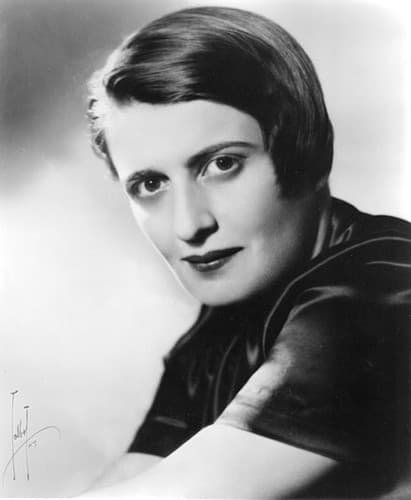
Alice O'Connor, better known by her pen name Ayn Rand, was a Russian-born American writer and philosopher. She is known for her fiction and for developing a philosophical system she named Objectivism. Born and educated in Russia, she moved to the United States in 1926. After two early novels that were initially unsuccessful and two Broadway plays, she achieved fame with her 1943 novel, The Fountainhead. In 1957, Rand published her best-selling work, the novel Atlas Shrugged. Afterward, until her death in 1982, she turned to non-fiction to promote her philosophy, publishing her own periodicals and releasing several collections of essays.
Similar books
- Brave New World
Aldous Huxley
4.0 (1.4M) average on GoodreadsFantasyExplores a dystopian society where individuality is suppressed for societal control.
- 1984
George Orwell
4.2 (3.1M) average on GoodreadsPoliticsFeatures a totalitarian regime that eradicates personal freedom and independent thought.
- The Fountainhead
Ayn Rand
3.9 (297k) average on GoodreadsLiterary FictionFurther develops themes of individualism, egoism, and the struggle against collectivism.
- Animal Farm
George Orwell
4.0 (2.7M) average on GoodreadsPoliticsA farm animals' rebellion against humans turns into a pig-led dictatorship, showing how power corrupts and revolutionary ideals are betrayed.
- Freakonomics: A Rogue Economist Explores the Hidden Side of Everything
Steven D. Levitt
4.0 (709k) average on GoodreadsBusinessThis book uses economic principles to reveal the surprising incentives behind everything from drug dealing and real estate to cheating teachers and the decline of crime.
- I Am Malala: The Story of the Girl Who Stood Up for Education and Was Shot by the Taliban
Malala Yousafzai
4.1 (419k) average on GoodreadsPoliticsA teenage girl from a Taliban-controlled valley refuses to give up her books, becoming a global voice for education even after an assassination attempt.





Enjoyed the summary?
A summary gives you the shape of the book. The book itself has the detail, the examples and the voice.
Find Anthem on AmazonAs an Amazon Associate, BookBrief earns from qualifying purchases. How we're funded