

Synopsis
Covers the whole plot, including the ending.
- Difficulty
- Hard
- Pacing
- Slow
- Mood
- Philosophical, Challenging, Intense, Idealistic
- Read it if
- You enjoy philosophical fiction, explore themes of individualism vs. collectivism, or are interested in Objectivism.
- Skip it if
- You prefer fast-paced plots, dislike lengthy philosophical monologues, or find Rand's ideology unappealing.
The Fountainhead Plot Summary
Covers the whole plot, including the ending.
Expulsion and Early Struggles
Howard Roark is expelled from the architectural department of the Stanton Institute of Technology for his modern designs. He moves to New York City, determined to work for Henry Cameron, an architect he admires. Roark gets a position, but when Cameron retires, Roark becomes unemployed. He struggles to find work that matches his principles, briefly working for Peter Keating, a former classmate who compromises for success. Roark eventually opens his own office, but few clients want his innovative vision, leading to financial problems.
Granite Quarry and Dominique Francon
Without commissions that allow artistic freedom, Roark closes his office and works in a granite quarry in Connecticut. There, he meets Dominique Francon, an architectural critic for 'The Banner' newspaper. Dominique is drawn to Roark's independent spirit but also feels antagonism towards his uncompromising nature, which she sees as a threat to a world she believes is corrupt. Their relationship is marked by a powerful, violent encounter, showing their complex mix of attraction and conflict, as Dominique both desires and resists Roark's influence.
The Enright House and Public Outcry
Roark designs the Enright House, a department store, in his modernist style. The building is functional and well-formed, but its stark appearance causes controversy. Ellsworth M. Toohey, a critic for 'The Banner,' uses his influence to lead a public campaign against Roark and the Enright House. Toohey, a collectivist who wants to destroy independent thought, manipulates public opinion, portraying Roark as arrogant. The public outcry leads to the client's financial ruin and Roark's professional isolation.
Dominique's Compromises
Believing that integrity is doomed by society, Dominique Francon begins a path of self-destruction and compromise. To defy the world and, in a twisted way, to protect Roark by showing her own unworthiness, she marries Peter Keating, the commercially successful but creatively empty architect. Her marriage is a cynical, loveless arrangement, meant to show her belief that happiness and integrity are impossible. She further tries to degrade herself by writing harsh critiques of architecture, even work she secretly admires, including Roark's, trying to become immune to the pain of a world that rejects her ideals.
The Stoddard Temple
Roark receives a commission from a wealthy patron, Mrs. Stoddard, to design a temple. He creates a minimalist structure that is innovative and personal. Ellsworth Toohey again attacks Roark. He manipulates public sentiment, calling the temple sacrilegious. The resulting scandal is huge, leading to a lawsuit against Mrs. Stoddard and the temple's destruction by court order. This incident further solidifies Roark's controversial reputation and shows society's resistance to his independent vision.
The Wynand Connection
Gail Wynand, the powerful owner of 'The Banner' newspaper, built his empire by pleasing the masses, but becomes interested in Howard Roark. Wynand, despite his cynicism, secretly admires Roark's integrity, seeing in him the man he once wanted to be before compromising his ideals. He starts to subtly support Roark's work, offering commissions and using his influence to promote designs, much to the anger of Ellsworth Toohey, Wynand's employee and ideological opponent. This alliance is tense, as Wynand struggles with his own conflicting values.
Dominique's Shift
Dominique Francon, growing disillusioned with her marriage to Peter Keating and her self-destructive path, realizes her attempts to protect Roark were pointless. She divorces Keating and marries Gail Wynand. Her reasons are complex: she sees Wynand's power and believes that by allying with him, she can shield Roark from attacks and ensure his success. She sees Wynand as the only man powerful enough to stand against the collective. However, this marriage is also a compromise, as she sacrifices personal happiness for what she sees as a greater good—the preservation of Roark's genius.
The Cortlandt Homes Project
Peter Keating, whose career is declining, is commissioned to design the Cortlandt Homes, a large public housing project. Knowing his own creative limits, Keating secretly asks Howard Roark to design the project under Keating's name. Roark, seeing a chance to build on a grand scale on his own terms, agrees, but only if his design is built exactly as conceived, without changes. Keating, desperate for success, agrees, setting the stage for a monumental project that will reveal the truth.
The Dynamite and the Trial
Despite Roark's clear instructions, the contractors for the Cortlandt Homes project, under pressure, make unauthorized changes to his original design. When Roark discovers these changes, which compromise his work's integrity, he takes drastic action. He dynamites the partially built structures, destroying the corrupted project. This act leads to his arrest and a public trial for property damage. The trial becomes a battle of ideas, with Roark's actions seen as either vandalism or a heroic defense of artistic integrity.
Roark's Speech and Acquittal
During his trial, Howard Roark gives a powerful speech defending his actions and his philosophy of individualism. He argues that the ego is the source of all human progress, and that the right to create belongs only to the individual, free from others' demands. He criticizes the collectivist mindset that tries to control the independent spirit. His speech resonates with some, including Gail Wynand, who, despite his earlier compromises, uses his newspaper to publish the speech in full. The jury, influenced by Roark's conviction and Wynand's support, acquits him.
Wynand's Fall and Redemption
Gail Wynand's decision to support Roark and publish his speech causes a huge backlash from his readers and advertisers, influenced by Toohey. His media empire crumbles as his newspapers lose circulation and his power weakens. Wynand, who built his empire on catering to the masses, faces the consequences of his brief moment of integrity. Though he loses everything, in his final act as an owner, he commissions Roark to design one last building for him—a skyscraper that symbolizes his own unfulfilled potential and the ideals he had abandoned, finding a form of redemption in acknowledging his true values.
The Wynand Building and Union
Howard Roark receives the commission from Gail Wynand to design the Wynand Building, a skyscraper that will be the tallest in New York. This project represents the peak of Roark's architectural vision, an achievement of individual integrity, free from compromise. As the building rises, a symbol of unyielding principle, Dominique Francon, having left her cynicism, finally embraces her love for Roark without reservation. She goes to him, now free to commit to the man whose spirit she had always admired, even in her misguided ways. Their union at the top of the Wynand Building symbolizes the triumph of individualism and love over societal pressures.
Principal Figures
Howard Roark
Protagonist
An uncompromising, individualist architect who refuses to conform.
Howard Roark is an architect of unparalleled talent and unyielding integrity. He is driven by his own creative vision and refuses to compromise his designs or principles for anyone, even if it means professional hardship and public scorn. Roark believes in the absolute right of the individual to create and to live for his own sake, without owing anything to others or sacrificing himself for the collective. He is not motivated by fame, money, or power, but by the pure joy of creation and the realization of his vision. His quiet strength and self-sufficiency make him an enigmatic figure, often misunderstood by society.
Relationships: Dominique Francon (Passionate, complex, and initially antagonistic love interest, later his wife.); Gail Wynand (Powerful patron and admirer, a man who sees in Roark the integrity he lost.); Ellsworth Toohey (Ideological antagonist and manipulator.); Peter Keating (Former classmate and professional rival, whom Roark helps out of a sense of detached principle.); Henry Cameron (Early mentor and fellow independent architect.)
Dominique Francon
Supporting/Love Interest
A beautiful and intelligent architectural critic who loves Roark but believes greatness is doomed.
Dominique Francon is a stunningly beautiful, intelligent, and fiercely independent woman, working as an architectural critic for 'The Banner.' She possesses a keen aesthetic sense and an almost spiritual appreciation for beauty and greatness, which she recognizes in Roark. However, she believes that the world is inherently corrupt and will inevitably destroy anything truly superior. This conviction leads her to a path of self-sabotage and deliberate compromise, marrying Peter Keating and then Gail Wynand, in an attempt to shield Roark from the world's destructive power by proving her own unworthiness, or to protect him through the power of others. Her love for Roark is profound but initially expressed through conflict and denial.
Relationships: Howard Roark (Passionate, complex, and initially antagonistic love interest, later his wife.); Peter Keating (Her first husband, a loveless marriage of cynical defiance.); Gail Wynand (Her second husband, a marriage of strategic protection for Roark.); Ellsworth Toohey (An intellectual adversary whose collectivist views she despises, though she sometimes inadvertently serves his purpose.)
Peter Keating
Antagonist/Foil
A successful but creatively bankrupt architect who compromises his way to the top.
Peter Keating is Roark's former classmate, a man driven by ambition, public approval, and a desire to please others. He is a brilliant social climber, adept at networking and conforming to popular taste, which propels him to professional success. However, Keating lacks original talent and genuine conviction. He constantly seeks validation from others and sacrifices his own desires and integrity to achieve external recognition. His career is a testament to compromise, leading to a hollow existence and eventual professional decline. He represents the antithesis of Roark, embodying the 'second-hander' who lives through others.
Relationships: Howard Roark (Professional rival and the object of Keating's envy and occasional reliance.); Dominique Francon (His first wife, a loveless marriage of convenience and defiance.); Ellsworth Toohey (Manipulator and patron, who uses Keating for his own ends.)
Ellsworth M. Toohey
Antagonist
An influential architectural critic and collectivist who seeks to destroy individualism.
Ellsworth M. Toohey is a prominent architectural critic, columnist, and intellectual leader, and the novel's primary antagonist. He is a master manipulator, driven by a profound hatred of individual achievement and a desire to subjugate all minds to the collective. Toohey subtly preaches altruism and self-sacrifice, but his true aim is to destroy independent thought and creativity, believing that if individuals are made to feel guilty for their own success, they will be easier to control. He uses his charm, intelligence, and media influence to orchestrate public opinion, tirelessly working to undermine Roark and anyone who embodies individualism.
Relationships: Howard Roark (His primary target and ideological enemy.); Peter Keating (His protégé and tool, whom he manipulates for his own purposes.); Gail Wynand (His employer, whom he attempts to control and influence.); Dominique Francon (An intellectual adversary, though she sometimes unwittingly serves his aims.)
Gail Wynand
Supporting
A powerful and cynical newspaper magnate who secretly admires Roark's integrity.
Gail Wynand is the immensely powerful and wealthy owner of 'The Banner' newspaper, a media empire built on sensationalism and pandering to the lowest common denominator. Though outwardly cynical and ruthless, Wynand possesses a deep-seated, unacknowledged admiration for greatness and integrity, which he sees in Roark. He is a man who once had high ideals but compromised them for power and success, and he lives with the quiet agony of that betrayal. His relationship with Roark is complex, marked by both a desire to possess and protect Roark's spirit, and a fear that Roark's uncompromising nature will destroy him, just as Wynand's own compromises have destroyed his soul.
Relationships: Howard Roark (Patron, friend, and the object of his profound, conflicted admiration.); Dominique Francon (His second wife, a marriage of strategic alliance and mutual understanding.); Ellsworth Toohey (His employee, whom he despises but tolerates for his utility in controlling the masses.)
Henry Cameron
Supporting
An aging, independent architect who serves as Roark's early mentor.
Henry Cameron is an aging architect whose career is in decline, largely because he, like Roark, refuses to compromise his artistic vision. He is one of the few architects Roark genuinely admires, and Roark seeks him out for work. Cameron embodies an earlier generation of independent creators who struggled against the tide of conventionalism. He recognizes Roark's genius and serves as an early mentor, validating Roark's uncompromising approach and offering him his first professional opportunity. Cameron represents the lineage of principled creation that Roark continues.
Relationships: Howard Roark (Mentor and fellow independent spirit.)
Stephen Mallory
Supporting
A sculptor who attempts to assassinate Toohey and later works with Roark.
Stephen Mallory is a talented sculptor whose career and spirit have been crushed by Ellsworth Toohey's insidious influence. He attempts to assassinate Toohey in a moment of despair and rage, believing Toohey to be a force of pure evil destroying the world's beauty and talent. Roark, recognizing Mallory's genuine artistic spirit and understanding his desperation, later commissions him to sculpt a nude figure for the Stoddard Temple. Mallory's character highlights the destructive power of Toohey's collectivism and the restorative power of Roark's recognition and support for individual creators.
Relationships: Ellsworth Toohey (The target of his attempted assassination, the cause of his despair.); Howard Roark (His patron and savior, who recognizes his talent.)
Austen Heller
Supporting
A wealthy and independent-minded client who gives Roark his first major commission.
Austen Heller is a wealthy, unconventional, and independent-minded client who is one of the first to recognize and appreciate Howard Roark's unique architectural vision. He commissions Roark to design his private residence, providing Roark with his first significant opportunity to build a structure entirely on his own terms. Heller is crucial in establishing Roark's early career, demonstrating that there are individuals who value genuine innovation over popular trends. He represents a rare instance of a client who truly respects an artist's integrity.
Relationships: Howard Roark (One of Roark's first and most important clients.)
Themes & Insights
Individualism vs. Collectivism
This is the central theme of 'The Fountainhead.' The novel champions radical individualism, stating that human progress and true value come from independent thought and creation, not from collective action or self-sacrifice. Howard Roark embodies this, refusing to compromise his vision for popular opinion or others' needs. His struggles against society, especially against Ellsworth Toohey's collectivist ideas, highlight the conflict between 'first-handers' who create and 'second-handers' who live through others. Roark's destruction of the Cortlandt Homes is the ultimate act against collectivist compromise, emphasizing the sanctity of individual creative integrity.
“The first right on earth is the right of the ego. Man’s first duty is to himself. His moral obligation is to take that which he desires, to make his own, and to use as he sees fit.”
The Integrity of the Creator
The novel explores artistic and personal integrity, especially how it relates to creative work. Roark's commitment to his architectural vision, even when facing poverty and scorn, shows this theme. He sees his work as part of himself, and any compromise to his designs is a violation of his soul. The book contrasts Roark's integrity with Peter Keating's willingness to conform for public approval, showing the emptiness of a life built on compromise. The dynamiting of Cortlandt Homes dramatically expresses this integrity, showing that a corrupted creation is worse than none.
“To sell your soul is the easiest thing in the world. That’s what everybody does every hour of his life. If I asked you to keep your soul, would you know what I meant?”
The Nature of Love and Relationships
Rand presents a view of love as a relationship between independent equals who admire each other's strength, rather than a bond based on sacrifice. The intense, often violent, relationship between Howard Roark and Dominique Francon is key to this theme. Their initial encounters are marked by conflict, reflecting their equally strong wills. Dominique's journey involves letting go of her belief that greatness cannot survive, eventually allowing her to fully embrace a love that respects Roark's uncompromising spirit. Gail Wynand's admiration for Roark, born from recognizing his own lost integrity, also relates to this theme of seeking value in others.
“To say ‘I love you’ one must first be able to say the ‘I’.”
The Power of Public Opinion and Media Manipulation
The novel examines how public opinion can be shaped by influential figures, especially through media. Ellsworth Toohey, a critic for 'The Banner,' skillfully creates public campaigns against Roark, using rhetoric to turn society against independent thought. Gail Wynand, a newspaper magnate, initially shows the media's power to pander to the lowest common denominator, but later supports Roark, leading to his own downfall. This theme highlights how vulnerable truth and individual genius are to controlled narratives and the collective's desire for conformity.
“The public is a herd of second-handers. They want to be told what to feel, what to think, what to like.”
Architecture as a Metaphor
Architecture in 'The Fountainhead' is a metaphor for man's creative spirit and his relationship to the world. Roark's modernist designs, with clean lines and structural integrity, symbolize his individualism and rational approach to life. In contrast, the traditional styles favored by Peter Keating represent conformity and the 'second-hand' mentality. The act of building itself, from concept to structure, mirrors the process of self-creation and asserting one's will on reality. The destruction of the Cortlandt Homes emphasizes that a corrupted creation is a betrayal of the self.
“I don’t believe in God, but I believe in architecture.”
Plot Devices & Literary Techniques
Foil Characters
Characters who highlight the protagonist's traits through contrast.
Peter Keating and Ellsworth Toohey serve as primary foils to Howard Roark. Keating's entire career and personal life are built on compromise and seeking external validation, directly contrasting Roark's uncompromising integrity and self-sufficiency. Toohey's collectivist ideology and manipulative tactics stand in stark opposition to Roark's radical individualism. These characters illuminate Roark's unique qualities and the philosophical stakes of his struggle by presenting alternative, yet ultimately destructive, paths.
Symbolism of Architecture
Buildings represent characters' philosophies and societal values.
Architecture is not merely a setting but a powerful symbolic device. Roark's buildings (e.g., the Enright House, the Wynand Building) are stark, functional, and revolutionary, embodying his integrity and individualistic philosophy. Keating's eclectic, derivative buildings symbolize his compromise and lack of original vision. The Stoddard Temple, designed by Roark, becomes a symbol of the human spirit, while its destruction by court order represents society's rejection of genius. The Cortlandt Homes, when altered, symbolize the corruption of a noble idea by collective interference.
The Courtroom Speech
A climactic monologue that articulates the novel's core philosophy.
Roark's trial for dynamiting the Cortlandt Homes culminates in a lengthy, impassioned speech where he directly articulates the philosophical underpinnings of his actions and the novel itself. This device allows Rand to explicitly state the tenets of Objectivism – the primacy of the individual ego, the creator, and the inherent evil of altruism and collectivism. It serves as the ideological climax, providing a clear and direct summary of the book's central message, moving beyond implied themes to overt philosophical declaration, and directly challenging the reader to consider these ideas.
The Anti-Heroine (Dominique Francon)
A female protagonist whose actions are initially self-destructive and contradictory.
Dominique Francon functions as an anti-heroine. Unlike a traditional heroine who might directly support the protagonist, Dominique initially acts in ways that seem to undermine Roark or herself, driven by a twisted form of love and a cynical worldview. Her marriages to Keating and Wynand are acts of defiance and protection, not traditional romance. This device creates narrative tension and allows for a deeper exploration of her complex psychological state, where her love for Roark is expressed through a struggle against a world she believes will destroy him, before she ultimately embraces her true feelings.
The Fountainhead Quotes
“To sell your soul is a lot worse than to sell your body. A body can be bought and sold. But a soul is yours, you can never get it back. When you sell your soul, you are selling your birthright, your right to be an individual.”
“The only thing that matters is the work. There is nothing else. No praise, no blame, no reward, no punishment, no love, no hatred. Only the work.”
“Civilization is the progress toward a society of privacy. The savage lives in a pack. The civilized man lives as an individual.”
“Integrity is the ability to stand by an idea.”
“The question isn't who is going to let me; it's who is going to stop me.”
“To say 'I love you' one must know first how to say the 'I.'”
“A creative man is motivated by the desire to achieve, not by the desire to beat others.”
“The most depraved type of human being is the man who has no self-respect.”
“Man's ego is the fountainhead of human progress.”
“There are two sides to every issue: one side is right and the other is wrong, but the middle is always evil.”
“Do not let your fire go out, spark by irreplaceable spark in the hopeless swamps of the not-quite, the not-yet, and the not-at-all.”
“The creator stands on his own judgment. The parasite follows the opinions of others.”
“Every man has a right to his own life, to his own mind, to his own values, to his own will.”
Quiz
10 questions on the plot and the characters. Each answer comes with a short explanation.
Question 1
What is Howard Roark's profession?
- Sculptor
- Architect
- Journalist
- Engineer
Show answer
B. Architect Howard Roark is introduced as a brilliant and uncompromising architect who is expelled from the architectural school for his unconventional designs.
Question 2
Which character is presented as the epitome of the 'second-hander,' constantly seeking validation and power through others?
- Gail Wynand
- Peter Keating
- Steven Mallory
- Austin Heller
Show answer
B. Peter Keating Peter Keating is the quintessential 'second-hander,' constantly making decisions based on what others expect of him and seeking fame and success through imitation and compromise.
Question 3
What is the name of the newspaper owned by Gail Wynand?
- The Banner
- The Gazette
- The New York Journal
- The Banner
Show answer
D. The Banner Gail Wynand built his media empire around his sensationalist newspaper, The Banner, which he used to manipulate public opinion.
Question 4
What major architectural project does Roark design, which is later controversially dynamited by him?
- The Stoddard Temple
- The Wynand Building
- The Cortlandt Homes
- The Heller House
Show answer
C. The Cortlandt Homes Roark dynamites the Cortlandt Homes after they are built with unauthorized alterations to his original design, violating his artistic integrity.
Question 5
Dominique Francon initially expresses her admiration for Roark by doing what?
- Writing a glowing review of his work in The Banner
- Smashing a vase in his apartment as an act of defiance
- Commissioning him to build her a country house
- Publicly defending him against criticism
Show answer
B. Smashing a vase in his apartment as an act of defiance Dominique expresses her complex admiration for Roark by smashing a valuable vase in his apartment, a symbolic act of recognizing his superiority and her own internal conflict.
Question 6
What is the central philosophical theme that Ayn Rand explores through the character of Howard Roark?
- The virtues of altruism and self-sacrifice
- The importance of social conformity for societal harmony
- The supremacy of the individual and the ego as the source of creation
- The dangers of unchecked capitalism
Show answer
C. The supremacy of the individual and the ego as the source of creation The Fountainhead champions individualism and the ego as the driving force behind human progress, contrasting it with the 'second-handers' who live through others.
Question 7
Why does Dominique Francon marry Peter Keating?
- She genuinely loves him and believes in his talent.
- She wants to punish herself and Roark by marrying someone she despises, believing society will always destroy the best.
- Her father arranges the marriage for business reasons.
- She is pressured by public opinion and social expectations.
Show answer
B. She wants to punish herself and Roark by marrying someone she despises, believing society will always destroy the best. Dominique marries Keating as a deliberate act of self-punishment and a bitter protest against a world she believes will inevitably destroy greatness like Roark's.
Question 8
What is the fate of Gail Wynand's newspaper, The Banner, at the end of the novel?
- It thrives and becomes more influential than ever.
- It is sold to a rival publisher and continues under new management.
- Wynand loses control of it as his editorial policies shift, leading to its financial ruin and his forced resignation.
- It merges with another media corporation.
Show answer
C. Wynand loses control of it as his editorial policies shift, leading to its financial ruin and his forced resignation. When Wynand tries to use The Banner to support Roark and his ideals, his readers and staff revolt, leading to his loss of control and the paper's ultimate decline.
Question 9
Who delivers the famous courtroom speech defending Roark's actions regarding the Cortlandt Homes?
- Peter Keating
- Gail Wynand
- Howard Roark himself
- Henry Cameron
Show answer
C. Howard Roark himself Roark delivers a powerful and lengthy speech in his own defense, articulating the core tenets of individualism and the creator's right to his work.
Question 10
What is the ultimate symbolic gesture of Dominique Francon's acceptance of Roark's ideals and her own identity at the very end of the novel?
- She leaves New York to pursue her own architectural career.
- She marries Howard Roark and stands by his side as he builds his greatest skyscraper.
- She publishes a book criticizing society's treatment of creators.
- She inherits Gail Wynand's media empire.
Show answer
B. She marries Howard Roark and stands by his side as he builds his greatest skyscraper. In the final scene, Dominique, now married to Roark, stands by him at the top of the Wynand Building, his greatest creation, symbolizing her full embrace of his values and their union.
The Fountainhead FAQ
What is the central conflict driving the plot of 'The Fountainhead'?
The central conflict revolves around the uncompromising individualist architect Howard Roark and his struggle against a collectivist society that values conformity and tradition over independent thought and creative genius. Roark's projects are constantly undermined or rejected by critics like Ellsworth Toohey and publishers like Gail Wynand, who champion mediocrity and the 'second-hander' mentality.
Who is Howard Roark and what makes him a unique protagonist?
Howard Roark is an architect driven solely by his own vision and integrity, refusing to compromise his designs for clients, critics, or public opinion. He embodies the 'first-hander' – a man who creates from his own mind without needing others' validation, distinguishing him from characters who derive their worth from social approval or the manipulation of others.
Describe the relationship between Howard Roark and Dominique Francon.
Their relationship is complex and deeply passionate, characterized by an initial violent encounter that evolves into a profound understanding and love based on mutual respect for their individualistic spirits. Dominique, initially seeking to destroy what she loves to protect it from the world, eventually realizes that Roark's integrity is his greatest strength, not a vulnerability.
What role does Gail Wynand play in the narrative?
Gail Wynand, a powerful newspaper magnate, initially admires Roark's integrity and even supports him, but ultimately compromises his own values by catering to public taste for profit. He represents the tragic figure who possesses the potential for greatness but succumbs to the pressure of public opinion, illustrating the corrupting influence of 'second-handedness.'
How does Ellsworth M. Toohey manipulate society and what is his ultimate goal?
Ellsworth M. Toohey is a prominent architectural critic and socialist who manipulates public opinion through his writings and influence on committees, subtly undermining individual achievement and promoting collectivism. His ultimate goal is to destroy the concept of the individual ego and replace it with a collective consciousness where no one can rise above the common denominator, thus gaining power through control over the 'souls' of men.
What is the significance of the Stoddard Temple commission and its destruction?
The Stoddard Temple was a radical, atheistic church designed by Roark, commissioned by a wealthy patron, and its subsequent destruction by Toohey's manipulation highlighted the societal intolerance for independent thought and art that challenged conventional norms. Its demolition by public outcry, despite its artistic merit, served as a stark example of the mob mentality Roark fights against.
What is the implied fate or trajectory of Peter Keating after the events of the novel?
After failing in his architectural career, which was built on imitation and compromise rather than genuine talent, Peter Keating is left a broken and disillusioned man, stripped of his social standing and personal ambition. His final encounter with Roark, where he admits his failures, suggests a future of obscurity and regret, having never truly found his own path.
How does the rape scene between Roark and Dominique foreshadow their later relationship dynamics?
The initial violent encounter, though controversial, establishes a primal connection between Roark and Dominique, where she instinctively recognizes his unyielding strength and integrity, which she both fears and desires. It foreshadows a relationship built on a profound, almost brutal, honesty and a mutual understanding of strength that transcends conventional societal norms and expectations.
What is the symbolic meaning behind the final scene where Dominique stands on the skyscraper with Roark?
The final scene, with Dominique standing atop the Wynand Building designed by Roark, symbolizes her full acceptance of Roark's philosophy and her own liberation from societal constraints. It represents the triumph of individualism and creative integrity, with the skyscraper itself standing as a monument to Roark's uncompromised vision, reaching towards the future.
How does Roark's character exemplify Rand's concept of 'egoism' as a virtue?
Roark's character embodies egoism as a virtue by consistently acting on his own judgment and values, prioritizing his creative vision over the approval or needs of others. He demonstrates that self-interest, when defined as the pursuit of one's rational values and productive work, is the driving force of progress and personal fulfillment, rather than a selfish vice.
Analyze the psychological motivations behind Dominique Francon's self-destructive tendencies and her marriage to Keating.
Dominique's self-destructive tendencies stem from her deep cynicism and despair over a world she perceives as incapable of appreciating greatness. She marries Keating and later Wynand as acts of self-punishment and an attempt to destroy her own spirit, believing that if she cannot have the ideal (Roark), she will embrace the grotesque or the mediocre to prove the world's depravity.
What psychological impact does Toohey's philosophy of altruism have on his followers?
Toohey's philosophy of altruism, which advocates self-sacrifice and service to others as the highest good, psychologically disarms his followers by making them feel guilty for any personal ambition or achievement. It fosters a sense of dependency and mediocrity, stripping individuals of their self-esteem and making them susceptible to his control by appealing to their desire for moral superiority through self-abnegation.
How does Peter Keating's journey illustrate the psychological toll of living a 'second-hand' life?
Peter Keating's journey illustrates the profound psychological toll of living a 'second-hand' life, where he constantly seeks validation and success through imitation and manipulation rather than genuine talent. He experiences increasing emptiness, anxiety, and eventual despair as he realizes his achievements are hollow, leading to a complete breakdown of his self-worth and identity.
Is 'The Fountainhead' truly a defense of selfishness, or is there a more nuanced interpretation?
While often perceived as a defense of selfishness, a more nuanced interpretation reveals it as a defense of rational self-interest and individualism against collectivism. Rand argues for the right of individuals to live for their own sake, pursue their own values, and create, without sacrificing themselves or others, distinguishing this from irrational greed or exploitation.
How does the novel address the concept of integrity, particularly through Roark's actions and choices?
The novel addresses integrity as an unyielding adherence to one's own rational judgment and values, regardless of external pressure or personal cost. Roark consistently demonstrates this by refusing to compromise his architectural designs, even when it means poverty or professional ostracization, illustrating that true integrity is about remaining true to oneself and one's vision.
What is the enduring relevance of 'The Fountainhead' in contemporary society?
The enduring relevance of 'The Fountainhead' lies in its timeless exploration of individualism versus collectivism, the struggle for creative freedom against conformity, and the importance of personal integrity. In a world still grappling with issues of social pressure, cancel culture, and the role of the individual in society, Rand's arguments for independent thought and uncompromised vision remain highly provocative and pertinent.
How do the character arcs of Dominique Francon and Gail Wynand contrast in their relationship with Roark's ideals?
Dominique's arc shows her moving from despair and defiance to a full embrace of Roark's ideals, finding her own strength and purpose through him. Gail Wynand, conversely, starts with an understanding and admiration for Roark's integrity but ultimately succumbs to the pressure of public opinion, sacrificing his ideals for power and ultimately failing to achieve true fulfillment, leading to his tragic downfall.
What philosophical arguments does Roark's courtroom speech present, and how does it summarize the book's core themes?
Roark's courtroom speech is a powerful defense of individualism, the creative spirit, and the moral right of man to exist for his own sake. It argues that all progress comes from the 'first-handers' – the creators and innovators – and that altruism and collectivism are inherently destructive forces. This speech succinctly summarizes the book's core themes of egoism as a virtue, the evil of the 'second-hander,' and the importance of individual integrity.
About the author
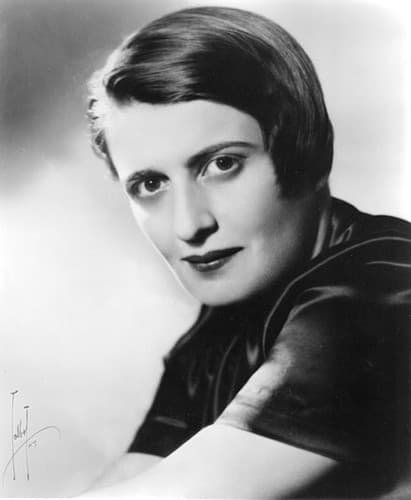
Alice O'Connor, better known by her pen name Ayn Rand, was a Russian-born American writer and philosopher. She is known for her fiction and for developing a philosophical system she named Objectivism. Born and educated in Russia, she moved to the United States in 1926. After two early novels that were initially unsuccessful and two Broadway plays, she achieved fame with her 1943 novel, The Fountainhead. In 1957, Rand published her best-selling work, the novel Atlas Shrugged. Afterward, until her death in 1982, she turned to non-fiction to promote her philosophy, publishing her own periodicals and releasing several collections of essays.
Similar books
- Atlas Shrugged
Ayn Rand
3.7 (354k) average on GoodreadsPoliticsExplores similar themes of individualism, capitalism, and the role of the creator in society, with a grander scope.
- Thus Spoke Zarathustra
Friedrich Nietzsche
4.0 (111k) average on GoodreadsPsychologyA philosophical novel that champions the 'Übermensch' and radical self-overcoming, aligning with Rand's celebration of the individual ego.
- The Stranger
Albert Camus
4.1 (3k) average on GoodreadsFantasyCamus's Meursault examines an individual's alienation and detachment from societal norms but from a perspective of existential absurdity and indifference, rather than Rand's purposeful, values-driven defiance. The Stranger delves into the meaninglessness of existence and the individual's struggle to find meaning, presenting a stark contrast to Rand's rationalist and optimistic view of human agency and the possibility of a fully integrated, self-sufficient ego.
- The Old Man and the Sea
Ernest Hemingway
3.8 (831k) average on GoodreadsLiterary FictionA Cuban fisherman's long struggle with a giant marlin becomes a story of endurance and dignity, now retold for young adults with illustrations, phonetic guides, and writing prompts in Traditional Chinese.
- One Hundred Years of Solitude
Gabriel García Márquez
4.1 (753k) average on GoodreadsLiterary FictionThrough the multi-generational story of the Buendía family, a mythical town deals with the repeating patterns of time, love, and solitude, as the extraordinary mixes with the ordinary.
- The Goldfinch
Donna Tartt
3.9 (720k) average on GoodreadsLiterary FictionHaunted by a tragic explosion and clutching a stolen Dutch masterpiece, a young orphan navigates the opulent drawing rooms of New York and the gritty underbelly of the art world, desperately seeking connection and redemption amidst a life spiraling into crime and obsession.






Enjoyed the summary?
A summary gives you the shape of the book. The book itself has the detail, the examples and the voice.
Find The Fountainhead on AmazonAs an Amazon Associate, BookBrief earns from qualifying purchases. How we're funded