
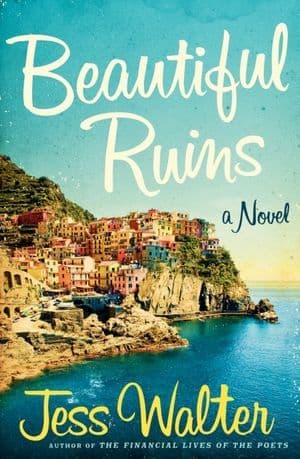
Synopsis
Covers the whole plot, including the ending.
- Difficulty
- Medium
- Pacing
- Moderate
- Mood
- Wistful, Romantic, Reflective, Humorous, Melancholy
- Read it if
- You enjoy sweeping, multi-generational sagas with a blend of romance, mystery, and historical detail, featuring interconnected lives and a sense of wistful longing.
- Skip it if
- You prefer straightforward, linear narratives without multiple timelines or a large cast of characters, or if you dislike open-ended resolutions.
Beautiful Ruins Plot Summary
Covers the whole plot, including the ending.
The Siren's Arrival in Porto Vergogna (1962)
In 1962, Pasquale Tursi runs the Hotel Adequate View in the small Italian village of Porto Vergogna. His life is quiet, following the rhythms of the sea and his family. This peace ends with the arrival of Dee Moray, an American actress. She says she is ill with a stomach ailment and has been sent to this remote place by the film studio to get better. Pasquale is immediately drawn to her beauty and vulnerability. He believes she is dying and sees her as a tragic figure. He becomes her devoted caretaker, making special meals and trying to make her comfortable, all while feeling an unspoken affection for her.
The Allure of Dee Moray and Richard Burton's Influence
As Dee stays at the Hotel Adequate View, Pasquale learns more about her, or what he thinks he learns. She mentions a film she was working on, 'Cleopatra,' and a powerful actor, Richard Burton, with whom she had a brief, intense affair. It seems her 'illness' might be more emotional than physical, a result of heartbreak and the chaotic world of Hollywood. Burton, known for his drinking and relationship with Elizabeth Taylor, is a shadowy but strong presence in Dee's story, shaping her current situation. Pasquale, despite his growing jealousy and confusion, stays dedicated to her, caught in her glamour and sadness.
A Fateful Day at the Beach and Dee's Disappearance
One day, Pasquale takes Dee to a secluded beach. While there, paparazzi, alerted by an unknown source, arrive, creating a chaotic scene. Pasquale tries to protect Dee from the cameras, leading to a struggle. In the confusion, Dee is taken away, seemingly by film studio representatives. Pasquale is left confused and heartbroken, with no explanation for her sudden departure. He has only questions and the memory of her. This event ends their brief connection and starts Pasquale's lifelong search for what happened to Dee Moray and why she left.
Fifty Years Later: Pasquale's Arrival in Hollywood (2012)
Fifty years later, in 2012, an older Pasquale Tursi, still thinking about Dee Moray's sudden disappearance, arrives in Hollywood. He has saved money his whole life to find her. He goes to the offices of Michael Deane, a powerful film producer who was involved in the original 'Cleopatra' production. Pasquale's arrival, with his broken English and serious quest, is an unexpected event in Deane's life. Deane's assistant, Claire Silver, at first thinks Pasquale is a deluded old man, but his persistence and the romantic sadness of his story start to interest her.
Michael Deane's Unfinished Film and Claire's Investigation
Michael Deane, who cares about his own legacy and a never-produced film script called 'Beautiful Ruins,' initially dismisses Pasquale. However, Claire Silver, his assistant, starts to connect Pasquale's story with Deane's past. She finds out that Deane was involved with 'Cleopatra' and had a history with Dee Moray. Claire begins to investigate, driven by her job and growing personal interest. Her research leads her to old film documents, interviews, and the possibility that Dee Moray's story is tied to Deane's artistic ambitions and regrets.
The Edinburgh Fringe Festival and Shane O'Hare
Claire's investigation leads her to Edinburgh, Scotland, specifically to the Fringe Festival, where she believes she can find more information about Dee Moray. There, she meets Shane O'Hare, a playwright and former college friend of Dee's son, Pat. Shane is trying to stage a play about a fictionalized version of Dee Moray's life, based on stories he heard from Pat. Claire, at first careful of Shane, slowly realizes that he might have important parts of the puzzle. Their talks reveal more about Dee's life after Porto Vergogna, her struggles, and her attempts to redefine herself outside of Hollywood.
The Truth About Dee Moray and Michael Deane's Role
Through her research and conversations, Claire discovers the truth about Dee Moray. Dee was not dying in Porto Vergogna; she was pregnant with Richard Burton's child. Michael Deane, fearing a scandal that would hurt the 'Cleopatra' production and his career, arranged for her removal from Italy and for her to have an abortion. He then paid her off and ensured her silence, ending her acting career and removing her from public memory. This shows Deane as a more cynical and manipulative figure than he first appeared, driven by self-preservation and the demands of the film industry.
Pasquale's Confrontation and the Unveiling of 'Beautiful Ruins'
Pasquale confronts Michael Deane, asking for answers about Dee. The language barrier and Deane's evasiveness make direct communication hard, but the emotional weight of Pasquale's lifelong quest is clear. Claire, now understanding Deane's deception, helps Pasquale understand what happened. She also uncovers the personal meaning of Deane's unfinished script, 'Beautiful Ruins.' It was his attempt to deal with his guilt and the consequences of his actions regarding Dee Moray.
The Legacy of Love and Regret
With the truth revealed, the characters deal with the implications. Pasquale, though heartbroken by Dee's fate, finds some closure. Claire, disappointed by Hollywood's ruthlessness but also inspired by love, re-evaluates her career. Michael Deane, facing his mortality and choices, starts to acknowledge his past. The story connects their lives, exploring unrequited love, ambition, regret, and how the past shapes the present. The 'beautiful ruins' represent lives lived, dreams broken, and the human spirit.
A Return to Porto Vergogna and a New Beginning
Pasquale returns to Porto Vergogna, knowing the truth of Dee's life and death. He finds some peace, understanding that his lifelong quest, though ending sadly, was not wasted. The story suggests a connection between Claire and Shane, hinting at a new beginning and a possible collaboration on a project that might tell Dee's story fairly. The book ends with a mix of sadness and hope, acknowledging the bittersweet nature of life, the beauty in flawed human connections, and the power of stories to shape our understanding of the past and inspire our future.
Principal Figures
Pasquale Tursi
Protagonist
Italian innkeeper, whose lifelong love for Dee Moray drives the narrative.
Pasquale is the earnest, romantic proprietor of the Hotel Adequate View in Porto Vergogna. In 1962, he falls deeply and innocently in love with Dee Moray, believing her to be a dying starlet. His devotion to her is absolute and enduring, shaping the entire course of his life. For fifty years, he harbors her memory and saves money, driven by the singular goal of finding out what happened to her. He is a man of simple means but profound emotional depth, representing purity of heart and the lasting power of first love. His journey to Hollywood is a testament to his unwavering hope.
Relationships: Dee Moray (Unrequited, obsessive love); Michael Deane (Antagonist, the man who knew Dee's secret); Claire Silver (Ally, interpreter of his quest)
Dee Moray
Central Figure/Catalyst
American actress whose mysterious past links all the characters.
Dee Moray is the enigmatic American actress who arrives at Pasquale's hotel in 1962. She is beautiful, vulnerable, and carrying a secret. Though initially presented as a dying starlet, she is actually pregnant with Richard Burton's child and is being hidden away by the studio to avoid scandal. Her life is tragically altered by the machinations of Hollywood. She later becomes a mother and lives a quieter life, forever shaped by her past. She is a symbol of lost potential and the collateral damage of fame and ambition.
Relationships: Pasquale Tursi (Object of his adoration, brief caretaker); Richard Burton (Lover, father of her child); Michael Deane (Manipulator, responsible for her career's end); Pat Moray (Son)
Michael Deane
Antagonist/Producer
Aging, manipulative Hollywood producer with a secret past involving Dee Moray.
Michael Deane is a powerful, self-serving Hollywood producer who, in 1962, orchestrated Dee Moray's disappearance to protect the 'Cleopatra' production and his own career. In 2012, he is an aging, legendary figure, still obsessed with his unproduced film, 'Beautiful Ruins.' He is cynical, pragmatic, and initially dismissive of Pasquale's quest. However, beneath his hardened exterior lies a complex individual haunted by his past actions, which he attempts to atone for, subconsciously, through his 'Beautiful Ruins' script. He represents the ruthless side of the film industry.
Relationships: Dee Moray (Manipulator, employer); Pasquale Tursi (The man he wronged, seeking answers); Claire Silver (Assistant, eventual conscience)
Claire Silver
Supporting/Protagonist
Ambitious young Hollywood assistant who unravels Dee Moray's story.
Claire is Michael Deane's bright, ambitious, and increasingly disillusioned assistant in 2012. She initially views Pasquale as a nuisance but becomes intrigued by his story and the mystery surrounding Dee Moray. Her investigative skills and growing moral compass drive the modern-day plot, leading her to uncover the truth about Dee and Deane's involvement. Claire serves as the reader's guide through the complexities of the past, representing a more ethical and empathetic approach to storytelling and human connection than her boss. She seeks truth and meaning beyond superficial Hollywood glamour.
Relationships: Michael Deane (Boss, mentor (initially), antagonist (eventually)); Pasquale Tursi (Ally, interpreter, friend); Shane O'Hare (Potential romantic interest, collaborator)
Richard Burton
Supporting/Mentioned
Charismatic, alcoholic actor and father of Dee Moray's child.
Richard Burton is a legendary, larger-than-life actor, famously entangled with Elizabeth Taylor. He is Dee Moray's lover and the father of her child. Though he only appears briefly in flashbacks and is primarily referenced, his presence is a powerful catalyst for the entire story. His affair with Dee sets in motion the events that lead to her being hidden away and her career ending. He embodies the intoxicating and destructive allure of Hollywood fame and its impact on those in its orbit.
Relationships: Dee Moray (Lover, father of her child); Elizabeth Taylor (Tempestuous wife (implied))
Shane O'Hare
Supporting
Struggling playwright and friend of Dee Moray's son.
Shane is a struggling playwright and former college friend of Pat Moray (Dee's son). In 2012, he is attempting to stage a play about a fictionalized version of Dee Moray's life at the Edinburgh Fringe Festival. He is somewhat self-absorbed and opportunistic but genuinely passionate about storytelling. He inadvertently holds pieces of Dee's later life story, which he shares with Claire. He represents the artistic struggle and the desire to give voice to forgotten narratives, eventually becoming a potential collaborator with Claire.
Relationships: Pat Moray (College friend); Claire Silver (Potential romantic interest, collaborator)
Pat Moray
Supporting/Mentioned
Dee Moray's son, whose stories inspire Shane O'Hare.
Pat is Dee Moray's son, a character primarily mentioned through Shane O'Hare's anecdotes. He is the source of the fragmented stories about his mother that Shane uses for his play. Pat represents the legacy of Dee's hidden life and the impact of her past on her family. Though not a direct participant in the modern-day quest, his existence and the stories he shared are crucial to unraveling the full truth about Dee.
Relationships: Dee Moray (Mother); Shane O'Hare (Friend)
Cassidy Deane
Supporting
Michael Deane's estranged daughter, a struggling screenwriter.
Cassidy is Michael Deane's estranged daughter, a struggling screenwriter who has a complicated relationship with her powerful father. She resents his neglect and the shadow of his career. Her attempts to connect with him and her own artistic ambitions provide a counterpoint to Deane's self-centeredness. She represents the next generation trying to make their mark in Hollywood, often in opposition to the established powers, and highlights the personal cost of Deane's professional obsessions.
Relationships: Michael Deane (Estranged daughter); Claire Silver (Colleague, potential ally)
Themes & Insights
Unrequited Love and Obsession
The book explores unrequited love, mainly through Pasquale Tursi's lifelong devotion to Dee Moray. His innocent affection in 1962 becomes a decades-long search for her fate. This theme shows in his saving money for fifty years to go to Hollywood, his memories of her, and his belief in her tragic beauty. It shows how one encounter can shape a whole life, even without reciprocation, and the bittersweet nature of holding onto a romantic ideal.
“He understood that he would spend the rest of his life thinking about her, wondering about her, and he would love her, in his own quiet way, until the day he died.”
The Illusion vs. Reality of Hollywood
Jess Walter contrasts Hollywood's glamorous image with its harsh realities. Dee Moray arrives in Porto Vergogna as a 'dying starlet,' a tragic figure, but the truth is she is a pregnant woman whose career is being sacrificed for studio interests. Michael Deane represents the ruthless side, willing to sacrifice people for profit and image. The book shows how fame can be fleeting, dreams can be broken, and the industry often puts spectacle over humanity, leaving 'beautiful ruins'.
“Hollywood was a cruel place. It took your dreams and made them into commodities, then sold them back to you at a vastly inflated price.”
The Enduring Power of Storytelling
Storytelling is a main part of 'Beautiful Ruins,' both as a plot device and a theme. The book itself is a complex story, combining many perspectives and timelines to build a complete narrative. Characters like Shane O'Hare try to tell Dee's story through theater, while Michael Deane deals with his past through his 'Beautiful Ruins' screenplay. Claire Silver's job is to uncover the true story, putting together pieces from different sources. The book shows how stories, true or embellished, shape our understanding of the past, keep memories, and offer a way to understanding and closure.
“Maybe that's what art was: a way to make sense of the beautiful ruins of our lives.”
Regret and Redemption
Regret is clear, especially in Michael Deane's character. His actions in 1962, driven by ambition, lead to Dee Moray's tragic fate and affect him for decades. His unproduced script, 'Beautiful Ruins,' is an attempt at redemption or at least an acknowledgment of his past wrongs. Pasquale regrets that he could not protect Dee or understand her situation. The book explores if redemption is possible for past mistakes and how people carry their choices throughout their lives, often finding comfort or atonement in unexpected ways.
“Some mistakes, he thought, were too big to fix. Some wounds too deep to heal. But you kept trying, didn't you? You always kept trying.”
The Passage of Time and Memory
The book spans fifty years, moving between 1962 and 2012, showing how time changes and preserves. Pasquale's memory of Dee stays clear despite the decades, showing the power of personal memory and first love. Public memory of Dee has faded, manipulated by Hollywood. The dual timeline allows Walter to explore how past events affect generations, shaping present lives and showing that collective and individual recollections are often unreliable. The 'ruins' themselves show time's relentless march.
“Memory, Pasquale thought, was a beautiful, treacherous thing. It could keep you company, or it could keep you trapped.”
Plot Devices & Literary Techniques
Dual Timeline/Non-Linear Narrative
Alternates between 1962 and 2012 to reveal the full story.
The novel employs a dual timeline, primarily alternating between 1962 in Porto Vergogna and 2012 in Hollywood and Edinburgh. This non-linear structure is crucial for building suspense and gradually revealing the full truth about Dee Moray. The 1962 scenes establish the initial encounter and Pasquale's love, while the 2012 scenes show the consequences and the quest for answers. This device allows Jess Walter to contrast past ideals with present realities, explore the long-term impact of decisions, and create a sense of mystery that unravels piece by piece across decades and perspectives.
Multiple Perspectives
Narrated through various characters to offer a multifaceted view of events.
The story is told from the viewpoints of various characters, including Pasquale, Dee, Michael Deane, Claire Silver, and Shane O'Hare, and even includes excerpts from Richard Burton's fictionalized memoir. This technique provides a rich, mosaic-like understanding of the events and the characters' motivations. It highlights the subjective nature of truth and how different individuals interpret and remember the same events. By offering these diverse lenses, the author creates a more complex and nuanced portrait of the characters and the central mystery surrounding Dee Moray.
The Unfinished Screenplay ('Beautiful Ruins')
A script that serves as a symbolic and literal link to the past.
Michael Deane's decades-long, unfinished screenplay, titled 'Beautiful Ruins,' acts as a powerful symbolic and literal plot device. Initially presented as Deane's grand artistic endeavor, it is gradually revealed to be his subconscious attempt to grapple with his guilt over Dee Moray's fate. The script contains thinly veiled versions of the true events, offering clues to Claire Silver's investigation. It represents unfulfilled artistic ambition, the weight of regret, and the way creators sometimes process their personal demons through their art, even if the work remains incomplete.
The 'Dying Starlet' Trope
A classic Hollywood trope used to misdirect and reveal deeper truths.
The initial premise of Dee Moray as a 'dying starlet' is a classic Hollywood trope, immediately invoking a sense of romantic tragedy and glamour. However, Jess Walter uses this device as a clever misdirection. The reality of Dee's situation—her pregnancy and the studio's cover-up—subverts this trope, exposing the harsh realities behind the cinematic illusion. This contrast between the romanticized image and the brutal truth highlights the novel's themes about the illusion versus reality of Hollywood and the human cost of fame and ambition.
The Remote Italian Village (Porto Vergogna)
A setting that symbolizes isolation, innocence, and a forgotten past.
Porto Vergogna, the isolated and picturesque Italian village where the story begins, functions as more than just a setting. Its remoteness symbolizes the innocence and simplicity of Pasquale's life before Dee's arrival, and also serves as a perfect place for the studio to hide Dee away from the prying eyes of the world. The village, whose name ironically means 'Port of Shame,' becomes a place where secrets are kept and where time seems to stand still for Pasquale, preserving his memories of Dee almost perfectly. It represents a contrast to the bustling, manipulative world of Hollywood.
Beautiful Ruins Quotes
“We are all just a collection of stories, and the ones we tell ourselves are the most important.”
“What is life but a series of inspired follies?”
“The world is a beautiful ruin, and we are all just trying to find our place in it.”
“Love is not a transaction. It is a gift, and sometimes it is given to the wrong person.”
“Memory is a funny thing. It chooses what to keep and what to discard, and we are left with the pieces.”
“In Hollywood, everyone is selling something, even if it's just a dream.”
“Sometimes the most beautiful things are the ones that are broken.”
“We spend our lives chasing after ghosts, only to realize they were never there to begin with.”
“Art is not about perfection. It's about capturing a moment, a feeling, a truth.”
“The past is a foreign country; they do things differently there.”
“Hope is the thing with feathers that perches in the soul, and sings the tune without the words, and never stops at all.”
“We are all actors in our own lives, playing parts we didn't choose.”
“Sometimes the only way to move forward is to look back.”
“In the end, all we have are the stories we leave behind.”
Quiz
10 questions on the plot and the characters. Each answer comes with a short explanation.
Question 1
In 1962, where does the young Italian innkeeper first see the American actress approaching?
- On a train in Rome
- On a boat in the Ligurian Sea
- On the set of Cleopatra in Egypt
- At the Edinburgh Fringe Festival
Show answer
B. On a boat in the Ligurian Sea The story opens in 1962 on the Italian coastline, where the innkeeper sees a woman in white approaching by boat on the Ligurian Sea, setting the central romance in motion.
Question 2
What is the initial condition of the American actress when she arrives at the innkeeper's hotel in 1962?
- She is recovering from a broken leg
- She is hiding from the paparazzi
- She is pregnant and seeking refuge
- She is believed to be dying
Show answer
D. She is believed to be dying The actress is described as 'dying' when she arrives, which prompts the innkeeper to care for her and sparks their emotional connection.
Question 3
Who is the 'heroically preserved producer' who connects characters across the decades in the novel?
- Richard Burton
- Michael Deane
- Pasquale Tursi
- Alvis Bender
Show answer
B. Michael Deane Michael Deane is the aging Hollywood producer who originally brought the actress to Italy and later becomes involved in reconnecting the characters in the present-day storyline.
Question 4
Which historical film production serves as a key backdrop for events in the 1960s timeline of the novel?
- Ben-Hur
- The Ten Commandments
- Cleopatra
- Lawrence of Arabia
Show answer
C. Cleopatra The lavish set of 'Cleopatra' is mentioned as a setting where characters like Richard Burton are involved, linking the fictional story to real historical Hollywood events.
Question 5
What motivates the elderly Italian man to search for the actress in the present-day storyline?
- He wants to repay a debt she owes him
- He is writing a memoir and needs her permission
- He seeks closure for their long-lost love
- He believes she stole a valuable painting from him
Show answer
C. He seeks closure for their long-lost love The innkeeper, Pasquale, searches for the actress decades later driven by unresolved feelings and a desire to reconnect with the woman he loved, highlighting the novel's themes of memory and longing.
Question 6
Which character is described as an 'army veteran turned fledgling novelist' in the book?
- Shane Wheeler
- Alvis Bender
- Richard Burton
- Michael Deane
Show answer
B. Alvis Bender Alvis Bender is a World War II veteran who writes a novel that becomes part of the interconnected narratives, adding depth to the story's exploration of art and trauma.
Question 7
How does Richard Burton's role in the novel primarily influence the plot?
- He donates money to save the Italian hotel
- His appetites set events in motion
- He adopts a child from one of the characters
- He directs a play at the Edinburgh Fringe Festival
Show answer
B. His appetites set events in motion Burton's hedonistic behavior during the 'Cleopatra' filming indirectly leads to the actress being sent to Italy, triggering the central romance and subsequent decades-spanning story.
Question 8
What is a key theme explored through the novel's structure of shifting timelines and multiple perspectives?
- The inevitability of technological progress
- The corruption of the film industry
- The persistence of dreams and human connection across time
- The superiority of historical fiction over other genres
Show answer
C. The persistence of dreams and human connection across time The novel weaves together stories from the 1960s to the present, emphasizing how characters' dreams, loves, and failures resonate over decades, reflecting on the 'beautiful ruins' of their lives.
Question 9
In addition to Italy and Hollywood, which location is featured as a setting for 'shabby revelry' in the novel?
- The Edinburgh Fringe Festival
- The Cannes Film Festival
- A Parisian café
- A New York theater district
Show answer
A. The Edinburgh Fringe Festival The Edinburgh Fringe Festival is mentioned as one of the diverse settings where characters' lives intersect, contributing to the novel's global and multi-decade scope.
Question 10
What does the title 'Beautiful Ruins' metaphorically refer to in the context of the novel?
- The decaying hotel in Italy that Pasquale inherits
- The failed film projects of Michael Deane
- The flawed yet fascinating lives of the characters
- The ancient Roman ruins visited by tourists
Show answer
C. The flawed yet fascinating lives of the characters The title encapsulates the novel's central idea: that the characters' imperfect, aged, or broken lives—like 'ruins'—still hold beauty, hope, and meaning through their dreams and connections.
Beautiful Ruins FAQ
What is 'Beautiful Ruins' about?
'Beautiful Ruins' is a multi-generational novel that follows the intertwined lives of characters across fifty years, beginning in 1962 when Italian innkeeper Pasquale Tursi meets dying American actress Dee Moray on the Ligurian coast. The story jumps to present-day Hollywood where an elderly Pasquale searches for Dee, revealing connections between a failed novelist, a cynical film producer, and even Richard Burton, whose affair with Elizabeth Taylor during the filming of 'Cleopatra' sets events in motion.
Why should I read 'Beautiful Ruins'?
You should read 'Beautiful Ruins' for its masterful weaving of historical events (like the chaotic production of 'Cleopatra') with intimate human dramas about love, ambition, and regret. Jess Walter creates a rich tapestry of flawed characters—from starstruck Pasquale to jaded producer Michael Deane—whose stories explore how dreams both sustain and haunt us across decades, all told with wit, heart, and vivid settings from Italy to Edinburgh.
What is the background/setting of 'Beautiful Ruins'?
The novel shifts between 1962 Italy, where Pasquale's remote coastal village of Porto Vergogna serves as a refuge for Dee Moray, and present-day Hollywood, where film industry machinations unfold. Key historical settings include the lavish 1960s Rome set of 'Cleopatra'—where Richard Burton's affair sparks chaos—and the gritty Edinburgh Fringe Festival, where aspiring writer Shane Wheeler struggles. These locales mirror the characters' journeys between idealized dreams and harsh realities.
What are the most memorable quotes?
Memorable quotes include Michael Deane's cynical Hollywood mantra: 'There are only two stories... either you're moving toward something or away from it,' and Pasquale's reflection on ruins: 'We want what we want even when we know it might kill us.' Another poignant line is Dee's admission: 'I have been pretending my whole life,' capturing the theme of performance versus authenticity that runs through the novel.
What writing style does Jess Walter use?
Jess Walter employs a non-linear, multi-perspective narrative that jumps between timelines and characters, blending literary prose with satirical elements—especially in Hollywood scenes. His style is richly descriptive for Italian landscapes, yet sharply dialogue-driven for industry satire, creating a balance between poignant emotion (as in Pasquale and Dee's romance) and witty critique of fame and ambition.
What minor details add significant meaning?
Minor details like the 'almost invisible' Porto Vergogna hotel—whose name means 'Port of Shame'—symbolize hidden dreams and failures. Dee's white dress when she arrives mirrors her role as a doomed starlet, while Richard Burton's flask and carousing hint at the destructive appetites driving the plot. The recurring motif of ruins, from ancient Roman sites to crumbling relationships, underscores themes of beauty in decay.
What are some subtle foreshadowing moments?
Early scenes foreshadow later revelations: Dee's mysterious 'illness' in 1962 hints at her pregnancy, not cancer, which ties to Michael Deane's cover-up. Pasquale's daydreams about America prefigure his lifelong quest for Dee. Shane Wheeler's failed play in Edinburgh foreshadows his redemption through writing Pat's story, while Michael's preserved appearance masks his moral decay, hinted at through his manipulative anecdotes.
What unexpected character connections exist?
Unexpected connections include Claire, Michael Deane's assistant, being the daughter of a man who served with Shane's father in war, linking their idealism. Alvis Bender, the veteran writer Pasquale meets, later influences Shane's novel. Most crucially, Dee's son, Pat Bender, is revealed to be the child she had with Michael Deane's associate, tying multiple lineages together and explaining Pasquale's decades-long search.
What are unspoken character motivations?
Pasquale's motivation is an unspoken longing for a grander life beyond his village, projected onto Dee as an ideal. Dee hides her pregnancy fear behind a performance of illness, driven by shame and Hollywood pressure. Michael Deane's manipulation stems from a deep insecurity about his own legacy, masked by bravado. Shane's quest to write a 'meaningful' story is motivated by guilt over his father's death and a desire for authenticity.
What psychological complexities do characters exhibit?
Pasquale exhibits romantic idealism clashing with practical resignation, while Dee grapples with identity as both actress and mother. Michael Deane shows narcissism layered with vulnerability about aging. Shane Wheeler battles impostor syndrome and grief. Richard Burton, though a minor character, embodies the turmoil of fame—charismatic yet self-destructive. These complexities explore how people cling to dreams despite failures.
What are the major emotional turning points?
Major emotional turns include Dee's revelation of her pregnancy to Pasquale, shattering his idealized view; Michael Deane's confession about covering up Dee's condition, exposing his moral compromises; Pasquale and Dee's reunion in Idaho, where they confront lost time and acceptance; and Shane's decision to write Pat's story, finding purpose beyond his own failures. Each turn pivots on characters facing harsh truths about their dreams.
How do relationship dynamics evolve?
Pasquale and Dee's relationship evolves from starstruck infatuation to a poignant, platonic connection based on shared history. Michael Deane and Claire shift from exploitative boss-assistant dynamics to mutual respect as Claire challenges his cynicism. Shane and his deceased father's relationship is reframed through storytelling, moving from guilt to understanding. Romantic and familial ties throughout the novel highlight how bonds adapt to disappointment and time.
Which parts remain ambiguous or open-ended?
The novel leaves ambiguous whether Pasquale and Dee's reunion leads to romance or simply closure, emphasizing the 'beautiful ruin' of their connection. Richard Burton's exact role in Dee's pregnancy is hinted but not confirmed. The fates of minor characters like Alvis Bender are unresolved, mirroring life's loose ends. The ending suggests Shane's novel might succeed, but his future remains open, focusing on the journey over outcomes.
What are controversial scenes or decisions?
Controversial elements include Michael Deane's decision to hide Dee's pregnancy and fake her cancer diagnosis, raising ethical questions about manipulation in Hollywood. Richard Burton's hedonistic behavior, while historically based, portrays celebrity as destructive. Some readers debate Pasquale's idealized pursuit of Dee as romantic versus obsessive. The non-linear structure can be divisive, as it requires piecing together timelines, challenging traditional narrative expectations.
'Beautiful Ruins' ending explained: how it ends & what it means
The ending sees Pasquale finding Dee in Idaho, where they share a quiet reunion, acknowledging their lost years but finding peace. Shane writes a novel about Pat, Dee's son, suggesting art can redeem fractured stories. Michael Deane achieves a cynical Hollywood comeback, yet hints at regret. The conclusion emphasizes that dreams may not be fulfilled as imagined, but their pursuit gives life meaning—beauty lies in the 'ruins' of imperfect lives, not in perfect endings.
About the author

Jess Walter is an American author known for his fiction, including the novels "Beautiful Ruins" and "The Zero." His work often explores themes of love, loss, and the complexities of human relationships, earning him recognition in contemporary literature. Walter's writing has garnered various accolades, reflecting his impact on the literary landscape.
Similar books
- A Gentleman in Moscow
Amor Towles
4.3 (293k) average on GoodreadsLiterary FictionFeatures a charming, reflective tone and a sense of history unfolding around a central, endearing character.
- The Seven Husbands of Evelyn Hugo
Taylor Jenkins Reid
4.3 (222k) average on GoodreadsHistorical FictionExplores the hidden lives of Hollywood stars, spanning decades with a central mystery and romantic themes.
- The Paris Wife
Paula McLain
3.8 (267k) average on GoodreadsHistorical FictionCombines historical figures with fictional narratives, focusing on love and artistic life in a specific era.
- A Visit From the Goon Squad
Jennifer Egan
3.7 (175k) average on GoodreadsLiterary FictionBoth novels employ fragmented, multi-perspective storytelling across different eras. Egan's work is more experimental in form and often more biting in its social commentary, while Walter's offers a warmer, more romantic, and lyrical sensibility.
- The Old Man and the Sea
Ernest Hemingway
3.8 (831k) average on GoodreadsLiterary FictionA Cuban fisherman's long struggle with a giant marlin becomes a story of endurance and dignity, now retold for young adults with illustrations, phonetic guides, and writing prompts in Traditional Chinese.
- One Hundred Years of Solitude
Gabriel García Márquez
4.1 (753k) average on GoodreadsLiterary FictionThrough the multi-generational story of the Buendía family, a mythical town deals with the repeating patterns of time, love, and solitude, as the extraordinary mixes with the ordinary.





Enjoyed the summary?
A summary gives you the shape of the book. The book itself has the detail, the examples and the voice.
Find Beautiful Ruins on AmazonAs an Amazon Associate, BookBrief earns from qualifying purchases. How we're funded