

Synopsis
Covers the whole plot, including the ending.
- Difficulty
- Hard
- Pacing
- Slow
- Mood
- Atmospheric, Suspenseful, Dark, Unsettling
- Read it if
- You enjoy psychological thrillers, historical fiction exploring complex themes of race and power, and narratives with unreliable elements that challenge perception.
- Skip it if
- You prefer straightforward plots without ambiguity or find detailed depictions of slavery and its aftermath too disturbing.
Benito Cereno Plot Summary
Covers the whole plot, including the ending.
A Ship in Distress
Captain Amasa Delano, leading the American sealer 'President of the United States,' is anchored off Santa María island, near Chile. One morning, he sees a large, dark ship approaching, seemingly in trouble. Its sails are ripped, rigging tangled, and it appears to drift. Delano, a kind and trusting man, immediately prepares to help, thinking it a merchant ship in need. As the ship gets closer, he sees its poor condition and the odd, chaotic activity on its decks, which raises his concern and interest.
Boarding the San Dominick
Delano boards the Spanish ship, the 'San Dominick.' He is immediately struck by the ship's mess and the unusual dynamic between the thin Spanish crew and the many enslaved Africans. The ship's captain, Don Benito Cereno, appears young, weak, and deeply troubled, always with his enslaved 'servant,' Babo. Cereno's answers to Delano's questions are vague and avoidant, broken by fits of sadness and physical weakness, which Babo seems to expect and handle with remarkable care. Delano blames Cereno's strange behavior on illness and the hardships at sea.
A Story of Sickness and Storms
Don Benito, often prompted and supported by Babo, tells a confusing story of their trip. He claims they sailed from Buenos Aires with enslaved people for Lima, but scurvy and calm weather killed many of both the Spanish crew and some enslaved people. A later violent storm, he says, further damaged the ship and swept away many of the remaining white sailors, including officers and his friend, Alexandro Aranda. Delano finds some details inconsistent but mostly accepts this story, blaming its confusion on Cereno's illness and trauma.
Peculiar Observations
During his time on the 'San Dominick,' Delano notices many odd things that bother him, though he quickly dismisses them. He sees the enslaved people using axes and other tools with unusual freedom and observes the Spanish sailors appearing quiet and scared. Babo's constant closeness to Don Benito, his apparent control over the captain's actions and words, and the unsettling, almost theatrical respect the enslaved show Babo, all seem strange but are explained by Delano as cultural differences or effects of the ship's distress. He even sees Babo shave Cereno in a disturbing scene, where the razor is held dangerously close to Cereno's throat.
A Growing Unease
Despite his initial trust, Delano starts to feel a deep unease. He briefly suspects a pirate plot, then a mutiny by the enslaved, or even a trick by Cereno to trap him. These brief suspicions, however, are always dismissed by Delano's natural optimism, his belief that enslaved people are naturally submissive, and his conviction that such wickedness is beyond human nature. He blames the strange atmosphere on his own imagination or the stress of the situation and continues to offer help and supplies, including water and provisions.
The Dinner and the Dagger
During a shared dinner, the ship's tension is clear. Delano, Cereno, and Babo are present, with Babo serving and seemingly directing Cereno's actions. At one point, Delano playfully tries to take a dagger from a young enslaved boy, but Babo quickly and sternly steps in, taking control. This incident further highlights Babo's unusual authority. Delano also sees a suspicious knot on a rope, which he tries to untie, but Babo's quick, almost threatening, intervention stops him. These small but important moments add up, yet Delano's mild view of events stays mostly the same.
The Leap for Freedom
After a full day on the 'San Dominick,' Delano decides to return to his ship. He offers to take Don Benito aboard the 'President' to recover, but Cereno refuses, saying he must stay with his ship. As Delano's boat pulls away from the 'San Dominick,' Don Benito suddenly jumps into Delano's boat, frantically seeking protection. Babo, who had been with Cereno, jumps in after him, trying to drag Cereno back, seemingly out of loyalty. At this moment, Captain Delano begins to grasp the full, horrifying truth.
The Revelation
As Babo tries to pull Cereno back, Delano's men intervene. During the struggle, Babo is found to be hiding a dagger. The truth is suddenly clear: the enslaved people, led by Babo, had mutinied, killed the Spanish officers, and taken control of the 'San Dominick.' Don Benito had been a prisoner, forced to keep up the act under constant threat. Babo's careful attention was a planned performance, meant to trick Delano and keep him from finding out about the mutiny. The 'San Dominick' was not a ship in trouble, but a ship controlled by its former captives.
The Chase and Capture
Delano's crew, now understanding the danger, immediately secures Babo. With the deception revealed, Delano orders his men to chase the 'San Dominick,' which is trying to escape. A chase follows, ending in a fierce fight as Delano's armed sailors board the Spanish ship. The mutineers, though resisting at first, are eventually overpowered and captured. During the boarding, the gruesome sight of Alexandro Aranda's skeleton, Don Benito's friend, nailed to the masthead with the words 'FOLLOW YOUR LEADER,' is found, confirming the mutiny's brutality.
The Trial and Testimony
After the capture, an investigation and trial are held in Lima, Peru. Don Benito Cereno, now free but deeply traumatized, gives his official statement, detailing the mutiny. He recounts how Babo organized the revolt, murdered the ship's officers, and forced Cereno to maintain the elaborate deception under threat of death. He describes the constant psychological torture and the ever-present danger he faced, revealing the true meaning behind Babo's constant presence and the many unsettling details Delano had observed but misunderstood. Cereno's testimony provides the official account of the 'San Dominick's' terrifying voyage.
The Aftermath for Cereno
Despite being freed and Babo's conviction, Don Benito Cereno remains deeply scarred by the events on the 'San Dominick.' He tells Delano that Babo's 'shadow' still follows him. The psychological trauma he endured, the constant fear, and the horror of seeing his friends murdered and being forced to take part, are too much for him. He dies a few months after the trial, a broken man, unable to escape the memory of the mutiny and Babo.
Babo's End
Babo, the cunning leader of the mutiny, is convicted and sentenced to death. Throughout his trial and execution, he remains silent, refusing to speak or offer any defense. He dies without revealing his reasons or showing regret. His head is cut off and, as a grim warning, is placed on a pole in Lima's plaza, facing the monastery where Don Benito Cereno's body lies, a final, silent confrontation between victim and oppressor, even in death.
Principal Figures
Captain Amasa Delano
Protagonist
An American ship captain, benevolent, trusting, and racially naive.
Captain Delano is the commander of the American sealer 'President of the United States.' He is portrayed as a fundamentally good-natured, practical, and unsuspicious man, almost to a fault. His benevolence drives him to offer aid to the distressed 'San Dominick.' However, he is also deeply naive, particularly regarding racial dynamics and the potential for rebellion among enslaved people. He consistently misinterprets events through a lens of ingrained racial prejudice and a belief in the natural order, unable to conceive of enslaved individuals as intelligent, rebellious agents. This leads him to repeatedly rationalize the strange occurrences on the ship.
Relationships: Benito Cereno (Initially a benefactor trying to help a distressed captain, later Cereno's rescuer from Babo.); Babo (Initially viewed as a loyal, attentive 'servant,' later revealed as Cereno's cunning captor and the mutiny's leader.)
Don Benito Cereno
Victim/Supporting
The frail and tormented captain of the 'San Dominick,' a prisoner in his own ship.
Don Benito Cereno is the young Spanish captain of the 'San Dominick.' When first encountered, he appears gravely ill, melancholic, and deeply disturbed, seemingly overwhelmed by the hardships of his voyage. He is constantly attended by his enslaved 'servant,' Babo, and struggles to provide coherent answers to Delano's questions. Later revealed to be a prisoner of his mutinous cargo, Cereno is a man on the brink of a breakdown, forced to play a role under constant threat of death. His physical and psychological suffering is immense, leaving him profoundly traumatized even after his rescue.
Relationships: Captain Amasa Delano (His unsuspecting rescuer, whom Cereno is forced to deceive.); Babo (His captor, tormentor, and the mastermind behind the mutiny, whom Cereno fears above all else.); Alexandro Aranda (His murdered friend and fellow officer, whose death and display at the masthead symbolizes the mutiny's brutality and his own constant threat.)
Babo
Antagonist
The cunning and ruthless leader of the slave mutiny.
Babo is one of the enslaved Africans aboard the 'San Dominick' and the true mastermind behind the mutiny. He presents himself as Don Benito Cereno's exceptionally loyal and attentive 'servant,' constantly anticipating Cereno's needs and supporting his every move. This performance is a masterful deception, designed to control Cereno and mislead Captain Delano. Babo is intelligent, resourceful, and utterly determined, driven by a fierce desire for freedom. His silent defiance even in the face of death underscores his unyielding will and the depth of his rebellion.
Relationships: Don Benito Cereno (His captive and puppet, forced to act under Babo's precise direction.); Captain Amasa Delano (The target of his elaborate deception, whom he nearly succeeds in misleading.)
Alexandro Aranda
Mentioned/Symbolic
Don Benito's murdered friend, whose skeleton becomes a gruesome warning.
Alexandro Aranda is Don Benito Cereno's close friend and the original owner of many of the enslaved people on board the 'San Dominick.' He is one of the first victims of the mutiny, murdered by Babo and his fellow rebels. His skeleton is later discovered nailed to the masthead of the 'San Dominick,' bearing the chilling inscription 'FOLLOW YOUR LEADER.' Aranda's fate serves as a constant, horrifying reminder to Cereno of the consequences of disobedience and a stark symbol of the mutineers' ruthlessness and their defiant message to their former oppressors.
Relationships: Don Benito Cereno (His friend and shipmate, whose death deeply traumatized Cereno.); Babo (His murderer and the one who orchestrated his gruesome display.)
The Spanish Sailors
Supporting
The few remaining loyal crew members, subjugated by the mutineers.
The Spanish sailors who remain on board the 'San Dominick' are a small, emaciated, and visibly terrified group. They are mere shadows of their former selves, having been stripped of their authority and forced into subservience by the mutineers. They are constantly watched and intimidated by the enslaved people, particularly Babo. Their silence and furtive glances are among the early clues that Delano misinterprets, attributing their demeanor to illness or the hardships of the voyage rather than to their true status as prisoners.
Relationships: Don Benito Cereno (Their captain, whom they share a common fate of captivity with.); Babo (Their captor and oppressor.)
The Enslaved People
Supporting/Collective Antagonist
The mutinous cargo of the 'San Dominick,' led by Babo.
The enslaved Africans aboard the 'San Dominick' are a diverse group who, under Babo's leadership, have successfully mutinied. They maintain a façade of ordinary enslaved people for Delano, but in reality, they are the ship's true masters. They are portrayed as capable and unified, demonstrating a fierce determination to achieve and maintain their freedom. Their collective actions, from the subtle intimidation of the Spanish crew to the swift intervention when Delano gets too close to the truth, show their active role in the deception.
Relationships: Babo (Their leader and motivator in the mutiny.); Don Benito Cereno (Their former master, now their captive.)
Themes & Insights
The Deceptiveness of Appearances / Reality vs. Representation
This theme is key to the novella, as Captain Delano often misreads the 'San Dominick's' reality based on his prior beliefs and what he expects to see. The whole situation is an elaborate, carefully staged act by Babo, meant to show a distressed slave ship while hiding a successful mutiny. Delano's inability to see past the surface, especially his racial biases that keep him from imagining enslaved people as capable of such cleverness, drives the story. The 'San Dominick' itself is a 'mask,' a representation that hides a horrifying truth, shown by Aranda's skeleton at the masthead, a grim piece of 'stagecraft' that highlights the deception. This theme shows how easily perception can be manipulated and how often people see what they want or expect, rather than what is real.
“Captain Delano's mind, ever alert to the least appearance of peril, though at the same time delighting in every sound that might betoken a friendly approach, was now, by turns, a prey to those opposite emotions, each of which produced its own peculiar illusion.”
Racism and Racial Prejudice
Melville explores the widespread racism of the time through Captain Delano's view. Delano's failure to understand the mutiny is largely due to his deep-seated belief in the inferiority of Black people. He interprets Babo's intelligence and assertiveness as 'dog-like loyalty' or 'childlike devotion,' never as the cleverness of a leader. He dismisses the enslaved people's ability to act, assuming they cannot organize or carry out such a complex plan. This prejudice blinds him to clear clues, causing him to explain away every inconsistency. The story implicitly criticizes how such biases prevent understanding and strengthen oppressive systems, showing how racism can make one unable to see the humanity, let alone the rebellious spirit, of the oppressed.
“There is something in the Negro which, in a peculiar way, fits him for an office like that of Babo... a strange affectionate good-nature, of the canine species, in the Negro, which, in a peculiar way, fits him for the office of a body-servant.”
The Nature of Evil and Human Depravity
The novella looks into the dark side of human nature, showing a complex mix of cruelty and desperation. While Babo's actions respond to slavery's inherent evil, his methods are brutal, ending in the gruesome display of Aranda's skeleton. Cereno, though a victim, also takes part in the system of slavery, making his suffering a result of a larger evil. Delano struggles to fit the 'benevolent' world he believes in with the horrifying reality he eventually finds. The story questions where true evil lies – in the system of slavery, in the violent rebellion against it, or in the human capacity for deception and brutality, regardless of motive.
“The past is passed. Why moralize upon it? Forget it. See, yon bright sun has forgotten it all, and the blue sea, and the blue sky; but the heart of man never forgets.”
Trauma and Its Lingering Effects
Don Benito Cereno's character arc clearly shows the deep and lasting impact of psychological trauma. Even after his rescue, he cannot recover from the ordeal. The constant fear, the forced involvement, and witnessing horrific violence leave him a broken man. His repeated statements about Babo's 'shadow' following him mean the experience has left a permanent mark on his mind. This theme highlights how extreme stress can permanently change a person, showing that freedom from physical capture does not always mean freedom from mental pain. Cereno's death is a tragic example of trauma's destructive power.
“The negro,' said Don Benito, gravely, 'don't you see, has left a shadow, literally, too, a shadow, for you, and for me, and for all of us.”
Plot Devices & Literary Techniques
Unreliable Narrator
The story is primarily filtered through Captain Delano's flawed perception.
The narrative is almost entirely told from Captain Amasa Delano's point of view, making him an unreliable narrator. His inherent optimism, racial biases, and inability to conceive of certain forms of depravity lead him to consistently misinterpret the events unfolding around him. He rationalizes every strange occurrence, dismissing crucial clues and constructing a benign reality that is far from the truth. This device forces the reader to engage critically with the narrative, questioning what is presented and searching for the underlying reality that Delano himself cannot perceive until the very end. The reader's understanding evolves alongside (or often ahead of) Delano's, creating a sense of dramatic irony and suspense.
Symbolism
Objects and characters carry deeper, often contradictory, meanings.
Melville employs rich symbolism throughout the novella. The 'San Dominick' itself symbolizes the decaying system of slavery, outwardly distressed but inwardly a powder keg of rebellion. The skeleton of Alexandro Aranda nailed to the masthead with the inscription 'FOLLOW YOUR LEADER' is a powerful symbol of brutal rebellion, a constant threat to Cereno, and a grim message to white authority. Babo's razor during the shaving scene symbolizes the constant, life-threatening control he exerts over Cereno. Even the names, 'San Dominick' (Saint Dominic, associated with the Inquisition) and 'President of the United States' (representing American ideals), carry ironic or contrasting symbolic weight, highlighting themes of oppression, freedom, and national identity.
Dramatic Irony
The reader is often aware of the truth before the protagonist.
Dramatic irony is a pervasive element, as the reader often grasps the true nature of the 'San Dominick's' situation and Babo's role long before Captain Delano. Clues such as the enslaved people's unusual freedom, the fear in the Spanish sailors' eyes, Babo's controlling gestures, and Cereno's evasiveness are presented in a way that allows a discerning reader to infer the mutiny. This creates tension and suspense, as the reader watches Delano repeatedly misinterpret events, often with a sense of dread, knowing the danger he is in while he remains blissfully unaware. The irony underscores Delano's naiveté and the effectiveness of Babo's deception.
Foreshadowing
Subtle hints and clues predict the eventual revelation of the mutiny.
Melville subtly weaves numerous instances of foreshadowing into the narrative. Examples include the initial observation of the ship's 'disorderly' appearance, the enslaved people's unusual access to tools, the Spanish sailors' furtive glances and fearful demeanor, Babo's constant proximity and seemingly dictatorial control over Cereno, and the incident with the dagger during dinner. Each of these details, though rationalized away by Delano, serves as a breadcrumb leading to the inevitable revelation of the mutiny. The cumulative effect builds a sense of unease and anticipation, preparing the reader for the shocking truth even as Delano remains oblivious.
Benito Cereno Quotes
“You are saved, Don Benito, saved!”
“The Spaniard's long, lean, pale face, that at intervals of gloom would appear just above the white of his neck-cloth; and long, lean, pale hands, whose nervous flutterings were at intervals revealed by his loosely-hanging sleeves.”
“As for the black, certainly, since Benito Cereno's illness, no one had been more assiduous than Babo in attending him.”
“Who, in the name of all that is good, are you, sir?”
“What has cast such a shadow upon you?”
“The negro. There is no shadow, then, but the negro.”
“He was a negro, and a slave; but with an air of a gentleman.”
“Somehow, there was a certain indefinable discomfort, at times, in the presence of Don Benito.”
“The morning was one of those rare ones, when a tropical sea, not yet agitated by the Trades, is for a space like a great blue eye, that looks up into the equally blue, tranquil eye of the sky.”
“Not a soul knew of it but myself and the negro.”
“It was impossible for Captain Delano to read the full import of the melancholy of Cereno.”
“And the Spaniard, what he thought was a dagger, was really a razor.”
“Follow your leader!”
“His body was then, by order of the Viceroy, gibbeted and burned.”
“And the shadow of the negro.”
Quiz
10 questions on the plot and the characters. Each answer comes with a short explanation.
Question 1
Upon first sighting the San Dominick, what is Captain Delano's initial assessment of the ship's appearance?
- It appears to be a well-maintained and prosperous merchant vessel.
- It looks like a ghost, with its sails tattered and its hull covered in barnacles.
- It resembles a warship, heavily armed and ready for battle.
- It seems to be a whaling ship, full of blubber and oil.
Show answer
B. It looks like a ghost, with its sails tattered and its hull covered in barnacles. Delano's initial impression of the San Dominick is one of decay and disarray, describing it as looking like a 'ghost' with its 'tattered' sails and 'barnacled' hull, indicating distress.
Question 2
What is the name of Benito Cereno's loyal personal servant who rarely leaves his side?
- Baboo
- Mardi
- Babo
- Ahab
Show answer
C. Babo Babo is the name of Benito Cereno's devoted personal servant, whose constant presence and seemingly subservient behavior are key to the deception.
Question 3
What object does Captain Delano observe Babo sharpening, which initially causes him slight unease?
- A harpoon
- A carving knife
- A razor
- A cutlass
Show answer
C. A razor Delano observes Babo sharpening a razor, ostensibly for shaving Cereno, which creates a subtle undercurrent of tension and potential threat, playing into the theme of hidden danger.
Question 4
What significant detail is carved on the stern-piece of the San Dominick, later revealed to Delano?
- A depiction of the Spanish royal crest.
- The phrase 'Follow Your Leader', beneath a skeleton.
- The ship's original name, 'The Golden Hind'.
- A map of the trade routes to the West Indies.
Show answer
B. The phrase 'Follow Your Leader', beneath a skeleton. The stern-piece bears the chilling inscription 'Follow Your Leader' beneath a skeleton, a grim message from the mutineers to Cereno, which Delano only understands after the truth is revealed.
Question 5
What is the primary reason Captain Delano continuously misinterprets the events aboard the San Dominick?
- He is intentionally being misled by his own crew.
- His inherent racism and inability to conceive of slaves as capable of such a complex rebellion.
- He suffers from a severe form of seasickness that clouds his judgment.
- He is secretly working with the Spanish crew to deceive his own men.
Show answer
B. His inherent racism and inability to conceive of slaves as capable of such a complex rebellion. Delano's ingrained racist assumptions prevent him from seeing the true dynamic between Babo and Cereno, as he cannot imagine enslaved people orchestrating such a sophisticated deception, leading to his constant misinterpretations.
Question 6
What final, desperate act does Babo commit that fully reveals the mutiny to Captain Delano?
- He attempts to set fire to the San Dominick.
- He tries to stab Benito Cereno as Cereno jumps into Delano's boat.
- He shouts a warning to the other enslaved people to attack Delano's men.
- He unveils a hidden cache of weapons on the deck.
Show answer
B. He tries to stab Benito Cereno as Cereno jumps into Delano's boat. As Cereno leaps into Delano's boat, Babo, still clinging to Cereno, attempts to stab him, a final, desperate act that shatters Delano's illusions and reveals the true nature of the events.
Question 7
What happens to Babo after the mutiny is suppressed and he is captured?
- He is sold into slavery in another country.
- He is executed, and his head is impaled on a pole facing the sea.
- He is imprisoned for life in a Spanish dungeon.
- He commits suicide out of despair.
Show answer
B. He is executed, and his head is impaled on a pole facing the sea. Babo is executed for his role in the mutiny, and his head is impaled on a pole, facing toward the sea, a stark and brutal symbol of the suppression of the rebellion.
Question 8
What is the ultimate fate of Benito Cereno after the events aboard the San Dominick?
- He fully recovers and resumes his life as a captain.
- He goes insane and is institutionalized.
- He dies of melancholia and trauma a few months later.
- He seeks revenge on the remaining mutineers.
Show answer
C. He dies of melancholia and trauma a few months later. Despite being rescued, Cereno is so deeply traumatized by the experience that he dies of melancholia and despair a few months later, unable to overcome the psychological scars.
Question 9
The novella explores the theme of 'appearance versus reality.' Which of the following best exemplifies this theme?
- The San Dominick initially appearing as a well-supplied ship.
- Benito Cereno's apparent illness masking his true fear and captivity.
- Captain Delano's outward calm demeanor hiding his inner anxieties.
- The true identity of the ship as a Spanish vessel.
Show answer
B. Benito Cereno's apparent illness masking his true fear and captivity. Cereno's feigned illness and debility are a crucial part of Babo's deception, making him appear a helpless invalid when he is, in fact, a prisoner under constant threat, perfectly embodying the theme of appearance versus reality.
Question 10
What is the primary narrative perspective used in 'Benito Cereno' for most of the story?
- First-person perspective from Benito Cereno's point of view.
- Omniscient narrator with access to all characters' thoughts.
- Limited third-person perspective, primarily from Captain Delano's point of view.
- A collection of letters and journal entries from various characters.
Show answer
C. Limited third-person perspective, primarily from Captain Delano's point of view. The majority of the novella is told from Captain Delano's limited third-person perspective, which allows the reader to experience his growing confusion and misinterpretations firsthand, making him an unreliable filter for the truth.
Benito Cereno FAQ
What is the initial situation Captain Delano encounters upon boarding the San Dominick?
Captain Delano finds the San Dominick in a state of disarray, with tattered sails, barnacle-encrusted hull, and a general air of decay. He observes a small, sickly crew of white sailors and a larger group of enslaved Africans, who seem to be performing various tasks, some quite unusual, under the seemingly erratic command of Captain Benito Cereno.
Who is Benito Cereno and what is his apparent condition when Delano first meets him?
Benito Cereno is the Spanish captain of the San Dominick. When Delano first meets him, Cereno appears to be gravely ill, melancholic, and deeply disturbed, exhibiting nervous tics, fainting spells, and an overall air of profound mental and physical distress. He seems overwhelmed by his circumstances and heavily reliant on his enslaved valet, Babo.
Who is Babo and what is his role in the narrative as perceived by Captain Delano?
Babo is presented as Captain Cereno's devoted personal valet, an enslaved African who attends to Cereno with seemingly unwavering loyalty and concern. Delano perceives Babo as a remarkably faithful and solicitous servant, often interpreting his close proximity and constant attention to Cereno as acts of genuine care and affection.
What 'mystery' does Captain Delano try to unravel during his time on the San Dominick?
Captain Delano attempts to understand the convoluted and inconsistent story of the San Dominick's voyage, particularly regarding a severe storm, an epidemic, and the deaths of many crew members and enslaved people. He is perplexed by Cereno's erratic behavior, the unusual interactions between the white crew and the enslaved Africans, and the general air of suppressed tension on board.
What is the true nature of the relationship between Benito Cereno and Babo, and the actual state of the San Dominick?
The true nature of their relationship is that Babo, along with Atufal, orchestrated a successful slave revolt, seizing control of the San Dominick. Babo is the actual leader, holding Cereno hostage and forcing him to maintain the charade of command. The 'distress' of the ship is a deliberate performance to lure unsuspecting vessels, and the 'loyal' enslaved people are actually the rebels.
What is the significance of the carving on the stern of the San Dominick, partially covered by canvas?
The carving depicts Christopher Columbus's flagship, the Santa María, with the motto 'Seguid vuestro jefe' (Follow your leader). This carving is ironically significant because the true leader, Babo, is obscured, while the ostensible leader, Cereno, is merely a puppet. The partially covered nature foreshadows the hidden truth and the subversion of traditional authority.
How does the shaving scene between Babo and Cereno serve as a crucial instance of dramatic irony?
During the shaving scene, Babo holds a razor to Cereno's throat, ostensibly shaving him but in reality holding him under direct threat, a fact unknown to Delano. Delano interprets Cereno's visible fear and Babo's close proximity as signs of Cereno's general frailty and Babo's devoted care, completely missing the life-or-death power dynamic at play.
What is the role of Atufal and the chain in maintaining the illusion of Cereno's authority?
Atufal, another leader of the revolt, is periodically brought before Cereno in chains, ostensibly as a punishment for insubordination. This theatrical display is orchestrated by Babo to reinforce the illusion that Cereno still holds authority over the enslaved people and that order, albeit harsh, is maintained. It further misleads Delano about the true power structure.
How does Captain Delano's inherent racial biases influence his perceptions of the events on the San Dominick?
Captain Delano's deeply ingrained racial biases lead him to consistently misinterpret the actions of Babo and the enslaved Africans. He views them through a lens of inherent subservience or childlike simplicity, incapable of complex thought or organized rebellion. This prevents him from seeing the obvious clues of their true intentions, as his assumptions about race blind him to the reality of their agency.
What psychological toll does the experience take on Benito Cereno, even after his rescue?
Even after his rescue, Benito Cereno remains profoundly traumatized by the revolt and his captivity under Babo. He is described as haunted by the 'shadow' of Babo, unable to recover his former spirit or health. The psychological scars of fear, humiliation, and the witnessing of violence lead to his eventual death, indicating a complete breakdown of his mental and emotional well-being.
Discuss the 'unreliable narrator' aspect, specifically how Delano's perspective shapes the initial narrative.
Captain Delano serves as an unreliable narrator because his perception is severely limited by his own biases, naivete, and inability to conceive of a slave revolt. The initial narrative is entirely filtered through his misinterpretations and assumptions, leading the reader to share his confusion and blindness until the truth is revealed in the depositions. His perspective is not intentionally deceitful, but profoundly flawed.
How does Melville use the character of Benito Cereno to explore themes of trauma and the fragility of authority?
Melville uses Cereno to portray the devastating psychological impact of extreme trauma and the complete shattering of perceived authority. Cereno, stripped of his power and agency, becomes a hollow shell, demonstrating how quickly established hierarchies can collapse under duress. His post-rescue decline underscores the lasting mental scars of such an ordeal, even for the 'victor.'
How does the novella challenge the reader's assumptions about good and evil, particularly concerning the enslaved characters?
The novella challenges simplistic notions of good and evil by presenting the enslaved characters, particularly Babo, as complex figures who resort to extreme violence in pursuit of freedom. While their actions are brutal, their motivation stems from profound oppression. The narrative forces readers to confront the moral ambiguities of rebellion against an inherently immoral system, complicating any easy judgment.
What is the significance of the title 'Benito Cereno' when the true protagonist could be argued to be Babo or Delano?
The title 'Benito Cereno' is significant because Cereno, despite being a puppet, is the focal point around which all the deception revolves. His suffering and the unraveling of his identity are central to the story's psychological depth. It highlights the surface appearance that Delano (and the reader) initially perceives, underscoring the theme of hidden realities and the tragic consequences for the man whose name is on the ship.
How does the novella use the ship itself, the San Dominick, as a symbol?
The San Dominick symbolizes the decaying institution of slavery and the corruption it breeds. Its physical dilapidation reflects the moral decay of the slave trade, while its hidden control by the enslaved rebels represents the inherent instability and eventual subversion of the system. It is a 'floating lie,' a microcosm of the larger societal deception surrounding human bondage.
What is the lasting 'shadow' that Cereno refers to, and what does it represent?
The 'shadow' that Cereno refers to is Babo, representing the indelible mark of trauma, fear, and the profound psychological impact of his ordeal. It symbolizes the inescapable memory of his captivity, the constant threat to his life, and the complete subversion of his authority. The shadow is not just Babo's physical presence, but the haunting specter of terror and humiliation.
In what ways can 'Benito Cereno' be interpreted as an allegory for the broader American experience with slavery?
The novella can be seen as an allegory for the American experience with slavery, where society (Delano) often maintained a willful blindness to the true horrors and inherent instability of the institution. The 'ship of state' (San Dominick) appears orderly but is riddled with internal rebellion, and the 'benevolent' master (Delano's perception of slaveholders) is oblivious to the deep-seated resentment and potential for violent revolt among the enslaved population.
How does the ending, with Babo's execution and Cereno's death, offer a bleak commentary on justice and consequences?
The ending offers a bleak commentary by showing that while Babo is executed, Cereno also succumbs to his trauma, suggesting that no one truly 'wins' or recovers from the brutality of slavery. Babo's silent, defiant head on display serves as a chilling symbol of unvanquished rebellion, while Cereno's death highlights the devastating, lingering psychological costs for those caught in its wake. Justice is served, but at a profound, unredeemable cost.
About the author
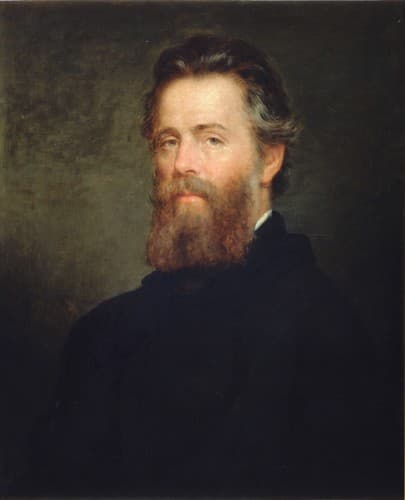
Herman Melville was an American novelist, short story writer, and poet of the American Renaissance period. Among his best-known works are Moby-Dick (1851); Typee (1846), a romanticized account of his experiences in Polynesia; and Billy Budd, Sailor, a posthumously published novella. Although his reputation was not high at the time of his death, the 1919 centennial of his birth was the starting point of a Melville revival, and Moby-Dick grew to be considered one of the great American novels.
Similar books
- The Turn of the Screw
Henry James
3.4 (104k) average on GoodreadsMysteryExplores psychological tension and ambiguity with potentially unreliable narration.
- Heart of Darkness
Joseph Conrad
3.4 (415k) average on GoodreadsHistorical FictionDeals with colonialism, moral decay, and a journey into the unknown with a sense of impending dread.
- Beloved
Toni Morrison
3.9 (325k) average on GoodreadsLiterary FictionExamines the brutal legacy of slavery and its psychological impact on individuals.
- Uncle Tom's Cabin
Harriet Beecher Stowe
3.9 (198k) average on GoodreadsHistorical Fiction"Benito Cereno" stands in stark contrast to Harriet Beecher Stowe's Uncle Tom's Cabin. Stowe's novel is a powerful, melodramatic, and explicitly abolitionist work designed to evoke empathy and moral outrage against slavery through direct emotional appeal and clear moral binaries. It humanizes enslaved characters through their suffering and piety. Melville, on the other hand, shies away from overt sentimentality. His narrative is less about individual suffering designed to elicit tears and more about the intellectual puzzle of understanding the deep-seated prejudices that prevent truth from being seen. While Uncle Tom's Cabin aims to persuade, "Benito Cereno" aims to disorient and provoke critical thought about the nature of perception itself, making it a more intellectually demanding but perhaps less immediately emotionally impactful work.
- To Kill a Mockingbird
Harper Lee
4.3 (4.5M) average on GoodreadsHistorical FictionIn the 1930s Jim Crow South, Harper Lee writes about racial injustice, moral growth, and the quiet courage of a lawyer father, Atticus Finch, as seen through his young daughter's eyes.
- The Great Gatsby
F. Scott Fitzgerald
3.9 (3.8M) average on GoodreadsHistorical FictionIn the opulent Roaring Twenties, a mysterious millionaire's lavish parties hide his desperate, tragic pursuit of a lost love, exposing the emptiness within the American Dream.






Enjoyed the summary?
A summary gives you the shape of the book. The book itself has the detail, the examples and the voice.
Find Benito Cereno on AmazonAs an Amazon Associate, BookBrief earns from qualifying purchases. How we're funded