
Synopsis
Covers the whole plot, including the ending.
- Difficulty
- Medium
- Pacing
- Variable
- Mood
- Satirical, Absurdist, Cynical, Philosophical, Darkly Humorous
- Read it if
- You enjoy experimental narratives, dark humor, and biting social commentary on American culture, with a strong metafictional element.
- Skip it if
- You prefer linear plots, straightforward character development, or are easily offended by cynical and often graphic depictions of human folly.
Breakfast of Champions Plot Summary
Covers the whole plot, including the ending.
The Narrator's Introduction and Mid-Life Crisis
The novel begins with the narrator, Kurt Vonnegut, explaining his wish to clear his mind of the 'crap' he has collected over his life. He identifies himself as the universe's creator within the book and states his intention to free his characters. He introduces Dwayne Hoover, a wealthy and seemingly successful Pontiac dealer in Midland City, Ohio, who is nearing a mental breakdown. Dwayne's inner turmoil shows in his erratic behavior and growing paranoia, which he attributes to chemical imbalances. The narrator also briefly introduces Kilgore Trout, an obscure science fiction writer, whose path will intersect with Dwayne's.
Midland City and Dwayne Hoover's Descent
Midland City is a typical American town, full of consumerism, pollution, and superficiality. The narrator often interjects with crude drawings and explanations of common objects, historical events, and social norms, showing their absurdity. Dwayne Hoover's mental state continues to worsen, marked by violent fantasies and a growing sense of alienation. He confides in his mistress, Francine Pefko, and his son, Bunny, about his anxieties, but finds no real comfort. His wife, Celia, is also unwell, preferring to stay in bed, further isolating Dwayne. The narrator suggests Dwayne's impending madness is a direct result of his environment and his inability to deal with the world around him.
Kilgore Trout's Journey to Midland City
Kilgore Trout, a struggling and unappreciated science fiction writer, receives an unexpected invitation to the first annual 'Festival of the Arts' in Midland City. He is offered a small payment and travel expenses, which he desperately needs. The narrator provides examples of Trout's bizarre and often pessimistic stories, many of which explore themes of human cruelty, environmental destruction, and life's meaninglessness. Trout, living in poverty in Cohoes, New York, views the invitation with cynicism and faint hope. He hitchhikes to Midland City, meeting various eccentric characters and thinking about the world.
The Festival of the Arts and Trout's Arrival
The Festival of the Arts in Midland City is a hollow and pretentious event, meant to boost the city's cultural image. Various minor characters, including the festival organizer Eliot Rosewater (a recurring Vonnegut character), appear. Kilgore Trout eventually arrives, disheveled and tired from his journey. He gets a room at the Holiday Inn and prepares for his presentation. The narrator continues his digressions, explaining everything from the American flag to the human anus, showing the arbitrary nature of human conventions. He notes that Trout's arrival is important, though Trout himself does not realize the effect his work will have on one Midland City resident.
Dwayne Reads Kilgore Trout
During a moment of despair, Dwayne Hoover finds a copy of Kilgore Trout's novel, 'Now It Can Be Told,' which Eliot Rosewater had mistakenly left at the Holiday Inn bar. The book's premise is that everyone in the universe, except for one individual (the reader), is a robot, placed on Earth by the Creator to test that one individual. Dwayne, in his fragile mental state, takes this fiction as absolute truth. This misinterpretation is the final trigger for his complete mental breakdown. The narrator details Dwayne's internal struggle as he deals with this horrifying revelation, believing himself to be the only real person in a world of automatons.
The Breakdown and Violence
Believing he is the only free-willed being, Dwayne Hoover's paranoia escalates into full-blown psychosis. He attends Kilgore Trout's lecture at the Festival of the Arts, where Trout is reading from 'Now It Can Be Told.' During the lecture, Dwayne's delusion solidifies. He then goes on a violent rampage, attacking several people he now sees as machines. He assaults Francine Pefko, his son Bunny, and even Kilgore Trout, biting off a piece of Trout's finger. The scene is chaotic and horrifying, yet mixed with the narrator's dark humor and detached observations about human nature and violence.
The Aftermath and Dwayne's Confinement
After his violent outburst, Dwayne Hoover is subdued and institutionalized. Midland City is left to deal with the shock and confusion of his actions. The narrator reflects on mental illness and the societal pressures that may have contributed to Dwayne's breakdown. He also highlights the wider world's indifference to such individual tragedies. Kilgore Trout is treated for his injury, and the festival quickly disperses. The incident becomes another strange, forgotten detail in Midland City's history, further showing the fleeting and often meaningless nature of human events.
Kilgore Trout's Encounter with the Narrator
After the chaos, Kilgore Trout, still reeling from the events and his injury, meets the narrator, Kurt Vonnegut, in a bar. The narrator reveals his identity as Trout's creator, explaining that he brought Trout into existence and controlled his life. He tells Trout he is now freeing him from his authorial control, giving him free will and the ability to make his own choices. This meta-fictional moment is a liberation for both Trout and the narrator, who is also trying to free himself from the 'crap' of his own mind. Trout, overwhelmed, asks, 'Make me young, make me young, make me young!' before crying.
Reflections on America and Humanity
In the concluding sections, the narrator continues his observations and criticisms of American society, touching on themes of war, racism, environmental degradation, and life's absurdity. He reflects on consumer culture's superficiality, unchecked capitalism's destructive nature, and the loneliness many individuals feel. The narrative becomes more philosophical and personal as Vonnegut grapples with his role as a creator and observer. He repeats his desire to cleanse his mind and leave a more honest legacy, free from the illusions and 'crap' he believes fill modern life.
The Narrator's Farewell
The book ends with the narrator's final farewell. He has freed his characters, especially Kilgore Trout, and has, to some extent, cleansed his own mind. He acknowledges storytelling's arbitrary nature and life's inherent contradictions. The ending is both poignant and darkly humorous, leaving the reader with a sense of liberation and lingering despair. The narrator's journey parallels Trout's, as both seek to escape their realities. Vonnegut expresses a hope that by stripping away the 'crap,' humanity might find a way to live more authentically, even in a world that often seems meaningless.
Principal Figures
Kurt Vonnegut Jr. (The Narrator)
Protagonist/Author-as-Character
The omniscient, self-inserting author who controls and eventually frees his characters.
Vonnegut appears as a character within his own novel, serving as the omniscient narrator and creator of the story's universe. He frequently interjects with personal anecdotes, drawings, and cynical commentary on American society, history, and human nature. He describes himself as a man in his fifties, grappling with the 'crap' in his mind and seeking to cleanse it. He acts as a puppet master, orchestrating events and manipulating his characters, particularly Kilgore Trout, before ultimately deciding to grant them free will.
Relationships: Kilgore Trout (Creator-creation, then liberator-liberated); Dwayne Hoover (Creator-creation, observer of his breakdown)
Dwayne Hoover
Protagonist/Antagonist (to himself)
A wealthy but mentally unstable Pontiac dealer on the verge of a violent breakdown.
Dwayne Hoover is a successful, middle-aged Pontiac dealer in Midland City, Ohio, who is slowly descending into madness. He is a product of consumer culture, outwardly prosperous but inwardly tormented by anxiety, paranoia, and a profound sense of meaninglessness. He attributes his mental state to a 'chemical imbalance' and struggles to connect with others. His impending breakdown is exacerbated by his environment and culminates in his misinterpretation of Kilgore Trout's novel, leading him to believe everyone else is a robot.
Relationships: Celia Hoover (Estranged wife, both mentally unwell); Francine Pefko (Mistress, later a victim of his violence); Bunny Hoover (Son, later a victim of his violence); Kilgore Trout (The unwitting catalyst for his breakdown)
Kilgore Trout
Protagonist/Author-as-Character
An obscure, unappreciated science fiction writer whose work tragically impacts Dwayne Hoover.
Kilgore Trout is a recurring character in Vonnegut's works, depicted here as a perpetually impoverished, pessimistic, and largely ignored science fiction writer. His stories, often summarized by the narrator, are bizarre, satirical, and deeply critical of humanity. He lives a life of quiet desperation, only finding fleeting moments of recognition. He is ultimately revealed to be a creation of the narrator, who eventually grants him free will, making him a symbol of the artist's struggle and the potential for liberation.
Relationships: Kurt Vonnegut Jr. (Creation-creator, then liberated from creator); Dwayne Hoover (Unwitting catalyst for Dwayne's breakdown, then a victim of his violence); Eliot Rosewater (Acquaintance, admirer of Trout's work)
Eliot Rosewater
Supporting
A wealthy, alcoholic philanthropist and admirer of Kilgore Trout's work.
Eliot Rosewater is a recurring Vonnegut character, a wealthy, eccentric, and alcoholic philanthropist who tries to do good in the world but often feels overwhelmed by its problems. He is a genuine admirer of Kilgore Trout's obscure work and is responsible for inviting Trout to the Midland City Festival of the Arts. His compassion and often self-destructive idealism stand in contrast to the cynicism of many other characters. He inadvertently provides Dwayne Hoover with the book that triggers his breakdown.
Relationships: Kilgore Trout (Admirer of Trout's work, benefactor); Dwayne Hoover (Unwittingly provides the catalyst for Dwayne's breakdown)
Francine Pefko
Supporting
Dwayne Hoover's secretary and mistress, who becomes a victim of his violence.
Francine Pefko is Dwayne Hoover's secretary and mistress. She is a kind but somewhat naive woman who genuinely cares for Dwayne, despite his increasingly erratic behavior. She tries to understand and support him, but is ultimately unable to comprehend the depth of his mental illness. She becomes one of the innocent victims of Dwayne's violent rampage when he believes her to be a robot.
Relationships: Dwayne Hoover (Secretary and mistress, later victim)
Celia Hoover
Supporting
Dwayne Hoover's mentally ill, reclusive wife.
Celia Hoover is Dwayne's wife, who is also mentally unwell and spends most of her time in bed, often hallucinating. Her illness further isolates Dwayne and contributes to his own deteriorating mental state. She represents another facet of the mental health crisis within the Hoover family and, by extension, society.
Relationships: Dwayne Hoover (Estranged wife, both mentally unwell)
Bunny Hoover
Supporting
Dwayne Hoover's son, a talented piano player who is also attacked by his father.
Bunny Hoover is Dwayne and Celia's son, a gifted young piano player. He is largely oblivious to the full extent of his parents' mental health issues, though he is present during his father's breakdown. He also becomes a victim of Dwayne's violence, highlighting the indiscriminate nature of his father's madness.
Relationships: Dwayne Hoover (Son, later victim); Celia Hoover (Mother)
Wayne Hoobler
Mentioned
A historical figure from Midland City, frequently referenced by the narrator.
Wayne Hoobler is a historical figure from Midland City who founded the town and left a complicated legacy. The narrator frequently references him, using him as a touchstone for discussions about local history, economic development, and the often-flawed nature of human ambition and legacy. He represents the kind of 'crap' in history that the narrator wishes to cleanse from his mind.
Themes & Insights
The Absurdity and Meaninglessness of Existence
Vonnegut constantly shows life's and society's inherent absurdity. Through the narrator's frequent digressions, crude drawings, and explanations of everyday objects and historical events, the novel removes any perceived profundity, revealing them as arbitrary and often nonsensical. Dwayne Hoover's descent into madness is partly because he cannot cope with this meaninglessness, while Kilgore Trout's stories often amplify it. The freedom granted to Trout by Vonnegut can be seen as an attempt to find meaning in agency, even if life itself remains absurd. This theme is highlighted by the narrator's repeated statement, 'Hi ho,' which is a dismissive acknowledgment of life's often pointless occurrences.
“'Hi ho,' said Dwayne Hoover, 'What's new?”
The Dangers of Misinterpreting Fiction as Reality
The novel's central conflict hinges on Dwayne Hoover's catastrophic misinterpretation of Kilgore Trout's science fiction novel, 'Now It Can Be Told.' Dwayne's fragile mind takes the satirical premise (that he is the only person with free will in a world of robots) as literal truth. This shows the dangers of failing to distinguish between fiction and reality, especially for those nearing mental collapse. The theme critiques the power of narratives, both fictional and societal, to shape perception and potentially destroy lives. It also comments on the author's responsibility and the reader's role in interpreting literature.
“You are the only creature in the entire Universe who has free will,' said the Creator. 'Everybody else is a robot, a machine.”
The American Dream and Its Discontents
The novel critiques the American Dream, portraying it as a hollow and destructive pursuit. Midland City, with its consumerism, pollution, and superficiality, embodies this ideal's failures. Dwayne Hoover, a seemingly successful car dealer, shows the individual driven to madness by the dream's pressures and emptiness. His wealth and possessions offer no comfort, only adding to his isolation and paranoia. Vonnegut suggests that the relentless pursuit of material success and conformity to societal norms leads to spiritual emptiness and mental decay, rather than happiness. The widespread environmental degradation and social injustices also show the dream's dark side.
“America was a nation of machines who were designed to make money, and who had no souls.”
Mental Illness and Societal Indifference
Mental illness is a theme, mainly seen through Dwayne Hoover's descent into psychosis and Celia Hoover's reclusive state. The novel explores how societal pressures, isolation, and a lack of genuine connection contribute to mental breakdown. Dwayne's attempts to articulate his suffering are met with misunderstanding or indifference, showing society's inability or unwillingness to address mental health issues. The narrator's detached, almost clinical descriptions of human suffering highlight a broader societal apathy, suggesting that individual tragedies are often absorbed and forgotten within the world's larger, uncaring machinery.
“He was trying to get a grip on himself, but there wasn't anything to grip.”
The Author's Role and Metafiction
Vonnegut constantly breaks the fourth wall, making himself a character in the novel and directly addressing the reader. This metafictional approach explores storytelling, authorship, and the relationship between creator and creation. By explicitly stating his control over his characters and then choosing to free them, Vonnegut grapples with his artistic responsibilities and the ethical implications of manipulating fictional lives. Freeing Kilgore Trout is a symbolic gesture of the author's desire to release himself from the 'crap' of his own mind, suggesting a therapeutic aspect to the writing process.
“I am an old man, and I am trying to clear my head.”
Plot Devices & Literary Techniques
Metafiction/Breaking the Fourth Wall
The author directly inserts himself into the narrative, commenting on his characters and the creative process.
Vonnegut frequently breaks the fourth wall, appearing as the omniscient narrator and a character within the story. He addresses the reader directly, explains his motivations for writing, and even interacts with his characters, most notably Kilgore Trout. This device highlights the artificiality of the narrative, forcing the reader to constantly acknowledge the book as a constructed artifact. It allows Vonnegut to comment on the nature of storytelling, the author's power, and the relationship between fiction and reality, while also providing a platform for his social and philosophical commentary.
Interspersed Drawings and Diagrams
Simple illustrations and explanations of common objects, adding to the satirical and didactic tone.
Throughout the novel, Vonnegut includes crude, childlike drawings and accompanying explanations of everyday objects (e.g., an American flag, a vagina, a human anus, a house). These illustrations serve multiple purposes: they underscore the narrator's intention to reduce complex ideas to their simplest, often absurd, components; they highlight the arbitrary nature of human inventions and conventions; and they contribute to the book's satirical and detached tone. They act as visual digressions, reinforcing the narrator's desire to 'cleanse' his mind of accumulated 'crap' by deconstructing the familiar.
Kilgore Trout's Fictional Stories
Summaries of Trout's bizarre and pessimistic science fiction tales, used for social commentary.
The narrator frequently summarizes plots from Kilgore Trout's obscure science fiction novels and short stories. These fictional fictions often serve as microcosms for Vonnegut's own social commentary, exploring themes of human cruelty, environmental destruction, and the meaninglessness of existence in a darkly humorous way. They provide a vehicle for Vonnegut to introduce philosophical ideas and critiques without directly lecturing the reader. Crucially, one of these stories, 'Now It Can Be Told,' becomes the catalyst for Dwayne Hoover's mental breakdown, making Trout's fiction integral to the plot.
Repetition of Phrases
Recurring words and phrases that emphasize themes and create a distinct narrative rhythm.
Vonnegut employs the repetition of specific phrases, most notably 'Hi ho' and 'And so on,' throughout the narrative. 'Hi ho' often follows a particularly bleak or absurd observation, serving as a dismissive, almost nihilistic shrug at the state of the world. 'And so on' conveys the endless, often meaningless, continuation of events and human endeavors. This repetitive device creates a distinctive narrative rhythm and reinforces the novel's themes of absurdity, meaninglessness, and the narrator's detached perspective on human affairs. It also contributes to the book's unique, almost conversational, voice.
Breakfast of Champions Quotes
“Trout was a man of so many gifts that it was as though God had personally made him a gift-wrapping service.”
“I will come to a time in my life when I will no longer be able to tell the difference between a human being and a piece of shit.”
“Make sure the world is flat.”
“This was the highest possible form of praise in the arts: to be told that one's work was like a human being. It was the only praise that mattered.”
“We are what we pretend to be, so we must be careful about what we pretend to be.”
“You are a very sentimental man, Mr. Vonnegut. I don't see how you can possibly be a successful writer.”
“The earth was being destroyed by its own inhabitants, and it was a crime. But the inhabitants were too busy with their own petty concerns to notice.”
“Everything was beautiful and nothing hurt.”
“It was the best of times, it was the worst of times. It was the only time I had.”
“I told him I was a novelist. He said, 'Oh, that's nice. What do you do for a living?'”
“The two most engaging powers of a photograph are to make new things familiar and familiar things new.”
“So I went to the window and looked out. The air was clean. The sky was blue. The sun was shining. The trees were green. The birds were singing. And the universe was unfolding as it should.”
“It was a good thing to be an artist, a creator. It was a good thing to be alive.”
“History is merely a list of surprises. It can only prepare us to be surprised yet again.”
Quiz
10 questions on the plot and the characters. Each answer comes with a short explanation.
Question 1
What is Dwayne Hoover's profession in Midland City?
- A novelist
- A car dealer
- A psychiatrist
- A fast-food restaurant owner
Show answer
B. A car dealer Dwayne Hoover is the wealthy owner of a Pontiac dealership in Midland City, which is central to the plot as he interacts with Kilgore Trout.
Question 2
What is the name of Kilgore Trout's pet, which he brings to Midland City?
- A dog named Rex
- A parrot named Polly
- A parakeet named Bill
- A green parakeet named Bill
Show answer
D. A green parakeet named Bill Kilgore Trout travels with his green parakeet, Bill, who serves as a small companion and sometimes a symbol of innocence or detachment.
Question 3
What event causes Dwayne Hoover to believe Kilgore Trout's fiction is reality?
- He attends a literary reading where Trout explains his work.
- He reads a specific short story that directly addresses him.
- He receives a personal letter from Trout confirming the truth of his stories.
- He encounters Trout at the arts festival and is given a manuscript containing the 'truth' about the universe.
Show answer
D. He encounters Trout at the arts festival and is given a manuscript containing the 'truth' about the universe. Dwayne Hoover's mental breakdown is triggered when Kilgore Trout, at the arts festival, gives him a manuscript that implies everyone else in the world is a robot, and only Dwayne is a free-willed being.
Question 4
What is the primary reason the narrator (Kurt Vonnegut) inserts himself into the story?
- To provide historical context for Midland City.
- To explain the scientific principles behind Kilgore Trout's stories.
- To free his characters and declare his own existence within the narrative.
- To introduce new characters that Kilgore Trout will meet.
Show answer
C. To free his characters and declare his own existence within the narrative. Vonnegut explicitly enters the narrative towards the end, meeting Kilgore Trout and declaring his intention to 'free' his characters, emphasizing the meta-fictional aspect of the novel.
Question 5
What recurring phrase does Vonnegut use to describe various objects, often with a simple drawing?
- And so it goes.
- Hello, babies. Welcome to Earth.
- Here is a picture of...
- Listen: ...
Show answer
C. Here is a picture of... Throughout the book, Vonnegut includes simple drawings and introduces them with the phrase 'Here is a picture of...' often followed by a mundane object like a flag or an anus, to highlight the arbitrary nature of symbols and the human tendency to overcomplicate things.
Question 6
Which of the following is NOT a characteristic of Kilgore Trout's science fiction stories, as described in the book?
- They often feature aliens who misunderstand human customs.
- They are typically published in pornographic magazines.
- They frequently involve complex scientific theories and detailed world-building.
- They contain profound philosophical insights disguised as pulp fiction.
Show answer
C. They frequently involve complex scientific theories and detailed world-building. Kilgore Trout's stories are characterized by their simple, often absurd premises, frequently published in obscure porn magazines, and despite their lowbrow context, they contain profound, often bleak, philosophical insights. They are not known for complex scientific theories or detailed world-building.
Question 7
What is the significance of the title 'Breakfast of Champions'?
- It refers to the meal Kilgore Trout eats before receiving an award.
- It is a brand name of dog food mentioned by a character.
- It is the brand name of a cereal that fuels the characters' ambitions.
- It is a sarcastic reference to the lives led by Americans, often implying a superficial or unexamined existence.
Show answer
D. It is a sarcastic reference to the lives led by Americans, often implying a superficial or unexamined existence. The title is a sarcastic take on the American dream and consumerism. It's a brand name for a cereal, but Vonnegut uses it to imply the 'champions' (ordinary Americans) are consuming bland, meaningless 'food' for thought, much like the empty calories of a sugary cereal, rather than engaging with deeper truths.
Question 8
What happens to Dwayne Hoover after he reads Kilgore Trout's manuscript?
- He becomes inspired to write his own science fiction novel.
- He experiences a complete mental breakdown, becoming violent and delusional.
- He dedicates his life to promoting Kilgore Trout's work.
- He has a profound spiritual awakening and abandons his materialistic life.
Show answer
B. He experiences a complete mental breakdown, becoming violent and delusional. Believing Trout's story that he is the only human and everyone else is a robot, Dwayne Hoover goes on a violent rampage, attacking several people before being subdued.
Question 9
The novel frequently uses simple, declarative sentences and often defines common terms. What is the author's likely purpose for this stylistic choice?
- To make the book accessible to a younger audience.
- To mimic the style of Kilgore Trout's pulp fiction stories.
- To strip away preconceived notions and expose the absurdity of human constructs and language.
- To demonstrate the narrator's lack of formal education.
Show answer
C. To strip away preconceived notions and expose the absurdity of human constructs and language. Vonnegut's simplistic definitions and language are a deliberate stylistic choice to strip away the complex, often misleading, layers of human language and social constructs, forcing the reader to see things in their most basic, sometimes absurd, form.
Question 10
What is the ultimate fate of Kilgore Trout at the end of the novel, after meeting the author?
- He commits suicide out of despair.
- He wins the Nobel Prize for Literature.
- He is 'freed' from the narrative by the author and disappears.
- He becomes Dwayne Hoover's personal psychiatrist.
Show answer
C. He is 'freed' from the narrative by the author and disappears. In a highly meta-fictional moment, Vonnegut directly addresses Kilgore Trout, telling him he is 'free' and can go home, effectively releasing him from the confines of the story, allowing him to 'exist' beyond the author's control.
Breakfast of Champions FAQ
What is the central premise of 'Breakfast of Champions'?
'Breakfast of Champions' revolves around Dwayne Hoover, a wealthy Pontiac dealer in Midland City, who is slowly going insane. His mental state deteriorates when he encounters the science fiction writer Kilgore Trout, whose fictional works Dwayne interprets as literal messages from the creator of the universe, leading him to believe he is the only free-willed being on Earth.
Who is Kilgore Trout and what is his role in the story?
Kilgore Trout is a perpetually unsuccessful and obscure science fiction writer, often considered an alter-ego for Vonnegut himself. In this novel, he is invited to an arts festival in Midland City, where his encounter with Dwayne Hoover tragically confirms Dwayne's delusion, triggering a violent outburst that brings the narrative to its climax.
What is the significance of Midland City as a setting?
Midland City serves as a microcosm of America, embodying its consumerism, pollution, and social anxieties. It's a seemingly ordinary place where the extraordinary breakdown of Dwayne Hoover highlights the absurdity and underlying madness Vonnegut perceives in American society, making it a fitting backdrop for the novel's satirical observations.
How does Vonnegut use the character of Dwayne Hoover to comment on American society?
Dwayne Hoover, a successful but deeply troubled businessman, represents the emptiness and potential for madness beneath the surface of the American Dream. His breakdown, fueled by misinterpreting art as reality, critiques a society that often struggles to distinguish between truth and fiction, leading to profound psychological distress and alienation.
What is the 'breakfast of champions' referred to in the title?
The 'breakfast of champions' refers to a moment when Kilgore Trout, after being released from prison, sees a sign for 'Montana Banana' and exclaims, 'There's the breakfast of champions!' This seemingly innocuous phrase, often associated with Wheaties cereal, is used by Vonnegut to highlight the arbitrary and often meaningless nature of everyday expressions and the commercial slogans that permeate American culture.
How does the narrator, Kurt Vonnegut, interact with his characters?
The narrator, explicitly identified as Kurt Vonnegut, frequently interjects into the narrative, providing personal anecdotes, historical context, and direct commentary on his characters and American society. He even physically appears at the end, confronting Kilgore Trout and 'freeing' him and the other characters, blurring the line between author and creation.
What is the purpose of the numerous drawings and illustrations throughout the book?
The simple, often crude, drawings of various objects, symbols, and body parts serve to strip away their conventional meaning and force the reader to see them afresh. They are a visual representation of Vonnegut's attempt to 'clean out' his mind and challenge preconceived notions, reinforcing the novel's themes of re-examining reality and questioning societal constructs.
How does Vonnegut satirize war and violence in the novel?
Vonnegut satirizes war by presenting its devastating effects with a detached, almost clinical tone, often reducing complex conflicts to absurd scenarios or highlighting the arbitrary nature of human cruelty. He frequently mentions atrocities like the Dresden bombing, juxtaposing them with mundane American life to underscore the pervasive and often unacknowledged violence in human history.
What role do women play in the narrative, particularly Francine Pefko and Celia Hoover?
Women like Francine Pefko, Dwayne's secretary, and Celia Hoover, Dwayne's wife, are largely depicted as victims of male-dominated society and its expectations, often suffering from mental health issues or being objectified. Francine struggles with her self-worth and intellect, while Celia's depression and eventual suicide underscore the profound psychological toll of living within such a stifling environment.
How does the concept of free will versus determinism manifest in the story?
The concept of free will is central, particularly through Dwayne Hoover's delusion that he is the only being with free will, a belief instilled by Kilgore Trout's story. Vonnegut, as the author-narrator, explicitly states that he is 'freeing' his characters, suggesting that their lives are predetermined until he grants them agency, thus playfully exploring the philosophical debate within a metafictional context.
What is the significance of the character of Wayne Hoobler?
Wayne Hoobler, Dwayne Hoover's gay son, represents another marginalized figure in Midland City, struggling with his identity in a conservative environment. His quiet suffering and eventual departure from Midland City highlight the societal pressures and lack of acceptance for those who deviate from traditional norms, mirroring the alienation experienced by other characters.
How does Vonnegut critique consumerism and capitalism?
Vonnegut critiques consumerism through Dwayne Hoover's successful car dealership and the pervasive presence of brand names and commercial slogans. He suggests that the relentless pursuit of material wealth and the artificiality of advertising contribute to a shallow and ultimately unfulfilling existence, leading to the psychological breakdown seen in characters like Dwayne.
What is the 'moment of truth' for Dwayne Hoover?
Dwayne Hoover's 'moment of truth' occurs when he encounters Kilgore Trout at the arts festival. Believing Trout to be his creator delivering a divine message, Dwayne unleashes a violent rampage, attacking several people, including Trout, and attempting to murder his mistress, triggering his complete mental collapse and subsequent institutionalization.
How does the novel explore themes of loneliness and alienation?
Loneliness and alienation are pervasive, affecting nearly every character, from the forgotten writer Kilgore Trout to the mentally unraveling Dwayne Hoover. Vonnegut portrays characters as isolated within their own minds, struggling to connect authentically in a society that often promotes superficial interactions and reinforces individual anxieties, leading to profound emotional detachment.
What is Vonnegut's ultimate message or goal with 'Breakfast of Champions'?
Vonnegut's ultimate goal is to encourage readers to question societal norms, challenge preconceived notions, and recognize the absurdity and often destructive nature of human behavior. By stripping away conventional meanings and presenting a raw, unfiltered view of America, he aims to promote empathy, critical thinking, and a fresh perspective on what it means to be human.
What is the significance of the green ribbon worn by Kilgore Trout?
Kilgore Trout's green ribbon, given to him by the narrator, symbolizes the author's intervention and the metafictional nature of the story. It marks Trout as a special character, chosen by Vonnegut to be 'freed' from his literary fate, and highlights the author's power over his creations and the blurring of lines between fiction and reality.
How does the novel deal with the concept of mental illness?
The novel directly addresses mental illness through Dwayne Hoover's severe psychological breakdown, presenting it as a consequence of societal pressures, isolation, and a flawed perception of reality. Vonnegut, while using it for satirical effect, also portrays the devastating personal impact of such conditions on individuals and their families, urging a more compassionate understanding.
What is the role of science fiction elements in a seemingly literary novel?
The science fiction elements, primarily through Kilgore Trout's stories, serve as a vehicle for Vonnegut to explore profound philosophical and social questions in an exaggerated, often absurd manner. They allow him to comment on humanity's folly, the nature of existence, and the potential for both technological advancement and self-destruction, without being constrained by realistic narrative conventions.
About the author
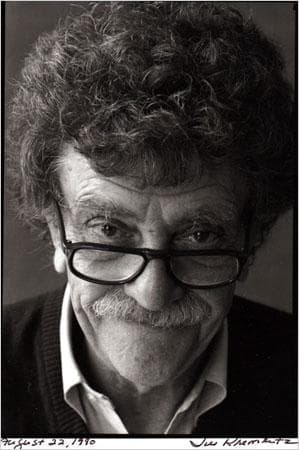
Kurt Vonnegut Jr. was an American author known for his satirical and often darkly humorous fiction. His notable works include "Breakfast of Champions," "Mother Night," "Player Piano," "A Man Without a Country," "Bluebeard," and "Timequake." Vonnegut's writing frequently explores themes of free will, technology, and the absurdity of human existence.
Similar books
- Catch-22
Joseph Heller
4.0 (723k) average on GoodreadsHistorical FictionFeatures absurd situations, satirical critique of institutions, and a cynical worldview.
- The Old Man and the Sea
Ernest Hemingway
3.8 (831k) average on GoodreadsLiterary FictionA Cuban fisherman's long struggle with a giant marlin becomes a story of endurance and dignity, now retold for young adults with illustrations, phonetic guides, and writing prompts in Traditional Chinese.
- One Hundred Years of Solitude
Gabriel García Márquez
4.1 (753k) average on GoodreadsLiterary FictionThrough the multi-generational story of the Buendía family, a mythical town deals with the repeating patterns of time, love, and solitude, as the extraordinary mixes with the ordinary.
- The Goldfinch
Donna Tartt
3.9 (720k) average on GoodreadsLiterary FictionHaunted by a tragic explosion and clutching a stolen Dutch masterpiece, a young orphan navigates the opulent drawing rooms of New York and the gritty underbelly of the art world, desperately seeking connection and redemption amidst a life spiraling into crime and obsession.
- Little Fires Everywhere
Celeste Ng
4.1 (713k) average on GoodreadsLiterary FictionIn Shaker Heights, an artist and her daughter move in, and their free-spirited lives clash with a rule-bound matriarch, revealing hidden conflicts beneath a perfect surface.
- Eleanor Oliphant Is Completely Fine
Gail Honeyman
4.3 (708k) average on GoodreadsLiterary FictionA lonely woman's structured life changes when an IT guy and an elderly man help her learn to open her heart.






Enjoyed the summary?
A summary gives you the shape of the book. The book itself has the detail, the examples and the voice.
Find Breakfast of Champions on AmazonAs an Amazon Associate, BookBrief earns from qualifying purchases. How we're funded