

Synopsis
Covers the whole plot, including the ending.
- Difficulty
- Medium
- Pacing
- Fast
- Mood
- Adventurous, Romantic, Exciting, Heroic
- Read it if
- You love classic swashbuckling adventures with a dash of romance, featuring a clever hero navigating impossible odds.
- Skip it if
- You prefer modern prose, grimdark themes, or stories without clear-cut heroes and villains.
Captain Blood Plot Summary
Covers the whole plot, including the ending.
A Quiet Life Interrupted
In 1685, Dr. Peter Blood, an Irish physician and former soldier, has a quiet practice in the English town of Bridgwater. He is content with his new life, having left behind military service. However, the peace ends with the Monmouth Rebellion. One night, he is called to treat Lord Gildoy, a wounded rebel, purely out of professional duty. Despite his lack of political allegiance, his act of medical aid is misinterpreted by the authorities. This innocent act of compassion will soon plunge Blood into a nightmare of injustice, ending his tranquil existence in England and beginning an unwanted adventure.
The Bloody Assizes and Transportation
Following the suppression of the Monmouth Rebellion, Judge Jeffreys presides over the 'Bloody Assizes.' Dr. Blood, with many others, is arrested and tried for treason. Despite his defense, asserting his role was purely medical and not political, Judge Jeffreys, known for his brutality, convicts him. Blood is sentenced to ten years of indentured servitude in the Caribbean colonies. Stripped of his freedom and his medical practice, he is transported aboard a slave ship to Barbados, a brutal journey that symbolizes his fall from a respected professional to a mere chattel.
Slavery in Barbados
Upon arrival in Barbados, Peter Blood is put up for sale as an indentured servant. His luck turns when Colonel Bishop, a wealthy plantation owner and the island's military governor, discovers Blood's medical expertise. Bishop purchases Blood, not for fieldwork, but to serve as his personal physician and to treat his household. This position offers Blood a slight reprieve from the harshest aspects of slavery. It is during this time that he meets Arabella Bishop, Colonel Bishop's beautiful and spirited niece, who has recently arrived from England. Their initial encounters are marked by a mix of disdain and grudging respect, setting the stage for their intertwined destinies.
The Spanish Raid and Bold Escape
Life as an indentured servant continues, but Blood's yearning for freedom remains strong. One day, the Spanish pirate Don Miguel de Espinosa launches a surprise attack on Bridgetown, the capital of Barbados. The island's defenses are overwhelmed, and Colonel Bishop is taken prisoner. Amidst the chaos and the Spaniards' subsequent celebration, Blood, seizing a desperate opportunity, rallies his fellow convicts and former soldiers. They stealthily board Espinosa's ship, the 'Cinco Llagas,' overpower the remaining Spanish crew, and sail away, leaving the stunned island behind. This audacious act marks their transformation from slaves to free men, albeit outlaws, and the birth of Captain Blood and his crew.
The Birth of Captain Blood
With the captured Spanish ship, which they rename 'The Arabella' in a gesture of defiance and perhaps ironic admiration for Arabella Bishop, Peter Blood and his crew embark on a life of piracy. Blood, with his strategic mind and medical knowledge, quickly proves himself a capable and surprisingly honorable captain. They establish a base on a secluded island and begin to prey on Spanish shipping, earning a fearsome reputation across the Caribbean. Unlike many ruthless buccaneers, Blood maintains a code of conduct, avoiding unnecessary cruelty and treating captives with respect. His fame grows, but so does the price on his head.
A Chance Encounter with Arabella
Captain Blood's piratical exploits lead him to intercept a Spanish galleon, only to discover Arabella Bishop among the passengers, being transported to safety by her uncle, Colonel Bishop, who had been ransomed. This unexpected reunion is full of tension. Arabella, though rescued from the Spaniards, views Blood as nothing more than a common thief and pirate, despite his chivalrous treatment of her. She struggles to reconcile the honorable physician she once knew with the feared buccaneer before her. Blood, still attracted to her, is stung by her condemnation, which highlights the difference between his current life and the respect he craves, especially from her.
The Duel with Levasseur
Captain Blood's reputation attracts other pirates, including the brutal French buccaneer, Captain Levasseur. Levasseur, seeing an opportunity, attempts to form an alliance with Blood, but his treacherous nature and disregard for honor soon become apparent. A conflict arises, particularly regarding the treatment of captives and stolen goods. Blood, a man of principle despite his outlaw status, finds himself at odds with Levasseur's ruthlessness. The tension culminates in a dramatic duel where Blood, demonstrating his superior swordsmanship and strategic thinking, defeats Levasseur, solidifying his position as a leader among the buccaneers and further establishing his unique code of conduct.
The Governor of Cartagena
A French fleet, under the command of Marquis de Rivarol, attacks the Spanish city of Cartagena. In a desperate move, the Spanish governor, Don Diego de Barrancas, offers Captain Blood and his crew a privateer's commission to defend the city against the French. Blood, pragmatic, accepts the offer, seeing an opportunity for legitimate gain and perhaps a step towards redemption. His strategic genius and naval expertise are put to the test as he masterminds the defense, effectively repelling the French invasion. This victory not only saves Cartagena but also significantly elevates Blood's standing, demonstrating his capabilities beyond mere piracy and earning him grudging respect from former enemies.
The English Threat and a New Commission
Following the Glorious Revolution in England, a new political landscape emerges. King James II is overthrown, and William of Orange ascends the throne. This shift brings about a war between England and France. The French, with their Spanish allies, begin to threaten the English colonies in the Caribbean. With the English fleet stretched thin and the colonies vulnerable, the desperate authorities, including the new Governor of Jamaica, are forced to consider unconventional solutions. They realize that Captain Blood, with his proven military prowess and knowledge of the local waters, is the most capable man to defend their interests, despite his past as a pirate.
Redemption and a Governor's Pardon
In a dramatic turn of events, the English government, recognizing Captain Blood's service in defending their colonies against French and Spanish aggression, offers him a full pardon for his past 'crimes.' More astonishingly, he is offered the position of Governor of Jamaica. This official recognition marks Blood's complete redemption, transforming him from a hunted outlaw into a respected figure of authority. Upon accepting the governorship, he finally earns the admiration and love of Arabella Bishop, who had previously scorned his piratical life. Their love, once seemingly impossible, blossoms, culminating in their union and a promise of a future together, free from the shadows of his past.
Principal Figures
Dr. Peter Blood
Protagonist
An Irish physician and former soldier, wrongly convicted and forced into piracy.
Peter Blood is a man of honor, intellect, and deep-seated principles, despite his circumstances. Initially a respected physician in England, he possesses a keen mind for strategy, a strong sense of justice, and exceptional swordsmanship. He is reluctant to embrace the life of a pirate, always viewing it as a temporary means to an end. His medical skills are a defining characteristic, often setting him apart from his more ruthless peers. He is driven by a desire for freedom, respect, and ultimately, the love of Arabella Bishop, which he believes he can only earn through legitimate means.
Relationships: Arabella Bishop (Love interest, initially scornful but eventually admiring and loving); Colonel Bishop (His owner during servitude, later an antagonist and then a subordinate); Jeremy Pitt (Loyal first mate and close friend)
Arabella Bishop
Love Interest
The spirited and beautiful niece of Colonel Bishop, who initially despises Blood's pirate life.
Arabella Bishop is a woman of strong will, high morals, and considerable beauty. She is initially presented as proud and somewhat disdainful, particularly towards Peter Blood after he becomes a pirate, viewing him as a common criminal. Her convictions are deeply rooted in societal norms and honor. Despite her initial scorn, she is intelligent enough to recognize Blood's inherent goodness and chivalry, even amidst his piratical actions. Her journey involves reconciling her strict moral code with her growing feelings for Blood, ultimately acknowledging his true character over his outlaw status.
Relationships: Dr. Peter Blood (Love interest, initially scornful, later deeply in love); Colonel Bishop (Her uncle and guardian)
Colonel Bishop
Antagonist/Supporting
A wealthy plantation owner and military governor, Arabella's uncle and Blood's former owner.
Colonel Bishop is a stern, somewhat self-important, and morally rigid man. He embodies the authority and social hierarchy of the colonial era. As Blood's owner, he initially shows some leniency due to Blood's medical skills but remains deeply prejudiced against him as a convict. His animosity towards Blood intensifies after Blood's escape and piratical success, seeing him as a direct challenge to his authority and a stain on his family's honor. Despite his flaws, he is fiercely protective of Arabella and ultimately, his loyalty shifts to the English Crown, even if it means serving under his former slave.
Relationships: Dr. Peter Blood (Master to slave, then enemy, then subordinate); Arabella Bishop (Uncle and guardian)
Jeremy Pitt
Supporting
Blood's loyal first mate and former indentured servant.
Jeremy Pitt is Captain Blood's steadfast and devoted first mate. He is a skilled seaman and a brave fighter, always ready to follow Blood's commands. Pitt represents the loyal companion, the man who believes in Blood's leadership and moral compass without question. He is more straightforward and less intellectual than Blood but possesses a strong sense of camaraderie and unwavering loyalty. His presence provides a constant source of support and friendship for Blood throughout his adventures, often acting as a sounding board for Blood's plans and concerns.
Relationships: Dr. Peter Blood (Loyal first mate and close friend)
Captain Levasseur
Antagonist
A treacherous and ruthless French buccaneer.
Captain Levasseur is a archetypal villainous pirate – brutal, opportunistic, and lacking any sense of honor or loyalty. He is driven by greed and a desire for power, willing to betray allies and inflict cruelty upon his captives. His character serves as a foil to Captain Blood, highlighting Blood's comparatively ethical approach to piracy. Levasseur's treachery and barbarity ultimately lead to his confrontation and demise at Blood's hands, reinforcing Blood's moral superiority even in the lawless world of the Spanish Main.
Relationships: Dr. Peter Blood (Rival and antagonist)
Judge Jeffreys
Mentioned/Antagonist
The infamous and cruel judge who condemns Blood to slavery.
Judge Jeffreys, though not a direct active participant for most of the narrative, serves as the initial catalyst for Blood's predicament. He is portrayed as a historical figure known for his mercilessness and brutality during the 'Bloody Assizes' after the Monmouth Rebellion. His unjust sentencing of Peter Blood, despite clear evidence of Blood's innocence, represents the arbitrary and cruel nature of power and injustice. He symbolizes the oppressive regime that Blood is forced to flee, making Blood's eventual redemption even more poignant.
Relationships: Dr. Peter Blood (His judge and condemner)
Themes & Insights
Justice vs. Injustice
The novel critically examines the arbitrary nature of justice and the impact of injustice. Peter Blood's initial conviction for treason, despite his humanitarian actions, exemplifies this. Judge Jeffreys's 'Bloody Assizes' are depicted as a miscarriage of justice, stripping Blood of his freedom and forcing him into a life of piracy. Even as a pirate, Blood often acts with fairness, contrasting with the 'legitimate' authorities who initially condemned him. His eventual pardon and appointment as governor represent a triumph of true justice over the initial legalistic injustice.
“They had condemned him as a traitor because he had healed a dying man. They had enslaved him because he had acted as a physician.”
Redemption and Honor
The theme of redemption is central to Captain Blood's journey. Though forced into piracy, Blood maintains a personal code of honor, distinguishing him from other buccaneers. He avoids unnecessary cruelty, protects the innocent, and strives for legitimate means of freedom. His actions, such as defending Cartagena and later the English colonies, are driven by a desire to prove his worth and regain his honor in the eyes of society and Arabella. His ultimate appointment as Governor signifies his full redemption, proving that honor can be found and restored even after a life of perceived crime.
“He was a pirate, true, but a pirate with a conscience, a sense of justice, and a heart that yearned for a life beyond the black flag.”
Love and Social Class
The romance between Peter Blood and Arabella Bishop is complicated by rigid social hierarchies and Blood's outlaw status. Arabella, a woman of high social standing, initially cannot reconcile her feelings for Blood with his identity as an indentured servant and later a pirate. Her internal conflict highlights the societal barriers to love across class divides. Blood's struggle to earn her respect and love is linked to his journey towards regaining his social standing and proving his inherent worth, demonstrating that true love can transcend conventional social barriers once prejudices are overcome.
“She could not love a thief and a pirate, even if he possessed the eyes of a physician and the soul of a gentleman.”
Freedom vs. Servitude
The narrative is driven by the contrast between freedom and various forms of servitude. Blood is first a free physician, then an indentured slave, and finally a free pirate captain. Even as a pirate, he exercises a form of freedom, albeit a dangerous and outlawed one. His escape from Barbados is a powerful act of reclaiming his liberty. The constant threat of recapture and the yearning for a legitimate, untainted freedom underscore this theme. His ultimate goal is not just physical freedom, but freedom from the stigma of his past and the ability to live a life of his own choosing.
“Better to reign in hell than serve in heaven, and better still to be master of one's own destiny on the wide, free sea.”
Plot Devices & Literary Techniques
The MacGuffin of the Monmouth Rebellion
The historical event that propels Blood into his adventure.
The Monmouth Rebellion serves as the initial catalyst for Peter Blood's entire adventure. It is a historical event that, while not central to Blood's personal goals, directly leads to his unjust conviction and subsequent transportation to the Caribbean. This device effectively removes Blood from his comfortable life and thrusts him into an entirely new, dangerous environment, setting the stage for his transformation into Captain Blood. Its primary function is to initiate the conflict and provide a plausible reason for Blood's forced exile.
The Stolen Ship
The means by which Blood and his crew escape slavery and begin their piratical life.
The seizure of Don Miguel de Espinosa's Spanish ship, renamed 'The Arabella,' is a pivotal plot device. It symbolizes Blood's dramatic break from servitude and his embrace of an outlaw existence. More than just a vessel, it represents the physical manifestation of his newfound freedom and the instrument through which he builds his reputation as Captain Blood. This act is the definitive turning point in the narrative, cementing his transition from a passive victim to an active agent of his own destiny.
The Code of the Pirate Captain
Blood's personal ethical guidelines that differentiate him from other pirates.
Captain Blood's adherence to a personal code of conduct, which includes treating captives honorably, avoiding unnecessary cruelty, and maintaining a semblance of justice, serves as a crucial plot device. It allows the reader to perceive Blood as a morally complex protagonist rather than a simple villain. This code often creates internal and external conflicts, particularly when he interacts with more ruthless pirates like Levasseur, highlighting his inherent goodness and paving the way for his eventual redemption and acceptance by society.
The Glorious Revolution
The political upheaval in England that creates an opportunity for Blood's pardon.
The Glorious Revolution in England, leading to the ascension of William of Orange, is a significant external plot device. It shifts the political landscape, creating new alliances and conflicts (England vs. France/Spain) in the Caribbean. This geopolitical change makes Captain Blood, formerly a hunted outlaw, a valuable asset to the English Crown due to his military expertise and knowledge of the region. It provides the perfect, albeit unexpected, context for the English authorities to offer him a pardon and a legitimate position, thus resolving his central conflict and enabling his happy ending.
Captain Blood Quotes
“But if I am to be a pirate, I will be a pirate of spirit, and will take no orders save from myself.”
“For the future, let it be understood that I am Captain Blood, and I take what I want.”
“There are times when a man must choose between his conscience and his neck. I have chosen my neck.”
“He laughed, a short, sharp laugh, that held more bitterness than mirth.”
“Love, it seemed, was a commodity as dangerous as any other on the high seas.”
“A man's worth is not in the clothes he wears, but in the heart he carries.”
“He had tasted the bitter bread of injustice, and it had made him strong.”
“To be free is to be master of one's own destiny, even if that destiny leads to the gallows.”
“There are no laws on the sea save those we make for ourselves.”
“He was a physician by training, a gentleman by birth, and a pirate by necessity.”
“Fortune, like a woman, is fickle, and must be wooed with boldness.”
“It is not the crime that makes the villain, but the intent.”
“The greatest treasure a man can possess is his liberty.”
“He had left England a convict, and returned a king of the seas.”
Quiz
10 questions on the plot and the characters. Each answer comes with a short explanation.
Question 1
What is Peter Blood's profession before he is wrongly convicted of treason?
- Sailor
- Soldier
- Physician
- Merchant
Show answer
C. Physician Peter Blood is an Irish physician and former soldier who is happily settled as a doctor in an English town.
Question 2
What specific historical event leads to Peter Blood's wrongful conviction?
- The Glorious Revolution
- The rebellion of the Duke of Monmouth
- The English Civil War
- A Spanish invasion of England
Show answer
B. The rebellion of the Duke of Monmouth Peter Blood is caught up by accident in the rebellion of the Duke of Monmouth when he saves a rebel's life.
Question 3
What is the initial sentence given to Peter Blood by Judge Jeffreys?
- Life imprisonment
- Execution by hanging
- Ten years as an indentured slave in the Caribbean
- Exile to the American colonies
Show answer
C. Ten years as an indentured slave in the Caribbean The hanging Judge Jeffreys sentences Peter Blood to ten years as an indentured slave in the Caribbean colonies.
Question 4
How does Peter Blood and his fellow convicts escape their servitude in the Caribbean?
- They are pardoned by the local governor.
- They overpower their guards and seize a small fishing boat.
- They steal a Spanish ship during a Spanish attack on the town.
- They are rescued by an English naval vessel.
Show answer
C. They steal a Spanish ship during a Spanish attack on the town. A Spanish ship attacks the town, and while the Spaniards celebrate their victory, Peter Blood boldly steals their ship.
Question 5
What is the primary obstacle to Peter Blood's love story with the woman he falls for in the Caribbean?
- She is already betrothed to another man.
- She is the daughter of the man who owns his servitude, and she cannot love a pirate.
- Their families are feuding.
- She is not interested in his adventurous lifestyle.
Show answer
B. She is the daughter of the man who owns his servitude, and she cannot love a pirate. He falls in love with the daughter of the man who owns his servitude, and the problem is that 'the woman he loves cannot love a thief and pirate.'
Question 6
In what region does Captain Blood become the most feared pirate?
- The Mediterranean Sea
- The South China Sea
- The Spanish Main
- The English Channel
Show answer
C. The Spanish Main He and his fellow convicts sail off to become the boldest and most fearless of pirates among the islands and on the Spanish Main.
Question 7
What is the source of Peter Blood's recognition and initial advantage while an indentured slave?
- His skills as a soldier
- His knowledge as a physician
- His ability to speak multiple languages
- His talent for navigation
Show answer
B. His knowledge as a physician Once in the Caribbean, his knowledge as a physician is recognized, which leads him to meet the daughter of his owner.
Question 8
Which historical figure is mentioned as the judge who sentences Peter Blood?
- Lord Chief Justice Coke
- Judge Jeffreys
- Sir Francis Bacon
- William Blackstone
Show answer
B. Judge Jeffreys The hanging Judge Jeffreys sentences him to ten years as an indentured slave.
Question 9
What is the primary conflict that Captain Blood faces, even after achieving success as a pirate?
- He is constantly pursued by the English navy.
- He struggles to maintain control over his unruly crew.
- His true love cannot accept him as a thief and pirate.
- He is unable to find enough treasure to satisfy his crew.
Show answer
C. His true love cannot accept him as a thief and pirate. All the glory of his adventures cannot help him, for the woman he loves cannot love a thief and pirate.
Question 10
The setting of the story primarily takes place in what decade of the 17th century?
- 1660s
- 1670s
- 1680s
- 1690s
Show answer
C. 1680s The story begins with Peter Blood settled in England 'in the 1680's'.
Captain Blood FAQ
What is the central conflict that drives Peter Blood's initial journey?
Peter Blood, an Irish physician, is wrongly convicted of treason by Judge Jeffreys after he provides medical aid to a wounded rebel during the Monmouth Rebellion. This unjust sentence condemns him to ten years of indentured servitude in the Caribbean, forcing him to abandon his peaceful life and setting the stage for his transformation.
How does Blood transition from an indentured slave to a pirate captain?
While enslaved in Barbados, a Spanish raid on the town provides Blood with an opportunity. He boldly seizes the Spanish frigate 'Cinco Llagas' (which he renames 'Arabella') along with his fellow convicts, escaping their servitude and embarking on a life of piracy, initially out of necessity and later out of a growing reputation.
Who is Arabella Bishop and what is her initial relationship with Peter Blood?
Arabella Bishop is the niece of Colonel Bishop, the man who owns Peter Blood's servitude in Barbados. Initially, she views Blood with disdain and disapproval due to his status as a convict and later as a pirate, despite his medical skills and inherent nobility. Their relationship is fraught with societal barriers and her strong moral objections.
What is the significance of the 'Arabella' in Captain Blood's story?
The 'Arabella' is the Spanish frigate 'Cinco Llagas' that Peter Blood steals during the Spanish raid on Barbados. He renames it in honor of Arabella Bishop, the woman he loves, despite her disapproval of his piratical life. The ship becomes his trusted vessel and a symbol of his new identity and his enduring, yet complicated, affection.
How does Captain Blood ultimately reconcile his pirate life with his love for Arabella?
Blood's redemption comes when he uses his piratical skills and fleet to defend Jamaica from a French invasion, effectively serving the English Crown. This act of patriotism, coupled with the revelation of his true character and motivations, finally allows Arabella to see past his pirate facade and accept his love, leading to his appointment as Governor of Jamaica.
What is the historical backdrop of the Monmouth Rebellion and how does it impact Blood?
The Monmouth Rebellion of 1685 was an attempt by James Scott, Duke of Monmouth, to overthrow King James II of England. Peter Blood's accidental involvement, by simply treating a wounded rebel, leads to his unjust conviction by Judge Jeffreys, demonstrating the arbitrary and brutal justice of the era and initiating his entire adventure.
Are there any subtle indications of Blood's noble character even during his piratical phase?
Yes, Blood consistently displays a code of honor that distinguishes him from typical pirates. He avoids unnecessary cruelty, protects the innocent when possible, and often acts with a strategic intelligence that prioritizes survival and justice over mere plunder, hinting at the gentleman he once was and would become again.
What role does Colonel Bishop play beyond being Arabella's uncle and Blood's former owner?
Colonel Bishop serves as a persistent antagonist, embodying the rigid societal structures and personal grudges that Blood must overcome. His relentless pursuit of Blood, fueled by a desire for revenge and the recovery of his niece, directly contributes to several dangerous encounters and complicates Blood's efforts to clear his name.
How does Peter Blood's profession as a physician influence his actions and character?
Blood's medical training instills in him a strong sense of duty to preserve life, which often tempers his piratical actions. He frequently uses his skills to treat allies and even enemies, showcasing his compassion and intellect, and reminding readers of the moral man beneath the pirate's veneer.
Discuss Arabella Bishop's internal conflict regarding her feelings for Peter Blood.
Arabella struggles between her attraction to Blood's intelligence and charisma, and her deeply ingrained moral revulsion towards his life as a pirate. Her internal conflict reflects societal expectations and personal principles clashing with genuine affection, making her journey towards accepting him a significant part of the romance.
How does Blood cope with the injustice of his initial conviction and forced servitude?
Blood copes by maintaining his dignity and intellect, even in servitude. He channels his frustration into strategic thinking and a determination to survive and eventually reclaim his freedom. His medical skills provide a sense of purpose, and his eventual escape is a direct response to the oppressive injustice he faced.
What psychological impact does 'command' have on Peter Blood, transitioning from doctor to pirate captain?
The transition to command forces Blood to develop leadership, strategic thinking, and ruthlessness, but also a profound sense of responsibility for his crew. He evolves from a man who saves individual lives to one who must make decisions affecting many, often under extreme pressure, which sharpens his character and resolve.
Is Captain Blood's transformation into a pirate truly a fall from grace, or an ascent to a different kind of heroism?
This is debatable. While society views it as a fall, Blood's piracy is born of injustice and necessity. He often acts with a moral compass, protecting the weak and fighting oppressive forces. His actions ultimately lead to him saving Jamaica, suggesting an ascent to a pragmatic form of heroism where the ends (justice, freedom) justify the means (piracy).
How does the novel challenge or uphold traditional notions of justice?
The novel strongly challenges traditional notions of justice through Judge Jeffreys's arbitrary convictions, showing how legal systems can be corrupt and unjust. Blood's subsequent 'pirate' justice, which often involves righting wrongs and defending the innocent, ironically presents a more morally sound alternative in a lawless world, until he can return to a legitimate path.
To what extent is 'Captain Blood' a romance versus an adventure novel?
While filled with thrilling adventures, 'Captain Blood' is fundamentally a romance, as Peter Blood's ultimate motivation and struggles are tied to winning Arabella Bishop's love and respect. His piratical exploits, though grand, are often a means to an end: to survive, prove his worth, and ultimately clear his name for her. The narrative always circles back to their complicated relationship.
Could Blood have achieved his redemption without becoming a pirate first?
It's unlikely. His unjust conviction left him with no legitimate path to freedom or vindication. Becoming a pirate, though morally ambiguous, provided him with the power, resources, and reputation necessary to eventually return to society on his own terms and prove his true character through his actions, such as defending Jamaica.
What is the significance of Blood refusing to plunder English ships unless absolutely necessary?
This detail is crucial in establishing Blood's underlying loyalty and patriotism, even as a pirate. It demonstrates that his grievances are with specific injustices and individuals, not with his homeland. This restraint ultimately makes his eventual alliance with England against the French more credible and paves the way for his redemption.
How does Sabatini use the character of Jeremy Pitt to highlight aspects of Blood's leadership?
Jeremy Pitt, Blood's loyal first mate, serves as a foil and a trusted confidante. His unwavering loyalty and practical, often less refined, approach to piracy highlight Blood's more strategic, intellectual, and morally nuanced leadership. Pitt's presence allows Blood to discuss his plans and internal conflicts, revealing more of his character.
About the author
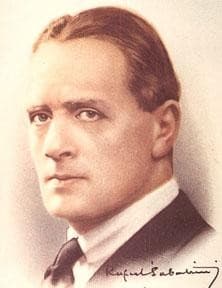
Rafael Sabatini was an Italian-born author known for his historical fiction and adventure novels. He is best known for works such as "Captain Blood," which follows the exploits of a wrongfully imprisoned physician turned pirate, and "Scaramouche," a tale set during the French Revolution. Sabatini's storytelling often features themes of swashbuckling adventure and romance.
Similar books
- The Scarlet Pimpernel
Emmuska Orczy
4.1 (124k) average on GoodreadsHistorical FictionFeatures a heroic figure with a secret identity fighting injustice in a historical setting.
- The Count of Monte Cristo
Alexandre Dumas
4.3 (746k) average on GoodreadsHistorical FictionInvolves a protagonist wrongly imprisoned who escapes and seeks redemption/revenge.
- Treasure Island
Robert Louis Stevenson
A classic pirate adventure with memorable characters and high seas action.
- To Kill a Mockingbird
Harper Lee
4.3 (4.5M) average on GoodreadsHistorical FictionIn the 1930s Jim Crow South, Harper Lee writes about racial injustice, moral growth, and the quiet courage of a lawyer father, Atticus Finch, as seen through his young daughter's eyes.
- The Great Gatsby
F. Scott Fitzgerald
3.9 (3.8M) average on GoodreadsHistorical FictionIn the opulent Roaring Twenties, a mysterious millionaire's lavish parties hide his desperate, tragic pursuit of a lost love, exposing the emptiness within the American Dream.
- Pride and Prejudice
Jane Austen
4.3 (3M) average on GoodreadsHistorical FictionIn a society focused on status and money, Elizabeth Bennet navigates love and pride, challenging Mr. Darcy and social expectations to find true affection.






Enjoyed the summary?
A summary gives you the shape of the book. The book itself has the detail, the examples and the voice.
Find Captain Blood on AmazonAs an Amazon Associate, BookBrief earns from qualifying purchases. How we're funded