
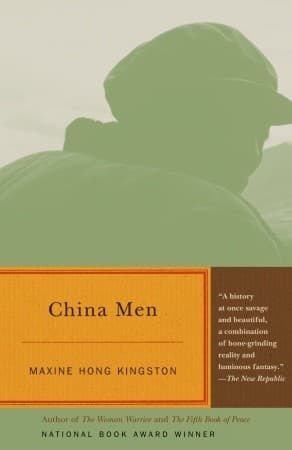
Synopsis
Covers the whole plot, including the ending.
- Difficulty
- Medium
- Pacing
- Moderate
- Mood
- Reflective, Historical, Resilient, Mythic, Poignant
- Read it if
- You are interested in historical fiction exploring the Chinese American immigrant experience, family sagas, and the interplay of history, myth, and personal narrative.
- Skip it if
- You prefer a straightforward, linear plot without shifts in perspective, time, or the blending of fact and folklore.
China Men Plot Summary
Covers the whole plot, including the ending.
The Father from China
Maxine Hong Kingston begins by exploring the mythical and real journey of her father, often called 'BaBa.' She tells of his arrival in America, searching for the 'Gold Mountain,' and the tough realities he faced. Early parts describe the hard, often brutal work done by Chinese immigrants, especially in laundries, one of the few jobs open to them. The story highlights cultural displacement and the great pressure to send money back to China, showing the dual identity and divided loyalties these men felt. Kingston uses a mix of memory, family stories, and history to picture her father's early life in a foreign land, dealing with racism and the hope of wealth.
The Grandfather and the Railroad
The story then moves to the experiences of Kingston's grandfather, 'Ah Goong,' and other 'China Men' who built the transcontinental railroad. This section vividly describes the dangerous and back-breaking work, including blasting tunnels through mountains, enduring harsh weather, and facing unsafe conditions with little safety. Kingston details the discrimination these workers faced; they were paid less than white workers and often given the most dangerous jobs. The men lived in isolated camps, forming close communities, but were always reminded of being foreign. This chapter shows the great contributions of Chinese immigrants to American infrastructure, often not recognized.
Laws Against the Chinese
This section focuses on the systemic racism in American laws, especially the Chinese Exclusion Act of 1882. Kingston explains how these laws stopped Chinese laborers from bringing their wives and families to America, creating 'bachelor societies' and causing great loneliness and hardship. She describes the 'paper sons' phenomenon, where men used false identities to get around immigration rules, and the constant fear of deportation. The story highlights the psychological cost of being seen as permanent foreigners and the struggle to establish a lasting presence in a country that actively tried to keep them out, affecting generations of Chinese Americans.
BaBa's Laundry and the Ghost Stories
Kingston recounts her father starting a laundry business in America, a common job for Chinese immigrants. This work was physically hard and often had low social status, but it provided a way to survive. The laundry becomes a central place for family life and storytelling, where BaBa shares tales of China and his past struggles. The story also includes Chinese folklore and ghost stories, showing the cultural beliefs immigrants carried with them. These stories helped them cope with being displaced and passed down their heritage to the next generation, mixing everyday life with myth.
The American-Born Sons
This part of the book explores the complex relationship between the immigrant 'China Men' and their American-born sons. The sons, growing up in a different culture, often struggled to understand their fathers' experiences and traditions. Kingston highlights the language barrier, cultural clashes, and the pressure on the sons to fit in while still honoring their heritage. The fathers, having gone through great hardship, often expected their sons to embody their sacrifices, leading to tension and misunderstanding. This generation gap shows the challenges of cultural transfer and identity for Chinese Americans living in two different worlds.
The Warrior Woman and the Silent Father
Kingston looks at her father's frequent silence, which she sees as both a way to protect himself from a hostile world and a source of frustration for his children. She contrasts this silence with the vibrant, often fantastical stories she tells, aiming to voice the unspoken histories of her ancestors. The story touches on the 'Warrior Woman' idea, a theme in Kingston's work, suggesting a strength and resilience beyond gender. Through her imagined reconstructions, Kingston tries to fill the gaps in her family's story, giving agency to those whose stories might otherwise remain untold, especially her father's.
Brother in Vietnam
The book moves to a more recent time, exploring the experiences of Kingston's brother, who serves in the Vietnam War. This section examines the irony and complexity of Chinese Americans fighting for a country that has historically discriminated against their people. It highlights the internal conflict of loyalty and identity, as well as the war's broader political context. The brother's experiences in Vietnam add another layer to the 'China Men' narrative – showing how they continue to contribute to American society, even in its wars, while still dealing with their place within it. His service represents a different kind of struggle for acceptance and belonging.
The 'Adoption' of American Ways
Kingston shows the various ways Chinese immigrants tried to adapt to American society, sometimes through forced assimilation and other times through creative cultural blending. This includes taking American names, celebrating certain holidays, and navigating the education system. However, the story also emphasizes the lasting strength of Chinese traditions and how they were kept despite outside pressures. The 'China Men' found clever ways to preserve their heritage, often in secret, while outwardly conforming to American expectations. This section highlights culture's resilience when facing great pressure to change.
The Immigrant's Dream vs. Reality
Throughout the book, Kingston consistently compares the alluring dream of 'Gold Mountain' – America as a land of opportunity and wealth – with the often brutal and discriminatory reality faced by Chinese immigrants. The men arrived with high hopes, only to encounter severe racism, exploitative labor, and legal barriers that denied them full citizenship and family life. This repeated theme shows the deep disappointment many felt, but also their persistent hope and determination to build a better life for future generations. The gap between expectation and reality creates a central tension in the lives of the 'China Men.'
Finding a Voice for the Voiceless
The final parts of the book emphasize Kingston's role as a storyteller and her dedication to voicing the often-silenced histories of Chinese men in America. She acknowledges gaps in memory and limits of her sources, yet she passionately reconstructs their lives through a mix of personal memories, historical facts, and imaginative additions. By weaving these different parts together, Kingston creates a rich story that honors their struggles, triumphs, and lasting legacy. Her narrative acts to reclaim their stories, ensuring that the contributions and sacrifices of these 'China Men' are not forgotten by history.
China Men Characters
BaBa (Kingston's Father)
Protagonist/Supporting
An immigrant seeking fortune in America, burdened by silence and tradition.
BaBa is Maxine Hong Kingston's father, a central figure whose experiences in America drive much of the narrative. He is a man of immense physical strength and perseverance, working in laundries and facing severe discrimination. Often portrayed as stoic and silent, his past is a source of mystery and fascination for his daughter. He embodies the struggles of the early Chinese immigrants, grappling with cultural displacement, the pressure to send money home, and the harsh realities of American racism. His silence is a key characteristic, reflecting both a coping mechanism and a generational divide.
Relationships: Maxine Hong Kingston (Daughter, narrator, interpreter of his silent history); Ah Goong (Father-in-law (Kingston's grandfather), shared immigrant experience); His Sons (Generational conflict, expectations, cultural misunderstanding)
Ah Goong (Kingston's Grandfather)
Supporting
A railroad worker whose labor helped build America.
Ah Goong is Kingston's maternal grandfather, representing the generation of 'China Men' who toiled on the transcontinental railroad. His story is one of extreme physical hardship, danger, and exploitation. He embodies the collective experience of the Chinese railroad workers, facing discrimination, dangerous conditions, and low wages. His narrative highlights the immense contribution of these men to American infrastructure, often overlooked by history. He is a symbol of resilience and the invisible labor that built the nation, enduring separation from his family and the harsh realities of immigrant life.
Relationships: BaBa (Shared immigrant experience, generational link); Chinese railroad workers (Comrades in hardship and labor)
Maxine Hong Kingston
Protagonist/Narrator
The author and narrator, seeking to understand and articulate her ancestral history.
Maxine Hong Kingston is the author and the narrative voice of the book. She serves as the primary investigator and interpreter of her family's history, blending personal memory, family stories, and historical research. Her role is to give voice to the 'China Men' whose stories might otherwise remain untold or misinterpreted. She grapples with her own identity as an American-born Chinese woman, navigating the legacy of her ancestors' struggles. Her driving force is to understand her heritage and to articulate the complex experiences of Chinese immigrants in America, filling the silences and correcting historical omissions.
Relationships: BaBa (Daughter, interpreter of his life); Mother (Source of stories and cultural heritage); Her Brothers (Shared family history, generational perspectives)
The Brother (in Vietnam)
Supporting
A Chinese American soldier fighting for a country that once excluded his people.
Kingston's unnamed brother serves in the Vietnam War, representing a later generation of Chinese Americans. His experience highlights the complex relationship between Chinese Americans and their adopted country, particularly in times of conflict. He embodies the irony of fighting for a nation that historically discriminated against his ancestors. His story broadens the scope of 'China Men' to include contemporary challenges and the ongoing struggle for full acceptance and belonging, demonstrating how Chinese Americans continue to contribute to and defend the United States.
Relationships: Maxine Hong Kingston (Sibling, shared family legacy); BaBa (Son, represents generational shift in American experience)
The Chinese Railroad Workers
Collective Supporting
A collective of men who endured immense hardship to build the transcontinental railroad.
This collective character represents the thousands of Chinese immigrants who labored on the transcontinental railroad. They are portrayed as resilient, resourceful, and enduring, facing extreme weather, dangerous working conditions, and racial discrimination. Their stories illustrate the physical and emotional toll of their work, their ingenuity in adapting to harsh environments, and the solidarity they found within their community. They are a powerful symbol of the unacknowledged contributions of Chinese immigrants to American history and the human cost of progress.
Relationships: Ah Goong (Fellow laborer, shared experience); American society (Victims of exploitation and discrimination)
The Paper Sons
Collective Supporting
Immigrants who adopted false identities to circumvent discriminatory immigration laws.
The 'Paper Sons' are a collective character representing the many Chinese men who, due to the Chinese Exclusion Act and subsequent discriminatory laws, adopted false identities to enter the United States. Their stories highlight the desperation and ingenuity required to bypass unjust immigration policies. They lived with the constant fear of exposure and deportation, carrying the burden of their fabricated pasts. This group embodies the systemic oppression faced by Chinese immigrants and their determination to find a way to America, despite the legal barriers.
Relationships: BaBa (Shared experience of navigating discriminatory laws); U.S. immigration officials (Adversaries, source of fear and scrutiny)
The Chinese Laundrymen
Collective Supporting
A collective of Chinese men who found livelihood in the laundry industry.
This collective character refers to the many Chinese immigrants, including BaBa, who worked in laundries across America. This was one of the few occupations open to them due to racial discrimination. Their stories depict the grueling physical labor, long hours, and the often solitary nature of their work. The laundry becomes a symbol of both survival and the circumscribed opportunities available to Chinese men. They represent the everyday struggles and resilience of immigrants carving out a living in a hostile environment, often sending their meager earnings back to China.
Relationships: BaBa (Fellow laundryman, shared occupation and struggle); American customers (Economic interaction, often marked by stereotypes)
The Mother (Kingston's Mother)
Supporting
A source of stories and cultural knowledge, embodying the strength of Chinese women.
Though less central than the 'China Men,' Kingston's mother plays a crucial supporting role as a repository of family stories, myths, and cultural traditions. She is often the one who passes down the oral histories that Kingston then interprets and expands upon. She represents the strength and resilience of Chinese women, often left behind in China or enduring their own hardships in America. Her voice, though not always directly quoted, is implicit in the narrative's rich tapestry of folklore and personal accounts, connecting the past to the present.
Relationships: Maxine Hong Kingston (Mother, storyteller, cultural link); BaBa (Wife, partner in the immigrant experience)
China Men Themes
The Search for Identity and Belonging
This theme is central to all the 'China Men' in the book. They constantly deal with their dual identities—Chinese heritage versus American reality. The immigrants struggle to find a place in a country that often rejects them, leading to feelings of displacement and always feeling 'foreign.' Kingston herself, as an American-born Chinese, tries to reconcile her ancestral past with her present, trying to understand where she belongs in this complex lineage. The theme appears in the longing for home, the adoption of American customs, and the ongoing struggle for acceptance. For example, the 'paper sons' show how far individuals went to establish a foothold, while the brother in Vietnam shows the complex demands of American identity.
“What 'A' could I be? I could be an American-Chinese. The hyphen is a bridge.”
The Power of Storytelling and Memory
Kingston uses storytelling to reclaim and interpret her ancestors' lives. Recognizing the silence of many 'China Men,' especially her father, she fills in the gaps with family lore, historical fact, and imagined scenes. Telling these stories is not just about recounting events, but about creating meaning, preserving heritage, and asserting a narrative that challenges official histories. The ghost stories and myths her father shared helped process trauma and maintain cultural connections. This theme is clear in Kingston's constant questioning and her choice to mix genres, creating a 'talk-story' that honors her ancestors.
“I learned to make my voice by telling the stories of the China Men who came to these shores.”
Racial Discrimination and Systemic Oppression
The book clearly shows the widespread racism and legal discrimination Chinese immigrants faced in America. From exploitative labor on the railroad to the Chinese Exclusion Act, the 'China Men' were systematically denied basic rights and opportunities. This theme highlights the constant struggle against prejudice, the violence they endured, and the psychological cost of being seen as permanent outsiders. Discriminatory laws, such as those preventing Chinese women from immigrating, had deep and lasting effects on family structures and individual lives. The story consistently exposes the hypocrisy of America as the 'Gold Mountain' while denying its promise to a specific group.
“They called us 'Chinamen' and built the railroad. They paid us less than white men. They worked us harder.”
The Burden of History and Ancestral Legacy
The 'China Men' carry the weight of their past—the hardships in China, the dangerous journey to America, and the struggles they faced upon arrival. This history deeply shapes their present lives and is passed down, directly and indirectly, to later generations. Kingston explores how the ancestors' sacrifices and traumas affect the American-born children, creating a sense of obligation and a desire to understand. The fathers' and grandfathers' silence often leaves the children to piece together their legacy, dealing with cultural expectations and their forebears' unstated pain. The book tries to lift this burden by giving it voice and recognition.
“The wild geese of my family flew from China to America, and though they landed, they never really arrived.”
Manhood and Masculinity in an Immigrant Context
The book specifically examines what it means to be a 'China Man' in America, exploring the unique challenges to traditional ideas of masculinity. Faced with emasculating labor, the inability to bring wives and families, and the constant threat of violence, these men had to redefine their roles. Their strength often lay in endurance, hard work, and silent suffering rather than typical displays of power. The absence of women and the creation of bachelor societies also affected their sense of manhood. Kingston explores how they maintained their dignity and provided for their families despite systemic attempts to strip them of their agency and traditional male roles.
“A man's worth was in his work, but what if his work was only to do what white men wouldn't?”
Plot Devices & Literary Techniques
Talk-Story (Gung-gung)
A narrative technique blending myth, memory, and history.
Kingston employs 'talk-story,' a traditional Chinese oral storytelling method, throughout the book. This device allows her to weave together factual accounts, personal anecdotes, family legends, and imaginative embellishments. It blurs the lines between history and myth, creating a rich and complex narrative that reflects the subjective nature of memory and cultural transmission. The talk-story enables Kingston to fill the silences in her family's history, interpreting and giving voice to experiences that might otherwise remain untold, particularly those of her often-silent father. It is a way of creating meaning and preserving heritage when direct historical records are scarce or biased.
Historical Interjections
Directly incorporating historical facts and legislative details.
Kingston frequently interjects historical facts, specific dates, and details about discriminatory laws (e.g., the Chinese Exclusion Act) into her narrative. This device grounds the personal stories of her family within a broader historical context, demonstrating how systemic oppression directly impacted individual lives. These interjections serve to validate the experiences of the 'China Men' and to correct official historical narratives that often omit or downplay the struggles of Chinese immigrants. By juxtaposing personal narratives with historical data, Kingston highlights the profound injustice and the enduring legacy of these policies on generations of Chinese Americans.
Shifting Perspectives and Pronouns
Varying narrative viewpoints to encompass collective and individual experiences.
Kingston often shifts between 'I,' 'he,' 'they,' and 'we,' sometimes within the same paragraph or chapter. This fluid use of pronouns allows her to move seamlessly between her own perspective, the specific experiences of individual family members (like her father), and the collective struggles of all 'China Men.' This device emphasizes the interconnectedness of individual stories with the broader immigrant experience. It also reflects the communal nature of oral storytelling and the way individual narratives become part of a larger, shared history, transcending singular identities to represent a collective voice.
Mythic Elements and Folklore
Incorporating traditional Chinese myths and legends.
Throughout the book, Kingston integrates elements of Chinese folklore, ghost stories, and mythological figures. These mythic elements serve several purposes: they enrich the cultural tapestry of the narrative, provide a lens through which the characters understand their world, and often act as metaphors for their real-life struggles. For example, stories of gods or spirits can reflect the immigrants' feelings of powerlessness or their desire for justice. This device highlights the enduring cultural heritage of the 'China Men' and how these stories provided comfort, meaning, and a connection to their homeland amidst the harsh realities of America.
The 'Gold Mountain' Metaphor
Symbolizing America as a land of opportunity versus its harsh reality.
The 'Gold Mountain' serves as a powerful recurring metaphor throughout the book. It represents the alluring promise of America as a land of wealth, opportunity, and a better life that drew Chinese immigrants across the ocean. However, the metaphor is consistently juxtaposed with the harsh, discriminatory, and often violent reality they encountered. This device highlights the profound disillusionment and betrayal felt by many 'China Men,' while also underscoring their enduring hope and resilience despite the shattered dream. It encapsulates the core tension between expectation and experience for the immigrants.
China Men Quotes
“In the Gold Rush Mountains, the white demons, who were mostly young men, lived with their mothers and sisters, and when they didn't have their own women, they brought wives from the East, or bought Chinese women.”
“The wild geese of the Chinese come to America, and they are called China Men.”
“When we Chinese were building the railroads, we were making America. We were making the land.”
“My father's father did not want to leave China, but he was forced to by poverty and the need to send money home.”
“The white demons said the Chinese were dirty, that we ate rats and dogs. But we ate what we could find, and we worked harder than anyone.”
“We were ghosts in America, working in the mines, building the railroads, planting the crops, and nobody saw us.”
“A man must choose his own country. He must choose his own family.”
“The Chinese women in America were few, and they were often prostitutes or wives bought from China.”
“To make a new life, you have to forget the old one. But how can you forget your own ancestors?”
“The ghosts of the dead, the ghosts of the living, they all follow us, they all watch us.”
“The white demons made laws against us, to keep us from owning land, to keep us from marrying their women.”
“We brought our language, our food, our customs. We brought China with us.”
“There are no women in this country. There are only men waiting to be men.”
“The stories are not true, but they are what happened.”
Quiz
10 questions on the plot and the characters. Each answer comes with a short explanation.
Question 1
Which of the following historical events is NOT directly referenced or alluded to as impacting the 'China Men' in the book?
- The building of the Transcontinental Railroad
- The Chinese Exclusion Act
- World War II
- The Opium Wars
Show answer
D. The Opium Wars While the Opium Wars were a significant event in Chinese history, 'China Men' focuses more on the experiences of Chinese immigrants in America and the specific historical events that shaped their lives there, such as the railroad, discriminatory laws, and later wars involving the US.
Question 2
What common struggle do the 'China Men' face when attempting to communicate with their families back in China?
- Lack of reliable mail service across the Pacific
- The difficulty of writing letters in English for translation
- The inability to send money along with their letters
- The problem of their wives in China not receiving or acknowledging their letters
Show answer
D. The problem of their wives in China not receiving or acknowledging their letters A recurring theme is the men's frustration and heartbreak over their letters to wives in China going unanswered or unacknowledged, leading to uncertainty and emotional distance.
Question 3
What specific method did some 'China Men' use to survive the dangerous work of building railroads through mountains?
- They were lowered in baskets over cliffs to plant explosives.
- They dug tunnels by hand using only shovels and picks.
- They used trained mules to carry dynamite to inaccessible locations.
- They built elaborate scaffolding systems to reach high rock faces.
Show answer
A. They were lowered in baskets over cliffs to plant explosives. The book vividly describes the perilous task of the 'China Men' being lowered in baskets down sheer cliffs to set dynamite for blasting tunnels and ledges for the railroad.
Question 4
The character 'Ah Goong' (Grandfather) is often associated with which metaphorical 'paper' identity he assumes in America?
- A 'paper son' who bought false immigration documents.
- A 'paper tiger' who appeared strong but was actually weak.
- A 'paper dragon' symbolizing his connection to Chinese myth.
- A 'paper doll' representing his fragile existence.
Show answer
A. A 'paper son' who bought false immigration documents. Ah Goong, like many Chinese immigrants during the Exclusion Act era, became a 'paper son' by purchasing false documentation to claim kinship with a US citizen, allowing him entry into the country.
Question 5
What does the author imply about the relationship between myth and reality in the lives of the 'China Men'?
- Myths are entirely separate from their lived experiences and provide only escapism.
- Myths serve as a way to understand, interpret, and sometimes reshape their harsh realities.
- Myths are primarily used by the 'China Men' to deceive American authorities.
- Myths are merely quaint stories with no practical application in their new lives.
Show answer
B. Myths serve as a way to understand, interpret, and sometimes reshape their harsh realities. The book blurs the lines between memory, myth, and fact, suggesting that myths and traditional stories provide a framework for the 'China Men' to make sense of their suffering and identity in a foreign land.
Question 6
Which specific U.S. state is most frequently associated with the 'China Men's' early labor experiences, particularly in railroad construction?
- New York
- California
- Texas
- Washington
Show answer
B. California The 'China Men' are predominantly depicted arriving in and working in California, especially during the Gold Rush era and the construction of the Transcontinental Railroad through the Sierra Nevada mountains.
Question 7
The 'China Men' are often described as having an ambivalent relationship with 'Gold Mountain.' What does 'Gold Mountain' represent to them?
- The physical mountains of China where their ancestors lived.
- The lure of wealth and opportunity in America, often contrasted with its harsh realities.
- A specific gold mine they hoped to discover in the American West.
- A mythical paradise they dreamed of returning to in China.
Show answer
B. The lure of wealth and opportunity in America, often contrasted with its harsh realities. 'Gold Mountain' (Gam Saan) is the traditional Chinese name for America, particularly California, symbolizing the promise of riches that drew many Chinese immigrants, despite the hardships they actually faced.
Question 8
What is the significance of the 'talk-stories' in the narrative structure of 'China Men'?
- They are purely fictional anecdotes inserted for entertainment.
- They represent the oral traditions and collective memory that shape the author's understanding of her ancestors' lives.
- They are historical documents quoted verbatim from original sources.
- They are internal monologues of the characters, revealing their innermost thoughts.
Show answer
B. They represent the oral traditions and collective memory that shape the author's understanding of her ancestors' lives. Kingston coined 'talk-story' to describe her unique blend of oral history, myth, and personal narrative, emphasizing how stories passed down through generations shape identity and understanding, especially in the absence of written records.
Question 9
How does the author typically portray the 'China Men's' relationship with their Chinese heritage once in America?
- They actively reject all aspects of their Chinese culture to assimilate fully.
- They struggle to maintain their traditions and language amidst pressure to assimilate and the distance from home.
- They successfully establish perfect replicas of Chinese villages in America.
- Their heritage becomes irrelevant to their daily lives in America.
Show answer
B. They struggle to maintain their traditions and language amidst pressure to assimilate and the distance from home. The book repeatedly shows the 'China Men' grappling with how to preserve their Chinese customs, language, and family ties in a new, often hostile, American environment that demands assimilation.
Question 10
What is the overarching narrative purpose of presenting multiple, sometimes contradictory, versions of a character's life story (e.g., the various 'talk-stories' about one man)?
- To confuse the reader and obscure the true history of the characters.
- To highlight the author's uncertainty and the fragmented nature of historical memory and oral tradition.
- To demonstrate the author's skill in inventing diverse fictional narratives.
- To allow for different interpretations of historical facts by academics.
Show answer
B. To highlight the author's uncertainty and the fragmented nature of historical memory and oral tradition. Kingston intentionally presents multiple, sometimes conflicting, versions of her ancestors' stories to reflect the challenges of reconstructing history from fragmented oral accounts, the subjectivity of memory, and the blending of fact and myth that defines her narrative approach.
China Men FAQ
What is the overarching theme of 'China Men' and how does it explore the Chinese American experience?
'China Men' explores the arduous journey and generational struggles of Chinese men in America, focusing on themes of identity, labor, racism, and the search for belonging. It weaves together historical facts, family lore, and mythical elements to illustrate their resilience and the psychic toll of being 'aliens' in a new land, ultimately highlighting their fight for recognition as 'China Men' rather than just 'Chinamen'.
Who are some of the key 'China Men' whose stories are told in the book?
The book features several generations, including 'Grandfather of the Sierra Nevada Mountains' who built railroads, the 'Great Grandfather of the Gold Mountain' who mined for gold, and 'Brave Orchid's husband' (the narrator's father) who worked in laundries and gambling houses. These figures represent different facets of the Chinese immigrant experience, from pioneering labor to navigating discriminatory laws.
How does the book blend historical fact with myth and personal memory?
Kingston seamlessly interweaves verifiable historical events, such as the building of the transcontinental railroad and the Chinese Exclusion Act, with family anecdotes passed down through generations and ancient Chinese myths. This blend creates a rich tapestry that not only documents history but also explores the emotional and psychological impact of these events, often filling gaps in documented history with imaginative storytelling.
What role does the 'Gold Mountain' play in the aspirations of the early immigrants?
The 'Gold Mountain' (Gum San) represents America as a land of opportunity and wealth, drawing many Chinese men seeking to escape poverty and strife in China. It symbolizes the promise of a better life, even though the reality often involved grueling labor, discrimination, and the harsh realization that the 'gold' was not easily found or kept.
How does the narrator's voice evolve throughout the book, particularly in relation to her father's story?
The narrator's voice shifts from a more detached, mythic storyteller to a more personal, inquisitive daughter, especially as she tries to understand her silent father, 'BaBa'. She attempts to give voice to his unspoken experiences and reconcile the myths she's heard with the harsh realities he faced, moving from a child's wonder to an adult's empathetic reconstruction.
What is the significance of the chapter 'The Laws' and how does it connect to the broader narrative?
'The Laws' details the numerous discriminatory laws enacted against Chinese immigrants, such as the Chinese Exclusion Act and anti-miscegenation laws. This chapter provides the historical context for the hardships faced by the 'China Men', explaining why they were often separated from families, denied citizenship, and confined to certain types of labor, thus underpinning the systemic racism they endured.
How does the story of Fa Mu Lan from 'The Woman Warrior' subtly influence the portrayal of masculinity in 'China Men'?
While not directly stated, the theme of Fa Mu Lan's cross-dressing and warrior spirit from 'The Woman Warrior' subtly informs the exploration of gender roles and strength in 'China Men'. It highlights how Chinese men, despite societal expectations, had to adapt, endure hardships, and sometimes take on roles that challenged traditional masculinity, showcasing a different kind of strength in their struggle for survival.
What is the symbolic meaning behind the 'talking-story' tradition mentioned in the book?
'Talking-story' refers to the oral tradition of passing down family histories, myths, and cautionary tales, often embellished and reinterpreted with each telling. It symbolizes the power of narrative to preserve culture, transmit identity, and make sense of past experiences, especially in the absence of written records or official recognition.
How does the narrator's father's silence contribute to the book's themes?
The father's silence is a profound element, representing the trauma, shame, and inability to articulate the suffering endured by many Chinese immigrants. It forces the narrator to imagine and reconstruct his experiences, highlighting the generational gap in understanding and the narrator's quest to give voice to the voiceless, thereby healing historical wounds through storytelling.
What psychological impact did the 'paper sons' phenomenon have on the identities of Chinese men?
The 'paper sons' phenomenon, where immigrants bought fraudulent identities, created deep psychological complexities. It forced individuals to live under false pretenses, constantly fearing exposure, and fractured their sense of self. This contributed to feelings of displacement, secrecy, and a struggle to form an authentic identity in America.
How does the concept of 'ghosts' manifest psychologically for the characters?
For the characters, 'ghosts' are not just literal spirits but also symbolic representations of the foreign, the unknown, and the oppressive forces they encounter in America. White Americans are often called 'ghosts,' signifying their alien nature and the fear they instill. Psychologically, this term reflects the immigrants' profound sense of otherness and isolation in a land that views them as spectral outsiders.
Discuss the psychological burden of being a 'bachelor society' for the early Chinese immigrants.
The 'bachelor society' created by discriminatory immigration laws, which largely prevented Chinese women from entering the U.S., imposed immense psychological burdens. It led to profound loneliness, sexual frustration, and a lack of family life, contributing to feelings of alienation, despair, and a sense of incompleteness among the men, impacting their mental and emotional well-being.
Is 'China Men' primarily a historical account, a family memoir, or a work of fiction, and why?
'China Men' defies easy categorization; it is all three. While grounded in historical events and family memories, Kingston uses fictionalized elements, myth, and a speculative narrative voice to fill gaps and explore emotional truths beyond mere facts. This hybrid approach allows for a deeper, more imaginative understanding of the Chinese American experience.
How does Kingston challenge traditional notions of heroism and masculinity through the stories of her 'China Men'?
Kingston redefines heroism by focusing on the quiet endurance, perseverance, and daily struggles of men who were often denied traditional avenues of power or recognition. Their masculinity is found not in overt aggression, but in their ability to work tirelessly, survive systemic oppression, and maintain cultural identity in the face of immense adversity, challenging stereotypical portrayals.
What is the significance of the repeated motif of 'naming' or 'not naming' characters in the book?
The frequent omission or ambiguity of character names reflects the historical erasure of Chinese immigrants, who were often nameless laborers or statistics. It also highlights the narrator's struggle to fully know and understand her ancestors, and the fragmented nature of inherited memory. By not always naming, Kingston emphasizes their collective experience while paradoxically giving them a universal voice.
How does 'China Men' contribute to the broader discourse of American literature and identity?
'China Men' significantly expands the canon of American literature by giving voice to a historically marginalized group and challenging the dominant narrative of American identity. It asserts the Chinese American experience as an integral part of the national story, demonstrating how diverse cultural backgrounds enrich and complicate the understanding of what it means to be American.
To what extent does the book offer a sense of resolution or hope for future generations of Chinese Americans?
While the book vividly portrays hardship, it ultimately offers a powerful sense of hope and resilience. The act of storytelling itself is an act of reclamation and healing, giving voice to past suffering. The narrator's ability to articulate these histories suggests a path toward understanding and empowerment for future generations, who can draw strength from their ancestors' endurance and fight for identity.
About the author

Maxine Hong Kingston is an American author known for her works that explore themes of identity, culture, and the immigrant experience. Her notable books include "The Woman Warrior," a blend of autobiography and Chinese folklore, and "China Men," which examines the lives of Chinese immigrants in America. Kingston's writing often reflects her own experiences as a Chinese American.
Similar books
- The Woman Warrior
Maxine Hong Kingston
3.7 (25k) average on GoodreadsBiographyExplores Chinese American identity, family history, and myth, often seen as a companion to 'China Men'.
- Pachinko
Min Jin Lee
4.3 (208k) average on GoodreadsLiterary FictionMulti-generational saga of an Asian immigrant family facing discrimination and striving for survival in a new land.
- Homegoing
Yaa Gyasi
4.4 (175k) average on GoodreadsLiterary FictionFollows the descendants of a family through centuries, exploring historical trauma and identity across generations.
- The Joy Luck Club
Amy Tan
3.9 (598k) average on GoodreadsHistorical FictionWhile both Kingston's China Men and Amy Tan's The Joy Luck Club (1989) explore intergenerational relationships and Chinese American identity, they differ significantly in focus and style. Tan's novel primarily centers on the mother-daughter dynamic and the clash of cultures within a more conventionally structured narrative, often emphasizing the immigrant mother's secrets and the American-born daughter's struggle to understand her heritage. Kingston, in China Men, focuses on the male lineage, employing a more experimental, fragmented 'talk-story' approach that blurs the lines between history and myth to reconstruct a broader, often more politically charged, historical narrative of Chinese men in America. Tan's work is often seen as more accessible due to its linear storytelling, while Kingston's demands a deeper engagement with its complex narrative layers and historical subtext.
- To Kill a Mockingbird
Harper Lee
4.3 (4.5M) average on GoodreadsHistorical FictionIn the 1930s Jim Crow South, Harper Lee writes about racial injustice, moral growth, and the quiet courage of a lawyer father, Atticus Finch, as seen through his young daughter's eyes.
- The Great Gatsby
F. Scott Fitzgerald
3.9 (3.8M) average on GoodreadsHistorical FictionIn the opulent Roaring Twenties, a mysterious millionaire's lavish parties hide his desperate, tragic pursuit of a lost love, exposing the emptiness within the American Dream.



Enjoyed the summary?
A summary gives you the shape of the book. The book itself has the detail, the examples and the voice.
Find China Men on AmazonAs an Amazon Associate, BookBrief earns from qualifying purchases. How we're funded