
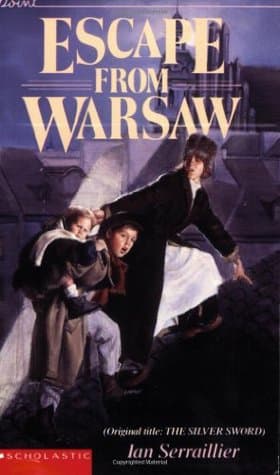
Synopsis
Covers the whole plot, including the ending.
- Difficulty
- Medium
- Pacing
- Moderate
- Mood
- Hopeful, Gritty, Adventurous, Heartwarming
- Read it if
- You enjoy historical fiction set during WWII, especially stories of children's resilience and survival against incredible odds.
- Skip it if
- You prefer fantasy or contemporary settings, or find stories of war and separation too distressing.
Escape from Warsaw Plot Summary
Covers the whole plot, including the ending.
The Arrest and Separation
In 1942, Warsaw is under Nazi occupation. The Balicki family, consisting of Joseph, Margrit, Ruth (13), Edek (11), and Bronia (3), lives in fear. One night, Nazi Storm Troopers burst into their home, arresting Joseph, a schoolteacher, for distributing anti-Nazi leaflets. Margrit, their mother, is also arrested shortly after. The three children are left alone in their bombed-out house, with only a small amount of food. Ruth, the eldest, takes on the responsibility of caring for her younger siblings, Edek and Bronia, amidst the chaos and danger of wartime Warsaw. They are forced to scavenge for food and shelter, constantly hiding from German soldiers.
Life in the Rubble
After their parents' arrests, Ruth, Edek, and Bronia try to survive in their partially destroyed home. However, the constant bombing and the threat of German patrols make it too dangerous. They are forced to live on the streets, scrounging for food in the rubble and sleeping in abandoned buildings. Edek, despite his young age, often takes risks to find supplies. Eventually, they find a more stable, though still uncertain, refuge in a disused cellar with other displaced families. Life is harsh, marked by hunger, cold, and the ever-present fear of discovery or starvation. Ruth tries to maintain a sense of normalcy for Bronia.
Edek's Disappearance
One day, Edek goes out to a nearby market to try and trade a valuable family heirloom – a silver sword – for food. He is desperate to provide for his sisters, especially Bronia, who is growing weaker. While at the market, he is caught by German soldiers, accused of looting, and forcibly taken away. Ruth and Bronia, waiting anxiously for his return, are devastated by his disappearance. They search for him for weeks, but their efforts are fruitless. Ruth is now solely responsible for Bronia, and her hope of finding their family together lessens further.
The Silver Sword and the Message
Months later, Ruth and Bronia are still living in the cellar. One day, a street boy named Jan, known for his cunning and thieving, appears carrying a small silver sword. To Ruth's astonishment, it is their family's sword, the one Edek had taken. Jan explains that he got it from a German soldier, who had taken it from a boy, Edek, in a prison camp. He also reveals that he met Joseph Balicki, their father, in a prison camp near Posen. Joseph had escaped and instructed Jan to tell his children to meet him in Switzerland, providing him with a specific address and a coded message.
The Journey Begins
Inspired by the news of their father and the hope of reunification, Ruth decides to travel to Switzerland. Jan, despite his initial reluctance and independent nature, agrees to accompany them, partly out of loyalty to Joseph and partly because he has nowhere else to go. He is a resourceful but often difficult companion. The three children, with little more than the clothes on their backs and the silver sword, begin their difficult trek out of Warsaw, heading south-west towards the Swiss border. Their journey is filled with danger, hunger, and constant uncertainty.
Encounters and Obstacles
As they travel through the war-torn countryside, the children face many obstacles. They must avoid German patrols, scavenge for food in bombed-out villages, and brave harsh weather. Jan's street smarts and thieving skills often prove useful for survival, though they sometimes put the group in danger. They travel by foot, sometimes hitching rides on military vehicles or trains. They witness the devastation of war firsthand, encountering displaced people, refugees, and the lingering presence of conflict. Bronia, being so young, struggles with the physical demands of the journey.
Reunion with Edek
While seeking shelter and food in a displaced persons' camp in Germany, a miraculous reunion occurs. Ruth spots a boy who looks remarkably like Edek. It is indeed him, but he is severely malnourished and suffering from tuberculosis, a consequence of his time in the prison camp and forced labor. Edek is overjoyed to see his sisters and Jan. Despite his weakened state, he is determined to continue the journey to Switzerland. The group now consists of all three Balicki children and Jan, but Edek's illness adds a significant challenge to their already difficult quest.
The Road to Switzerland
With Edek now part of the group, their progress is slower and more difficult. Ruth and Jan must often carry or support him. They rely on the kindness of strangers and their own ingenuity to survive. They cross into Allied-occupied Germany, where conditions are slightly better, but the journey remains dangerous. Edek's cough worsens, and he frequently suffers from fevers. Ruth tries to care for him as best she can, while Jan continues to be their primary provider of food, sometimes stealing from farms or military stores. Their determination to reach their father in Switzerland remains their driving force.
Across the Border
After months of traveling across Poland and Germany, the children finally reach the border of Switzerland. Exhausted, hungry, and with Edek critically ill, they are discovered by Swiss border guards. They are taken to a refugee camp, where Edek immediately receives medical attention. Ruth explains their story and their father's address in Switzerland. The camp provides them with much-needed rest, food, and safety. While they are safe, the final reunion with their parents is not yet complete, and they await confirmation of their father's whereabouts.
Family Reunited
At the refugee camp, the Swiss authorities verify Joseph Balicki's presence in Switzerland. He is contacted and immediately comes to the camp. The reunion is emotional and joyous, though tinged with the pain of their shared experiences and Edek's fragile health. Joseph is overwhelmed to find his children alive. Soon after, they receive news that Margrit, their mother, has also been located and released from a German labor camp. She is brought to Switzerland, completing the family's long-awaited reunion. Jan, having fulfilled his promise, is also welcomed into their new life, though his independent spirit remains.
Escape from Warsaw Characters
Ruth Balicki
Protagonist
The responsible and determined eldest sister, leader of the children's journey.
Ruth is the eldest of the Balicki children, around 13 years old at the start of the story. Intelligent, resourceful, and deeply compassionate, she takes on the role of caregiver and protector for her younger siblings, Edek and Bronia, after their parents' arrests. She is driven by an unwavering hope of reuniting her family and displays remarkable courage and resilience in the face of immense hardship. Her maturity beyond her years is evident in her decision-making and her ability to maintain a sense of order and hope for her siblings.
Relationships: Edek Balicki (Younger brother, whom she protects and cares for.); Bronia Balicki (Youngest sister, whom she mothers and comforts.); Jan (Initially a reluctant companion, later a loyal friend and essential member of their group.); Joseph Balicki (Father, whom she seeks to reunite with.); Margrit Balicki (Mother, whom she also hopes to find.)
Edek Balicki
Protagonist
The brave but vulnerable middle child, whose capture and illness are central to the plot.
Edek is the middle Balicki child, about 11 years old. Initially brave and adventurous, he tries to help his family by scavenging for food, which leads to his capture by the Germans. His experience in a prison camp and forced labor leaves him severely ill with tuberculosis, making him a vulnerable but determined member of the group during their journey. Despite his physical weakness, he maintains a strong will to survive and reunite with his family. His disappearance and subsequent reunion are pivotal moments in the narrative.
Relationships: Ruth Balicki (Elder sister and primary caregiver.); Bronia Balicki (Youngest sister, whom he cares for when able.); Jan (Friend and fellow traveler, who found the silver sword Edek lost.); Joseph Balicki (Father, whose escape inspires him.); Margrit Balicki (Mother, whom he longs to see again.)
Bronia Balicki
Supporting
The innocent youngest child, a symbol of vulnerability and the future.
Bronia is the youngest Balicki child, only three years old when her parents are arrested. Her innocence and helplessness highlight the brutality of the war and the immense responsibility placed on Ruth. She often carries a small wooden toy parrot, a comfort object. Bronia's survival depends entirely on her older siblings, and her well-being is a constant concern for Ruth. She represents the future and the reason for the children's desperate journey, serving as a powerful emotional anchor for the family.
Relationships: Ruth Balicki (Elder sister and primary mother figure.); Edek Balicki (Brother, who tries to protect her.); Jan (Companion on the journey, often amused by her.); Joseph Balicki (Father, whom she barely remembers.); Margrit Balicki (Mother, whose return she eagerly awaits.)
Jan
Supporting
A cunning and resourceful street urchin who becomes an unlikely ally.
Jan is a street-wise and often mischievous orphan boy, roughly Edek's age, who has learned to survive by his wits and thieving. He is initially fiercely independent and cynical, but his encounter with Joseph Balicki and his possession of the silver sword connect him to the Balicki family. Despite his rough exterior, he possesses a hidden loyalty and resourcefulness that proves invaluable to the children's journey. He is adept at finding food and navigating dangerous situations, making him an essential, albeit sometimes challenging, member of their group.
Relationships: Ruth Balicki (Companion and leader figure, whom he respects despite their clashes.); Edek Balicki (Fellow traveler and friend, especially during Edek's illness.); Bronia Balicki (Youngest companion, whom he often looks out for.); Joseph Balicki (The man who entrusted him with the silver sword and the mission.)
Joseph Balicki
Supporting
The father, a schoolteacher who instigates the children's quest.
Joseph Balicki is the children's father and a schoolteacher who is arrested by the Nazis for his anti-Nazi activities. His escape from a prison camp and his message to his children about meeting him in Switzerland provide the central motivation for their incredible journey. He is a symbol of hope and the ultimate destination for the children. Though absent for most of the narrative, his presence is felt through his actions and the children's determination to find him. He is a loving and brave father.
Relationships: Margrit Balicki (Wife, also imprisoned.); Ruth Balicki (Daughter, who leads the quest to find him.); Edek Balicki (Son, who endures hardship to reunite with him.); Bronia Balicki (Daughter, whom he longs to see again.); Jan (The messenger he entrusted with the silver sword.)
Margrit Balicki
Supporting
The children's mother, also a victim of Nazi persecution.
Margrit Balicki is the children's mother, arrested shortly after Joseph. She endures imprisonment in a German labor camp throughout the war. Her fate is unknown to the children for most of their journey, adding to their anxieties. Her eventual reunion with her family in Switzerland completes the long-awaited family reunification. She represents the suffering of countless civilians during the war and the enduring strength of maternal love.
Relationships: Joseph Balicki (Husband, whom she is separated from.); Ruth Balicki (Daughter, whom she is separated from.); Edek Balicki (Son, whom she is separated from.); Bronia Balicki (Youngest daughter, whom she is separated from.)
Ivan
Mentioned
A Russian soldier who briefly helps the children.
Ivan is a kind Russian soldier who encounters the children during their journey through Germany. He offers them food, shelter, and some much-needed compassion. He symbolizes the occasional humanity found amidst the widespread conflict and the varied experiences of different Allied forces. His brief but impactful interaction provides a moment of relief and assistance for the struggling children.
Relationships: Ruth Balicki (Briefly helped by him.); Edek Balicki (Briefly helped by him.); Bronia Balicki (Briefly helped by him.); Jan (Briefly helped by him.)
Escape from Warsaw Themes
The Resilience of the Human Spirit
Despite great hardship, loss, and constant danger, the Balicki children, particularly Ruth and Edek, show extraordinary strength. They endure hunger, cold, fear, and illness, yet never give up on their quest to find their parents. Ruth's unwavering determination to care for her siblings and lead them to safety, and Edek's will to survive despite his illness, show the human ability to persevere against great odds. Jan, too, despite his cynical exterior, shows great resourcefulness and loyalty.
“Ruth felt a surge of strength. She had promised her mother to look after the children, and she would do it, come what may.”
The Power of Family and Hope
The main driving force of the entire story is the children's hope of reuniting their family. The silver sword, and the message it carries, becomes a symbol of this hope. Their love for each other and their parents fuels their difficult journey across war-torn Europe. Even when separated, the thought of their parents provides motivation, and their reunion in Switzerland is the ultimate triumph, showing the importance of family bonds in surviving trauma.
“The silver sword was more than just a toy or an heirloom; it was a link, a promise, a beacon guiding them home.”
The Devastation of War, Especially on Children
The novel clearly portrays the realities of World War II from a child's perspective. Warsaw is shown as a city in ruins, and the children experience loss, displacement, hunger, and constant fear. Edek's illness due to his time in a prison camp, Bronia's vulnerability, and Ruth's forced maturity all highlight the devastating impact of conflict on innocent people. The constant threat of German soldiers and the widespread destruction serve as a reminder of war's cruelty.
“The war had taken their home, their parents, and almost their lives, but it could not take their hope.”
Compassion and Humanity Amidst Cruelty
While the war brings great suffering and cruelty, the story also shows moments of unexpected kindness and compassion. Figures like the Russian soldier Ivan, or various unnamed civilians who offer food or shelter, show that humanity can persist even in the darkest of times. Jan, initially a self-serving orphan, develops loyalty and care for the Balicki children, showing how shared difficulty can create unexpected bonds and bring out the best in people.
“Even in the heart of the war, there were good people, ready to help those in need.”
Plot Devices & Literary Techniques
The Silver Sword
A physical object that symbolizes hope and connection.
The silver sword is a small, symbolic heirloom that initially belongs to the Balicki family. It is lost by Edek, then found by Jan, who uses it as a kind of talisman. Crucially, it becomes the physical link between Joseph Balicki and his children, as Joseph entrusts Jan with the sword and the message to find his family. It represents the promise of reunion and provides a tangible goal for the children's journey, serving as a beacon of hope throughout their travels.
The Message to Switzerland
The driving objective and catalyst for the children's journey.
The message from Joseph Balicki, delivered by Jan, instructing his children to meet him in Switzerland, serves as the primary objective and catalyst for the entire plot. Without this clear destination and the hope of reunion, the children might have succumbed to despair. It provides them with a concrete goal and a reason to endure the immense hardships of their journey, transforming them from aimless survivors into determined travelers with a mission.
The Displaced Persons' Camp
A setting that facilitates crucial plot developments and provides temporary safety.
The displaced persons' camp serves as a critical plot device for several reasons. It is the location where Ruth and Bronia are miraculously reunited with Edek, a pivotal moment in their journey. The camp also provides a temporary haven of safety, food, and medical attention, which is vital for Edek's critical condition. Finally, it acts as the administrative hub through which the family's whereabouts are verified, directly leading to their ultimate reunion with Joseph and Margrit in Switzerland.
Escape from Warsaw Quotes
“They were going to England, a country they had heard of all their lives, a country where people were free.”
“War makes you grow up quickly. It makes you see things you don't want to see and do things you don't want to do.”
“The German soldier was not a monster, not entirely. He was a man, doing a job, a terrible job, but still a man.”
“Even in the darkest times, there is always a flicker of hope, a small light that can guide you through.”
“It wasn't just about escaping. It was about surviving, about keeping a family together, no matter what.”
“The silver sword was more than just a toy; it was a symbol, a link to their father, a promise of reunion.”
“Hunger was a constant companion, a gnawing ache that never truly left them.”
“Kindness, in those days, was a rare and precious commodity, to be cherished and remembered.”
“The journey was long and perilous, but every step taken was a step closer to freedom.”
“He stole, not because he was bad, but because he had to. It was the only way to keep them alive.”
“Home was no longer a place, but a feeling, a memory, a dream of what might be again.”
“The war had taken so much, but it couldn't take away their spirit, their determination to live.”
“They had learned to trust their instincts, to read the signs, to know when danger was near.”
“The greatest treasure they possessed was each other.”
Quiz
10 questions on the plot and the characters. Each answer comes with a short explanation.
Question 1
What event immediately precedes the Balicki children being left alone in Warsaw?
- Their father is taken to a prison camp.
- Their house is destroyed by bombing.
- Nazi Storm Troopers arrest their mother.
- They are separated from their parents during an evacuation.
Show answer
C. Nazi Storm Troopers arrest their mother. The synopsis explicitly states, 'the Balicki children watch in horror as Nazi Storm Troopers arrest their mother. Now they are alone.'
Question 2
Where does the information state that the Balicki children's father has made it to?
- England
- Switzerland
- France
- Russia
Show answer
B. Switzerland The text clearly states, 'Finally, they get word that their father is alive. He has made it to Switzerland.'
Question 3
What is the primary motivation for Edek and Ruth to undertake the dangerous journey?
- To escape the bombings in Warsaw.
- To find better food and shelter.
- To join the resistance movement.
- To reunite with their father in Switzerland.
Show answer
D. To reunite with their father in Switzerland. The synopsis states their determination to find their father: 'Edek and Ruth are determined to find him, though they know how dangerous the long trip from Warsaw will be.'
Question 4
Which of the following describes the general conditions the children face in Warsaw after their mother's arrest?
- They live comfortably with relatives.
- Food and shelter are abundant and safe.
- Food and shelter are hard to come by, and they live in constant fear.
- They are immediately taken in by a charitable organization.
Show answer
C. Food and shelter are hard to come by, and they live in constant fear. The text explicitly states: 'With the war raging around them, food and shelter are hard to come by. They live in constant fear.'
Question 5
What specific year is the opening scene of the story set in?
- 1939
- 1940
- 1942
- 1944
Show answer
C. 1942 The very first line of the synopsis sets the scene: 'On a cold, dark night in Warsaw in 1942...'
Question 6
The story is described as 'taken from actual accounts.' What literary genre does this detail most strongly support?
- Fantasy
- Science Fiction
- Historical Fiction
- Mystery
Show answer
C. Historical Fiction The description states the book is 'Historical Fiction' and further reinforces this by mentioning it's 'taken from actual accounts' and set in 'WARSAW 1942', grounding it in historical reality.
Question 7
What is the implied consequence if Edek and Ruth do not complete their journey to find their father?
- They will be forced to return to Warsaw.
- They may never see their parents again.
- They will be arrested by the Nazis.
- They will be separated from each other.
Show answer
B. They may never see their parents again. The synopsis states: 'But they also know that if they don't make it, they may never see their parents again.'
Question 8
The phrase 'With the war raging around them' contributes most to which of the following themes?
- The triumph of good over evil.
- The pervasive danger and chaos of wartime.
- The importance of international diplomacy.
- The resilience of political systems.
Show answer
B. The pervasive danger and chaos of wartime. This phrase directly highlights the constant threat and instability of their environment due to the ongoing war, emphasizing the theme of pervasive danger.
Question 9
Considering the provided information, which character is explicitly stated as being determined to find their father?
- Their mother
- Edek and Ruth
- Their father
- Only Edek
Show answer
B. Edek and Ruth The text states: 'Edek and Ruth are determined to find him...', referring to their father.
Question 10
The description 'On a cold, dark night' at the beginning of the story primarily serves to establish what kind of atmosphere?
- A festive and celebratory mood.
- A sense of tranquility and peace.
- An ominous and somber tone.
- A mysterious and adventurous feeling.
Show answer
C. An ominous and somber tone. The words 'cold' and 'dark' immediately create a sense of foreboding and unhappiness, setting an ominous and somber tone appropriate for the subsequent arrest and wartime conditions.
Escape from Warsaw FAQ
What is the central premise of 'Escape from Warsaw'?
The story follows the Balicki children—Ruth, Edek, Bronia, and baby Jan—as they struggle to survive in Nazi-occupied Poland after their parents are arrested. Their main goal becomes to reunite with their father, who they learn has escaped to Switzerland, necessitating a perilous journey across war-torn Europe.
Who are the main characters in the Balicki family?
The core family includes Ruth, the eldest and most responsible; Edek, the brave but sometimes reckless brother; Bronia, the quiet middle sister; and Jan, a streetwise orphan who effectively becomes part of their family. Their parents, Joseph and Margrit Balicki, are separated from them early in the war.
What happens to the Balicki parents at the beginning of the book?
Their mother, Margrit Balicki, is arrested by Nazi Storm Troopers in Warsaw. Later, their father, Joseph Balicki, a teacher, is taken as a prisoner of war by the Germans but eventually escapes to Switzerland, which becomes the children's destination.
How do the children survive in Warsaw after their parents' arrest?
They initially rely on their own resourcefulness, finding shelter in bombed-out buildings and scrounging for food. Edek, despite his youth, takes on the responsibility of stealing to feed his sisters, eventually leading to his own capture by the Germans.
Who is Jan, and how does he join the Balicki children?
Jan is a cunning and independent orphan boy who the Balicki children encounter on the streets of Warsaw. He is initially a thief, but after Bronia shares her small doll with him, he forms a bond with them and becomes a loyal, resourceful, if sometimes mischievous, member of their group.
What significant item does Jan carry, and what is its importance?
Jan carries a small, battered silver sword, which he claims belonged to his father. This sword becomes a symbol of hope and protection for the children, and its eventual connection to their father, Joseph Balicki, is a crucial plot point, revealing how Joseph communicated his survival.
How do the children learn their father is alive and in Switzerland?
They encounter their father's former servant, who recognizes the silver sword Jan carries. This servant explains that Joseph Balicki left the sword with a message for his children, indicating his escape to Switzerland and urging them to meet him there.
What challenges do Ruth, Edek, Bronia, and Jan face on their journey?
Their journey is fraught with danger, including navigating war zones, evading soldiers, finding scarce food and shelter, dealing with illness (Edek's tuberculosis), and facing the constant threat of capture or starvation. They travel by foot, train, and boat, encountering both kindness and cruelty.
How does Edek's health deteriorate, and what impact does it have?
Edek contracts tuberculosis during his time in a German labor camp, and his health steadily worsens throughout their journey. This forces Ruth to take on even greater responsibility and creates immense emotional strain on the group, highlighting the devastating human cost of the war.
What role does the 'silver sword' play in their eventual reunion?
The silver sword is not just a symbol; it is the physical link to their father. Joseph Balicki deliberately left it with a message for his children, knowing Jan's resourcefulness. Its recognition by the servant and later by Joseph himself confirms their identities and allows for their eventual reunion.
How does Ruth demonstrate resilience and leadership throughout the ordeal?
Ruth, despite her young age, takes on the maternal role for her siblings, making difficult decisions, caring for Edek, and maintaining hope. Her unwavering determination and practical skills are central to the children's survival, showcasing immense emotional fortitude.
What psychological impact does the war have on Jan?
Jan, having been an orphan and street child, exhibits a hardened, cynical exterior and a strong survival instinct. His initial distrust and thieving ways gradually give way to loyalty and affection for the Balicki children, showing his capacity for connection despite trauma.
How does Edek's experience as a prisoner of war affect his character?
Edek returns from the labor camp physically weakened by tuberculosis and emotionally scarred. He carries the trauma of his capture and forced labor, which manifests in his sometimes withdrawn behavior and his struggle with illness, yet he retains his bravery and love for his family.
What themes of hope and despair are explored in the children's journey?
The children constantly battle despair due to loss, starvation, and the harsh realities of war. However, the recurring motif of the silver sword, the kindness of strangers, and their unwavering bond continually rekindle their hope for reunion and a better future.
How does the book portray the moral ambiguities of wartime survival?
The book subtly explores this through Edek's early thieving and Jan's opportunistic nature. It shows that in extreme circumstances, traditional morality can be blurred as characters resort to desperate measures to survive, yet their core humanity and loyalty remain intact.
Is the ending of the book entirely happy, considering the children's experiences?
While the children are ultimately reunited with both parents in Switzerland, the ending is tinged with the lingering effects of their trauma. Edek's ongoing illness and the profound experiences they've endured suggest that while they found safety, the scars of war will remain, offering a realistic rather than purely fairytale resolution.
What message about family resilience does the story convey?
The story strongly emphasizes the unbreakable bond of family and the extraordinary lengths individuals will go to protect and reunite with their loved ones. The children's unwavering dedication to finding their parents, and each other, is the driving force behind their survival.
How does the book use the setting of war-torn Europe to enhance the narrative?
The vivid descriptions of ruined cities, displaced people, and the constant threat of danger immerse the reader in the harsh realities of World War II. The perilous journey across multiple countries highlights the widespread devastation and the resilience required to navigate such a landscape.
Similar books
- The Boy in the Striped Pajamas
John Boyne
4.2 (518k) average on GoodreadsChildren'sExplores WWII from a child's perspective, focusing on innocence amidst conflict.
- Number the Stars
Lois Lowry
4.2 (448k) average on GoodreadsChildren'sFeatures children's bravery and survival during WWII in occupied Europe.
- The Diary of a Young Girl
Anne Frank
4.2 (2.7M) average on GoodreadsBiographyWhile both books deal with WWII, Anne Frank's diary offers a first-person, intimate, and harrowing account of hiding and persecution, providing a direct window into the psychological toll of war. "Escape from Warsaw," in contrast, focuses on the post-war journey of survival and reunion, offering an external, adventure-driven narrative. Frank's work is non-fiction and deeply personal, whereas Serraillier's is historical fiction, designed to educate and inspire through a more structured plot.
- When Hitler Stole Pink Rabbit
Judith Kerr
4.0 (14k) average on GoodreadsChildren'sKerr's novel, also children's historical fiction about WWII, focuses on the experience of a Jewish family fleeing Nazi Germany before the war's full eruption, dealing with themes of displacement, cultural adaptation, and the loss of normalcy. "Escape from Warsaw" is set after the war, depicting the physical and emotional landscape of a devastated Europe and the active search for family. Kerr's book is more about the gradual adjustment to being a refugee, while Serraillier's is about the arduous, dangerous journey of reunification in a war-torn landscape.
- Harry Potter and the Sorcerer's Stone
J.K. Rowling
4.5 (7M) average on GoodreadsFantasyRescued from a miserable life under the stairs, an orphaned boy discovers he's a wizard destined for a magical school, where he uncovers a dangerous secret tied to the dark wizard who murdered his parents.
- The Hobbit, or There and Back Again
J.R.R. Tolkien
4.3 (2.9M) average on GoodreadsFantasyA comfort-loving hobbit named Bilbo Baggins is whisked away by a mischievous wizard and a band of dwarves on an unexpected journey to reclaim stolen treasure from a fearsome dragon, discovering courage and a magical ring along the way.





Enjoyed the summary?
A summary gives you the shape of the book. The book itself has the detail, the examples and the voice.
Find Escape from Warsaw on AmazonAs an Amazon Associate, BookBrief earns from qualifying purchases. How we're funded