
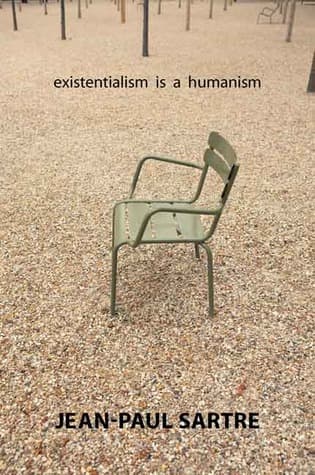
Core Idea
- Difficulty
- Medium
- Read it if
- You are curious about the foundational ideas of existentialism, want to understand Sartre's core arguments about freedom and responsibility, or are looking for a concise introduction to a major philosophical movement.
- Skip it if
- You prefer a less abstract or more empirical approach to understanding human nature, or you are already deeply familiar with Sartre's work and seeking new insights.
Key Takeaways from Existentialism is a Humanism
Existence Precedes Essence
You are defined by your actions, not by a predetermined nature.
Sartre states that there is no inherent human nature or purpose. Unlike a manufactured item, which has a design before it exists, humans are born without a defined identity. We are a blank slate, and our choices, actions, and goals create who we are. This means we are not tied to a 'soul,' a divine plan, or even our past. Every decision we make helps form who we become. This is an active, continuous process of self-creation. It places great responsibility on individuals to define their own meaning and values in a world without inherent ones.
“What do we mean by saying that existence precedes essence? We mean that man first of all exists, encounters himself, surges up in the world—and that he defines himself afterwards.”
In the book: Sartre's core argument against the 'essence precedes existence' view held by both religious creationism (God as a divine artisan) and determinist philosophical traditions. He uses the analogy of a paper-knife, which is conceived with an essence before it is made, contrasting it with human existence.
Try this: Actively recognize that your identity is not fixed but is constantly being shaped by your choices. Instead of seeking a predefined purpose, commit to projects and actions that align with the person you wish to become. Embrace the freedom to redefine yourself through new commitments and experiences, rather than feeling constrained by past failures or societal expectations.
Related ideas: radical-freedom, self-creation, human-condition
Condemned to Be Free
Absolute freedom brings absolute responsibility.
This statement captures the main idea of Sartre's existentialism. Without a God or a set nature to guide us, we are completely free to choose our path. This freedom is a burden, though, because it comes with the heavy weight of total responsibility. Every choice we make is ours alone. We cannot blame outside forces, genetics, or past events to justify our actions. This absolute freedom means we are the only ones who create our values and the meaning of our lives. This makes us accountable for every part of who we are and the world we live in.
“Man is condemned to be free; because once thrown into the world, he is responsible for everything he does.”
In the book: Sartre's logical deduction from the premise of 'existence precedes essence.' If there is no pre-existing essence, then there are no external dictates for human action, leaving humans entirely free and therefore entirely responsible.
Try this: Stop making excuses or blaming external factors for your circumstances or choices. Own your decisions, even the difficult ones, and recognize that you always have the power to choose a different path. Embrace the weight of this responsibility as the true source of your agency and capacity for change.
Related ideas: radical-freedom, responsibility, anguish
Anguish, Forlornness, Despair
The emotional landscape of absolute freedom and responsibility.
Sartre identifies three basic emotional states that come from the human condition: anguish, forlornness, and despair. Anguish is the deep anxiety that comes from knowing the huge responsibility of choosing not only for oneself but, by extension, for all people. Forlornness (or 'abandonment') comes from realizing there is no God or outside moral law to justify our choices or give meaning. We are alone in creating our values. Despair comes from understanding that we can only rely on what we control – our actions – and that many outcomes are beyond our influence. These are not mental health problems but natural parts of being conscious and free.
“These are the three notions which will enable us to understand better what we mean by saying that existence precedes essence.”
In the book: Sartre uses the example of a military leader making a decision that will affect the lives of many soldiers. The leader experiences anguish because their choice establishes a value for all humanity. He also references Dostoevsky's 'if God does not exist, everything is permitted' to explain forlornness.
Try this: Recognize these feelings not as weaknesses but as natural responses to your freedom and responsibility. Instead of avoiding them, use anguish as a motivator for careful, considered action. Embrace forlornness as an invitation to create your own values, and let despair guide you to focus your energy on what you can truly control.
Related ideas: anguish, forlornness, despair, human-condition
The Universal Value of Choice
In choosing for ourselves, we choose for all humanity.
This is one of Sartre's most difficult and often misunderstood claims. He says that when we make a choice, we are not just deciding for ourselves; we are also suggesting that choice as a universal value. By choosing to act in a certain way, we are, in a sense, saying, 'This is how a person should act.' This means every personal decision carries a deep ethical weight, as it helps define what it means to be human. There is no escaping this responsibility; even choosing not to choose is a choice that defines you and, by extension, humanity.
“In choosing myself, I choose man. ... And in this way, I am responsible for myself and for everyone else. I am creating a certain image of man of my own choosing.”
In the book: Sartre's example of a young man torn between caring for his mother and joining the Free French forces. Whatever he chooses, he is establishing a value not just for himself but suggesting a universal human response to such a dilemma.
Try this: Before making significant decisions, consider the broader implications. Ask yourself: 'If everyone acted as I am about to act, would that be a world I endorse?' This thought experiment can help clarify your values and lead to more deliberate, ethically conscious choices, moving beyond purely self-interested motivations.
Related ideas: universal-ethics, responsibility, intersubjectivity
Bad Faith and Self-Deception
Avoiding freedom and responsibility by pretending to be an object.
Bad faith (mauvaise foi) is Sartre's term for self-deception. It happens when people deny their freedom and responsibility by pretending to be objects or by taking on pre-set roles. This might appear as claiming 'I had no choice,' 'that's just how I am,' or 'society made me do it.' It is an attempt to escape the anxiety of freedom by treating oneself as something determined by outside forces or an unchangeable nature. Sartre sees this as a basic dishonesty, a deliberate turning away from the truth of our complete freedom and the responsibility that comes with it. Living authentically means facing this temptation and accepting our ability to choose.
“The man who takes refuge in the excuse of his passions, or by inventing some deterministic doctrine, is a man in bad faith.”
In the book: Sartre gives the example of a waiter who performs his role with excessive, almost mechanical precision, as if he *is* merely a waiter, rather than a free consciousness who *chooses* to be a waiter. This is a denial of his transcendence and freedom.
Try this: Be vigilant for moments when you attempt to externalize blame or claim helplessness. Challenge thoughts like 'I can't' or 'it's just my nature.' Recognize these as potential acts of bad faith and consciously reaffirm your capacity to choose and act differently, even in difficult circumstances. Embrace the discomfort of responsibility over the false comfort of determinism.
Related ideas: authenticity, self-deception, freedom
Humanism Without God
Man is the sole lawmaker of values and meaning.
Sartre redefines humanism, separating it from any divine source. For him, existential humanism says that humans are the ultimate source of value and meaning. Without a God to give commands or a pre-existing plan for humanity, we are fully responsible for creating our own moral code and purpose. This is not permission for negativity, but an empowering call to action. It means we have the dignity and burden of making our own values through our choices and commitments, building a human world based on human goals. It is a humanism of action, not just thought.
“There is no other universe than a human universe, the universe of human subjectivity.”
In the book: Sartre's direct refutation of criticisms that existentialism leads to quietism or moral relativism. He argues that by choosing, we are creating values, and thus, an ethics arises from human action, not from an external source.
Try this: Instead of waiting for external validation or a 'higher purpose,' actively engage in creating meaning in your life through your projects, relationships, and contributions. Take ownership of your values and be prepared to articulate and defend them, knowing they are products of your own free commitments.
Related ideas: humanism, atheism, value-creation, meaning-making
Action Defines Being
You are nothing more than the sum of your actions.
Sartre stresses that our identity comes from our actions, not from our intentions, potential, or reputation. We are not defined by what we could be, or what others think we are, but by what we do. A coward acts cowardly, regardless of an inner wish to be brave. A hero performs heroic acts. This focus on action means that self-realization is an ongoing process of doing. True identity is always changing, shown through real engagement with the world. It is a strong call to move beyond just thinking or wishing and to show our values through our deeds.
“Man is nothing else but what he purposes, he exists only in so far as he realizes himself, he is therefore nothing else but the sum of his actions, nothing else but what his life is.”
In the book: Sartre's critique of doctrines that define man by his 'passions' or 'potential.' He argues that 'there is no love apart from the deeds of love; no potentiality of love other than that which is manifested in loving.'
Try this: Focus on consistent action rather than just intentions or declarations. If you want to be a kind person, perform acts of kindness. If you want to be a writer, write. Understand that your identity is forged daily through your tangible engagement with the world, not through internal musings or unfulfilled desires.
Related ideas: action-over-intention, self-realization, authenticity
Intersubjectivity and the Other
Our freedom is intertwined with the freedom of others.
While Sartre stresses individual freedom, he clarifies that this freedom is not isolated. Our choices naturally involve others. When we choose, we are not only choosing for ourselves but also suggesting a value that, by implication, we believe others should also choose. Also, our self-awareness and self-definition are deeply affected by the 'Other.' We become aware of ourselves in relation to how others see us. This means our freedom is not absolute when we are alone, but exists in a complex, often difficult relationship with everyone else's freedom. True freedom, then, must also confirm the freedom of others.
“I can choose only in relation to a certain end, and when I propose that end, it is impossible for me not to propose as the end of all men.”
In the book: Sartre's argument that we only become aware of qualities like 'cowardice' or 'bravery' through the judgment of others, demonstrating that our being-for-itself is always also a being-for-others. He uses the example of the universal implication of any choice.
Try this: Consider the impact of your choices on others and recognize that your freedom is not an isolated phenomenon. Strive to make choices that not only affirm your own freedom but also respect and enable the freedom of others. Engage in empathy and mutual recognition, understanding that a truly free world requires the freedom of all its inhabitants.
Related ideas: intersubjectivity, the-other, mutual-recognition, ethics
No Determinism, Only Choice
Neither passions nor circumstances negate our ultimate freedom.
Sartre strongly rejects all forms of determinism, whether from psychology, biology, or society. While he acknowledges that we are born into specific situations, with certain temperaments and influences, these factors do not decide our choices. We are always free to choose how we react to our circumstances. Even strong feelings or overwhelming emotions do not remove our responsibility; we choose to be swept away by them. This view is very empowering, stating that humans have a natural, constant ability to choose. This makes us the ultimate creators of our own future, even when facing great pressure.
“There is no determinism, man is free, man is freedom.”
In the book: Sartre's example of the young man choosing between his mother and the resistance, where no pre-existing moral rule or emotional pull could make the decision for him; he had to invent the rule through his choice. He also discusses how we 'choose' our passions.
Try this: When faced with difficult situations, resist the urge to feel powerless or to claim that you 'had no choice.' Actively seek out the choices available to you, even if they are uncomfortable or require significant effort. Embrace the understanding that your response to any circumstance is ultimately a reflection of your freedom.
Related ideas: anti-determinism, radical-freedom, choice
Optimism of Action
Existentialism is a philosophy of hope through engagement.
Despite the serious themes of anxiety and responsibility, Sartre says existentialism is an optimistic idea. This optimism is not simple happiness but a strong belief in human potential and ability. It is an optimism of action, stating that because we are free and responsible, we have the power to create meaning, shape our lives, and affect the world through our choices and commitments. It rejects inaction and fate, calling people to active involvement, to 'make themselves' through their goals. The future is not set, and it is up to each of us to create it through our deeds. This makes existentialism a philosophy of hope through real, committed action.
“There is no reality except in action. ... You are nothing else but your life.”
In the book: Sartre's direct rebuttal to criticisms that existentialism is a 'gloomy' philosophy, arguing that by making man the master of his fate, it is profoundly hopeful. His emphasis on the 'project' and self-making through action.
Try this: Channel any feelings of existential dread into productive action. Identify a project or cause you care about and commit to it fully. Understand that by acting, you are not only defining yourself but also contributing to the creation of a meaningful world, embodying the active optimism that Sartre champions.
Related ideas: optimism-of-action, project, engagement, meaning-making
Existentialism is a Humanism Quotes
“Existence precedes essence.”
“Man is condemned to be free.”
“Man is nothing else but what he makes of himself.”
“We are left alone, without excuse.”
“In choosing for himself he chooses for all men.”
“Man is a being who hurls himself toward a future.”
“There is no human nature, because there is no God to have a conception of it.”
“Life has no meaning a priori... It is up to you to give it a meaning.”
“I am my choices.”
“One is still what one is going to cease to be and already what one is going to become.”
“The coward makes himself cowardly, the hero makes himself heroic.”
“Freedom is the foundation of all values.”
“There are no accidents in life.”
Quiz
10 questions on the main ideas. Each answer comes with a short explanation.
Question 1
What was the primary purpose of Sartre's 1945 lecture 'Existentialism is a Humanism'?
- To introduce existentialism as a completely new philosophical movement
- To correct common misconceptions about his philosophy and explain existentialism
- To criticize other existentialist thinkers like Camus and Heidegger
- To argue for the existence of God in a post-war context
Show answer
B. To correct common misconceptions about his philosophy and explain existentialism Sartre accepted the invitation to speak specifically to address widespread misunderstandings about his thought and to expound his philosophy as a form of existentialism, which was being widely discussed but often misinterpreted at the time.
Question 2
According to Sartre's doctrine in this book, what is the central concept that defines human existence?
- Reason and logic
- Freedom and choice
- Social conformity
- Divine predestination
Show answer
B. Freedom and choice Sartre places freedom at the center of his existentialist doctrine, arguing that humans are born into an empty universe and create their essence through freely made choices.
Question 3
What famous existentialist phrase encapsulates Sartre's view that humans define themselves through actions rather than having a predetermined nature?
- "I think, therefore I am"
- "God is dead"
- "Existence precedes essence"
- "The unexamined life is not worth living"
Show answer
C. "Existence precedes essence" Sartre's principle 'existence precedes essence' means that humans first exist without a predefined purpose or nature, and then create their essence through their choices and actions.
Question 4
Why does Sartre claim that in choosing for ourselves, we also choose for all mankind?
- Because our choices are always influenced by societal norms
- Because by affirming the value of what we choose, we imply it is good for everyone
- Because humans are biologically programmed to imitate each other
- Because God commands us to consider others in our decisions
Show answer
B. Because by affirming the value of what we choose, we imply it is good for everyone Sartre argues that when we make a choice, we affirm the value of that choice, thereby committing not only ourselves but suggesting that this value should apply universally to all humanity.
Question 5
What additional content is included in this edition of 'Existentialism is a Humanism' beyond Sartre's original lecture?
- Only the 1945 lecture in a new English translation
- The lecture, Sartre's analysis of Camus's 'The Stranger', and supplementary materials
- A collection of Sartre's early novels and plays
- Critical essays from multiple philosophers refuting existentialism
Show answer
B. The lecture, Sartre's analysis of Camus's 'The Stranger', and supplementary materials This edition includes a new English translation of Sartre's 1945 lecture, his analysis of Camus's 'The Stranger', and additional materials like an introduction by Arlette Elkaïm-Sartre and a discussion by Annie Cohen-Solal.
Question 6
According to Sartre, what is the only thing that limits human freedom and the ongoing process of self-creation?
- Social institutions and laws
- Biological and psychological constraints
- The contingency of death
- Economic conditions and class struggle
Show answer
C. The contingency of death Sartre states that were it not for the contingency of death, humans would never end the process of creating their essence through choices; death is the ultimate limit on this freedom.
Question 7
What irony does Sartre acknowledge about his lecture 'Existentialism is a Humanism'?
- He claimed existentialism was for philosophers but made it accessible to a general audience
- He argued against humanism while titling his lecture 'Existentialism is a Humanism'
- He delivered it in French but intended it only for English-speaking intellectuals
- He rejected existentialism as a label but used it to gain popularity
Show answer
A. He claimed existentialism was for philosophers but made it accessible to a general audience Sartre ironically asserted that existentialism was essentially a doctrine for philosophers, yet he proceeded to explain it in a way that made it understandable to a broad public audience at the Club Maintenant.
Question 8
In the context of Sartre's existentialism, what does it mean to live in a 'godless universe'?
- That religion is irrelevant to human affairs
- That humans have no inherent purpose or values imposed by a divine being
- That science has disproven the existence of God
- That moral relativism is the only valid ethical stance
Show answer
B. That humans have no inherent purpose or values imposed by a divine being Sartre's concept of a godless universe means there is no pre-existing divine plan or inherent human essence; humans are radically free to create their own values and meaning through choices.
Question 9
How does Sartre's analysis of Camus's 'The Stranger' in this edition likely relate to his own existentialist ideas?
- It critiques Camus for not being existentialist enough
- It explores themes of absurdity and alienation that align with existentialist concerns
- It argues that Camus's work is superior to Sartre's own philosophy
- It focuses solely on literary style without philosophical implications
Show answer
B. It explores themes of absurdity and alienation that align with existentialist concerns Camus's 'The Stranger' deals with themes like absurdity, freedom, and alienation, which are central to existentialism; Sartre's analysis would likely examine how these themes reflect or contrast with his own philosophical views.
Question 10
What practical implication does Sartre's existentialism have for individual responsibility according to this book?
- Responsibility is minimized because humans are products of their environment
- Humans bear absolute responsibility for their choices and their impact on humanity
- Responsibility is shared equally among all members of society
- Only actions that harm others incur moral responsibility
Show answer
B. Humans bear absolute responsibility for their choices and their impact on humanity Since humans are free to choose and create their essence, Sartre argues they are fully responsible for their actions. Moreover, by choosing, they commit all of mankind, implying a heavy burden of responsibility for the values they affirm.
Existentialism is a Humanism FAQ
What is existentialism according to Sartre?
Sartre defines existentialism as a philosophy centered on human freedom and responsibility, where 'existence precedes essence.' This means humans are not born with a predetermined purpose but create their own essence through their choices and actions in a godless universe.
What does 'existence precedes essence' mean?
This core existentialist principle means humans are not born with a fixed nature or purpose. Instead, we first exist, and then through our free choices and actions, we define our own essence, values, and identity over time.
How is Sartre's existentialism different from other philosophies?
Unlike philosophies that posit predetermined human nature or divine purpose, Sartre's existentialism emphasizes radical freedom, personal responsibility, and the absence of inherent meaning in a godless universe. It focuses on individuals creating their own values through action.
Does existentialism work as a practical philosophy for daily life?
Yes, Sartre argues existentialism is practical because it empowers individuals to take responsibility for their choices. By recognizing our freedom, we can actively shape our lives and values, though this comes with the weight of responsibility for ourselves and humanity.
What role does freedom play in Sartre's existentialism?
Freedom is central to Sartre's doctrine. He asserts humans are 'condemned to be free,' meaning we are inherently free to choose our actions in every situation, and through these choices, we define ourselves and commit to values that affect all mankind.
How does Sartre's view differ from Albert Camus's existentialism?
While both are existentialists, Sartre emphasizes active freedom and responsibility in creating meaning, whereas Camus focuses more on the absurdity of life and finding meaning despite it. The book includes Sartre's analysis of Camus's 'The Stranger,' highlighting these nuances.
Why did Sartre give the 'Existentialism Is a Humanism' lecture?
Sartre gave the lecture in 1945 to clarify misconceptions about existentialism, defending it as a human-centered philosophy. He aimed to show it's not pessimistic but empowers individuals through freedom and responsibility, making it accessible to a general audience.
What is included in this edition of the book?
This edition features a new English translation of Sartre's 1945 lecture, his analysis of Camus's 'The Stranger,' and supplementary materials like an introduction by Arlette Elkaïm-Sartre, a Q&A with Sartre, and a discussion by biographer Annie Cohen-Solal.
How does Sartre address the idea of death in existentialism?
Sartre views death as a contingency that limits human existence but doesn't negate freedom. He argues that until death, we are free to choose and create our essence, with death representing the final end of this ongoing self-creation.
Is existentialism only for philosophers, as Sartre suggests?
While Sartre initially called it a doctrine for philosophers, his lecture aimed to make it accessible to everyone. He shows existentialism applies to daily life by emphasizing how ordinary choices reflect our freedom and responsibility, making it relevant beyond academic circles.
About the author
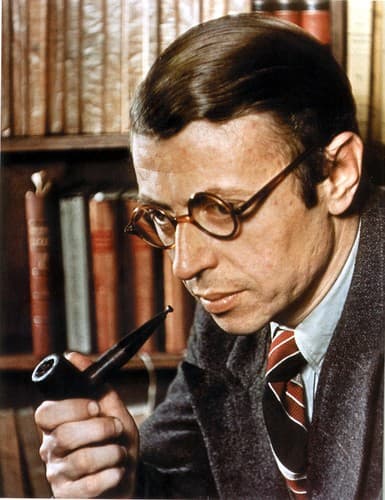
Jean-Paul Charles Aymard Sartre was a French philosopher, playwright, novelist, screenwriter, political activist, biographer, and literary critic, considered a leading figure in 20th-century French philosophy and Marxism. Sartre was one of the key figures in the philosophy of existentialism. His work has influenced sociology, critical theory, post-colonial theory, and literary studies, and continues to do so. He was awarded the 1964 Nobel Prize in Literature despite attempting to refuse it, saying that he always declined official honors and that "a writer should not allow himself to be turned into an institution."
Similar books
- The Myth of Sisyphus
Albert Camus
4.2 (25k) average on GoodreadsPhilosophyExplores the absurdity of existence and the human response to a meaningless world, a key theme in existential thought.
- Being and Nothingness
Jean-Paul Sartre
4.0 (26k) average on GoodreadsPsychologyProvides a more extensive and systematic development of the ideas introduced in 'Existentialism is a Humanism'.
- The Ethics of Ambiguity
Simone de Beauvoir
4.2 (5k) average on GoodreadsPhilosophySimone de Beauvoir, a close associate of Sartre, builds upon and refines existentialist ethics in The Ethics of Ambiguity (1947). While largely aligned with Sartre's fundamental principles, Beauvoir provides a more nuanced exploration of freedom and responsibility, particularly in the context of intersubjectivity and the challenges of ethical action in an ambiguous world. She critiques the simplistic understanding of freedom that can lead to oppressive actions, emphasizing that true freedom necessitates the freedom of others. Her work often addresses the practical implications of existentialist ethics more thoroughly than Sartre's lecture, which, while asserting universal value, doesn't delve into the complexities of its application as deeply as Beauvoir does.
- Brave New World
Aldous Huxley
4.0 (1.4M) average on GoodreadsFantasyIn a future where happiness comes from chemicals and individuality is gone, one man's desire for real experience threatens the calm, controlled society.
- Life of Pi
Yann Martel
3.9 (1.3M) average on GoodreadsFantasyStranded in the vast Pacific, a young Indian boy forms an unlikely bond with a Bengal tiger, questioning belief and survival.
- The Picture of Dorian Gray
Oscar Wilde
4.1 (966k) average on GoodreadsFantasyA beautiful young man's soul decays within a cursed portrait, mirroring the grotesque cost of his hedonistic pursuit of eternal youth and illicit pleasure.




Enjoyed the summary?
A summary gives you the shape of the book. The book itself has the detail, the examples and the voice.
Find Existentialism is a Humanism on AmazonAs an Amazon Associate, BookBrief earns from qualifying purchases. How we're funded