
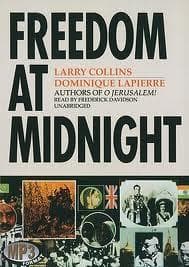
Core Idea
- Difficulty
- Medium
- Read it if
- You want a gripping, detailed, and human-centered account of India's independence and partition, exploring the political machinations and immense human tragedy.
- Skip it if
- You prefer a purely academic or dispassionate analysis of the events, or are looking for a concise overview rather than an immersive narrative.
Key Takeaways from Freedom at Midnight
The Burden of Empire's End
The British departure from India was less a grand gesture and more a desperate scramble to escape an unsustainable dominion.
The book portrays the pressure on Britain after WWII to give up India. The decision to grant independence was driven by a depleted treasury, a war-weary populace, and the impossibility of maintaining control over a restive subcontinent. The narrative shows the ironic twist where the 'jewel in the crown' had become a financial and administrative burden. The British, once masters of manipulation, found themselves outmaneuvered by Indian nationalism, leading to a hasty retreat that prioritized British interests over the stability of the departing colony.
“The British Empire, once a source of immense pride and power, had become an economic and moral albatross, its jewel in the crown now a burning ember they were desperate to drop.”
In the book: The authors detail the financial strain on post-war Britain, unable to sustain the administrative and military costs of governing India, and the political will in London for a rapid exit, exemplified by Prime Minister Clement Attlee's directive for a swift transfer of power.
Try this: Leaders must recognize when an endeavor, no matter how historically significant, becomes an unsustainable drain on resources and adjust strategy for a timely and responsible exit, rather than prolonging an inevitable decline.
Related ideas: decolonization, post-colonialism, geopolitics
Mountbatten's Hasty Handoff
Lord Mountbatten's accelerated timetable for independence exacerbated the chaos and violence of partition.
The book critiques Lord Mountbatten's role as the last Viceroy, particularly his decision to move the date of independence from June 1948 to August 1947. While intended to minimize unrest, this acceleration had the opposite effect, compressing political negotiation into an impossible timeframe. The hurried demarcation of borders by Cyril Radcliffe, who had never visited India, and the lack of preparation for the mass migration, directly contributed to the scale of communal violence. Mountbatten appears as a figure driven by ambition, a desire for a clean break, and an underestimation of the deep religious divides.
“Mountbatten's 'surgical' approach to partition proved to be anything but, leaving a gaping wound that bled for decades.”
In the book: Collins and Lapierre extensively document Mountbatten's unilateral decision to bring forward the independence date and the subsequent scramble to complete the partition process, including the Radcliffe Line's creation in just five weeks, without local consultation or proper demographic data.
Try this: When managing complex transitions, especially those involving diverse populations, a rapid timetable without adequate planning and stakeholder involvement can lead to catastrophic unintended consequences. Prioritize thoroughness over speed.
Related ideas: partition-of-india, lord-mountbatten, communal-violence
The Price of Freedom: Human Cost
The joy of independence was tragically overshadowed by an explosion of communal violence, displacement, and death.
Beyond the political events, 'Freedom at Midnight' shows the human toll of partition. The book details the massacres, rapes, forced conversions, and displacement that came with the creation of India and Pakistan. It paints a grim picture of trains arriving filled with corpses, of refugees trekking for hundreds of miles, and of families torn apart. This account is a powerful reminder that political decisions often have devastating consequences for ordinary people, transforming concepts of 'nation' and 'border' into experiences of terror and loss. The scale of the violence, estimated to be between 1 to 2 million dead and 10 to 20 million displaced, is a stark indictment of the leadership's failure to anticipate and reduce the fallout.
“The midnight hour of freedom was also the dawn of an unimaginable nightmare, as millions paid for independence with their lives and their homes.”
In the book: The authors recount numerous eyewitness testimonies, stories of refugee trains, the systematic violence in Punjab and Bengal, and the overwhelmed administrative machinery trying to cope with the exodus.
Try this: Policymakers must prioritize human security and well-being above political expediency, especially during periods of significant societal change. Anticipate worst-case scenarios and plan for humanitarian aid and conflict resolution.
Related ideas: human-rights, refugee-crisis, ethnic-cleansing
Gandhi's Lonely Battle
Mahatma Gandhi, the architect of non-violence, found himself a tragic, isolated figure amidst the partition's bloodbath.
The book presents a portrayal of Mahatma Gandhi in his final years. Having led India to independence through non-violent resistance, he was marginalized during the negotiations for partition. His pleas for unity and his attempts to bridge the Hindu-Muslim divide were largely ignored by the political leadership, who were more concerned with power and state-building. Gandhi's desperate fasts and visits to riot-torn areas were noble, but insufficient to stop the communal hatred. His assassination, detailed, is a tragic end to a life dedicated to peace, showing the failure of his ideals in the face of political expediency and ingrained animosity.
“The apostle of non-violence, who had led India to freedom, found himself a prophet without honor in his own land, unable to quell the fires of hatred he had inadvertently helped to ignite.”
In the book: The book describes Gandhi's diminishing influence in the Congress Party, his solitary efforts to bring peace to Calcutta and Delhi during the riots, and the details leading up to his assassination by Nathuram Godse.
Try this: Even the most powerful moral leaders can be sidelined by political pragmatism and popular fervor. True leadership requires not only vision but also the ability to adapt strategies to prevent the subversion of core values.
Related ideas: mahatma-gandhi, non-violence, political-marginalization
The Princely States: A Legacy of Anomaly
The integration of India's 565 princely states presented a unique and perilous challenge to the nascent nation.
A subplot of 'Freedom at Midnight' is the position of India's princely states. These semi-autonomous entities, from vast kingdoms to tiny enclaves, enjoyed extravagant lifestyles under British paramountcy but faced a crisis with independence. The book details the varied characters of the maharajas and their attempts to maintain their privileges or declare independence. Sardar Patel, with his diplomacy and coercion, played a role in integrating these states into the Indian Union. This process shows the arbitrary nature of colonial rule and the task of forging a unified nation from a diverse and fragmented political situation.
“The maharajas, once absolute rulers of their fantastical kingdoms, found their opulent worlds crumbling under the relentless march of modern nation-building.”
In the book: The authors provide colorful anecdotes about various maharajas, such as the Maharaja of Patiala's lavish lifestyle, and the political maneuvering involved in integrating states like Hyderabad and Junagadh.
Try this: Nation-building requires decisive leadership and strategic integration of diverse elements, often necessitating a delicate balance of negotiation and firm action to overcome entrenched interests and historical anomalies.
Related ideas: princely-states, sardar-patel, indian-union
The Blame Game: Who's Responsible?
The book implicitly argues that responsibility for the partition's horrors lies with a confluence of British haste, Indian political ambition, and communal intransigence.
While not explicitly assigning blame, the narrative suggests a shared responsibility for the catastrophic outcomes of partition. The British are faulted for their 'divide and rule' policies and their hasty, unprepared exit. Indian leaders, particularly Nehru and Jinnah, are depicted as being too entrenched in their positions and too eager for power to prioritize a unified India over their political aspirations. The deep communal prejudices, inflamed by political rhetoric, are also highlighted as a driver of the violence. The book avoids a simplistic villain-hero narrative, instead presenting a complex interplay of factors that led to one of history's largest forced migrations and humanitarian crises.
“The seeds of partition were sown by British 'divide and rule,' nurtured by communal leaders, and harvested in a frenzy of political ambition and fear.”
In the book: The detailed accounts of Jinnah's unwavering demand for Pakistan, Nehru's desire for a strong central government, and Mountbatten's accelerated timetable all contribute to this complex picture of shared responsibility.
Try this: Historical events, especially those with tragic outcomes, rarely have a single cause or culprit. Understanding the multiple contributing factors – political, social, and individual – is crucial for informed analysis and preventing future mistakes.
Related ideas: jinnah, nehru, divide-and-rule
The Power of Individual Stories
The book's strength lies in its ability to humanize history through countless personal anecdotes and vivid character sketches.
Collins and Lapierre excel at bringing history to life through their research and focus on individual stories. From the maharajas to the experiences of refugees, the book grounds the events of independence in the lived realities of people from all parts of society. This approach makes the political narrative accessible and emotionally resonant. It shows that understanding history requires looking beyond grand narratives and appreciating the impact of events on ordinary individuals, whose voices often get lost in broader historical accounts. The authors' ability to weave these personal tales into the larger history is what makes the book so compelling and memorable.
“History is not just about dates and treaties; it is the sum of countless human experiences, both grand and agonizingly personal.”
In the book: The inclusion of specific stories like the Maharaja of Nawanagar's passion for cricket, the plight of a Muslim family fleeing to Pakistan, or the British soldiers' emotional departure, enriches the historical account.
Try this: When communicating complex information, integrate personal narratives and specific examples to make the content relatable, memorable, and impactful. Human stories are powerful tools for understanding and empathy.
Related ideas: oral-history, historiography, narrative-history
The Enduring Scars of Partition
The partition of India and Pakistan left deep, lasting wounds that continue to shape the geopolitics of the subcontinent.
Even decades after the events, 'Freedom at Midnight' shows that the consequences of partition are not just historical footnotes but living realities. The book implicitly connects the hurried and violent division to the ongoing tensions between India and Pakistan, particularly over Kashmir. The mass displacement created refugee populations that struggled for generations, and the communal hatreds during that period continue. This takeaway emphasizes that political decisions made under duress, especially those involving territorial and identity divisions, can have multi-generational impacts, shaping international relations, domestic politics, and social cohesion for decades, if not centuries. The book is a reminder of the long shadow cast by historical trauma.
“The lines drawn in haste on a map became the fault lines of future conflicts, forever altering the destiny of a subcontinent.”
In the book: While the book concludes with Gandhi's assassination in 1948, the detailed description of the creation of the borders and the subsequent migrations implicitly sets the stage for future conflicts like the Kashmir dispute and the enduring animosity between the two nations.
Try this: When making decisions with far-reaching implications, especially those involving borders and ethnic groups, consider the long-term, intergenerational consequences and prioritize sustainable solutions over temporary fixes.
Related ideas: kashmir-conflict, indo-pakistan-relations, historical-trauma
The Spectacle of Power and Poverty
The narrative vividly contrasts the obscene wealth and privilege of the British Raj and Indian royalty with the widespread poverty of the masses.
The authors show the stark dichotomy that defined colonial India: the wealth and opulent lifestyles of the British administrators and the Indian maharajas, set against the backdrop of poverty, disease, and illiteracy among the majority of the Indian population. The book describes lavish banquets, extravagant palaces, and eccentric royal customs, juxtaposed with scenes of famine, overcrowded cities, and the struggles of ordinary people. This contrast is not just descriptive; it is a commentary on the injustices of the colonial system and the deep inequalities that persisted even among the Indian elite. It shows the social and economic challenges awaiting the newly independent nations.
“Beneath the gilded surface of imperial grandeur and princely extravagance lay the undeniable bedrock of a nation's destitution.”
In the book: The book details the extravagant ceremonies of the Raj, the maharajas' wealth (e.g., the jewels of the Nizam of Hyderabad), and the widespread poverty that Gandhi encountered on his travels.
Try this: Understanding historical contexts requires acknowledging the power dynamics and economic disparities that often underpin societal structures, as these factors significantly influence political outcomes and social change.
Related ideas: colonialism, socioeconomic-inequality, british-raj
Freedom at Midnight Quotes
“The partition of India is not a settlement; it is a sentence of death.”
“I am not a saint who has strayed into politics; I am a politician trying to be a saint.”
“The British are leaving India in a state of chaos and bloodshed.”
“We have a Muslim nation and a Hindu nation, but where is the Indian nation?”
“Mountbatten's deadline was a ticking time bomb for millions.”
“The trains arrived full of corpses, a macabre exchange of populations.”
“Jinnah's Pakistan was born in a hospital bed, not on the battlefield.”
“Nehru's 'tryst with destiny' speech masked the bloodshed outside.”
“The British divided and left; we are left to divide ourselves.”
“Gandhi's fast was a moral weapon against a tide of hatred.”
“The Radcliffe Line was drawn with a ruler, ignoring villages and hearts.”
“Independence came at midnight, but freedom was delayed by bloodshed.”
“Mountbatten's vanity cost more time than it saved.”
“The last Viceroy presided over the dissolution of an empire.”
Quiz
10 questions on the main ideas. Each answer comes with a short explanation.
Question 1
Who was appointed as the last Viceroy of British India, a key figure in the events leading to Indian independence as described in the book?
- Lord Curzon
- Lord Mountbatten of Burma
- Lord Dalhousie
- Lord Wavell
Show answer
B. Lord Mountbatten of Burma The book begins with the appointment of Lord Mountbatten as the last Viceroy, tasked with overseeing the transfer of power and partition of India, making him central to the narrative.
Question 2
What was the exact date and time when India gained independence, as highlighted in the book's opening?
- August 15, 1947, at dawn
- August 14, 1947, at midnight
- January 26, 1950, at noon
- June 3, 1947, at sunset
Show answer
B. August 14, 1947, at midnight The book emphasizes the symbolic moment at midnight on August 14, 1947, when the Union Jack was lowered, marking India's independence and the birth of two nations.
Question 3
Which event marks the end of the narrative in 'Freedom at Midnight'?
- The first India-Pakistan war
- The assassination and funeral of Mahatma Gandhi
- The integration of princely states
- The adoption of India's constitution
Show answer
B. The assassination and funeral of Mahatma Gandhi The book concludes with the assassination and funeral of Mahatma Gandhi, which symbolizes the tragic aftermath of partition and the challenges of the new nations.
Question 4
According to the book, what was one of the 'prices of freedom' paid during Indian independence?
- Economic sanctions by Britain
- Riots, bloodshed, partition, and war
- Loss of cultural heritage
- Immediate famine across the subcontinent
Show answer
B. Riots, bloodshed, partition, and war The book describes how independence came with high costs, including widespread violence, partition into India and Pakistan, and communal conflicts that erupted into riots and war.
Question 5
What anecdotal detail from the book illustrates the extravagance of Indian maharajas, as mentioned in reviews?
- A maharaja owning a private zoo with rare animals
- A maharaja being measured against his weight in gold
- A maharaja hosting a feast for thousands daily
- A maharaja traveling with a golden chariot
Show answer
B. A maharaja being measured against his weight in gold Reviews highlight this vivid anecdote from the book, showcasing the opulence and eccentricities of the maharajas during the British Raj, which contrasts with the poverty and turmoil of the era.
Question 6
How does the book portray the role of Mahatma Gandhi in the independence movement, based on its narrative?
- As a militant leader advocating armed rebellion
- As a spiritual figure promoting non-violence and unity
- As a political negotiator focused solely on economic terms
- As a symbol of Hindu nationalism
Show answer
B. As a spiritual figure promoting non-violence and unity The book depicts Gandhi as a central, spiritual leader whose principles of non-violence and efforts to prevent partition were key to the independence struggle, culminating in his tragic assassination.
Question 7
What historical scope does 'Freedom at Midnight' cover, according to its description?
- Only the events of August 1947
- From Mountbatten's appointment to Gandhi's death
- The entire 300-year history of British rule in India
- The post-independence development of India and Pakistan
Show answer
B. From Mountbatten's appointment to Gandhi's death The book focuses on the critical period from Lord Mountbatten's appointment as Viceroy to Gandhi's assassination, detailing the immediate events around independence and partition.
Question 8
Which reviewer described the book as 'a panoramic spectacular' that reads like 'sensational fiction'?
- James Cameron of The New York Sunday Times
- Judson Hand of The New York Daily News
- Margaret Manning of The Boston Globe
- J.M. Sanchez of The Houston Chronicle
Show answer
B. Judson Hand of The New York Daily News Judson Hand's review praises the book's vivid and engaging narrative style, comparing it to fiction despite its historical accuracy, as cited in the book description.
Question 9
What does the book suggest was a key factor compelling the British to leave India, based on historical analysis included?
- Military defeat in World War II
- The force of economics and history
- Pressure from the United Nations
- A sudden change in British public opinion
Show answer
B. The force of economics and history The book, as noted in reviews, analyzes how economic strains and historical inevitabilities, rather than single events, forced the British to end their rule and partition India.
Question 10
In what way does the book use anecdotes and character sketches to enhance its historical account?
- By fictionalizing events for dramatic effect
- By providing a dry, chronological timeline
- By illustrating the human and personal dimensions of history
- By focusing solely on political negotiations
Show answer
C. By illustrating the human and personal dimensions of history The book is praised for its use of vivid anecdotes and character sketches, such as Gandhi's meeting with the King or maharajas' extravagance, to make the historical events more relatable and engaging, highlighting the human stories behind the politics.
Freedom at Midnight FAQ
What is 'Freedom at Midnight' about?
'Freedom at Midnight' is a historical narrative detailing the events surrounding Indian independence in 1947, focusing on the transition from British rule to the partition into India and Pakistan. It covers key figures like Lord Mountbatten and Mahatma Gandhi, and the violent aftermath of partition.
Does 'Freedom at Midnight' accurately portray historical events?
Yes, the book is praised for its thorough research and accuracy by contemporaries like journalist James Cameron, who witnessed many events. It blends scholarly investigation with vivid storytelling, though it emphasizes dramatic anecdotes and character sketches.
What is the significance of the title 'Freedom at Midnight'?
The title refers to the moment at midnight on August 14-15, 1947, when India gained independence from British rule, marking the end of an empire and the birth of two nations amid widespread turmoil and bloodshed.
How different is 'Freedom at Midnight' from other books on Indian independence?
Unlike dry academic histories, 'Freedom at Midnight' reads like sensational fiction with a panoramic, narrative-driven approach. It highlights personal stories, extravagant details, and dramatic events, making it more accessible and engaging for general readers.
What role does Lord Mountbatten play in the book?
Lord Mountbatten is depicted as the last Viceroy of British India, appointed to oversee the transfer of power. The book explores his decisions and actions during the chaotic partition process, which contributed to the violence and displacement.
Does 'Freedom at Midnight' cover Mahatma Gandhi's assassination?
Yes, the book concludes with the assassination and funeral of Mahatma Gandhi, tying his death to the broader themes of independence and the tragic costs of freedom during the partition era.
What is the partition of India as described in the book?
The partition refers to the division of British India into two independent nations, India and Pakistan, in 1947. The book details the resulting riots, massacres, and mass migrations that caused immense suffering and death.
How does 'Freedom at Midnight' portray the British Empire's end?
It portrays the end as a compelled withdrawal due to economic and historical forces, marked by extravagance, squalor, and violence. The narrative critiques imperial rule while highlighting the human drama of its collapse.
Is 'Freedom at Midnight' suitable for readers new to Indian history?
Yes, its engaging, anecdotal style makes it accessible to newcomers, providing a comprehensive overview of independence and partition through vivid storytelling and character sketches, though it assumes some basic historical context.
What practical insights does the book offer about leadership during crises?
The book illustrates the challenges of leadership through figures like Mountbatten and Gandhi, showing how decisions during the partition had profound consequences, emphasizing the importance of diplomacy and moral authority in times of turmoil.
About the author

Larry Collins is an American author known for his non-fiction works, particularly in collaboration with Dominique Lapierre. He is best recognized for "Freedom at Midnight," which chronicles the events surrounding India's partition and independence. Collins's writing often focuses on historical narratives and significant global events.
Similar books
- Train to Pakistan
Khushwant Singh
3.9 (23k) average on GoodreadsHistorical FictionA fictionalized, yet deeply resonant, account of the human impact of partition on a single village.
- 1984
George Orwell
4.2 (3.1M) average on GoodreadsPoliticsIn a future where surveillance and thought control are absolute, a man's search for truth clashes with the Party, showing that hope can be a form of rebellion.
- Animal Farm
George Orwell
4.0 (2.7M) average on GoodreadsPoliticsA farm animals' rebellion against humans turns into a pig-led dictatorship, showing how power corrupts and revolutionary ideals are betrayed.
- Freakonomics: A Rogue Economist Explores the Hidden Side of Everything
Steven D. Levitt
4.0 (709k) average on GoodreadsBusinessThis book uses economic principles to reveal the surprising incentives behind everything from drug dealing and real estate to cheating teachers and the decline of crime.
- I Am Malala: The Story of the Girl Who Stood Up for Education and Was Shot by the Taliban
Malala Yousafzai
4.1 (419k) average on GoodreadsPoliticsA teenage girl from a Taliban-controlled valley refuses to give up her books, becoming a global voice for education even after an assassination attempt.
- Atlas Shrugged
Ayn Rand
3.7 (354k) average on GoodreadsPoliticsIn a dystopian America where innovators vanish, a brilliant heiress races to uncover the truth behind the disappearing industrialists and the enigmatic John Galt, who vows to stop the world's progress.





Enjoyed the summary?
A summary gives you the shape of the book. The book itself has the detail, the examples and the voice.
Find Freedom at Midnight on AmazonAs an Amazon Associate, BookBrief earns from qualifying purchases. How we're funded