
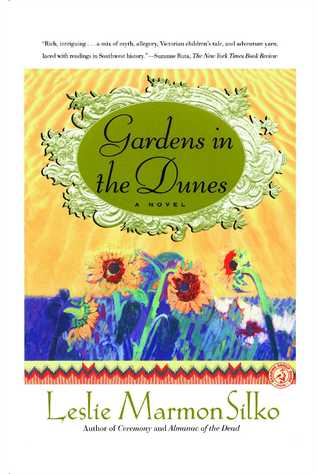
Synopsis
Covers the whole plot, including the ending.
- Difficulty
- Medium
- Pacing
- Moderate
- Mood
- Epic, Reflective, Cultural, Lyrical, Spiritual
- Read it if
- You enjoy sweeping historical sagas that explore themes of cultural clash, identity, and the resilience of indigenous traditions, with a strong female protagonist's journey.
- Skip it if
- You prefer fast-paced plots and straightforward narratives without extensive exploration of cultural details and internal character development.
Gardens in the Dunes Plot Summary
Covers the whole plot, including the ending.
The Destruction of the Sand Lizard Home
The story begins with Indigo, a young girl of the Sand Lizard people, living a traditional life with her family in the dunes of the American Southwest. Her world involves a deep connection to the land, ancient stories, and the cultivation of unique gardens hidden within the desert. This peaceful life is interrupted when white soldiers arrive, destroying their homes, harming their sacred sites, and capturing many of the Sand Lizard people, including Indigo's mother and older sister, Sister Salt. Indigo escapes the initial raid but sees the destruction, which ends her childhood innocence and the traditional life she knows. She is eventually found and taken to a government Indian school, where she is forced to abandon her language and customs.
A New Life with Hattie and Edward
After a time at the harsh government school, Hattie and Edward Palmer, a well-meaning but somewhat naive white couple, 'rescue' Indigo. Hattie, an advocate for Native American rights and a botanist, sees Indigo as a chance to prove her progressive ideals. Edward is a wealthy scholar interested in ancient cultures and plants. They take Indigo into their home, planning to educate her in white society's ways, believing they are offering her a better life. Indigo struggles to adapt to their Victorian customs, the rigid schedule, and the suppression of her natural instincts, but Hattie's kindness and Edward's intellectual curiosity about her heritage begin to form an unusual bond between them.
Journey to New York and Europe
Edward's scholarly work leads the couple, with Indigo, on an extensive journey. They first travel to New York, where Indigo experiences urban life, a contrast to the desert. Later, they go on a grand tour of Europe. Indigo, often quiet, observes keenly. She sees the wealth and class structures of European society, visits botanical gardens, and sees ancient artifacts in museums. This exposure to diverse cultures and histories broadens her understanding of the world beyond her desert home and the American frontier, even as she secretly holds onto her Sand Lizard identity and memories.
Brazil and the Search for Sacred Plants
The journey continues to Brazil, specifically the Amazon rainforest, as Edward looks for rare and ancient plants for his botanical studies. This environment, though different from her desert home, connects with Indigo's deep relationship with nature. She observes indigenous communities and their traditional ways, seeing similarities with her own people's connection to the land. During this time, Edward's interest in 'primitive' cultures also leads him to appreciate Indigo's innate knowledge and resilience, though he still struggles to fully bridge the cultural divide. Indigo, meanwhile, finds a temporary sense of belonging in the lush, untamed wilderness.
Sister Salt's Escape and Survival
While Indigo is traveling, her older sister, Sister Salt, endures the hardships of forced assimilation and abuse at the hands of white captors. Driven by her spirit and the memory of her family's traditions, Sister Salt eventually escapes. She journeys, relying on her knowledge of the land and the kindness of other Native Americans, as well as some sympathetic white individuals. Her path involves survival, resistance, and an effort to reconnect with her people and their ancestral lands, facing constant threats and the erosion of her culture.
Hattie's Growing Disillusionment
Throughout their travels, Hattie, initially confident in her progressive views, gradually confronts the complexities and injustices of colonialism. She sees the exploitation of indigenous peoples in Brazil and the superficiality of European society. Her interactions with Indigo, and her growing awareness of the cultural divide between them, make her question her own assumptions and the effectiveness of her 'civilizing' mission. She begins to understand that 'helping' Indigo might have alienated her from her true heritage, leading to guilt and a reevaluation of her life's purpose and her relationship with Edward.
Return to the Southwest
After years abroad, the Palmers and Indigo return to the American Southwest. Edward still pursues his botanical research, now with a deeper, if still academic, appreciation for indigenous knowledge. Hattie increasingly focuses on finding a way to make amends for her past actions and to genuinely support Native American communities. Indigo, now older and having gained much worldly experience, feels a pull back to her ancestral lands and the hope of finding her family, especially Sister Salt. The desert, once a place of childhood, now represents memory, loss, and potential reunion.
Indigo's Search for Sister Salt
Upon their return to the Southwest, Indigo, with Hattie's support and Edward's resources, begins her search for Sister Salt. She uses her knowledge of the land and the subtle clues of her people's movements, combined with her understanding of the larger world, to navigate the region. This search is not just for her sister, but for her roots, her identity, and the remnants of her culture. She encounters various Native American communities, some displaced, others holding onto their traditions, gathering information that guides her path.
Reunion and Rebirth of the Gardens
Indigo and Sister Salt finally reunite. Their reunion is a moment of shared grief, resilience, and renewed hope. Sister Salt, having survived years of hardship, has also kept the knowledge of their people's sacred gardens and planting traditions. Together, they begin the task of restoring their ancestral lands and the hidden gardens in the dunes. This act of planting is not just agricultural; it is an act of cultural reclamation, resistance, and shows the spirit of the Sand Lizard people. Hattie, having fully committed to supporting them, provides resources and protection.
A Blended Future
With Hattie's assistance and Edward's eventual, if more distant, support, Indigo and Sister Salt establish a new community rooted in their ancestral traditions but also selectively incorporating elements from the outside world. They become guardians of their heritage, teaching the younger generation the importance of their language, stories, and the sacred gardens. The story ends with the sisters, embodying both the ancient wisdom of their people and the broader understanding gained through their experiences, cultivating not only the physical gardens but also a resilient future for the Sand Lizard people, showing the power of cultural endurance and adaptation.
Principal Figures
Indigo
Protagonist
A young Sand Lizard girl striving to reconcile her heritage with the modern world.
Indigo is the central character, a young girl from the Sand Lizard people who embodies resilience and a deep spiritual connection to her land and traditions. Initially innocent and deeply rooted in her culture, she is abruptly thrust into the white world after her family's destruction. Throughout her journey with Hattie and Edward, she remains an acute observer, internalizing new experiences while secretly preserving her core identity. Her silence often belies a profound wisdom and a fierce determination to return to her roots. She learns to navigate different worlds without fully abandoning her own.
Relationships: Sister Salt (Older sister, deep familial bond, shared heritage); Hattie Palmer (Adoptive guardian, complex mother-figure, initially well-meaning but culturally insensitive, later supportive ally); Edward Palmer (Adoptive guardian, intellectual, initially sees her as a 'specimen', later develops respect); Grandma Fleet (Maternal figure, spiritual guide and source of traditional knowledge)
Sister Salt
Supporting
Indigo's older sister, a symbol of resistance and the endurance of traditional knowledge.
Sister Salt is Indigo's older sister, a strong and resilient woman who endures immense hardship after being captured by white soldiers. She embodies the fierce determination to survive and to preserve the Sand Lizard traditions. Unlike Indigo, who travels the world, Sister Salt navigates the brutal realities of the American frontier, facing exploitation and violence. Her unwavering commitment to her people's ways, particularly the sacred gardens, makes her a beacon of hope and a crucial link to their past. She represents the direct resistance and survival of Native American culture.
Relationships: Indigo (Younger sister, deep familial bond, shared heritage and future); Grandma Fleet (Maternal figure, spiritual guide and source of traditional knowledge)
Hattie Palmer
Supporting
A progressive white woman who grapples with her own cultural biases and desire to 'help'.
Hattie is Edward's wife, a botanist and well-intentioned but initially culturally naive white woman who takes Indigo in. She genuinely believes she is 'saving' Indigo and providing her with opportunities, but her actions are often rooted in a colonial mindset. Her journey is one of increasing awareness and disillusionment as she witnesses the injustices of the world and the limitations of her own perspective. She eventually becomes a true ally to Indigo and Sister Salt, using her resources to support their cultural reclamation, demonstrating a capacity for growth and genuine empathy.
Relationships: Indigo (Adoptive guardian, complex mother-figure, later a respectful friend); Edward Palmer (Husband, intellectual companion, but their marriage experiences strain due to differing views on indigenous cultures)
Edward Palmer
Supporting
A wealthy, intellectually curious scholar whose interest in 'primitive' cultures is initially academic.
Edward is Hattie's wealthy husband, a scholar with a keen interest in ancient civilizations, botany, and 'primitive' cultures. He is intellectually curious and provides the means for their extensive travels. While he treats Indigo with a certain detached kindness, his initial view of her is often as an interesting specimen or a subject for study rather than a fully autonomous individual. He represents the academic, often objectifying, gaze upon indigenous cultures. Over time, his intellectual understanding deepens into a more genuine appreciation, though he remains somewhat aloof compared to Hattie.
Relationships: Hattie Palmer (Wife, intellectual companion, but their marriage experiences strain); Indigo (Adoptive guardian, initially sees her as a 'specimen', later develops intellectual respect)
Grandma Fleet
Supporting
Indigo's grandmother, a keeper of ancient knowledge and the spiritual heart of the Sand Lizard people.
Grandma Fleet is Indigo's grandmother and a powerful spiritual figure among the Sand Lizard people. She is a repository of ancient stories, traditional ceremonies, and the intricate knowledge of the desert plants and their sacred gardens. Her presence, though often through Indigo's memories and flashbacks, represents the enduring strength and wisdom of the Sand Lizard heritage. She instills in Indigo a deep connection to the land and a sense of cultural identity that sustains her throughout her displacement. She is the anchor to Indigo's past and her guiding spirit.
Relationships: Indigo (Grandmother, spiritual guide, and teacher); Sister Salt (Grandmother, source of traditional knowledge)
Mariah
Supporting
A young Native American woman at the government school who helps Indigo.
Mariah is a Native American girl whom Indigo befriends at the government Indian school. She is a fellow captive, suffering under the harsh assimilation policies, but she shows kindness and offers a sense of camaraderie to Indigo during a traumatic period. Mariah represents the solidarity among the children enduring the schools and provides Indigo with a glimpse of shared struggle and silent resistance. Her presence highlights the brutal realities of the government's efforts to eradicate Native culture and the resilience of the children caught within it.
Relationships: Indigo (Friend and fellow student at the government school)
Flo
Supporting
A kind-hearted domestic worker in the Palmer household.
Flo is a domestic worker in the Palmer household. She is a compassionate and observant woman who interacts with Indigo with more genuine warmth and less cultural baggage than Hattie and Edward initially do. She offers Indigo small acts of kindness and understanding, providing a silent comfort and a sense of normalcy in the foreign environment of the Palmer's home. Flo represents the common people who, despite their own limited power, can offer humanity and empathy across social and racial divides.
Relationships: Indigo (Kind domestic worker, offers comfort and small acts of empathy)
Old Man Chaos
Mentioned
A mythical trickster figure from Sand Lizard mythology.
Old Man Chaos is not a living character but a significant figure in the Sand Lizard oral traditions, often mentioned by Grandma Fleet and remembered by Indigo and Sister Salt. He represents the unpredictable, disruptive, and often humorous forces of nature and life. His stories serve as a moral compass and a way of understanding the world's complexities, reminding the Sand Lizard people that order and chaos are intertwined. His presence in the narrative reinforces the enduring power of indigenous storytelling and worldview.
Themes & Insights
Identity and Self-Discovery
The novel explores Indigo's journey to define her identity amidst conflicting cultural influences. Taken from her Sand Lizard heritage and exposed to European and American societies, Indigo constantly navigates the tension between assimilation and cultural preservation. Her internal struggle is clear in her silent observations, her adherence to her memories, and her ultimate return to her roots. The theme is also reflected in Hattie's self-discovery, as she re-evaluates her own biases and role in the colonial project.
“She had learned to be still and to watch, to collect the details of this new world while holding fast to the memory of her own.”
Cultural Preservation and Reclamation
At its heart, the book shows the resilience of indigenous cultures in the face of destruction and assimilation. The Sand Lizard people's sacred gardens symbolize their deep connection to the land, their spiritual beliefs, and their way of life. Indigo and Sister Salt's efforts to restore these gardens are acts of cultural reclamation, showing that tradition can endure and even flourish despite immense pressures. The oral traditions and stories, particularly those of Grandma Fleet and Old Man Chaos, also help preserve the culture.
“The stories were seeds. They contained everything, all the knowledge and the memory of the land.”
Colonialism and Its Impact
The novel portrays the devastating impact of colonialism on Native American communities, from the initial violence and land dispossession to the forced assimilation of government schools. It also critiques the 'benevolent' colonialism practiced by characters like Hattie, whose good intentions are initially marred by cultural ignorance and a desire to 'civilize.' The global journey highlights the widespread nature of colonial power structures, seen in Brazil and Europe, and the exploitation of indigenous peoples and their resources worldwide.
“They thought they were saving her, but they were only erasing her.”
The Healing Power of Nature
Nature, particularly the desert and its hidden gardens, is a source of healing, identity, and spiritual connection for the Sand Lizard people. Indigo's memories of the gardens and her eventual return to them are central to her recovery and the revitalization of her culture. Even in the Amazon, the rainforest offers a different, yet powerful, connection to the earth. Hattie, as a botanist, also finds solace and understanding in the natural world, suggesting a human need for this connection, but the Sand Lizard relationship is sacred.
“The desert held the secrets, but it also held the healing.”
The Complexity of Family and Belonging
The novel explores various forms of family—the traditional Sand Lizard kinship, the adoptive family of Hattie and Edward, and the chosen family Indigo and Sister Salt eventually build. Indigo's longing for her birth family, especially Sister Salt, drives much of her journey. The reunion of the sisters is an affirmation of blood ties and shared heritage. The evolving relationship between Indigo and the Palmers also shows how belonging can be formed across cultural divides, with challenges and lessons learned on all sides.
“Family was not just blood; it was the stories shared, the land remembered, and the hands that planted together.”
Plot Devices & Literary Techniques
Dual Perspective/Cultural Contrast
Juxtaposes traditional Sand Lizard worldview with Western perspectives.
The narrative frequently shifts between Indigo's internal, often silent, observations and the external, dominant white perspective. This device highlights the stark cultural contrasts and the misunderstandings that arise. Indigo's silent wisdom often serves as a counterpoint to the verbose, often ethnocentric, views of Hattie and Edward, allowing the reader to experience the world through two radically different lenses. This contrast underscores the novel's themes of colonialism and cultural identity.
Symbolism of Gardens and Plants
Represents cultural heritage, resilience, and spiritual connection.
The hidden gardens of the Sand Lizard people are central to the novel's symbolism. They represent not just sustenance, but also cultural identity, spiritual connection to the land, and the deep, ancient knowledge passed down through generations. The specific plants, like corn, are imbued with sacred meaning. Their destruction symbolizes the colonial assault on indigenous culture, and their eventual replanting by Indigo and Sister Salt signifies cultural reclamation, healing, and enduring life. Hattie's botanical interests also connect to this, highlighting a different, scientific appreciation for plants.
Journey as Metaphor
Represents a quest for identity, knowledge, and spiritual return.
Indigo's physical journey across continents (America, Europe, Brazil) is a powerful metaphor for her internal journey of self-discovery and cultural negotiation. Each new location exposes her to different facets of the world, broadening her understanding while simultaneously reinforcing her connection to her origins. Her return to the Southwest is not just a homecoming but a spiritual and cultural re-engagement, a completion of her arc from displacement to rootedness. The journey also represents Hattie's evolving understanding of the world and her own biases.
Oral Tradition and Storytelling
Preserves cultural knowledge and provides a moral framework.
The stories, myths, and oral traditions of the Sand Lizard people, particularly those recounted by Grandma Fleet and featuring figures like Old Man Chaos, are crucial to the narrative. These stories are not merely entertainment; they are repositories of history, spiritual belief, practical knowledge, and moral lessons. They provide Indigo and Sister Salt with a continuous link to their heritage and a framework for understanding the world, even when physically separated from their people. This device emphasizes the enduring power of indigenous knowledge systems.
The Desert as a Living Entity
More than a setting, it is a character reflecting the Sand Lizard people's spirit.
The American Southwest desert is not merely a backdrop; it is presented as a living, breathing entity with its own spirit, wisdom, and challenges. For the Sand Lizard people, the desert is their home, their provider, and an integral part of their spiritual identity. Its harshness mirrors the hardships they face, while its hidden beauty and resilience reflect their own. Indigo's deep connection to the desert grounds her throughout her travels and ultimately calls her home, embodying the profound relationship between indigenous peoples and their ancestral lands.
Gardens in the Dunes Quotes
“The gardens were not just for food; they were for remembering.”
“The white people think they own the land, but the land owns them.”
“In the desert, water is life, and life is water.”
“We are the sand, the wind, the rain—we are the gardens.”
“The old stories are like seeds; they must be planted to grow.”
“Freedom is not given; it is taken, like water from a dry riverbed.”
“Every plant has a story, and every story has a root.”
“The world is a garden, and we are its keepers.”
“They tried to bury us, but they didn't know we were seeds.”
“In the silence of the dunes, you can hear the voices of the ancestors.”
“To forget the gardens is to forget who we are.”
“The wind carries the seeds of change, and we must be ready to plant them.”
“We do not own the land; we belong to it.”
“The gardens in the dunes are a rebellion against forgetting.”
Quiz
10 questions on the plot and the characters. Each answer comes with a short explanation.
Question 1
What is the name of the Native American tribe to which Indigo belongs?
- The Desert Walkers
- The Sand Lizard people
- The River People
- The Mountain Clan
Show answer
B. The Sand Lizard people Indigo is a member of the Sand Lizard people, a Native American tribe whose way of life is threatened by encroaching white culture in the novel.
Question 2
Who rescues Indigo from the government school?
- Edward alone
- Hattie and Edward
- A group of tribal elders
- A sympathetic teacher
Show answer
B. Hattie and Edward Hattie and her husband Edward rescue Indigo from the government school and take her in, aiming to educate her in white customs.
Question 3
What major event leads to Indigo being separated from her tribe?
- A natural disaster destroys her village
- She voluntarily leaves to seek education
- White soldiers destroy her home and family
- She is kidnapped by traders
Show answer
C. White soldiers destroy her home and family Indigo is ripped from her tribe when white soldiers attack, destroying her home and family, which sets the central conflict of the novel in motion.
Question 4
Which of the following is NOT a location visited during Indigo's journey with Hattie and Edward?
- The European continent
- The jungles of Brazil
- The deserts of Southwest America
- The plains of Africa
Show answer
D. The plains of Africa Indigo travels to Europe, Brazil, and returns to the Southwest American desert, but Africa is not mentioned as a destination in the provided summary.
Question 5
What is the primary goal of Hattie and Edward in taking Indigo in?
- To exploit her for labor
- To transform her into a 'proper' young lady
- To help her reconnect with her tribe
- To study her culture scientifically
Show answer
B. To transform her into a 'proper' young lady Hattie and Edward aim to assimilate Indigo into white society by teaching her to be a 'proper' young lady, reflecting the novel's themes of cultural conflict.
Question 6
How does Indigo's relationship with her adoptive parents evolve by the end of the novel?
- She rejects them completely and returns to her tribe
- She teaches them as much as she learns from them
- They abandon her in a foreign country
- They become distant and formal
Show answer
B. She teaches them as much as she learns from them Indigo bridges cultural gaps and engages in mutual learning, teaching Hattie and Edward about her heritage while also adapting to their world.
Question 7
What central theme does the novel explore through Indigo's experiences?
- The inevitability of technological progress
- The reconciliation of diametrically opposed worlds
- The superiority of Western education
- The decline of urban life
Show answer
B. The reconciliation of diametrically opposed worlds The novel focuses on Indigo's quest to reconcile her Native American heritage with white culture, highlighting themes of cultural conflict and integration.
Question 8
In what way does the novel's title 'Gardens in the Dunes' metaphorically relate to the story?
- It refers to literal gardens built by the characters
- It symbolizes the fragility and resilience of cultural identity in harsh conditions
- It describes the agricultural practices of the Sand Lizard people
- It represents the European gardens visited during the journey
Show answer
B. It symbolizes the fragility and resilience of cultural identity in harsh conditions The title metaphorically suggests how cultural traditions and personal identity, like gardens, can thrive even in challenging or 'barren' environments, mirroring Indigo's journey.
Question 9
What role does Edward's worldliness play in the narrative?
- It isolates him from both Indigo and Hattie
- It enables the extensive travels that expose Indigo to diverse cultures
- It leads him to reject Indigo's heritage entirely
- It causes financial ruin for the family
Show answer
B. It enables the extensive travels that expose Indigo to diverse cultures Edward's worldly nature facilitates the journeys to Europe and Brazil, which are crucial for Indigo's exposure to and negotiation between different cultures.
Question 10
How does the novel's structure, spanning multiple continents, enhance its thematic depth?
- By emphasizing the universality of colonial oppression
- By contrasting Indigenous and Western perspectives on nature and culture
- By focusing solely on the economic aspects of travel
- By providing a linear progression from savagery to civilization
Show answer
B. By contrasting Indigenous and Western perspectives on nature and culture The global journey allows the novel to juxtapose different cultural and environmental settings, deepening the exploration of themes like identity, belonging, and the clash between traditional and modern worlds.
Gardens in the Dunes FAQ
What is 'Gardens in the Dunes' about?
The novel follows Indigo, a young Native American girl from the Sand Lizard tribe, who is forcibly taken from her family and placed in a government assimilation school. She's rescued by Hattie and Edward, a white couple who attempt to 'civilize' her, leading to a journey across Europe, Brazil, and back to the American Southwest where she navigates the clash between her Indigenous heritage and white culture.
Why should I read 'Gardens in the Dunes'?
It offers a profound exploration of cultural collision, resilience, and identity through the lens of a marginalized Indigenous perspective. Silko's rich prose weaves together themes of colonialism, botany, spirituality, and environmentalism, creating a multilayered narrative that challenges readers to reconsider historical narratives.
What is the background/setting of 'Gardens in the Dunes'?
The story spans the late 19th century American Southwest, European cities like London and Rome, and the Brazilian jungle. Key settings include the desert gardens of the Sand Lizard people, oppressive government schools, and the lavish estates of Hattie and Edward's acquaintances, highlighting contrasts between Indigenous and colonial worlds.
What are the most memorable quotes?
Notable quotes include Indigo's reflection: 'The gardens remember what people forget,' emphasizing cultural memory, and Hattie's realization: 'We thought we were saving her, but she was saving us.' These lines capture the novel's themes of reciprocity and the enduring power of tradition.
What writing style does the author use?
Silko employs lyrical, descriptive prose interwoven with Indigenous storytelling techniques, such as circular narratives and mythic elements. The style blends historical detail with spiritual symbolism, creating a dense, immersive reading experience that mirrors the novel's exploration of interconnected worlds.
What minor details add significant meaning?
Indigo's collection of seeds and plants throughout her travels symbolizes her effort to preserve her heritage. The recurring image of gardens—both the desert gardens of her tribe and the cultivated European ones—serves as a metaphor for cultural cultivation and resistance against erasure.
What are some subtle foreshadowing moments?
Early mentions of the Sand Lizard people's prophecy about 'strangers who bring destruction' foreshadow the soldiers' arrival. Indigo's fascination with Edward's botanical specimens hints at her later role in bridging natural and cultural worlds, while Hattie's initial discomfort with assimilation policies subtly predicts her eventual rebellion against them.
What unexpected character connections exist?
Edward's work in botany parallels Indigo's ancestral knowledge of desert plants, creating an unspoken bond despite their cultural differences. Hattie's suppressed artistic aspirations mirror Indigo's struggle for self-expression, revealing shared desires for autonomy that transcend their racial and social divides.
What are unspoken character motivations?
Hattie rescues Indigo partly to fill a void in her childless marriage and to rebel against societal expectations, though she frames it as charity. Edward's interest in Indigo stems from a scholarly curiosity about 'primitive' cultures, masking his own insecurities about modernity and progress.
What psychological complexities do characters exhibit?
Indigo displays resilience mixed with trauma, using her memories and rituals to maintain sanity amid displacement. Hattie grapples with guilt and complicity in colonialism, while Edward embodies the conflicted intellectual who romanticizes Indigenous culture yet benefits from its oppression.
What are the major emotional turning points?
Key moments include Indigo's tearful recollection of her family's destruction, Hattie's decision to defy Edward by supporting Indigo's return home, and the climax where Indigo replants her collected seeds in the desert, symbolizing emotional and cultural rebirth.
How do relationship dynamics evolve?
Indigo and Hattie's relationship shifts from savior-victim to mutual mentorship, with Hattie learning about sustainability and spirituality. Edward's paternalistic attitude gradually gives way to respect for Indigo's knowledge, though tension persists due to his unacknowledged privilege.
Which parts remain ambiguous or open-ended?
The fate of the Sand Lizard tribe after Indigo's return is left uncertain, reflecting the real historical erasure of Indigenous groups. The novel also leaves open whether Hattie and Edward's changed perspectives lead to lasting action against colonialism, or remain personal revelations.
What are controversial scenes or decisions?
The depiction of government schools as brutal assimilation tools has sparked debate about historical accuracy versus narrative framing. Some readers critique Hattie and Edward's rescue as a 'white savior' trope, though others argue the novel subverts this by showing Indigo's agency and their eventual dependency on her.
'Gardens in the Dunes' ending explained: how it ends & what it means
The novel ends with Indigo returning to the desert, replanting her gathered seeds to revive her tribe's gardens. This symbolizes hope for cultural regeneration despite loss, suggesting that resilience lies in adapting traditions rather than rejecting change. Hattie and Edward are left reflecting on their transformed worldviews, implying that reconciliation requires ongoing effort.
What is the significance of the title 'Gardens in the Dunes'?
The title refers to the cultivated desert gardens of the Sand Lizard people, which represent Indigenous knowledge, sustainability, and cultural identity thriving in harsh conditions. It contrasts with European formal gardens, highlighting different relationships with nature and the idea that beauty and resilience can emerge from adversity.
About the author

Leslie Marmon Silko is a Native American author known for her contributions to contemporary literature. Her notable works include "Ceremony," which explores themes of healing and identity, and "Gardens in the Dunes," a novel that intertwines the lives of Native Americans and European settlers. Silko's writing often reflects her heritage and the complexities of cultural identity.
Similar books
- Ceremony
Leslie Marmon Silko
3.8 (18k) average on GoodreadsLiterary FictionExplores Native American identity, tradition, and healing through a powerful, spiritual narrative.
- The Round House
Louise Erdrich
3.9 (96k) average on GoodreadsLiterary FictionFeatures contemporary Native American life, legal struggles, and cultural identity with a strong sense of place.
- Love Medicine
Louise Erdrich
4.0 (22k) average on GoodreadsLiterary FictionWhile both Silko and Erdrich are celebrated Native American authors who explore indigenous life, Love Medicine employs a multi-generational, polyphonic narrative structure, presenting a mosaic of interconnected stories from various Ojibwe characters. This contrasts with Gardens in the Dunes' more linear, albeit digressive, focus on Indigo's journey. Erdrich's work often delves deeper into the complexities of reservation life and familial relationships within a more contemporary setting, whereas Silko's novel is firmly rooted in a specific historical period, emphasizing the direct impact of colonial policies on traditional ways of life. Erdrich's narrative often feels more immediate and character-driven, while Silko's is more contemplative and landscape-driven.
- The Old Man and the Sea
Ernest Hemingway
3.8 (831k) average on GoodreadsLiterary FictionA Cuban fisherman's long struggle with a giant marlin becomes a story of endurance and dignity, now retold for young adults with illustrations, phonetic guides, and writing prompts in Traditional Chinese.
- One Hundred Years of Solitude
Gabriel García Márquez
4.1 (753k) average on GoodreadsLiterary FictionThrough the multi-generational story of the Buendía family, a mythical town deals with the repeating patterns of time, love, and solitude, as the extraordinary mixes with the ordinary.
- The Goldfinch
Donna Tartt
3.9 (720k) average on GoodreadsLiterary FictionHaunted by a tragic explosion and clutching a stolen Dutch masterpiece, a young orphan navigates the opulent drawing rooms of New York and the gritty underbelly of the art world, desperately seeking connection and redemption amidst a life spiraling into crime and obsession.





Enjoyed the summary?
A summary gives you the shape of the book. The book itself has the detail, the examples and the voice.
Find Gardens in the Dunes on AmazonAs an Amazon Associate, BookBrief earns from qualifying purchases. How we're funded