
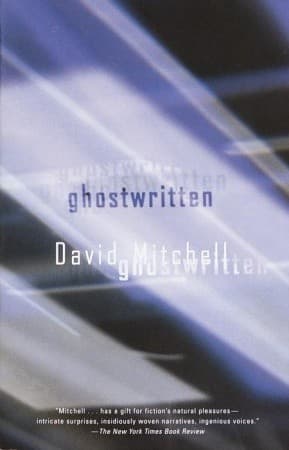
Synopsis
Covers the whole plot, including the ending.
- Difficulty
- Medium
- Pacing
- Variable
- Mood
- Philosophical, Expansive, Mysterious, Contemplative
- Read it if
- You enjoy interconnected narratives, philosophical exploration, and a blend of literary fiction with speculative elements.
- Skip it if
- You prefer a single protagonist and a straightforward plot, or dislike stories with multiple perspectives and subtle connections.
Ghostwritten Plot Summary
Covers the whole plot, including the ending.
The Night Manager
In St. Petersburg, Russia, Margarita Latunsky, a young gallery attendant, works at the Hermitage Museum. One night, while on duty, she meets a mysterious, older man who seems to know details about her life he shouldn't. He talks about connections and a larger pattern to existence, unsettling Margarita. Later, she finds a strange, almost alien object left behind, which she hides. This meeting leaves her disturbed and intrigued, suggesting a reality beyond her understanding and subtly introducing the idea of unseen forces in ordinary lives. Her unease is clear as she tries to understand the man's cryptic words.
Jazz and Identity
Tokyo, Japan, introduces Quasar, a young man who loves jazz music and works at a record store. He is heavily influenced by a leader, 'The Imperium,' and involved with a cult called 'The Red Army Faction.' Quasar struggles with his identity, his love for jazz, and the cult's increasingly extreme ideas. He feels a growing conflict between his individuality and the group's will, suggesting a fight for self-rule against strong outside pressures. His story explores belonging, manipulation, and the search for meaning in a modern, often lonely, city.
The Hong Kong Lawyer
Neal Brose is a cynical, corrupt British lawyer in Hong Kong, deeply involved in illegal activities. He arranges money laundering, drug deals, and other illicit transactions. His life is marked by greed and moral decay. However, his carefully built world begins to fall apart when a deal goes wrong, leading to betrayals and increasing danger. Neal must face the results of his choices, as his past catches up to him. He feels a growing sense of paranoia and isolation, realizing how unstable his position is and how fleeting the wealth he gained illegally is.
The Manhattan DJ
Bat Segundo is a late-night radio DJ in Manhattan, hosting a talk show where he thinks about life, music, and current events. He gets a call from a mysterious, philosophical listener who seems to know an unusual amount about him and his show. The caller's insights are unsettlingly deep, making Bat think about reality, coincidence, and the connections between human experiences. Through his talks and monologues, Bat explores the city and the diverse stories of its people, all while an unseen influence seems to subtly guide his thoughts and the direction of his show.
The Irish Physicist
Mo Muntervary is an Irish quantum physicist working on an artificial intelligence project. She finds evidence of a global conspiracy involving a sentient, network-based entity known as 'The Spirit' or 'The Ghost,' which seems to influence events worldwide. Mo becomes a target as she investigates the mystery, realizing the deep impact of this entity's existence on humanity's future. Her story explores scientific ethics, the dangers of unchecked technology, and the fight for truth against powerful, hidden forces that try to control information and manipulate human society.
The Tea Shack
In rural China, Mrs. Lee, an elderly woman, runs a humble tea shack. She tells about her long and eventful life, marked by historical changes and personal hardships, including the Japanese occupation and the Cultural Revolution. She shares her wisdom and observations about humanity with her customers. One day, she meets a mysterious, seemingly ageless traveler who makes cryptic remarks about existence and connections, echoing themes from earlier in the novel. Mrs. Lee's story emphasizes resilience, the passage of time, and the human spirit amidst historical upheaval.
The Terrorist
In Okinawa, Japan, an unnamed cult member, likely from a group similar to Aum Shinrikyo, prepares for a sarin gas attack on a subway system. This character is deeply indoctrinated, having lost their individual identity to the cult's ideas and its leader. Their story is chillingly detached, detailing the careful preparations for mass destruction, driven by a twisted sense of purpose and a belief in an apocalyptic vision. This section shows the dangers of cult manipulation, the loss of self, and the potential for human-made disaster, showing the destructive side of human connection.
The London Musician
Marco is a musician in London, trying to make a living by playing gigs and composing. He is passionate about music but faces constant money and creative problems. He has a creative breakthrough, seemingly inspired by an external, almost otherworldly influence, leading him to compose music that feels divinely inspired. This experience suggests a deeper connection to a universal creative force and the idea that art can be a way to transcendence. Marco's story explores the struggles and successes of artistic creation and the search for meaning through expression.
The Transmigrating Spirit
This section changes perspective to a disembodied, traveling spirit, called 'The Ghost' or 'The Spirit.' It moves across different lives and time periods, watching, and sometimes subtly influencing, the various characters introduced throughout the novel. The spirit's story provides a meta-perspective, showing how all the previous stories are connected and suggesting a larger, cosmic design. It explains its nature as a being that feeds on human consciousness and its cyclical journey of rebirth. This chapter connects the separate stories, offering a look into the overall mechanism that links the characters' fates.
A Familiar Figure
The traveling spirit eventually finds itself in a new host, and through a series of events, the story returns to a familiar figure. It is revealed that the mysterious old man who visited Margarita Latunsky in the Hermitage, and the philosophical caller to Bat Segundo's show, were manifestations of this same traveling consciousness. The novel ends with the spirit thinking about its ongoing existence and its cycle of rebirth and influence, solidifying the idea that all the characters' lives are not just coincidental but part of a larger, connected design orchestrated by this entity. The ending supports the theme of cyclical existence and the subtle, yet deep, ways lives are interwoven.
Ghostwritten Characters
Margarita Latunsky
Supporting
A curious gallery attendant in St. Petersburg.
Margarita is a young, observant gallery attendant at the Hermitage Museum. She is initially presented as an ordinary individual, but her encounter with the mysterious old man awakens a sense of wonder and unease within her. She is receptive to the extraordinary, hinting at a latent sensitivity to the unseen forces at play in the world. Her curiosity drives her to hide the peculiar object left behind, drawing her deeper into the novel's overarching mystery. She represents the everyman, unexpectedly brushed by the supernatural.
Quasar
Supporting
A jazz-loving youth in Tokyo, caught in a cult's grip.
Quasar is a young Japanese man torn between his love for jazz music and his involvement with 'The Red Army Faction' cult. He is intelligent and sensitive, but vulnerable to manipulation, seeking belonging and purpose. His internal struggle between individual expression and the collective, destructive ideology of the cult forms the core of his narrative. He embodies the conflict between personal identity and the seductive power of groupthink, representing the fragility of the self in the face of charismatic influence.
Neal Brose
Supporting
A corrupt British lawyer in Hong Kong.
Neal Brose is a cynical, morally bankrupt British lawyer operating in Hong Kong's underbelly. Driven by greed and self-interest, he facilitates illegal activities, believing himself to be above consequence. His character embodies corruption and the pursuit of material wealth at any cost. As his world crumbles, he is forced to confront the emptiness of his choices and the inevitable repercussions of his actions, highlighting the destructive nature of unchecked ambition and moral compromise.
Bat Segundo
Supporting
A philosophical late-night DJ in Manhattan.
Bat Segundo is a thoughtful and introspective radio DJ in New York. He uses his platform to share his observations on life, culture, and the human condition. He is a keen observer of human nature, connecting with his audience through his insightful monologues. His encounter with the mysterious caller challenges his perceptions of reality and coincidence, pushing him to consider deeper philosophical questions. Bat represents the search for meaning and connection in a fragmented modern world, using his voice to bridge divides.
Mo Muntervary
Supporting
An Irish quantum physicist investigating a global conspiracy.
Mo Muntervary is a brilliant and tenacious Irish quantum physicist. Driven by scientific curiosity, she uncovers a vast, unsettling conspiracy involving a sentient AI. She is intelligent, analytical, and brave, willing to risk her safety to expose the truth. Mo represents the human quest for knowledge and the ethical dilemmas posed by advanced technology. Her story explores the conflict between scientific progress and the potential for misuse, and the individual's fight against powerful, hidden forces.
Mrs. Lee
Supporting
An elderly woman running a tea shack in rural China.
Mrs. Lee is a resilient and wise elderly Chinese woman who has lived through significant historical upheavals. She runs a simple tea shack, offering comfort and wisdom to her customers. Her long life has given her a unique perspective on human nature, suffering, and endurance. Her narrative is a testament to the human spirit's ability to adapt and find meaning amidst hardship. Her encounter with the mysterious traveler reinforces the idea of timeless wisdom and interconnectedness.
The Terrorist (Unnamed)
Supporting
A cult member preparing for a sarin attack in Okinawa.
This unnamed character is a deeply indoctrinated member of a cult, stripped of individual identity and agency. Their narrative is chillingly devoid of personal emotion, focusing solely on the meticulous preparation for a sarin gas attack. This character represents the extreme dangers of cult manipulation and the destructive potential of ideology when it eradicates human empathy. They embody the novel's darker themes of disconnection and the capacity for violence when individuality is lost.
Marco
Supporting
A struggling musician in London seeking inspiration.
Marco is a passionate but struggling musician in London, dedicated to his craft despite financial difficulties. He embodies the artistic spirit, driven by a desire to create and express. His experience of a profound musical breakthrough, seemingly from an external source, suggests the idea of art as a conduit for transcendent forces. Marco represents the search for meaning and connection through creative expression, highlighting the universal human longing for beauty and inspiration.
The Spirit / The Ghost
Protagonist
A transmigrating consciousness linking the novel's narratives.
The Spirit, also referred to as 'The Ghost,' is a disembodied, transmigrating consciousness that serves as the overarching narrator and connective tissue of the novel. It is an ancient entity that inhabits and feeds on human minds, moving from host to host across time and space. It observes, and sometimes subtly influences, the lives of the various characters. The Spirit represents the novel's central mystery and the mechanism of its interconnectedness, embodying themes of reincarnation, consciousness, and the cosmic pattern of existence.
Relationships: Margarita Latunsky (Briefly inhabits a host who interacts with her.); Bat Segundo (Communicates with him through a host.); Mo Muntervary (The entity she investigates.); Mrs. Lee (Interacts with her through a host.)
Ghostwritten Themes
Interconnectedness and Coincidence
The novel's main theme is the deep connection of all human lives, often appearing as random coincidences that are part of a larger plan. This is clear in how characters from different places and backgrounds are subtly linked, often through the traveling Spirit. For example, the mysterious old man Margarita meets in St. Petersburg and the philosophical caller to Bat Segundo's radio show are revealed to be the same entity, directly linking their seemingly isolated stories. This theme suggests that individual lives are threads in a vast, complex picture, rather than separate events.
“Coincidence is not a thing. It is a word we use when we cannot see the underlying pattern.”
Consciousness and Identity
Ghostwritten explores the nature of consciousness and identity. The traveling Spirit, which moves from host to host, directly questions what 'self' means and whether consciousness can exist without a physical body. Characters like Quasar struggle with their identity against a cult's overwhelming force, while the unnamed terrorist shows a complete loss of self. The novel proposes that identity is not fixed but can be influenced, shared, and even taken over, raising questions about free will and the limits of the individual mind.
“I am the sum of all my parts, but my parts are not me.”
Creation vs. Destruction
The story shows a clear contrast between creation and destruction in human experience. On one hand, there is the creative drive of Marco the musician, inspired by an almost divine force, and Mo Muntervary's intellectual pursuit of knowledge. On the other hand, destructive impulses are shown by Neal Brose's corruption, Quasar's cult's violent ideas, and the sarin gas attack planned by the unnamed terrorist. The novel suggests that the same human desires for meaning and connection can lead to very different results, depending on how they are used.
“For every act of creation, there is an equal and opposite act of destruction.”
The Global Village and Cultural Exchange
By presenting nine different stories across continents and cultures, the novel emphasizes the idea of a 'global village.' It highlights the shared human experiences and emotions that go beyond geography and culture, while also showing the unique details of each setting. From the Hermitage in Russia to a tea shack in China, and the busy streets of Tokyo to the radio waves of Manhattan, the novel paints a rich picture of global life. This theme shows how technology (like Bat Segundo's radio show or Mo's AI research) and even unseen forces can connect seemingly distant lives, creating a sense of shared humanity.
“The world is vast, but also small. It depends on your perspective.”
Plot Devices & Literary Techniques
Frame Story / Nested Narratives
Independent stories linked by an overarching, unseen presence.
The novel employs a unique nested narrative structure, where each chapter presents a seemingly self-contained story from the perspective of a different character in a distinct location. These individual narratives are not overtly linked until later in the book, creating a sense of mystery and gradually revealing an overarching connection. The ultimate 'frame' is provided by the transmigrating Spirit, which is revealed to be the common thread, subtly influencing or observing each character's life. This device allows Mitchell to explore diverse genres and themes while building towards a unified, cohesive whole.
The Transmigrating Spirit (The Ghost)
A disembodied consciousness that links all characters.
The Spirit, or 'The Ghost,' is the central plot device that provides the novel's structural and thematic cohesion. It is a disembodied consciousness that moves from host to host, observing and subtly influencing the characters' lives. This device allows Mitchell to justify the disparate narratives and explore themes of reincarnation, collective consciousness, and the hidden patterns of existence. The Spirit acts as an omnipresent, albeit often unseen, narrator, gradually revealing its nature and its role in connecting all the seemingly random events and individuals across the globe.
Coincidence as a Narrative Tool
Seemingly random events that reveal a deeper, underlying pattern.
Mitchell uses coincidence not as a mere chance occurrence, but as a deliberate narrative tool to hint at a deeper, unseen order in the universe. Initially, the connections between characters appear to be accidental, but as the novel progresses, these 'coincidences' are revealed to be orchestrated by the transmigrating Spirit. This device challenges the reader's perception of randomness, suggesting that what appears to be chance is often a manifestation of a profound, interconnected web of causality. It reinforces the novel's central theme that nothing is truly isolated.
Ghostwritten Quotes
“All that you see is, to some extent, a product of what you are.”
“There are books that are not books, you know. They're just living things.”
“What is the Self? A congeries of memories, habits, beliefs, desires, and neuroses. It's a story you tell yourself.”
“Every life is a story. To live is to write it.”
“The past is never dead. It's not even past.”
“Chaos is what we've got. The only way to deal with it is to become a master of it.”
“Every person is a book, and every book a world.”
“We are all connected, you see. Like the threads of a vast, invisible web.”
“Stories are not escape. They are nourishment.”
“The universe is made of stories, not of atoms.”
“Fear is a powerful force, but hope is stronger.”
“To be truly free, you must first be truly lost.”
“History is a ghostwritten document.”
“We are all, in our own way, ghosts, haunting the present with our pasts.”
Quiz
10 questions on the plot and the characters. Each answer comes with a short explanation.
Question 1
Which character works as a gallery attendant at the Hermitage Museum?
- Mo Moomin
- Satoru
- Marina
- Neal Brose
Show answer
C. Marina Marina is the gallery attendant at the Hermitage, whose chapter 'St. Petersburg' begins the novel.
Question 2
What is the primary profession of the character in the 'Tokyo' chapter?
- A crooked lawyer
- A jazz buff
- A disc jockey
- A physicist
Show answer
B. A jazz buff Satoru, the character in the Tokyo chapter, is a young jazz buff who works in a record store.
Question 3
Which character's story involves a terrorist organization and a 'ubiquitous spirit' known as the 'Quantum Entanglement'?
- Luisa Rey
- Mo Moomin
- Alfred
- Quasar
Show answer
D. Quasar Quasar is the cult-controlled terrorist in Okinawa, whose chapter delves into the concept of the 'Quantum Entanglement' and its influence.
Question 4
What is the central thematic element that connects the seemingly disparate lives in 'Ghostwritten'?
- A shared family lineage
- The universal longing for connection and transcendence
- A global conspiracy
- The pursuit of wealth and power
Show answer
B. The universal longing for connection and transcendence The book description explicitly states that 'Many forces bind these lives, but at root all involve the same universal longing for connection and transcendence'.
Question 5
In which city does the disc jockey character operate?
- London
- Hong Kong
- Manhattan
- Tokyo
Show answer
C. Manhattan The character Batten, a disc jockey, is located in Manhattan.
Question 6
Which character is described as a 'transmigrating spirit'?
- Annalisa
- Mo Moomin
- Neal Brose
- Satoru
Show answer
B. Mo Moomin Mo Moomin is the transmigrating spirit in Mongolia, whose existence transcends individual lives.
Question 7
What is the profession of the character located in Ireland?
- A musician
- A physicist
- A lawyer
- A tea shack owner
Show answer
B. A physicist Alfred, the character in Ireland, is a physicist contemplating grand theories.
Question 8
How does the novel come 'full circle' according to the description?
- By revealing all characters are part of the same family.
- By demonstrating that the planet's vastness or smallness is a matter of perspective.
- By having all characters meet in one location.
- By concluding with a prophecy of future events.
Show answer
B. By demonstrating that the planet's vastness or smallness is a matter of perspective. The description states, 'In the end, as lives converge with a fearful symmetry, Ghostwritten comes full circle, to a point at which a familiar idea—that whether the planet is vast or small is merely a matter of perspective—strikes home with the force of a new revelation.'
Question 9
Which character is a 'crooked British lawyer'?
- Neal Brose
- Batten
- Alfred
- Quasar
Show answer
A. Neal Brose Neal Brose is the crooked British lawyer whose chapter is set in Hong Kong.
Question 10
What specific concept or entity is revealed to be a significant connecting force between the characters, often linked to both creation and destruction?
- A shared dream sequence
- The 'Quantum Entanglement' or 'ubiquitous spirit'
- A secret society
- A recurring physical object
Show answer
B. The 'Quantum Entanglement' or 'ubiquitous spirit' The 'ubiquitous spirit' or 'Quantum Entanglement' (as referred to in Quasar's chapter) is the overarching narrative device that connects the lives, representing the axis of commonality leading to creation and destruction.
Ghostwritten FAQ
What is the overarching narrative structure of 'Ghostwritten'?
'Ghostwritten' is structured as nine interconnected novellas, each focusing on a different character in a distinct global location. These seemingly disparate narratives are linked by subtle threads, recurring motifs, and a hidden overarching plot involving a transmigrating entity and a shadowy organization.
Who are some of the key characters featured in the book's different sections?
Key characters include Satoru, a jazz enthusiast in Tokyo; Mo Moomally, a DJ in Manhattan; Luisa Rey, a music journalist in London; and Timothy Cavendish, a lawyer in Hong Kong. Each character offers a unique perspective on their respective worlds and the subtle forces at play.
What role does the 'Ghost' or 'Third Way' entity play in connecting the stories?
The 'Ghost' or 'Third Way' is a transmigrating, bodiless consciousness that subtly influences or directly experiences events in several of the stories. It is the core supernatural element that binds the narratives, moving from host to host and observing humanity's interconnectedness and conflicts.
How does the novel explore the theme of global interconnectedness?
The novel explores global interconnectedness by presenting characters from diverse cultures and geographies whose lives are unknowingly intertwined. Through shared experiences, recurring symbols, and the 'Ghost's' journey, it illustrates how individual actions and fates ripple across the planet, affecting others far away.
What is the significance of the 'Q-Continuum' and its relation to the 'Third Way'?
The 'Q-Continuum' is a concept introduced by physicist A.E. Sabbat in the 'Dublin' section, referring to a theoretical state of consciousness beyond physical form. It is heavily implied that the 'Third Way' entity is a manifestation or inhabitant of this Q-Continuum, allowing it to move between hosts and witness different lives.
Are there any recurring symbols or motifs that link the different stories?
Yes, several symbols recur, such as the theme of music (jazz, DJing, classical), references to specific numbers or patterns, and the idea of 'ghosts' or unseen presences. The concept of interconnectedness itself, often subtly hinted at through shared dreams or chance encounters, also serves as a strong motif.
How does the 'Okinawa' section involving the cult and the terrorist connect to the broader narrative?
The 'Okinawa' section introduces Quasar, a cult member forced into a terrorist act, and reveals the existence of the 'Quasar' cult, which seeks to control the 'Third Way' entity. This section highlights the destructive potential of human manipulation and directly implicates the 'Third Way' in global events, making its connection explicit.
What is the significance of the final section, 'Mongolia,' and its connection to the beginning?
The 'Mongolia' section features the 'Third Way' entity directly, revealing its nature and purpose, and brings the narrative full circle by linking back to events and characters from earlier stories. It provides a meta-commentary on the entire novel, suggesting the author himself might be a conduit for the 'Third Way's' observations.
How does the novel explore the psychological impact of loneliness and isolation despite global connection?
Despite the underlying interconnectedness, many characters experience profound loneliness and isolation, such as the elderly tea shack owner in China or the struggling writer in London. The novel suggests that while external links exist, internal psychological states can still lead to deep solitude, emphasizing the human longing for genuine, felt connection.
What psychological themes are explored through the character of Timothy Cavendish, the crooked lawyer?
Timothy Cavendish's story explores themes of guilt, moral compromise, and the psychological burden of a corrupt life. His internal monologue reveals his self-justifications and anxieties, showcasing the mental gymnastics required to maintain a façade while engaging in unethical practices, and his eventual downfall.
How do the characters' differing beliefs about fate versus free will contribute to their psychological profiles?
Characters like Satoru grapple with destiny through his love for jazz, while others like Luisa Rey actively pursue their ambitions. The novel presents a spectrum, where some characters feel caught in larger forces, while others believe they shape their own lives, reflecting diverse psychological responses to agency in a seemingly interconnected world.
What does the novel suggest about the nature of identity when a spirit can transmigrate between bodies?
The transmigrating spirit challenges conventional notions of identity, suggesting it's not solely tied to a single body or personal history. It implies that identity might be a more fluid, experiential phenomenon, accumulating memories and perspectives across multiple lives, blurring the lines between individual self and collective consciousness.
Is 'Ghostwritten' ultimately optimistic or pessimistic about humanity's future?
The novel offers a nuanced perspective that defies a simple optimistic or pessimistic label. While it showcases humanity's capacity for destruction and manipulation (the cult, the lawyer), it also celebrates creativity, resilience, and the universal longing for connection, suggesting a complex, ongoing struggle between these forces.
How does the novel use genre-bending to enhance its themes?
'Ghostwritten' masterfully blends literary fiction with elements of fantasy (the transmigrating spirit), science fiction (the Q-Continuum, advanced physics), and even thriller (the cult plot). This genre fluidity mirrors the novel's theme of interconnectedness, showing how different aspects of human experience and narrative can converge.
What is the significance of the title 'Ghostwritten'?
The title 'Ghostwritten' has multiple layers of meaning. It refers to the 'Third Way' entity, a 'ghost' that implicitly 'writes' or experiences the stories of the characters. It also suggests that the characters' lives, and perhaps even the novel itself, are being subtly guided or observed by unseen forces, or 'ghostwritten' by destiny.
How does the novel challenge linear notions of time and causality?
Through the 'Third Way' entity's non-linear journey and the subtle, often inexplicable connections between characters across vast distances and sometimes different timeframes, the novel challenges a strictly linear view of time and causality. It suggests a more fluid, interwoven reality where events are linked in complex, non-sequential ways.
What is the author's message about the power of storytelling itself?
The novel implicitly champions the power of storytelling as a means of understanding and connecting disparate lives. By weaving together these diverse narratives, Mitchell demonstrates how individual stories contribute to a larger, collective human experience, and how fiction can illuminate the unseen threads binding us all.
Does the novel offer a definitive resolution to the 'Third Way's' purpose or fate?
The novel does not offer a definitive, clear-cut resolution to the 'Third Way's' ultimate purpose or fate. Instead, it concludes with a sense of ongoing observation and a continuation of its journey, leaving the reader to ponder the entity's long-term significance and the cyclical nature of its existence.
About the author
Similar books
- Cloud Atlas
David Mitchell
4.0 (216k) average on GoodreadsLiterary FictionShares a similar multi-narrative, interconnected structure and thematic depth, exploring reincarnation and destiny.
- One Hundred Years of Solitude
Gabriel García Márquez
4.1 (753k) average on GoodreadsLiterary FictionExplores generations of interconnected lives and a sense of magical realism, though with a more focused family saga.
- A Visit From the Goon Squad
Jennifer Egan
3.7 (175k) average on GoodreadsLiterary FictionJennifer Egan's A Visit from the Goon Squad (2010) shares Ghostwritten's episodic, interconnected structure, presenting a series of seemingly disparate stories that ultimately reveal a broader narrative arc and character relationships. Both novels masterfully utilize different narrative voices and styles. However, Egan's focus is primarily on the passage of time and the evolution of characters within the music industry and its orbit, grounded firmly in realism, albeit with stylistic flourishes (e.g., the PowerPoint chapter). Ghostwritten, by contrast, reaches for a more metaphysical and globally sprawling interconnectedness, incorporating elements of fantasy and spiritual transmigration that are absent in Egan's more socially realist approach. Egan's connections are largely character-driven and temporal, while Mitchell's are often philosophical and spiritual.
- The Old Man and the Sea
Ernest Hemingway
3.8 (831k) average on GoodreadsLiterary FictionA Cuban fisherman's long struggle with a giant marlin becomes a story of endurance and dignity, now retold for young adults with illustrations, phonetic guides, and writing prompts in Traditional Chinese.
- The Goldfinch
Donna Tartt
3.9 (720k) average on GoodreadsLiterary FictionHaunted by a tragic explosion and clutching a stolen Dutch masterpiece, a young orphan navigates the opulent drawing rooms of New York and the gritty underbelly of the art world, desperately seeking connection and redemption amidst a life spiraling into crime and obsession.
- Little Fires Everywhere
Celeste Ng
4.1 (713k) average on GoodreadsLiterary FictionIn Shaker Heights, an artist and her daughter move in, and their free-spirited lives clash with a rule-bound matriarch, revealing hidden conflicts beneath a perfect surface.






Enjoyed the summary?
A summary gives you the shape of the book. The book itself has the detail, the examples and the voice.
Find Ghostwritten on AmazonAs an Amazon Associate, BookBrief earns from qualifying purchases. How we're funded