

Core Idea
- Difficulty
- Medium
- Read it if
- You are seeking spiritual solace, appreciate poetic expression of devotion, or wish to explore an Eastern perspective on the divine and human existence.
- Skip it if
- You prefer empirical non-fiction, are looking for a linear philosophical argument, or dislike highly metaphorical and lyrical prose.
Key Takeaways from Gitanjali
The Divine in the Mundane
Finding God not in temples, but in the everyday labor and simple beauty of the world.
Tagore redefines where the sacred is found. He questions traditional, institutionalized forms of worship that often separate the devotee from the world. For Tagore, the divine is not limited to sacred places or rituals but is present in the real world of human existence—in the farmer's work, the road-maker's path, and the simple beauty of nature. This view encourages a deep engagement with life, suggesting that true spiritual understanding comes from active participation in the world rather than retreating from it. It calls us to see the divine in our daily lives and interactions, turning ordinary moments into chances for spiritual connection.
“Leave this chanting and singing and telling of beads! Whom dost thou worship in this lonely dark corner of a temple with doors all shut? Open thine eyes and see thy God is not before thee!”
In the book: Poems like 'Leave this chanting and singing and telling of beads!' directly illustrate this, depicting God not in the temple but 'where the tiller is tilling the hard ground and where the pathmaker is breaking stones.'
Try this: Consciously seek moments of divine presence in daily activities: while working, walking in nature, or engaging in simple acts of service. Reframe mundane tasks as opportunities for spiritual connection, recognizing the sacred in the ordinary.
Related ideas: immanence, sacred-profane, devotion-in-action
Love as the Ultimate Path
Spiritual enlightenment is not achieved through asceticism or intellect, but through selfless love and devotion.
Tagore champions love, specifically a very personal, almost romantic, devotion to the divine, as the most direct and powerful way to spiritual union. He avoids intellectual show-offs, strict dogma, and flashy displays of piety, seeing them as obstacles to true connection. Instead, he advocates for a simple, heartfelt surrender, where the ego's demands and external decorations are removed to allow for a direct relationship with the beloved God. This love is not just an emotion but an active state of being, filling every part of life and turning the individual into a channel for divine expression. It is a strong affirmation of the heart over the mind in the spiritual search.
“My song has put off her adornments. She has no pride of dress and decoration. Ornaments would mar our union; they would come between thee and me; and their jingling would drown thy whispers.”
In the book: Numerous poems express a longing for union with the divine beloved, using metaphors of human love and separation. For instance, the 'song' putting off adornments symbolizes shedding ego and superficiality for true communion.
Try this: Cultivate a practice of selfless love and devotion in your relationships and daily life. Approach challenges with an open heart, seeking to understand and connect rather than to dominate or intellectualize. Practice gratitude and compassion as expressions of this love.
Related ideas: bhakti-yoga, divine-love, surrender
The Melody of Life and Death
Embracing both life and death as integral, harmonious parts of a continuous divine symphony.
Tagore presents a complete view of existence where life and death are not opposing forces but two inseparable movements within a larger cosmic dance. He sees death not as an end but as a change, a shedding of the old to make way for the new, like a constantly refilled container. This view removes the fear of death and instead invites acceptance of impermanence as a natural and beautiful part of the divine plan. It highlights the cyclical nature of being, where every ending holds the seed of a new beginning, creating a sense of peace and continuity in the face of change. This allows for a deeper appreciation of life's temporary beauty.
“Thou hast made me endless, such is thy pleasure. This frail vessel thou emptiest again and again, and fillest it ever with fresh life.”
In the book: The imagery of the 'frail vessel' being emptied and refilled, and the longing for the 'last release' not as an end but a reunion, consistently points to this integrated understanding of life and death.
Try this: Practice mindfulness of impermanence. Reflect on the cyclical nature of life (seasons, growth, decay). When facing endings, try to see them as opportunities for new beginnings. Cultivate gratitude for the present moment, understanding its fleeting beauty.
Related ideas: impermanence, cyclical-time, existential-acceptance
Freedom Through Self-Surrender
True liberation is found not in asserting the ego, but in lovingly surrendering it to the divine will.
Contrary to modern ideas of self-assertion, Tagore suggests that ultimate freedom comes from a deep act of self-surrender to a higher power. He sees the ego, with its endless desires and attachments, as the main source of suffering and bondage. By letting go of the need for control and trusting the divine, one can go beyond the limits of the individual self and experience a vast sense of peace and liberation. This surrender is not a sign of weakness but an act of great strength and faith, aligning one's personal will with the universal flow. It is a paradox where losing the self leads to finding a greater, more expansive self.
“My desires are many and my cry is pitiful, but thou comest to save, and I am saved. Thou art ever ready to take me in thy arms, and I am saved.”
In the book: The frequent plea for the 'chains of desire' to be broken, or the 'ego' to be dissolved, signifies this quest for freedom through surrender. The image of being 'saved' by the divine, despite one's own limitations, reinforces this.
Try this: Identify areas where you cling tightly to control. Practice letting go of small desires and outcomes, trusting in a larger process. Engage in meditative practices that encourage the dissolution of the ego, such as selfless service or prayer.
Related ideas: ego-dissolution, divine-will, liberation
Silence and Song
The deepest spiritual truths are found in the stillness beyond words, yet expressed through the beauty of art and poetry.
Tagore skillfully handles the paradox of expressing the inexpressible. He acknowledges that ultimate truth often exists beyond language, in the deep silence of the soul. Yet, he dedicates his life to voicing these truths through his beautiful poetry. This highlights the role of art, music, and poetry as ways to experience spirituality, able to hint at the divine where direct description fails. The 'song' becomes a metaphor for the soul's yearning and its attempt to bridge the gap between human experience and divine reality, even when words feel insufficient. It is an affirmation of art as a spiritual practice itself.
“My heart longs to join in thy song, but my voice is dead, and my words are without wings. Oh, that my heart could break its silence and soar like a bird into the sky!”
In the book: The entire collection is a testament to this, with Tagore constantly reaching for words to describe his spiritual longing and connection, even while acknowledging the limitations of language. The recurring motif of the 'song' (Gitanjali literally means 'Song Offerings') underscores this.
Try this: Engage in creative expression (writing, music, art) as a form of spiritual practice, allowing intuition and emotion to guide you. Also, cultivate moments of silence and contemplation to access deeper insights that lie beyond verbal thought.
Related ideas: mysticism, art-as-devotion, ineffable
The Gift of Emptiness
True receiving requires creating space within oneself, emptying the ego to be filled by the divine.
Tagore's frequent use of the 'vessel' metaphor emphasizes a deep spiritual principle: to receive much, one must first be empty. This 'emptying' is not a deprivation but a necessary clearing of the self—of ego, fixed ideas, desires, and attachments—to create space for the divine to enter and fill. It suggests an active, conscious process of letting go, making oneself receptive rather than striving. This concept challenges the acquisitive nature of human desire, proposing that true fulfillment comes from a state of humble receptivity rather than endless pursuit. It is a call to cultivate inner spaciousness.
“This frail vessel thou emptiest again and again, and fillest it ever with fresh life.”
In the book: The constant emptying and refilling of the vessel is a central image, signifying the need for renewal and the divine's continuous giving once space is made. The speaker often expresses a desire to be 'made pure' or 'empty' for God's touch.
Try this: Practice intentional 'emptying' in your life: declutter physical spaces, clear mental clutter through meditation, or release old beliefs. Approach new experiences with an open mind, ready to be filled, rather than with rigid expectations.
Related ideas: kenosis, receptivity, detachment
Joy in Suffering
Even sorrow and pain are gifts, serving as catalysts for deeper spiritual understanding and union.
Tagore offers a different view of suffering, seeing it not as an obstacle to joy but as an inherent part of the spiritual journey. He suggests that pain, struggle, and even moments of separation from the divine beloved are not punishments, but serve to deepen longing, refine the soul, and ultimately lead to a deeper and more appreciative union. Like a child on a difficult journey to its mother, the 'pain' is overshadowed by the anticipation of reunion. This viewpoint encourages resilience and finding meaning even in hardship, understanding that life's challenges can create a greater capacity for love and spiritual depth. It is a full acceptance of life's entire spectrum.
“The child who is going to meet his mother is glad of the journey, even though he has to cross a difficult path. The bride who is going to meet her beloved is glad of the journey, even though she has to cross a difficult path.”
In the book: The 'difficult path' imagery, or the speaker's yearning during moments of perceived divine absence, illustrates how these challenges intensify the desire for reunion and ultimately lead to greater spiritual insight.
Try this: When facing difficulties, try to view them as opportunities for growth and deepening your spiritual connection. Practice gratitude for the lessons learned through hardship. Cultivate resilience by focusing on the ultimate goal or meaning behind your struggles.
Related ideas: suffering-as-grace, spiritual-alchemy, divine-purpose-in-pain
The Weaver of Destiny
Acknowledging a divine hand in the unfolding of life, even in the seemingly random or painful.
Tagore often refers to an overarching divine intelligence that guides life's events, a 'weaver' of destiny. While acknowledging human choice and the self-imposed 'nets' of desire, he also points to a larger, benevolent force at work. This perspective offers comfort and a sense of purpose, suggesting that even misfortunes or delays are part of a grander design, guiding the individual toward ultimate union with the divine. It encourages trust in this cosmic process, even when the immediate path seems unclear or difficult. This is not passive fatalism, but an active faith in a benevolent, guiding presence.
“He whom I enclose with my name is weeping in this dungeon. I am ever busy in weaving the net of my desires, and it is my net that holds me fast.”
In the book: The speaker often attributes both blessings and challenges to the 'hand' of the divine. The imagery of the 'net of desires' that traps the self, but also the eventual 'release' by the divine, points to this interplay between human action and divine orchestration.
Try this: Cultivate faith in a larger, benevolent order. When faced with setbacks, pause to consider what lessons might be unfolding, rather than solely focusing on personal failure. Practice surrendering control over outcomes, trusting in a greater plan.
Related ideas: providence, fate-vs-free-will, divine-plan
The Eternal Playmate
Approaching the divine with the joyful innocence and playful abandon of a child.
Tagore's relationship with the divine often has a charming intimacy and playfulness, similar to a child's interaction with a beloved parent or friend. This approach contrasts sharply with more severe or fear-based spiritual traditions. He sees God not as a distant, judging figure, but as an 'eternal playmate' with whom he shares a deep, joyful connection. This view brings lightness and wonder into the spiritual journey, emphasizing delight, curiosity, and an open heart over strict adherence to rules. It suggests that spiritual growth can be an adventure, full of discovery and simple, pure joy.
“When I go from hence, let this be my parting word, that what I have seen is unsurpassable. I have tasted of the hidden honey of this lotus that expands on the ocean of light, and so am I blessed—let this be my parting word.”
In the book: The frequent expression of joy and wonder at the divine's creations, and the intimate, informal tone of address to God ('my King,' 'my Lord,' 'my beloved'), reflects this playful and deeply personal relationship.
Try this: Cultivate a sense of childlike wonder and curiosity in your spiritual exploration. Approach prayer or meditation with an attitude of joyful anticipation rather than solemn duty. Find delight in the simple beauties of life as reflections of the divine 'play.'
Related ideas: divine-child, spiritual-joy, bhakti-marga
The Song of the Soul
Life itself is a continuous offering, a song of the soul yearning for and expressing the divine.
The title, 'Gitanjali,' meaning 'Song Offerings,' captures this main idea: life is a continuous, unfolding song of the soul, offered to the divine. Every experience, emotion, and moment of existence is a verse in this ongoing melody, an expression of the soul's yearning and its eventual union. Tagore sees his poetry not just as words, but as direct offerings, a spiritual act in itself. This perspective elevates daily life into a sacred performance, where every breath, every action, and every feeling contributes to a grand symphony directed toward the divine beloved. It is a complete view where spirituality fills every aspect of being, making life an extended act of worship and creative expression.
“My song has come to its end, and the singer is silent. The light of the sun is on my face, and the dew of the morning is on my forehead.”
In the book: The entire collection, structured as a series of 'songs,' exemplifies this. The recurring motif of the 'song' as a medium for communication with God, and the desire for his 'life's music' to be heard by the divine, are central.
Try this: View your own life as a unique 'song' or offering. Infuse intention and mindfulness into your daily activities, recognizing them as expressions of your deepest self. Find ways to creatively express your spiritual journey and gratitude.
Related ideas: life-as-worship, creative-spirituality, divine-expression
Gitanjali Quotes
“Thou hast made me endless, such is thy pleasure. This frail vessel thou emptiest again and again, and fillest it ever with fresh life.”
“The song that I came to sing remains unsung to this day. I have spent my days in stringing and unstringing my instrument.”
“Let all my senses burn in a flame of worship, and all my thoughts fly in a song of praise.”
“Where the mind is without fear and the head is held high, where knowledge is free...”
“My Lord, I know that I can never find You in the market-place, nor in the temple of the rich, nor in the solitary cell of the hermit.”
“Death, thy servant, is at my door. He has crossed the unknown sea and brought thy call to my home.”
“I came to your shore as a stranger, I lived in your house as a guest, I leave your door as a friend, for I have known you, my world.”
“The child who is born in the house is not a stranger, but a familiar guest.”
“The morning will come, the darkness will vanish, and thy voice will pour down in golden streams.”
“Deliverance is not for me in renunciation. I feel the embrace of freedom in a thousand bonds of delight.”
“I have no sleep tonight. The time has come for my voyage, and I am to launch my boat.”
“He whom I enclose with my name is weeping in this dungeon. I am ever busy building this wall all around myself.”
“My heart, the bird of the wilderness, has found its sky in your eyes.”
“Light, oh where is the light? Kindle it with the burning fire of desire!”
Quiz
10 questions on the main ideas. Each answer comes with a short explanation.
Question 1
In Poem 1 of 'Gitanjali', Tagore writes, 'Thou hast made me endless, such is thy pleasure.' What concept does 'endless' primarily refer to in this context?
- The speaker's material wealth
- The eternal nature of the soul and divine connection
- The vastness of the physical universe
- The unending cycle of reincarnation
Show answer
B. The eternal nature of the soul and divine connection In Poem 1, 'endless' refers to the soul's immortality and its continuous connection with the divine, a core theme of Gitanjali.
Question 2
Which of the following best describes the 'King' or 'Lord' addressed throughout 'Gitanjali'?
- An earthly monarch to whom Tagore dedicates his poems
- A specific deity from the Hindu pantheon
- The universal, immanent, and transcendent Divine
- The collective consciousness of humanity
Show answer
C. The universal, immanent, and transcendent Divine The 'King' or 'Lord' in Gitanjali represents the universal, all-encompassing divine presence, not a specific human ruler or a singular deity.
Question 3
In Poem 35, 'Where the mind is without fear,' what does Tagore advocate for a nation to achieve true freedom?
- Economic prosperity and military strength
- Intellectual freedom, truthfulness, and progressive thought
- Strict adherence to traditional customs and beliefs
- Isolation from other cultures and nations
Show answer
B. Intellectual freedom, truthfulness, and progressive thought Poem 35 is a prayer for a nation where people are free from fear, prejudice, and narrow-mindedness, emphasizing intellectual and moral freedom.
Question 4
Tagore frequently uses imagery of music and song in 'Gitanjali'. What does the speaker's 'song' often symbolize?
- A literal musical performance
- The expression of the soul's devotion and longing for the divine
- A political protest against colonial rule
- A lament for lost love
Show answer
B. The expression of the soul's devotion and longing for the divine The 'song' in Gitanjali is a metaphor for the poet's spiritual expression, his prayers, praises, and his soul's yearning for union with the Divine.
Question 5
In several poems, Tagore describes the 'dust' or 'earth' as significant. What spiritual meaning does this often convey?
- The insignificance of human existence
- The physical body as a temporary vessel and its humility before the divine
- A source of agricultural wealth
- The corruption of worldly affairs
Show answer
B. The physical body as a temporary vessel and its humility before the divine The 'dust' or 'earth' often signifies humility, the transient nature of the physical body, and the idea that even in the mundane, the divine can be found.
Question 6
Tagore's 'Gitanjali' was originally written in Bengali. Who primarily translated it into English, leading to his Nobel Prize in Literature?
- W. B. Yeats
- Ezra Pound
- Rabindranath Tagore himself
- Mahatma Gandhi
Show answer
C. Rabindranath Tagore himself Tagore himself translated his Bengali poems into English prose, a collection that W. B. Yeats championed and wrote an introduction for, leading to international recognition.
Question 7
The concept of 'renunciation' appears in Gitanjali. How does Tagore typically portray renunciation in the context of spiritual devotion?
- As a complete withdrawal from all worldly duties and relationships
- As a detachment from the fruits of action, performing duties without selfish desire
- As an act of self-punishment to achieve spiritual purity
- As a rejection of all material possessions and living in poverty
Show answer
B. As a detachment from the fruits of action, performing duties without selfish desire Tagore's view of renunciation is often aligned with Karma Yoga, where one performs actions and fulfills duties in the world but without attachment to outcomes, dedicating them to the divine.
Question 8
In Poem 13, Tagore writes, 'I know not how thou singest, my master! I ever listen in silent amazement.' This reflects a common theme of the speaker's relationship with the divine. What is it?
- A relationship based on intellectual debate and questioning
- A master-disciple relationship characterized by awe, humility, and surrender
- A relationship of equals sharing artistic pursuits
- A distant and impersonal connection
Show answer
B. A master-disciple relationship characterized by awe, humility, and surrender The speaker frequently adopts a posture of humility and wonder before the divine, acknowledging the incomprehensible greatness of God and his own smallness.
Question 9
How does 'Gitanjali' generally approach the concept of suffering and sorrow?
- As an inescapable evil to be avoided at all costs
- As a divine test or a path that can lead to deeper spiritual realization and closer union with God
- As a result of past karmic deeds that must be endured passively
- As an illusion to be transcended through meditation
Show answer
B. As a divine test or a path that can lead to deeper spiritual realization and closer union with God Tagore often portrays suffering not as purely negative, but as a potential catalyst for spiritual growth, a means by which the soul is purified and drawn closer to the divine.
Question 10
In 'Gitanjali', the divine is often depicted as intimately involved in the everyday world. Which of the following best exemplifies this 'immanent' aspect of God?
- God residing solely in distant heavens, detached from human affairs
- God being found in the simple acts of daily life, labor, and nature
- God appearing only in grand miracles and supernatural events
- God communicated through complex philosophical treatises only
Show answer
B. God being found in the simple acts of daily life, labor, and nature A key theme in Gitanjali is the immanence of the divine – God is not just transcendent but also present in the ordinary, the humble, and the natural world, in the work of human hands and the beauty of creation.
Gitanjali FAQ
What is the central theme of Rabindranath Tagore's Gitanjali?
Gitanjali, meaning 'Song Offerings,' primarily explores themes of devotion, the divine, the beauty of nature, and the human soul's longing for union with God. It reflects a deeply personal spiritual journey expressed through lyrical poetry.
Does Gitanjali promote any specific religion or spiritual practice?
While deeply rooted in Hindu philosophical traditions, Gitanjali's spirituality is universal and transcends specific religious dogma. Tagore emphasizes a personal, experiential relationship with the divine, appealing to readers of various faiths.
What is the significance of the Nobel Prize in Literature for Gitanjali?
Rabindranath Tagore was awarded the Nobel Prize in Literature in 1913 primarily for the English translation of Gitanjali, which brought his profound spiritual and poetic genius to a global audience. It marked the first Nobel Prize for a non-European writer.
What is the concept of 'devotion' as depicted in Gitanjali?
In Gitanjali, devotion is portrayed not as ritualistic practice but as a heartfelt yearning and surrender to the divine, often personified as a beloved friend or master. It's a journey of self-discovery and humble offering of one's life experiences.
How does Gitanjali differ from other devotional poetry collections?
Gitanjali stands out for its unique blend of mystical introspection, profound philosophical depth, and accessible lyrical beauty. Unlike some devotional works, it avoids rigid doctrine, focusing instead on the universal human experience of seeking transcendence through nature and personal faith.
Does the English translation of Gitanjali accurately convey the original Bengali?
Tagore himself translated many of the poems into English, creating what is essentially a new work that captures the essence and spirit of the original Bengali while adapting it for an English-speaking audience. While not a literal word-for-word translation, it retains his poetic voice and spiritual message.
What kind of language and imagery can I expect in Gitanjali?
Gitanjali is characterized by its simple yet profound language, rich with natural imagery such as rivers, flowers, dawn, and dusk, symbolizing spiritual truths. Tagore uses metaphors and parables to convey complex philosophical ideas in an accessible and evocative manner.
How can Gitanjali be relevant to a modern reader?
Gitanjali's timeless themes of inner peace, connection to nature, the search for meaning, and the beauty of human experience continue to resonate. Its message of spiritual awakening and finding joy in simplicity offers solace and inspiration in the complexities of modern life.
About the author
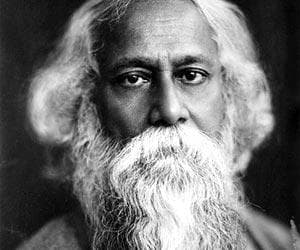
Rabindranath Tagore was a Bengali poet, writer, playwright, composer, philosopher, social reformer and painter. He reshaped Bengali literature and music as well as Indian art with Contextual Modernism in the late 19th and early 20th centuries. Author of the "profoundly sensitive, fresh and beautiful" poetry of Gitanjali, he became in 1913 the first non-European and the first lyricist to win the Nobel Prize in Literature. Tagore's poetic songs were viewed as spiritual and mercurial; however, his "elegant prose and magical poetry" remain largely unknown outside Bengal. He was a fellow of the Royal Asiatic Society. Referred to as "the Bard of Bengal", Tagore was known by sobriquets: Gurudeb, Kobiguru, Biswokobi.
Similar books
- The Prophet
Kahlil Gibran
4.2 (235k) average on GoodreadsSpiritualityBoth offer poetic meditations on life, love, death, and spirituality with a lyrical, philosophical tone.
- Leaves of Grass
Walt Whitman
4.1 (90k) average on GoodreadsPhilosophyShares a similar expansive, spiritual, and deeply personal engagement with the divine within nature and humanity.
- Eat, Pray, Love
Elizabeth Gilbert
3.6 (1.5M) average on GoodreadsLifestyleA heartbroken writer leaves her conventional life for a year-long global search for pleasure in Italy, spiritual devotion in India, and unexpected love and balance in Bali.
- Educated
Tara Westover
4.5 (796k) average on GoodreadsBiographyRaised in the Idaho mountains by fundamentalist survivalists, a young woman forges her own path to education, battling fierce family loyalty and personal demons to discover a world beyond her isolated upbringing.
- The Poisonwood Bible
Barbara Kingsolver
4.1 (659k) average on GoodreadsLiterary FictionA zealous missionary's rigid faith clashes with the Belgian Congo's wilderness and people, unraveling his family through the eyes of his five unforgettable women.
- Siddhartha
Hermann Hesse
4.0 (583k) average on GoodreadsHistorical FictionSiddhartha leaves a life of privilege and piety, embracing asceticism, wealth, and love to find enlightenment not in dogma, but in the whispers of a river and the unity of all existence.






Enjoyed the summary?
A summary gives you the shape of the book. The book itself has the detail, the examples and the voice.
Find Gitanjali on AmazonAs an Amazon Associate, BookBrief earns from qualifying purchases. How we're funded