
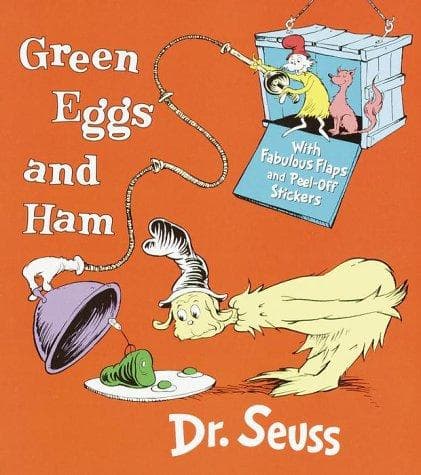
Core Idea
- Difficulty
- Easy
- Read it if
- You appreciate a story that humorously illustrates the importance of not giving up, the benefits of trying new things, and how context can sway opinions. It's also great for understanding how a simple, repeated request can eventually lead to a breakthrough.
- Skip it if
- You dislike repetitive narratives or prefer stories with complex plots and deep character development. If you're looking for a serious philosophical treatise on human nature, this might be too simplistic.
Key Takeaways from Green Eggs and Ham
The Power of Persistence
Unwavering effort can overcome initial resistance and lead to new discoveries.
The protagonist, Sam-I-Am, demonstrates an extraordinary level of persistence in his quest to convince the unnamed character to try green eggs and ham. Despite repeated and emphatic rejections, Sam-I-Am continues to offer the dish in various locations and with different companions. This relentless pursuit highlights how consistent effort, even in the face of strong opposition, can eventually wear down resistance. The narrative illustrates that sometimes, people need multiple exposures or different contexts to consider something new. This isn't about manipulation, but about creating enough opportunities for an experience to occur, thereby allowing for a change of mind. The sheer number of scenarios Sam-I-Am constructs underscores the idea that a single 'no' does not always equate to a permanent rejection, but rather an opportunity to re-evaluate the approach.
“I do not like them, Sam-I-Am. I do not like green eggs and ham.”
In the book: Sam-I-Am's repeated offering of green eggs and ham across 10 different scenarios (in a house, with a mouse, in a box, with a fox, in a car, in a tree, on a train, in the dark, in the rain, on a boat).
Try this: When introducing new ideas or products, anticipate initial resistance and plan for multiple, varied approaches rather than giving up after the first rejection. Focus on creating diverse opportunities for engagement.
Related ideas: persistence, resilience, overcoming-resistance, sales-strategy
The Value of Experiential Learning
Direct experience often trumps preconceived notions and verbal warnings.
For much of the book, the unnamed character vehemently rejects green eggs and ham without ever having tasted them. His dislike is based purely on appearance and perhaps an aversion to novelty. It is only when he finally succumbs to Sam-I-Am's persistence and takes a bite that his opinion completely reverses. This dramatic shift underscores the critical role of direct experience in forming preferences and understanding. The narrative suggests that no amount of persuasion or argument can replace the firsthand encounter. Many biases and fears are rooted in assumptions rather than reality, and breaking through these often requires a willingness to 'try it for yourself.' The immediate positive reaction after tasting highlights how quickly deeply held, but unfounded, beliefs can be overturned by concrete evidence.
“Say! I like green eggs and ham! I do! I like them, Sam-I-Am!”
In the book: The character's immediate declaration of liking green eggs and ham after the very first taste, despite all prior rejections.
Try this: When facing skepticism or resistance to an idea, prioritize creating opportunities for direct experience or a 'trial run' rather than relying solely on explanations or arguments. Let the product or idea speak for itself through user engagement.
Related ideas: experiential-learning, overcoming-bias, firsthand-experience, taste-test
Challenging Assumptions
Prejudgments can limit one's experiences and prevent the discovery of new enjoyments.
The unnamed character's refusal to try green eggs and ham is not based on taste, but on an assumption of dislike, likely fueled by the unusual color and perhaps a general aversion to the unfamiliar. This illustrates how preconceived notions can act as significant barriers to exploration and personal growth. The character's initial stance is absolute and unyielding, demonstrating how powerful and limiting such assumptions can be. The story encourages readers to question their own immediate reactions and judgments, especially when they lack empirical basis. By finally trying the food, the character not only discovers something he enjoys but also implicitly learns a lesson about the fallibility of his own initial judgments. This takeaway emphasizes the importance of an open mind in navigating new opportunities and experiences.
“I would not, could not, in a box. I could not, would not, with a fox.”
In the book: The character's repeated refusal to try the food based on its appearance and the sheer variety of contexts in which he still refuses, indicating a deep-seated, unfounded bias.
Try this: Before dismissing new opportunities, ideas, or even foods, pause to consider if your rejection is based on actual experience or merely on a preconceived notion. Actively seek to challenge your own assumptions.
Related ideas: cognitive-bias, open-mindedness, prejudgment, novelty-aversion
The Influence of Context on Acceptance
The environment and companions can subtly shift one's willingness to try new things.
Sam-I-Am systematically varies the context in which he offers the green eggs and ham: in a house, with a mouse, in a box, with a fox, in a car, in a tree, on a train, in the dark, in the rain, and on a boat. While the character initially rejects the food in every single scenario, the sheer variety of settings implicitly highlights how context can influence perception and willingness. Although the character's resistance remains steadfast until the very end, the repeated change of scenery and companions serves to chip away at his resolve. In real-world scenarios, presenting an idea or product in different environments, or with different stakeholders, can reveal which contexts are most conducive to acceptance. The story subtly suggests that the 'how' and 'where' of an offering can be as important as the 'what,' even if not immediately successful.
“Not in a house. Not with a mouse. Not in a box. Not with a fox.”
In the book: Sam-I-Am's deliberate and exhaustive exploration of various locations and companions for offering the green eggs and ham.
Try this: When presenting a new initiative, consider how different environments, audiences, or framing might impact its reception. Experiment with varying contexts to find the most receptive setting for your message.
Related ideas: contextual-influence, environmental-factors, framing-effect, situational-awareness
The Power of a Simple Request
Direct and clear requests, even if repeated, are foundational to communication.
Sam-I-Am's communication strategy is remarkably simple and direct: he repeatedly asks if the other character likes green eggs and ham and offers them. There is no complex argument, no emotional plea, just a consistent, clear offer. This simplicity is powerful in its clarity and lack of ambiguity. While the character initially says no, the consistent, unchanging nature of Sam-I-Am's offer keeps the core question at the forefront. In communication, especially when trying to introduce something new or overcome resistance, maintaining a clear, uncomplicated message can be more effective than convoluted explanations. The book demonstrates that sometimes, the most basic and persistent question can eventually lead to a breakthrough, cutting through layers of assumed dislike or indifference.
“Do you like green eggs and ham?”
In the book: Sam-I-Am's consistent use of the same core question and offer throughout the book, despite variations in setting.
Try this: When communicating an important message or making a request, strive for clarity and simplicity. Avoid overcomplicating the message, even if it requires repetition to ensure understanding and consideration.
Related ideas: clear-communication, directness, simplicity, consistent-messaging
The Impact of Novelty and Appearance
Unusual characteristics can be an initial deterrent, regardless of intrinsic quality.
The primary reason for the unnamed character's initial rejection of the food is its unusual green color. This highlights how novelty, especially when it deviates from established norms (like the color of eggs and ham), can trigger immediate aversion or suspicion. People often rely on visual cues and past experiences to judge new things, and anything that stands out as 'different' can be met with resistance, irrespective of its actual taste or utility. The story subtly points out that appearances can be deceiving and that an unusual presentation doesn't necessarily equate to poor quality. For innovations or unique products, this suggests that initial resistance might stem from their novelty rather than any inherent flaw, requiring strategies to overcome this visual or conceptual barrier.
“I do not like them. I do not like green eggs and ham.”
In the book: The character's immediate and strong dislike, expressed before tasting, which can be inferred to be primarily due to the green color of the food.
Try this: When introducing a product or idea with novel or unusual characteristics, anticipate initial resistance based on appearance or deviation from norms. Consider strategies to mitigate this, such as emphasizing benefits or offering trials, to move past superficial judgment.
Related ideas: novelty-effect, visual-bias, first-impressions, product-design
The Importance of Trying Before Deciding
Making decisions without full information can lead to missed opportunities and incorrect conclusions.
The core lesson for the unnamed character is the importance of trying something before forming a definitive opinion. His repeated rejections are based on an assumed dislike, not an actual taste experience. This illustrates a common human tendency to make judgments based on incomplete information, fear of the unknown, or external influences. The narrative argues that such premature decisions can lead to missing out on potentially enjoyable experiences. By finally trying the green eggs and ham, the character gains complete information, allowing him to make an informed decision that drastically alters his perspective. This emphasizes the value of empirical testing and gathering all relevant data before solidifying a stance.
“You do not like them. So you say. Try them! Try them! And you may.”
In the book: The character's unwavering 'I do not like them' before tasting, contrasted with his immediate 'I do like them!' after tasting.
Try this: Before making a final decision on a new project, strategy, or opportunity, ensure you have gathered sufficient information and, if possible, have direct experience or conducted pilot tests. Avoid making judgments based solely on speculation or superficial observation.
Related ideas: informed-decision-making, evidence-based-decisions, cognitive-dissonance, evaluation
Overcoming Stubbornness
Deep-seated resistance can be overcome through patient, non-confrontational engagement.
The unnamed character exhibits extreme stubbornness, rejecting the green eggs and ham in every conceivable situation and with every companion. This level of resistance could easily deter a less persistent individual. However, Sam-I-Am's approach is not confrontational; he simply continues to offer the food, changing the context without directly arguing or shaming the character. This patient, unwavering, and non-aggressive strategy ultimately wears down the stubbornness. The story suggests that sometimes, the most effective way to overcome deeply entrenched resistance is not through force or argument, but through consistent, gentle, and varied engagement that provides multiple opportunities for the resistant party to reconsider on their own terms. The lack of direct pressure allows the character to eventually make the choice himself.
“I would not eat them here or there. I would not eat them anywhere.”
In the book: Sam-I-Am's consistent offering without resorting to anger, threats, or giving up, despite the character's repeated, emphatic rejections.
Try this: When facing stubborn resistance in team members or clients, avoid direct confrontation. Instead, maintain a patient, consistent approach, offering alternatives and new perspectives over time, allowing them space to come around at their own pace.
Related ideas: stubbornness, patience, non-confrontational-communication, behavioral-change
The Power of Positive Reinforcement (Implicit)
Discovering a positive outcome can be a powerful motivator for future openness.
While Sam-I-Am doesn't explicitly offer rewards, the sheer delight the unnamed character expresses after finally trying and liking green eggs and ham serves as a powerful form of implicit positive reinforcement. The discovery of enjoyment is its own reward, and this positive experience is likely to make the character more open to trying new things in the future. The story concludes with gratitude, emphasizing that the positive outcome was worth the journey. This highlights how a single positive experience, especially after overcoming initial resistance, can fundamentally shift attitudes and behaviors, fostering a greater willingness to embrace novelty and step outside one's comfort zone. The intrinsic reward of satisfaction is a potent driver for change.
“I do so like green eggs and ham! Thank you, thank you, Sam-I-Am!”
In the book: The character's enthusiastic declaration of liking the food and his heartfelt thanks to Sam-I-Am at the very end of the story.
Try this: When someone overcomes initial resistance and tries something new, ensure the positive outcome or benefit is clearly recognized and celebrated. This reinforces the behavior and encourages future openness to new ideas and experiences.
Related ideas: positive-reinforcement, intrinsic-motivation, reward-system, behavioral-psychology
Green Eggs and Ham Quotes
“I do not like them, Sam-I-Am. I do not like green eggs and ham.”
“Would you like them here or there?”
“I would not like them here or there. I would not like them anywhere.”
“I do not like them in a house. I do not like them with a mouse.”
“I do not like them in a box. I do not like them with a fox.”
“I do not like them here or there. I do not like them anywhere. I do not like green eggs and ham. I do not like them, Sam-I-Am.”
“You do not like them. So you say. Try them! Try them! And you may. Try them and you may, I say.”
“Say! In the dark? Here in the dark! Would you, could you, in the dark?”
“I would not, could not, in the dark.”
“I like green eggs and ham! I do! I like them, Sam-I-Am!”
“And I would eat them in a boat! And I would eat them with a goat...”
“I do so like green eggs and ham! Thank you! Thank you, Sam-I-Am!”
Quiz
10 questions on the main ideas. Each answer comes with a short explanation.
Question 1
What food item is the main subject of the book 'Green Eggs and Ham'?
- Green Pancakes
- Green Eggs and Ham
- Green Waffles
- Green Toast
Show answer
B. Green Eggs and Ham The title of the book clearly indicates that the main food item is 'Green Eggs and Ham'.
Question 2
Who is the main character who repeatedly refuses to try the green eggs and ham?
- Sam-I-Am
- The Grinch
- The unnamed character (often referred to as Guy-Am-I)
- The Cat in the Hat
Show answer
C. The unnamed character (often referred to as Guy-Am-I) The character who refuses is an unnamed character, distinct from Sam-I-Am who is offering the food.
Question 3
Who is the persistent character who tries to convince the other to eat the green eggs and ham?
- The Boy in the Hat
- Sam-I-Am
- The Lorax
- Horton
Show answer
B. Sam-I-Am Sam-I-Am is the character who persistently offers and promotes the green eggs and ham.
Question 4
What is one of the first places Sam-I-Am suggests eating the green eggs and ham?
- In a house
- On a boat
- In a tree
- With a fox
Show answer
A. In a house Early in the book, Sam-I-Am asks, 'Would you like them in a house? Or would you like them with a mouse?'
Question 5
The story explores the theme of trying new things. What eventually happens when the reluctant character finally tries the green eggs and ham?
- He dislikes them even more than before.
- He immediately falls asleep.
- He discovers he likes them very much.
- He turns green himself.
Show answer
C. He discovers he likes them very much. After finally tasting them, the character declares, 'I do so like green eggs and ham! Thank you! Thank you, Sam-I-Am!'
Question 6
Which mode of transportation is NOT mentioned as a place to eat green eggs and ham?
- A boat
- A train
- A plane
- A car
Show answer
D. A car The story mentions a boat, a train, and a plane, among other places, but not a car.
Question 7
What animal is mentioned early in the book as a companion for eating green eggs and ham?
- A fox
- A mouse
- A goat
- A dog
Show answer
B. A mouse Sam-I-Am asks, 'Would you like them in a house? Or would you like them with a mouse?'
Question 8
The book is known for its simple, repetitive language. What literary device does Dr. Seuss heavily employ in 'Green Eggs and Ham'?
- Metaphor
- Alliteration
- Rhyme and repetition
- Personification
Show answer
C. Rhyme and repetition The book is famous for its use of simple, rhyming words and repeated phrases, which helps young readers engage with the story.
Question 9
In what specific setting does the character finally agree to try the green eggs and ham?
- In a box
- In the dark
- In a boat, with a goat, in the rain, on a train, in a car, in a tree, in a house, with a mouse, here and there, everywhere!
- After a crash, in the water
Show answer
D. After a crash, in the water The character tries them after a chaotic scene involving a boat, train, and car, which results in a crash near the water.
Question 10
What is the primary lesson or moral conveyed by 'Green Eggs and Ham'?
- Always trust your first impression.
- It's important to be persistent.
- Don't knock it 'til you try it.
- Green food is always delicious.
Show answer
C. Don't knock it 'til you try it. The main lesson is about being open to new experiences and trying things before deciding you don't like them.
Green Eggs and Ham FAQ
What is 'Green Eggs and Ham: A Magnetic Play Book'?
It's an interactive version of Dr. Seuss's classic story, 'Green Eggs and Ham,' designed with magnetic pieces. Children can use these pieces to recreate scenes or move characters around the book's pages, adding a tactile element to the reading experience.
Who is the author of 'Green Eggs and Ham: A Magnetic Play Book'?
While the original story 'Green Eggs and Ham' was written by Dr. Seuss (Theodor Seuss Geisel), the specific 'Magnetic Play Book' adaptation is typically attributed to 'Unknown' or the publisher who created the interactive format. It's a spin-off of the beloved classic.
What age group is this magnetic play book suitable for?
This book is generally recommended for preschoolers and young elementary school children, typically ages 3-6. The large magnetic pieces are easy for small hands to manipulate, and the interactive nature keeps younger readers engaged.
What kind of magnetic pieces are included with the book?
The book usually comes with various magnetic pieces representing key characters and objects from the story, such as Sam-I-Am, the unnamed character, green eggs and ham, a boat, a house, and a fox. These pieces allow children to interact directly with the story's settings.
How does the magnetic play book enhance the original story?
It enhances the story by turning reading into an active, hands-on experience. Children can move characters as the plot unfolds, fostering imaginative play and helping them visualize the narrative. This interactivity can also improve comprehension and retention.
Are the magnetic pieces durable and safe for children?
Most magnetic play books are designed with durable, child-safe pieces, often made from thick, laminated cardboard with embedded magnets. However, it's always advisable to check the specific product's safety warnings regarding small parts, especially for very young children.
Can this book be used as an educational tool?
Absolutely! It's great for developing fine motor skills as children grasp and place the magnets. It also encourages storytelling, sequencing events, and reinforces vocabulary, making it a fun and effective educational resource.
What makes 'Green Eggs and Ham' a classic story?
'Green Eggs and Ham' is celebrated for its simple yet powerful message about trying new things before dismissing them, its repetitive and rhyming text, and its memorable characters. It's a testament to perseverance and open-mindedness, making it a timeless favorite.
Similar books
- The Little Engine That Could
Watty Piper
4.2 (102k) average on GoodreadsFantasyBoth books emphasize the power of persistence and a 'can-do' attitude in overcoming obstacles, though 'Green Eggs and Ham' focuses on convincing another, while 'The Little Engine' focuses on self-belief.
- The Very Hungry Caterpillar
Eric Carle
4.3 (396k) average on GoodreadsChildren'sThis book also subtly introduces the idea of trying various things (foods, in this case) and the process of transformation and growth that comes from new experiences, albeit without the explicit theme of persuasion.
- The Diary of a Young Girl
Anne Frank
4.2 (2.7M) average on GoodreadsBiographyDuring the Nazi occupation, a teenage girl's diary, written from a secret annex, shares observations on humanity, hope, and the wait for freedom.
- Twisted 1. Twisted love
Ana Huang
3.7 (1.7M) average on GoodreadsA quiet billionaire with a difficult past finds his guarded heart opening to the woman he must protect, but their growing passion uncovers dangerous secrets and a shared, traumatic history.
- Eat, Pray, Love
Elizabeth Gilbert
3.6 (1.5M) average on GoodreadsLifestyleA heartbroken writer leaves her conventional life for a year-long global search for pleasure in Italy, spiritual devotion in India, and unexpected love and balance in Bali.
- Night
Elie Wiesel
4.3 (970k) average on GoodreadsBiographyIn the darkness of Auschwitz and Buchenwald, a teenage Elie Wiesel faces the extermination of his family, the loss of his faith, and the lasting scars of humanity's deepest cruelty.





Enjoyed the summary?
A summary gives you the shape of the book. The book itself has the detail, the examples and the voice.
Find Green Eggs and Ham on AmazonAs an Amazon Associate, BookBrief earns from qualifying purchases. How we're funded