
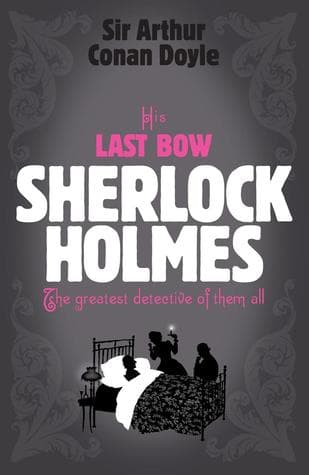
Synopsis
Covers the whole plot, including the ending.
- Difficulty
- Medium
- Pacing
- Moderate
- Mood
- Intriguing, Suspenseful, Classic, Intellectual
- Read it if
- You enjoy classic mystery stories, particularly those featuring a brilliant, eccentric detective and intricate plots.
- Skip it if
- You prefer modern, fast-paced thrillers or are looking for a single, continuous narrative.
His Last Bow Plot Summary
Covers the whole plot, including the ending.
The Adventure of Wisteria Lodge - Part 1: The Singular Request
John Scott Eccles, a bachelor, visits Sherlock Holmes and Dr. Watson with a strange story. He accepted an invitation from Mr. Aloysius Garcia, a Spanish gentleman he barely knew, to stay at Wisteria Lodge in Surrey. Eccles found Garcia and his quiet butler, Henderson, acting oddly. There were no other guests, and the atmosphere was tense. During his stay, Garcia gave him a note with a cryptic message about 'seven o'clock' and a drawing of a man, then took it back, saying it was a joke. The next morning, Eccles awoke to find Garcia gone, leaving a locked room and a feeling of dread. Fearing trouble, he went to London to see Holmes.
The Adventure of Wisteria Lodge - Part 2: The Murder at Wisteria Lodge
Holmes, with Watson and Inspector Gregson, went to Wisteria Lodge. They found Garcia's body in a nearby wood, killed by a blow. The house offered few clues, but Holmes noticed a strange pattern of animal sacrifice in the garden and found a coded message from Garcia. He learned that Garcia was not Spanish but an Englishman named Ferguson, and Henderson was actually Don Murillo, 'The Tiger of San Pedro,' a former dictator from Central America. Murillo, living under a false name, was being hunted by a revolutionary group, and Garcia was part of this group, trying to assassinate him.
The Adventure of the Bruce-Partington Plans - Part 1: The Stolen Naval Submarine Plans
Dr. Watson recounts the case of the Bruce-Partington plans, a matter of national importance. Young Arthur Cadogan West, a clerk at the Woolwich Arsenal, was found dead on the Underground tracks, holding top-secret plans for a new submarine, the 'Bruce-Partington.' The plans were incomplete, with seven pages missing. Scotland Yard, led by Inspector Lestrade, was confused, as West was a good man with no clear reason for theft or suicide, and his death was suspicious. The plans were in a locked safe, and West had the key. The Admiralty, in a panic, asked Sherlock Holmes to find the missing pages before they reached enemy hands.
The Adventure of the Bruce-Partington Plans - Part 2: A Master of Disguise and Espionage
Holmes investigated carefully, finding that West was not the thief. The real culprit was Colonel Valentine Walter, West's brother-in-law, a spy for a foreign power. Walter, using pulleys and a dummy, made it seem like West had taken the plans. He then killed West to hide his tracks and placed the partial plans on him. Holmes, through his deductions, realized Walter's elaborate way of entering and leaving the locked room and identified the true motive: selling the plans for a fortune. Holmes confronted Walter, recovered the missing plans, and ensured Walter's capture, preventing a national disaster and preserving England's naval strength.
The Adventure of the Dying Detective - Part 1: Holmes's Grave Illness
Dr. Watson received an urgent message from Mrs. Hudson, asking him to come to Baker Street. When he arrived, Watson was horrified to find Sherlock Holmes in a terrible state, seemingly dying from a rare and contagious tropical disease called 'Tarpeian fever,' caught during a case. Holmes forbade Watson from examining him, refusing medical attention from his friend, insisting on being treated only by a Mr. Culverton Smith, an expert on the disease from Sumatra. Holmes's condition quickly worsened; he seemed delirious, struggled to breathe, and his face was twisted in pain, leaving Watson terrified and helpless.
The Adventure of the Dying Detective - Part 2: The Trap Unveiled
Holmes, after a long wait, told Watson to hide and watch when Culverton Smith arrived. Smith, a man with a sinister look, revealed he intentionally infected Holmes with the disease using a poisoned ivory box. Believing Holmes was truly dying, Smith bragged about his crime, admitting he murdered his own nephew the same way. At Holmes's signal, Inspector Morton entered and arrested Smith. Holmes then miraculously recovered, revealing his illness was a trick to get Smith to confess. He had carefully staged the entire scene, even using make-up and fasting to appear genuinely ill, much to Watson's great relief and admiration.
The Disappearance of Lady Frances Carfax - Part 1: The Missing Heiress
Dr. Watson, on holiday, received a letter from Sherlock Holmes asking him to investigate the disappearance of Lady Frances Carfax, a wealthy and independent woman who had vanished. Lady Frances, known for her strong will and somewhat unusual habits, had been traveling abroad. Her last known location was Lausanne, Switzerland, where she fired her maid and withdrew a large sum of money. Holmes, busy with another case, entrusted Watson with the initial work. Watson followed fragmented clues, meeting suspicious people and hitting dead ends, failing to find Lady Frances but confirming the unsettling nature of her disappearance.
The Disappearance of Lady Frances Carfax - Part 2: The Coffin and the Crooks
Holmes took over the case from Watson, quickly putting together the fragmented information. He identified the criminals as the Reverend Dr. Shlessinger and his wife, con artists who preyed on wealthy, vulnerable women. They had befriended Lady Frances, isolated her, and then abducted her. Their plan was to fake her death, have her body cremated, and then claim her inheritance. Holmes tracked them to a funeral parlor, where he intervened just as Lady Frances, drugged and unconscious, was about to be placed in a coffin for a staged cremation. Holmes rescued her, exposed the criminals, and ensured their capture, saving Lady Frances from a horrifying fate.
His Last Bow - Part 1: Von Bork's German Spy Ring
The year is 1914, on the eve of World War I. Von Bork, a clever German master spy, had built an intelligence network in England. He operated from a secluded villa on the Kent coast, collecting military secrets and preparing for the coming conflict. He was helped by his Irish-American accomplice, Altamont, and his housekeeper, Martha. Von Bork was confident in his success, believing he had outsmarted British intelligence. He planned a final, meeting with Altamont, who he thought was delivering the ultimate prize: the complete British naval codes, which would ensure England's defeat.
His Last Bow - Part 2: Holmes's Masterful Deception
Von Bork waited for Altamont's arrival, expecting to receive the naval codes. When Altamont finally appeared, he was a rough, anti-British American. He gave Von Bork a package, which Von Bork opened to find a book on practical German grammar. Before Von Bork could react, Altamont, who was a disguised Sherlock Holmes, incapacitated him with a chloroform-soaked sponge. Holmes, having spent two years infiltrating German spy circles under the name Altamont, revealed his true identity. He explained his long game, his patience, and how he had finally caught Von Bork and his entire network, gathering all the intelligence they had collected for the British government. Dr. Watson arrived, and together, they secured Von Bork and his documents, neutralizing the German threat on the eve of war.
Principal Figures
Sherlock Holmes
Protagonist
The brilliant, eccentric consulting detective.
Sherlock Holmes is a master of deductive reasoning, observation, and disguise. He possesses an unparalleled intellect, a meticulous attention to detail, and a deep understanding of human psychology and criminal methods. While often appearing cold or detached, he is driven by a strong sense of justice and patriotism. His methods are unconventional, sometimes involving elaborate deceptions and patient, long-term undercover work, as seen in 'His Last Bow'. He thrives on intellectual challenge and views crime as a puzzle to be solved.
Relationships: Dr. John Watson (Closest friend, chronicler, and loyal assistant); Mrs. Hudson (Landlady, occasionally a maternal figure); Inspector Lestrade (Scotland Yard detective, often baffled by Holmes's methods but respects him)
Dr. John Watson
Supporting
Holmes's loyal friend, chronicler, and occasional assistant.
Dr. Watson is Holmes's devoted companion and the narrator of most of his adventures. A former army surgeon, he is observant, courageous, and possesses a strong moral compass. While not as intellectually brilliant as Holmes, he provides a grounded, empathetic perspective and serves as a crucial foil, often asking the questions the reader would. He is fiercely loyal to Holmes, often expressing concern for his friend's well-being, particularly in 'The Dying Detective', and provides a human element to Holmes's often detached genius. He is a steadfast and reliable presence.
Relationships: Sherlock Holmes (Closest friend, colleague, and chronicler); Mrs. Hudson (Acquaintance, fellow resident of Baker Street)
Von Bork
Antagonist
A cunning German master spy operating in England.
Von Bork is a highly intelligent and dangerously effective German intelligence agent. He is meticulously organized, patient, and utterly ruthless in his pursuit of British military secrets. He operates a sophisticated network from a secluded villa, confident in his ability to outwit British counter-intelligence. His ambition and perceived invincibility are his greatest strengths, but also his ultimate downfall. He represents the external threat to England on the eve of World War I, embodying the cunning and methodical nature of enemy espionage.
Relationships: Altamont (Sherlock Holmes) (Undercover contact, perceived accomplice); Martha (Housekeeper, minor accomplice)
Aloysius Garcia (Ferguson)
Supporting
A mysterious figure involved in a revolutionary plot.
Aloysius Garcia, whose real name is Ferguson, is a key figure in 'The Adventure of Wisteria Lodge'. He is initially presented as a reclusive Spanish gentleman, but Holmes soon uncovers his true identity as an Englishman involved in a revolutionary plot against Don Murillo, 'The Tiger of San Pedro'. Garcia is a man driven by a desire for justice or revenge, willing to put himself in danger. His mysterious behavior and sudden disappearance set the stage for Holmes's investigation into a deeper, more dangerous international conspiracy, highlighting the hidden lives individuals can lead.
Relationships: Don Murillo (Henderson) (Target of his revolutionary plot); John Scott Eccles (Unwitting guest at Wisteria Lodge)
Don Murillo (Henderson)
Antagonist
A ruthless former dictator, 'The Tiger of San Pedro'.
Don Murillo, known as Henderson in 'The Adventure of Wisteria Lodge', is a brutal and feared former dictator from Central America. Living in England under an assumed identity, he is a man constantly under threat from those he oppressed. He is cunning, dangerous, and utterly ruthless, capable of extreme violence to protect his secrets and his life. His past actions have created a network of enemies, leading to the revolutionary plot against him. His presence in England brings a taste of international political intrigue and violence to the quiet English countryside.
Relationships: Aloysius Garcia (Targeted by Garcia's revolutionary plot); John Scott Eccles (Host at Wisteria Lodge)
Arthur Cadogan West
Supporting
A naval clerk falsely implicated in the theft of secret plans.
Arthur Cadogan West is a young, respectable clerk at the Woolwich Arsenal in 'The Adventure of the Bruce-Partington Plans'. His sudden death and the discovery of the stolen naval plans on his person make him the prime suspect in a national security breach. He is portrayed as a man of good character with no apparent motive for such a crime, making his implication all the more perplexing. His tragic fate serves as the central enigma for Holmes to unravel, demonstrating how innocent individuals can become pawns in larger, more sinister schemes of espionage and betrayal.
Relationships: Colonel Valentine Walter (Brother-in-law, his murderer and the true spy)
Colonel Valentine Walter
Antagonist
A master spy and the true thief of the Bruce-Partington plans.
Colonel Valentine Walter is the cunning and treacherous villain in 'The Adventure of the Bruce-Partington Plans'. He is a master spy, working for a foreign power, and the brother-in-law of the deceased Arthur Cadogan West. Walter is incredibly resourceful and deceptive, orchestrating an elaborate scheme to steal the crucial naval plans and frame West for the crime, even committing murder to cover his tracks. His calm demeanor and respectable façade mask a deeply unpatriotic and avaricious nature. He represents the insidious threat of internal betrayal within the British establishment.
Relationships: Arthur Cadogan West (Brother-in-law, whom he murdered and framed)
Culverton Smith
Antagonist
A malevolent 'expert' on rare diseases, and a murderer.
Culverton Smith is the chilling antagonist in 'The Adventure of the Dying Detective'. He is presented as an expert on rare tropical diseases, but he is in fact a cold-blooded murderer who deliberately infected his own nephew. Smith is arrogant, self-serving, and utterly devoid of remorse. He is drawn into Holmes's trap by his vanity and his desire to see Holmes suffer and die, gloating over his perceived victory. His character highlights the depths of human cruelty and the subtle, insidious ways in which murder can be committed, making him a truly sinister figure.
Relationships: Sherlock Holmes (Target of his attempted murder and the one who exposes him)
Lady Frances Carfax
Supporting
A wealthy, independent woman who mysteriously disappears.
Lady Frances Carfax is the titular figure in 'The Disappearance of Lady Frances Carfax'. She is depicted as a strong-willed, independent, and somewhat eccentric woman of considerable wealth. Her desire for self-sufficiency and her trust in seemingly benevolent figures make her vulnerable to manipulation and abduction. Her disappearance and the sinister plot surrounding her highlight the dangers faced by solitary individuals, especially women, who possess significant assets. She serves as a symbol of the innocent victim whom Holmes must race against time to save from a horrifying fate.
Relationships: Reverend Dr. Shlessinger and his wife (Con artists who abduct her)
Reverend Dr. Shlessinger and his wife
Antagonist
A pair of con artists who abduct and attempt to murder Lady Frances Carfax.
The Reverend Dr. Shlessinger and his wife are a sinister pair of con artists in 'The Disappearance of Lady Frances Carfax'. They are cunning, manipulative, and utterly ruthless, preying on wealthy, vulnerable individuals. Shlessinger uses his clerical guise to gain trust, while his wife acts as his accomplice. Their elaborate scheme involves isolating their victims, faking their deaths, and then claiming their inheritance. They represent the dark side of human greed and the exploitation of trust, creating a truly chilling threat for Lady Frances. Their methodical cruelty makes them particularly dangerous adversaries.
Relationships: Lady Frances Carfax (Their intended victim)
Themes & Insights
Patriotism and Duty
This theme is most clear in 'His Last Bow,' where Sherlock Holmes comes out of retirement to serve his country during wartime. He spends two years undercover, enduring hardship and sacrificing personal recognition, all for national security. This contrasts with the self-serving motives of spies like Von Bork and Colonel Valentine Walter. Holmes's dedication to England's safety shows a deep sense of patriotic duty, changing his detective work from a mental exercise to a vital service. The story highlights the silent heroes who protect the nation from unseen threats.
“Good old Watson! You are the one fixed point in a changing age. There's an east wind coming, Watson. Such a wind as never blew on England yet. It will be cold and bitter, Watson, and a good many of us may wither before its blast. But it's an ill wind that blows nobody good. It will sweep the cobwebs out of the attic.”
Deception and Disguise
Deception is a common element, central to both the crimes Holmes investigates and his own methods. In 'His Last Bow,' Holmes himself uses the elaborate disguise of Altamont for two years to infiltrate a German spy ring. In 'The Dying Detective,' he fakes a fatal illness to trick Culverton Smith into confessing. Criminals like Colonel Valentine Walter ('The Bruce-Partington Plans') use clever tricks and misdirection to commit their crimes and frame others. Don Murillo ('Wisteria Lodge') lives under a false identity. This theme shows how easily people can be fooled and how Holmes skillfully handles these layers of falsehood.
“The greatest crimes are not committed by the professional criminal, but by the man who is above suspicion.”
Justice vs. Law
While Holmes often works with the law (represented by Scotland Yard inspectors), there are times when his pursuit of justice operates outside strict legal rules, or when the law itself is not enough. In 'Wisteria Lodge,' the pursuit of Don Murillo by revolutionaries suggests a form of justice outside the law for past wrongs. Holmes's willingness to use deception, as in 'The Dying Detective,' to get a confession, prioritizes revealing the truth and punishing the guilty over strict adherence to legal procedure. This theme explores the moral complexities of crime and punishment, and Holmes's role as an arbiter of a higher form of justice.
“I am a unofficial person... I have no right to intrude where the law is at work.”
The Vulnerability of the Innocent
Several stories show how innocent people become victims of larger, more sinister plots. John Scott Eccles ('Wisteria Lodge') is an unwitting part of a revolutionary scheme. Arthur Cadogan West ('The Bruce-Partington Plans') is murdered and framed by his own brother-in-law. Lady Frances Carfax ('The Disappearance of Lady Frances Carfax') is targeted for her wealth and independence, almost falling victim to a gruesome plot. These cases highlight how easily malevolent forces can exploit trust and circumstance, showing the need for Holmes's protection.
“Data! Data! Data! I can't make bricks without clay.”
Plot Devices & Literary Techniques
The Red Herring
Misleading clues or characters designed to divert the reader's and detective's attention.
Red herrings are frequently employed to complicate Holmes's cases. In 'The Bruce-Partington Plans', Arthur Cadogan West appears to be the thief, but he is actually a victim. In 'The Dying Detective', Holmes's own seemingly fatal illness is a major red herring designed to mislead Watson and, more importantly, Culverton Smith. These diversions serve to heighten suspense and demonstrate Holmes's ability to see through superficial appearances to the underlying truth, often by focusing on seemingly insignificant details that others overlook.
The Unreliable Narrator (Limited Perspective)
Watson's narration, while detailed, often lacks Holmes's full understanding until the reveal.
Dr. Watson serves as the primary narrator, offering a detailed but often limited perspective. He records events faithfully, but his understanding of the deeper implications or Holmes's grand design is usually incomplete until Holmes's final explanation. This device allows for dramatic reveals, as the reader experiences the mystery alongside Watson, sharing his confusion and eventual enlightenment. It also highlights Holmes's superior intellect by contrasting his comprehensive grasp of the situation with Watson's more conventional, step-by-step understanding, making Holmes's deductions seem even more brilliant.
The Elaborate Deception
Holmes's use of complex, staged scenarios to trap criminals.
Holmes frequently employs elaborate deceptions not just to solve crimes, but to actively ensnare criminals. The most prominent example is in 'The Dying Detective', where he convincingly feigns a deadly illness to lure Culverton Smith into confessing. In 'His Last Bow', his two-year undercover operation as Altamont is the ultimate elaborate deception, demonstrating his willingness to commit fully to a role to achieve justice. This device showcases Holmes's theatrical flair and his understanding of human psychology, using the criminal's own arrogance or greed against them in a carefully orchestrated trap.
The Locked Room Mystery
A seemingly impossible crime committed in a sealed environment.
While not always a literal locked room, this device refers to situations where a crime appears to have been committed under impossible circumstances, defying conventional explanation. In 'Wisteria Lodge', Garcia's disappearance from a seemingly secure room initially presents as an impossible event. In 'The Bruce-Partington Plans', the theft of documents from a locked safe and West's death under perplexing circumstances create a similar sense of impossibility. Holmes specializes in unraveling these seemingly impenetrable puzzles, exposing the hidden mechanisms or overlooked details that make the 'impossible' possible.
His Last Bow Quotes
“Data! Data! Data! I can't make bricks without clay.”
“What object is served by this circle of misery and violence and fear? It must tend to some end, or else our universe is ruled by chance, which, so far as I believe, is an unthinkable thought.”
“The lowest and vilest alleys in London do not present a more dreadful record of sin than does the smiling and beautiful countryside.”
“It is a fact that in the larger cities the greater proportion of crime is social, as opposed to professional.”
“I am a brain, Watson. The rest of me is a mere appendix.”
“There are grave doubts as to whether the world is not making a gigantic blunder in overpopulating itself.”
“The world is full of obvious things which nobody by any chance ever observes.”
“Every problem becomes a platitude when once it is explained.”
“It is not my business to think, but to see.”
“The game is afoot!”
“There is nothing more deceptive than an obvious fact.”
“He has a brain, a good working brain, but he has not that supreme gift of the imagination.”
“The last and most important of the cases which I have to recount.”
“Good old Watson! You are the one fixed point in a changing age.”
Quiz
10 questions on the plot and the characters. Each answer comes with a short explanation.
Question 1
In the title story 'His Last Bow', what specific threat is Sherlock Holmes brought out of retirement to combat?
- A series of assassinations targeting British diplomats.
- A plan to steal vital naval blueprints.
- The German espionage threat at the approach of World War I.
- An anarchist plot to bomb Parliament.
Show answer
C. The German espionage threat at the approach of World War I. The synopsis explicitly states that Holmes is brought out of retirement to help the Government fight the German threat at the approach of the First World War.
Question 2
Who specifically requests Sherlock Holmes's services in 'His Last Bow' to hunt down the German agent, Von Bork?
- Mycroft Holmes
- Inspector Lestrade
- The Prime Minister
- The Head of MI5
Show answer
C. The Prime Minister The synopsis states, 'The Prime Minister himself requests Holmes's services to hunt down the remarkable German agent, Von Bork.'
Question 3
In 'The Dying Detective', what specific condition does Dr. Watson believe Sherlock Holmes is suffering from?
- A rare form of consumption.
- A mysterious tropical disease.
- Pneumonia, exacerbated by overwork.
- Food poisoning from a recent case.
Show answer
B. A mysterious tropical disease. The synopsis mentions, 'In 'The Dying Detective', Dr Watson is horrified to discover Holmes at death's door from a mysterious tropical disease.'
Question 4
What is the primary role Sherlock Holmes plays in 'His Last Bow' regarding Von Bork?
- To act as a double agent, feeding Von Bork false information.
- To analyze Von Bork's coded messages for the British government.
- To infiltrate Von Bork's network and ultimately capture him.
- To protect Von Bork from assassination attempts by rival spies.
Show answer
C. To infiltrate Von Bork's network and ultimately capture him. Holmes's mission is to 'hunt down' Von Bork, implying an active role in his capture, which he achieves by infiltrating and deceiving him.
Question 5
Which of the following stories is NOT mentioned in the synopsis as being part of the 'His Last Bow' collection?
- 'Wisteria Lodge'
- 'The Red-Headed League'
- 'The Bruce-Partington Plans'
- 'The Disappearance of Lady Frances Carfax'
Show answer
B. 'The Red-Headed League' The synopsis lists 'Wisteria Lodge', 'The Bruce-Partington Plans', and 'The Disappearance of Lady Frances Carfax' as cases completing the volume, but 'The Red-Headed League' is not mentioned.
Question 6
What is the true purpose behind Holmes's feigned illness in 'The Dying Detective'?
- To test Watson's medical knowledge and dedication.
- To expose a corrupt doctor who would refuse to treat him.
- To lay a trap for a murderer, luring them into his presence.
- To observe the reactions of his housekeeper, Mrs. Hudson.
Show answer
C. To lay a trap for a murderer, luring them into his presence. The synopsis clearly states that Holmes 'lays a trap for a murderer' by faking his illness.
Question 7
What is the thematic significance of Holmes's return to service in 'His Last Bow'?
- It symbolizes the triumph of individual genius over bureaucratic incompetence.
- It represents the shift from traditional crime-solving to modern espionage, reflecting the changing global landscape.
- It highlights Holmes's disillusionment with the British government's reliance on his past methods.
- It emphasizes the enduring power of friendship between Holmes and Watson.
Show answer
B. It represents the shift from traditional crime-solving to modern espionage, reflecting the changing global landscape. Holmes's last case, dealing with international espionage on the eve of WWI, signifies a thematic shift from personal crimes to larger geopolitical conflicts, marking a 'last bow' to a certain era of detective work.
Question 8
How does Holmes's characterization in 'His Last Bow' differ from his earlier portrayals, particularly in terms of his public persona?
- He is more openly emotional and less reserved than in earlier stories.
- He adopts a convincing disguise as a rough Irish-American informant named Altamont, a departure from his usual methods of observation.
- He works more closely with Scotland Yard, sharing credit for his successes.
- He becomes more reliant on Dr. Watson's direct assistance in undercover operations.
Show answer
B. He adopts a convincing disguise as a rough Irish-American informant named Altamont, a departure from his usual methods of observation. In 'His Last Bow', Holmes adopts the long-term, deep cover identity of Altamont, an Irish-American, which is a significant and extended departure from his typical, more transient disguises.
Question 9
What is the crucial piece of information Von Bork believes he is receiving from 'Altamont' (Holmes) in 'His Last Bow'?
- Details about the British naval fleet's movements.
- A comprehensive list of British secret agents operating in Germany.
- A book containing highly sensitive British defence secrets.
- The exact date of Britain's declaration of war.
Show answer
C. A book containing highly sensitive British defence secrets. Holmes, disguised as Altamont, presents Von Bork with a 'book' which Von Bork believes contains critical British defence secrets, but it is actually a trap.
Question 10
What is the general tone or mood conveyed by the collection's title, 'His Last Bow'?
- A sense of ongoing adventure and new beginnings for the detective.
- A melancholic and conclusive feeling, signifying an end to Holmes's active career.
- A triumphant and celebratory mood, marking Holmes's greatest victory.
- An ambiguous and mysterious tone, leaving Holmes's fate uncertain.
Show answer
B. A melancholic and conclusive feeling, signifying an end to Holmes's active career. The phrase 'His Last Bow' strongly suggests a final performance or conclusion, indicating that this is likely Holmes's last major case before his permanent retirement.
His Last Bow FAQ
What is the central premise of the title story, 'His Last Bow'?
The title story sees a retired Sherlock Holmes, living under the alias 'Altamont' and posing as an Irish-American informant, recruited by the British government at the urgent request of the Prime Minister. His mission is to infiltrate and expose the formidable German spy network led by the master agent, Von Bork, just days before the outbreak of World War I.
Who is Von Bork and what is his significance in 'His Last Bow'?
Von Bork is the primary antagonist in 'His Last Bow', a highly intelligent and cunning German master spy operating from his villa in Harwich, England. He has successfully gathered critical British naval intelligence, and his imminent departure to Germany with the secrets represents a grave threat to national security, making him Holmes's ultimate target.
How does Sherlock Holmes manage to deceive Von Bork in 'His Last Bow'?
Holmes, under the guise of Altamont, cultivates a persona of a disgruntled Irish-American agent offering valuable British secrets to Von Bork. He meticulously builds this false identity over two years, eventually luring Von Bork into a trap by promising a final, crucial document – a coded cipher that is, in fact, a harmless book of war statistics.
What role does Dr. Watson play in 'His Last Bow'?
Dr. Watson's role is primarily that of the narrator, observing and recounting the events as Holmes explains his elaborate two-year deception to him. He is called to Von Bork's villa at the culmination of the plan, witnessing Holmes's final confrontation with the German spy and the subsequent capture, providing the traditional narrative perspective.
What is the key twist or revelation in 'The Dying Detective'?
The key twist in 'The Dying Detective' is that Holmes's apparent fatal illness, which horrifies Watson, is an elaborate ruse. He feigns a highly contagious tropical disease to manipulate and expose Culverton Smith, a man he suspects of murdering his nephew Victor Savage, by making Smith believe Holmes is truly on his deathbed and needs his 'expertise'.
Are there any subtle indications of Holmes's true intentions in 'The Dying Detective' before the reveal?
Yes, subtle clues include Holmes refusing Watson's medical examination, specifically requesting the doctor not touch him, and his peculiar insistence on not eating or drinking for three days. His dramatic, almost theatrical, descriptions of his symptoms and his unwavering focus on Culverton Smith, even while seemingly at death's door, hint at a deeper plan.
How does 'His Last Bow' connect to the broader historical context of its publication?
'His Last Bow' was published in 1917, during World War I, and serves as a patriotic piece reflecting contemporary anxieties about German espionage and the war effort. It positions Holmes as a national hero, using his intellect for the greater good of Britain against a real-world threat, effectively rallying public sentiment.
What is the significance of the coded message Holmes gives Von Bork in 'His Last Bow'?
The 'coded message' is actually a copy of 'Practical Handbook of Bee Culture,' a book on beekeeping, which is a subtle nod to Holmes's actual retirement hobby. It's a brilliant piece of misdirection, appearing to be a vital military cipher but in reality, being harmless, allowing Holmes to capture Von Bork without revealing any genuine secrets.
In 'The Bruce-Partington Plans', what is the crucial detail about the stolen submarine plans?
The crucial detail is that only three out of ten pages of the top-secret submarine plans were stolen, not the entire set. This immediately suggests a more intricate plot than a simple theft, as the missing pages are useless without the others, pointing to a betrayal from within or a deliberate attempt to frame someone, leading Holmes to uncover the true culprit, Colonel Valentine Walter.
How does Holmes demonstrate his mastery of disguise and deception in 'His Last Bow'?
Holmes meticulously crafts the persona of Altamont, an Irish-American informant, for two years, adopting a convincing accent, mannerisms, and backstory. He even fakes minor injuries and illnesses to maintain the illusion, showing his profound ability to inhabit an entirely different identity and gain the trust of a highly suspicious target like Von Bork.
What psychological insight does 'The Dying Detective' offer into Holmes's character?
'The Dying Detective' reveals Holmes's profound self-sacrifice and willingness to endure extreme physical discomfort and emotional manipulation (even of Watson) for the sake of justice. It highlights his single-minded dedication to catching a criminal, even if it means appearing vulnerable and risking his own reputation and health in the process.
How does Holmes's interaction with Watson in 'The Dying Detective' reflect their complex relationship?
Holmes's interaction in 'The Dying Detective' showcases the deep trust and affection Watson has for Holmes, which Holmes exploits for his plan. While Holmes's deception causes Watson immense pain and distress, it also underscores the enduring bond where Watson's loyalty is unwavering, even when faced with his friend's apparent demise, solidifying their unique partnership.
What does 'His Last Bow' suggest about Holmes's personal values and patriotism?
'His Last Bow' strongly suggests Holmes possesses a deep, albeit often hidden, sense of patriotism and duty to his country. Despite his long retirement, he readily sacrifices his peace and anonymity to serve Britain against a grave national threat, demonstrating that his intellectual prowess is ultimately at the service of justice and national security.
Does 'His Last Bow' truly represent Holmes's final case, or is the title metaphorical?
While titled 'His Last Bow,' implying a final performance, it is generally considered metaphorical in terms of his written adventures, as other stories were published later that chronologically occur before this one. However, within the story's narrative, it marks his conclusive contribution to Britain's war effort, a grand 'bow' to his career of service.
How does the collection's structure, mixing earlier cases with the title story, affect the reader's experience?
The collection's structure, blending the patriotic, high-stakes 'His Last Bow' with earlier, more classic Holmesian mysteries, creates a diverse reading experience. It allows readers to appreciate Holmes's consistent brilliance across different stages of his career, from intricate domestic crimes to grand international espionage, showcasing his versatility and enduring appeal.
Is Holmes's use of deception in 'The Dying Detective' morally justifiable?
Holmes's deception in 'The Dying Detective' is highly debatable morally. While it achieves justice by exposing a murderer, it causes immense emotional distress to his closest friend, Watson, and manipulates others. Proponents argue the ends justify the means for a greater good, while critics highlight the ethical cost of such calculated emotional abuse.
What is the enduring appeal of 'His Last Bow' as a collection?
The enduring appeal of 'His Last Bow' lies in its blend of classic Holmesian deduction and the dramatic, patriotic title story that provides a poignant 'farewell' to the character as a public servant. It offers a cross-section of Holmes's cases, showcasing his intellectual prowess in various scenarios, from domestic mysteries to international espionage, solidifying his legend.
How does 'Wisteria Lodge' exemplify Holmes's methods in dealing with complex, multi-layered conspiracies?
In 'Wisteria Lodge', Holmes meticulously unravels a complex conspiracy involving a sinister cult, a missing employer, and a brutal murder, by focusing on seemingly minor details like the strange note and the coded messages. He pieced together the motives of characters like Mr. Garcia and Henderson (Don Murillo), exposing a web of revenge and political intrigue that transcends the initial appearance of a simple domestic crime.
About the author
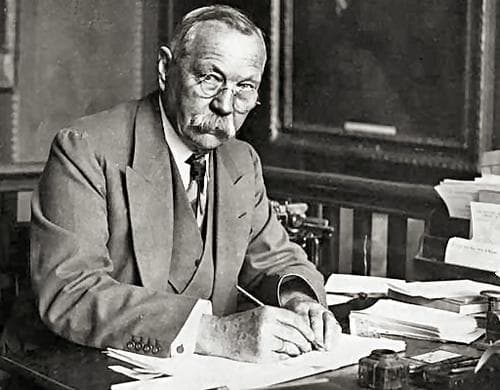
Sir Arthur Ignatius Conan Doyle was a British writer and physician. He created the character Sherlock Holmes in 1887 for A Study in Scarlet, the first of four novels and fifty-six short stories about Holmes and Dr. Watson. The Sherlock Holmes stories are milestones in the field of crime fiction.
Similar books
- The Adventures of Sherlock Holmes
Arthur Conan Doyle
4.3 (243k) average on GoodreadsMysteryAnother collection of classic Sherlock Holmes short stories.
- A Study in Scarlet
Arthur Conan Doyle
4.2 (324k) average on GoodreadsHistorical FictionThe first Sherlock Holmes novel, introducing the characters and their methods.
- The Moonstone
Wilkie Collins
3.9 (79k) average on GoodreadsHistorical FictionWhile both His Last Bow and The Moonstone are foundational works in detective fiction, Collins's novel, published decades earlier, is often cited as the first full-length English detective novel. The Moonstone employs multiple narrators, offering diverse perspectives on the crime and building suspense through conflicting accounts, a structural complexity largely absent in the more straightforward, Holmes-centric narratives of His Last Bow. Doyle's focus is almost exclusively on Holmes's singular genius, whereas Collins explores the societal impact of the crime and the fallibility of human perception through a broader cast of voices. While Collins's work might be seen as more experimental in its narrative form, Doyle's collection excels in the consistent application of a singular, brilliant detective's method.
- The Secret Agent
Joseph Conrad
3.6 (19k) average on GoodreadsThrillerThe Secret Agent, published just a decade before His Last Bow, also deals with themes of espionage and national security, but does so with a starkly different tone and philosophical depth. Conrad's novel is a dark, cynical exploration of political extremism, state paranoia, and moral ambiguity, offering a bleak commentary on human nature. In contrast, His Last Bow, particularly its title story, presents a more heroic and optimistic view of intelligence work, with Holmes serving as a clear-cut patriot defending his nation. While both grapple with the dangers of hidden enemies, Conrad delves into the psychological and social decay caused by such threats, whereas Doyle primarily uses them as a backdrop for Holmes's intellectual triumph and unwavering moral compass. Conrad's work is arguably more literary and critical in its examination of its themes, while Doyle prioritizes engaging mystery and the celebration of intellect.
- To Kill a Mockingbird
Harper Lee
4.3 (4.5M) average on GoodreadsHistorical FictionIn the 1930s Jim Crow South, Harper Lee writes about racial injustice, moral growth, and the quiet courage of a lawyer father, Atticus Finch, as seen through his young daughter's eyes.
- The Great Gatsby
F. Scott Fitzgerald
3.9 (3.8M) average on GoodreadsHistorical FictionIn the opulent Roaring Twenties, a mysterious millionaire's lavish parties hide his desperate, tragic pursuit of a lost love, exposing the emptiness within the American Dream.




Enjoyed the summary?
A summary gives you the shape of the book. The book itself has the detail, the examples and the voice.
Find His Last Bow on AmazonAs an Amazon Associate, BookBrief earns from qualifying purchases. How we're funded