
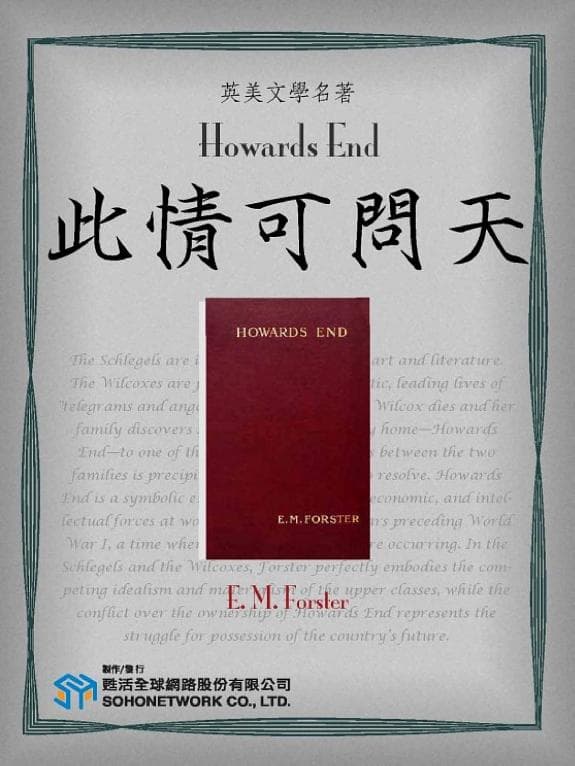
Synopsis
Covers the whole plot, including the ending.
- Difficulty
- Medium
- Pacing
- Moderate
- Mood
- Reflective, Thought-provoking, Melancholy, British
- Read it if
- You enjoy classic English literature that explores social class, morality, and the clash between tradition and modernity with nuanced character development.
- Skip it if
- You prefer fast-paced plots or lighthearted reads without deep social commentary.
Howards End Plot Summary
Covers the whole plot, including the ending.
A Misunderstanding at Howards End
Helen Schlegel, a young, artistic woman, visits Howards End, the country estate of the wealthy, practical Wilcox family. She quickly gets engaged to Paul Wilcox, the youngest son, during her stay. Her elder sister, Margaret, receives a telegram about this engagement, causing a stir among the Schlegel family, who live a more bohemian and intellectual life. However, the Wilcox family quickly ends the engagement, seeing it as a youthful mistake. The Schlegels, at first embarrassed, are relieved, though the incident shows the clear cultural differences between the two families. Mrs. Wilcox, the matriarch, is unusually kind to Helen at this time, a gesture that will be important later.
The Schlegels and the Basts
Back in London, Margaret and Helen Schlegel meet Leonard Bast, a young, aspiring intellectual from a lower-middle-class background, at a concert. Leonard accidentally takes Helen's umbrella, leading to a brief, awkward meeting. The Schlegels, driven by their liberal ideas and a wish to help the less fortunate, become interested in Leonard. They see him as a symbol of the struggling working class and feel a duty to help him improve his life. Their attempts to guide and advise Leonard, however, often come across as patronizing and ultimately hurt him, showing the limits of their well-meaning but sometimes naive idealism.
Mrs. Wilcox's Last Wish
Mrs. Wilcox, a quiet and spiritual woman who feels a deep connection to Howards End, develops an unexpected friendship with Margaret Schlegel. She sees a similar spirit in Margaret, looking past her intellect to a deep understanding of life and connection to the land. On her deathbed, Mrs. Wilcox writes a will leaving Howards End to Margaret. However, her family, especially her husband Henry Wilcox, dismisses this handwritten note as a sentimental idea, believing Ruth was not of sound mind. They burn the note and keep its contents secret from Margaret, thinking it would be impractical and disruptive to their family's plans.
The Growing Relationship Between Margaret and Henry
After Mrs. Wilcox's death, Henry Wilcox, a practical and successful businessman, finds himself drawn to Margaret Schlegel. Despite their different temperaments and views – Henry representing business and practicality, and Margaret representing ideas and emotion – they begin a courtship. Margaret, at first wary of Henry's bluntness, is attracted to his strength and stability, and perhaps a sense of rootedness he represents. Their engagement surprises both their families and friends, raising questions about whether such different people can truly be happy together. The relationship highlights the novel's look at connecting societal divides.
The Schlegels' Eviction and Leonard's Plight
The Schlegel sisters face eviction from their London home, Wickham Place, which is to be torn down for modern development. This loss deeply affects them, symbolizing the increasing materialism and disregard for tradition they see in society. Meanwhile, Leonard Bast, after getting well-meaning but bad advice from the Schlegels (prompted by Henry Wilcox's casual remarks about his employer), quits his job, believing a better opportunity awaits. This decision proves disastrous, leading to his unemployment and severe financial trouble. His struggles further complicate the Schlegels' sense of social duty and their relationship with the Wilcoxes.
Marriage and Disillusionment
Margaret and Henry marry, and Margaret tries to balance her intellectual ideals with Henry's practical, conventional world. She tries to connect with his children, especially Evie and Charles, but finds their superficiality and strict social attitudes difficult. Henry, for his part, remains largely unchanged, prioritizing business and social standing over emotional depth or intellectual pursuits. Their marriage, while outwardly respectable, has a growing sense of disappointment for Margaret. She struggles with the compromises she has made and the difficulty of bridging the gap between their life philosophies, hinting at deeper conflicts to come.
Helen's Compassion and Growing Despair
Helen Schlegel, deeply affected by Leonard Bast's increasing poverty and the perceived unfairness of his situation, becomes distressed. She blames Henry Wilcox, indirectly, for Leonard's misfortune and feels a deep sense of guilt and responsibility. In an act of desperate compassion, Helen has an affair with Leonard Bast. This relationship, born from emotional turmoil and a desire for connection, results in her pregnancy. Overwhelmed and ashamed, Helen flees to Germany, cutting off communication with Margaret and falling into a period of deep emotional crisis, further isolating herself from her family.
The Truth Revealed and The Schlegels' Retreat
Margaret, increasingly worried by Helen's long absence and silence, eventually discovers her sister's pregnancy. Horrified by the social implications and Helen's distress, Margaret is determined to help her. She confronts Helen in Germany and eventually convinces her to return to England. With nowhere else to go and seeking a peaceful refuge for Helen, Margaret brings her to Howards End, the very place Ruth Wilcox had intended for her. This decision is made without Henry's full knowledge or approval, setting the stage for a dramatic confrontation between the sisters and the Wilcox family.
Confrontation at Howards End
At Howards End, the truth about Helen's pregnancy and Leonard Bast's fatherhood is finally revealed to Henry Wilcox. His reaction is one of moral outrage and strict adherence to social rules. He is particularly angry about Leonard's presence at Howards End. Charles Wilcox, Henry's son, driven by a sense of family honor and a desire to punish Leonard, confronts him violently. In the struggle, Leonard Bast has a fatal heart attack, caused by a bookshelf falling on him. This tragic event, a result of misunderstandings, class prejudice, and moral rigidity, shatters the lives of all involved and shows the destructive consequences of their interactions.
The Aftermath and Charles's Imprisonment
After Leonard Bast's death, Charles Wilcox is arrested and charged with manslaughter. Despite Henry's attempts to use his influence, Charles is convicted and sentenced to prison. The scandal devastates the Wilcox family, showing their hypocrisy and the fragility of their social standing. Margaret, though deeply pained by the tragedy, remains loyal to Helen. She refuses to abandon her sister and takes on her role as a protector and supporter. This period forces Margaret to re-evaluate her marriage and her relationship with the Wilcox family, leading to a profound shift in her understanding of compassion and justice.
Reconciliation and Inheritance
The stress and scandal affect Henry Wilcox, who suffers a stroke, leaving him frail. In his weakened state, he becomes more dependent on Margaret, and a fragile reconciliation begins to emerge between them. During this time, Ruth Wilcox's original will, leaving Howards End to Margaret, comes to light through a confession from Henry's sister. This revelation, though long overdue, provides a sense of poetic justice. With Charles in prison and Henry incapacitated, Howards End effectively passes into Margaret's hands, fulfilling Ruth's original, disregarded wish. The estate, once a symbol of division, begins to represent a potential for unity.
A New Beginning at Howards End
In the novel's final scenes, Margaret, Helen, and Helen's young son, Tom, live together peacefully at Howards End. Henry Wilcox, still recovering from his stroke, lives with them, his spirit softened by adversity. The estate, now under Margaret's care, embodies continuity and healing. The Schlegel sisters, having endured much suffering and societal judgment, have found a home where their intellectual and emotional values can coexist with life's practicalities. The ending suggests a hopeful, if complex, blend of the conflicting forces that have driven the story, hinting at the possibility of connecting different classes and sensibilities through the spirit of Howards End.
Principal Figures
Margaret Schlegel
Protagonist
An intellectual and compassionate woman seeking to connect diverse worlds.
Margaret is the elder of the two Schlegel sisters, intelligent, cultured, and deeply empathetic. She embodies a blend of idealism and practicality, striving to understand and reconcile disparate elements of society. She believes in 'only connect' – the idea of bridging the gap between the material and spiritual, the rich and the poor, the intellectual and the conventional. Her journey involves navigating complex relationships and challenging her own ideals against the harsh realities of the world.
Relationships: Helen Schlegel (Devoted sister, intellectual companion, emotional anchor); Henry Wilcox (Husband, initially a source of stability and later disillusionment); Ruth Wilcox (Spiritual kindred spirit, inheritor of her legacy); Leonard Bast (Object of her well-intentioned but ultimately harmful charity)
Helen Schlegel
Supporting
Margaret's impulsive and emotionally driven younger sister.
Helen is Margaret's younger sister, more impulsive, passionate, and less pragmatic. She is deeply sensitive to injustice and poverty, often acting on her emotions rather than rational thought. Her idealism is more fervent and less tempered than Margaret's, leading her into difficult situations. She represents the unbridled spirit and emotional depth, but also the potential for recklessness when idealism clashes with reality.
Relationships: Margaret Schlegel (Beloved sister, emotional support); Paul Wilcox (Brief, impulsive engagement); Leonard Bast (Lover, father of her child, object of her compassion)
Henry Wilcox
Antagonist/Supporting
A pragmatic and wealthy businessman representing the material world.
Henry Wilcox is the patriarch of the Wilcox family, a successful, conservative, and rigidly conventional businessman. He embodies the practical, materialistic, and unsentimental aspects of Edwardian society. He values property, status, and order above all else, often dismissing emotions and intellectual pursuits as frivolous. While not malicious, his lack of empathy and rigid moral code cause immense suffering and highlight the destructive potential of an unexamined life.
Relationships: Margaret Schlegel (Husband, initially a source of stability, later a symbol of societal rigidity); Ruth Wilcox (Late wife, whose wishes he disregarded); Charles Wilcox (Son, whose actions lead to tragedy); Paul Wilcox (Son, briefly engaged to Helen)
Ruth Wilcox
Supporting/Catalyst
The spiritual matriarch of Howards End, with a deep connection to the land.
Ruth Wilcox is Henry's first wife and the spiritual heart of Howards End. She is quiet, sensitive, and intuitive, possessing a deep, almost mystical connection to the country house and the land. Unlike her family, she has a profound inner life and a natural understanding of human connection. She recognizes a kindred spirit in Margaret Schlegel, seeing beyond social conventions to a shared sensibility. Her dying wish to leave Howards End to Margaret acts as the central catalyst for the novel's plot.
Relationships: Henry Wilcox (Husband, whose values she gently contrasts); Margaret Schlegel (Spiritual successor, chosen inheritor of Howards End); Helen Schlegel (Shows unexpected kindness towards her)
Leonard Bast
Supporting
A struggling clerk from the lower-middle class, aspiring to culture.
Leonard Bast is a young, impoverished clerk from the lower-middle class who yearns for intellectual and cultural enrichment. He reads widely and attends concerts, attempting to uplift himself beyond his station. However, he is often naive, easily influenced, and lacks the resources or social connections to truly escape his circumstances. He represents the aspirations and vulnerabilities of the working class, caught between the desire for self-improvement and the harsh realities of economic struggle. His life becomes tragically entangled with both the Schlegels and the Wilcoxes.
Relationships: Helen Schlegel (Lover, father of her child); Margaret Schlegel (Benefactor, source of misguided advice); Jacky Bast (Wife, a symbol of his social entrapment)
Charles Wilcox
Supporting
Henry's eldest son, embodying the most rigid aspects of the Wilcox family.
Charles Wilcox is Henry's eldest son, a character who perfectly embodies the most unyielding and prejudiced aspects of the Wilcox family. He is arrogant, conventional, and obsessed with social propriety and family honor. He lacks imagination and empathy, quick to judge and condemn those who do not conform to his narrow worldview. His actions are often driven by a sense of entitlement and a desire to protect his family's reputation, leading directly to the novel's tragic climax.
Relationships: Henry Wilcox (Son, shares his father's values but takes them to a destructive extreme); Margaret Schlegel (Sister-in-law, whom he resents); Leonard Bast (Victim of his anger and prejudice)
Tibby Schlegel
Supporting
The Schlegel brother, a scholarly and somewhat detached intellectual.
Tibby Schlegel is the younger brother of Margaret and Helen, a scholarly and rather delicate young man. He is highly intelligent, devoted to his studies at Oxford, and somewhat detached from the practicalities and emotional turmoil of the world around him. He represents the intellectual, academic sphere, often providing a quiet contrast to the more passionate and socially engaged perspectives of his sisters. He is generally kind but often appears aloof or absorbed in his own intellectual pursuits.
Relationships: Margaret Schlegel (Sister, intellectual companion); Helen Schlegel (Sister, occasionally exasperated by her impulsiveness)
Jacky Bast
Supporting/Mentioned
Leonard Bast's unrefined and tragic wife.
Jacky Bast is Leonard's wife, a woman from a lower social class, depicted as unrefined, uneducated, and prone to drunkenness. Her presence in Leonard's life highlights his inability to fully escape his origins and serves as a symbol of the social constraints and burdens he carries. She is a tragic figure, largely helpless and misunderstood, whose past is entangled with Henry Wilcox, revealing his own moral ambiguities. Her existence underscores the harsh realities faced by the very poor.
Relationships: Leonard Bast (Wife, a burden and a symbol of his social limitations); Henry Wilcox (Former mistress, a secret that fuels later drama)
Themes & Insights
Only Connect
This central theme, stated in the novel's epigraph, explores the need to bridge the gap between the material and the spiritual, the practical and the emotional, the outer life and the inner life. Margaret Schlegel embodies this struggle, trying to reconcile her intellectual ideals with the practical world of the Wilcoxes. The novel suggests that true fulfillment and societal harmony can only be achieved by connecting these different elements, rather than letting them exist separately or in conflict. Not connecting leads to misunderstanding, suffering, and tragedy, as seen in the interactions between the Schlegels, Wilcoxes, and Basts.
“Only connect! That was the whole of her sermon. Only connect the prose and the passion, and both will be exalted, and human love will be seen at its highest. Live in fragments no longer.”
Class and Social Divide
Howards End carefully examines the rigid class structure of Edwardian England and the deep gap between the wealthy upper-middle class (Wilcoxes), the intellectual middle class (Schlegels), and the struggling lower-middle class (Basts). The novel shows the prejudices, misunderstandings, and injustices that come from these divisions. The Schlegels' attempts to 'help' Leonard Bast, though well-meaning, often show their own class biases and the limits of charity without true understanding. The tragic outcome of Leonard's life is a direct result of these societal barriers and the inability of different classes to genuinely connect or empathize with each other.
“We are not out to alter the world, but to enjoy ourselves in it.”
The English Countryside vs. Urban Life
The novel contrasts the lasting spiritual qualities of the English countryside, especially as shown by Howards End, with the temporary, materialistic, and often isolating nature of urban life, represented by London. Howards End symbolizes tradition, rootedness, and a deeper connection to history and nature, qualities valued by Ruth Wilcox and later understood by Margaret. London, on the other hand, is shown as a place of constant change, commercialism, and social fragmentation, where homes are torn down for development and people can easily get lost or exploited. The struggle for Howards End becomes a metaphor for keeping a vital part of England's soul against modernity and unchecked capitalism.
“It was a house that had been built for a family, and it was still a family house.”
Property and Inheritance
The theme of property, especially the ownership and inheritance of Howards End, drives much of the plot. The house is not just a building but a symbol of legacy, tradition, and a way of life. The Wilcoxes see property as something to be managed and passed down, often ignoring sentimental value or individual wishes. Ruth Wilcox's attempt to leave Howards End to Margaret, and her family's subsequent hiding of this wish, highlights the conflict between legal ownership and moral right. Ultimately, the question of who 'deserves' to inherit Howards End becomes a deeper inquiry into who has the spiritual capacity to truly understand and preserve its essence, linking property to character and values.
“Mistrust the man who has no material needs.”
Feminism and Women's Independence
The Schlegel sisters, especially Margaret, represent a new generation of independent women in Edwardian society. They are educated, financially independent (to some extent), and engage in intellectual discussions and social activism, challenging traditional gender roles. Margaret's marriage to Henry Wilcox forces her to confront the limits placed on women within conventional marriage and the expectations of a patriarchal society. Helen's pregnancy outside of marriage further explores the societal judgment and lack of support for women who defy norms. The novel subtly critiques the constraints on women's lives and their struggle to find agency and fulfillment outside of prescribed roles.
“She had wanted to be a heroine, but had been too wise.”
Plot Devices & Literary Techniques
Symbolism of Howards End
The country house as a symbol of England's soul and the possibility of 'connecting'.
Howards End is the most potent symbol in the novel, representing not just a house but a way of life, an enduring connection to the English past, and the potential for spiritual and cultural continuity. It embodies stability, rootedness, and a certain 'magic' that transcends mere property value. For Ruth Wilcox, it is her spiritual home; for Margaret, it becomes the place where 'only connect' can truly be realized. Its fate reflects the struggle for England's soul amidst industrialization and shifting social values, eventually becoming a place where disparate elements can find a fragile harmony.
Foreshadowing
Early events and character traits hinting at future conflicts and tragedies.
Forster employs foreshadowing through character interactions and subtle narrative hints. The initial misunderstanding between Helen and Paul Wilcox at Howards End immediately establishes the cultural clash between the families. Mrs. Wilcox's early connection with Margaret and her subsequent, disregarded will clearly foreshadow the eventual fight for the house. Leonard Bast's desperate circumstances and the Schlegels' well-meaning but ultimately harmful advice to him hint at his tragic fate. These narrative techniques build suspense and underscore the inevitability of the characters' intertwined destinies, often rooted in their inherent differences.
Dramatic Irony
The audience's awareness of information unknown to the characters.
Dramatic irony is frequently used, particularly concerning Ruth Wilcox's will. The reader knows from early in the novel that Ruth intended Howards End for Margaret, a fact that Henry and his children suppress. This creates a constant tension as Margaret and Henry's relationship develops, with the reader aware of the profound injustice and the hidden truth that will eventually surface. This irony highlights the Wilcoxes' moral blindness and their self-serving actions, while also emphasizing the eventual poetic justice when Margaret finally comes into possession of the house.
Social Commentary
The narrative's implicit and explicit critique of Edwardian society.
The novel functions as a powerful piece of social commentary, critiquing the class system, the materialism of the wealthy, and the limitations of intellectualism without practical application. Forster uses the interactions between the Schlegels, Wilcoxes, and Basts to expose the hypocrisy, prejudice, and moral failings of different social strata. The narrative questions what constitutes 'goodness' and 'success' in society, suggesting that true value lies in empathy, connection, and a deeper understanding of humanity, rather than in wealth, status, or rigid adherence to convention. It implicitly advocates for a more integrated and compassionate society.
Howards End Quotes
“Only connect! That was the whole of her sermon. Only connect the prose and the passion, and both will be exalted, and human love will be seen at its highest. Live in fragments no longer.”
“It isn't what we say or do that matters, but what we have been through.”
“She had never talked to him seriously. She had never asked him for his opinions. She knew that he had none.”
“The poor cannot be about their business, when they are required to be about other people's.”
“One may as well be dead as to have no imagination.”
“She took life as a whole, in a way that few women can, and even fewer men.”
“We are not concerned with the very poor. They are unthinkable, and only to be approached by the statistician or the poet.”
“It is not the educated who make the world go round, but the uneducated.”
“She was not a girl who could be kept in a box, and she had never been. Her mind, so far as it had been trained, was of the masculine order.”
“Life's a struggle, and we're all in it together.”
“She saw that in the world of emotion, the world of ideas, there are no milestones, no points of departure, no arrivals.”
“If we don't know where we are going, it is useless to ask how to get there.”
“The truest possession is that which no one else can share.”
“Mistrust all enterprises that require new clothes.”
Quiz
10 questions on the plot and the characters. Each answer comes with a short explanation.
Question 1
Which family cherishes Howards End due to its rich history and cultural heritage at the beginning of the novel?
- The Schlegels
- The Basts
- The Wilcoxes
- The Pembrokes
Show answer
C. The Wilcoxes The Wilcoxes are introduced as the family who owns and cherishes Howards End, representing traditional English values.
Question 2
What is the nationality of the Schlegel family, which is described as 'the new aristocracy'?
- Fully German
- Half-German
- Fully English
- Half-French
Show answer
B. Half-German The Schlegels are explicitly described as 'half-German,' highlighting their intellectual and somewhat 'foreign' perspective compared to the English Wilcoxes.
Question 3
What does Ruth Wilcox do on her deathbed regarding Howards End?
- She sells it to the Basts.
- She verbally expresses a wish for her son to inherit it.
- She leaves it to Margaret Schlegel in a written note.
- She designates it as a public trust.
Show answer
C. She leaves it to Margaret Schlegel in a written note. Ruth Wilcox leaves a written note bequeathing Howards End to Margaret Schlegel, a pivotal moment in the plot.
Question 4
Who burns Ruth Wilcox's deathbed note regarding Howards End?
- Margaret Schlegel
- Henry Wilcox
- Helen Schlegel
- Leonard Bast
Show answer
B. Henry Wilcox Henry Wilcox burns the note, disregarding his late wife's wishes and setting up a major conflict and moral dilemma.
Question 5
What concept does the quote 'The tragedy of preparedness has scarcely been handled, save by the Greeks. Life is indeed dangerous, but not in the way morality would have us believe. It is indeed unmanageable, but the essence of it is not a battle. It is unmanageable because it is a romance, and its essence is romantic beauty.' from E.M. Forster suggest about life?
- Life is primarily a series of moral battles.
- Life is manageable through careful planning and preparedness.
- Life's unmanageability stems from its romantic and beautiful essence, not just moral danger.
- Life is best understood through Greek tragedies.
Show answer
C. Life's unmanageability stems from its romantic and beautiful essence, not just moral danger. The quote emphasizes that life's unmanageability is rooted in its romantic beauty, suggesting a deeper, less rational force than mere moral battles or preparedness.
Question 6
The description states 'The Never-Ending Conflict Between the Old Ways and the New Ways' as a central theme. Which two families primarily embody this conflict?
- The Wilcoxes and the Basts
- The Schlegels and the Basts
- The Wilcoxes and the Schlegels
- The Wilcoxes and the Pembrokes
Show answer
C. The Wilcoxes and the Schlegels The Wilcoxes represent the 'old ways' (traditional, practical) and the Schlegels represent the 'new aristocracy' (intellectual, cultured), creating the core thematic conflict.
Question 7
What is the primary characteristic of the Wilcox family as described in the summary?
- Intellectual and artistic
- Poor and struggling
- Rich with traditional ideas
- Socially ambitious and manipulative
Show answer
C. Rich with traditional ideas The Wilcoxes are described as 'a rich family with traditional ideas,' contrasting them with the more progressive Schlegels.
Question 8
What specific detail about Howards End makes it significant to the Wilcoxes beyond its monetary value?
- It is a newly built, modern estate.
- It is a rental property they wish to buy.
- It has a rich history and cultural heritage.
- It is located in a bustling city center.
Show answer
C. It has a rich history and cultural heritage. The summary explicitly states Howards End is 'an estate with a rich history and cultural heritage cherished by the Wilcoxes,' emphasizing its symbolic importance.
Question 9
The summary poses the question: 'Is Margaret bound to Howards End? And what does all of this have to do with the struggling Basts?' What does this suggest about the role of the Basts in the novel?
- They are unrelated to the main plot.
- They serve as comic relief.
- Their struggles are intrinsically linked to the fate of Howards End and the other families.
- They are minor characters with no significant impact.
Show answer
C. Their struggles are intrinsically linked to the fate of Howards End and the other families. The question implies a significant connection between the Basts' struggles and the central themes and plot surrounding Howards End, suggesting their importance in the novel's tapestry.
Question 10
How does Henry Wilcox's action of burning Ruth's note impact the potential inheritance of Howards End by Margaret Schlegel?
- It legally transfers ownership to Margaret immediately.
- It nullifies Ruth's wishes, preventing Margaret from inheriting the house directly as intended.
- It ensures that Howards End will be sold to a third party.
- It forces Margaret to buy the house from Henry.
Show answer
B. It nullifies Ruth's wishes, preventing Margaret from inheriting the house directly as intended. By burning the note, Henry Wilcox effectively suppresses Ruth's dying wish, preventing Margaret from inheriting Howards End directly and legally, setting the stage for future complications.
Howards End FAQ
What is the central conflict explored in 'Howards End'?
The novel primarily explores the conflict between different social classes and their values, specifically contrasting the intellectual, artistic, and somewhat bohemian Schlegel sisters with the pragmatic, materialistic, and traditional Wilcox family. It also delves into the tension between the 'seen' world of commerce and property and the 'unseen' world of emotions, culture, and personal connection.
Who are the main families in 'Howards End' and what do they represent?
The main families are the Schlegels and the Wilcoxes. The Schlegels, Margaret and Helen, represent intellectualism, culture, and progressive thought, often prioritizing personal connection over material wealth. The Wilcoxes, led by Henry, embody traditional English values, capitalism, and a more practical, less introspective approach to life.
What role does Howards End play in the story?
Howards End is not just a house; it symbolizes England itself, with its deep roots, history, and the potential for a harmonious blend of different ways of life. It acts as a nexus where the lives of the Schlegels, Wilcoxes, and Basts converge, representing heritage, stability, and a potential antidote to the rootlessness of modern life.
How does Ruth Wilcox's deathbed wish influence the plot?
Ruth Wilcox's informal will, leaving Howards End to Margaret Schlegel, is a pivotal moment. Though suppressed by her family, particularly Henry, this wish establishes a profound, almost spiritual, connection between Margaret and the estate, setting the stage for Margaret's eventual marriage to Henry and her ultimate ownership of the house.
Who is Leonard Bast and what is his significance?
Leonard Bast is a struggling, lower-middle-class clerk who yearns for culture and intellectual improvement but lacks the means and guidance to achieve it. His tragic trajectory highlights the social injustices and the difficulties of upward mobility, serving as a bridge and a casualty between the worlds of the Schlegels and the Wilcoxes.
What is the significance of the elm tree at Howards End?
The great wych-elm tree at Howards End is a symbol of deep English roots, ancient wisdom, and the enduring connection to the land. It represents the spiritual heart of the estate, often associated with Ruth Wilcox's intuitive understanding and her deep bond with the house, standing as a silent witness to the changing generations.
How does the 'hay fever' incident involving Helen Schlegel and Paul Wilcox foreshadow later events?
The brief, passionate, and quickly aborted engagement between Helen and Paul at the beginning of the novel foreshadows the complex entanglements and misunderstandings that will define the relationship between the Schlegels and the Wilcoxes. It introduces the impulsive nature of Helen and the Wilcoxes' tendency to dismiss emotional depth.
What is the meaning behind the repeated phrase 'only connect'?
'Only connect' is the novel's unofficial epigraph and central philosophical message, urging a synthesis of the practical and the ideal, the material and the spiritual, the outer life and the inner life. It's a call for empathy, understanding, and bridging the divides between people, classes, and ways of thinking.
How does Margaret Schlegel's character evolve throughout the novel?
Margaret begins as an intellectual idealist but evolves into a more pragmatic and understanding figure who seeks to reconcile disparate elements. She learns to appreciate the Wilcoxes' practical strengths while holding onto her own values, ultimately becoming the unifying force that attempts to 'connect' different worlds.
Analyze Henry Wilcox's psychological motivations for his actions, particularly regarding Ruth's will.
Henry Wilcox is driven by a strong sense of propriety, tradition, and a patriarchal need for control. His burning of Ruth's will stems from a belief in his own authority, a dismissal of Ruth's unconventional wishes, and perhaps an unconscious desire to assert his dominance over the emotional and less tangible aspects of life.
What psychological impact does the loss of Howards End have on Helen Schlegel?
The perceived loss of Howards End and the subsequent disillusionment with the Wilcoxes profoundly impacts Helen, leading to a period of emotional withdrawal, cynicism, and a radicalization of her ideals. Her later actions, including her affair with Leonard Bast, can be seen as a desperate attempt to find meaning and connection outside conventional society.
How does Forster use the characters of Dolly and Charles Wilcox to represent the flaws of their class?
Dolly and Charles Wilcox embody the more superficial, prejudiced, and unthinking aspects of the English upper-middle class. Dolly is flighty and materialistic, while Charles is rigid, class-conscious, and prone to violence, ultimately leading to Leonard Bast's death. They represent the dangers of a lack of empathy and intellectual curiosity.
Is the ending of 'Howards End' optimistic or pessimistic regarding the future of England?
The ending is complex, offering a qualified optimism. While Howards End is preserved and a new generation (Helen's son, Leonard's child) is being raised there, suggesting a future where different elements might converge, the tragedy of Leonard Bast and the underlying social inequalities persist. It's an optimistic vision tempered by a realistic acknowledgment of ongoing struggles.
How does the novel critique the concept of 'property' and ownership?
'Howards End' critiques the purely materialistic view of property, suggesting that true ownership extends beyond legal deeds to include spiritual connection, historical understanding, and a sense of stewardship. Ruth Wilcox's intuitive connection to the house contrasts sharply with Henry's business-like, transactional approach to land and possessions.
What is the significance of Helen's unplanned pregnancy with Leonard Bast's child?
Helen's pregnancy is deeply significant; it literally and symbolically merges the worlds of the Schlegels and Basts, forcing a connection between the intellectual elite and the struggling lower class. The child represents a potential future where the best qualities of both worlds might be integrated, and it ultimately secures Helen's and Margaret's place at Howards End.
To what extent does 'Howards End' suggest that class barriers can truly be overcome?
The novel suggests that while individual connections can bridge class divides (e.g., Margaret and Henry, Helen and Leonard), systemic class barriers remain deeply entrenched and often lead to tragedy, as seen with Leonard Bast. It's a nuanced view, implying that true integration requires more than just goodwill, but fundamental societal change.
How does the novel portray the role of women in early 20th-century English society?
The novel showcases various roles for women: the independent, intellectual Schlegel sisters challenging norms; the traditional, domestic Ruth Wilcox with her deep, intuitive wisdom; and the more conventional Dolly Wilcox. It highlights the constraints and expectations placed upon women, but also their capacity for agency and influence, particularly Margaret's eventual stewardship of Howards End.
About the author

Edward Morgan Forster was an English author, best known for his novels, particularly A Room with a View (1908), Howards End (1910) and A Passage to India (1924).
Similar books
- A Room With a View
E.M. Forster
3.9 (152k) average on GoodreadsHistorical FictionExplores social conventions and personal freedom in early 20th-century England with a focus on class and love.
- Pride and Prejudice
Jane Austen
4.3 (3M) average on GoodreadsHistorical FictionClassic novel examining class, marriage, and societal expectations in a nuanced manner.
- Mrs Dalloway
Virginia Woolf
3.8 (361k) average on GoodreadsFictionWoolf's Mrs Dalloway (1925), a modernist contemporary, offers a contrasting approach to social commentary and human connection. While both novels explore the inner lives of their characters and the complexities of English society, Woolf employs stream-of-consciousness and a non-linear narrative to delve into subjective experience and the fleeting nature of time. Forster, in Howards End, maintains a more traditional narrative structure, using direct authorial commentary to guide the reader through his social critique. Woolf's focus is more on the internal psychological landscape and the subjective perception of reality, whereas Forster explicitly dramatizes the clash of external social forces.
- The Old Man and the Sea
Ernest Hemingway
3.8 (831k) average on GoodreadsLiterary FictionA Cuban fisherman's long struggle with a giant marlin becomes a story of endurance and dignity, now retold for young adults with illustrations, phonetic guides, and writing prompts in Traditional Chinese.
- One Hundred Years of Solitude
Gabriel García Márquez
4.1 (753k) average on GoodreadsLiterary FictionThrough the multi-generational story of the Buendía family, a mythical town deals with the repeating patterns of time, love, and solitude, as the extraordinary mixes with the ordinary.
- The Goldfinch
Donna Tartt
3.9 (720k) average on GoodreadsLiterary FictionHaunted by a tragic explosion and clutching a stolen Dutch masterpiece, a young orphan navigates the opulent drawing rooms of New York and the gritty underbelly of the art world, desperately seeking connection and redemption amidst a life spiraling into crime and obsession.





Enjoyed the summary?
A summary gives you the shape of the book. The book itself has the detail, the examples and the voice.
Find Howards End on AmazonAs an Amazon Associate, BookBrief earns from qualifying purchases. How we're funded