
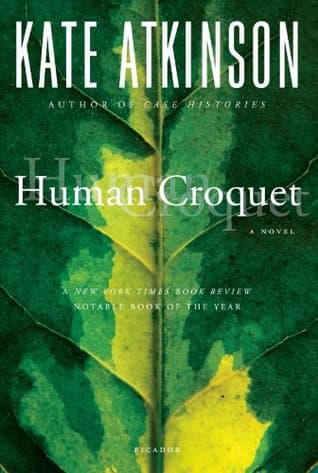
Synopsis
Covers the whole plot, including the ending.
- Difficulty
- Hard
- Pacing
- Variable
- Mood
- Whimsical, Mysterious, Melancholy, Introspective, Dreamlike
- Read it if
- You enjoy literary fiction that blends magical realism, historical mystery, and coming-of-age themes with a distinctly British voice, and don't mind a non-linear narrative.
- Skip it if
- You prefer straightforward plots, realistic settings, or find complex, multi-layered narratives with elements of fantasy and historical interweaving to be confusing.
Human Croquet Plot Summary
Covers the whole plot, including the ending.
The Fairfax Family and Lythe
Isobel Fairfax grows up in the seemingly ordinary 1960s British suburb of Lythe, introducing her unusual family. Her father, Charles, is a war hero with a difficult past. Her mother, Eliza, vanished years ago, leaving a gap in their lives. Isobel lives with her older brother, Charles Jr. (Charley), and her Aunt Vinny, a practical but unhelpful woman. Lythe itself is not entirely normal; it sits on an ancient Elizabethan estate, suggesting a deeper, more complex history that subtly affects the present. Isobel often feels out of place and connected to the past, hinting at the time-bending events to come.
The Disappearance of Eliza
Eliza Fairfax's disappearance is a central puzzle in Isobel's life. The official story is that Eliza simply left, but Isobel feels there is more to it. Her father, Charles, rarely talks about Eliza, and the subject is generally avoided. This unresolved mystery fuels Isobel's thoughts and her growing wish to find the truth. The lack of closure about her mother's fate leaves Isobel with a deep sense of loss and a constant suspicion about her family's outward appearance. She starts to notice small clues and inconsistencies that suggest a darker story than the one she has been told.
Shakespearean Echoes and Time Slips
As Isobel grows up, she begins to experience unsettling 'time slips' and encounters with figures from Lythe's Elizabethan past, especially those linked to the original estate and its tutor, William Shakespeare. These are not just dreams; they are vivid, disorienting shifts where the past enters the present. She sees glimpses of Elizabethan life, hears old speech, and sometimes briefly inhabits historical moments. These experiences are both frightening and fascinating, blurring the lines between reality and illusion and suggesting that the past is not truly gone but merely waiting to reappear. Specific locations or objects in Lythe often trigger these events.
The Croquet Game and Its Rules
A metaphorical and sometimes literal game of 'human croquet' shapes the novel's structure. This game, with its seemingly random but very important rules, represents the complex, often cruel, and connected relationships and events that define Isobel's life. The 'wickets' and 'mallets' are the people and situations that drive or hinder characters, often with unexpected results. Isobel often refers to these rules, trying to understand the irrationality around her. The game helps explain fate, cause and effect, and the intricate web of decisions and accidents that determine one's path, showing the often-futile struggle against predetermined outcomes.
The Identity of Isobel
A key and unsettling part of Isobel's journey is the idea that she might not be the 'original' Isobel Fairfax. Hints suggest there might have been another Isobel, perhaps her mother's sister, who died young, or even that Isobel herself is a reincarnation or a replacement. This uncertainty about her own identity is deeply confusing, adding to her feeling of being an outsider and her search for truth. The possibility of being a doppelgänger or living a borrowed life makes her question her memories, her relationships, and her very existence, further blurring the lines between personal history and collective memory.
Charley's Descent and the Family Secrets
Isobel's older brother, Charley, becomes increasingly troubled and withdrawn as the story continues. He holds important family secrets, especially about their mother, Eliza, and his own identity. Charley often speaks in riddles, hints at dark truths, and struggles with what seems to be a mental illness or a deep personal crisis. His erratic behavior and cryptic statements are both a source of worry for Isobel and an important, though unreliable, source of information about the past. His decline is linked to the unraveling of the Fairfax family's carefully built facade.
The Truth About Eliza's Fate
Through her time slips, investigations, and Charley's fragmented disclosures, Isobel slowly puts together the truth about her mother, Eliza. It turns out Eliza did not abandon the family but was murdered by Charles, Isobel's father, and buried in the family garden. This act was covered up, and the family, including Aunt Vinny, helped maintain the lie. This discovery shatters Isobel's view of her father as a war hero and her family as merely eccentric, revealing a deep darkness at the core of their lives and explaining much of the lingering guilt and oddness in Lythe.
The Elizabethan Connection and Isobel's Role
Isobel learns that the Fairfax family's history is closely tied to the Elizabethan era, especially with a family called the Lythes and their tutor, William Shakespeare. She discovers that her family has been repeating a pattern of tragedy, betrayal, and murder that mirrors events from that distant past. Isobel herself is a reincarnation or spiritual echo of an Elizabethan girl, also named Isobel, who was involved in a similar tragic love triangle and death. This realization explains her time slips and her strong sense of déjà vu, suggesting a predetermined fate she is trying to escape or change.
Confronting the Past and Present
Knowing about Eliza's murder, Isobel confronts her father, Charles. The confrontation is filled with denial, guilt, and the weight of decades of lies. Charles's war trauma is presented as a partial reason for his actions, but it does not excuse them. Isobel also grapples with the involvement of other family members, especially Aunt Vinny, who knew the truth and helped keep the deception going. This confrontation is a key moment, forcing Isobel to compare her idealized image of her family with the grim reality and decide how she will move forward with this devastating knowledge, breaking the cycle of silence.
The Enduring Cycle and Isobel's Choice
As the novel ends, Isobel understands that the 'human croquet' game, the cycles of fate and family tragedy, are powerful. She sees the patterns from the Elizabethan past repeating in her own life, particularly the tragic love triangle involving her, her brother Charley, and a young man named Tom. The story suggests that Isobel could repeat the fate of her Elizabethan namesake, but she chooses to break free from the predetermined cycle. Her decision shows an attempt to take control and forge her own path, rather than giving in to the tragic echoes of history. The ending is bittersweet, acknowledging the lasting impact of the past but offering a hint of hope for individual freedom.
Principal Figures
Isobel Fairfax
Protagonist
A perceptive young girl navigating a complex family history and her own shifting identity.
Isobel is a highly intelligent and introspective girl, growing up in 1960s Lythe. She possesses a keen observational eye and a deep curiosity that drives her to uncover the truth behind her mother's disappearance and the eccentricities of her family. She is often depicted as an outsider, feeling a sense of displacement and a peculiar connection to the past. Isobel is imaginative and sensitive, frequently experiencing time slips that blur the lines between her present and Lythe's Elizabethan history. Her quest for identity is central to her character, as she grapples with the possibility that she might not be who she thinks she is.
Relationships: Charles Fairfax (father) (Distant, loving but ultimately betrayed by his dark secret.); Eliza Fairfax (mother) (Absent, a source of mystery and longing.); Charley Fairfax (brother) (Close, complex, and fraught with shared secrets and emotional burdens.); Aunt Vinny (A pragmatic but complicit guardian figure.)
Charles Fairfax (father)
Supporting/Antagonist
A haunted war hero concealing a dark secret.
Charles Fairfax is Isobel's father, a seemingly distinguished war hero whose past is shrouded in unspoken trauma. He is often withdrawn and emotionally distant, carrying the heavy burden of a terrible secret. His love for his children is apparent, but it is overshadowed by his guilt and his desperate attempts to maintain a facade of normalcy. His character embodies the destructive nature of secrets and the long-lasting impact of both personal and historical violence. He represents the patriarchal figure who attempts to control the narrative of his family, ultimately failing as the truth emerges.
Relationships: Isobel Fairfax (Father-daughter, strained by his secrets and eventual revelation.); Eliza Fairfax (wife) (Murderer-victim, the central tragedy of the family.); Charley Fairfax (son) (Father-son, a complex bond burdened by shared knowledge and trauma.)
Eliza Fairfax
Mentioned/Catalyst
Isobel's vanished mother, whose absence drives the central mystery.
Eliza Fairfax is Isobel's mother, who disappeared years before the story begins, leaving a profound void in the family. She is largely a figure of memory and speculation, her absence acting as the primary catalyst for Isobel's investigation. Her character is gradually revealed through flashbacks, fragments of memory, and the dark secrets of the family, transforming from a seemingly absent mother into the tragic victim of a heinous crime. Eliza represents the lost past and the buried truths that haunt the Fairfax family, her fate inextricably linked to the cycles of tragedy.
Relationships: Isobel Fairfax (daughter) (Mother-daughter, a longing for connection and truth.); Charles Fairfax (husband) (Victim-perpetrator, the core of the family's dark secret.)
Charley Fairfax
Supporting
Isobel's troubled older brother, burdened by family secrets and mental fragility.
Charley is Isobel's older brother, a sensitive and intelligent boy whose mental state deteriorates as the story progresses. He is privy to many of the family's secrets, particularly regarding Eliza's disappearance, and his cryptic remarks and increasingly erratic behavior provide Isobel with crucial, albeit challenging, clues. Charley embodies the psychological toll of living with unspoken trauma and lies. He is both a victim of his family's past and a tragic figure destined to repeat elements of it. His connection to the Elizabethan past is also profound, hinting at a cyclical nature of their family's fate.
Relationships: Isobel Fairfax (sister) (Close, complex, and mutually dependent in their search for truth.); Charles Fairfax (father) (Strained, complicit in the cover-up, and emotionally distant.)
Aunt Vinny
Supporting
Isobel's pragmatic and complicit aunt.
Aunt Vinny is Charles's sister and Isobel and Charley's aunt, who lives with the family. She is portrayed as a practical, somewhat conventional woman who attempts to maintain order and appearances. However, she is also complicit in the cover-up of Eliza's murder, choosing to protect her brother and the family's reputation over truth. Her character highlights the societal pressures and family loyalties that can lead individuals to participate in profound deceptions. While not malicious, her inaction and silence contribute significantly to Isobel's suffering and the perpetuation of the family's dark secrets.
Relationships: Isobel Fairfax (Guardian figure, but emotionally distant and dishonest.); Charles Fairfax (brother) (Loyal, complicit, and protective.); Eliza Fairfax (Aware of her murder, complicit in its cover-up.)
William Shakespeare
Mentioned/Incidental
The historical figure whose presence influences Lythe's past and Isobel's time slips.
William Shakespeare, though not a direct character in the present-day narrative, is a significant historical figure who once tutored the Lythe family on the estate where Isobel's home now stands. His presence is felt through the Elizabethan time slips Isobel experiences, and the narrative often draws parallels between his plays and the tragic events unfolding in the Fairfax family. He represents the deep historical roots of Lythe and the idea that history, like literature, often repeats its themes of love, betrayal, and death. His influence underscores the novel's blend of historical fiction and meta-narrative.
Tom
Supporting
A young man who becomes entangled in Isobel's life and the family's cyclical fate.
Tom is a young man who enters Isobel's life, forming a romantic connection with her. He is a seemingly ordinary individual who becomes inadvertently drawn into the Fairfax family's extraordinary and tragic history. His presence often serves to highlight the potential for Isobel to break free from the predetermined patterns, but he also becomes a figure around whom the cyclical nature of love triangles and betrayals can manifest. Tom represents the possibility of a 'normal' life, yet he is inevitably pulled into the complex web of past and present that defines Lythe.
Relationships: Isobel Fairfax (Romantic interest, a potential partner for a new future.)
Themes & Insights
The Weight of History and Memory
The novel explores how the past still shapes the present. Isobel's time slips into Elizabethan Lythe show this literally, as historical events and figures (like William Shakespeare) echo through generations. The Fairfax family's dark secrets, especially Eliza's murder, directly result from this theme, as the unaddressed past continues to haunt and control the lives of the present-day characters. The story suggests that denying or burying history only allows it to worsen and repeat, forcing Isobel to face both personal and collective memories to break free.
“History, if you don't watch out, tends to repeat itself.”
Identity and Self-Discovery
Isobel's journey is about self-discovery, complicated by the unsettling idea that she might not be the 'original' Isobel Fairfax. This theme appears in her search to understand her mother's disappearance and her own unusual connection to the past. The blending of identities, the suggestion of reincarnation or doppelgängers, makes Isobel question her very existence and her place in the world. Her struggle to define herself outside her family's history and the repeating patterns of fate is central to her growth.
“Perhaps she wasn't Isobel at all, but someone else, wearing Isobel's skin.”
The Nature of Reality and Illusion
Kate Atkinson skillfully blurs the lines between what is real and what is imagined, what is present and what is past. Isobel's time slips are the clearest example of this, but the theme also extends to the carefully built illusions within the Fairfax family. The 'official' story of Eliza's disappearance versus the brutal truth, Charles's heroic image versus his dark deeds, all contribute to a sense of an unreliable reality. The 'human croquet' game itself, with its arbitrary rules, suggests that life operates on a logic that is not always rational or easily understood, challenging the reader's view of what is truly happening.
“Nothing was ever quite what it seemed in the Fairfax family, or in Lythe.”
Family Secrets and Trauma
At its core, the novel explores the devastating effects of family secrets and trauma passed down through generations. Eliza's murder and its cover-up poison the Fairfax household, leading to Charley's mental decline, Charles's emotional distance, and Isobel's constant unease. The unspoken truths create a suffocating atmosphere of denial and guilt that prevents real connection and healing. The novel argues that these buried traumas, whether personal or collective (like war), inevitably resurface and demand to be dealt with, often repeating their destructive patterns until confronted.
“Secrets were like weeds, they grew and choked everything else.”
Plot Devices & Literary Techniques
Time Slips / Magical Realism
Isobel's involuntary journeys into the Elizabethan past.
This device allows Isobel to literally experience and witness events from Lythe's Elizabethan history, blurring the boundaries between past and present. These 'time warps' are not just dreams or fantasies; they are vivid, disorienting shifts in perception where Isobel sees, hears, and sometimes interacts with historical figures like William Shakespeare or the original Lythe family. This device is crucial for revealing the cyclical nature of the family's tragedies and for providing Isobel with direct access to the truths that her present-day family attempts to conceal, creating a unique blend of historical fiction and fantasy.
The 'Human Croquet' Game
A symbolic framework representing fate, causality, and interconnected lives.
The metaphorical game of 'human croquet' serves as a narrative and thematic framework for the novel. It represents the complex, often arbitrary, and sometimes cruel rules that govern the characters' lives. The 'wickets' and 'mallets' are the people, events, and circumstances that propel or hinder characters, often leading to unforeseen consequences. Isobel frequently refers to these rules, trying to make sense of the irrationality around her. This device underscores the themes of fate versus free will, suggesting that while individuals may try to navigate the game, its fundamental rules are often beyond their control, leading to cyclical patterns of tragedy.
Unreliable Narration / Shifting Perspectives
The narrative's constant questioning of its own reality and Isobel's identity.
The novel employs an unreliable narrative, primarily through Isobel's perspective, which is often challenged by her time slips, the conflicting accounts of others, and the possibility of her being a doppelgänger. This device creates a pervasive sense of ambiguity and mystery, forcing the reader to constantly question what is real, what is imagined, and what version of events is true. It mirrors Isobel's own struggle for identity and truth, immersing the reader in her disorientation and making the uncovering of secrets all the more impactful when a semblance of truth finally emerges from the layers of illusion and historical echoes.
Intertextuality (Shakespearean References)
Drawing parallels between the plot and Shakespeare's plays.
The novel frequently references William Shakespeare's plays, particularly tragedies, creating a rich layer of intertextuality. These references are not merely decorative; they serve to highlight the universal and cyclical nature of human drama – love, betrayal, murder, and mistaken identity – suggesting that the Fairfax family's story is a modern-day echo of ancient archetypes. The allusions to plays like 'Hamlet' or 'King Lear' provide a dramatic framework for understanding the profound tragedies and moral dilemmas faced by the characters, reinforcing the idea that history, like literature, often repeats its most potent themes.
Human Croquet Quotes
“The past is a foreign country; they do things differently there.”
“Life was a game, and some people were just better at it than others.”
“Every family has its secrets, its own private mythology.”
“She had always felt a little like a character in a book, waiting for her story to begin.”
“The future was a dark, unwritten page, and she was afraid of what might be scribbled on it.”
“Time, she had discovered, was not a straight line but a tangled skein, looping and knotting back on itself.”
“We are all just stories in the end, aren't we?”
“The world was full of magic, if you only knew where to look.”
“Sometimes you had to create your own history, because the real one was too painful to bear.”
“Every decision you made echoed through time, creating ripples you could never foresee.”
“It wasn't that she didn't believe in ghosts, it was just that she thought they were probably more interested in their own business than hers.”
“The truth was a slippery thing, always changing shape, depending on who was holding it.”
“Childhood was a landscape you carried within you, a map of all your future journeys.”
“The past was never really gone, just waiting for the right moment to reappear.”
Quiz
10 questions on the plot and the characters. Each answer comes with a short explanation.
Question 1
What is the name of the protagonist in 'Human Croquet'?
- Audrey Fairfax
- Isobel Fairfax
- Constance Fairfax
- Beatrice Fairfax
Show answer
B. Isobel Fairfax The main character and narrator of 'Human Croquet' is Isobel Fairfax, who navigates the mysteries of her family and village.
Question 2
In what decade does Isobel primarily grow up in the 'typical British suburb' of Lythe?
- 1950s
- 1960s
- 1970s
- 1980s
Show answer
B. 1960s The novel explicitly states that Isobel grows up in a 'typical 1960s British suburb' of Lythe.
Question 3
Which historical literary figure is said to have lived in Lythe during its Elizabethan feudal estate era?
- Geoffrey Chaucer
- Christopher Marlowe
- William Shakespeare
- Ben Jonson
Show answer
C. William Shakespeare Lythe was once home to a young English tutor named William Shakespeare, which ties into the novel's time-warping elements.
Question 4
What is the primary genre blend of 'Human Croquet' as described in the summary?
- Science Fiction, Romance, Thriller
- Fantasy, Mystery, Coming-of-Age
- Historical Drama, War Story, Comedy
- Detective Fiction, Social Satire, Horror
Show answer
B. Fantasy, Mystery, Coming-of-Age The novel is described as 'Part fairy tale, part mystery, part coming-of-age novel,' encompassing fantasy, mystery, and coming-of-age elements.
Question 5
What unusual phenomenon does Isobel occasionally experience as she investigates her village's history?
- Visions of the future
- Shakespearean time warps
- Encounters with mythical creatures
- Conversations with ghosts
Show answer
B. Shakespearean time warps As Isobel investigates, she 'occasionally gets caught in Shakespearean time warps,' linking the past and present.
Question 6
What key family mystery is Isobel trying to uncover regarding her mother?
- Her mother's secret fortune
- Her mother's true identity
- The truth about her missing mother
- Her mother's estranged family
Show answer
C. The truth about her missing mother Isobel gets closer to the 'shocking truths about her missing mother,' indicating a central mystery surrounding her disappearance.
Question 7
The novel is described as rich with 'the disappointments and possibilities every family shares.' What theme does this highlight?
- The inevitability of tragedy
- The universal complexities of family life
- The pursuit of individual happiness
- The struggle for social justice
Show answer
B. The universal complexities of family life This phrase directly points to the novel's exploration of the multifaceted and often contradictory experiences inherent in family relationships.
Question 8
How does Isobel's investigation of her family's history connect with her social environment?
- It helps her win a local history competition.
- It reveals the hidden lives of her close friends and classmates.
- It leads her to discover a secret society in her village.
- It causes her to distance herself from all her peers.
Show answer
B. It reveals the hidden lives of her close friends and classmates. The summary states that Isobel gets closer to 'the hidden lives of her close friends and classmates' as she investigates, showing a connection between personal and social discovery.
Question 9
The novel is lauded as a 'stunning feat of imagination and storytelling.' What aspect of the plot best exemplifies this claim?
- Its realistic portrayal of 1960s British suburbia.
- The seamless integration of historical figures, time warps, and family mystery.
- The use of a single, linear narrative perspective throughout.
- Its straightforward resolution of all plot points by the end.
Show answer
B. The seamless integration of historical figures, time warps, and family mystery. The blend of Elizabethan history, Shakespearean time warps, and a contemporary family mystery demonstrates a high degree of imaginative integration and complex storytelling.
Question 10
Beyond her missing mother, what other family member's 'shocking truths' does Isobel uncover?
- Her grandmother's secret past
- Her war-hero father's hidden life
- Her brother's criminal activities
- Her aunt's unrevealed inheritance
Show answer
B. Her war-hero father's hidden life The summary mentions Isobel getting closer to 'the shocking truths about her missing mother, her war-hero father, and the hidden lives of her close friends and classmates.'
Human Croquet FAQ
What is the central premise of 'Human Croquet'?
The novel follows Isobel Fairfax, a young girl growing up in 1960s Lythe, a seemingly ordinary British suburb. She navigates her coming-of-age while uncovering the intertwined mysteries of her eccentric family, the disappearance of her mother, and the historical layers of her village, which once hosted William Shakespeare.
Who is Isobel Fairfax, and what makes her unique?
Isobel Fairfax is the protagonist, a precocious and imaginative girl with a unique ability to perceive time slippages, often linking her to Elizabethan England. Her internal world is rich with literary allusions, and she possesses a deep, almost psychic, connection to her family's past and the historical fabric of Lythe.
What role does William Shakespeare play in the narrative?
William Shakespeare is presented as a tutor who once lived in Lythe during his youth, and his presence ripples through time, influencing the village and Isobel's family. Isobel frequently experiences 'time warps' that transport her to his era, suggesting a deep, almost fated, connection between her family's history and his early life.
What mystery surrounds Isobel's mother, Eliza?
Isobel's mother, Eliza, vanished without a trace when Isobel was young, leaving a void and many unanswered questions. The novel gradually reveals the shocking circumstances of her disappearance, hinting at a darker truth connected to the family's secrets and the trauma of war experienced by Isobel's father.
How does the setting of Lythe contribute to the story?
Lythe is not just a typical 1960s suburb; it's a place imbued with historical significance, having been an Elizabethan feudal estate. This dual nature allows for the blending of ordinary domestic life with fantastical time shifts, making Lythe a character in itself that holds both contemporary secrets and echoes of the distant past.
What is the significance of the recurring 'croquet' motif?
The 'human croquet' of the title symbolizes the intricate, often chaotic, and rule-bound social interactions within families and communities, where individuals are moved and manipulated by unseen forces. It also alludes to the game's historical connection to aristocratic estates, mirroring the Fairfax family's faded grandeur and their peculiar rituals.
Are Isobel's time warps literal or metaphorical?
The novel deliberately blurs the line between literal and metaphorical for Isobel's time warps. While they feel real to her, they could also be interpreted as heightened manifestations of her vivid imagination and her deep engagement with history, allowing the reader to ponder the nature of memory and storytelling.
What is the true nature of Isobel's father, Bartholomew, and his war experiences?
Bartholomew is presented as a war hero, but his heroism is tinged with deep psychological trauma and a hidden past. His experiences in World War II profoundly affect his ability to connect with his family and contribute to the melancholic atmosphere of the Fairfax household, revealing the long-lasting impact of conflict.
How do the various historical periods intersect and influence each other in the book?
The Elizabethan era, particularly through Shakespeare's presence, and the post-WWII 1960s are shown to be intricately linked. The past isn't just history; it's a living force that continually shapes the present, suggesting a cyclical nature of events and family destinies, where old secrets resonate in new generations.
How does Isobel's imagination serve as a coping mechanism?
Isobel's rich imagination and her ability to perceive time shifts act as a powerful coping mechanism against the confusing and often painful realities of her life. Her internal world provides an escape from the secrets, the absence of her mother, and the emotional distance of her father, allowing her to process her experiences creatively.
What psychological impact does Eliza's disappearance have on the Fairfax family?
Eliza's disappearance creates a profound psychological void, leading to unspoken grief, unresolved trauma, and a pervasive sense of secrecy within the Fairfax family. Each member copes differently, but the event casts a long shadow, contributing to Bartholomew's withdrawal and Isobel's intense need for understanding.
How does the novel explore themes of memory and trauma?
The novel deeply explores how individual and collective memories, particularly traumatic ones like war and loss, shape identity and family dynamics. It suggests that trauma can manifest across generations, influencing behavior and relationships, and that memory is often fragmented, subjective, and prone to revision.
What is the significance of the 'fairy tale' elements in the context of the family's reality?
The fairy tale elements, such as Isobel's unique perceptions and the magical realism, serve to both heighten the sense of mystery and to provide a framework for understanding the often-unbelievable truths of the Fairfax family. They offer a way to process the dark realities and the strange circumstances that defy conventional explanation.
Is the ending of 'Human Croquet' conclusive, or does it leave room for ambiguity?
The ending provides significant revelations regarding the central mysteries, particularly Eliza's fate, offering a sense of closure. However, it also retains a degree of ambiguity regarding the fantastical elements and the ultimate implications of Isobel's experiences, inviting readers to ponder the nature of truth and storytelling.
What is the novel's overall message about family and secrets?
The novel suggests that families are complex tapestries woven with love, disappointment, and deeply buried secrets, which, if left unaddressed, can profoundly affect future generations. It explores how these hidden truths shape individual identities and relationships, highlighting the enduring power of family legacies.
How does the narrative challenge conventional perceptions of time and reality?
Through Isobel's experiences, the narrative constantly blurs the boundaries between past and present, challenging a linear perception of time. It suggests that reality is subjective and multifaceted, often influenced by imagination, memory, and the persistent echoes of historical events, making the reader question what is truly 'real'.
What role do the secondary characters, like Isobel's siblings and friends, play in her journey?
Isobel's siblings, particularly her older brother Charles, and her friends provide both contrast and support, reflecting different ways of navigating their strange family and social world. They offer alternative perspectives and contribute to the complex web of relationships that Isobel must untangle as she seeks answers.
How does the novel use humor despite its darker themes?
The novel masterfully integrates dark humor and wit, often through Isobel's precocious observations and the eccentricities of her family. This humor serves as a counterpoint to the underlying sadness and mystery, preventing the narrative from becoming overly bleak and adding a distinctive charm to the storytelling.
About the author

Kate Atkinson is a British author known for her fiction, particularly her exploration of themes such as time and memory. Her notable works include "Life After Life," which examines multiple lives lived by the same character, and "Case Histories," a detective novel featuring private investigator Jackson Brodie. Other significant titles include "One Good Turn," "Behind the Scenes at the Museum," and "Human Croquet."
Similar books
- Life of Pi
Yann Martel
3.9 (1.3M) average on GoodreadsFantasyFeatures a blend of magical realism, philosophical undertones, and a protagonist recounting their extraordinary life.
- Atonement
Ian McEwan
4.4 (70) average on GoodreadsExplores complex family dynamics, the impact of historical events, and a central mystery with literary depth.
- Orlando
Virginia Woolf
3.9 (61k) average on GoodreadsFantasyPlays with time, identity, and historical periods in a fluid, imaginative way, with a strong literary voice.
- The Old Man and the Sea
Ernest Hemingway
3.8 (831k) average on GoodreadsLiterary FictionA Cuban fisherman's long struggle with a giant marlin becomes a story of endurance and dignity, now retold for young adults with illustrations, phonetic guides, and writing prompts in Traditional Chinese.
- One Hundred Years of Solitude
Gabriel García Márquez
4.1 (753k) average on GoodreadsLiterary FictionThrough the multi-generational story of the Buendía family, a mythical town deals with the repeating patterns of time, love, and solitude, as the extraordinary mixes with the ordinary.
- The Goldfinch
Donna Tartt
3.9 (720k) average on GoodreadsLiterary FictionHaunted by a tragic explosion and clutching a stolen Dutch masterpiece, a young orphan navigates the opulent drawing rooms of New York and the gritty underbelly of the art world, desperately seeking connection and redemption amidst a life spiraling into crime and obsession.





Enjoyed the summary?
A summary gives you the shape of the book. The book itself has the detail, the examples and the voice.
Find Human Croquet on AmazonAs an Amazon Associate, BookBrief earns from qualifying purchases. How we're funded